







Abstract
A growing body of research has linked aspects of religion with intimate partner violence (IPV). Most studies have focused on IPV perpetration, with far fewer studies considering how religious factors affect IPV victimization. Our study contributes to this literature by examining the links between multiple religious domains and the risk of experiencing IPV. We analyze longitudinal data from five waves of the Fragile Families and Child Well-being project, a nationwide sample of urban, mostly minority, lower income unmarried couples. Data are analyzed via discrete-time event history analysis, estimated with complementary log-log regression, and the findings are: (a) Partner’s religious attendance frequency is inversely associated with the risk of IPV victimization in most models, for both mothers and fathers. (b) Couples’ religious attendance similarity is associated with lower risk of IPV victimization for mothers but not fathers. (c) Affiliation with a conservative Protestant or sectarian religious group is linked with elevated risk of IPV victimization. Most of the observed religious variations in IPV victimization risk withstand multiple controls for relationship quality, as well as an array of demographic characteristics. We contribute to the growing literature on religion and IPV, highlighting the role of religious attendance as a noteworthy prophylactic against IPV.
Keywords
Introduction
Intimate partner violence (IPV) is a major social problem and a significant public health concern in the United States and, indeed, around the globe (Bell & Curry, 2024; Kifle et al., 2024; Leemis et al., 2022; Peterson et al., 2018; C. N. Spencer et al., 2023; White et al., 2023). IPV is a broad construct that encompasses attempted or completed acts of physical, sexual, or psychological abuse committed by one’s current or former romantic partner (Smith et al., 2018). IPV can result in a wide array of physical injuries, mental health problems, and even death (Bell & Curry, 2024; Loxton et al., 2017; C. N. Spencer et al., 2023; White et al., 2023). Although both men and women may be perpetrators and victims of physical abuse, the available data indicate that women tend to experience greater exposure and sustain more serious injuries than men (Fanslow et al., 2023; Smith et al., 2018). According to data from the Global Burden of Disease project and the World Health Organization, nearly one in three women (31%) has experienced an act of violence since 2000 (Sardinha et al., 2022). The estimated prevalence of partner violence against men in those data is considerably lower, but those low levels may be influenced by underreporting (Lalonde & Arnocky, 2023).
Considering such alarming findings, a significant body of research has sought to identify individual and couple characteristics that are associated with an elevated risk of violent perpetration or victimization (for a review, see C. M. Spencer et al., 2019). For example, rates of IPV tend to be higher among certain demographic groups, such as younger couples, racial and ethnic minority couples, cohabiting couples, and those couples from more socially and economically marginalized backgrounds, who may be experiencing chronic stressors such as unemployment, poverty, and discrimination (Brush, 2011; Ellison et al., 2007; Wong et al., 2016). The likelihood of IPV also tends to rise in the presence of alcohol and substance abuse (Armstrong et al., 2019) and may be increased by social isolation and the lack of social support (Dias et al., 2019). Patriarchal beliefs and attitudes, which can legitimate or promote gender inequality and female subordination, are also thought to contribute to the risk of IPV (Peralta et al., 2010; Priest et al., 2024).
An additional factor in IPV perpetration and victimization that has received intermittent attention from researchers is religion (for a recent review, see Istratii & Ali, 2023). Although scholars have long speculated that religious factors–especially those associated with more conservative denominations and traditions—may exacerbate the risk of IPV (Istratii & Ali, 2023; Nason-Clark, 1997; Priest et al., 2024; Tracy, 2007), a small but growing body of research has found that frequency of attendance at religious services is inversely correlated with IPV risk (Ellison & Anderson, 2001; Ellison et al., 1999, 2007; Fergusson et al., 1986; Higginbotham et al., 2007; Zavala & Muniz, 2022). Nevertheless, the findings from such studies have been somewhat inconsistent (Brinkerhoff et al., 1992; Conradi et al., 2002; DeRose et al., 2021; Kim, 2021; Renzetti et al., 2017; C. M. Spencer et al., 2019). This body of research has been characterized by several important limitations, including heavy use of cross-sectional data, which precludes the establishment of causal relationships (for a rare exception, see Fergusson et al., 1986), as well as reliance on a limited number of religion measures (e.g., frequency of individual attendance), and the use of convenience samples.
Another key limitation of religion-IPV literature has been the primary focus on religious factors as risk or protective factors in IPV perpetration, with less attention to the possible role of religion in shaping risk of IPV victimization. Still, the latter topic has received intermittent attention from researchers (Higginbotham et al., 2007; Kim, 2021). In one notable contribution, Zavala and Muniz (2022) analyzed data from a large (n = 4,162) nationwide cross-sectional survey of individuals in dating relationships, and they found that the frequency of religious attendance was associated with reduced risk of IPV victimization. A key goal of their study was to test hypotheses derived from routine activities theory, a prominent approach in criminological research. According to that perspective, offenses are more likely to be committed when an offender deems a target suitable, and a capable guardian is absent. Consistent with that approach, they controlled for such factors as: (a) exposure to determined offenders (e.g., number of criminal associates); (b) target suitability (e.g., drug and alcohol use); and (c) capable guardianship (e.g., relationship commitment, family attachment). Although a few of these factors partly mediate the link between religious involvement and IPV, the frequency of religious attendance remained a significant inverse predictor of IPV victimization in all models. As those authors noted, this robust pattern suggests the need for further investigation into the role of religious factors in protecting against IPV victimization.
Our study adds to this literature in several ways. We focus on the role of three facets of religion—frequency of individual religious attendance, frequent joint religious attendance, and religious affiliation—in shaping the risk of victimization. We begin by developing a series of theoretical arguments linking each of these religious domains with IPV victimization risk. Relevant hypotheses are then assessed using longitudinal data from the Fragile Families and Child Wellbeing Study (often referred to simply as “Fragile Families,” hereafter labeled “FF”), a national sample of young urban parents from primarily minority, lower SES backgrounds, who are at elevated risk for domestic violence. Event history modeling is used to specify the effects of religious factors on IPV victimization, controlling for key socio-demographic and relationship characteristics. After our findings, we discuss implications, study limitations, and promising directions for future research.
Theoretical and Empirical Background
Religious Involvement
How and why might religious involvement—gauged in terms of the frequency of attendance at religious services and other religious variables—influence the risk of IPV victimization? One useful starting point for theorizing effects of religious involvement on IPV and other aspects of relationship quality was developed by Wilcox and Wolfinger (2008, 2016). Their work focuses on what they term the “three Ns” that are derived from religious participation: norms, networks, and nomos. In what follows, we outline the links between these ideas and risk of IPV victimization.
To begin, religious traditions and communities promulgate a range of norms, or role-based expectations, to shape a wide array of human behavior. Two types of norms are relevant for the study of religion and IPV victimization risk: general norms and relational norms (Ellison et al., 2010; Wilcox & Wolfinger, 2008). Briefly, general norms, such as the Golden Rule in the Abrahamic tradition, are intended to inform interpersonal relationships of all types. Relational norms, by contrast, offer specific guidance for marital unions and intimate partnerships. These more focused norms extol the virtues of loving kindness, gentleness, forbearance and forgiveness toward spouses and partners (e.g., 1 Cor. 13:4–7). Taken together, these sets of norms may well influence how individuals conduct themselves within intimate unions, and how they interact with their partners, in ways that may deter acrimony and conflict, especially violent conflict (Ellison et al., 2011; Henderson et al., 2018; Mahoney, 2010).
These norms are often couched within broader religious scripts about marriage, relationships, and family life. Most religious traditions promote visions of the “ideal” religious unions and familial bonds. In these religious unions, each partner gains a sense of how they are expected to perform their own roles, and also what they may expect from their mate in the way of commitment, fidelity, kindness, generosity, and conflict resolution (Wilcox & Wolfinger, 2016). This may lead religious individuals to be particularly selective when choosing mates, excluding potential partners who show any signs of problematic behaviors, including any potential for intense conflict or violence.
In addition, religious communities are sites for the cultivation of social networks. Congregations bring together people who share core affinities for religious rituals and other activities to which they jointly ascribe sacred character. They also provide opportunities for regular contact with coreligionists (Ellison & George, 1994; Krause, 2008). In addition, they offer resources for informal support (e.g., advice and feedback) and formal assistance (e.g., ministries focused on marriage and family, pastoral counseling; Krause, 2008; Taylor et al., 2000; Wilcox et al., 2004). Overall, congregational networks are especially relevant to the risk of IPV because they: (a) convey and reinforce norms involving social and familial relationships; (b) enhance the chances that violations of those norms (e.g., high-conflict or violent unions) will be detected and addressed; and (c) provide opportunities for partners in difficult relationships to gain informal support (i.e., confidants, emotional assistance, feedback and guidance) and formal aid, all of which may deter IPV.
Wilcox and Wolfinger (2008, 2016) also develop the concept of nomos, by which they refer to the role of religion as an overarching system of meaning via which the faithful interpret and assign significance to the people, relationships, and events in their lives. This concept may be relevant to the risk of IPV victimization in at least two ways. First, religion and spirituality have been shown to confer a wide array of cognitive resources that can facilitate successful coping with stressful events and conditions, often helping the faithful to manage negative emotions such as depression, anxiety, anger, and others (DeAngelis & Ellison, 2017; Ellison & Henderson, 2011; Pargament, 1997; for a review, see Upenieks, 2025). To the extent that religious worldviews and meaning systems can buffer the effects of stressors on negative emotions, they may reduce the risk of IPV.
Second, religious partners and couples may infuse their relationship with specific religious meaning, such as sanctification. Briefly, researchers have found that partners in sanctified unions tend: (a) to view their partnership as the product of divine intent and intervention (e.g., the partners were brought together by God, for a sacred purpose); and (b) to see characteristics of the divine in one’s partner (Kusner et al., 2014; Mahoney et al., 2003). Sanctification has been associated with a broad array of desirable relational processes and outcomes, including greater relationship investment, bonding, and satisfaction, reduced negative affect, and more constructive conflict resolution strategies, among others (Lichter & Carmalt, 2009; Mahoney, 2010). Sanctification also appears to mitigate the deleterious effects of stressors such as relational inequity (i.e., perceived unfairness in the contributions of marital partners in finances or housework), financial pressure, or other stresses on relationship quality (DeMaris et al., 2010; Ellison et al., 2011). Thus, sanctification of intimate unions suggests another pathway through which regular religious involvement may be linked with reduced risk of IPV victimization.
Taken together, the foregoing theoretical arguments lead to our first study hypothesis:
Similarity in Religious Attendance
In addition to individual religious involvement, there are also reasons to anticipate that shared patterns of attendance among partners will reduce the risk of IPV victimization. Briefly, a long tradition of theory and research has linked religious homogamy (i.e., similarities in religious affiliation, practice, or belief) with greater relationship quality and lower risk of problems such as conflict and dissolution or divorce (Curtis & Ellison, 2002; Ellison et al., 1999, 2010; Higginbotham et al., 2007; Vaaler et al., 2009). Although early work emphasized common religious affiliation, developments over the past several decades—including rising rates of exogamy (i.e., out-marriage) for most religious groups—have reduced the salience of denominational boundaries for intimate unions (Sherkat, 2004). By contrast, other forms of religious (dis)similarity, including those involving religious attendance or practice, now loom much more important in this domain (Call & Heaton, 1997; Curtis & Ellison, 2002; Myers, 2006; Vaaler et al., 2009).
Why might attendance similarity reduce IPV victimization? First, couples who attend religious services together are likely to share religious convictions (Upenieks et al., 2022). Joint involvement in religious activities and rituals may signify that both partners share religious beliefs and place a priority on religious faith. Such joint participation may strengthen common values and promote relationship quality. Such partners may also spend time engaging in other, non-religious activities, all of which may promote bonding and solidarity. Indeed, Wilcox and Wolfinger (2016) found that the social networks fostered by joint attendance accounted for about half of the positive relationship between religious participation and union quality. At the same time, it is possible that partners who share a disinterest in, or an emphatic rejection of, conventional religious groups and ideals find their disbelief to be a shared basis of solidarity.
Second, religious attendance is a robust correlate of a host of factors that can affect relationship quality, including views of household labor arrangements, number and timing of childbearing, childrearing practices, choice of friends and leisure activities, relationships with in-laws, social and political values, and much more (Hayford & Morgan, 2008; Perry & Schleifer, 2019). Couples in which partners share similar levels of religious commitment (e.g., both highly religious, both moderately religious, both non-religious) may agree, broadly speaking, on a wide array of other factors. To the extent that they share a common worldview and similar priorities about their relationship and other matters, this may lower the potential for conflict and reduce the risk of IPV victimization. By contrast, couples in which partners diverge in their religious values or practices may encounter disagreement in other areas, thus raising the risk that disputes may spill over into violence (Curtis & Ellison, 2002; Ellison et al., 1999; Higginbotham et al., 2007).
Third, religious attendance may also be an important determinant of social networks (DiPrete et al., 2011; Merino, 2014). More religiously active persons may choose to associate with, and find a basis of common friendship with, coreligionists. By contrast, more secular persons may prefer to avoid sustained contact with their more religious counterparts, due to real or perceived disagreement over religious matters and other areas, such as social and political values and lifestyle norms. This raises the possibility that the degree of religious similarity among partners may shape their friendship networks and the sources of input and feedback they may elicit and receive, regarding relationship matters or other issues. Thus, couples who attend religious services frequently may socialize with, and draw considerable input from, fellow church members or clergy (Upenieks et al., 2022). On the other hand, those who do not attend may receive feedback from secular network members. Among partners who differ in their levels of religious involvement, potentially disparate sources of network support could exacerbate existing divisions over family and domestic affairs as well as other issues.
These lines of argument suggest a second hypothesis:
Women’s Conservative Religious Affiliation
In addition to individual and joint religious involvement, prior theory, research, and popular writing have explored various links between conservative religious affiliation and the problem of IPV. Much of this work has centered on conservative (i.e., fundamentalist, evangelical, and charismatic) forms of Protestantism, although some observers have extended this coverage to conservative sectarian groups such as the Latter-day Saints (Mormons) and the Jehovah’s Witnesses. Although there are certainly exceptions, researchers have long recognized that such organizations and communities tend to embrace patriarchal teachings that can promote “separate spheres” ideologies regarding female domesticity and male headship (Bartkowski, 1997; Ellison & Bartkowski, 2002; Sherkat, 2000; Whitnah, 2022). These and other conservative religious groups also tend to exclude women from positions of power and authority within the religious community, such as clergy positions, lay leadership roles, and religious education, especially when the latter involves women instructing men. For at least 4 decades, an influential line of thought has argued that patriarchal teachings and culture within such groups tolerate and legitimate IPV, especially by men (against women; Gezinski et al., 2023; Nason-Clark, 1997; Nason-Clark et al., 2018; Priest et al., 2024; Tracy, 2007). These arguments highlight the broad tendency for many conservative groups to regulate and restrict the roles of women, without any comparable guidance or limitations on men’s activities.
However, the few studies of the links between conservative religion and IPV have, like the IPV literature more broadly, focused more on perpetration than on victimization. Here, the evidence has been quite mixed. Researchers have generally found no clear association between conservative Protestant or sectarian affiliation and the risk of IPV perpetration (Brinkerhoff et al., 1992; Conradi et al., 2002; Ellison et al., 1999), although studies focusing on conservative theological beliefs hint at a potentially important connection. For example, a study of college men linked fundamentalist Christian beliefs with greater approval and use of physical force in dating relationships (Koch & Ramirez, 2010). Another study, focused on U.S. married couples, showed that theologically conservative men (i.e., those who strongly espouse beliefs in biblical literalism and authority) are more prone to commit IPV when—but only when—partnered with theologically liberal women, which is a statistically rare combination (Ellison et al., 1999). Still other work has suggested that pastors and lay leaders from conservative Protestant religious groups are more prone to discourage women victims of IPV from leaving abusive relationships, sometimes prioritizing the longevity of the union and the emotional and spiritual needs of male perpetrators over the safety of victimized women (Gezinski et al., 2023; Nason-Clark, 1997; Nason-Clark et al., 2018; Whitnah, 2022). There is also evidence that conservative Christian teachings may emphasize not only the covenant-like structure of marriage, but also the valorization of suffering and forgiveness, in ways that lead faithful women to remain in violent unions. Indeed, because conservative pastors may be ill-equipped to address IPV within the church, women in fundamentalist, evangelical, or sectarian religious communities may be reluctant to seek clergy assistance or counseling to deal with violence in intimate relationships (Gezinski et al., 2023; Istratii & Ali, 2023; Nason-Clark et al., 2018; Priest et al., 2024). This has led advocates to call for improved clergy training to meet the needs of both victims and perpetrators of IPV within conservative religious communities.
Although the evidence is not unequivocal, there is sufficient theory and evidence to support our final study hypothesis:
Methods
Data
We analyze data from the Fragile Families and Child Wellbeing Study, a national survey designed to study new unwed parents, their relationships, and their children in large U.S. cities (Reichman et al., 2001). The survey follows approximately 3,700 children born to unmarried parents and 1,200 children born to married parents in twenty cities with populations over 200,000. 1 The baseline interviews were conducted between February 1998 and September 2000. New mothers were interviewed in the hospital within 48 hr of giving birth, and new fathers were interviewed at the hospital or elsewhere around the same time (no data on same-sex couples were collected). Five follow-up interviews queried parents and children 1, 3, 5, 9 and 15 years after birth. Summary statistics for our sample can be found in Table 1.
Summary Statistics Measured at Wave 1.
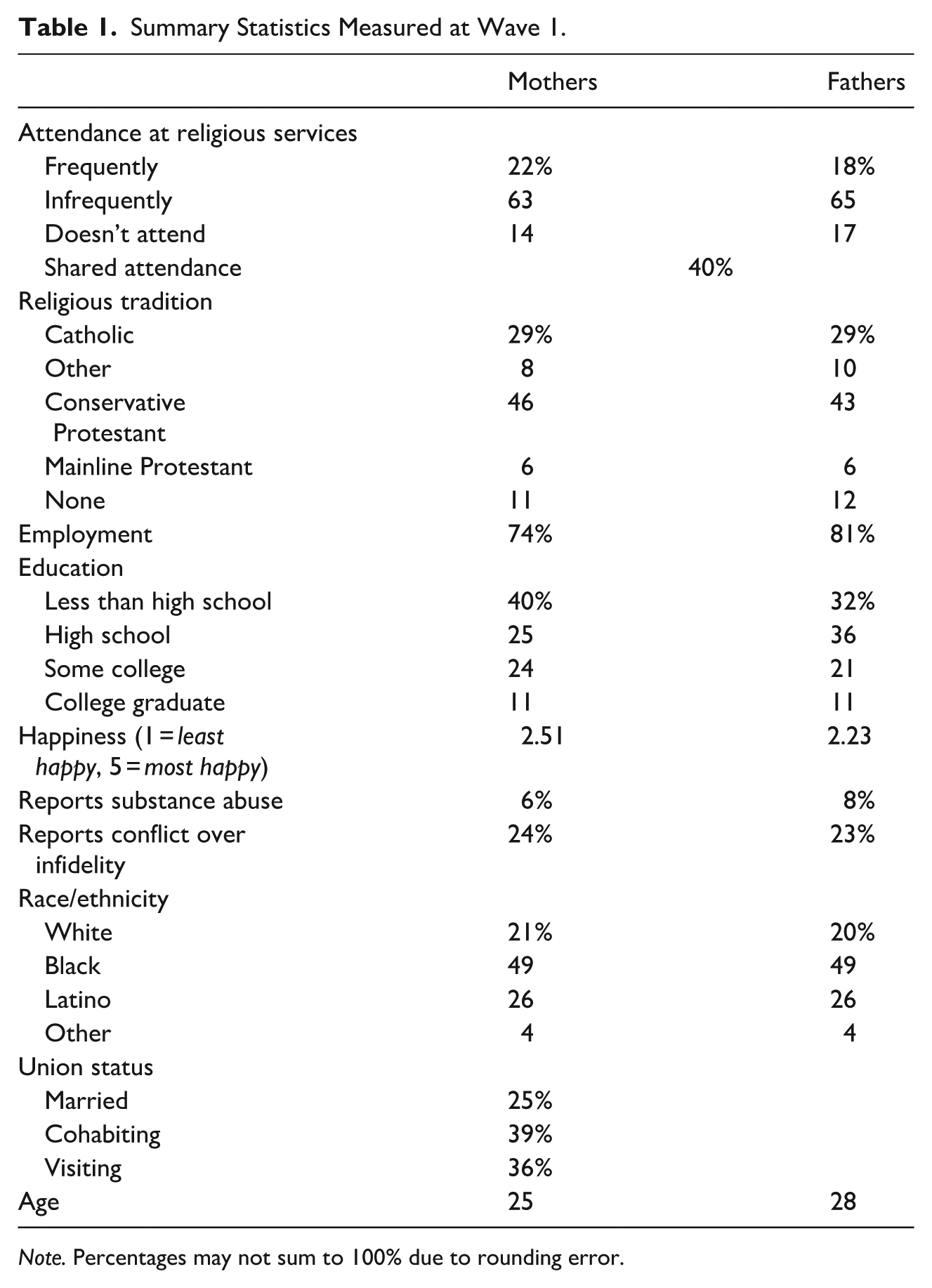
Note. Percentages may not sum to 100% due to rounding error.
Our analysis includes data from the first five survey waves, extending through the nine-year follow-up; the 15-year interview excludes necessary variables. Attrition is fairly low; for instance, over the five survey waves we analyze, dropout rates for mothers are 9%, 2%, 13%, and 6%. Moreover, attrition is not correlated with religiosity or most other social or demographic respondent attributes (Fragile Families & Child Wellbeing Study, n.d.).
Our sample includes mothers and fathers who remain in a relationship—married, cohabiting, or non-residential—at any survey wave. Thus, individuals who fail to participate in later waves or have ended their relationship are included for the duration of their presence in the data.
Analyses are unweighted. The weights only make respondents at individual survey waves nationally representative, so they are problematic when studying panel data. They also exclude a substantial number of cases. We experimented with weighting based on the first survey wave and obtained substantially similar results.
Missing data are deleted listwise except in the case of variables that are missing on large numbers of cases, which might have substantive impact on the analyses. For these items we employed mean imputation by survey wave, with a dummy variable indicating imputation; for categorical data, we added a dummy for missing data. 2 More sophisticated means of handling missing data, such as multiple imputation, do not perform appreciably better (Paul et al., 2008).
Variables
Our dependent variable is a dichotomous measure of any report of IPV victimization. Each survey wave contains between two and four questions tapping experiences with domestic violence. Sample wording of these questions includes: “He slaps or kicks you,” or “She pushes, grabs, or shoves you.” An affirmative response to any of these questions indicates the presence of IPV in that survey wave.
Our primary independent variable is religiosity, measured by church attendance. This is a three-category variable indicating whether respondents attend religious services frequently (several times a month or more), infrequently, or not at all. Prior research indicates that attendance at services is one of the most reliable measures of respondent religiosity (Call & Heaton, 1997; Wilcox & Wolfinger, 2016).
We measure religious denomination using a simplified version of the now-customary coding scheme proposed by Steensland et al. (2000), contrasting respondents who are Catholic, mainline Protestants, conservative Protestants, other faiths, or who are unaffiliated. Attendance and denomination are measured separately for each partner, with an additional dummy variable measuring whether mothers and fathers attend with the same frequency. The strong correlation between mothers’ and fathers’ denominations precludes a measure of denominational homogamy. Denomination is only measured in the first and third survey waves, so denomination in other waves is coded identically (i.e., second wave denomination is set to first wave levels; fourth and fifth wave denominations are set to third wave levels).
We seek to explain observed relationships between religion and having experienced IPV with two sets of independent variables, tapping socioeconomic status and relationship quality. The first measures education for each spouse (less than high school, high school graduate, some college, four-year college graduate) and whether each partner is currently working. 3
Second, we measure three dimensions of relationship quality for each respondent. These include a five-point Likert scale of relational happiness, whether each partner reports substance abuse (coded yes/no), and whether each partner reports being unfaithful in the relationship (yes/no). Happiness isn’t measured in the first survey wave, so we set it at second wave levels. Infidelity isn’t measured in the second and third survey waves, so it is set at Wave 1 levels. We acknowledge the collective weakness of these relationship quality variables and interpret them accordingly.
Finally, several control variables are used to account for spuriousness in the relationship between religion and IPV. These include race/ethnicity (white, African American, Latino, other), age and its square, and union status (married, cohabiting, “visiting”). 4 Race/ethnicity and age are only included for the responding partner due to the high similarity within couples on these measures.
Analysis
We analyze IPV using discrete time-event history models estimated via complementary log-log regression. The complementary log-log is a better estimator than logit or probit when discrete data approximate a continuous time process (Allison, 2010). 5 The Fragile Families data do not indicate when IPV occurred, so we know only what survey wave it occurred in. We therefore created one record for each survey wave for each respondent. Respondents are treated as “dead” in the survey wave; they report IPV (event history models are known as survival models in the life sciences, thereby imparting the word “dead” as a homograph, meaning that the event being studied has occurred). Duration dependence is modeled using a vector of dummy variables. 6 Finally, all independent variables except race and the aforementioned exceptions are measured at all five surveys and therefore treated as time-varying in our analysis.
Mothers and fathers are analyzed separately for two reasons. First is the possibility of gender differences in rates of IPV victimization (Fanslow et al., 2023) and religiosity (Pew Research Center, 2016). The second reason concerns the nature of data collection. Men and women are chosen as respondents because they’re parents of newborns; they are not individually sampled. Each is separately interviewed. Conducting the analysis separately for men and women preserves any gender-specific idiosyncrasies within the survey.
We believe that event history models best reflect the underlying data for three reasons. First, they make use of all available data. Second, they account for right censoring based on the amount of available data; some respondents will first experience IPV at some point after the last available survey wave. Others will drop out of the panel. Third, they are a well-known class of models that require relatively modest statistical assumptions.
Results
Table 2 displays the results of the event history analysis that explores the predictors of men becoming victims of interpersonal violence. Model 1 controls for basic differences between respondents, including religious faith, race/ethnicity, relationship status, and age. Men who attend religious services regularly—several times a month or more—are 26% less likely to be IPV victims (1 – exp[−0.30] = 0.26, p < .001) compared to their peers who attend less often or not at all. The effect of men’s religious attendance exists irrespective of their partner’s attendance: the coefficient measuring joint attendance is small and not statistically significant. These results are fundamentally unchanged after controlling for socioeconomic attributes, including education and employment (Model 2) and relationship dynamics, including happiness, sexual fidelity, and substance abuse (Model 3). For the variables measuring religious denomination, men whose partners are of “other” faiths are more likely to report IPV in Models 2 and 3. The other category reflects various smaller conservative faiths, such as Islam, Latter-Day Saints, Orthodox Judaism, and Jehovah’s Witnesses. Members of these faiths are more likely to be in insular communities and less likely to acknowledge violence that transcends traditional gender norms. Finally, the other independent variables have effects that broadly accord with either previous research on IPV or common sense. College-educated men are substantially less likely to be victims of IPV, as are men in happy relationships devoid of conflict over infidelity or substance abuse.
Event History Analysis of Male Interpersonal Violence Victimization.
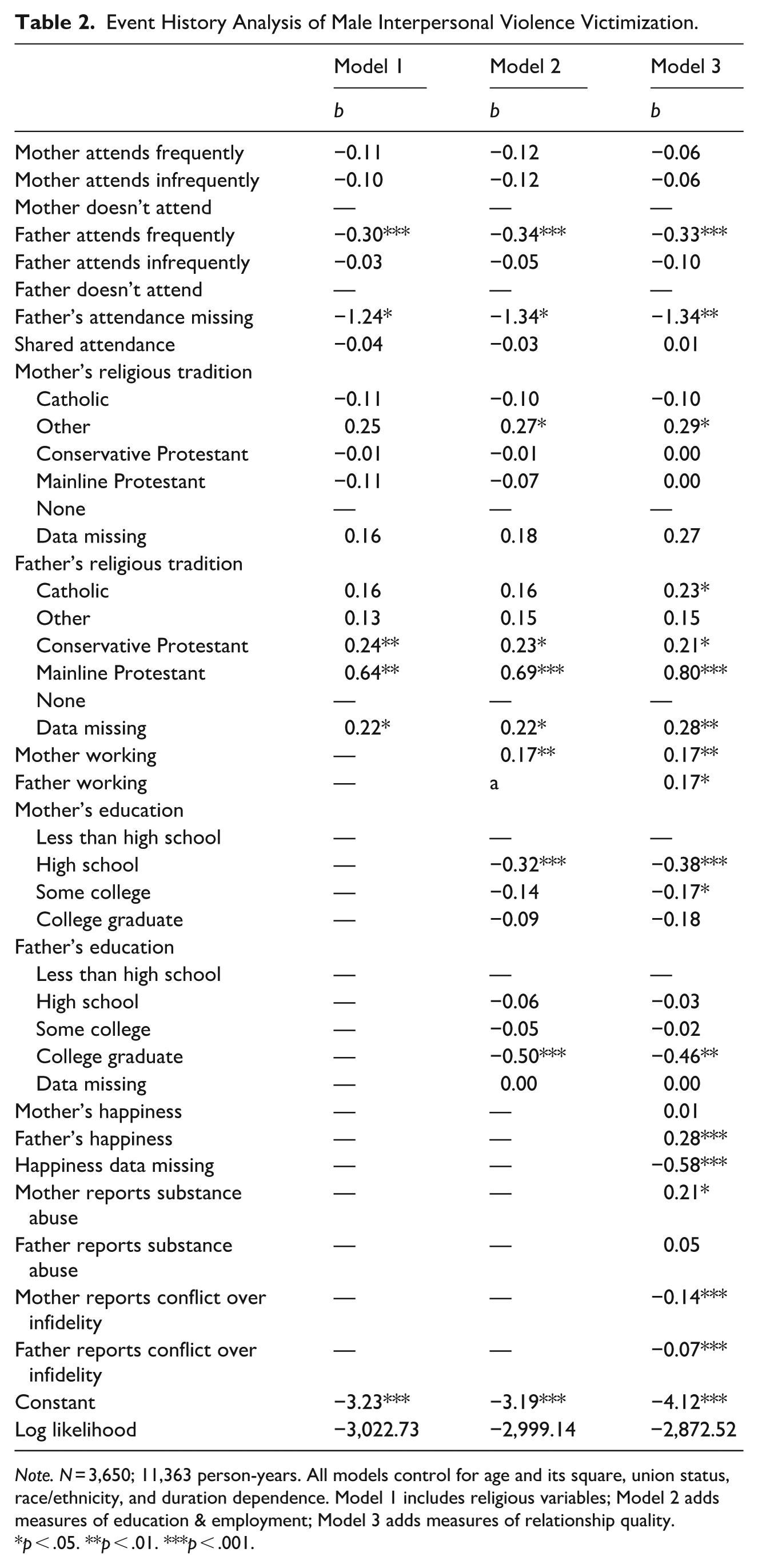
Note. N = 3,650; 11,363 person-years. All models control for age and its square, union status, race/ethnicity, and duration dependence. Model 1 includes religious variables; Model 2 adds measures of education & employment; Model 3 adds measures of relationship quality.
p < .05. **p < .01. ***p < .001.
Table 3 shows how religion and other factors affect the chances that women are victims of IPV. Model 1 indicates that women who attend services regularly are 15% less likely to be victims (1 – exp[−0.16] = 0.15, p < .05) compared to their peers who attend less often. This effect is relatively modest, and it disappears in Models 2 and 3, which adjust for socioeconomic and relationship quality differences between respondents.
Event History Analysis of Female Interpersonal Violence Victimization.
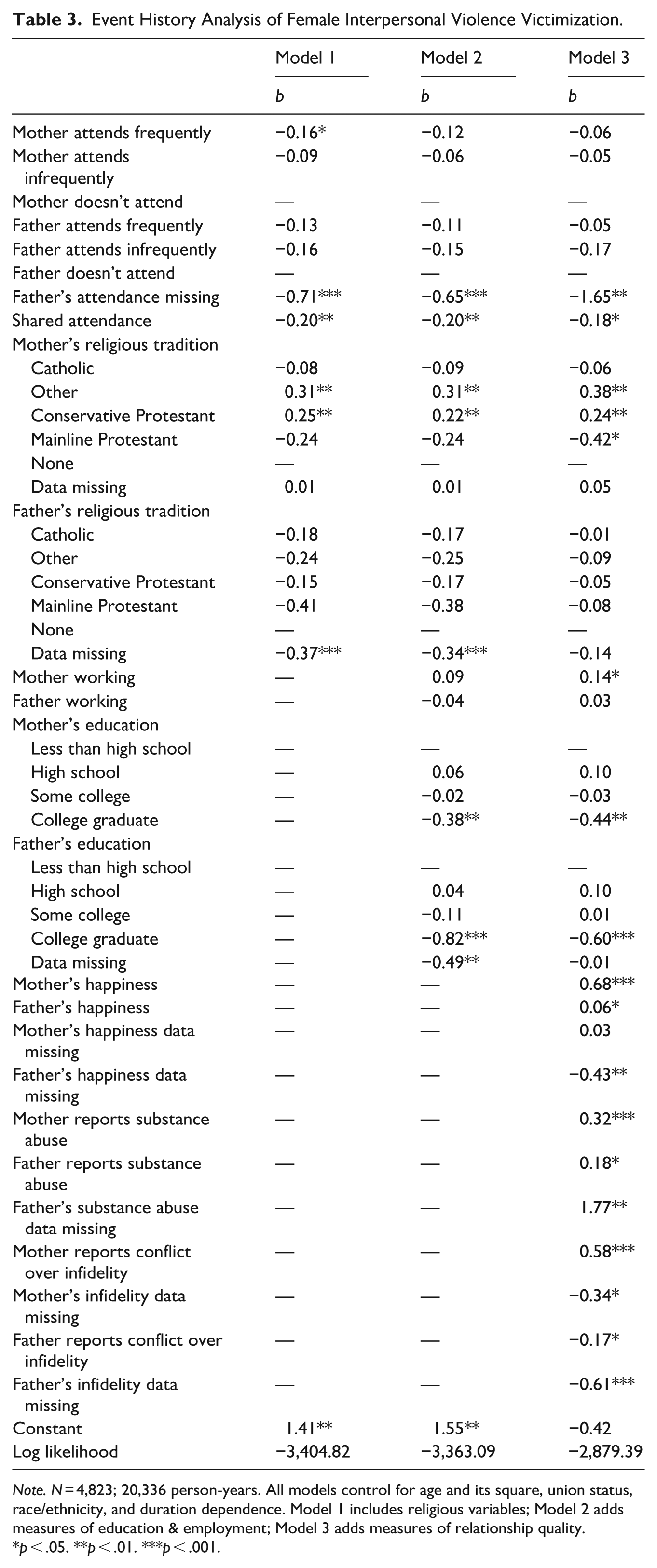
Note. N = 4,823; 20,336 person-years. All models control for age and its square, union status, race/ethnicity, and duration dependence. Model 1 includes religious variables; Model 2 adds measures of education & employment; Model 3 adds measures of relationship quality.
p < .05. **p < .01. ***p < .001.
Other religious factors affect rates of IPV for women. Female respondents who attend services with the same frequency as their male partners have lower rates of victimization. According to Model 1, shared attendance reduces the chances of being a victim by 18% (1 – exp[−0.20] = .18, p < .01) compared to couples who don’t share patterns of religious attendance. This figure, which barely changes after controlling for additional differences between couples, is indicative of couples who share broad agreement about the optimal level of religiosity in their relationship. It likely reflects couples who choose to attend services together. Table 3 also suggests two denominational differences in religious affiliation that are consistent with previous research (Ellison et al., 1999; Koch & Ramirez, 2010; Nason-Clark et al., 2018; Whitnah, 2022). Women affiliated with theologically conservative faiths are more likely to be victims of domestic violence compared to their unaffiliated peers. This includes conservative Protestants, 28% more likely to be victims of IPV (exp[0.25] – 1 = 0.28, p < .01), and members of other faiths, 36% more likely to be victims (exp[0.31] – 1 = 0.36, p < .01). The other category is eclectic but includes patriarchal denominations such as Islam, Mormonism, and Orthodox Judaism. Rates of IPV in these communities have traditionally been high. These denominational effects remain unchanged after adjusting for socioeconomic differences and differences in relationship quality between respondents. Indeed, the heightened risk of IPV corresponding to the “other denomination” category is greatest after controlling for all these differences between respondents (exp[0.38] – 1 = 0.46, p < .01).
Discussion
Although researchers have shown recurrent interest in the links between religious factors and IPV, most of this attention has been devoted to the religious variation in IPV perpetration. Fewer studies have examined the role of religious factors in IPV victimization. Our work contributes to this literature in several ways. First, in contrast to other work in this area, we use five waves of panel data, which strengthens claims about religious causation. Second, we focus on the effects of three measures of religion on IPV victimization among males and females: frequency of attendance at services, attendance (dis)similarity among partners, and conservative or sectarian religious affiliation. Third, we include statistical adjustments for multiple indicators of relationship quality, as well as demographic covariates. Fourth, in contrast to most previous studies of this topic, we examine the role of religious factors and covariates in predicting IPV victimization for both women and men. Overall, we believe this approach offers the strongest support yet for claims regarding the causal effects of religious factors on IPV victimization.
Several specific findings warrant brief discussion. First, in most models, people who attend religious services regularly are at lower risk of IPV victimization than their counterparts who attend less often. In general, respondents’ religious attendance seems to matter more than their partner’s attendance regarding IPV victimization. In some models—specifically, the event history models for women—controls for relationship quality variables (i.e., partners’ reports of relationship happiness and problem behaviors) attenuate the link between a respondent’s religious attendance and IPV victimization.
What might account for this pattern? As we noted above, religious communities socialize an array of general norms (e.g., the Golden Rule) and relationship-specific guidelines about how partners should behave in intimate unions (Wilcox & Wolfinger, 2016). Many religiously active people valorize intimate relationships, imbuing them with particular significance and sense of purpose. This includes processes of sanctification that have been linked with enhanced relationship quality and conflict resolution (Ellison et al., 2011; Lichter & Carmalt, 2009; Mahoney, 2010; Mahoney et al., 2003). Religiously active persons may encode scripts about what a good, loving “Christian” (or other religious) partnership should entail. To the extent this is the case, people who attend services regularly may be especially selective when choosing partners, and they may also avoid or exit problematic relationships if—and indeed, perhaps long before—they seem likely to entail violence.
Networks of coreligionists within a house of worship may sustain these relationship norms, and the threat of detection and negative social sanctions may influence relationship functioning, including the risk of IPV victimization. Informal support, especially confiding relationships and socio-emotional aid (i.e., making individuals feel loved, valued, and cared about), may help couples repair frayed unions and may provide insight about relationship issues (Wilcox & Wolfinger, 2008, 2016). Informal support also means less loneliness and less social isolation. Numerous studies have linked attendance at religious services with greater social integration (Bradley et al., 2020; Ellison & George, 1994; Ellison et al., 2026). One of the hallmarks of interpersonal violence is forced isolation; in contrast, a large social network makes violence harder to hide. In addition, social relations within a congregation may offer a range of formal (e.g., couples’ ministries, pastoral counseling) and informal (e.g., observant peers) supports that may aid couples in improving their relationship and in defusing conflict between partners (Wilcox et al., 2004). Finally, religious groups may provide an array of social and cognitive resources that assist in maintaining a sense of meaning and purpose, building a positive self-image, enhancing mental well-being and decreasing emotional distress, and coping with major life events and chronic stressors (Ellison & Henderson, 2011; Upenieks, 2025). Any or all of these mechanisms could reduce the risk of IPV victimization. The FF data do not allow us to adjudicate among these and other potential pathways linking religion with IPV, but future research should certainly take up this challenge.
In a second notable result, we find that attendance (dis)similarity affects the risk of IPV victimization. This pattern surfaces in event history models predicting the risk of women’s victimization, but not in models of men’s victimization. Briefly, similarities in attendance may reduce IPV via any or all of the following mechanisms or pathways: (a) shared levels of religious commitment; (b) time spent by partners in shared activities, which can promote bonding; (c) similarities in partners’ network composition and input or feedback from network members about relationship issues; (d) similar beliefs and preferences on familial matters such as childbearing, parenting, etc., as well as similarities in social and political values, choices of friends and leisure pursuits, and perhaps more (Curtis & Ellison, 2002). Our results with regard to attendance (dis)similarity and women’s IPV victimization broadly parallel the findings of previous studies, which have linked certain types of religious dissimilarity (in practice and in belief) with the risk of male IPV perpetration (Ellison et al., 1999), frequency of disputes (Curtis & Ellison, 2002), and risk of marital dissolution (Vaaler et al., 2009).
A third key finding also warrants discussion. In the event history models for women’s (but not men’s) victimization, we find that affiliation with a conservative (i.e., fundamentalist, evangelical, or charismatic) Protestant or sectarian group is associated with increased risk of IPV victimization. Although such groups are not monolithic, many denominations and congregations of these types tend to embrace patriarchal views and practices. As discussed above, these may include (but are not restricted to) congregational or denominational policies that limit or exclude women from clergy positions, lay leadership roles, and religious education activities, especially those that involve women instructing or leading men (Homan & Burdette, 2021). Such practices closely parallel what Homan and Burdette (2021) have characterized as structural sexism within religious groups. Some conservative Protestant and sectarian faith communities also promote gender essentialism, male headship, and separate spheres ideologies that emphasize female domesticity and submission to male leadership within the home and other domains (Alberta, 2023; Bartkowski, 1997; Sherkat, 2000; Whitnah, 2022). Scholars have long argued that such ideologies may have undesirable effects regarding IPV for two reasons. First, patriarchal doctrines may encourage men to attempt to control women, perhaps legitimating or excusing the use of force. Second, the emphasis on intimate (heterosexual) relationships in many conservative religious communities could also lead women to remain in troubled relationships even after they become toxic, thus increasing the risk of violent victimization for these women (Gezinski et al., 2023; Nason-Clark et al., 2018). Our results seem broadly consistent with these concerns.
Study Limitations
Like almost all studies, our work is characterized by several limitations. First, the FF sample is exclusively urban and consists primarily of lower-SES, minority couples who had recently become parents at the time of the initial FF interview. To be sure, this is an important, diverse study population that is thought to be particularly vulnerable to the risk of IPV and other relationship problems. However, our findings about religious influences on IPV victimization can only be generalized to this population, and additional research is needed to replicate these results among other groups.
Second, additional research is needed to examine how religious effects may vary across diverse sets of romantic couples. For example, although there is some evidence from past studies that links between religious attendance and IPV perpetration vary by race and ethnicity (Ellison et al., 2007), we are unaware of any clear evidence of religion-by-race interactions in studies of IPV victimization. In addition, research on the role, if any, of religious and spiritual factors in shaping the risk of IPV victimization among same-sex, as opposed to heterosexual couples, is lacking. Addressing these important issues concerning diversity in intimate unions lies beyond the scope of the present paper, but it is clearly an area worth pursuing in future work.
Third, although our use of individual religious attendance, partners’ religious (dis)similarity, and religious affiliation align well with previous work on IPV perpetration and victimization (Ellison et al., 1999; Kim, 2021), it would nevertheless be optimal to utilize additional measures of religiosity that are unavailable across waves of the FF data. As suggested above, one obvious candidate would be a direct measure of relationship sanctification, or the attribution of spiritual purpose and divine significance to the intimate union (Mahoney, 2010; Mahoney et al., 2003). This has been associated with several facets of positive relationship functioning, including successful conflict resolution styles, and seems to offer specific benefits for couples facing financial or other stressors (DeMaris et al., 2010; Ellison et al., 2011). A second possibility involves religious motivation, particularly intrinsic as opposed to extrinsic orientations, toward religious involvement. For example, Renzetti et al. (2017) have reported that the association between religious involvement and IPV perpetration may hinge on the degree of introjection or internalization of religious norms and spiritual values, with deterrent effects vis-à-vis IPV evident among those who are more intrinsically oriented toward their faith. Yet another fruitful direction would be to explore the role of congregational friendship and support networks. Based on previous research, the degree to which partners share religious values and joint religious activities (within the congregation and at home) is also worth considering in this context (Ellison et al., 2010; Henderson et al., 2018). In addition, prayer for one’s partner has been shown to enhance relationship quality and mitigate conflict (Fincham & Beach, 2014; Lambert et al., 2013; Wilcox & Wolfinger, 2016). And there may be other promising candidates for inquiry.
Fourth, although addressing this issue lies beyond the scope of the current project, additional work is needed to understand variations in faith-based responses to IPV. One important area is the role of clergy members in responding to IPV. Although there is inconsistency in the literature, and many clergy members are valuable frontline responders to, and sources of support for, victims of domestic violence (Goertzen & Fox, 2023; Zust et al., 2017), studies have also raised concerns about the role of religious leaders in this context (Alberta, 2023). One line of research has suggested that some clergy, especially those in more conservative faith communities, may: (a) lack adequate training and information about the causes and consequences of IPV; (b) avoid publicly discussing the problem of domestic violence within congregations; (c) respond in ways encourage victims—especially women—to remain in violent unions, thereby putting themselves at (greater) risk; and/or (d) delay or decline to make referrals to victim services and secular helping professionals (Houston-Kolnik et al., 2019; Nason-Clark et al., 2018; for a review of research on faith-based responses, see Istratii & Ali, 2023). For this reason, additional awareness and education may be needed in seminaries and clergy organizations (Drumm et al., 2018; McMullin et al., 2015).
Finally, although many of our findings withstand controls for multiple measures of relationship quality and functioning, it would be useful to incorporate other indicators of such constructs in future work. Promising examples might include acts of generosity, forgiveness, positive communication, trust, and others (Henderson et al., 2018). Doing so could help explain the protective effect of religious attendance on risk of IPV victimization found in several of our models.
Conclusion
These limitations notwithstanding, our study adds to the literature on religion and IPV by: (a) focusing on victimization rather than perpetration, which has received much of the attention in this area until recently; (b) developing a series of theoretical arguments linking multiple dimensions of religious involvement with the risk of IPV victimization among both women and men; and (c) using multiple waves of longitudinal data on an important and vulnerable population, that is, the Fragile Families (FF) project. Our study indicates that the social institution of religion may be a double-edged sword when it comes to IPV victimization, protecting in some ways but exacerbating the risk of such victimization in other ways. Although this study makes a novel—and, we believe, noteworthy—contribution, it is clearly not the final word on this topic. Future studies along the lines sketched above can further illuminate the complex links between religious factors and the scourge of IPV.
Footnotes
Acknowledgements
We thank Calvin Pyatt for research assistance.

Funding
The authors received no financial support for the research and/or authorship of this article.
Declaration of Conflicting Interests
The authors declared no potential conflicts of interests with respect to the authorship and/or publication of this article.