






Abstract
If you are reading this article, the odds are that you are feeling the strain of being a family caregiver or have experienced this in the past. “Family caregiver” has been defined in a number of ways depending on who is defining it and for what purpose. For example, publicly-funded programs may use very specific criteria to limit eligibility. Generally, a family caregiver is someone who provides unpaid care to a friend or family member who has an illness or disability.
In their national family caregiving survey conducted in 2019 and summarized in Caregiving in the United States 2020,
1
AARP and the National Alliance for Caregiving (NAC) defined family caregivers broadly: At any time in the last 12 months, has anyone in your household provided unpaid care to a relative or friend 18 years or older to help them take care of themselves? This may include helping with personal needs or household chores. It might be managing a person’s finances, arranging for outside services, or visiting regularly to see how they are doing. This adult need not live with you.
Based on the survey data, AARP and NAC estimate that over 19% of Americans, 48 million adults, are family caregivers. On average, family caregivers work at a paying job 36 hours per week and provide 24 hours of unpaid care. Nearly one-third (30%) of family caregivers have a child or grandchild under the age of 18 living in the household (with much higher percentages for the Generation X and Millennials cohorts). Other survey findings are described in Figure 1.
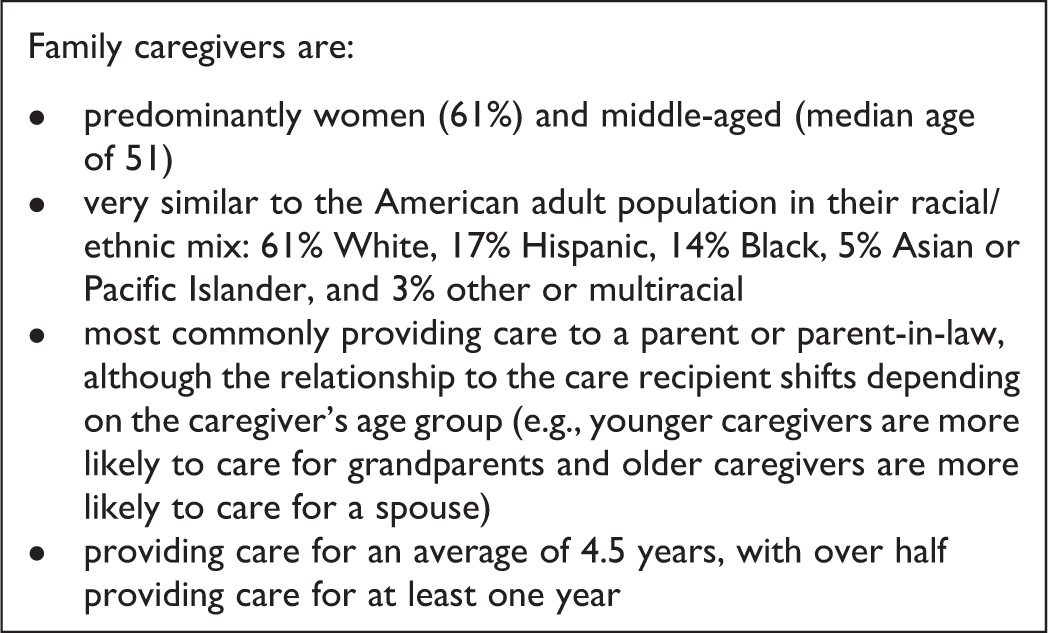
Descriptive information on family caregivers from AARP/NAC 2019 survey.
While these statistics are very useful in providing a profile of American family caregivers, it is equally important to consider the variation behind them. Family caregivers and their care recipients are heterogeneous groups. Each caregiving situation is unique and dynamic: caregivers’ and care recipients’ circumstances and needs can change from day to day.
Demographic and other factors are expected to exacerbate the pressure on family caregiving in America. 2 We have witnessed the hardship that the COVID-19 pandemic has placed on this already fragile ecosystem as family caregivers and care recipients have struggled with social isolation, increased financial strain, and worrisome decisions for every in-person encounter as to whether the benefits outweigh the risks. 3 Is the enhanced quality of life that an elderly person with advanced dementia gets from attending a day care program and the break that it provides for the caregiver, which allows her to work, worth the increased risk for both of getting COVID-19? That is the type of calculation many families, including mine, have had to make. The pandemic has increased societal awareness of the struggles of family caregivers, including among employers, many of whom have expanded paid leave and implemented new benefits such as back-up elder care. 4
A Personal Family Caregiving Experience
As a member of the “sandwich generation,” 5 I juggle parenting responsibilities with caretaking of elderly and impaired parents while also working outside of the home. As is true for most people in this group, there are times when I am at that flex point of needing to attend to work, child, and parents simultaneously.
One morning in February 2014, I was leading a client call from my car while parked at a nursing home where my 76-year-old mother was receiving hospice care. A formerly vibrant woman and successful visual artist, she had an aggressive type of cancer that was not responsive to treatment. She wanted to die at home, but the combination of her care needs and the geographic isolation of her home seemed to leave our family with no other choice. My stepfather was in his eighties and unable to lift her, and they couldn’t rely on aides or family to help because their home was inaccessible in icy or snowy weather.
On that winter day, the difficulty of balancing my desire to help care for her with my full-time job and parenting responsibilities for a 9-year old child felt intolerable. I reached out to a colleague who I knew had been caring for her husband through a terminal illness, and she suggested I look into taking an unpaid leave of absence. I decided to pursue this and cut back to working half days since I had deliverables that couldn’t readily be delegated to someone else. I no longer recall how long it took to request and receive approval for the leave through my manager and our human resources department. I just remember that my mother died within days of it starting.
The Workplace Disconnect in Supporting Family Caregivers
I regret that I didn’t provide more support to my mother and stepfather during the last months of her life, and I’m sure that my productivity at work suffered during that time. Looking back, ideally what could have helped me better manage this stressful time was more perceived support from my employer including an assessment of my needs as a caregiver performed by someone with expertise in elder care.
When employees are in the midst of a family caregiving crisis, they often, like me, cannot objectively identify their needs. Managers and even human resources representatives may not have the knowledge, skills, or time to help employees navigate caregiving responsibilities and challenges. Employees are often reluctant to seek help with caregiving needs from their employers because they fear it will negatively impact their jobs. In their 2019 report, The Caring Company, based on surveys of U.S. employers’ human resources representatives and of employees who self-identified as caregivers, researchers at Harvard Business School found that 59% of employees agreed that “Caregivers are perceived to be less committed to their careers than non-caregivers.” 6 Over half of employees (55%) believed caregivers are less likely to progress at the same rate as their peers even if their input is similar.
Employees may not necessarily identify themselves as caregivers, as I didn’t when my mother was dying. After all, I wasn’t living with her or helping with personal needs such as bathing or dressing. If I had had a more comprehensive understanding of family caregiving, I would have recognized that by visiting my mother regularly and providing emotional support, discussing her needs with other family members and health care providers, resolving hospice coverage issues, and participating in end-of-life planning, I was acting as a caregiver.
Why Employers Should Assess Their Employees’ Roles and Needs as Family Caregivers
Employers may believe that by offering benefits such as flexible work schedules, paid time off, and employee assistance programs (EAPs) they are sufficiently supporting their employees in their caregiving roles. These benefits can all be useful to family caregivers, depending on their design features. EAPs, in particular, may not be sufficiently specialized to address employees’ family caregiving needs.
7
In general, what employers offer does not seem to align with employees’ needs. The authors of The Caring Company conclude that with respect to addressing their employees’ caregiving needs “…there is a gross misalignment between what companies currently provide and what employees need.” They found that the majority of employers surveyed do not: measure their employees’ caregiving responsibilities; have awareness of how caregiving responsibilities change based on employees’ demographic status (e.g., life stage); or understand the direct or indirect costs of caregiving to their employees or the impacts on their performance.
As an example of this misalignment: when asked which caregiving-related benefits were most important to their decision to stay with the company, over 3-quarters of employees identified caregiving provider referral services (e.g., a company that providers referrals to pre-screened adult day care or in home aides), but only 38% of employers considered these services to be an effective benefit for retaining employees.
The COVID-19 pandemic has heightened employers’ awareness of the caregiving responsibilities of their workers, but it appears to be biased toward parenting. It’s harder to ignore that many employees are also parents when their children are audible in the background or jumping in mom’s or dad’s lap during a Zoom meeting. Whereas pets and children have generally become welcome distractions during virtual work meetings, we don’t typically hear or see caregiving of people who are ill or disabled in the background. A recent survey conducted by AARP and S&P Global found that 62% of companies increased their benefits and resources, such as flexible work schedules and paid sick time, in response to the COVID-19 pandemic; however, companies reported being more supportive of employees’ parenting roles than their roles as caregivers to adults who are ill or disabled (Figure 2). 8 For example, half as many employers reported that benefits for family caregivers were a high or top priority compared to parents of young children (under age 5).
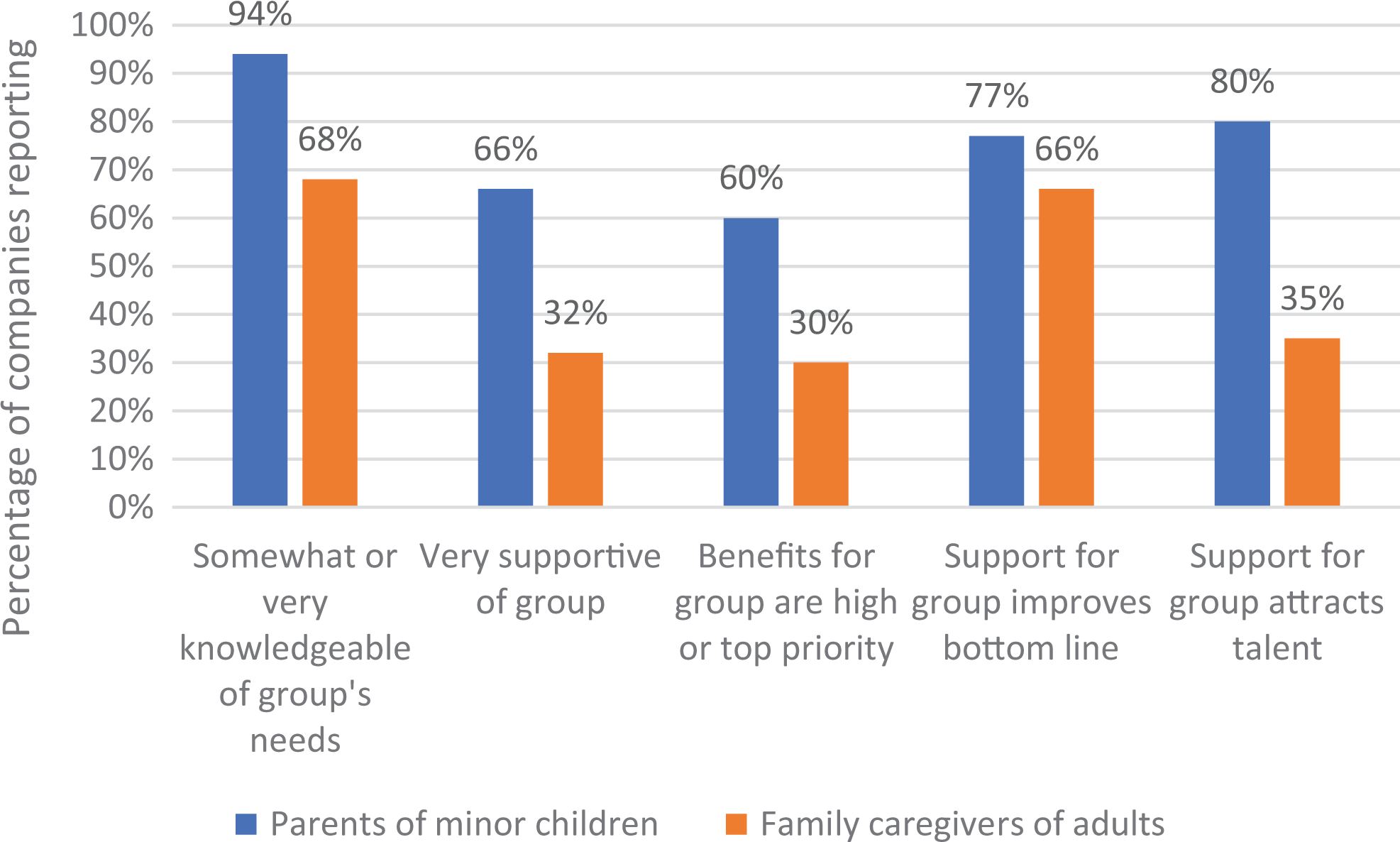
Largest U.S. companies’ support of parents compared to family caregivers, 2020. Source: AARP/S&P Global Survey of Largest U.S. Companies, July-October 2020.
Assuming that employers see the value of providing support to their employees with caregiving issues, how might they do so more effectively? The authors of The Caring Company recommend employers start by conducting a “care census.” In a care census, employers take action to collect information on their employees’ caregiving roles and needs, use the findings to identify gaps in current offerings and to inform design of benefit expansion or creation of new benefits, and develop a method to measure return on investment. In the remainder of this article, I focus on the first of these activities: assessment of employees’ roles and needs as caregivers.
Family Caregiver Assessment
Assessment of family caregivers’ needs and well-being separately from those of the care recipient has long been recommended as an essential component of caregiver support by organizations such as Family Caregiver Alliance and AARP. A family caregiver assessment serves multiple purposes, including primarily to collect important information about the caregiver’s role, tasks, strengths, everyday challenges, and needs in order to identify services, resources, and training that will allow him or her to continue to support the care recipient (Figure 3). 9
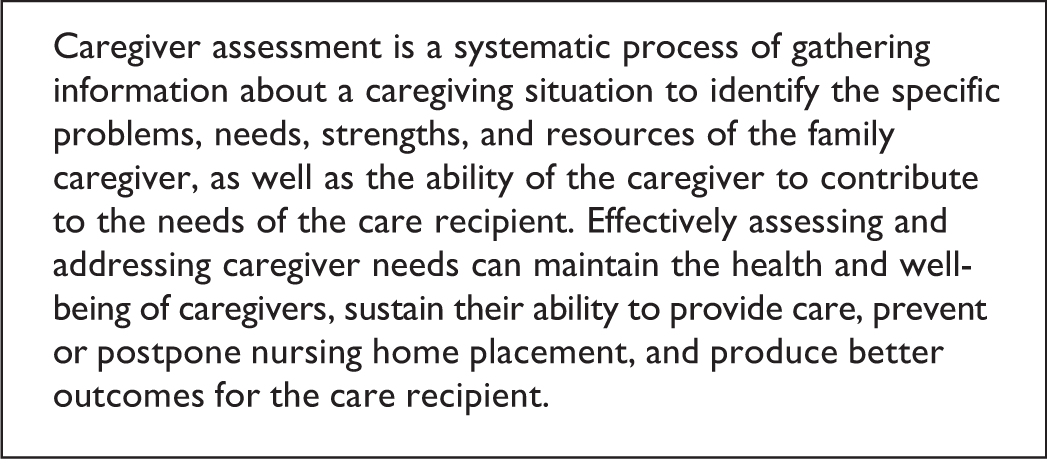
Definition of caregiver assessment.
It also provides an opportunity for the caregiver to be “acknowledged, valued, and better understood by practitioners” which, in turn, boosts morale. 10 Family Caregiver Alliance identified 7 essential domains of a family caregiver assessment (Figure 4). 10
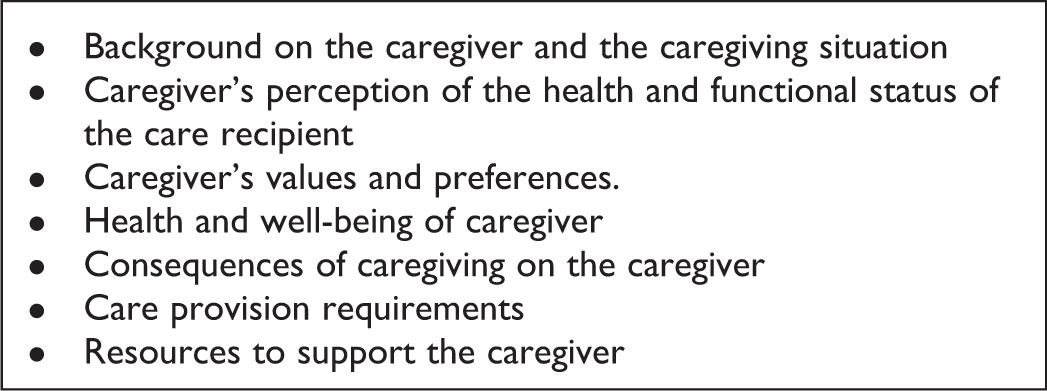
Family caregiver assessment domains.
The better that employers understand what family caregiving entails, based on evidence-based individual caregiver assessment practices, the more likely they can thoughtfully approach an organization-level assessment of their employees’ caregiving roles and needs. Ideally, they should collect information directly from employees rather than rely on assumptions based on employee demographics. This not only gives the employer a more accurate picture of the needs unique to their organization, but also, as articulated in The Caring Company, promotes a “care culture in which employers acknowledge the care needs of employees and encourage the usage of care benefits.”
Next Steps for Employers
The good news is that there are numerous examples of employers who have conducted assessments of their employees’ caregiving needs, and implemented benefits and programs to better support them, and tools for employers who are at the beginning stages of considering options. Many of these programs were in place prior to the COVID-19 pandemic, and others have been created (or expanded) in response to it. For example, ViacomCBS, which already had robust elder care benefits, responded to the pandemic by accelerating the implementation of a new and permanent 6-week paid leave benefit for family caregivers. 11 My employer, IBM, put into effect a 4-week emergency paid leave benefit which parents and caregivers can request during the pandemic. 12 Boston College’s Center on Aging and Work and AARP are just 2 examples of organizations that have case studies and other practical resources to help employers get started. 13
There are also proprietary 14 and publicly-available tools that employers can use to conduct company-wide caregiving needs assessments. An example of the latter is the University of Wisconsin-Madison Division of Extension’s Employed Caregiver Survey (ECS). The ECS is a 10-minute, anonymous web-based survey that employers’ human resources personnel can implement at no-cost, the results of which are summarized and reported back to the employer by Extension staff. 15 The survey domains are reflective of those described above for family caregiver assessments, including: caregiver characteristics and relationship to the care recipient; care recipients’ health conditions and living arrangements; amount, types, and duration of care provided; impacts on work; and preferences for types of assistance and how and where to receive it.
Where could employers start if they have identified a need for family caregiving supports for their employees, but are not ready to implement a benefit program? Greg Link, Director of the Office of Supportive and Caregiver Services at the U.S. Department of Health and Human Services Administration for Community Living, suggests employers reach out, individually or in collaboration with other local businesses or organizations, to their State Unit on Aging or local Area Agency on Aging to leverage expertise, services, and resources funded by the National Family Caregiver Support Program (NFCSP). 16 The NFCSP, funded by the Older Americans Act Title III-E, funds states and territories to provide family caregivers with services such as information and referral; counseling, training and support groups; and respite services. Another important resource for employers to know about is the U.S. Department of Veterans Affairs extensive Caregiver Support programs, which are offered both for veterans who have service-connected conditions and those whose conditions are not service-connected. 17 State Medicaid programs also may provide caregiver services and supports through programs serving Medicaid-eligible individuals with long-term services and supports needs.
Conclusion
As a middle-aged married woman with elderly and impaired parents and step-parents, I know that family caregiving is very likely in my future both as a caregiver and as a recipient of care. Our workplaces and larger society can and must do better to create a “care culture” that supports family caregivers. Perhaps a more nuanced understanding of family caregiving and our own relationship to it can move us forward. It remains to be seen whether employers’ increased awareness of and support for their employees’ caregiving roles during the COVID-19 pandemic will result in permanent changes that better align benefits with employees’ needs. An important first step in the right direction is for employers to explicitly measure and assess the needs of their employees.