







Abstract
Purpose
This study examined the associations among movement behaviors, stress responses, and work performance and explored whether stress responses serve as a mediating factor.
Design
Cross-sectional study.
Setting
Remote work settings.
Sample
A total of 100 workers with remote work arrangements.
Measures
Daily movement behaviors were measured using accelerometers. Stress responses and work performance were assessed using the Brief Job Stress Questionnaire and World Health Organization Health and Work Performance Questionnaire, respectively.
Analysis
Multiple linear regression and mediation analyses were conducted using both unadjusted and adjusted models.
Results
In the adjusted model, higher daily step counts (per 1,000 steps) were significantly associated with lower stress responses (B = −1.03, 95%CI [–1.86, −0.20], P = .02). Stress responses were negatively associated with work performance (B = −0.47, 95%CI [–0.72, −0.21], P < .001). Mediation analysis showed significant indirect effects of daily steps (per 1000 steps) on work performance through stress responses after adjusting for covariates (indirect effect = 0.46, BootSE = 0.25, 95% CI [0.08, 1.03]).
Conclusion
Daily steps were indirectly associated with work performance through stress responses among Japanese workers with remote work arrangements. Encouraging walking and increasing daily movement may enhance occupational mental well-being and productivity in this population.
Keywords
Purpose
Since the coronavirus disease (COVID-19) pandemic in 2020, a significant shift towards remote work has occurred globally. Remote work is considered a flexible work pattern that allows employees to operate outside the conventional office environment, typically from home or other locations. 1 A 2025 survey conducted in Japan revealed that the implementation rate of remote work remained at 22.5% among surveyed full-time employees (n = 26,352), with 82.2% of employees expressing a desire to maintain this work model as part of their regular work style. 2 The advantages of remote work are widely recognized, such as reduced commuting time and greater flexibility in managing personal life. 3 However, owing to distractions and blurred boundaries between personal life and work during remote work, workers may find it difficult to concentrate on their employment tasks, in turn negatively impacting performance and increasing presenteeism. 4 In addition, remote work may reduce face-to-face interaction with colleagues, increase feelings of isolation and loneliness, and pose challenges for balancing work and life, all of which may be relevant to stress-related responses.5-7
Remote work has been recognized as an important determinant of daily movement behaviors, including physical activity (PA) and sedentary behavior (SB). A systematic review showed that working from home was significantly associated with a 17% reduction in overall PA, including a 26% decrease in light physical activity (LPA) and a 20% decrease in moderate-to-vigorous physical activity (MVPA), along with a 16% increase in SB. 8 Such behavioral change may negatively affect employees’ psychological well-being, particularly in terms of stress responses. Stress responses refer to psychological and physiological reactions owing to internal or external environmental challenges, which involve interactions among the nervous, endocrine, and immune systems. 9 Physiological evidence suggests that PA modulates hypothalamic-pituitary-adrenal (HPA) axis function, leading to reduced cortisol secretion and consequently alleviating stress-related responses, 10 whereas prolonged SB can contribute to musculoskeletal discomfort and increased stress perception owing to muscle stiffness. 11 However, evidence showing the relationship between SB and stress responses remains inconclusive, with some studies identifying SB as a potential contributor while others showing no significant association across different work contexts.12,13
In addition to its health implications, stress responses have also been widely recognized as a key determinant of work performance. Higher stress responses are associated with reduced motivation and impaired productivity.14-16 Given that PA has a positive impact on stress responses, which in turn affects work performance, a growing body of research has explored whether promoting PA and reducing SB could alleviate stress responses and enhance work outcomes. However, empirical evidence remains inconsistent. For example, a randomized controlled trial in Japan revealed that employees who received a workplace sit-stand desk intervention not only significantly reduced their sitting time but also improved their work performance, although mechanisms regarding stress responses, were not examined. 17 Similarly, the SMART Work & Life study conducted in England showed significant findings regarding reduced sitting time and increased standing time; however, only small changes were observed for stress and productivity. 18 Maylor et al. reported meaningful changes in physiological stress and work performance after a multicomponent intervention to reduce sitting time in office workers, while no significant change in perceived stress was observed. 19 In contrast, a pilot randomized controlled trial by Falk et al. suggested positive effects of height-adjustable desks and an online SB intervention program on both stress and work performance among remote employees. 20 These findings suggest a possible association between PA, SB, and work performance. However, the underlying mechanisms of stress responses, acting as mediators, have rarely been investigated, particularly in remote work settings.
Based on previous literature, we hypothesized that higher levels of PA and lower levels of SB would be associated with better work performance, with stress responses acting as a potential mediator. The aim of this study was to examine the associations among movement behaviors (including PA and SB), stress responses, and work performance in workers with remote work arrangements. Additionally, we tested whether stress responses mediate the relationship between movement behaviors and work performance. This research may contribute to a better understanding of how behavioral and psychological factors influence occupational outcomes in the context of remote work and provide evidence for future PA interventions aimed at improving both occupational mental health and work performance.
Methods
Design
This cross-sectional study was designed to examine the associations among movement behaviors (including PA and SB), stress responses, and work performance, and to test the mediating role of stress responses. Data were obtained from the baseline datasets of two previous multi-component PA intervention studies conducted among Japanese workers in 2021 and 2022.21,22 Both original studies were approved by the Ethics Committee of the Institute of Health and Sport Sciences, University of Tsukuba (approval numbers 020-149 and 021-188). This study was reported and written in accordance with the Strengthening the Reporting of Observational Studies in Epidemiology (STROBE) statement. 23
Sample
Both original studies were conducted in Japan and involved 1 insurance company and 1 information technology (IT) company. The two companies were recruited for the studies using a convenience sampling approach through a referral from an intermediary. Participants were recruited through internal newsletters within each company in January 2021 and January 2022, respectively, and subsequently completed baseline assessments. The insurance company implemented remote work policies owing to the pandemic, while employees at the IT company were allowed to work from home or in the office at their own discretion. Most employees at these two companies worked from home several days per week. Information on the total number of employees at each company was not available from the original studies.
Participants were eligible if they were office workers aged 20-65 years and could use a smartphone. Individuals were excluded if they planned to retire permanently or temporarily during the study period or were unable to move independently owing to injury or other reasons. For this secondary analysis, an additional inclusion criterion was that participants worked remotely at least 1 day per week. All participants were required to provide written informed consent prior to the baseline assessment in the original studies.
A total of 524 office workers were initially approached from two independent PA intervention studies previously conducted in Japan. Given that both studies shared the same inclusion and exclusion criteria and recruitment procedures, the datasets were merged to increase sample size and enhance statistical power for this secondary analysis. Participants were excluded if they (1) did not complete the baseline questionnaire on demographics, (2) lacked valid accelerometer data, or (3) did not meet the remote work criterion (ie, worked from home at least 1 day per week). After applying these criteria, 100 participants were eligible for the analysis. Among these participants, 6 had missing data on body weight, and 1 had missing data on work performance. Figure 1 shows a detailed flowchart illustrating participant selection and data integration. Flow diagram of participant recruitment and exclusion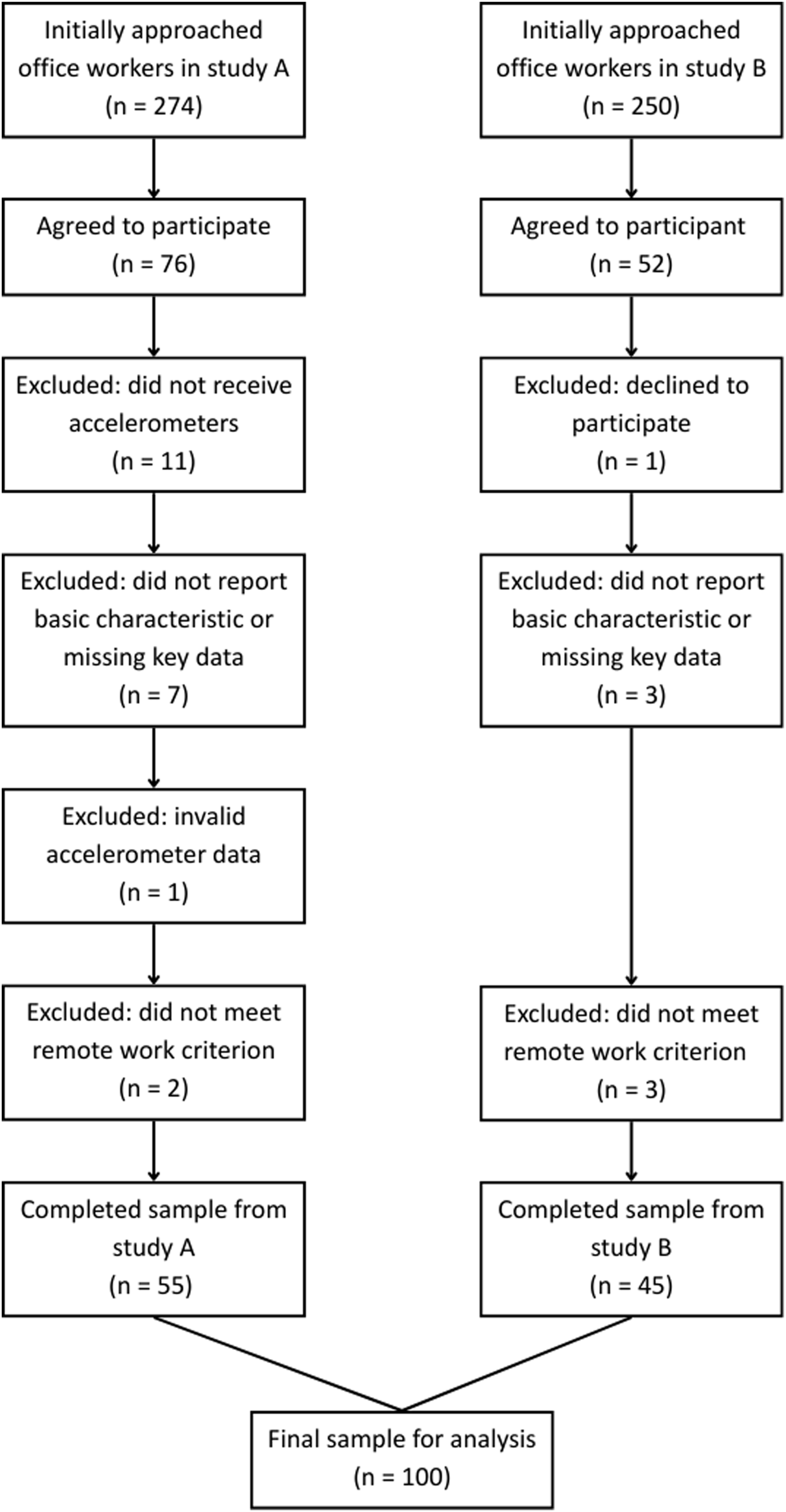
Measures
Covariates
Participants reported basic characteristics through a self-administered online questionnaire, including sex, age, height, weight, sleep duration, smoking status, education level, job position, years of service, living arrangements (alone or with others), and marital status. Body mass index (BMI, kg/m2) was calculated from self-reported height and weight.
Physical Activity and Sedentary Behavior
PA and SB were objectively measured using a triaxial accelerometer (Active style Pro HJA-750c; Omron Healthcare, Kyoto, Japan), which has demonstrated validity and reliability in assessing daily movement behaviors. 24 Participants were instructed to wear the device on their waist during waking hours for 7 consecutive days and to remove it only during sleep, bathing, or water-based activities. Data were considered valid if the wearing time was at least 10 hours per day on at least 3 days within the 7-day period. 25 During the measurement period, participants were asked to complete a daily activity record that included information on sleep and wake times, working hours, lunch breaks, remote work status, and any periods when the accelerometer was not worn. Step count (steps/day), LPA (min/day), MVPA (min/day), and SB (min/day) were recorded using an accelerometer. Accelerometer data were processed using a macro program developed and distributed by the Japan Physical Activity Research Platform. 26 PA intensity was classified using metabolic equivalent (MET) thresholds. Light intensity ranged from 1.6 to 2.9 METs, Moderate intensity from 3.0 to 5.9 METs, and vigorous intensity was defined as ≥ 6.0 METs. 27 MVPA was calculated as the sum of moderate and vigorous intensity activity. To improve interpretability in the regression models, step counts were scaled to 1000 steps and SB to 30 minutes.
Stress Responses
Stress responses were measured using selected subscales of the Brief Job Stress Questionnaire (BJSQ), a validated instrument widely used in the field of occupational health, which has demonstrated reliability and validity. 28 The selected subscales included (1) five aspects of psychological distress—vigor (3 items), anger-irritability (3 items), fatigue (3 items), anxiety (3 items), and depression (6 items), and (2) physical stress reactions (11 items). The items were rated on a 4-point Likert scale. Psychological distress and physical stress reactions were rated from 1 (“Almost never”) to 4 (“Almost always”). The total score was calculated by summing all items, ranging from 29 to 116. Mean scores were calculated for each BJSQ subscale by dividing the total subscale score by the number of items, ranging from 1 to 4. Positive items (vigor) were reverse-coded so that higher scores consistently indicated higher levels of psychological or physical stress responses.
Work performance
Work performance was assessed using the absolute presenteeism item from the World Health Organization Health and Work Performance Questionnaire (HPQ) short form. 29 Overall job performance over the past 28 days was rated on a scale of 0 (“Worst performance”) to 10 (“Top performance”). The score was multiplied by 10 to obtain the absolute presenteeism score, ranging from 0 to 100, with higher scores indicating better work performance. 30
Analysis
Descriptive variables are presented as means and standard deviations (M ± SD) for continuous variables, including participant characteristics, daily step counts, LPA, MVPA, SB, stress responses, and work performance. Categorical variables are reported as frequencies (N) and percentages (%), including sex, smoking status, job position, education level, living arrangements, and marital status. Descriptive statistics were calculated using available data for each variable.
To examine the association among movement behaviors, stress responses, and work performance, 3 sets of multiple linear regression analyses were conducted: (1) PA/SB and stress responses, (2) stress responses and work performance, and (3) PA/SB and work performance. Each regression analysis included two models: Model 1 included only exposure variables, and Model 2 was fully adjusted for age, sex, BMI, company, years of service, remote workdays per week, living arrangements, and accelerometer wearing time.
Mediation analyses were conducted using PROCESS macro (version 4.2) in SPSS,
31
applying Model 4 to test for simple mediation. The mediation role of stress responses in the relationship between movement behaviors (ie, daily steps, LPA, MVPA, or SB) and work performance was examined. Each movement behavior was entered as the independent variable (X), with stress responses as the mediator (M) and work performance as the dependent variable (Y). Figure 2 illustrates the conceptual diagram. The analysis was performed using bootstrapping with 5000 samples and a 95% confidence interval (CI). An initial model was estimated to test for presence, followed by a fully adjusted model controlled for the same covariates as those in Model 2. Conceptual diagram of the simple mediation model using PROCESS macro Model 4. Note. Path a represents the effect of movement behaviors (eg, steps, MVPA, LPA, SB) on stress responses; path b represents the effect of stress responses on work performance; path c′ indicates the direct effect of movement behaviors on work performance after controlling for stress responses; path c refers to the total effect of movement behaviors on work performance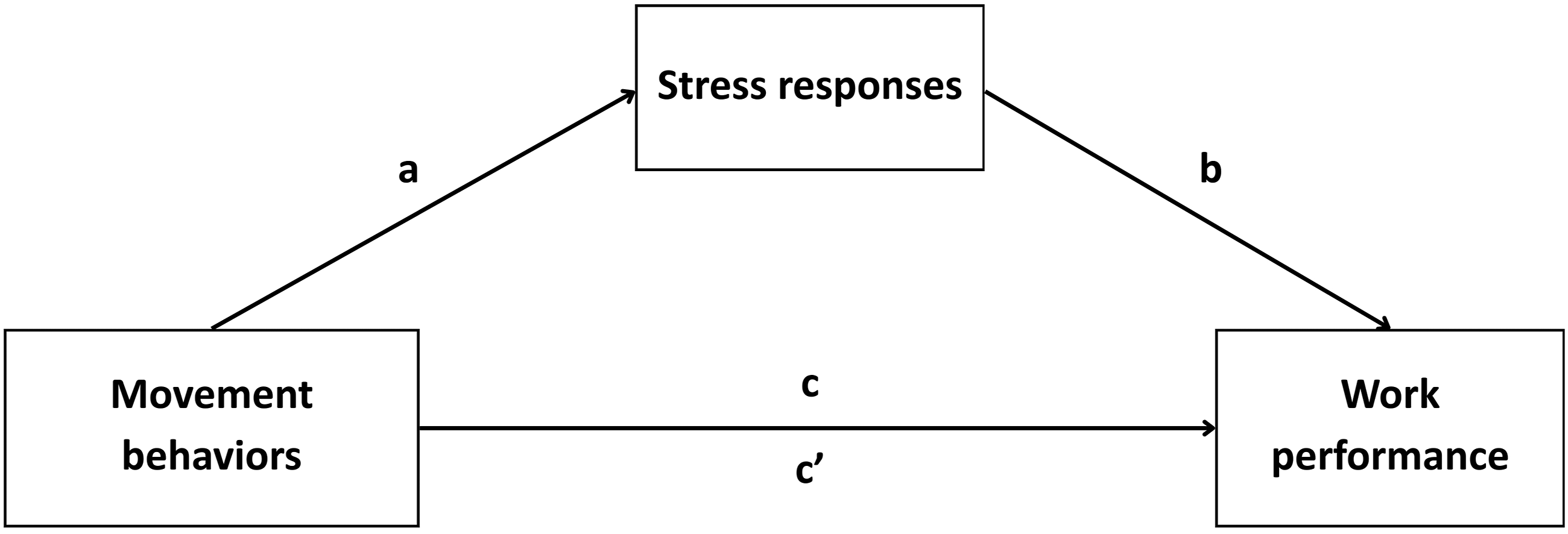
Regression and mediation analyses were conducted using complete-case data for all variables included in each model. All statistical analyses were performed using IBM SPSS Statistics version 30.0 (IBM Corp., Armonk, NY, USA). Statistical significance was set at P < .05 (two-tailed).
Results
Descriptive Data
Characteristics of Participants
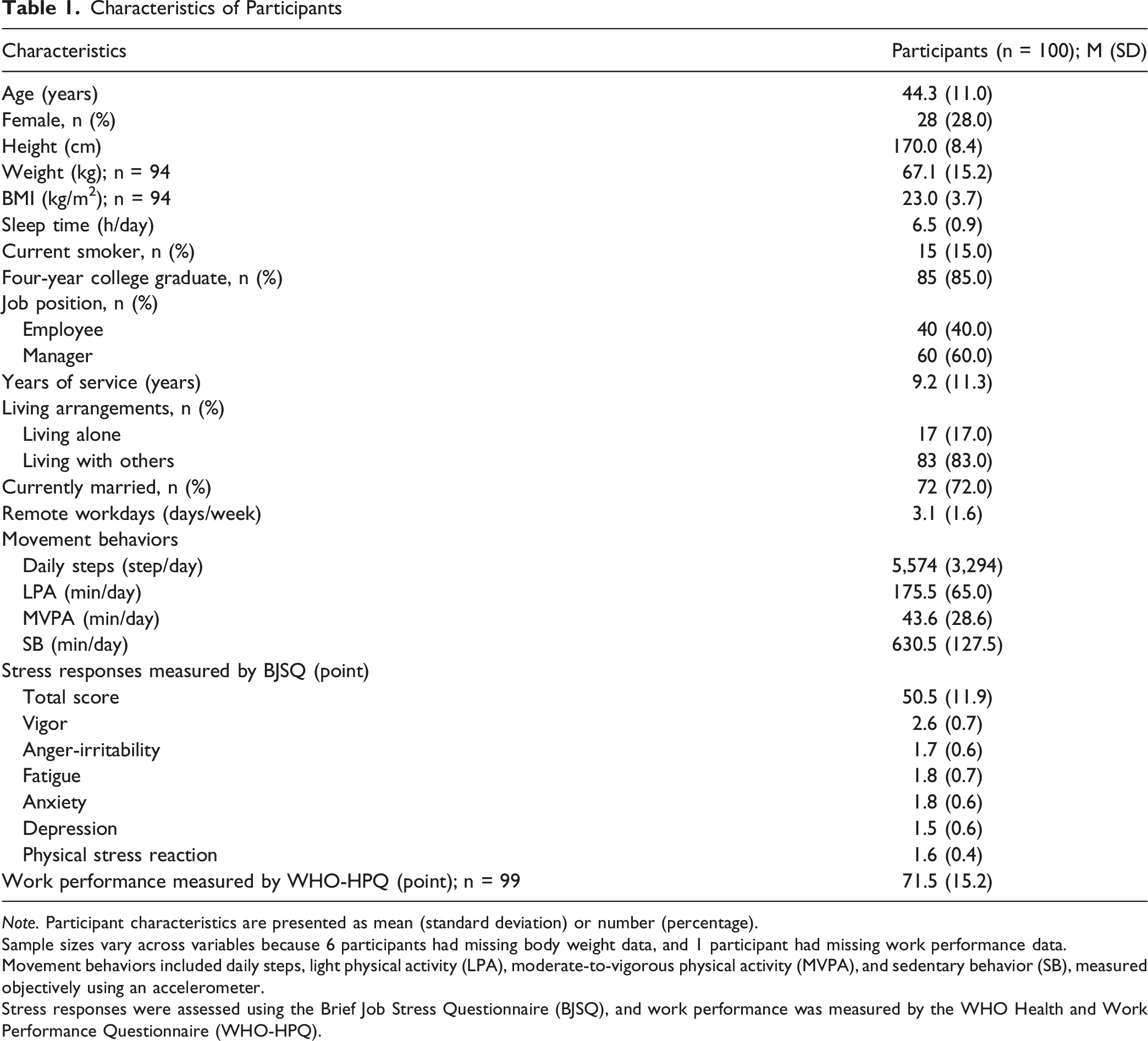
Note. Participant characteristics are presented as mean (standard deviation) or number (percentage).
Sample sizes vary across variables because 6 participants had missing body weight data, and 1 participant had missing work performance data.
Movement behaviors included daily steps, light physical activity (LPA), moderate-to-vigorous physical activity (MVPA), and sedentary behavior (SB), measured objectively using an accelerometer.
Stress responses were assessed using the Brief Job Stress Questionnaire (BJSQ), and work performance was measured by the WHO Health and Work Performance Questionnaire (WHO-HPQ).
Association between movement behaviors, stress responses, and work performance
Multiple Linear Regression Models Examining Associations Between Movement Behaviors and Stress Responses, Stress Responses and Work Performance, and Movement Behaviors and Work Performance
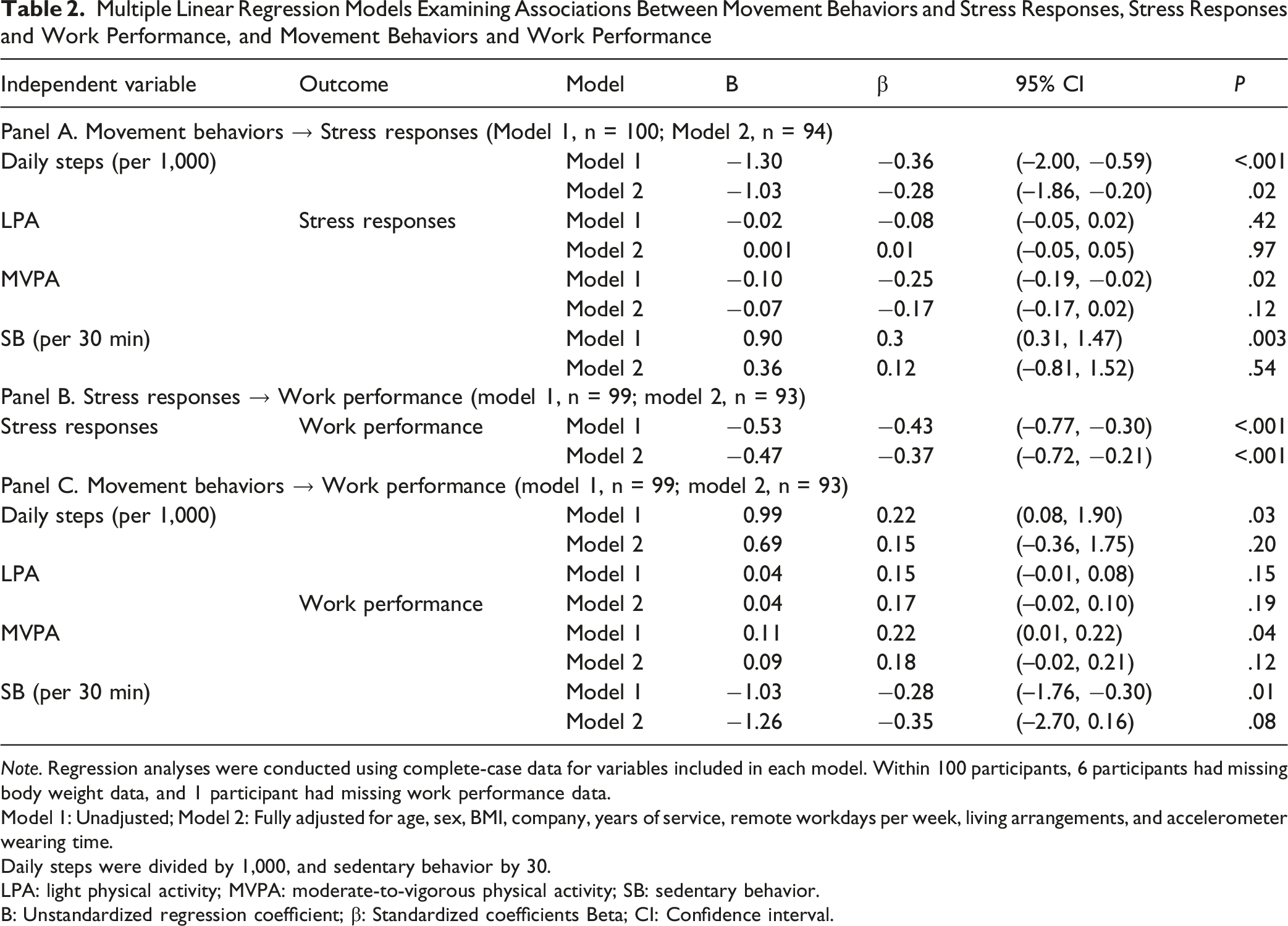
Note. Regression analyses were conducted using complete-case data for variables included in each model. Within 100 participants, 6 participants had missing body weight data, and 1 participant had missing work performance data.
Model 1: Unadjusted; Model 2: Fully adjusted for age, sex, BMI, company, years of service, remote workdays per week, living arrangements, and accelerometer wearing time.
Daily steps were divided by 1,000, and sedentary behavior by 30.
LPA: light physical activity; MVPA: moderate-to-vigorous physical activity; SB: sedentary behavior.
B: Unstandardized regression coefficient; β: Standardized coefficients Beta; CI: Confidence interval.
Mediation Analysis
Mediation Effect of Stress Responses on the Association Between Movement Behavior and Work Performance
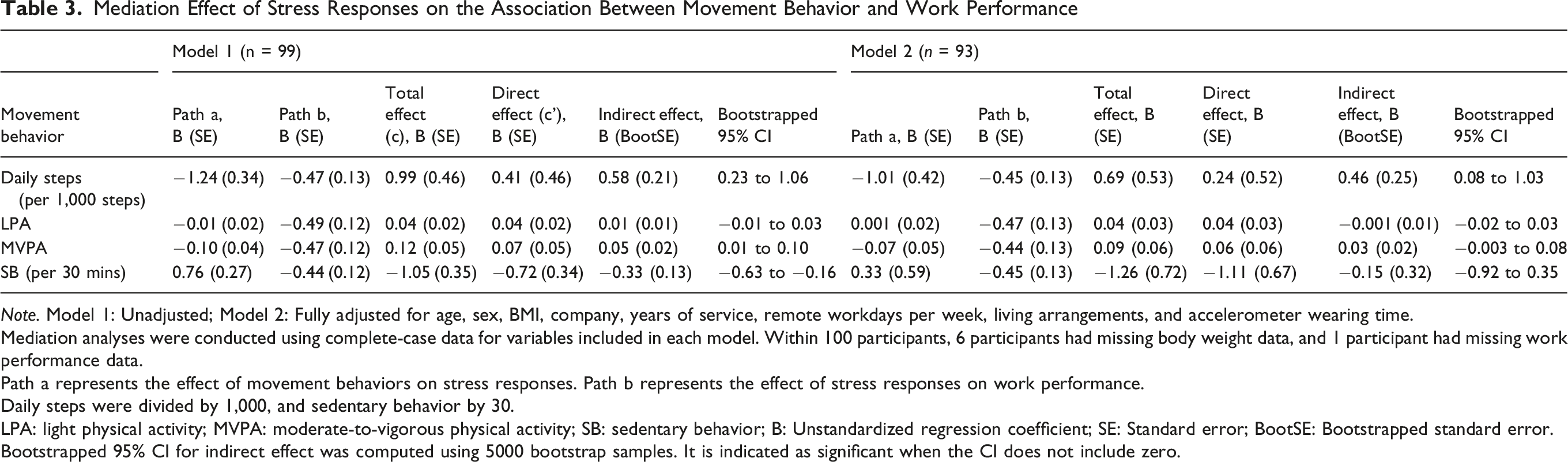
Note. Model 1: Unadjusted; Model 2: Fully adjusted for age, sex, BMI, company, years of service, remote workdays per week, living arrangements, and accelerometer wearing time.
Mediation analyses were conducted using complete-case data for variables included in each model. Within 100 participants, 6 participants had missing body weight data, and 1 participant had missing work performance data.
Path a represents the effect of movement behaviors on stress responses. Path b represents the effect of stress responses on work performance.
Daily steps were divided by 1,000, and sedentary behavior by 30.
LPA: light physical activity; MVPA: moderate-to-vigorous physical activity; SB: sedentary behavior; B: Unstandardized regression coefficient; SE: Standard error; BootSE: Bootstrapped standard error.
Bootstrapped 95% CI for indirect effect was computed using 5000 bootstrap samples. It is indicated as significant when the CI does not include zero.
Sensitivity Analysis
The two core associations of daily steps and stress responses, and stress responses and work performance, were further examined stratified by company as a supplementary sensitivity analysis (Supplemental Table S1). The overall pattern of associations was consistent in both companies, although the results were less stable because of the smaller sample sizes.
Discussion
This cross-sectional study aimed to examine the associations among movement behaviors, stress responses, and work performance, and further investigated whether stress responses mediate the effects of these movement behaviors on work performance among Japanese workers with remote work arrangements. Multiple linear regression analyses revealed that, after adjusting for covariates, higher daily step counts were significantly associated with lower stress responses. In turn, higher stress responses were significantly associated with lower work performance. However, none of the movement behaviors were directly associated with work performance in the fully adjusted model. Mediation analyses indicated that only daily steps had a significant indirect association with work performance through stress responses after adjusting for covariates. These findings suggest that stress responses may mediate the relationships between daily steps and work performance in workers with remote work arrangements.
Higher daily steps were significantly associated with lower stress responses in the fully adjusted model, consistent with previous evidence. For example, a recent systematic review reported that reduced PA during the COVID-19 lockdown was associated with increased mental health problems, including occupational stress. 32 A cross-sectional study in Japan also showed that regular exercise, including walking, was significantly associated with stress responses, with the associations moderated by work-related MVPA. 33 From a mechanistic perspective, walking, as a form of aerobic activity, may help alleviate stress by enhancing serotonin secretion through neural regulatory pathways. 34 Although previous studies have suggested that SB was associated with occupational stress,12,35 this was not significant after full adjustment in the present study. This finding indicated that the relationship between SB and stress responses may be influenced by contextual factors such as work environment, telework frequency, and other background characteristics. Furthermore, compared with LPA, MVPA, and SB, daily steps may reflect a broader range of accumulated daily movement behaviors in remote workers, including incidental activities such as short active breaks, light movements, and other physical activities embedded in everyday life.
Another key finding was that a higher level of stress responses was significantly associated with lower work performance, which aligns with existing literature. Ardic et al. reported that increased job-related stress can impair work performance by reducing motivation. 15 During the COVID-19 pandemic, many studies have documented elevated occupational stress among healthcare workers due to increased workload, which negatively affected their work performance.14,36,37 However, relatively few studies have examined this association among workers with remote arrangements, despite substantial changes in their work patterns and lifestyles in recent years.
The mediation analyses further suggested that daily steps may be indirectly associated with work performance through stress responses. After adjusting for covariates, the indirect effect of daily steps remained significant, whereas the total and direct effects were not. In contrast, although MVPA and SB showed significant indirect effects in the unadjusted models, these associations became non-significant after adjusting for covariates. These findings suggest that the associations of MVPA and SB with work performance may be confounded by participants’ characteristics, work context, remote work frequency, and living arrangements. Previous studies partially support this pathway. A large-scale Japanese Internet survey (JACSIS) conducted during the COVID-19 pandemic reported that remote working significantly increased SB, which was associated with decreased work performance, 38 although stress responses were not examined. Similarly, a randomized controlled trial by Grace et al. showed moderate improvements in work performance among employees working from home following a height-adjustable desk intervention combined with a behavioral program to increase PA and reduce occupational SB. 39 However, these studies did not investigate the mediating role of stress responses. Overall, the present findings suggest that daily steps may serve as a comprehensive behavior indicator indirectly associated with work performance through stress responses in workers with remote work arrangements.
This study has several limitations. First, its cross-sectional design prevents the establishment of causal relationships between movement behaviors, stress responses, and work performance, as unmeasured confounding factors may have influenced the observed associations. Second, other relevant domains of job stress, such as job demands and job resources, were not assessed, which may limit the comprehensiveness of the job stress construct. Third, work performance was assessed using the self-reported WHO-HPQ without objective measures (supervisor ratings or productivity records), which may introduce reporting bias. In addition, although a valid day was defined as at least 10 hours of accelerometer wearing time, actual wearing time may have varied across participants, potentially affecting the comparability of estimated daily movement levels. Furthermore, participants were recruited from two companies in different industries; differences in job characteristics and remote work policies may have influenced their PA levels in daily routines, stress responses, and work performance. In addition, sensitivity analyses stratified by company showed comparable directional patterns for the association between daily steps, stress responses, and work performance. Future research should examine whether these associations differ across occupational contexts. Finally, this study focused exclusively on workers in Japan, most of whom held university degrees, which may limit the generalizability of the findings to other occupational groups or individuals with lower education levels.
Overall, the findings of this study suggest that increasing PA, particularly daily steps, may help alleviate stress responses and enhance work performance among workers with remote work arrangements. The findings have practical implications for workplace health promotion in Japan. Organizations may consider implementing practical strategies to promote active breaks and increase daily step accumulation during the workday. Such strategies may need to be tailored to job characteristics, work context, and the extent of remote work across industries. For example, job-specific initiatives may vary depending on whether workers engage in highly screen-related tasks or have different levels of schedule flexibility. At the individual level, employees may benefit from incorporating more movement into their daily routines to support well-being and productivity. At a broader level, policymakers and healthcare professionals may play an important role in fostering healthier working environments in Japan. Policymakers could integrate PA and stress management into occupational health guidance for telework settings, while healthcare professionals may encourage increased daily movement and greater awareness of stress-related psychological and physical concerns that may affect work performance. Future studies should employ longitudinal or intervention designs and include more diverse occupational samples to strengthen causal inference and generalizability.
In conclusion, daily steps were indirectly associated with work performance through stress responses among workers with remote work arrangements. These findings highlight the importance of considering psychological factors, particularly stress responses, in behavioral interventions aimed at improving work performance in remote or hybrid work settings. Promoting practical strategies, such as walking and increasing daily movement, may support occupational mental well-being and overall productivity. Previous studies have shown that physical activity and sedentary behavior may be associated with stress responses and work performance; however, evidence specific to workers with remote work arrangements remains limited. Furthermore, only a few studies have been conducted to explore whether stress responses, as a psychological factor, mediate the relationship between movement behaviors and work performance. This study revealed that daily steps were indirectly associated with work performance through stress responses after adjusting for covariates among Japanese workers who work remotely at least 1 day per week. These results suggest the critical mediating role of psychological and physical stress responses in workplace health promotion. Promoting physical activity and accumulating more daily steps may be effective in enhancing mental health and work performance in remote and hybrid work settings.“SO WHAT”
What is already known on this topic?
What does this study add?
What are the implications for health promotion practice or research?
Supplemental Material
Supplemental Material - Movement Behaviors and Work Performance Among Japanese Workers With Remote Work Arrangements: The Mediating Role of Stress Responses
Supplemental Material for Movement Behaviors and Work Performance Among Japanese Workers With Remote Work Arrangements: The Mediating Role of Stress Responses by Chang Zou, Jihoon Kim, Yutong Shi, Masahiro Morimoto, Akihito Shimazu, Yoshio Nakata in American Journal of Health Promotion
Footnotes
Acknowledgements
The authors would like to thank the participating companies and all participants for their cooperation and contributions to this study.

Ethical Consideration
Both original studies were approved by the Ethics Committee of the Institute of Health and Sport Sciences, University of Tsukuba (approval numbers 020-149 and 021-188).
Consent to Participate
All participants were required to provide written informed consent prior to the baseline assessment in the original studies.
Author Contributions
C.Z., J.K., Y.S., and Y.N. conceived the study; C.Z., J.K., and Y.S. designed the methodology; C.Z., J.K., and Y.S. curated the data; C.Z. and J.K. analyzed the data; C.Z. prepared the first draft of the manuscript; J.K., Y.S., M.M., A.S., and Y.N. reviewed and edited the manuscript; and Y.N. supervised the overall study. All authors read and approved the final version of the manuscript.
Funding
The original studies were based on a collaborative research agreement between the University of Tsukuba Institute of Health and Sport Sciences and MS&AD InterRisk Research & Consulting, Inc., and supported in part by JST SPRING (JPMJSP2124), JSPS KAKENHI (23H03161), and the Advanced Research Initiative for Human High Performance (ARIHHP), University of Tsukuba.
Declaration of Conflicting Interests
The authors declared no potential conflicts of interest with respect to the research, authorship, and/or publication of this article
Data Availability Statement
Data were derived from two previously conducted intervention trials. The data are not publicly available owing to participant confidentiality and ethical restrictions. Data may be available from the corresponding author upon reasonable request.
Supplemental Material
Supplemental material for this article is available online.
References
Supplementary Material
Please find the following supplemental material available below.
For Open Access articles published under a Creative Commons License, all supplemental material carries the same license as the article it is associated with.
For non-Open Access articles published, all supplemental material carries a non-exclusive license, and permission requests for re-use of supplemental material or any part of supplemental material shall be sent directly to the copyright owner as specified in the copyright notice associated with the article.
