






Abstract
Trust decisions often rely on a partner’s reputation, yet little is known about interindividual differences in how people use such information when deciding whom to trust. Across four pre-registered studies (total N = 1,171), we examined whether associations between trust-related personality traits and trust vary as a function of a trustee’s reputation. We focused on three traits that should differentially interact with reputation information: General Trust—the tendency to believe in the benevolence of others; Victim Sensitivity—the anxious expectation of being exploited by others; and Honesty-Humility—an individual’s dispositional prosociality. In Studies 1–3, participants acted as trustors in peer-to-peer car-sharing scenarios and rated either the trustworthiness of potential renters or their intention to rent out their car. In Study 4, participants made real, incentivized trust decisions in economic trust games with reputation cues based on actual behavior. Across studies, higher reputation consistently increased trust, and General Trust showed a broad positive association with trust. By contrast, Victim Sensitivity and Honesty-Humility showed reputation-contingent associations with trust; however, the specific interaction patterns varied across studies. Overall, trustor personality and trustee reputation jointly shape trust, yet the nature of this interplay differs across personality traits and the motivational tendencies they capture.
Plain Language Summary
When deciding whether to trust someone, people often rely on that person’s reputation. For example, we may trust someone more if others have rated them positively. However, not everyone uses reputation information in the same way. In this research, we examined how personality differences are related to people’s trust decisions when reputation information is available. We focused on three traits: a general tendency to trust others, called General Trust; a tendency to worry about being taken advantage of, called Victim Sensitivity; and a tendency to be fair and cooperative, called Honesty-Humility. Across four studies, people trusted others more when those others had a better reputation. People with higher General Trust also tended to trust more overall. Victim Sensitivity and Honesty-Humility were also related to trust, but these links depended on the other person’s reputation. However, the exact patterns differed across studies, so they should be interpreted cautiously. Overall, our findings suggest that trust decisions are shaped both by what we know about others and by our own personality. They also show that personality may matter in different ways depending on the reputation information available.
Trust is essential in our increasingly interconnected and digitalized world in which we interact with strangers on a daily basis. This is particularly evident in the so-called “sharing economy” and, more specifically, on peer-to-peer sharing platforms (Diekmann et al., 2014; Köbis et al., 2021). These platforms provide an environment in which consumers grant each other “temporary access to under-utilized physical assets (idle capacity), possibly for money” (Frenken & Schor, 2017, p. 5). For example, people offer sharing rides in their private cars, provide access to their private Wi-Fi, or offer their apartments and cars for short-term rental.
Transactions on peer-to-peer sharing platforms typically involve two parties: a trustor (the supplier) and a trustee (the consumer). Based on quite limited information (e.g., a booking request received from an interested party), the trustor must decide whether to trust by sharing their private asset (e.g., a spare room) with a trustee. When both parties cooperate and do what they have agreed upon, the transaction is mutually beneficial: the trustor (usually) gains extra income, and the trustee obtains a needed service or product at a lower cost. However, the outcome of the transaction depends on the trustee’s ability, integrity, and goodwill (Chica et al., 2019). This introduces risks for the trustor, such as potential damage to property, theft, or personal harm (Frenken & Schor, 2017). Anticipating these risks, the trustor might choose to forgo the transaction, resulting in a lost opportunity for both parties.
To mitigate perceived risks and encourage engagement in transactions, peer-to-peer platforms have implemented rating systems that allow trustors (and trustees) to evaluate transactions (Bolton et al., 2004; Rosenthal et al., 2020; Tadelis, 2016). For instance, a trustor can evaluate the quality of the trustee’s cooperative behavior (i.e., whether a rented item was returned undamaged). With repeated use of the platform, trustees build a “reputation” (i.e., an average rating score), which is typically displayed on their user profiles. Extensive research has demonstrated that reputation, defined as shared beliefs about a person’s qualities and attributes, such as their cooperativeness (Takács et al., 2021), strongly influences interpersonal trust. Both on peer-to-peer sharing platforms and beyond these digital marketplaces, reputation is crucial for interpersonal trust: Across various social and economic contexts, people are more inclined to interact with and trust those who have a positive reputation (e.g., Boero et al., 2009; Bozoyan & Vogt, 2016; Cuesta et al., 2015; Milinski & Semmann, 2002; Takács et al., 2021).
While much is known about how a trustee’s reputation influences trust decisions, less attention has been paid to how the trustor’s personality interacts with such reputation information in social exchange situations. Crucially, people arguably differ in whether and how they use trustworthiness cues, such as reputation, when deciding to trust others in a social transaction. More precisely, it is plausible that stable interindividual differences in the sensitivity to such cues, potentially captured by trust-related personality traits, play an important role, but this has not yet been systematically examined. The present research aims to address this gap by investigating how trustor personality traits interact with trustee reputation to shape trust decisions.
Personality traits have been shown to reliably predict trust across different contexts and methodologies, including standardized economic games (Thielmann & Hilbig, 2014) and experience sampling in everyday life (Weiss et al., 2021). In the present research, we focus on three personality traits, which differ in how and when they predict trust perceptions and trust-related behavior. Specifically, we examine General Trust (GT; Yamagishi & Yamagishi, 1994) and Honesty-Humility (HH), two personality traits positively associated with trust. Additionally, we examine Victim Sensitivity 1 (VS; Schmitt et al., 2005, 2010), which also predicts trustworthiness perceptions, albeit in a different fashion: Victim-sensitive individuals tend to have lower trustworthiness perceptions, as they are hypersensitive to trustworthiness cues (e.g., Gollwitzer et al., 2015). While these traits are generally (positively and negatively) related to trust, they differently predict how individuals interpret cues regarding others’ trustworthiness, which in turn, influences their own behavior. This leads to the central question of the present research: How do trustors’ personality traits interact with a trustee’s reputation in shaping trustworthiness perceptions and intentions to trust? We propose that GT, VS, and HH differently interact with a trustee’s reputation, as we will explain in the following.
General Trust (GT)
GT reflects a person’s general willingness to trust others based on the expectation of goodwill and benign intent (Yamagishi & Yamagishi, 1994). A substantial body of evidence shows that GT strongly predicts trust across various situations: Individuals with higher GT scores are generally more inclined to trust others (Thielmann et al., 2020). Importantly, GT “will influence how much trust one has for a trustee prior to data on that particular party being available” (Mayer et al., 1995, p. 715). In other words, GT “is likely to be the most relevant trust antecedent in contexts involving unfamiliar actors” (Colquitt et al., 2007, p. 911).
Vitally, GT is not situation-specific and, thus, should positively predict trust regardless of situational cues, such as characteristics of the trustee (Mayer et al., 1995). In line with this, GT has been shown to be positively associated with trust across situations, independent of information available about the cooperation partner (Weiss et al., 2021). Meta-analytic evidence further shows that GT correlates positively with trust across various social dilemma situations (i.e., different situations that all afford interpersonal trust), irrespective of the specific type of social dilemma (Balliet & Van Lange, 2013). Moreover, GT remains a significant predictor of behavior even when controlling for the trustworthiness of the trustee (Colquitt et al., 2007), indicating that the effect of GT on trust extends beyond mere expectations of the trustee’s trustworthiness. Consequently, GT may be positively related to trust regardless of the reputation of the trustee. Specifically, the relation of a trustor’s GT and their trust may not (or only weakly) interact with trustee reputation.
Victim Sensitivity (VS)
VS reflects an individual’s anxious expectation of being exploited by others (Gollwitzer et al., 2013; Gollwitzer & Rothmund, 2009). High-VS individuals are particularly prone to anticipating that others will exploit them when given the opportunity. Consequently, VS is generally negatively related to trusting behavior (e.g., Nuding et al., 2025). However, in contrast to GT, the relationship between VS and trust depends on available information about the trustworthiness of the potential exchange partner. Specifically, individuals high in VS are highly sensitive to untrustworthiness cues and the perceived likelihood of exploitation. Even subtle indications of untrustworthiness can lead them to distrust others (Gollwitzer et al., 2009, 2012).
For example, Gollwitzer and colleagues (2012) asked participants to rate the trustworthiness of computer-animated faces that differed in their emotional expression (hostile, neutral, or friendly). Their findings showed that high-VS individuals rated hostile but also even neutral faces as more untrustworthy than low-VS individuals, whereas no such effect emerged for friendly faces. This suggests that the negative relationship between VS and trust becomes weaker in situations in which the potential exchange partner appears unambiguously trustworthy. In the present context, we thus propose that high-VS individuals take reputation information about their interaction partners quite seriously and probably interpret even moderate (or lacking) reputation ratings as indicators of others’ untrustworthiness (Gollwitzer et al., 2009, 2012). Only a highly positive reputation of the trustee might mitigate this distrust.
Honesty-Humility (HH)
HH reflects a core dimension of the HEXACO model of personality (Ashton & Lee, 2007; Lee & Ashton, 2004), which extends the classical Big Five framework (e.g., Costa & McCrae, 1985) by introducing HH as a sixth factor. HH captures people’s “tendency to be fair and genuine in dealing with others, in the sense of cooperating with others even when one might exploit them without suffering retaliation” (Ashton & Lee, 2007, p. 156). In line with this definition, HH robustly predicts trust and cooperation across various situations (see meta-analytic evidence by Thielmann et al., 2020; Zettler et al., 2020). One explanation for this is that individuals project their own trustworthiness onto others, with increasing trust the higher one’s own trustworthiness (i.e., HH; Pfattheicher & Böhm, 2018; Thielmann & Hilbig, 2014). More precisely, people scoring high on HH tend to trust others because they themselves are trustworthy and they assume that others are similarly trustworthy.
Similar to GT, HH is positively associated with trust in situations where no additional information about the trustee is available (i.e., trusting strangers by default). However, unlike GT, the relationship between HH and trust is context-dependent (Hilbig et al., 2012; Zettler & Hilbig, 2010). Zettler et al. (2013) examined this in an economic game where participants decided whether to trust and cooperate with another person. They received probabilistic information indicating whether the other person was likely to cooperate or exploit them. The results showed the expected interaction between HH and situational information: High-HH individuals adapted their behavior, refraining from cooperation once they expected defection from the other person. Conversely, when defection was unlikely, they tended to trust and cooperate. By contrast, low-HH individuals did not adapt their behavior and chose to distrust irrespective of the probability of cooperation by the other person. In sum, the positive relationship between HH and trust becomes weaker in situations in which the potential exchange partner appears untrustworthy. In the present context, we thus propose that HH interacts with reputation cues, leading to a positive association with trust when reputation information is absent or positive, while this association should decrease when the trustee’s reputation is negative.
Overview of Studies
In the present research, we investigate how trustors’ personality traits interact with trustees’ reputations in shaping trustors’ perceptions of trustworthiness and their intention to trust. Based on prior research and theoretical assumptions, we propose that GT, HH, and VS should be differently associated with the use of reputation information when deciding to trust. More precisely, we predict that GT is positively associated with trust regardless of the trustee’s reputation, that VS is negatively associated with trust unless the trustee’s reputation is unambiguously positive, and that HH is positively associated with trust unless the trustee’s reputation is unambiguously negative.
To test these predictions, we conducted a series of four pre-registered studies. Studies 1–3 examined intention-based trust decisions in the context of peer-to-peer sharing platforms. Participants were instructed to imagine owning a rarely used car and consider renting it out via a car-sharing platform, thereby adopting the role of the trustor. They then received four rental requests from potential users (trustees), each rated on a 5-star scale by other platform users. We experimentally manipulated the reputation of the trustees, ranging from being new to the platform (lacking reputation), having a low reputation score, a medium reputation score, to a high reputation score. For each request, participants rated either the perceived trustworthiness of the trustee (Study 1) or their intention to rent out their car to this individual (Studies 2 and 3). In Study 4, we extended this paradigm to actual behavior by using an incentivized trust game. Participants made trust decisions that affected their chances of winning monetary prizes. In each round, they decided how many lottery tickets to entrust to a trustee whose reputation had been independently determined in a separate pre-study based on prior behavioral data.
In sum, we test the following hypotheses (Hypothesis 4 is tested in Studies 2–4 only):
Trust depends on the trustee’s reputation: The higher the trustee’s reputation, the more participants find them trustworthy.
The relation between a trustor’s VS and their intention to trust depends on the trustee’s reputation. Specifically, VS and trust are more strongly negatively related when the trustee’s reputation is lacking, low, or medium, as compared to when the trustee’s reputation is high.
The relation between a trustor’s HH and their intention to trust depends on the trustee’s reputation. Specifically, HH and trust are more strongly positively related when the trustee’s reputation is lacking, medium, or high, as compared to when the trustee’s reputation is low.
Trust is positively associated with the trustor’s GT. Specifically, trust is higher the higher a trustor’s score on GT, irrespective of the trustee’s reputation.
All of the studies reported in this manuscript were pre-registered (Study 1: https://aspredicted.org/Q4K_HHF; Study 2: https://aspredicted.org/V7M_ZST; Study 3: https://aspredicted.org/CHC_FWD; Study 4: https://aspredicted.org/uk9fm6.pdf) and all pre-registrations included the study design, a pre-planned stopping rule, and inclusion/exclusion criteria. Planned analyses were not detailed in the pre-registrations. 2 Materials, data, codebooks, and analysis scripts are available on the Open Science Framework (OSF; https://osf.io/9r3wj/). We report how we determined our sample sizes, data exclusions, all manipulations, and measures (see material files on the OSF).
Study 1
In Study 1, we investigated the impact of the trustor’s personality traits (here: VS and HH), the trustee’s reputation information, and the interaction of these factors on perceptions of trustworthiness. We therefore measured participants’ personality traits and then presented them with a scenario involving peer-to-peer car sharing, where the reputation of potential renters (i.e., trustees) varied. Using a within-subjects design, we manipulated the reputation of the trustees in four reputation conditions: lacking reputation, low reputation (3/5 stars), medium reputation (4/5 stars), and high reputation (5/5 stars).
Method
Sample
Due to the lack of prior research, we had no specific expectations regarding the size of potential effects and, thus, followed a pragmatic approach for sample size planning. Specifically, we planned (and pre-registered) to stop collecting data after reaching a sample size of N = 320 valid participants (i.e., after data exclusions). In case this sample size had not been reached by a pre-specified date, data collection would stop after collecting data from at least N = 260 participants. Sample size and validity of participation (see exclusion criteria) were monitored during the sampling period. However, no analyses were conducted prior to the end of data collection.
We recruited English-speaking participants living in Germany via mailing lists, social media, and a research participation platform (students are registered on this platform to participate in studies for course credit). Participants received course credit or had a chance to win gift vouchers (4 × 50€) in exchange for participation in the study lasting approximately 15 min. By the pre-registered stopping date, 440 participants had started and 308 (70%) had finished the study. As pre-registered, we excluded 58 participants who did not answer all attention check questions correctly. 3 Additionally, we excluded eight participants who indicated that they did not participate attentively (Meade & Craig, 2012) and, deviating from our pre-registration, one participant who gave identical responses to all HH items, despite inverted items. This resulted in a final sample of N = 238 participants (168 women; 68 men; 2 other; age range: 18–69; M = 26.09 years, SD = 10.39).
Based on the collected data, we conducted simulations to estimate the statistical power to detect the hypothesized interaction effects (i.e., the Contrast 1 × Trait interaction) in our multilevel models (see below). For both the analyses testing the effects of VS (i.e., its interaction with reputation information) and HH, our final sample size was sufficiently large to detect significant standardized effects (with α = .05) as small as b = .05 with adequate statistical power (1−β ≥ .80). For further details on these simulations, see the supplementary files on the OSF.
Measures and Procedure
The study was conducted in English and administered online via SoSciSurvey (Leiner, 2019). After providing informed consent, participants completed the Justice Sensitivity Inventory (Schmitt et al., 2005, 2010), which includes the VS scale, as well as the HEXACO-60 questionnaire (Ashton & Lee, 2009), which includes the HH scale, in randomized order.
The Justice Sensitivity Inventory consists of 40 items in total and is divided into four subscales with 10 items each (presented in the following order): Victim Sensitivity (VS; ωt = .82), Observer Sensitivity (ωt = .86), Beneficiary Sensitivity (ωt = .89), and Perpetrator Sensitivity (ωt = .89). 4 An example item for the VS subscale is “It bothers me when others receive something that ought to be mine.” Participants responded on a 6-point Likert scale ranging from 1 = not at all to 6 = exactly.
HH was measured with 10 items (ωt = .66). An example item is “I would never accept a bribe, even if it were very large.” Participants responded on a 5-point Likert scale ranging from 1 = strongly disagree to 5 = strongly agree.
Participants were then presented with a car-sharing scenario. They were asked to imagine owning a car they rarely use and were considering offering it for short-term rental on a car-sharing platform (i.e., they took the role of trustors). Participants were informed about the standard day price on the platform (35 Euros) and that all potential renters were 21 years or older with a valid driver’s license. Next, participants received four consecutive requests from four different platform users (“trustees”) who asked about renting their car for a day. Profiles typical for peer-to-peer car-sharing platforms were provided, including the trustee’s first name, age, a picture, number of previous trips, validation status of the trustee’s license, and a star rating as reputation information, resulting in four within-subjects conditions: high (5/5 stars), medium (4/5 stars), low (3/5 stars), and lacking reputation (no rating received yet). 5 The order in which the four trustees were presented and their respective reputations were randomized. Participants indicated the trustworthiness of each trustee on one item (“Please indicate how trustworthy you find this driver”) on a scale ranging from 1 = not at all trustworthy to 6 = very trustworthy. 6
Following this task, three attention check questions assessed participants’ attentiveness to the instructions. These attention checks asked about key features of the scenario to ensure that participants had carefully read and understood the vignette. For example, one item asked participants to recall a central but specific aspect of the situation (“According to the situation described, did you receive booking requests for the same day by all drivers, or for different days?”). Participants also provided demographic information (age, gender) and answered five items regarding their familiarity and prior experiences with peer-to-peer sharing platforms (ωt = .83), which was added for exploratory analyses. Lastly, they indicated whether they themselves think they participated attentively (“use-my-data” item; see Meade & Craig, 2012) before they were thanked and debriefed. All study materials are provided in the supplementary files on the OSF.
Results and Discussion
Participants’ trustworthiness ratings varied strongly across conditions. High-reputation trustees received the highest trustworthiness ratings (M = 5.13, SD = 0.98), followed by those with a medium reputation (M = 4.56, SD = 0.90), low reputation (M = 3.39, SD = 1.01), and lacking reputation (M = 3.32, SD = 1.08). The difference between low and no reputation conditions, however, was relatively small. We used Page’s trend test (Page, 1963) to test whether trustworthiness ratings followed an ordinal trend across conditions (as specified in Hypothesis 1). In line with this notion, we found a strong positive rank-order correlation between trustee reputation (coded in the following order: 1 = lacking reputation, 2 = low reputation, 3 = medium reputation, 4 = high reputation) and perceived trustworthiness, L = 6,753, Z = 18.03, p < .001, rs = .80.
Multilevel analyses (fixed effects) predicting trustworthiness (Study 1)
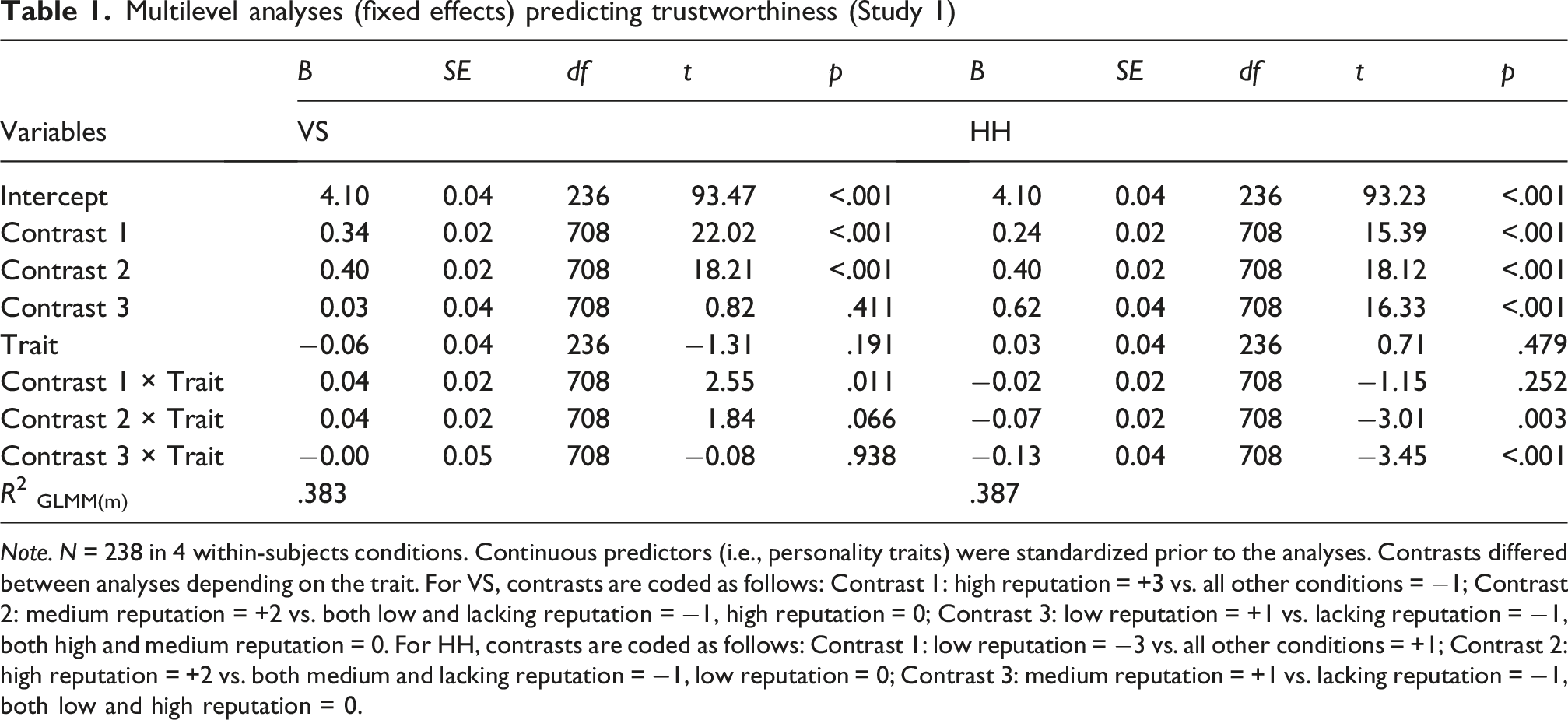
Note. N = 238 in 4 within-subjects conditions. Continuous predictors (i.e., personality traits) were standardized prior to the analyses. Contrasts differed between analyses depending on the trait. For VS, contrasts are coded as follows: Contrast 1: high reputation = +3 vs. all other conditions = −1; Contrast 2: medium reputation = +2 vs. both low and lacking reputation = −1, high reputation = 0; Contrast 3: low reputation = +1 vs. lacking reputation = −1, both high and medium reputation = 0. For HH, contrasts are coded as follows: Contrast 1: low reputation = −3 vs. all other conditions = +1; Contrast 2: high reputation = +2 vs. both medium and lacking reputation = −1, low reputation = 0; Contrast 3: medium reputation = +1 vs. lacking reputation = −1, both low and high reputation = 0.
For exploratory purposes, we re-ran the analyses including familiarity with peer-to-peer sharing platforms, age, and gender as covariates (each tested in separate models). Familiarity and gender showed no significant effects, whereas age showed a negative main effect. Importantly, these covariates did not alter the focal results (with minor differences in the model including HH). Detailed results are reported in the supplementary materials on the OSF.
Victim Sensitivity (VS)
Figure 1 (left panel) displays the interaction between reputation information and VS on trustworthiness perceptions. Consistent with Hypothesis 2, the negative relationship between VS and perceived trustworthiness was stronger for trustees with a lacking, low, or medium reputation, compared to those with a high reputation, as indicated by a significant Contrast 1 × VS interaction. All other interactions between VS and contrasts were non-significant. Simple slopes analyses further revealed that VS was significantly negatively related to trustworthiness in both the lacking-reputation condition, b = −.14, t (755) = −2.10, p = .036, and the low-reputation condition, b = −.14, t (755) = −2.20, p = .028. In contrast, VS was not significantly related to trustworthiness in the medium-reputation condition, b = −.02, t (755) = −0.25, p = .805, and in the high-reputation condition, b = .06, t (755) = 0.97, p = .333. Interactions of reputation with VS (left panel) and HH (right panel) on trustworthiness (Study 1)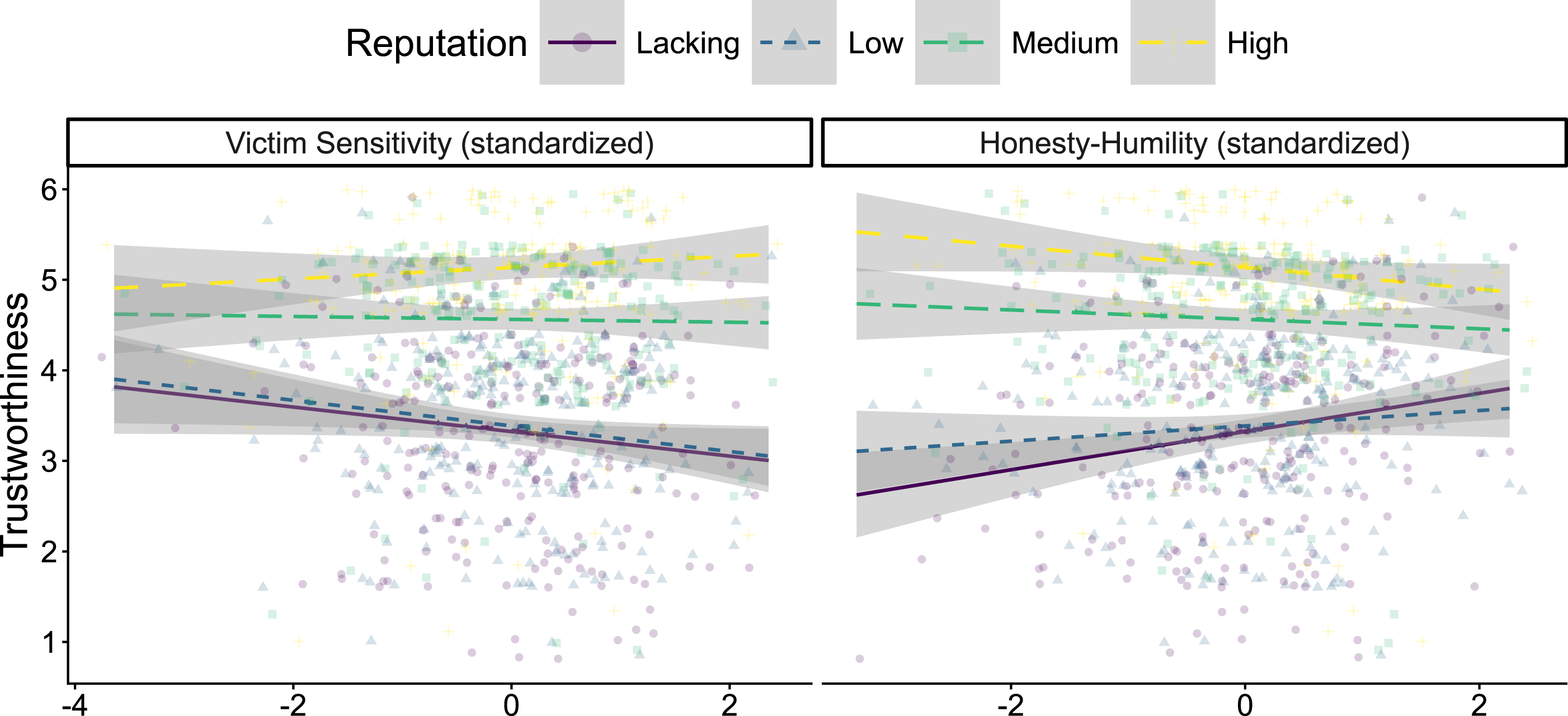
Honesty-Humility (HH)
Figure 1 (right panel) presents the interaction between reputation information and HH on trustworthiness perceptions. The interaction effect specified in Hypothesis 3 (i.e., the Contrast 1 × HH interaction) was not significant, which means that HH did not show a stronger positive relationship with trustworthiness when the reputation was lacking, medium, or high, compared to low reputation. However, both the Contrast 2 × HH and Contrast 3 × HH interactions were significant. Simple slopes analyses further revealed that HH was significantly positively related to trustworthiness in the lacking-reputation condition, b = .21, t (747) = 3.29, p = .001, but not in the low-reputation, b = .08, t (747) = 1.32, p = .187, the medium-reputation, b = −.05, t (747) = −0.81, p = .419, or the high-reputation conditions, b = −.12, t (747) = −1.85, p = .065. These results, thus, show an interaction between HH and reputation, yet the observed pattern deviated from our initial expectations.
Overall, the results of Study 1 were partially in line with our hypotheses. We found strong support for the predicted main effect of reputation information on trustworthiness perceptions: higher reputation reliably led to higher trustworthiness ratings. Beyond this main effect, VS and HH showed reputation-contingent associations with trustworthiness perceptions, although the patterns differed between traits. Specifically, trustors high in VS responded more strongly to reputation information than trustors low in VS and reacted particularly strongly to a trustee’s reputation in the lacking- and low-reputation conditions, where the negative link between VS and trustworthiness was most pronounced. Conversely, the association between HH and trustworthiness ratings differed across reputation conditions, with a stronger positive relationship in the lacking-reputation condition and unexpectedly weaker (and slightly negative) effects in the medium- and high-reputation conditions. These findings suggest that for trustees with low or lacking reputation, trustworthiness perceptions are more favorable when trustors are high in HH and low in VS, whereas trustworthiness perceptions for trustees with medium or high reputation remain relatively independent of the trustor’s HH and VS.
Study 2
Study 1 revealed patterns that were partially in line with our hypotheses. To further understand the interaction of trustor personality traits and trustee reputation, Study 2 aimed to replicate Study 1 while introducing General Trust (GT) as an additional personality trait. Additionally, we slightly changed the methodological approach by directly measuring participants’ intention to rent out their cars rather than their perceived trustworthiness. 7 Moreover, we expanded the reputation information beyond star ratings by including short verbatim comments from other customers who had interacted with the respective trustee. This adjustment served to increase ecological validity, as reputation information on peer-to-peer platforms is often communicated through both quantitative ratings and qualitative feedback. Moreover, the inclusion of comments provided participants with richer cues about the trustee’s reputation. This methodological adjustment may have altered the way reputation information was used in participants’ decisions, as the qualitative feedback could make reputation cues more salient and interpretable.
Method
Sample
We again followed a pragmatic approach for sample size planning based on funding constraints and pre-registered to collect data from N = 400 participants. Participants from the USA were recruited via Amazon’s Mechanical Turk and compensated $1.00 for their participation.
In total, 442 participants started and 401 (91%) finished the study. As pre-registered, we excluded 114 participants who did not answer all attention check questions correctly and two participants who indicated that they did not participate attentively (Meade & Craig, 2012). 8 Additionally, in line with Study 1 but again deviating from our pre-registration, we excluded one participant who gave identical responses to all HH items, despite inverted items. This resulted in a final sample of N = 284 participants (146 women; 136 men; 2 other; age range: 21–89; M = 45.62 years, SD = 13.90).
Again, based on the collected data, we conducted simulations to estimate the statistical power to detect the hypothesized interaction effects (i.e., the Contrast 1 × Trait interaction) in our multilevel models. Our final sample size allowed us to detect significant standardized interaction effects (α = .05) as small as b = .05 for both the model with VS and with HH with adequate statistical power (1−β ≥ .80). Again, further details can be found in the supplementary files on the OSF.
Measures and Procedure
The general procedure closely resembled Study 1, with minor adjustments. Participants first completed the Justice Sensitivity Inventory (including VS), followed by HH and GT in randomized order. VS (ωt = .93) and HH (ωt = .84) were measured with the same scales as in Study 1. GT was measured with the six items (ωt = .93) taken from Yamagishi and Yamagishi (1994). An example item is “Most people are trustworthy.” Responses were given on a 5-point Likert scale ranging from 1 = strongly disagree to 5 = strongly agree.
Participants were then provided with the same car-sharing scenario as in Study 1, with two modifications. First, star ratings were adjusted to provide a value with one decimal place and were accompanied by the six “most recent” verbatim comments. The high (overall 4.9/5 stars) reputation condition, for example, included a 5-star rating from a person called Sarah commenting “Everything perfect!” The medium (overall 4.1/5 stars) reputation condition included comments from reviewers ranging from three stars (Lauren: “All good.”) to five stars (Christina: “Nice and uncomplicated interaction.”), with predominantly 4-star ratings (e.g., Carl: “Everything went well, no complaints.”). The low (overall 3.2/5 stars) reputation condition included ratings ranging from two stars (Joe: “Okay.”) to four stars (Nate: “Everything was fine.”), with predominantly 3-star ratings (e.g., Kelly: “OK.”). Again, the driver in the lacking-reputation condition only included the information that they had not yet been rated. The order of conditions was again randomized. Second, instead of assessing people’s trustworthiness perceptions of the trustee, we directly asked participants to indicate their intention to rent out their car to the driver on a 6-point Likert scale ranging from 1 = no intention to 6 = strong intention.
Following this task, three attention check questions, identical to those implemented in Study 1, assessed participants’ attentiveness. Additionally, we included two open-text items to assess participants’ English proficiency and then asked whether they themselves think they participated attentively (“use-my-data” item; see Meade & Craig, 2012) before they were thanked and debriefed. All study materials are provided in the supplementary files on the OSF.
Results and Discussion
In line with Study 1, we found expected differences between conditions in participants’ intentions to trust: Participants expressed a higher intention to rent out their car to high-reputation trustees (M = 5.56, SD = 0.99), compared to medium-reputation (M = 4.77, SD = 1.21), low-reputation (M = 3.27, SD = 1.38), and lacking-reputation trustees (M = 2.64, SD = 1.52). Notably, the differences between the low- and lacking-reputation conditions were considerably larger than those observed in Study 1. Echoing the results from Study 1, trustee reputation and intention to trust were positively and significantly related according to Page’s trend test, L = 8,214.5, Z = 22.91, p < .001, rs = .78, which corroborates Hypothesis 1.
Multilevel analyses (fixed effects) predicting the intention to rent out the car (Study 2)
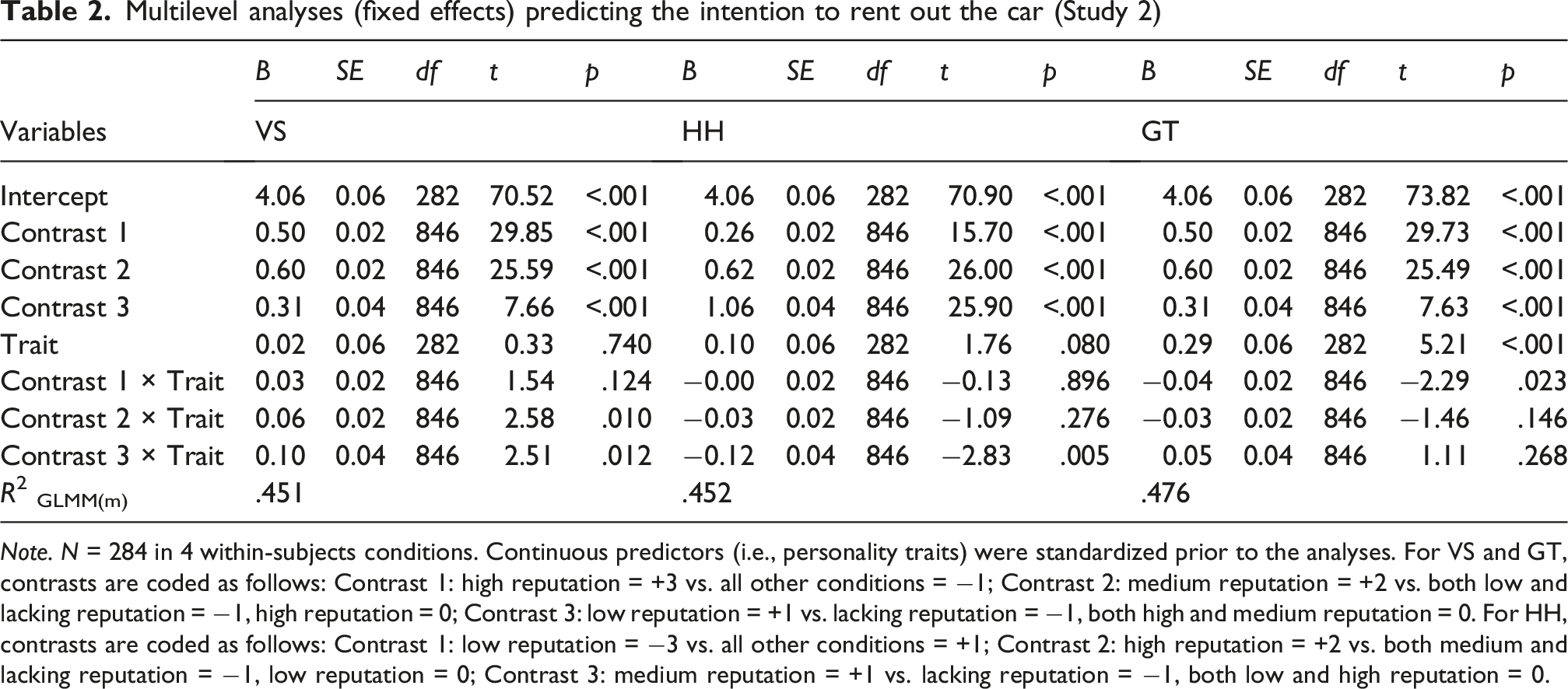
Note. N = 284 in 4 within-subjects conditions. Continuous predictors (i.e., personality traits) were standardized prior to the analyses. For VS and GT, contrasts are coded as follows: Contrast 1: high reputation = +3 vs. all other conditions = −1; Contrast 2: medium reputation = +2 vs. both low and lacking reputation = −1, high reputation = 0; Contrast 3: low reputation = +1 vs. lacking reputation = −1, both high and medium reputation = 0. For HH, contrasts are coded as follows: Contrast 1: low reputation = −3 vs. all other conditions = +1; Contrast 2: high reputation = +2 vs. both medium and lacking reputation = −1, low reputation = 0; Contrast 3: medium reputation = +1 vs. lacking reputation = −1, both low and high reputation = 0.
Again, for exploratory purposes, we re-ran the analyses including age and gender as covariates (each tested in separate models). Gender showed no significant effect, whereas age showed a positive main effect. Importantly, these covariates did not alter the focal results. Detailed results are reported in the supplementary materials on the OSF.
Victim Sensitivity (VS)
Figure 2 (left panel) illustrates the interaction between reputation information and VS on trust. Again, we found significant interaction effects between VS and reputation; however, the pattern observed in Study 2 diverged from that in Study 1 and Hypothesis 2. We hypothesized a negative association between VS and trustworthiness unless the trustee had a high (positive) reputation. This pattern was supported in Study 1. Study 2, however, revealed a negative association between VS and trust only in the lacking-reputation condition, b = −.17, t (731) = −2.23, p = .026. In the other three conditions, VS was unrelated to trust, as shown in the low-reputation, b = .04, t (731) = 0.46, p = .644, the medium-reputation, b = .12, t (731) = 1.51, p = .131, and the high-reputation condition, b = .10, t (731) = 1.26, p = .208. Consequently, the interaction term involving Contrast 1 was not significant, while interactions with both Contrasts 2 and 3 were significant (see Table 2). Thus, Hypothesis 2 was only partially supported in Study 2: The association between VS and trust did depend on reputation information, but in a different fashion than we had predicted. Interactions of reputation with VS (left panel), HH (middle panel), and GT (right panel) on intention to rent out the car (Study 2)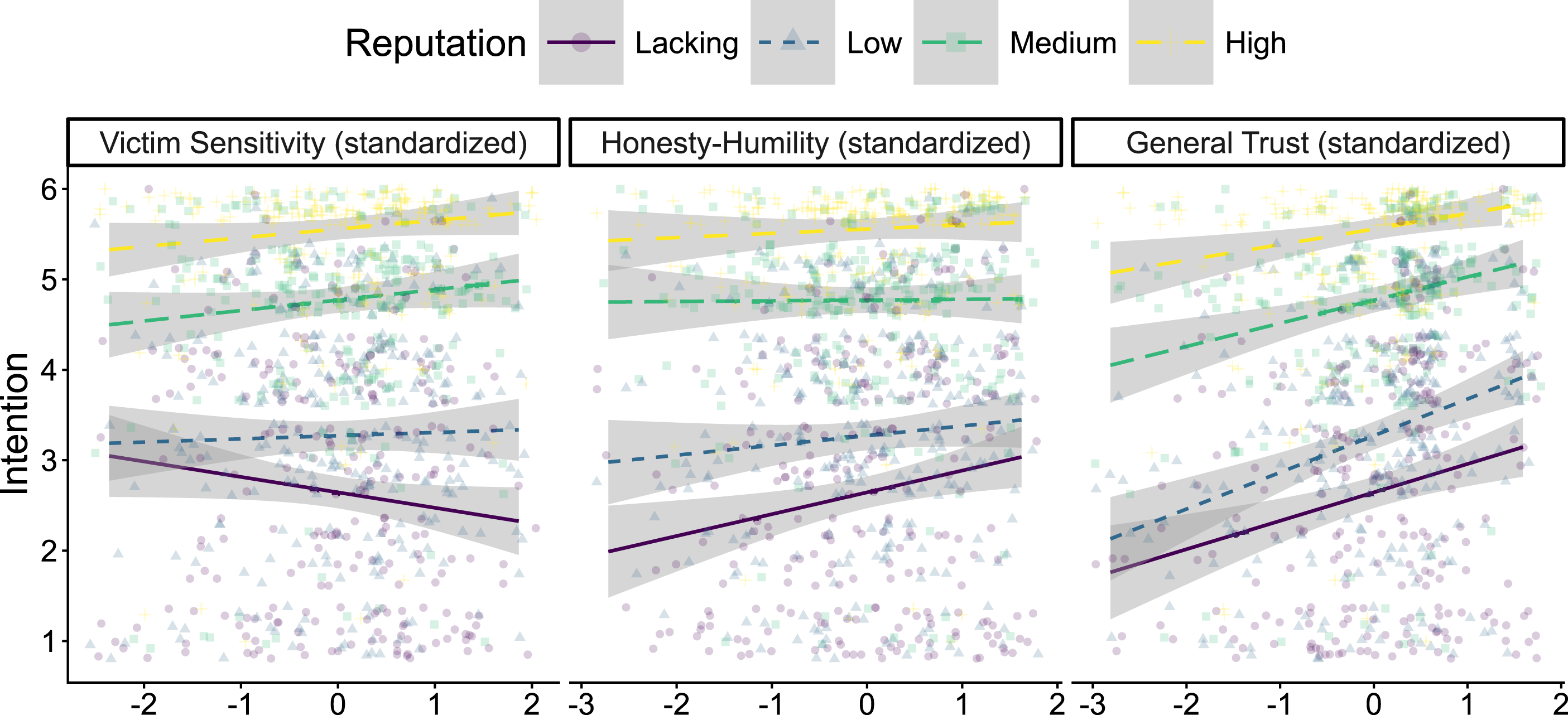
Honesty-Humility (HH)
Figure 2 (middle panel) displays the interaction between reputation information and HH on trust. Again, the relationship between HH and trust was conditional on reputation information. However, the hypothesized Contrast 1 × HH was again not significant. Additionally, results slightly deviated from those of Study 1, as only the interaction between HH and Contrast 3 (but not Contrast 2) was significant. Simple slopes analyses replicated the results of Study 1, showing a significant positive relation of HH with trust in the lacking-reputation condition, b = .24, t (738) = 3.16, p = .002, but no significant relations in the low-reputation, b = .11, t (738) = 1.41, p = .159, the medium-reputation, b = .01, t (738) = 0.11, p = .916, and the high-reputation condition, b = .05, t (738) = 0.62, p = .538. Thus, Study 2 again indicated that the relationship between HH and trust was contingent on the reputation of the trustee, although the specific patterns did not align with Hypothesis 3.
General Trust (GT)
Figure 2 (right panel) depicts the interaction between reputation information and GT on trust. As predicted (Hypothesis 4), GT showed an overall positive relationship with trust, corresponding to a significant unconditional main effect of GT on trust (see Table 2). Simple slopes analyses further revealed significant positive associations between GT and trust across all conditions: lacking reputation, b = .31, t (771) = 4.21, p < .001, low reputation, b = .41, t (771) = 5.43, p < .001, medium reputation, b = .26, t (771) = 3.43, p < .001, and high reputation, b = .17, t (771) = 2.30, p = .022. Moreover, we observed an unpredicted significant Contrast 1 × GT interaction effect, indicating that the relationship between GT and trust was stronger when reputation was lacking, low, or medium compared to when it was high.
In summary, Study 2 replicated the strong main effect of reputation observed in Study 1: participants reported higher trust intentions toward trustees with more positive reputations. Beyond this robust reputation effect, Study 2 provided further evidence that the associations between trust and VS and HH, respectively, depended on the trustee’s reputation. However, the specific patterns of these relationships did not align with Hypotheses 2 and 3 and partially deviated from Study 1 results, warranting further investigation and replication. One possible factor that may have contributed to these deviations concerns the methodological modification introduced in Study 2. In contrast to Study 1, reputation information was not limited to star ratings but was supplemented by qualitative comments from “previous interaction partners.” This addition may have reduced uncertainty by increasing the amount of information about the trustee and the diagnosticity of reputation cues, potentially altering how participants weighted reputation information in their trust decisions.
Furthermore, Study 2 included GT as an additional personality disposition relevant to trust. The data supported the hypothesized positive association between GT and trust across conditions, while revealing unexpected differences in this relationship, particularly a weaker positive association between GT and trust in the high-reputation condition compared to the other conditions (i.e., a significant Contrast 1 × GT interaction effect). This attenuation under highly positive reputation cues may reflect that strong situational signals reduce the relative impact of dispositional trust. However, given the exploratory nature of these interaction patterns, this interpretation should be considered tentative and requires further investigation.
Study 3
Studies 1 and 2 provided first evidence that the associations of VS and HH with trust are contingent on reputation information about the trustee. However, the observed patterns were only partially consistent with our hypotheses and varied between the two studies. These discrepancies may stem from methodological differences between the two studies (changes in the key dependent variable and experimental manipulation). Additionally, Study 2 offered initial insights into the role of trustors’ GT, generally supporting our corresponding hypothesis. To enhance confidence in our findings, we conducted Study 3, directly replicating the design of Study 2.
Method
Sample
We again followed a pragmatic approach for sample size planning based on funding constraints and pre-registered to collect data from N = 300 participants. This time, we recruited participants from the UK via Prolific Academic, which has been shown to yield higher data quality and lower rates of inattentive responding compared to Amazon’s Mechanical Turk (Peer et al., 2022). Correspondingly, we targeted a smaller sample than in Study 2, anticipating fewer exclusions due to the higher data quality expected. Participants received £ 1 for their participation.
Of the 318 participants who started the study, 307 (97%) completed it. As pre-registered, we excluded 63 participants who did not answer all attention check questions correctly and one participant who indicated that they did not participate attentively (Meade & Craig, 2012). 9 Additionally, we excluded one participant who failed the English proficiency check. This resulted in a final sample of N = 242 participants (174 women; 67 men; 1 other; age range: 19–78; M = 42.79 years, SD = 11.79).
Again, based on the collected data, we conducted simulations to estimate the statistical power to detect the hypothesized interaction effects (i.e., the Contrast 1 × Trait interaction) in our multilevel models. Our final sample size allowed us to detect significant standardized effects (α = .05) as small as b = .05 for both the model with VS and with HH with adequate statistical power (1−β ≥ .80). Further details can again be found in the supplementary files on the OSF.
Measures and Procedure
The procedure was identical to the one in Study 2. The internal consistency values for VS (ωt = .91), HH (ωt = .75), and GT (ωt = .89) were at least satisfactory. All study materials are provided in the supplementary files on the OSF.
Results and Discussion
Trust again differed between conditions, with the highest levels observed in the high-reputation condition (M = 5.54, SD = 0.98), followed by the medium-reputation condition (M = 4.94, SD = 1.11), the low-reputation condition (M = 3.70, SD = 1.30), and the lacking-reputation condition (M = 2.76, SD = 1.43). Again, the trustee’s reputation and intention to trust were positively and significantly related according to Page’s trend test, L = 7,009, Z = 21.36, p < .001, rs = .79, which lends once more support to Hypothesis 1.
Multilevel analyses (fixed effects) predicting the intention to rent out the car (Study 3)
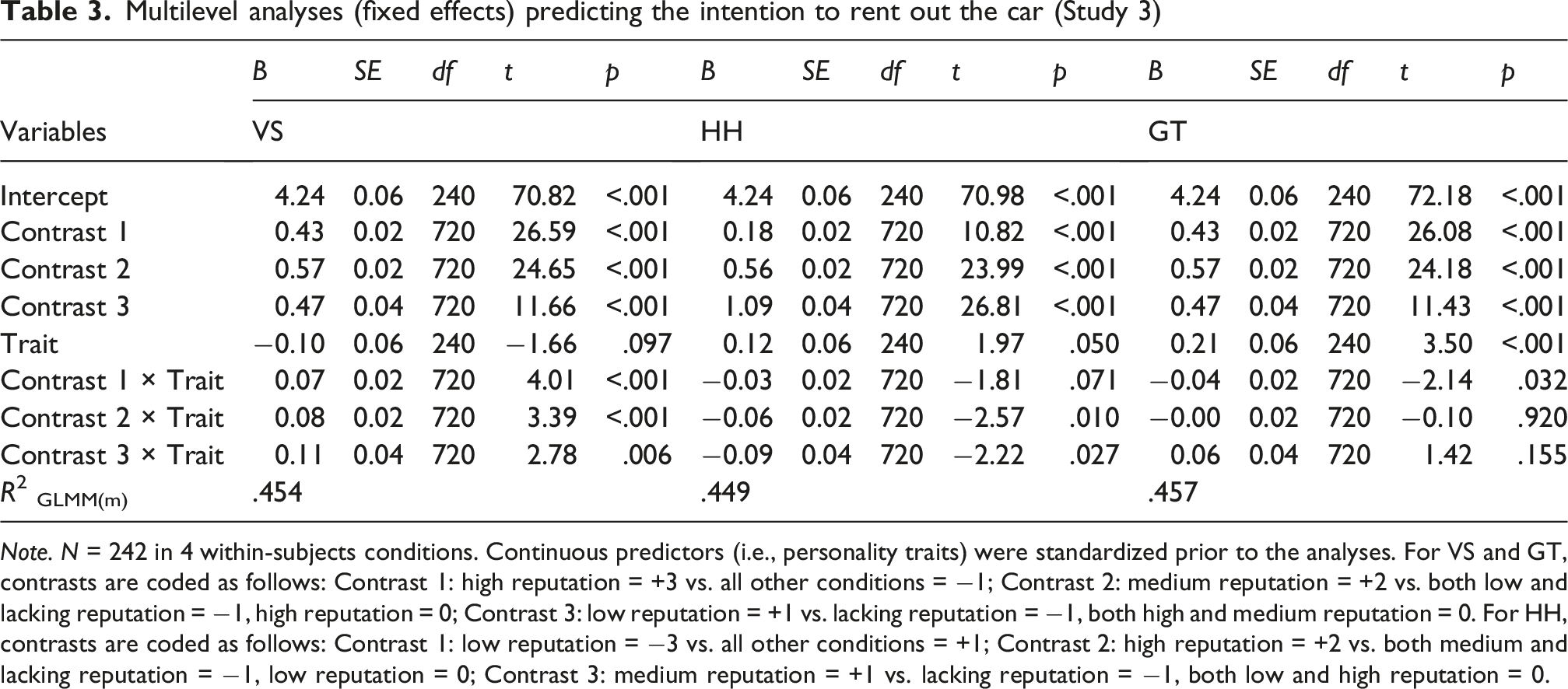
Note. N = 242 in 4 within-subjects conditions. Continuous predictors (i.e., personality traits) were standardized prior to the analyses. For VS and GT, contrasts are coded as follows: Contrast 1: high reputation = +3 vs. all other conditions = −1; Contrast 2: medium reputation = +2 vs. both low and lacking reputation = −1, high reputation = 0; Contrast 3: low reputation = +1 vs. lacking reputation = −1, both high and medium reputation = 0. For HH, contrasts are coded as follows: Contrast 1: low reputation = −3 vs. all other conditions = +1; Contrast 2: high reputation = +2 vs. both medium and lacking reputation = −1, low reputation = 0; Contrast 3: medium reputation = +1 vs. lacking reputation = −1, both low and high reputation = 0.
Again, we conducted exploratory analyses including age and gender as covariates (each tested in separate models). Gender showed no significant effect, whereas age showed a positive main effect. Importantly, the focal results remained unchanged. Detailed results are reported in the supplementary materials on the OSF.
Victim Sensitivity (VS)
Figure 3 (left panel) shows the interaction between reputation information and VS on trust. Partly in line with Hypothesis 2, the Contrast 1 × VS interaction was significant, indicating a less negative association between VS and trust in the high-reputation condition than in the other conditions. However, the full pattern did not match the hypothesis, as we also observed significant unpredicted Contrast 2 × VS and Contrast 3 × VS interactions. Simple slopes analyses revealed a significant negative relationship between VS and trust in the lacking-reputation condition, b = −.36, t (583) = −4.59, p < .001; however, VS was unrelated to trust in any of the other conditions: low reputation, b = −.13, t (583) = −1.71, p = .088, medium reputation, b = −.01, t (583) = −0.11, p = .913, and high reputation, b = .10, t (583) = 1.26, p = .209. Thus, these findings only partially align with Hypothesis 2, as we predicted significant negative associations of VS with trust in the low- and medium-reputation conditions. Interactions of reputation with VS (left panel), HH (middle panel), and GT (right panel) on intention to rent out the car (Study 3)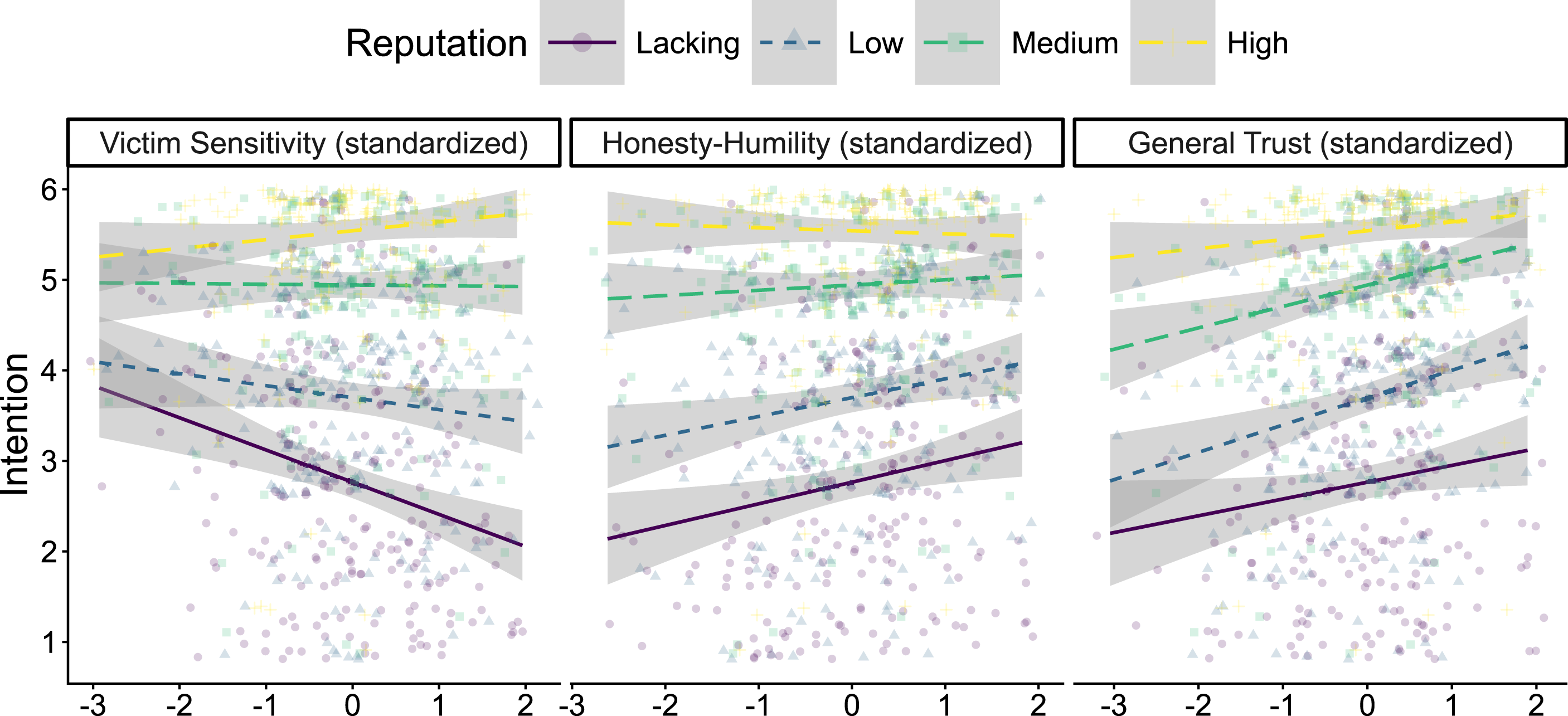
Honesty-Humility (HH)
Figure 3 (middle panel) illustrates the interaction between reputation information and HH on trust. Again, HH showed a reputation-contingent association with trust. However, as in Studies 1 and 2, the Contrast 1 × HH interaction effect was not significant, contrasting our initial predictions (Hypothesis 3). Instead, the Contrast 2 × HH and Contrast 3 × HH interaction effects were statistically significant. Simple slopes analyses resembled the findings from Studies 1 and 2, demonstrating the strongest positive relationship between HH and trust in the lacking-reputation condition, b = .24, t (594) = 3.07, p = .002. Notably, HH also exhibited a significant positive relationship with trust in the low-reputation condition, b = .21, t (594) = 2.67, p = .008; however, there was no significant association in the medium-reputation condition, b = .06, t (594) = 0.75, p = .457, and the high-reputation condition, b = −.03, t (594) = −0.42, p = .672. These results diverge from Hypothesis 3, as we anticipated weaker associations of HH with trust in the low-reputation condition compared to all other conditions.
General Trust (GT)
Figure 3 (right panel) displays the interaction between reputation information and GT on trust. As predicted in Hypothesis 4 and consistent with Study 2, GT was positively related to trust across reputation conditions, which is reflected in a strong (and significant) main effect of GT (see Table 3). Additionally, the Contrast 1 × GT interaction was significant, indicating that the relationship between GT and trust was stronger when reputation was lacking, low, or medium, compared to when it was high. This was not predicted initially but replicates the findings of Study 2. Importantly, simple slopes analyses showed that GT was significantly positively related to trust in all conditions except for the high-reputation condition: lacking reputation, b = .19, t (608) = 2.40, p = .017, low reputation, b = .30, t (608) = 3.91, p < .001, medium reputation, b = .24, t (608) = 3.06, p = .002, and high reputation, b = .10, t (608) = 1.37, p = .204.
In summary, Study 3 aimed to replicate Study 2 with a different sample. First, Study 3 again revealed a strong main effect of reputation: participants reported higher trust intentions toward trustees with more positive reputations. Beyond this, the results partially aligned with Studies 1 and 2 regarding the interplay of reputation information with VS and HH. Specifically, VS was again most strongly negatively and HH most strongly positively associated with trust in the lacking-reputation condition. However, the specific findings did not fully match the results found in Studies 1 and 2 and our initial predictions. For GT, we again observed a positive main effect on trust; however, this association was again unexpectedly weaker when reputation was high.
Study 4
The first three studies examined how trustors’ personality traits interact with trustee reputation information when evaluating potential trustees or forming intentions to trust them. However, as these studies relied on hypothetical decision scenarios, it remains unclear whether the same patterns would emerge in a situation in which not only trusting intentions, but actual trusting behavior is assessed. To address this issue, we conducted a fourth, fully incentivized behavioral study using a modified trust game paradigm (Berg et al., 1995).
In this study, participants made several trust decisions (represented by lottery tickets that determined their chances of winning gift vouchers) across interactions with several trustees. The behavioral data of these trustees originated from Ockenfels and Schier (2020), in which multiple trustees made consecutive decisions in trust games. In a separate pre-study, we asked independent participants to observe subsets of these decisions and rate each trustee’s behavior on a 5-star scale. 10 The resulting aggregated ratings served as the reputation information used in the present study; again, with four conditions (lacking, low, medium, high). One other decision of each trustee (not presented for the rating in our pre-study) was then used to determine the actual payoff outcomes of participants’ trust decisions. This procedure allowed us to match participants’ choices with real trustee behavior, thereby creating a fully incentivized design without any deception.
Method
Sample
We determined the required sample size a priori using parametric simulation with the simr package in R, exactly mirroring the planned mixed-effects analyses (i.e., contrast coding for the four reputation levels and z-standardized traits). As the smallest effect of theoretical interest, we targeted the Contrast 1 × Trait interaction and specified a population effect of b = 0.04, which roughly corresponds to the effects found in Studies 1-3. We fitted the reference model to Study 1 to obtain realistic variance components, replaced the Contrast 1 × Trait coefficient by b = 0.04, and simulated power across candidate sample sizes. Simulations (2,000 iterations; α = .05, two-sided) indicate that a power of 1−β ≥ .80 is achieved with approximately N = 300 participants. We pre-registered to collect complete data from N = 360 participants to account for potential exclusions.
Participants were recruited in Germany via university mailing lists, social media, and local participant pools. Additionally, we collected data via in-person sessions conducted under lab-like conditions during seminars. Participation took approximately 10–15 min. As an incentive, all participants had the chance to win one of ten 50€ gift vouchers based on their results in the incentivized trust game.
In total, 588 participants started the study and 438 (74%) completed it. As pre-registered, we excluded five participants who indicated that they had not participated attentively (“use-my-data” item; Meade & Craig, 2012), six participants who failed an instructed attention check embedded in the HH questionnaire, and 20 participants who answered the comprehension check questions on the trust game incorrectly more than twice. No participants had to be excluded due to lacking variance in their HH responses. The final sample thus consisted of N = 407 participants (307 women, 86 men, 14 other; age range: 18–76 years; M = 32.70, SD = 15.23). 11
Measures and Procedure
The study was conducted in German and administered online via SoSciSurvey (Leiner, 2019). After providing informed consent, participants completed the personality measures VS (ωt = .85), HH (ωt = .72), and GT (ωt = .78) in randomized order. All personality traits were measured identically to Studies 1–3 (with one minor exception that the three additional justice sensitivity subscales other than VS were measured with short two-item versions; Baumert et al., 2014).
Subsequently, participants played a series of four trust games in the role of the trustor. In each game, participants and their interaction partners received six lottery tickets, respectively. Then, they decided how many of them (0–6) to entrust to the trustee. The number of entrusted tickets served as the dependent variable and behavioral measure of trust. Entrusted tickets were tripled and transferred to the trustee, who then decided whether to share the total amount (i.e., the trustees’ endowment, the transferred and tripled number of tickets, and the trustors’ remaining tickets) equally between both players or to keep the distribution as is (Berg et al., 1995). Participants were informed that, at the end of the study, one of the four trust games would be randomly selected to determine their number of lottery tickets for the prize draw.
Before each decision, participants received information about the trustee’s reputation. Reputation was manipulated within subjects with four conditions: lacking, low, medium, and high. The specific reputation scores were based on a separate pre-study in which independent participants had observed a subset of each trustee’s previous decisions in several trust-game interactions (from Ockenfels & Schier, 2020) and rated their behavior on a 5-star scale. In the main Study 4, three trustees were selected to represent the low- (3 stars), medium- (4 stars), and high-reputation (5 stars) conditions. One trustee with no available ratings represented the lacking-reputation condition. Importantly, in this condition, participants were explicitly informed that an insufficient number of ratings was available for this trustee. To determine the actual payoff outcome for participants, their decision in the randomly selected trust game was matched with one decision (which was not shown to participants in the pre-test) of the respective trustee from Ockenfels and Schier (2020). All decisions were, thus, fully incentivized and no deception was used.
The order of the four conditions was randomized across participants. Comprehension check questions before the trust game ensured that all participants understood the trust game structure and payoff logic; participants failing these checks were asked to re-read the instructions and respond again. This procedure was repeated once. Participants who still answered incorrectly after the second attempt were excluded from the analyses. After completing all four rounds of the trust game, participants answered demographic questions (age, gender, household income) and the attentiveness item (“use-my-data”). All study materials are provided in the supplementary files on the OSF.
Results and Discussion
Trust again differed between experimental conditions. The highest levels of behavioral trust were observed in the high-reputation condition (M = 5.17, SD = 1.23), followed by the medium-reputation condition (M = 4.31, SD = 1.34). In contrast, participants entrusted the fewest tickets to trustees with a low reputation (M = 3.02, SD = 1.44) or lacking reputation (M = 3.27, SD = 1.63). Thus, while the general trend mirrored the previous studies, the low-reputation trustees elicited even less trust than those without any reputation. In line with Hypothesis 1, the trustee’s reputation was positively and significantly related to trusting behavior according to Page’s trend test, L = 11,400, Z = 21.03, p < .001, rs = .60, just as in Studies 1–3.
Multilevel analyses (fixed effects) predicting trust (Study 4)
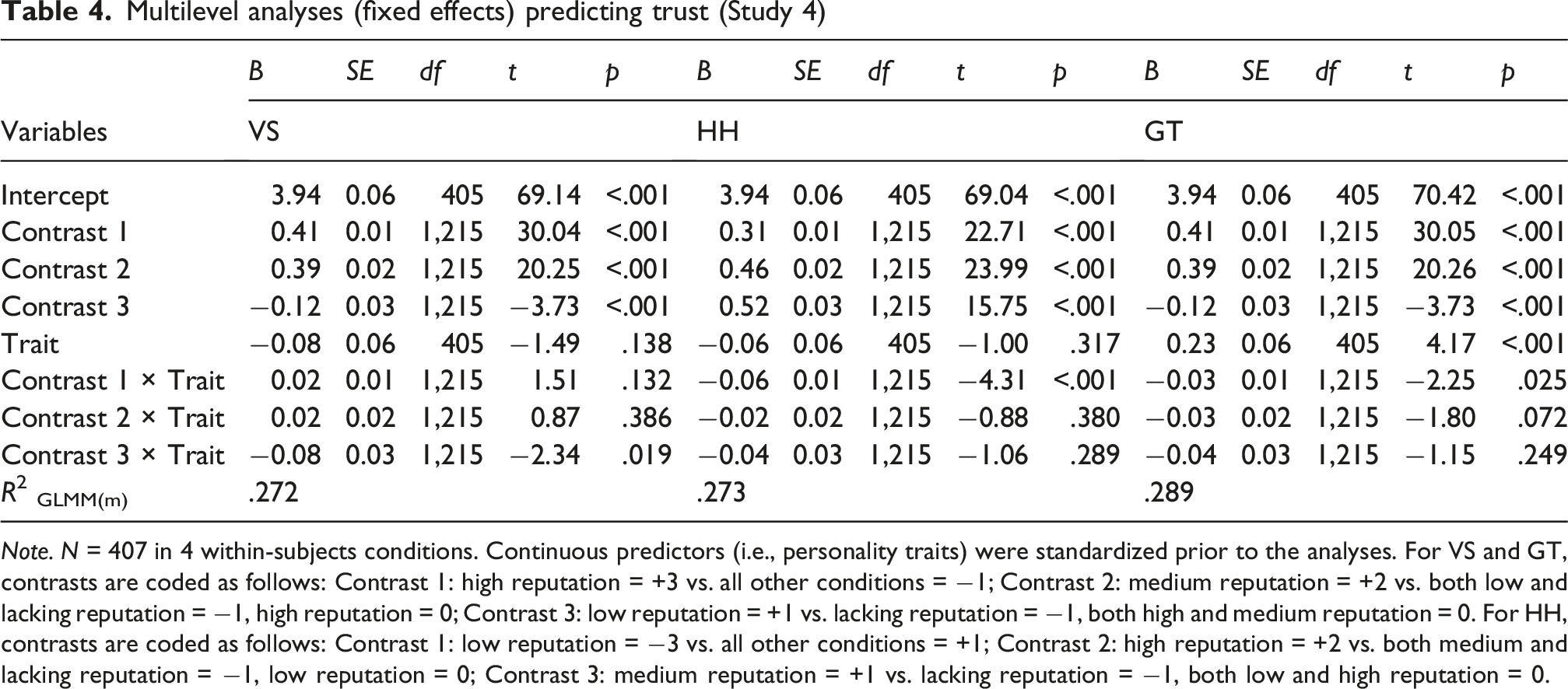
Note. N = 407 in 4 within-subjects conditions. Continuous predictors (i.e., personality traits) were standardized prior to the analyses. For VS and GT, contrasts are coded as follows: Contrast 1: high reputation = +3 vs. all other conditions = −1; Contrast 2: medium reputation = +2 vs. both low and lacking reputation = −1, high reputation = 0; Contrast 3: low reputation = +1 vs. lacking reputation = −1, both high and medium reputation = 0. For HH, contrasts are coded as follows: Contrast 1: low reputation = −3 vs. all other conditions = +1; Contrast 2: high reputation = +2 vs. both medium and lacking reputation = −1, low reputation = 0; Contrast 3: medium reputation = +1 vs. lacking reputation = −1, both low and high reputation = 0.
We additionally conducted exploratory analyses including household income, age, and gender as covariates (each tested in separate models). Income showed a negative main effect, and gender a positive effect on trust (with men reporting higher trust than women), whereas age had no effect. Importantly, these covariates did not substantively alter the focal results (with minor differences in the HH models). Detailed results are reported in the supplementary materials on the OSF.
Victim Sensitivity (VS)
As illustrated in Figure 4 (left panel), the VS × reputation interaction was again significant. However, its specific pattern deviated from both our initial prediction (Hypothesis 2) and the patterns observed in the previous studies. We had hypothesized a negative association between VS and trust, except when the trustee’s reputation was high. Descriptively, the weakest negative association between VS and trust indeed emerged in the high-reputation condition, b = −.02, t (851) = −0.33, p = .740. However, a significant negative association appeared only in the low-reputation condition, b = −.20, t (851) = −2.85, p = .005. By contrast, VS was not significantly related to trust in the lacking-reputation, b = −.04, t (851) = −0.63, p = .532, and the medium-reputation condition, b = −.07, t (851) = −1.03, p = .306. Consequently, the hypothesized interaction involving Contrast 1 was not significant, whereas the Contrast 3 × VS interaction was significant (see Table 4). Thus, Study 4 did not support the specific pattern predicted in Hypothesis 2. Although the association between VS and trust again depended on reputation information, the specific pattern differed from our expectations and from Studies 1–3. Interactions of reputation with VS (left panel), HH (middle panel), and GT (right panel) on behavioral trust (Study 4)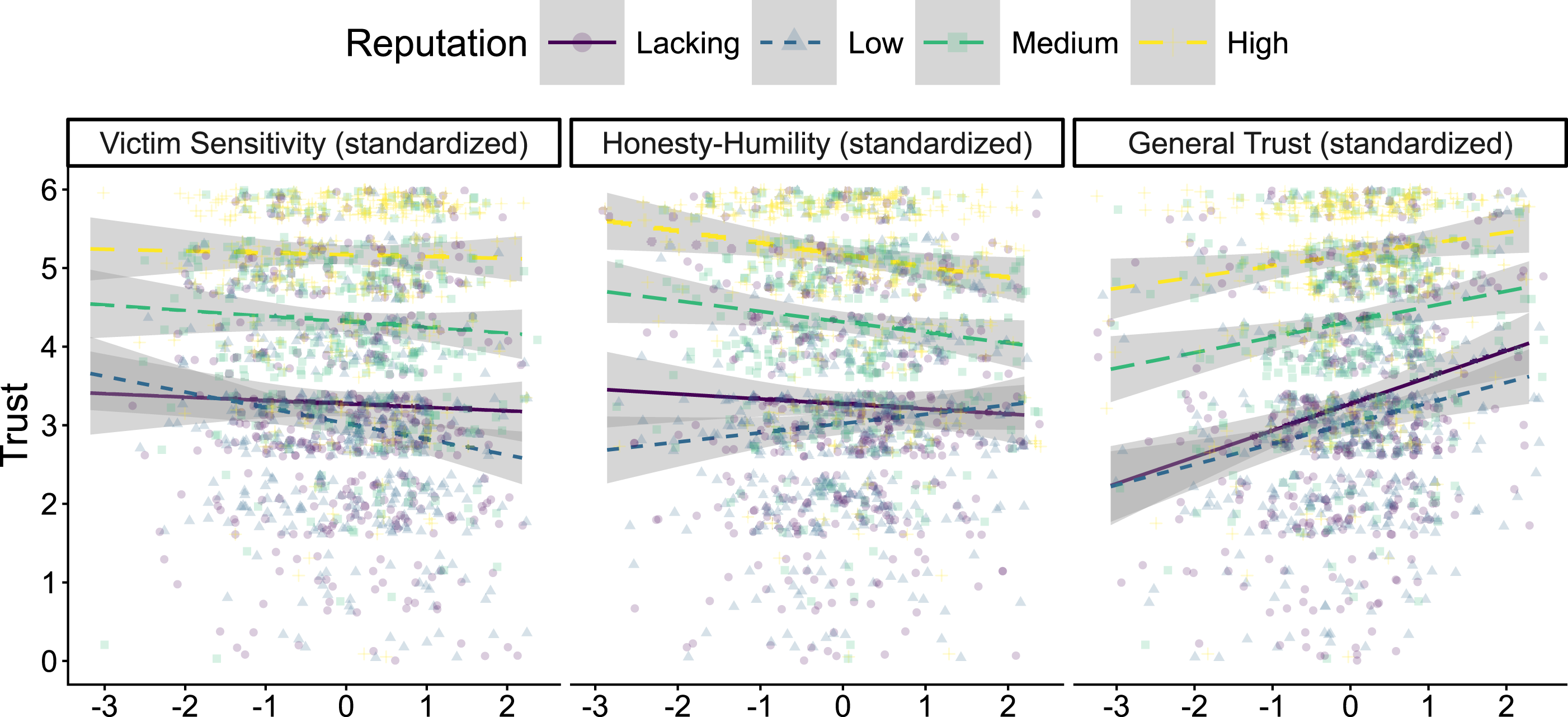
Honesty-Humility (HH)
Figure 4 (middle panel) illustrates the interaction between reputation information and HH on trust. As in the previous studies, the relationship between HH and trust was conditional on reputation information. However, the pattern diverged from our predictions (Hypothesis 3) and from the results of Studies 1–3. Specifically, the association between HH and trust was significantly negative in the high-reputation condition, b = −.15, t (845) = −2.13, p = .034, but not significant in the medium-reputation, b = −.13, t (845) = −1.91, p = .056, or in the lacking-reputation condition, b = −.06, t (845) = −0.91, p = .365. Contrary to our initial predictions but in line with Studies 1-3, HH was positively (though not significantly) related to trust in the low-reputation condition, b = .12, t (845) = 1.68, p = .094. Correspondingly, the Contrast 1 × HH interaction effect was significant (see Table 4), but in the opposite direction of the hypothesized pattern. The Contrast 2 × HH and Contrast 3 × HH interactions were not significant, contrasting with Studies 1–3. Thus, Study 4 did not support the specific pattern predicted in Hypothesis 3. Although HH again interacted with reputation information, the specific pattern differed from both the expected direction and the results obtained in Studies 1–3.
General Trust (GT)
Figure 4 (right panel) displays the interaction between reputation information and GT on trust. As predicted in Hypothesis 4 and consistent with Studies 2 and 3, GT was positively related to trust across reputation conditions, reflected in a strong and significant main effect of GT (see Table 4). Additionally, although not predicted initially but replicating the patterns observed in Studies 2 and 3, the Contrast 1 × GT interaction was significant, indicating that the positive relationship between GT and trust was stronger when reputation was lacking, low, or medium compared to when it was high. Still, simple slopes analyses showed that GT was significantly positively related to trust in all conditions: lacking reputation, b = .34, t (867) = 4.87, p < .001, low reputation, b = .26, t (867) = 3.76, p < .001, medium reputation, b = .20, t (867) = 2.82, p = .005, and high reputation, b = .14, t (867) = 2.05, p = .041. Thus, Hypothesis 4 was supported: GT showed a robust positive association with behavioral trust across all reputation levels, replicating the pattern observed in Studies 2 and 3.
In sum, Study 4 extended the previous experiments by examining actual trust behavior in a fully incentivized paradigm. Replicating the earlier findings, trustee reputation again exerted a strong influence on trust, confirming that participants’ behavioral decisions were indeed based on reputation cues. Beyond this main effect, the interactions between personality traits and reputation partly mirrored, but also diverged from those observed in Studies 1–3. On the one hand, GT was again consistently positively related to trust across reputation levels, while VS and HH interacted with reputation information. On the other hand, the specific directions and strengths of these interaction effects differed from our previous findings and initial predictions. In the General Discussion, we will summarize and discuss the commonalities and differences between the four studies in detail.
General Discussion
Three central findings emerged from the present set of studies. First, trustee reputation was consistently related to trustworthiness perceptions (Study 1), trust intentions (Studies 2 and 3), and behavioral trust (Study 4). Second, General Trust (GT) showed a robust positive association with trust across reputation conditions, suggesting a broad dispositional tendency to trust others even when reputational information varies. Third, Victim Sensitivity (VS) and Honesty-Humility (HH) showed reputation-contingent associations with trust, although the precise configuration of these interactions varied across studies and provided only partial, inconsistent support for the originally predicted patterns. In the following, we first discuss the robust findings regarding reputation and GT and then turn to the reputation-contingent but less stable associations involving VS and HH.
Robust Main Effects of Reputation and General Trust
Across all four studies, trustee reputation showed a robust and substantial association with trust, consistent with our theorizing and a large body of prior literature (e.g., Kuen et al., 2023; ter Huurne et al., 2017). Higher reputation reliably increased perceived trustworthiness, trust intentions, and trusting behavior. This pattern confirms that differences in perceived reputation meaningfully influence people’s willingness to rely on others.
Looking at personality traits, we found that GT was consistently positively associated with trust across all studies. This finding aligns with meta-analytic evidence showing that GT is related to trust and cooperation across a wide range of social dilemma contexts (Balliet & Van Lange, 2013). Notably, although the association between GT and trust remained positive across our reputation conditions, it was attenuated when the trustee had a highly positive reputation. This pattern is consistent with situational strength perspectives (Cooper & Withey, 2009), suggesting that dispositional differences may exert a weaker influence when situational cues strongly constrain behavior. In the present studies, this implies that in the high-reputation condition, where situational cues strongly signaled trustworthiness, participants were generally inclined to trust, leaving less room for interindividual differences in GT to further increase trust. Nevertheless, GT appears to reflect a broad baseline tendency to trust that remains positive even when reputational information varies.
Reputation-Contingent Trait Associations
The present findings suggest that personality traits differ in how strongly their associations with trust depend on reputation cues. While GT showed a relatively robust association with trust across reputation conditions, the associations of VS and HH with trust were more clearly reputation-contingent. Importantly, however, the exact form and direction of these trait × reputation interactions varied across studies.
VS was negatively associated with trust mainly when reputation information about the target was lacking (an effect that occurred in Studies 1–3) or low (Studies 1 and 4), that is, situations that may signal elevated or uncertain exploitation risk. By contrast, VS was generally unrelated to trust when the target’s reputation was relatively positive (i.e., in the medium- and high-reputation conditions). This pattern suggests that VS may be negatively related to trust when reputational cues leave room for uncertainty, whereas more positive reputation may attenuate VS-related distrust.
This interpretation is compatible with previous findings suggesting that victim-sensitive individuals have a strong tendency to distrust interaction partners when information about them is lacking, a pattern described as a “schema-consistent guessing bias” among people high in VS (Süssenbach et al., 2016). It is also compatible with the idea that VS reflects a heightened vigilance toward potential exploitation (e.g., Gollwitzer et al., 2013; Köhler & Gollwitzer, 2024) and a dispositional fear of being exploited by others, which may be relatively robust and difficult to dispel (e.g., by situational cues; Köhler et al., 2024; Köhler & Gollwitzer, 2024; Nuding et al., 2025). However, victim-sensitive individuals are not generally unwilling to trust others, but may require clearer or less ambiguous cues indicating low exploitation risk (Maltese et al., 2016). Importantly, given the inconsistent patterns observed across studies, the present findings do not allow for precise conclusions about the threshold at which positive reputation cues attenuate VS-related distrust.
A different pattern emerged for HH. In Studies 1–3, HH was positively associated with trust most clearly when reputation information was absent, whereas in Study 4, this positive association was descriptively most evident under explicitly low reputation. Thus, one possible interpretation is that, in contrast to VS, individuals high in HH appear to have a strong tendency to trust their interaction partners. This tendency may make individuals high in HH, as compared to individuals low in HH, more willing to trust others when reputational information leaves room for benevolent assumptions. In line with this interpretation, the absence of reputation was particularly ambiguous in Studies 1–3 (we discuss this in more detail below), where HH exhibited the strongest positive association with trust. In Study 4, however, this condition was less ambiguous, and the association between HH and trust was no longer observed. This interpretation is compatible with prior research suggesting that individuals high in HH tend to project their own cooperativeness onto others, particularly when situational information leaves room for interpretation (Pfattheicher & Böhm, 2018; Thielmann & Hilbig, 2014). However, because the HH patterns varied across studies, this interpretation should be treated as tentative.
Notably, across studies, HH was only weakly (and in some cases negatively) associated with trust in the medium- and high-reputation conditions. One might speculate that the attenuated association under high reputation reflects situational strength, similar to the attenuation observed for GT under high reputation (see above). However, this interpretation remains post hoc and should be examined directly in future research. Moreover, the weak and sometimes negative associations under positive reputation cues deviate from prior findings that suggest a generally positive association between HH and trust (Thielmann & Hilbig, 2014). Taken together, the HH findings are best interpreted as evidence that the association between HH and trust is reputation-contingent, but that the exact form of this contingency remains unsettled.
Understanding Cross-Study Variability
The variability in the precise configuration of the investigated trait × reputation interactions warrants careful consideration. The following explanations may be seen as plausible post hoc interpretations of this variability and as hypotheses for future research. Across studies, differences in measurement (trustworthiness perceptions, intentions, and incentivized behavior), in the richness of reputation information, in the ambiguity of lacking reputation, and in whether decisions were hypothetical or incentivized may have influenced how participants interpreted and responded to reputational cues. Such contextual differences could have affected the perceived diagnosticity of reputation levels and, consequently, the degree to which dispositional tendencies shaped trust responses.
For instance, in Studies 1–3, the absence of ratings in the lacking reputation condition was left unexplained and may have been interpreted as potentially suspicious, as missing reputation is perceived as a strategic behavior in reputation systems (Wibral, 2015). By contrast, in Study 4, the absence of ratings was explicitly attributed to an insufficient number of prior evaluations. Similarly, the inclusion of qualitative comments in Studies 2 and 3 may have rendered reputation cues more concrete than star ratings alone. In the incentivized paradigm of Study 4, decisions additionally carried tangible consequences.
These contextual nuances may help explain why the specific interaction patterns for VS and HH were not identical across studies. However, because these features varied across studies rather than being experimentally isolated, the present data cannot determine which of these factors explains the observed cross-study variability. Future research should systematically manipulate these contextual features to examine when and how dispositional differences (e.g., in VS and HH) interact with reputation information in shaping trust decisions.
Theoretical and Practical Implications
The present findings contribute to trust research by integrating dispositional and situational perspectives in a differentiated manner. While prior work has often examined trustee characteristics (e.g., reputation) or trustor traits in isolation, the present research suggests that trust decisions reflect an interplay between trustee reputation and trustor personality traits. Reputation is a central mechanism through which trust is maintained in social and digital environments (Wu et al., 2021), yet its psychological impact partly depends on the person evaluating it.
More specifically, the distinction between traits showing relatively general associations with trust and traits showing more reputation-contingent associations refines existing person × situation frameworks in trust research (e.g., Thielmann & Hilbig, 2014). However, future research is needed to examine whether the present findings generalize beyond formal rating systems. Informal reputation transmission, such as through gossip and social information exchange, likewise affects trust and cooperation (Dores Cruz et al., 2021) and may interact with personality traits in similar ways.
The present findings also bear practical relevance for digital platforms and other environments in which reputation systems are used to facilitate trust and cooperation among strangers. While reputation information clearly structures trust decisions, its impact is not psychologically uniform: Individuals differ in how strongly they respond to reputational cues and may also differ in how they interpret ambiguous or mixed signals. This suggests that reputation systems may influence users differently depending on dispositional tendencies. Although platforms most likely cannot tailor systems to individual personality traits directly, recognizing variability in cue responsiveness may inform the design of complementary trust-building mechanisms, such as identity verification procedures, structured feedback formats, or additional transparency features.
Limitations and Future Directions
Several limitations of the present research should be acknowledged. First, all studies relied on non-representative convenience samples from Western, educated, industrialized, rich, and democratic (WEIRD) contexts. Although additional robustness analyses, including age, gender (in all studies), and economic status (in Study 4), did not substantially alter the focal trait × reputation patterns, the generalizability of the findings to other cultural or socio-economic contexts remains an open question.
Second, reputation was operationalized through star ratings (with and without qualitative comments) and experimentally manipulated across four discrete levels. While this approach closely mirrors many real-world platform designs, reputation systems vary widely in format and complexity. Different representations of feedback (e.g., numerical probabilities, narrative descriptions, aggregated behavioral statistics) may differ in perceived diagnosticity and could interact differently with personality traits. Systematically varying reputation formats would help clarify how dispositional tendencies influence the use of trustworthiness cues.
Third, the use of within-subject designs may have heightened participants’ awareness of the manipulated reputation levels. Although such designs offer important advantages (e.g., increased statistical power), they may also amplify contrast effects or demand characteristics. Replications using between-subjects designs would therefore provide additional evidence for the generalizability of the observed associations.
Lastly, several contextual features varied across studies but were not experimentally isolated, including the dependent variable, the richness and format of reputation information, the ambiguity of lacking reputation, and whether decisions were hypothetical or incentivized. We discussed these features as plausible explanations for cross-study variability, but the present design does not allow us to identify them as causal boundary conditions. Future research should manipulate these features systematically to clarify how VS and HH are associated with trust under different reputation conditions.
Conclusion
Across four pre-registered studies, trustee reputation reliably affected trust, and GT showed a general positive association with trust. In contrast, VS and HH showed reputation-contingent associations with trust, but the precise forms of these interactions varied across studies and should not be interpreted as stable evidence for the originally predicted patterns. Taken together, these findings highlight that understanding trust requires integrating person and situation perspectives, recognizing not only whether people trust, but how they use available cues when deciding to do so.
Footnotes
Ethical Considerations
All studies adhered to the Ethical Guidelines of the American Psychological Association (APA) and the German Psychological Society (DGPs). Ethics approval by institutional review boards or committees is not mandatory in Germany if a study fully discloses all information regarding the study to participants and is unlikely to cause harm, stress, or any other form of negative affect exceeding an “everyday experience” level. None of this was the case for the present studies; therefore, no official ethics approval had to be obtained. We did not deceive participants in any of the studies. Participants gave their informed consent by selecting a checkbox at the beginning of the study.
Funding
The authors disclosed receipt of the following financial support for the research, authorship, and/or publication of this article: The first author was supported by the German Federal Ministry of Education and Research (BMBF; now: Federal Ministry of Research, Technology, and Space) and the Free State of Bavaria under the Excellence Strategy of the Federal Government and the States. The funding source was not involved in the study design, the collection, analysis, and interpretation of data, the writing of this manuscript, or the decision to submit the article for publication. We have no conflicts of interest to disclose.
Declaration of Conflicting Interests
The authors declared no potential conflicts of interest with respect to the research, authorship, and/or publication of this article.
Open Science Statement
All of the studies reported in this manuscript were pre-registered (Study 1: https://aspredicted.org/Q4K_HHF; Study 2: https://aspredicted.org/V7M_ZST; Study 3: https://aspredicted.org/CHC_FWD; Study 4: https://aspredicted.org/uk9fm6.pdf) and all pre-registrations included the study design, a pre-planned stopping rule, and inclusion/exclusion criteria. Planned analyses were not detailed in the pre-registrations due to space limits of the aspredicted.org pre-registration platform. Across studies, we explored trait × reputation interactions using a consistent analytical framework. All study materials, data, codebooks, and analysis scripts necessary to reproduce the reported results are openly available on the Open Science Framework ( ).
).