






Abstract
Background:
Adherence to Baby Friendly Initiative (BFI) practices is low in Canadian hospitals, despite evidence showing a positive impact of BFI practices on breastfeeding rates and duration. In 2012, the provincial Ontario Ministry of Health and Long Term Care added BFI status to its progress indicators for Public Health Units, which are now required to begin BFI implementation.
Objective:
This study aims to explore health care workers’ self-reported knowledge of the BFI and their perceptions of the importance of its components.
Methods:
A questionnaire was electronically sent to 2237 employees working at our institution.
Results:
Questionnaires were completed by 651 participants, of which 110 (16.9%) and 87 (13.5%) participants reported having good knowledge of the BFI and the Ten Steps to Successful Breastfeeding, respectively. Multiple logistic regression showed that having children and having received formal breastfeeding education were associated with higher self-reported knowledge. Additionally, 481 (75%) participants reported that it was important or very important to them that the institution adopt the BFI. Having children and being an allied health professional were associated with perceiving the implementation of the BFI as important.
Conclusion:
The results of our study have allowed us to identify potential barriers to implementation of the BFI, which can be targeted through system changes and staff education. Through this approach, we hope to facilitate acceptance of the BFI at our institution and increase support for optimal breastfeeding practices among our patients.
Keywords
Well Established
The Baby Friendly Initiative (BFI), a Canadian adaptation of the WHO/UNICEF Baby-Friendly Hospital Initiative, is known to have a positive impact on breastfeeding rates and duration. Yet adherence to BFI practices is low in Canadian hospitals.
Newly Expressed
We identified specific barriers to the BFI implementation in a tertiary care centre, including a lack of staff education and fear of stigmatizing women who do not breastfeed. Targeting these barriers may result in greater acceptance of the BFI.
Background
Human milk is the normal and ideal form of nutrition for newborns, while breastfeeding also benefits mothers. Exclusive breastfeeding should be protected, promoted, and supported for the first six months after birth. 1 As such, the World Health Organization (WHO) and United Nations Children’s Fund (UNICEF) developed the “Ten Steps to Successful Breastfeeding” in 1989. 2 This document, together with the Innocenti Declaration 3 and the WHO International Code of Marketing of Breastmilk Substitutes, 4 serves as the basis for the Baby-Friendly Hospital Initiative (BFHI), launched in 1991.
The Baby Friendly Initiative (BFI) is a Canadian adaptation of the WHO/UNICEF’s BHFI and was launched in Canada in 1998. 5 Reflecting a continuum of care from the hospital to the community, the BFI is “an integrated approach for hospitals and community health services … and provides ten evidence-based steps to optimally support maternal-child health for all mothers and babies” (p. 3) (Table 1). 5 However, adherence to BFI practices is low in Canada 6 despite a significant amount of evidence demonstrating the positive impact of the initiative on breastfeeding rates and duration.7-11
WHO Ten Steps to Successful Breastfeeding and Integrated Ten Steps Practice Outcome Indicators.

In 2012, the Ontario Ministry of Health and Long Term Care invested $2.5 million in a Baby Friendly Initiative Implementation Strategy to enhance breastfeeding in Ontario, by supporting hospitals and community health services to adopt Baby-Friendly best practices, through the development of tools and educational resources. 12 As a leading children’s hospital, the Children’s Hospital of Eastern Ontario (CHEO) is embarking on the first steps of BFI implementation. To ensure that the implementation is as successful as possible, we sought to determine CHEO employees’ (a) self-reported knowledge with regards to the BFI and (b) perceptions of the importance of various components of the BFI, so as to explore how receptive employees were to the BFI implementation. To our knowledge, this is the first study to specifically assess staff’s individual BFI perceptions prior to institutional implementation.
Methods
Design
We used a cross-sectional survey of all CHEO paid employees who have any type of contact with patients and families in order to reach employees who have the potential to interact with breastfeeding infants and their families. The CHEO Research Ethics Board approved this study. Although a qualitative component was not intended at the onset of the study, multiple participants sent unsolicited comments on breastfeeding perceptions and personal breastfeeding experiences to the principal investigator via e-mail after completing the survey. Research Ethics Board permission to analyze those comments was granted.
Setting
CHEO, located in Ottawa, Ontario, Canada, is a tertiary care stand-alone pediatric institution. While CHEO does not offer maternity services, it does have a level 3 neonatal intensive care unit. In Ontario, the BFI has been recognized by the Ministry of Health and Long-Term Care as a priority, and all hospitals and community health services providing care for newborns and infants are encouraged to adopt the BFI 12 to support and promote breastfeeding in this vulnerable population.
Sample
All CHEO paid employees who have an internal CHEO e-mail address and who have contact with patients and families were approached. This included pediatricians, emergency physicians, surgeons, anesthesiologists, physician trainees, pediatric medicine and surgical nurses, operating room and emergency department nurses, allied health professionals (physiotherapists, speech and language pathologists, respiratory therapists, social workers, psychologists, genetics counselors, audiologists), unit clerks, crisis intervention workers, and technologists. We also included employees in management or leadership positions, regardless of clinical contact. An electronic invitation outlining the study purpose, the intended use of data, and informed consent information was sent to all eligible employees, with a link to the online questionnaire. Two follow-up e-mails with the survey link were sent at two-week intervals to remind potential participants about the opportunity to complete the questionnaire. No sample size was calculated, as this was a sample of convenience, and a power analysis was not conducted.
An electronic invitation to participate in our questionnaire was sent to 2237 employees. Seventy-four e-mails bounced back (26 had full mailboxes, 48 had nonfunctioning e-mail addresses), for a total of 2163 invitations successfully delivered. The response rate was 30%, with 651 participants returning completed questionnaires
Data Collection / Survey Instrument
As there was no existing tool in the literature assessing individuals’ perceptions of the importance of various steps of the BFI, the study team developed the survey instrument (Appendix 1). Questions were developed based on elements from the Ten Steps to Successful Breastfeeding, 2 which form the basis of the BFI. In order to discriminate among respondents and to ensure adequate reliability of responses, at least three survey items were developed to answer each research question. 13 Thirty-five CHEO employees representing a cross-section of various disciplines piloted the survey for clarity and length. The survey was revised based on their feedback. The final instrument consisted of 28 multiple-choice questions covering two main domains: (a) self-reported knowledge (n = 3) and (b) perception of importance of various aspects of the BFI (n = 16), as well as demographics. All questions were given equal weight for scoring purposes.
Data Analysis
Quantitative Analysis
Descriptive statistics were used to summarize the survey respondents’ demographic characteristics, self-reported knowledge, and perceptions of importance of various BFI components. For discrete variables, frequencies and percentages were reported. The results were based on “valid” survey responses such that missing data (unanswered items) were excluded from analyses. A chi-square test for trend was conducted in order to assess whether self-reported knowledge was associated with perception of importance of implementation of the BFI. Overall knowledge of the BFI was defined as self-reported “knowledge of the BFI” (question 1 on the questionnaire). The 5-point Likert-type scale used in the questionnaire was collapsed to form a 3-point Likert-type scale with “poor,” “fair,” and “good” categories, which were then used as the outcome for the ordinal logistic regression. Overall perceived relevance of the BFI implementation was defined as “perceived importance that CHEO implement the Baby-Friendly Initiative” (question 18 of the questionnaire). The four questionnaire categories (“not important,” “somewhat important,” “important,” and “very important”) were used as the outcome for the ordinal logistic regression. Multivariate ordinal logistic regression was used to identify demographic factors independently associated with knowledge of the BFI and perceived relevance of the BFI implementation. Due to their conceptual importance, all demographic factors including gender, age, having children, formal breastfeeding education, years of service, and profession were included in the multivariate models regardless of statistical significance. Missing data were handled using list-wise deletion (deletion of cases where data were missing on one or more variables) in the logistic regression models. The assumption of proportional odds was tested for both models in order to ensure that treating the outcome as ordinal was appropriate. Results are reported as odds ratios with 95 percent confidence intervals. Two-sided p values less than 0.05 were considered statistically significant. All statistical analyses were performed using SPSS 23.0 (SPSS Inc., Chicago, IL).
Qualitative Analysis
A conventional qualitative content analysis 14 was used to analyze the data from the comments. Coding was developed inductively (from the data content) as opposed to employing a predefined coding scheme. A trained qualitative analyst independently coded the transcripts following an initial process of data familiarization. 15 Analyses followed an initial process of open coding, in which comments were coded at the unit of meaning level (either words, phrases, or sentences), followed by a process of integration in which codes were grouped into themes or constructs based on underlying issues or content around which the individual codes grouped. 16 Codes were developed using the constant comparison method; codes were generated and compared within and across cases and then revised, combined, or separated in light of new data and emerging themes. 16
Results
Demographic characteristics of survey participants are described in Table 2.
Demographics of Quantitative Survey Participants (N = 651).
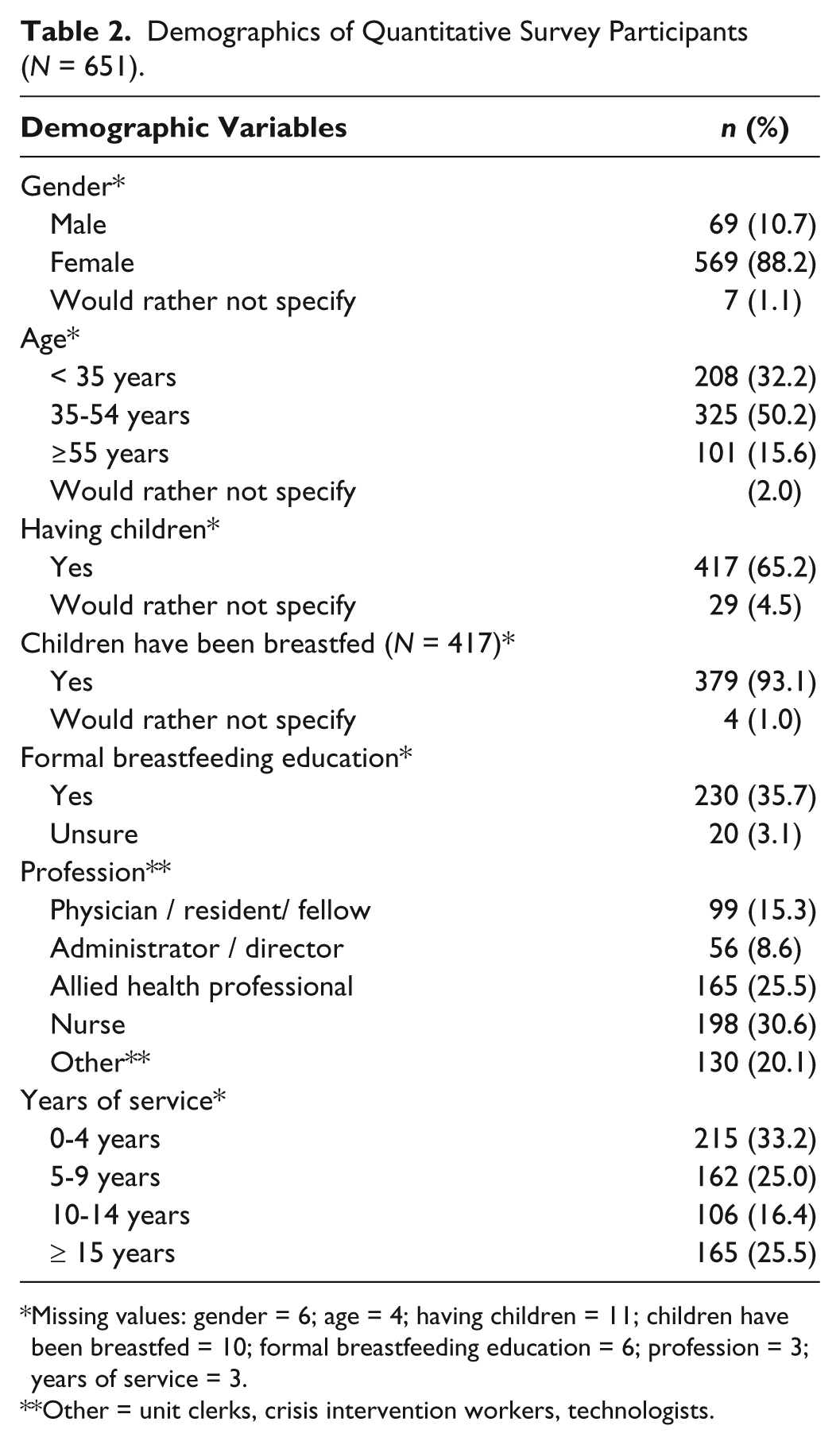
Missing values: gender = 6; age = 4; having children = 11; children have been breastfed = 10; formal breastfeeding education = 6; profession = 3; years of service = 3.
Other = unit clerks, crisis intervention workers, technologists.
Survey results with regards to our two research aims, self-reported knowledge with regards to the BFI and perceptions of the importance of various components of the BFI, are described below.
Self-Reported Knowledge with Regards to the BFI
Table 3 summarizes the self-reported knowledge of CHEO employees with regards to the BFI. Univariate testing demonstrated that self-reported knowledge of the BFI was highly associated with higher perception of the importance of implementation of the BFI (p < 0.001). Table 4 presents the results of the multivariate ordinal logistic regression, which identified demographic factors associated with self-reported knowledge of the BFI.
Self-Reported Knowledge of CHEO Employees with Regards to the BFI (N = 651).
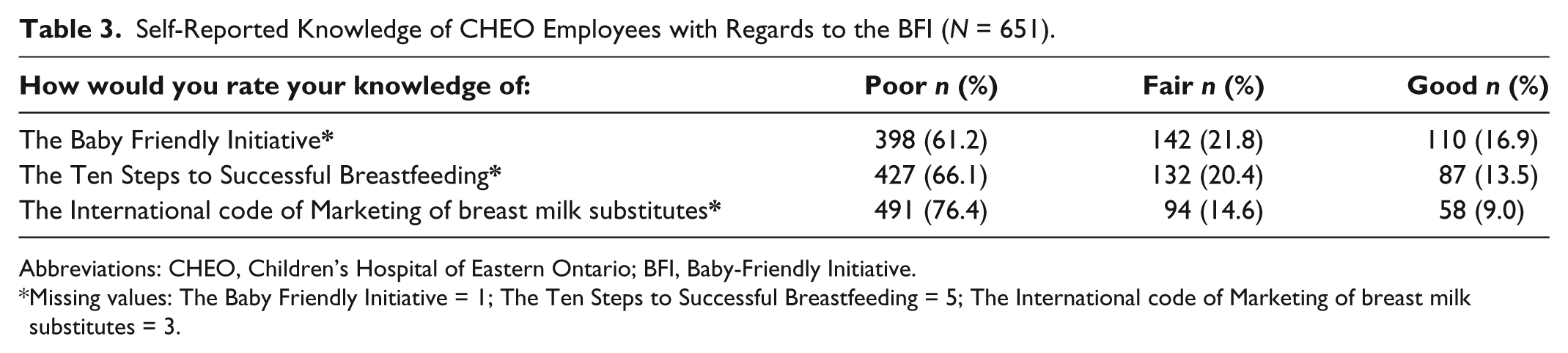
Abbreviations: CHEO, Children’s Hospital of Eastern Ontario; BFI, Baby-Friendly Initiative.
Missing values: The Baby Friendly Initiative = 1; The Ten Steps to Successful Breastfeeding = 5; The International code of Marketing of breast milk substitutes = 3.
Multivariate Ordinal Logistic Regression Analysis of Self-Reported Knowledge of the BFI on Demographic variables (N = 457).

Abbreviations: CI, confidence interval; OR, odds ratio.
p < 0.05.
Perceptions of the Importance of Various Components of the BFI
Table 5 summarizes the results of participants’ perceptions with respect to various components of the BFI. Multivariate ordinal logistic regression identified several demographic factors associated with perceived relevance of the BFI implementation. Respondents who had children were more likely to assign higher importance level ratings for adopting the BFI than respondents who did not have children (OR = 2.03; 95% CI = 1.27-3.27). Allied health professionals were more likely to assign higher importance level ratings for adopting the BFI than nurses (OR = 1.55; 95% CI = 1.01-2.37). There was no statistically significant relationship between gender, age, formal breastfeeding education, years of service, and perceived relevance of implementing the BFI.
Participants’ Perceptions of Various Aspects of the Baby-Friendly Initiative: Content Analysis Results (N = 651).

Missing values: CHEO has a breastfeeding policy = 4; breastfeeding policy be communicated = 7; you receive training = 4; CHEO personnel receive training = 3; benefits of breastfeeding be discussed with mothers = 7; benefits of breastfeeding be discussed with families = 2; CHEO provide education to mothers and families = 3; physicians be able to support breastfeeding mothers = 5; nurses be able to support breastfeeding mothers = 3; mothers be helped to maintain breastfeeding = 6; allow breastfeeding mothers and infants to remain together = 5; CHEO help establish peer or professional breastfeeding support groups = 14; CHEO purchase formula at market price = 4; CHEO adopt the Baby Friendly Initiative = 12.
Qualitative Results
Sixteen participants (0.2% of survey respondents) sent unsolicited electronic comments to the principal investigator. Participants reflected on the BFI and breastfeeding generally, from both professional and personal perspectives, indicating the socially entrenched nature of breastfeeding and how this socialized nature permeates professional practice. Comments ranged in terms of length and scope, with participants expressing support for the BFI, but also indicating areas of concerns regarding breastfeeding advocacy. Notably, comments were not specific to the implementation of the BFI per se but rather related to breastfeeding promotion. Individual codes pertained to the language used, consent, relationships between providers and family members, notions of responsibility, support, as well as the physical environment. When codes were thematically grouped, a dominant theme was the need to be aware of context when promoting breastfeeding. This was associated with a number of minor themes including responsibility, support, and the role that the physical environment plays in breastfeeding.
Context
An overarching theme reflected in the majority of the comments was the need to adapt to the specific context in which breastfeeding promotion is applied. Specifically, respondents felt there should be a distinction between the context of the acute-care hospital setting, where mothers and children often have more complex health needs, and the maternity hospital or the general population setting. The importance of respecting individual patient contexts, which may sometimes preclude breastfeeding, was also emphasized.
“Maintaining breastfeeding within the context of illness takes great time and expertise. Unlike birth hospitals […], these babies have touchpoints at various locations. […] That makes for the need for different strategies for success vs a unit in a birth hospital.” #03 “I support a breastfeeding initiative in general, but as you know there are certain conditions where breastfeeding in NOT recommended […]” #07.
Responsibility
Comments regarding responsibility reflected views on parental responsibility, and also questions on roles and responsibilities of the hospital staff, and those of the hospital as an institution.
“[…] it was hard to be in a room of breastfeeding moms or to hear the talk about it. I felt that I had to defend my decision and yet it wasn’t a conversation I wanted to have with others. It’s a sensitive subject and I hope your initiative delivers the message of the importance of breastfeeding without minimizing those moms who choose to formula feed. We all want what is best for our children.” #16
Half of the comments received discussed the social pressure to breastfeed and the potential for parents to be stigmatized if they could not, or chose not to, breastfeed.
“In my 15 years of supporting breastfeeding mothers, I have met many different moms, many different babies in the NICU with many different needs than the general baby population … I just would like to stress the importance of not forgetting that some mothers cannot breastfeed for the safety of their children (chronic addiction issues or HIV infection, etc.) and also that some babies have difficult medical needs that make the breastfeeding introduction slower, longer but nevertheless possible (hence the need for more specialized knowledge and more support for moms, i.e. support for pumping etc.).” #11
Ultimately, these comments represented a tension between doing the best for their individual patients, taking into account their individual circumstances, and promoting best practice and a provincially supported population health program:
“If we are truly about supporting children, youth, and their families, we should be doing exactly that rather than forcing our own agendas upon them.” #13
Support
In large part, this derived from respondents’ perceived responsibilities as members of the clinical team. Their roles are to provide social and emotional support to parents but also to provide an education and physical environment that supports them, irrespective of their decisions about breastfeeding decision.
“I fully support the BFI as long as I don’t hear staff saying ‘breast is best’ to our patients, and when our families can be given non-judgmental nutritional advice once they have made the decision not to breastfeed.” #10
Discussion
We found that, although most survey participants self-assessed their knowledge of the BFI as poor, the majority of them were supportive of adopting the BFI at the institution, suggesting that the CHEO employees who participated in our study recognized the importance of promoting and supporting exclusive breastfeeding practices. However, poor knowledge is concerning, as previous studies have shown that it may negatively impact the implementation of breastfeeding support initiatives.17,18
It is troubling to note that while 75% of survey participants felt it would be important or very important to implement the BFI at CHEO, only slightly more than one-third of respondents felt it would be important or very important that all CHEO personnel receive breastfeeding training. This challenges Step 2 of the BFI, which states the need to ensure that all health care providers have the knowledge and skills necessary to implement the breastfeeding policy, specifically that “the manager shows records of orientation of all health care providers, volunteers and staff to the breastfeeding policy and attendance at breastfeeding education programs” (p. 4). 19 Although CHEO does not provide maternity services, it provides care to a large number of infants in multiple settings, including clinics, the emergency department, inpatient wards, and the neonatal intensive care units, highlighting the need for health care providers to be supportive of breastfeeding in various areas of the hospital.
Not surprisingly, over three quarters of respondents felt uncomfortable or very uncomfortable with the institution purchasing formula at market price. To comply fully with the BFI, an institution must pay fair market price for all formula and infant feeding supplies that it uses. 20 Given the current economic climate, this could be a limitation in the implementation of the BFI. However, experience from other centers has demonstrated that this obstacle is not insurmountable. 20 By implementing the Ten Steps, the number of breastfeeding mothers is expected to increase, and the amount of formula needed will diminish. In addition, formula is likely to be used less liberally if acquired by the hospital at market price.
In keeping with other studies, previous breastfeeding education is associated with improved knowledge of baby-friendly initiatives. 21 Interestingly, our results showed that self-reported knowledge of the BFI was highly associated with higher perception of the importance of its implementation, suggesting that breastfeeding education may result in higher acceptance of the BFI. In our study, having children was positively associated with both self-reported knowledge of the BFI and the perception of the importance of BFI implementation. This is not surprising as personal experiences with breastfeeding are known to impact health care practices. 22 We did not find an association between age or years of service and perception of the importance of BFI implementation. This contrasts with other studies showing that resistance to implementation of baby-friendly practices is often related to length of service, with younger and/or less experienced staff more amenable to change.18,22,23 This may be because our questionnaire was exploring the idea of BFI implementation as opposed to assessing practices.
Previous studies have also reported that occupation is a predicting factor for acceptance of baby-friendly initiatives, with physicians’ practices being most difficult to change. 22 In our study, there was no difference in physicians’ perception of the importance of BFI as compared to nurses, which is reassuring as physician support is known to significantly impact breastfeeding rates and duration.24-26 Being an allied health professional (physiotherapist, speech and language pathologist, respiratory therapist, social worker, psychologist, genetic counselor, audiologist), however, was positively associated with the perception of importance of the baby-friendly initiative. This is an important finding as it identifies a group of potential supporters and leaders of the BFI, who may act as champions as we move towards implementing the BFI.
Comments from the qualitative analysis emphasized the need for the institution to acknowledge the infrequent situations where breastfeeding is not indicated. People also voiced concerns around the stigma associated with not breastfeeding, recognizing the importance of not shaming women who choose not to or cannot breastfeed, and supporting all mothers, no matter what their method of feeding is. These comments, while coming from a very small sample of participants, echo the dilemma reported in other studies21,23,27 where, while the importance of breastfeeding is recognized, there is a worry that the BFI is “forcing” women into breastfeeding. People also feel a tension between their own personal breastfeeding experiences and the steps outlined by the BFI. 22 Although the comments cited were from a very small group of survey respondents, they represent a very real fear of the BFI, one that needs to be addressed for implementation to be successful. On the one hand, they underscore a lack of knowledge with regards to the BFI, since both the BFI and BFHI support and emphasize the importance of giving all mothers the feeding support they need, including the promotion of skin-to-skin care to promote optimal parent-infant relationships, regardless of feeding methods,19,28 but they are also a powerful reminder that the establishment of a supportive, inclusive, and respectful environment is critical for the successful uptake of the initiative.
Study limitations include a low overall response rate. However, a response rate of 30% is typical for organizational surveys of employees. 29 In addition, surveys in health care environments, such as the ones targeted in this study, often have low response rates due to high workload demands. 30 Employees with an interest in breastfeeding were probably more likely to complete the questionnaire, and therefore our sampled population may not be representative of all CHEO employees. However, employees with an interest in breastfeeding would be expected to have better knowledge and potentially more positive perceptions with regards to the BFI. There was also a clear gender bias in our respondents, which is partly representative of the gender of CHEO’s staff but could also raise the possibility that women have a greater interest in breastfeeding in general. Additionally, as there was no plan at study onset to collect open-ended comments from participants, the responses reflect the views of a very small group, who, for personal or professional reasons, felt very strongly about the BFI. Finally, although the survey instrument was piloted and reviewed, psychometric testing was not performed. Currently, no such questionnaire on individuals’ perceptions with regards to the BFI exists in the literature.
Conclusion
Key factors known to affect the success of the implementation of baby-friendly practices include availability of human and financial resources to carry out the Ten Steps, a well-coordinated change in management strategy including multidisciplinary involvement and motivated and credible leaders, open communication, and a flexible approach. 21 Implementing baby-friendly initiatives is a complex and multifaceted process, 31 as a number of social, cultural, and contextual barriers must be addressed. 18 The results of our study have allowed us to identify some of these barriers, which can be targeted through system changes and staff education, while emphasizing the importance of fostering a supportive and nonthreatening environment for all mothers, regardless of feeding choices. Through this approach, we hope to facilitate acceptance of the BFI at our institution and provide increased support for optimal breastfeeding practices to our patients.
Footnotes
Appendix
Acknowledgements
The authors would like to acknowledge the CHEO Research Institute for providing in-kind statistical analysis support for this study.
Declaration of Conflicting Interests
The authors declared no potential conflicts of interest with respect to the research, authorship, and/or publication of this article.
Funding
The authors received no financial support for the research, authorship, and/or publication of this article.