






Abstract
Background:
Previous breastfeeding experience has been associated with subsequent infant feeding practices. However, few longitudinal studies have investigated formula-only feeding patterns or the full range of potentially associated characteristics.
Objective:
This study aimed to determine the recurrence of infant feeding practices and maternal, birthing, and infant characteristics associated with recurrent formula-only feeding and changes between exclusive breastfeeding and formula-only feeding across subsequent births.
Methods:
We conducted a population-based record-linkage study of 317 027 mothers, with a term singleton live-birth in 2007-2011, New South Wales, Australia. Infant feeding patterns were described using sequential birth pairs. For mothers with a first and second birth, robust Poisson regression was used to investigate the association between maternal, birthing, and infant characteristics and infant feeding patterns. Combined relative risks (RRs) were calculated for selected maternal characteristics.
Results:
Across 69 994 sequential birth pairs, the recurrence rate of formula-only feeding was 71%, and 92% for exclusive breastfeeding. Maternal characteristics < 25 years old, being Australian born or single, smoking during pregnancy, and living in lower socioeconomic areas were most strongly associated with repeat formula-only feeding (RR, 22.1; 95% confidence interval [CI], 18.6-26.3), changing from exclusive breastfeeding to formula-only feeding (RR, 9.0; 95% CI, 7.4-10.7), and being less likely to change from formula-only feeding to exclusive breastfeeding (RR, 0.47; 95% CI, 0.38-0.59).
Conclusion:
Infant feeding practices were strongly recurrent, highlighting the importance of successful breastfeeding for first-time mothers. Additional support for young mothers from disadvantaged backgrounds accounting for infant feeding history, experiences, and common barriers could improve recurrent exclusive breastfeeding and positively affect infant and maternal health.
Well Established
Studies of breastfeeding patterns in mothers over subsequent births have suggested strong recurrence of infant feeding practices. Targeted support for first-time mothers is important for improving exclusive breastfeeding rates, and any additional support should acknowledge any previous infant feeding history.
Newly Expressed
Exclusive breastfeeding and formula-only feeding were both strongly recurrent, with minimal changes between them across subsequent births. Additional specialized breastfeeding information and support for first-time, young, disadvantaged, single mothers may reduce recurrent formula-only feeding, improving breastfeeding rates and infant outcomes.
Background
International guidelines recommend exclusive breastfeeding for all infants in the first 6 months of life with nutritional benefits and protection against infections and disease compared to their formula-only counterparts.1-4 There are also health benefits for the mother, such as a reduced risk of myocardial infarction, diabetes, and cancer in later life.5,6 Furthermore, breastfeeding initiation in the first few days of life is important for ensuring sustained breastfeeding. Breastfeeding initiation in Australia (92%) is generally higher than in the United States, United Kingdom, Canada, and New Zealand, and lower than in Nordic countries.7,8 There exists a vast literature describing the maternal sociodemographic, infant, health, institutional, and cultural characteristics associated with breastfeeding initiation, duration, and exclusivity.9-14 However, one of the most important and consistently identified characteristics was previous infant feeding experience, although few studies were based on longitudinal data.15-17
Modeling infant feeding patterns across consecutive births is important for understanding the relative contributions of maternal versus previous or current birthing and infant characteristics. This cannot be determined from cross-sectional studies and is important information for breastfeeding promotion strategies. Studies highlight that successful breastfeeding in the first birth was associated with subsequent breastfeeding initiation and success.15,16 Furthermore, mothers who did not attempt or had unsuccessful breastfeeding in their first birth were unlikely to initiate breastfeeding in subsequent births. 16 The only large population-based longitudinal study of exclusive breastfeeding demonstrated recurrence that varied by ethnicity and immigrant status and recommended policies advocating additional support specifically for these mothers in their first birth. 17 However, these studies have only been able to investigate limited characteristics due to a lack of either information or power and typically focus on a single infant feeding pattern.15-17
Further research using large studies is needed to better identify potential maternal, birthing, and infant characteristics associated with specific infant feeding patterns, such as recurrent formula-only feeding or changes between exclusive breastfeeding and formula feeding across subsequent births. The aims of this study were to (1) describe infant feeding patterns across subsequent births, (2) investigate maternal, birthing, and infant characteristics associated with recurrent formula-only feeding across subsequent births, and (3) investigate maternal, birthing, and infant characteristics associated with formula-only feeding patterns across subsequent births.
Methods
Design, Setting, and Sample
We used a population-based record-linkage cohort study to investigate infant feeding patterns across subsequent births. The cohort was identified using statewide anonymous administrative birth records for New South Wales (NSW), Australia, from 2007 to 2011. New South Wales is the largest state in Australia with more than 7 million people representing more than one third of the Australian population and of all births. 18 In Australia, most mothers choose hospital care for pregnancy and birth, and 28% occur in private hospitals. 18 Ethical approval was obtained from the NSW Population and Health Services Research Ethics Committee.
The study population included all term (≥ 37 weeks gestation) singleton live births. Exclusions from the study population were preterm or multiple births, infants with major congenital conditions, 19 home births, and births to mothers with any severe maternal morbidity. Severe maternal morbidity was defined according to a validated composite indicator of adverse maternal health events. 20 This indicator includes morbid events, such as acute cardiovascular events, major anesthetic complications, or postprocedural complications, and morbid procedures, such as transfusions, hysterectomy, or mechanical ventilation. The study sample included 69 994 mothers with sequential birth pairs, of which 43 701 were first (parity 0) and second (parity 1) birth pairs (Figure 1).

Occurrence and Recurrence of Infant Feeding at Discharge among Mothers with a First and Second Birth.
Data Sources
The NSW Perinatal Data Collection (PDC) is a statewide population-based surveillance system of all live births and stillbirths of ≥ 20 weeks gestation or, if gestational age is unknown, ≥ 400 grams birth weight. The PDC has data about maternal, pregnancy, labor and delivery characteristics, and infant outcomes. This information was entered into electronic hospital databases by the attending midwife or doctor at hospital-based bookings or admissions during the pregnancy, birth, and postnatal periods. The NSW Admitted Patient Data Collection (APDC) is a statewide collection of all inpatient admissions to any public or private hospital in NSW. The APDC has data about patient demographics, the treating hospital, medical conditions, and procedures. Information from each admission was recorded in medical records or entered into electronic hospital databases by treating staff. Medical conditions and procedures were coded after discharge by expert clinical coders according to the 10th revision of the International Classification of Disease, Australian Modification, and the Australian Classification of Health Interventions. Previous validation studies have found that perinatal information recorded in these databases is accurate and reliable.21-23 Probabilistic record linkage of the PDC and APDC was performed by the NSW Centre for Health Record Linkage using established and reliable methods, with 98.1% of records linked.24,25
Measurement
Infant feeding status at discharge from birth care was obtained from 3 tick-box categories: “breastfeeding,” “expressed breast milk,” or “infant formula” recorded in the birth record, where more than 1 type can be reported. Based on these, we defined 2 measures of infant feeding status: (1) exclusive breastfeeding (EBF), indicated by a recording of “breastfeeding” or “expressed breast milk” but not “infant formula,” and (2) formula-only feeding (FOF), indicated by a recording of only “infant formula.”
Maternal characteristics available in the datasets and examined in the study included age, parity, timing of first antenatal care visit, country of birth, married or de-facto (unmarried couple living together on a regular basis) relationship status, interpregnancy interval (time between the first and second dates of birth minus the second infant’s gestational age), smoking during pregnancy, diabetes (gestational or pre-existing), hypertensive disorders of pregnancy, and socioeconomic status. The Australian Bureau of Statistics Index of Education and Occupation was used to create socioeconomic quintiles based on the Statistical Local Area of residence. 26 This index is an average relative measure of education and occupation for each Statistical Local Area based on the occupation, education or qualifications, and employment status of residents. 27 Birthing characteristics included vaginal birth or cesarean section (by labor onset), labor induction/augmentation by oxytocics, type of intrapartum analgesia, care type (private or public hospital by private insurance status), hospital location (rural/regional vs urban), tertiary hospital, and Baby-Friendly Hospital Initiative (BFHI) accreditation. Infant characteristics included gestational age (reported in completed weeks as determined by the best clinical estimate, including early ultrasound and last menstrual period), 5 minute Apgar score, admission to a special care nursery (SCN) or neonatal intensive care unit (NICU), birth weight for gestational age and gender using Australian population percentiles, 28 and birth admission length of stay.
Data Analysis
First, we briefly described the proportion and trends in FOF and EBF for the study population. Then, to address the first study aim, we identified all mothers in the study population with sequential birth pairs during the study period. Infant feeding patterns across the first and second births were described (number and percentage). For our second aim, we investigated characteristics associated with recurrent FOF in first and second births by using multivariable logistic regression to compare these mothers with those who had exclusively breastfed in their first and second births. For the third aim, to assess patterns of change between first and second births, we performed 2 separate analyses. The first was mothers who exclusively breastfed in their first birth and fed only formula in their second birth compared with those who exclusively breastfed in their first and second births. The second was the converse, that is, mothers who fed only formula in their first birth and exclusively breastfed in their second birth compared with mothers who fed only formula in their first and second births.
For aims 2 and 3, multivariable logistic regression models with progressive backward elimination were used to identify significantly (P value < .05) associated characteristics. Each final model was then re-fit using a robust multivariable Poisson model to obtain adjusted relative risks. 29 For each of the final logistic regression models, a combined analysis for a group of selected maternal characteristics was used to obtain combined adjusted risk estimates. This required estimating the expected proportion of mothers with the outcome assuming that all mothers in the study population were “exposed” and then “unexposed” with respect to the combination of characteristics. These expected proportions were then used to calculate a risk difference and relative risk, with bootstrapping used to obtain 95% bias-corrected confidence intervals (CIs) for all estimates. 30 Analyses were performed in SAS 9.3 (SAS Institute) and Stata IC 13 (StataCorp).
For the selected study population, a small number of characteristics had missing information ranging from < 0.01% to 0.25% of records, except for weeks gestation at first antenatal visit, which was 1.5%. As the total number of records with any missing information was only 2.2%, these were excluded and a complete case analysis performed. 31
Results
In NSW between 2007 and 2011, there were 388 854 liveborn term singleton infants without major congenital conditions born in hospital to 317 027 mothers without severe maternal morbidity. The proportion of exclusively breastfed infants was 82.8%, whereas 11.3% were fed only formula. Between 2007 and 2011, EBF rates increased from 81.9% to 84.3% (chi-square trend test P value < .001), whereas FOF rates declined from 12.2% to 10.1% (chi-square trend test P value < .001).
Infant Feeding Practices across Subsequent Births
Overall, there were 69 994 mothers with sequential birth pairs. Among mothers with a first and second birth (parity 0 and 1; n = 43 701, 62% of all pairs), 86.5% exclusively breastfed for the first time in their first birth and 28.6% exclusively breastfed (for the first time) in their second birth. In comparison, the first occurrence of FOF was 7.3% for the first birth and 5.1% for the second. The remaining 6.3% of mothers (n = 2739) had both formula and breastfeeding recorded in their first birth. Among mothers who exclusively breastfed their first born infants, 92% of their second born infants were also exclusively breastfed, whereas for mothers with FOF in their first birth, 66% of second born infants were also fed only formula (Figure 1). Among mothers with both formula feeding and breastfeeding in their first birth, 65.6% had exclusively breastfed in their second birth, whereas 16.3% had fed only formula. A comparison of recurrent feeding infant practices for higher order birth pairs revealed increasing rates of recurrent FOF for parity (1,2) (74%) and (2,3) (79%) birth pairs (Table 1). The recurrence of EBF was similar across all sequential birth pairs (92%).
Changes in Infant Feeding Status at Discharge According to Parity between Sequential Births.

Abbreviations: EBF, exclusive breastfeeding; FOF, formula-only feeding.
Not-FOF and not-EBF include all those births with partial breastfeeding recorded at discharge from birth care.
Includes all sequential birth pairs, for example, parity (0,1), (1,2), (2,3), and so on.
Characteristics Associated with Recurrent Infant Feeding Practices
Table 2 presents a comparison of the maternal characteristics between mothers who fed only formula for their first and second births and mothers who exclusively breastfed for their first and second births. Maternal characteristics including living in areas with lower education/occupation quintiles, being Australian born, being single, smoking during pregnancy, and young maternal age (< 25 years) were significantly associated with recurrent FOF. In addition, birthing characteristics associated with an increased risk of recurrent FOF included prelabor cesarean section (adjusted relative risk [aRR] = 1.72; 95% CI, 1.41-2.10), general (aRR = 1.53; 95% CI, 1.20-1.95) or epidural (aRR = 1.65; 95% CI, 1.46-1.87) intrapartum analgesia, and birth in a private hospital (aRR = 1.33; 95% CI, 1.17-1.52). Giving birth in a rural or regional hospital (aRR = 0.80; 95% CI, 0.73-0.89) or BFHI accreditation (aRR = 0.80; 95% CI, 0.67-0.95) reduced the risk of recurrent FOF. Having an infant who was born early-term (37-38 weeks gestation, aRR = 1.17; 95% CI, 1.06-1.29) or admitted to a SCN/NICU (aRR = 1.17; 95% CI, 1.03-1.33) increased the risk of recurrent FOF. Detailed information for birthing and infant characteristics can be found in Supplementary Table 1.
First Birth Maternal Characteristics Associated with Recurrent Formula-Only Feeding at Discharge among Mothers with a First and Second Birth.
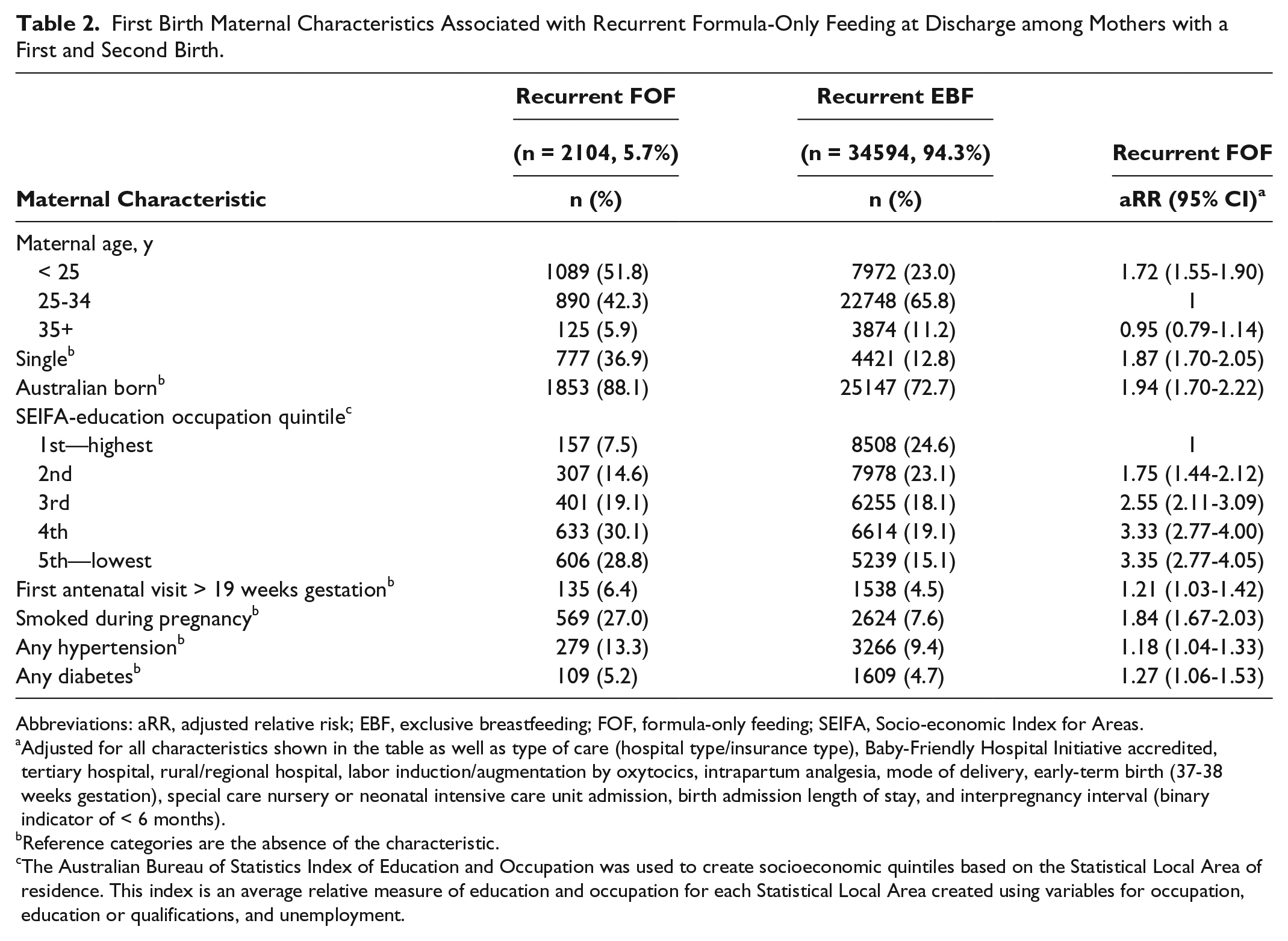
Abbreviations: aRR, adjusted relative risk; EBF, exclusive breastfeeding; FOF, formula-only feeding; SEIFA, Socio-economic Index for Areas.
Adjusted for all characteristics shown in the table as well as type of care (hospital type/insurance type), Baby-Friendly Hospital Initiative accredited, tertiary hospital, rural/regional hospital, labor induction/augmentation by oxytocics, intrapartum analgesia, mode of delivery, early-term birth (37-38 weeks gestation), special care nursery or neonatal intensive care unit admission, birth admission length of stay, and interpregnancy interval (binary indicator of < 6 months).
Reference categories are the absence of the characteristic.
The Australian Bureau of Statistics Index of Education and Occupation was used to create socioeconomic quintiles based on the Statistical Local Area of residence. This index is an average relative measure of education and occupation for each Statistical Local Area created using variables for occupation, education or qualifications, and unemployment.
Characteristics Associated with Changes in Infant Feeding Practices
Changing from FOF to EBF (n = 912, 28.6%) was more likely to occur than changing from EBF to FOF (n = 1915, 5.1%), although the second group of mothers was twice as large (Figure 1). The proportion of mothers who changed from EBF to FOF or FOF to EBF by maternal characteristics is presented in Table 3. Maternal characteristics significantly associated with an increased risk of changing from EBF in the first birth to FOF in the second included living in areas with lower education/occupation quintiles, smoking during pregnancy, young maternal age (< 25 years), being Australian born, and being single. Among mothers with EBF in their first birth, an increased risk of FOF in the second birth was also associated with birthing characteristics, including birth in private hospital (aRR = 1.23; 95% CI, 1.09-1.38); labor induction/augmentation by oxytocics (aRR = 1.23; 95% CI, 1.09-1.39); general (aRR = 1.93; 95% CI, 1.46-2.54), epidural (aRR = 1.52; 95% CI, 1.33-1.74), or spinal (aRR = 1.66; 95% CI, 1.35-2.04) intrapartum analgesia; and prelabor cesarean section (aRR = 1.23; 95% CI, 1.01-1.51). Among mothers with FOF in their first birth, maternal characteristics significantly associated with a reduced rate of changing to EBF in their second birth included being Australian born or single, smoking during pregnancy, and young maternal age (< 25 years). The only birthing characteristic associated with a decreased risk of changing to EBF in the second birth was prelabor cesarean section (aRR = 0.77; 95% CI, 0.67-0.89). For both changes in infant feeding between the first and second births, no significant associations were found with second birth infant characteristics (early-term birth, SCN/NICU admission, 5 minute Apgar score < 7, small or large weight for gestational age). Detailed information for birthing and infant characteristics can be found in Supplementary Table 2.
Second Birth Maternal Characteristics Associated with Changes in Infant Feeding among Mothers with a First and Second Birth.

Abbreviations: aRR, adjusted relative risk; EBF, exclusive breastfeeding; FOF, formula-only feeding; ns, nonsignificant in the final model due to P value > .05; SEIFA, Socio-economic Index for Areas.
Adjusted for significant characteristics shown in the table as well as type of care (hospital type/insurance type), Baby-Friendly Hospital Initiative, tertiary hospital, rural/regional hospital, labor induction/augmentation by oxytocics, intrapartum analgesia, mode of delivery, early-term birth (37-38 weeks gestation), special care nursery or neonatal intensive care unit admission, birth admission length of stay, and interpregnancy interval (binary indicator of < 6 months).
Adjusted for significant characteristics shown in the table as well as mode of delivery and birth admission length of stay.
Reference categories are the absence of the characteristic.
The Australian Bureau of Statistics Index of Education and Occupation was used to create socioeconomic quintiles based on the Statistical Local Area of residence. This index is an average relative measure of education and occupation for each Statistical Local Area created using variables for occupation, education or qualifications, and unemployment.
Table 4 presents the combined analysis of significant maternal characteristics associated with infant feeding patterns. Young (< 25 years old), single, Australian-born mothers who smoked during pregnancy and were residents of areas in the 2 lowest education/occupation quintiles had a 22-fold increased risk of recurrent FOF. These same mothers had a 9-fold increased risk of changing from EBF in their first birth to FOF in their second and were also only half as likely to change from FOF in their first birth to EBF in their second.
Combined Effect of Young Maternal Age, Smoking, Low Education/Occupation Quintiles, Single and Australian Born with Recurrent or Changed Infant Feeding Status at Discharge.

For each of the final logistic regression models presented in Tables 2 and 3, the combined effect for the characteristics maternal age < 25 years, smoking during pregnancy, being single, being Australian born, and having a residence in an area in the lowest 2 education/occupation quintiles were estimated. This required obtaining the expected proportion of mothers with the outcome assuming that all mothers in the study population were “exposed” and then “unexposed” with respect to these maternal characteristics. The absolute risk difference and risk ratio are then calculated as the difference or ratio of the exposed and unexposed proportions, respectively.
1000 bootstrap samples were used to obtain 95% bias-corrected confidence intervals for all reported estimates.
Discussion
With this study of infant feeding across subsequent births in a large maternity population, we have contributed to the current knowledge about the strength of recurrence of infant feeding patterns. We investigated characteristics associated with feeding patterns across subsequent births and found that maternal characteristics were more strongly associated than birthing or infant characteristics. We found that mothers younger than 25 years from low socioeconomic areas, who smoked during pregnancy, were born in Australia, and were not married or in a de-facto relationship had a substantial increased risk of repeated FOF or changing from EBF to FOF, as well as being most unlikely to change to EBF after FOF. Although immigrant status, 17 marital status, 15 and maternal age15,16 have been previously identified in longitudinal studies, this is the first study to characterize smoking and socioeconomic status and the combined association of all of these maternal characteristics. This information can be used to inform mothers, clinicians, and policy makers about the importance of establishing EBF in the first birth and to target antenatal and postnatal support and interventions for mothers most at risk of establishing repeated FOF or changing to FOF in subsequent births.
Recurrent Infant Feeding Practices
We found high rates of recurrence for both EBF and FOF. The only previous population-based record-linkage study investigating longitudinal patterns of infant feeding at discharge reported a similar rate of FOF recurrence but much lower EBF recurrence (69%). 17 The difference in EBF recurrence is likely due to the lower rate of combined formula and breastfeeding in our maternity population. Two other longitudinal cohort studies reported comparable rates of EBF recurrence,15,32 whereas a smaller study reported much stronger recurrent FOF (93%). 16 These studies and our own have demonstrated the high recurrence rate of infant feeding practices across subsequent births. These findings suggest that supporting first-time mothers to exclusively breastfeed, particularly through additional postnatal support and education, may be beneficial for the success of breastfeeding in subsequent births. Furthermore, these findings may have wider benefits, given that nonexclusive breastfeeding in-hospital is associated with early cessation and nonexclusive breastfeeding after discharge.33-35
Information and antenatal education for mothers should assist to manage their expectations of breastfeeding and provide reassurance that postnatal breastfeeding support during the hospital stay is available and is standard care. 36 Findings from studies like ours can be used to inform mothers that breastfeeding their first child will increase the likelihood of successfully breastfeeding subsequent children. Education and support programs should also engage expectant fathers to inform and encourage involvement in infant feeding postnatally. 37 The findings from our study that many maternal, birthing, and infant characteristics were associated with recurrent FOF compared with recurrent EBF can be used to provide additional support during the antenatal and postnatal periods to mothers most at risk of recurrent FOF. Further work is required to examine the social drivers of recurrent FOF behavior for these mothers. Any targeted strategies, services, and information needs to address common barriers and reasons that mothers may decide not to breastfeed exclusively or at all. 14
Changes in Infant Feeding Practices
The number of mothers who changed from EBF to FOF was twice as large as those who changed from FOF to EBF. We found that maternal and birthing characteristics had similar associations with changing from EBF to FOF, suggesting that both play an important role. Reasons for this change could include personal circumstance (other children to care for), previous negative breastfeeding experiences, the influence of other family members (eg, partner or mother), hospital setting, and the effect of birth interventions (eg, cesarean section or intrapartum analgesia).13,14,38-40 For these mothers, the postnatal stay represents an opportunity where additional support can assist a return to exclusive breastfeeding, even if formula supplementation in hospital was required. Upon discharge, further attempts through postnatal follow-up or discharge programs, community groups, and lactation consultants to support exclusive breastfeeding should be made. Evidence suggests that ongoing support can increase breastfeeding exclusivity and duration as well as satisfaction.41,42
The rate of change from FOF to EBF was higher than for EBF to FOF and represents a positive change between births. A US study examining selected characteristics among mothers who did not breastfeed their first child suggested that younger mothers with lower education and higher poverty were most likely not to initiate breastfeeding with their second child. 32 Although none of their results were statistically significant, our results are consistent with their findings. In addition, we identified not being in a married or de-facto relationship and smoking during pregnancy as additional maternal characteristics associated with being less likely to change to EBF after FOF.
Limitations
There are some limitations of our study that warrant consideration. Although the validity of infant feeding information reported on the PDC is unknown, previous validation studies provide good evidence that events occurring at birth or immediately postpartum are well reported in routinely collected administrative data.21,22 We also could not investigate all potentially relevant maternal characteristics (eg, maternal body mass index) or time to initiation or duration of exclusive breastfeeding. Socioeconomic information was available only at an area level and should be interpreted with this in mind. To a degree, our findings will reflect the Australian context: high breastfeeding initiation rates, 8 moderate BFHI accreditation rate among industrialized countries, 43 a 41% workforce participation rate among new mothers, 44 no nationally legislated entitlement to lactation breaks, and high cultural diversity. However, such contextual diversity is common, and a number of maternal characteristics identified were consistent with other overseas studies.15-17
Conclusion
Infant feeding patterns were strongly recurrent across subsequent births. Whereas many birthing and infant characteristics were associated with infant feeding patterns, maternal characteristics were most strongly associated. Broadly, public health strategies for promoting and supporting exclusive breastfeeding for first-time mothers could substantially and positively affect infant and maternal health. Studies are also needed to investigate the motivations among mothers who change from FOF to EBF to aid the development of positive interventions to support such a change. Finally, targeted strategies and interventions for young, single mothers from low socioeconomic areas that account for infant feeding history or experiences and address commonly experienced barriers will further support recurrent exclusive breastfeeding.
Footnotes
Acknowledgements
The authors thank the NSW Ministry of Health for access to population health data and the NSW Centre for Health Record Linkage for linking the datasets. Jason P. Bentley was supported by an Australian Postgraduate Scholarship, Merit Award, and Northern Clinical School Scholarship, and Natasha Nassar was supported by an Australian NHMRC Development Fellowship (APP1067066).
Authors’ Note
Jason P. Bentley is a PhD candidate of the Kolling Institute at Royal North Shore Hospital and Sydney Medical School, University of Sydney. The topic of his PhD is infant and child health and development, with a specific focus on perinatal exposures and a healthy start to life. As part of this body of research, breastfeeding policy and promotion were identified as important aspects of a healthy start to life. Profiling longitudinal infant feeding patterns and investigating a wider range of associated maternal, birthing, and infant characteristics using large population-based data were identified as a gap in the existing literature.
Declaration of Conflicting Interests
The authors declared no potential conflicts of interest with respect to the research, authorship, and/or publication of this article.
Funding
The authors received no financial support for the research, authorship, and/or publication of this article.

References
Supplementary Material
Please find the following supplemental material available below.
For Open Access articles published under a Creative Commons License, all supplemental material carries the same license as the article it is associated with.
For non-Open Access articles published, all supplemental material carries a non-exclusive license, and permission requests for re-use of supplemental material or any part of supplemental material shall be sent directly to the copyright owner as specified in the copyright notice associated with the article.
