






Abstract
Background:
Prior research in high-income countries finds that young mothers tend to breastfeed their infants for shorter durations than older mothers; however, there are gaps in our understanding of the processes by which age influences breastfeeding.
Research aim:
The primary objective of this study was to test the mediating effects of parity and education attainment on the association between maternal age and two breastfeeding outcomes: total duration and duration of exclusive breastfeeding.
Methods:
This study was a secondary data analysis of the IFPS II, a prospective, longitudinal study of ~ 4,900 American mothers. Robust and bias-corrected regression analyses tested the direct effect of age and the indirect effects of age through parity and education for each outcome of interest.
Results:
Parity and education attainment together explain nearly all of the association between maternal age and both measures of breastfeeding duration. The mediating role of education is significantly larger than parity for both outcomes.
Conclusion:
These findings indicate that maternal age primarily indexes parity and education but contributes minimally to breastfeeding duration via a direct effect. The findings have implications for intervention development and targeting strategies.
Keywords
Truncation of the breastfeeding relationship is harmful to both maternal and child health; it has been linked to increases in prevalence and severity of certain infections in infancy, increases in risk of sudden infant death syndrome, and higher rates of certain maternal cancers (Sterken & INFACT Canada, 2006). Despite these risks, adolescent mothers in high-income countries have some of the lowest rates of breastfeeding of any age group, generally breastfeeding for shorter durations than is recommended by the World Health Organization (Thulier & Mercer, 2009; World Health Organization, 2003).
There is disagreement among life-course theorists as to why young mothers and older mothers might differ in health behaviors, including infant feeding. Some have postulated that age is the primary driving factor for change in behaviors over the adult lifespan (Levinson, 1978), whereas others claim that age is not a sufficient explanation for changes in behavioral outcomes over time (Rutter, 1996). Therefore, a major question from a life-course perspective is whether the relationship between maternal age and breastfeeding is actually the result of factors associated with maternal age. Understanding this relationship is also essential for practitioners who currently work to boost breastfeeding rates among adolescent mothers (Rosen, 2014).
Background
Two plausible mediating mechanisms for the relationship between maternal age and breastfeeding duration are parity and education attainment. Both factors are highly related to maternal age (Thulier & Mercer, 2009). Systematic reviews have shown that the influence of parity on breastfeeding duration remains somewhat unclear (Gatti, 2008). The role of education also remains unsettled; some studies in high-income countries have found that age and education independently predict breastfeeding duration (Cox, Binns, & Giglia, 2015; Thulier & Mercer, 2009), whereas others have not (Vogel, Hutchison, & Mitchell, 1999). A mediation effect might explain these mixed empirical results. To date, there have been no published quantitative studies that attempt to clarify the relationships between age, education, parity, and breastfeeding duration using longitudinal, observational data. The existing literature on these relationships is limited and comes primarily from qualitative studies and intervention evaluations (Dykes, Moran, Burt, & Edwards, 2003; Hall, Moran, Edwards, Dyke, & Downe, 2007). The present study tests the hypothesis that parity and education attainment together fully mediate the relationship between maternal age and breastfeeding duration for a sample of U.S. mothers.
Methods
Design
Data come from the Infant Feeding Practices Study II (IFPS II), a prospective, longitudinal study conducted by the Centers for Disease Control and Prevention (Fein et al., 2008). Surveys included infant feeding, health, and dietary information for mother and infant. The current study was a secondary data analysis.
Setting
All participants gave birth in the United States between 2005 and 2007.
Sample
The IFPS II surveyed ~ 4,900 mothers; ~ 2,000 mothers completed all waves of data collection. Mothers were excluded if they were younger than 18 years at the time of recruitment or if the infant met the following exclusion criteria: born prior to 35 weeks gestation, had a medical condition that would affect feeding, was a twin or higher order multiple, weighed less than 5 lbs at birth, or stayed in the intensive care unit for more than 3 days (Fein et al., 2008). Maternal age ranged from 18 to 52 years (M = 27.9, SD = 5.8). Parity ranged from 0 to 12 (M = 1.1, SD = 1.2). See Table 1 for additional demographic details.
Demographic Characteristics.

Note. N = 3,974. Data were not available from all participants in all categories.
Measurement
Maternal age was measured continuously in years. Parity was also measured continuously as number of live births prior to current pregnancy. Education attainment was measured as seven ordinal categories ranging from “1-7 years of grade school” to “postsecondary,” and these categories were treated as continuous in the mediation analysis. Each preceding measure was prenatally self-reported. The two outcome measures were constructed using data from all waves: duration of any breastfeeding (the age of complete weaning, in weeks) and duration of exclusive breastfeeding (the age at which infant formula was introduced, in weeks).
Key Messages:
Research shows that younger mothers stop breastfeeding sooner than older mothers, but it is unclear what drives this difference.
This study found that parity and educational attainment account for most differences in breastfeeding duration by age.
Furthermore, educational attainment accounted for more of this association than parity.
This study provides the first step towards understanding the causal mechanisms leading to early breastfeeding truncation for adolescent mothers.
Data Collection
Participants were recruited from a national consumer opinion panel of more than 500,000 individuals. The prenatal questionnaire was completed by mail during the third trimester of pregnancy, and the neonatal wave data were collected via phone interview around the time of birth. Each subsequent questionnaire was administered by mail approximately monthly until the child’s first birthday. Respondents received a small gift worth about $3 for each completed survey (Fein et al., 2008).
Data Analysis
To contextualize the main analyses, preliminary analyses described breastfeeding outcomes by age. Mediation analyses were then conducted on mothers with complete breastfeeding histories (n = 1,878 for total duration; n = 2,654 for exclusive duration). Least squares regression analyses were used to determine the direct effect of age on duration and the indirect (mediation) effects of age on duration through both parity and education attainment (Baron & Kenny, 1986). This method is a type of process analysis that tests whether the mediators of interest are plausible causal mechanisms by which an independent variable affects an outcome; this is done by comparing the magnitude and significance of the association between the independent variable and outcome, with and without the mediators of interest (Kenny, 2016). For each outcome, significance of the total indirect effects was tested using bootstrapping procedures with 5,000 replications and bias-corrected confidence intervals (CIs). Bootstrapping is a strategy in which many analysis samples are simulated using random resamples (with replacement) from the original sample. Confidence intervals are then estimated for each resample, and results are pooled across simulations. This yields estimates that are more accurate and more robust to violations of parametric assumptions, like normality (Preacher & Hayes, 2008).
The current mediation analyses do not control for income or occupational prestige. It is highly plausible that income and/or occupation are the mechanisms by which education attainment influences breastfeeding, and therefore, controlling their influence would be theoretically and statistically inappropriate (Schisterman, Cole, & Platt, 2009).
Results
As expected, adolescent mothers breastfed for shorter durations than older mothers, both totally and exclusively. For mothers who initiated breastfeeding (n = 1,311), the average duration of any breastfeeding was 24.2 weeks (8.3 weeks for mothers < 20 years old, and 27.9 weeks for mothers > 30 years old), and the average duration of exclusive breastfeeding was 9.0 weeks (3.6 weeks for mothers < 20, and 9.5 weeks for mothers > 30).
Figure 1 shows path coefficients for the mediation analyses on both outcomes of interest. Together, parity and education attainment account for a significant portion of the association between age and total breastfeeding duration (77.8%). The effect of education is more than 3 times as large as the effect of parity (proportion of total effect is 60.0% and 17.8%, respectively). The total indirect effect was statistically significant, bias-corrected 95% CI [0.26, 0.44]. A similar pattern was found for the duration of exclusive breastfeeding: 72.7% of the total effect of age was mediated by education and parity together (48.6% and 24.2% of the total effect, respectively). This combined indirect effect was also statistically significant, bias-corrected 95% CI [0.15, 0.23].
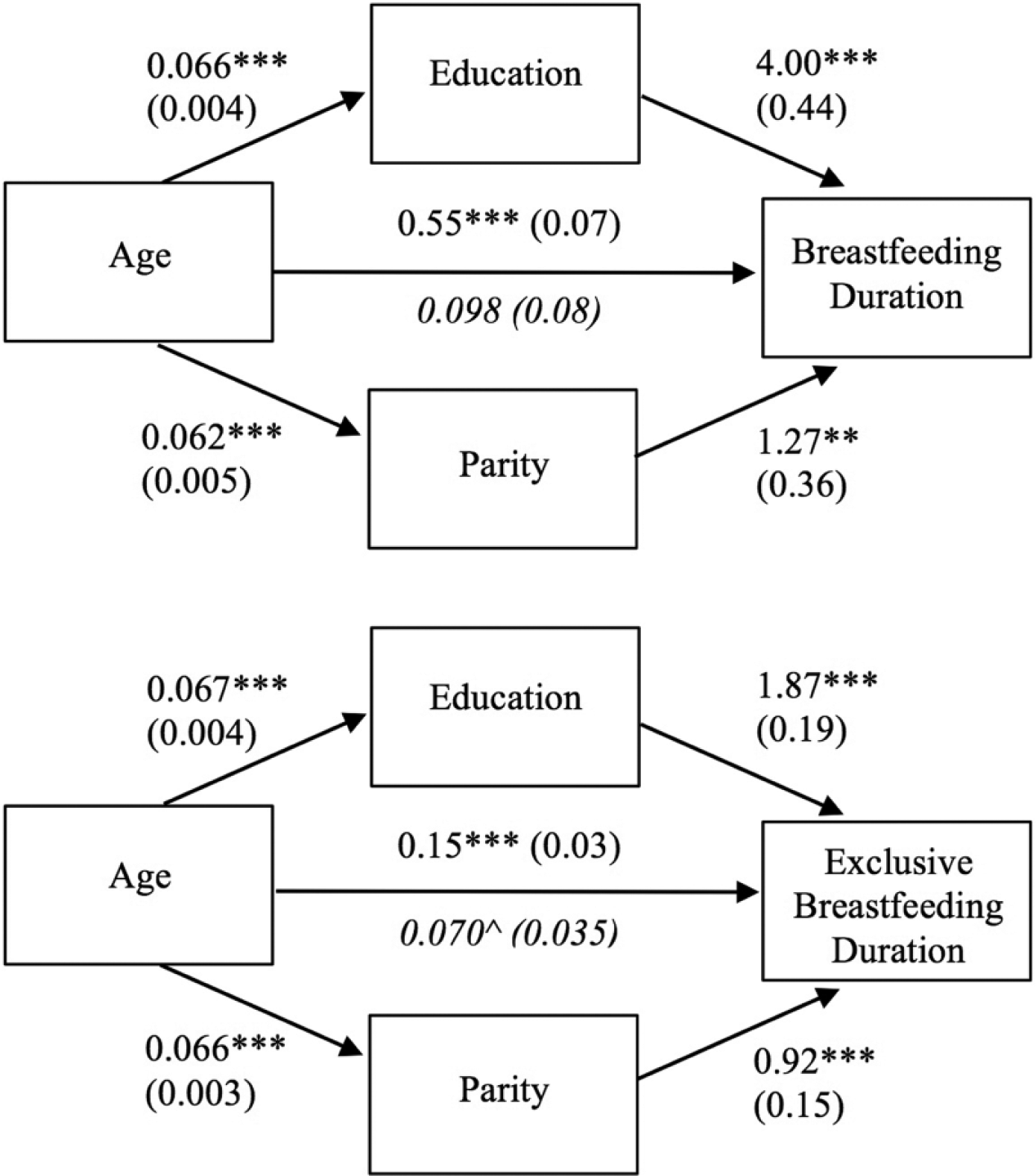
Unstandardized path coefficients, breastfeeding duration (N = 1,878), and exclusive breastfeeding duration (N = 2,654). The unstandardized coefficient for regressing age on breastfeeding duration, controlling for the indirect effect of the mediators, is in italics. Standard errors for coefficients are in parentheses.
As Figure 1 illustrates, the coefficient for the direct effect of age on total breastfeeding duration (net indirect effects) was not significant; however, the direct effect of age on exclusive breastfeeding duration approached statistical significance (p = .05).
Discussion
The variation in observed infant-feeding practices by maternal age appears to primarily index differences in parity and education. Age itself exerts relatively little, if any, direct influence on breastfeeding duration. This finding supports Rutter’s (1996) theoretical supposition that changes in health behavior over a life course are due to factors related to age, not age per se.
There are several plausible explanations for why education may mediate the relationship between maternal age and breastfeeding duration. Increases in education attainment may lead to increases in knowledge about the benefits of breastfeeding, which studies have found influences breastfeeding decisions (Stuebe & Bonuck, 2011). Systematic reviews have indeed found that adolescents generally have less accurate knowledge about breastfeeding (Wambach & Cole, 2000). Higher education attainment may also lead to higher income, more prestigious occupations, and more access to paid parental leave, all of which could plausibly account for infant-feeding choices, independent of breastfeeding knowledge (Guendelman et al., 2009). Future studies might explicitly test these pathways for adolescent mothers in particular. Likewise, there are several reasons that parity might mediate the relationship between age and breastfeeding duration. Mothers who have given birth to other children are likely to have a more abundant or readily available mature milk supply due to cumulative breast changes that occur with each pregnancy (Dewey, Nommsen-Rivers, Heinig, & Cohen, 2003). Mothers with older children may also have more breastfeeding experience or increased motivation to avoid the high cost of infant formula. Future research should investigate the “active ingredients” of these two mediators; in other words, what about multiparity and higher education causes increased duration and exclusivity of breastfeeding? Understanding these causal relationships is crucial for designing effective breastfeeding interventions.
The direct effect of age on exclusive breastfeeding duration (net the indirect effect) approaches significance, which indicates that there may be mechanisms not captured in the current model. Increased support from health care providers is one mechanism that could account for this residual effect. Research has shown that pediatricians regularly advise adolescent mothers to discontinue or reduce breastfeeding if they seem too young or immature (Feldman-Winter, Schanler, O’Connor, & Lawrence, 2008). This influence cannot be adequately tested using the IFPS II but should be explored in future studies.
There are important public health implications of the current study results. Because the association between age and breastfeeding duration is not a direct effect, targeting younger mothers may not be an effective strategy for increasing breastfeeding. Instead, interventionists might consider targeting primiparas or mothers with lower education attainment. The results also indicate that it may be prudent to impart young women with knowledge about breastfeeding earlier in their reproductive and education life course, perhaps as part of a comprehensive sex education or health education class during adolescence. There is evidence that these types of programs can be effective (Walsh, Moseley, & Jackson, 2008) and that U.S. educators and students might be receptive to this type of intervention strategy (Leffler, 2000; Spear, 2010). These programs could seek to normalize breastfeeding and give emerging adolescents the practical skills and self-efficacy that are necessary to successfully breastfeed.
The IFPS II is a valuable data set with a large sample size, but it is not nationally representative; compared with similar population-based studies, the IFPS II sample is significantly more likely to be white, have higher income, be employed, and breastfeed for longer durations (Fein et al., 2008). In addition, because of the 2005 Gulf hurricanes, mothers from the southern U.S. region were less likely to have full data than mothers from other regions. Each of these sampling idiosyncrasies, as well as the significant attrition over time, may bias the current findings, and results of this preliminary analysis should not be generalized to the United States as a whole. Replication of the current results with nationally representative samples is a necessary next step.
Conclusion
This is the first study to quantitatively examine the mediating role of both parity and education attainment on the well-known associations between maternal age and two facets of breastfeeding duration in the United States. Studies like these are crucial to begin understanding changes in infant-feeding practices over the maternal life course. Identifying causal pathways from sociodemographic characteristics to healthy breastfeeding behaviors is also important for designing effective interventions. Findings indicate that education and parity together fully mediate the association between age and total duration and partially mediate the association between age and exclusive duration. The results support life-course theories that consider age alone to be an incomplete explanation for behavioral change over time. Additional explorations of the causal pathways that lead to truncated breastfeeding, as well as replication using nationally representative samples, are the next steps for researchers.
Footnotes
Acknowledgements
The author gratefully acknowledges the general support and editorial assistance of Drs. Hirokazu Yoshikawa, Kathleen Ziol-Guest, and Margaret Giorgio.
Author’s Note
The author is a current doctoral student in the Psychology and Social Intervention program within the Applied Psychology Department of New York University’s Steinhardt School of Culture, Education, and Human Development.
Declaration of Conflicting Interests
The author declared no potential conflicts of interest with respect to the research, authorship, and/or publication of this article.
Funding
The author received no financial support for the research, authorship, and/or publication of this article.