






Abstract
Background:
Weight loss is universal for exclusively breastfed newborns in the first few days after birth. Many newborns exclusively breastfed during birth hospitalization receive formula in the first month after discharge and thus cease exclusive breastfeeding. However, the relationship between early weight loss and subsequent cessation of breastfeeding and exclusive breastfeeding is unknown.
Research aim:
This study aimed to determine the relationship between newborn weight loss and duration and exclusivity of breastfeeding among newborns breastfed exclusively during the birth hospitalization.
Methods:
Retrospective cohort study at Kaiser Permanente Northern California hospitals between 2009 and 2013. The main predictor variable was weight loss during birth hospitalization. The main outcomes were cessation of breastfeeding and cessation of exclusive breastfeeding in the first 25 days after discharge.
Results:
Among our sample, 83,344 were exclusively breastfed during birth hospitalization. At 25 days after discharge, 15.6%, 95% confidence interval (CI) [14.6%, 16.6%], of those delivered vaginally and 17.6%, 95% CI [14.5%, 20.6%], of those delivered by cesarean section were estimated to have completely ceased breastfeeding; 57.0%, 95% CI [55.5%, 58.4%], and 57.9%, 95% CI [53.6%, 61.8%], respectively, had ceased exclusive breastfeeding. Survival curves depicting rates of breastfeeding cessation through 1 month did not differ by degree of weight loss or by weight loss trajectory. However, curves depicting rates of exclusive breastfeeding demonstrated significantly more formula use among those with more weight loss at discharge.
Conclusion:
Among those exclusively breastfed during birth hospitalization, weight loss nomograms may help identify newborns at higher risk of cessation of exclusive breastfeeding. Lactation support targeted to those with exacerbated weight loss trajectories may improve duration of exclusive breastfeeding.
Keywords
Background
Exclusive breastfeeding is defined by the World Health Organization (WHO) as feeding nothing but human milk, vitamins, minerals, and medications and has multiple health benefits for mothers and newborns. The WHO, the Centers for Disease Control and Prevention (CDC), and the surgeon general all recommend exclusive breastfeeding for 6 months after birth (CDC, 2013a, 2013b; U.S. Department of Health and Human Services, 2011; WHO, 2011). However, although 64% of U.S. newborns breastfeed exclusively for the first 2 days, only 22.3% breastfeed exclusively for 6 months (CDC, 2016).
Newborn weight loss might be associated with cessation of exclusive breastfeeding. In the first few days after birth, exclusively breastfed newborns lose 7% to 8% of their birth weight (Flaherman et al., 2015; Macdonald, Ross, Grant, & Young, 2003; van Dommelen, van Wouwe, Breuning-Boers, van Buuren, & Verkerk, 2007). Initial difficulty with breastfeeding can cause more pronounced weight loss, which might lead to formula supplementation. Although previous studies have shown an association between formula use and cessation of breastfeeding (DiGirolamo, Grummer-Strawn, & Fein, 2008; Holmes, Auinger, & Howard, 2011; Petrova, Hegyi, & Mehta, 2007), none have described how breastfeeding cessation correlates with weight loss in an exclusively breastfed cohort.
We sought to examine the association between degree of weight loss during birth hospitalization and breastfeeding duration and exclusivity through 1 month. To identify possible predictors of formula initiation and/or breastfeeding cessation that might be identifiable prior to discharge, we also explored the effect of weight loss trajectory during birth hospitalization on these outcomes.
Methods
Design
This is a retrospective cohort study examining the relationship between weight loss during birth hospitalization and subsequent duration of breastfeeding and exclusive breastfeeding in the first month after birth. This study was approved by the institutional review boards of the University of California, San Francisco, Penn State College of Medicine, and Kaiser Permanente Northern California.
Setting
Data were collected at 14 Kaiser Permanente Northern California birthing hospitals between January 1, 2009, and December 31, 2013.
Sample
From a cohort of 161,471 neonates born at ≥ 36 weeks gestation, who survived to discharge home and who did not receive level 2 or level 3 care, we extracted data on all weights obtained during birth hospitalization as well as on gestational age, method of delivery, length of stay, maternal race/ethnicity, and type (human milk or formula) of all inpatient feedings. For this study, we excluded all newborns who received any formula during birth hospitalization. See Figure 1 for details on cohort derivation. We identified 83,344 exclusively breastfed newborns, of whom 68,250 were delivered vaginally and 15,094 were delivered by cesarean section.
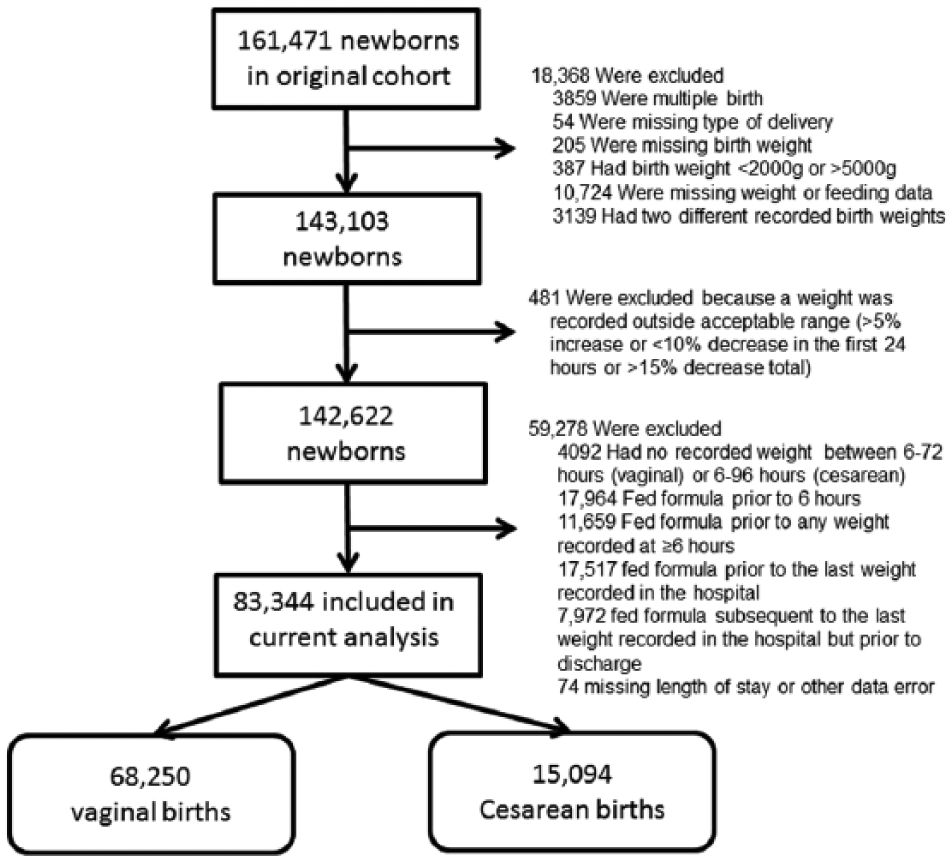
Derivation of the final cohort.
Measurement
Using our published nomograms (Flaherman et al., 2015), we classified each newborn into one of five categories of weight loss based on their last recorded weight prior to discharge from birth hospitalization (“discharge zone”). These discharge zones were < 50th percentile of weight loss, ≥ 50th but < 75th percentile of weight loss, ≥ 75th but < 90th percentile of weight loss, ≥ 90th but < 95th percentile of weight loss, and ≥ 95th percentile of weight loss. For neonates who had ≥ 2 weight measurements subsequent to birth weight, we compared the first weight loss zone with the second weight loss zone by categorizing newborns into three trajectories of weight loss: exacerbated weight loss, ameliorated weight loss, and stable weight loss. We defined exacerbated weight loss as occurring when an infant moved to a weight loss zone indicating more pronounced weight loss. We defined ameliorated weight loss as occurring when an infant moved to a weight loss zone indicating less pronounced weight loss.
Key Messages
The effect of newborn weight loss on duration of breastfeeding and exclusive breastfeeding has not previously been studied.
Our study found that weight loss at discharge from birth hospitalization was not associated with breastfeeding cessation in the first month.
However, weight loss at discharge from birth hospitalization was associated with cessation of exclusive breastfeeding in the first month.
Developing interventions targeted toward newborns with pronounced early weight loss might improve rates of exclusive breastfeeding.
At each outpatient visit in the first 30 postnatal days, parents were surveyed by clinical staff regarding feeding practices. Time to complete breastfeeding cessation was based on the item, “Do you feed your baby breast milk?” At the first instance in which a mother answered “No,” breastfeeding was defined to have ceased completely for the newborn somewhere between the previous visit (or discharge) and the current visit. Newborns whose mothers answered “Yes” at all outpatient visits were censored at the last outpatient visit for this outcome. Time to exclusive breastfeeding cessation was based on the item, “Do you feed your baby anything besides breast milk or iron?” Mothers who answered “Yes” were defined to have ceased exclusive breastfeeding somewhere between the previous visit (or discharge) and the current visit. Newborns whose mothers answered “No” at each visit were censored at the last outpatient visit for this outcome. If a newborn had no outpatient visits in which a breastfeeding survey was administered, that newborn was censored at the time of discharge from birth hospitalization.
Data Analysis
Based on the outpatient survey described above, we computed two separate time-to-event outcomes: time to complete breastfeeding cessation and time to exclusive breastfeeding cessation. Both outcomes were calculated starting at time of discharge, not time of birth, because all patients were exclusively breastfeeding at discharge, and discharge times varied among newborns. The exact date of an event (when it occurred) for each outcome could not be determined. Rather, an event was known to occur only in the interval between two time points, which is a situation known as interval censoring.
We used Turnbull’s estimator (Turnbull, 1976), which is appropriate for interval censored data, to construct survival curves for each outcome by discharge zone and weight loss trajectory. We used Sun’s nonparametric test, which is appropriate for interval censored data, to test whether survival curves differed among groups (Sun, 1996). If curves differed among groups, we used the same test with a Bonferroni correction to compare each pair of survival curves.
Results
Among this cohort of newborns breastfed exclusively through discharge from birth hospitalization, mean (standard deviation [SD]) birth weight was 3,438 (425) g, mean (SD) gestational age was 39.2 (1.1) weeks, and maternal race-ethnicity included 45.7% white non-Hispanic, 6.4% black non-Hispanic, 23.3% Hispanic, and 21.5% Asian. The last weight prior to discharge from birth hospitalization was obtained at a median (interquartile range [IQR]) of 23 (16–31) and 44 (37–59) hours for newborns delivered vaginally and by cesarean, respectively. Median (IQR) weight loss at the last weight measured prior to discharge was 4.0% (2.5%–5.5%) for newborns delivered vaginally and 7.1% (5.8%–8.3%) for newborns delivered by cesarean. The mean interval between obtaining the last weight measured prior to discharge and actual discharge from birth hospitalization was a median (IQR) of 12.8 (11.0–14.8) hours for vaginal deliveries and 13.0 (11.2–14.8) hours for cesarean deliveries. In this cohort, 95.7% of newborns had at least one follow-up weight obtained after discharge from birth hospitalization and before 1 month of age (see Table 1).
Ascertainment of Weights During Birth Hospitalization and Breastfeeding Status After Discharge From Birth Hospitalization.

Note. Data are given as n (%).
Among 68,250 vaginally delivered newborns exclusively breastfed during birth hospitalization, 6,286 (9%) answered “No” to the question, “Do you feed your baby breast milk?” and 24,862 (36%) answered “Yes” to the question, “Do you feed your baby anything besides breast milk or iron?” at some time point during an outpatient visit. When accounting for time using survival curves, at 25 days after discharge, 15.6%, 95% confidence interval (CI) [14.6%, 16.6%], were estimated to have completely ceased breastfeeding and 57.0%, 95% CI [55.5%, 58.4%], had ceased exclusive breastfeeding. Among 15,094 newborns delivered by cesarean and exclusively breastfed during birth hospitalization, 1,292 (9%) answered “No” to the question, “Do you feed your baby breast milk?” and 5,214 (35%) answered “Yes” to the question, “Do you feed your baby anything besides breast milk or iron?” at some time point during an outpatient visit. When accounting for time using survival curves, at 25 days after discharge, 17.6%, 95% CI [14.5%, 20.6%], were estimated to have completely ceased breastfeeding and 57.9%, 95% CI [53.6%, 61.8%], had ceased exclusive breastfeeding.
For both vaginally delivered neonates and those delivered by cesarean, rates of complete breastfeeding cessation in the first month after birth were indistinguishable by discharge zone (ps = .21 and .29, respectively) (see Figures 2A and 2B). In contrast to curves for the outcome of breastfeeding cessation, the curves for the outcome of cessation of exclusive breastfeeding differed significantly by discharge zone for both vaginally and cesarean delivered newborns (see Figures 3A and 3B; p < .001 for each), with cessation of exclusive breastfeeding more common for those with more exacerbated weight loss at the time of discharge. Testing each pair of survival curves and using a Bonferroni correction for significance (p = .005 for 10 total tests), newborns whose discharge weight loss zone was < 50th percentile were less likely to discontinue exclusive breastfeeding after both vaginal and cesarean delivery (p < .001) (tables available from authors on request).

Time from discharge to complete breastfeeding cessation by discharge zone for newborns who were delivered vaginally (A) and by cesarean (B).

Time from discharge to exclusive breastfeeding cessation by discharge zone for newborns who were delivered vaginally (A) and by cesarean (B).
In this cohort, 33,160 newborns (39.8%, of whom 19,306 were delivered vaginally and 13,854 were delivered by cesarean) had ≥ 2 weights recorded subsequent to birth weight during birth hospitalization and were included in the analysis of the effect of weight loss trajectory on complete breastfeeding cessation and exclusive breastfeeding cessation (see Table 1). Among these neonates, 21.5% had a trajectory of exacerbated weight loss (moved to a lower weight loss zone), 21.9% had a trajectory of ameliorated weight loss (moved to a higher weight loss zone), and 56.7% had a stable weight trajectory (stayed in the same weight loss zone) for the next recorded weight loss. Trajectories were not associated with complete breastfeeding cessation (data not shown). However, trajectories were associated with cessation of exclusive breastfeeding (see Figures 4A and 4B; p < .001 for each). For both types of delivery, each pair of survival curves was significantly different using a Bonferroni correction (p = .016) (three total tests for each type of delivery). In particular, a trajectory of exacerbated weight loss was strongly associated with a decreased likelihood of exclusive breastfeeding for both types of delivery.
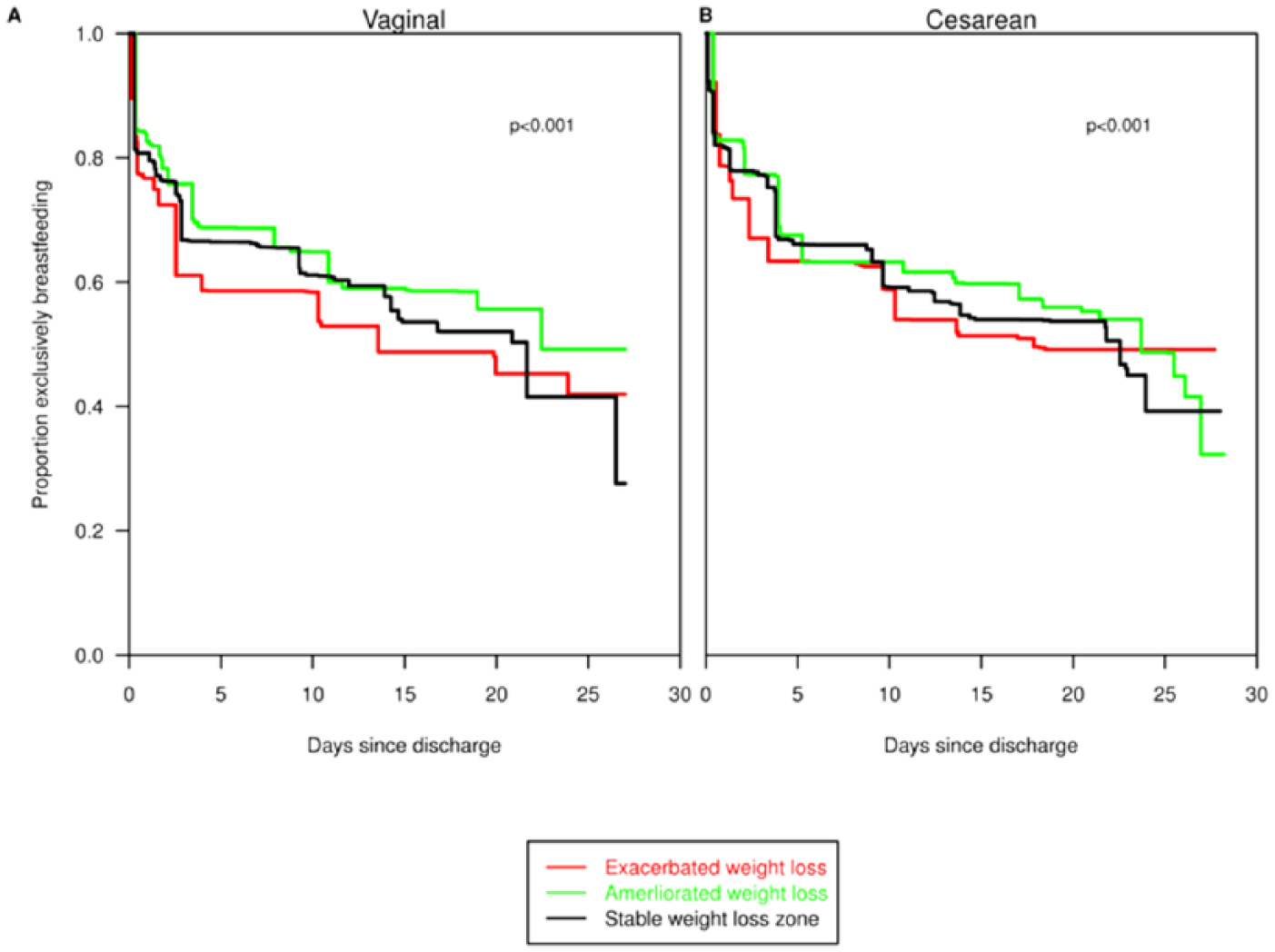
Time from discharge to exclusive breastfeeding cessation by change in weight loss zone for newborns who were delivered vaginally (A) and by cesarean (B).
Discussion
Among newborns exclusively breastfed during birth hospitalization, weight loss at discharge was associated with duration of exclusive breastfeeding but not duration of any breastfeeding through 1 month. Newborns with an exacerbated weight loss trajectory during the course of birth hospitalization were much less likely to continue exclusive breastfeeding than those with stable or improved weight loss trajectories. By tracking newborn weight patterns in the context of norms available by hour of age, it might be possible to identify newborns and mothers with a trajectory indicating need of additional breastfeeding support. Since our study also found that weight loss that exacerbates over time is associated with worse outcomes, our results also raise the possibility that a weight obtained subsequent to birth weight might provide a baseline “dry” weight (measured after the initial period of diuresis) that could be used to assess subsequent weight changes (Noel-Weiss, Woodend, Peterson, Gibb, & Groll, 2011). Further research in this area is necessary to identify the optimal timing, safety, and effectiveness of the use of a baseline dry weight.
This study has several limitations. First, we have no data on maternal parity, breastfeeding experience, socioeconomic status, or reasons for cessation of exclusive breastfeeding. Newborns who elicited clinical concern regarding effective breastfeeding might have been more likely to have received formula during birth hospitalization and thus be excluded from our cohort. Second, Northern California has breastfeeding rates that are relatively high compared with much of the United States (California Department of Public Health, 2013). Thus, our results may not be generalizable to all geographic locations. Third, cessation of exclusive breastfeeding was determined by an affirmative response to the question, “Do you feed your baby anything besides breast milk or iron?” Since some parents might have responded affirmatively if they had fed their baby vitamins, minerals, or medications, our results may overestimate overall rates of exclusive breastfeeding cessation in this cohort. However, it seems unlikely that such misclassification would have differed by weight loss. Last, our outcome assessment continued for only 30 days after birth, when overall breastfeeding prevalence was high for all categories of neonates. Additional research is needed to examine the effect of early weight loss on the clinically relevant outcomes of breastfeeding duration through 3, 6, and 12 months.
However, based on our results, it is reasonable to conclude that more pronounced weight loss at discharge from birth hospitalization increases the likelihood that babies will cease exclusive breastfeeding after discharge. Our study also suggests that an exacerbated weight loss trajectory may be an important marker of breastfeeding problems. Newborns with exacerbating weight loss might benefit from the development of interventions targeted to support ongoing breastfeeding for this population. Tracking weight loss trajectory as part of routine newborn care might help provide optimal support to mothers and their breastfeeding newborns.
Footnotes
Declaration of Conflicting Interests
The authors declared no potential conflicts of interest with respect to the research, authorship, and/or publication of this article.
Funding
The authors disclosed receipt of the following financial support for the research, authorship, and/or publication of this article: This work was supported by the HRSA/Maternal Child Health Bureau, grant number R40 MC26811.