







Abstract
Background:
It is well known that the best nutritional option for infants is human milk, and that when breastfeeding is not possible, human milk banks are a possible alternative. However, in the case of infants with fat transport disorder like chylothorax, defatting of human milk is mandatory.
Research Aim:
The aim of the study was to reduce milk fat content without reducing other nutrients, increasing oxidative stress, or introducing harmful microorganisms.
Methods:
In this prospective, cross-sectional, observational study, we examined the influence of defatting and pasteurization of 50 donor samples on fat, macro- and micronutrients, as well as on oxidative stress markers.
Results:
Low-temperature centrifugation proved to be very efficient in defatting, reducing the concentration of triglycerides by 85% and cholesterol by 50%. The macronutrients (proteins, albumin, and Immunoglobulin A) did not undergo significant changes due to defatting and pasteurization procedures, while iron decreased by 36%. However, as the majority of iron is retained, this result does not remarkably change the milk composition. Furthermore, oxidative stress markers and antioxidant levels were unchanged, and the milk result was microbiologically safe.
Conclusions:
Cold milk centrifugation proved to be an effective technique that allows the reduction of human milk lipids. The determination of triglycerides and cholesterol can be used as an indicator of skimming. This procedure is not accompanied by substantial modifications of other components present in the milk.
Key Messages
Human milk is the best nutritional option for infants, and, in the case of infants with chylothorax, defatting of milk is mandatory.
We demonstrate that cold centrifugation is an effective tool for lowering milk fat, and that the assessment of the extent of lipid reduction can easily be measured by triglycerides assay.
We also demonstrate that defatting and pasteurization does not significantly alter the nutritional, oxidative, antioxidant, and microbiological properties of milk, thus adding to knowledge about the usefulness and safety of low-fat human milk.
Background
Human milk contains 40%–50% of its total energy in the form of fatty acids, mainly long-chain monounsaturated or saturated triglycerides (LCTs), which are absorbed and packaged into chylomicrons before being transported through the lymphatic system and into the thoracic duct. Medium-chain triglycerides (MCTs), which make up 10%–20% of the fatty acids in human milk, are shorter in length (6–12 carbon atoms), thus being directly absorbed into the portal venous system (Eriksen et al., 2018).
The type of fat in human milk is of great importance when feeding infants who have disorders of fat transport and metabolism, like lymphangectasia or chylothorax. Chylothorax is a condition that occurs when the thoracic duct is incomplete or damaged, causing chylous fluid to accumulate in the pleural space. Neonatal chylothorax can be either congenital or acquired, the latter of which is usually seen after thoracic surgery for direct trauma to lymphatic vessels or to the thoracic duct. A less common cause of chylothorax in newborns is the central venous hypertension secondary to venous thrombosis (Costa & Saxena, 2018).
Although there is no standard of care for infants with chylothorax, most centers begin treatment with a modification of the diet in order to minimize fat accumulation in the damaged thoracic duct, thus allowing time to heal. Until now, when a breastfed infant was diagnosed with chylothorax, mother’s milk administration was temporarily interrupted, and a medium-chain triglycerides (MCTs) diet was supplied (Concheiro-Guisan et al., 2019).
Recently, instead of providing a high-MCT formula, a treatment option for infants with chylothorax has been the use of human milk with a reduction in LCT (Höck et al., 2021). Indeed, the European Society of Gastroenterology, Hepatology and Pediatric Nutrition (ESPGHAN; https://www.espghan.org/) recommends the use of donated human milk (DHM), and its use in neonatal intensive care units is increasing (Yang et al., 2020). DHM must be obtained from a milk bank that follows specific guidelines, for instance those published by the European Association of Milk Banks (EMBA; Weaver et al., 2019).
In order to ensure safety, DHM needs to be pasteurized before its use. Although pasteurization is necessary, it may influence the activity and concentration of several biological factors, including antioxidants and oxidative stress markers (Juncker et al., 2021). Furthermore, defatting procedures require extensive centrifugation (20 min), and, although this is at a controlled temperature (5 °C), this could influence the levels of antioxidants and oxidative stress markers.
In addition, it should be pointed out that the fetus has developed in a low oxygen atmosphere; the maturation of the antioxidant systems occurs late in gestation. Consequently, preterm newborn infants may be incapable of handling the explosion of tissues’ oxygen free radicals caused by breathing. Oxygen free radicals are very reactive by-products of oxygen reduction, capable of causing oxidative damage to multiple organs, including the brain (Moore et al., 2018). Therefore, high rates of oxidative stress are common in preterm infants, and the antioxidant properties of human milk limit the oxidative damage.
In this scenario, it is of fundamental importance that the diet of the infant does not include additional oxidants or that the manipulation of DHM decreases the antioxidant naturally present. However, detailed data about the impact of milk manipulation on these factors is currently insufficient and conflicting (Bertino et al., 2018). It is critical to study the alteration of both antioxidants and oxidative stress markers resulting from DHM manipulation. The aim of the study was to diminish the DHM fat content without reducing the other macro- and micronutrients, increasing oxidative stress, or introducing harmful microorganisms.
Methods
Research Design
In this prospective, cross-sectional, observational study, we examined the influence of defatting and pasteurization of 50 donor samples on fat, macro- and micronutrients, as well as on oxidative stress markers. The Ethics Committee of the Medical Center approved the present study on February 3, 2021 (Authorization Code 2261).
Setting and Relevant Context
The Human Milk Bank (HMB) in our hospital covers the needs of the Lazio region in Italy. Lazio is located in central Italy, with the city of Rome as its main province. With 5,710,811 inhabitants, Lazio is the second most populated region in Italy, and occupies 17,232 km² of Italian territory. In the last year of operation, our HMB offered 1240 L of milk to newborns. Our HMB has been part of the Associazione Italiana Banche del Latte Umano Donato (AIBLUD) since its establishment in 2000.
AIBLUD is the Italian partner of the European Association of Milk Banks (EMBA), and follows its guidelines (Weaver et al., 2019). Our HMB refers to the AIBLUD guidelines for the organization and management of donated human milk banks as part of the Italian Ministry of Health’s protection, promotion, and support of breastfeeding.
Sample
The target population was postpartum women who breastfed their newborns by exclusive breastfeeding and became milk donors to our HMB. Eligible participants were those who met the inclusion criteria, that was based on milk availability from exclusive breastfeeding women
Since fat content in human milk can be very variable (Dror & Allen, 2018), for a decrease in fat content of about 80% (Jackson et al., 2020), the sample size, determined with a power of 80% and a Type I error rate (α) of 0.05, was 12 participants. We were thus above the minimum sample size.
Measurement
Our measurement examined two areas: (1) fat content in milk, and (2) the remaining bioavailable nutrients present after the sample was defatted. Skimming efficacy or the remainder of fat in the milk sample was measured by determining triglycerides and cholesterol levels. To determine the level of bioavailable nutrients, we assessed the milk’s proteins (including Immunoglobulin A (IgA) and albumin), calcium, and iron concentrations.
Proteins hold several beneficial properties. Indeed, beside the developmental and immunological benefits, some proteins possess antimicrobial properties, and were analyzed in order to be sure that the defatting procedures do not alter the levels of these fundamental nutrients. Calcium is a critical micronutrient for bone health and plays an essential role as second messenger in cell-signaling pathways. Iron is necessary for hemoglobin synthesis, and for the infant’s neurological development. Moreover, some of the bacteriostatic properties of human milk are associated with the bioavailability of iron in human milk. The assessment of their levels during milk manipulations is thus of fundamental importance.
As the manipulation of DHM could result in an increase of oxidative damage and/or a decrease in the antioxidant naturally present in human milk, we analyzed lipid peroxidation markers (T-BARS and 8-isoprostane levels), and DNA/RNA oxidative damage levels, together with the total antioxidant concentrations before centrifugation (PRE samples). Milk samples were centrifuged at 3,600 rpm for 20 min at a temperature of 5 °C in order to eliminate fat (POST samples), and then pasteurized (62.5 °C for 30 min; PA samples).
Finally, as aminothiols (cysteine [Cys], cysteinyl-glycine [Cys-Gly], glutathione [GSH], and homocysteine [Hcy]) are the major non-enzymatic antioxidant compounds, we analyzed their levels in the DHM.
Total Cholesterol, Triglyceride, Total Proteins, and Albumin Assays
Total cholesterol, triglyceride, total proteins, and albumin were analyzed by the Roche Cobas 8000/c702 module (Roche Diagnostics GmbH, Sandhofer Strasse 116, D-68305 Mannheim, Germany, EU). PRE samples were diluted 1:5 with phosphate buffered saline (PBS; Sigma-Aldrich, St. Louis, MO, USA) before analysis. POST and PA samples were analyzed without any further manipulation. 200 µl of each sample were placed in the instrument analysis vial and automatically processed in triplicate.
Total cholesterol levels were determined by an enzymatic colorimetric method (CHOL2 Cobas® kit for c702 module; Roche Diagnostics GmbH, Sandhofer Strasse 116, D-68305 Mannheim, Germany). The coefficient of variation (CV) for milk samples was 9.6%; recovery was 95%; the method was linear in the range used for the determinations (0.8–80 mg/dl).
Triglyceride levels were determined by an enzymatic colorimetric method (TRIGL Cobas® kit for c702 module; Roche Diagnostics GmbH, Sandhofer Strasse 116, D-68305 Mannheim, Germany). The reliability and validity of the method were: CV for milk samples was 5.1%; recovery was 94.7%; and the method was linear in the range used for the determinations (0.09–8.85 mg/ml). Quality Control (QC) for total cholesterol and triglycerides determinations, were the PreciControl ClinChem Multi 1 (normal levels) and 2 (high level; Roche Diagnostics GmbH, Sandhofer Strasse 116, D-68305 Mannheim, Germany).
Total proteins levels were determined by a colorimetric method (TP2 Cobas® kit for c702 module; Roche Diagnostics GmbH, Sandhofer Strasse 116, D-68305 Mannheim, Germany). The CV for milk samples was 6.3%; recovery was 97%; and the method was linear in the range used for the determinations (0.12–12 g/ml).
Albumin levels were determined by a colorimetric method (ALBT2 Cobas® kit for c702 module; Roche Diagnostics GmbH, Sandhofer Strasse 116, D-68305 Mannheim, Germany). The CV for milk samples was 3.7%; recovery was 96.4%; and the method was linear in the range used for the determinations (0.2–6 g/ml). For total proteins and albumin levels, the QC was the Precinorm PUC (normal levels) and Precipath PUC (high levels; Roche Diagnostics GmbH, Sandhofer Strasse 116, D-68305 Mannheim, Germany, EU).
Calcium and Iron Assays
Calcium levels were determined by an enzymatic colorimetric method (CA2 Cobas® kit for c702 module; Roche Diagnostics GmbH, Sandhofer Strasse 116, D-68305 Mannheim, Germany). The CV for milk samples was 7.4%; recovery was 95.2%; and the method was linear in the range used for the determinations (2.5–25 mg/dl). PRE samples were diluted 1:5 with PBS (Sigma-Aldrich, St. Louis, MO, USA) before analysis. POST and PA samples were analyzed without any further manipulation. 200 µl of each sample were placed in the instrument analysis vial and automatically processed in triplicate.
Iron levels were determined by a colorimetric method (IRON2 Cobas® kit for c702 module; Roche Diagnostics GmbH, Sandhofer Strasse 116, D-68305 Mannheim, Germany). The CV for milk samples was 12.6%; recovery was 92%; and the method was linear in the range used for the determinations (0.05–10 mg/L). For these determinations, the QC PreciControl ClinChem Multi 1 (normal levels) and 2 (high level) were used (Roche Diagnostics GmbH, Sandhofer Strasse 116, D-68305 Mannheim, Germany).
Total IgA Assays
Total IgA antibodies were analyzed by enzyme-linked immunosorbent assay (ELISA). Briefly, 96-well plates were coated for 1 hr at room temperature (RT) with purified goat anti-human IgA antibodies (Jackson ImmunoResearch Europe, Ely, Cambridgeshire, UK). After washing with PBS containing 0.05% Tween®20 (Sigma-Aldrich, St. Louis, MO, USA) and blocking with PBS containing 1% bovine serum albumin (BSA; Sigma-Aldrich, St. Louis, MO, USA), plates were incubated for 1 hr with 200 µl of diluted human milk (1:2000). Secondary antibodies were peroxidase-conjugated F(ab)2 fragments of goat anti-human IgA antibodies (Jackson ImmunoResearch Europe, Ely, Cambridgeshire, UK). The assay was developed with O-phenylendiamine tablets (Sigma-Aldrich, St. Louis, MO, USA). Optical density was measured on a microtiter plate reader at 450 nm and Ig concentrations were calculated by interpolation with the standard curve based on serial dilutions of monoclonal human IgA antibody (Jackson ImmunoResearch Europe, Ely, Cambridgeshire, UK).
Total Antioxidant and Oxidative Stress Markers
Total Antioxidant (analyzed as Trolox [6-hydroxy-2,5,7,8-tetramethylchroman-2-carboxylic acid], a water-soluble analog of vitamin E), Thiobarbituric Acid Reactive Substances (T-BARS, expressed as malondialdehyde levels), 8-isoprostane, and DNA/RNA Oxidative Damage (expressed as 8-Hydroxy-2’-deoxyguanosine levels) were analyzed on freshly prepared samples by commercial kit following the manufacturer instructions (Cayman Chemical, Ann Arbor, MI, USA).
Thiols (cysteine [Cys], cysteinyl-glycine [Cys-Gly], glutathione [GSH], and homocysteine [Hcy]), the major non-enzymatic antioxidant compounds, were analyzed as previously reported (Pastore et al., 2022).
Microbiological Screening
The microbiological analysis of human milk was performed on samples collected pre and post pasteurization in sterile bottles. The samples were subjected to standard culture with semi-quantitative technique, depositing 10 µl aliquots on the following culture media: tryptic soy agar (TSA, Thermo Fisher Scientific, Inc.), macconkey agar (MK, bioMérieux Italia SpA), columbia CNA agar + 5% sheep blood (CNA, bioMérieux Italia SpA), and chocolate polyvitex agar (PVX, bioMérieux Italia SpA). The culture media were incubated for 24–48 hr under the following temperature conditions: 35 ± 2 °C in aerobic atmosphere for TSA and MK, and 35 ± 2 °C in aerobic atmosphere with the addition of carbon dioxide for CAN and PVX. Colonies grown after incubation were identified by mass spectrometry (MALDI-TOF MS, Bruker) and for each identified microorganism the charge was reported expressed as Colony Forming Units per ml of sample (CFU/ml). Microbiological acceptability criteria for human milk are the absence of microbial growth in samples tested after pasteurization (Weaver et al., 2019).
Data Collection
Recruitment and data collection took place February–December 2021. Technical staff collected data and informed consent from participants at the HMB. Data were collected for each participant from questionnaires containing demographic and clinical information, and the corresponding samples were labeled and analyzed as described below. To maintain confidentiality, samples were labeled with de-identified barcodes and all data collected were stored in a locked room with limited access.
Milk samples from a group of 50 inpatient mothers were collected in glass bottles and immediately frozen (−20 °C). Each sample was thawed in a water bath with stirring at 37 °C and an aliquot of each sample was taken before centrifugation (PRE samples), while the rest was skimmed by cold centrifugation as previously described by Drewniak et al. (2018). Briefly, milk samples were centrifuged at 3,600 rpm for 20 min at a temperature of 5 °C in order to eliminate fat (POST samples), and then pasteurized (62.5 °C for 30 min; PA samples). These samples were stored at −20 °C until analysis.
Data Analysis
Means and standard deviations (SD) were used for descriptive measurements of all the parameters studied. Kolmogorov–Smirnov and Lilliefors tests for normality were performed on all data. The two-tailed nonparametric Mann–Whitney test was used for comparison between groups, and correlations were calculated as Spearman correlation coefficients. P < .05 was considered statistically significant. Statistical analysis was performed using GraphPad Prism (Version 3.03; GraphPad Software, San Diego, CA, USA).
Results
Characteristics of the Sample
The mean age of the donors was 34.5 years (range 18–43 years), and all filled out the Demographic Questionnaire provided (see the online Supplemental Materials).
Analytes
The influence of defatting procedures on the levels of the various analytes studied is reported in Table 1.
Influence of Defatting Procedures on the Levels of the Various Analytes Studied.
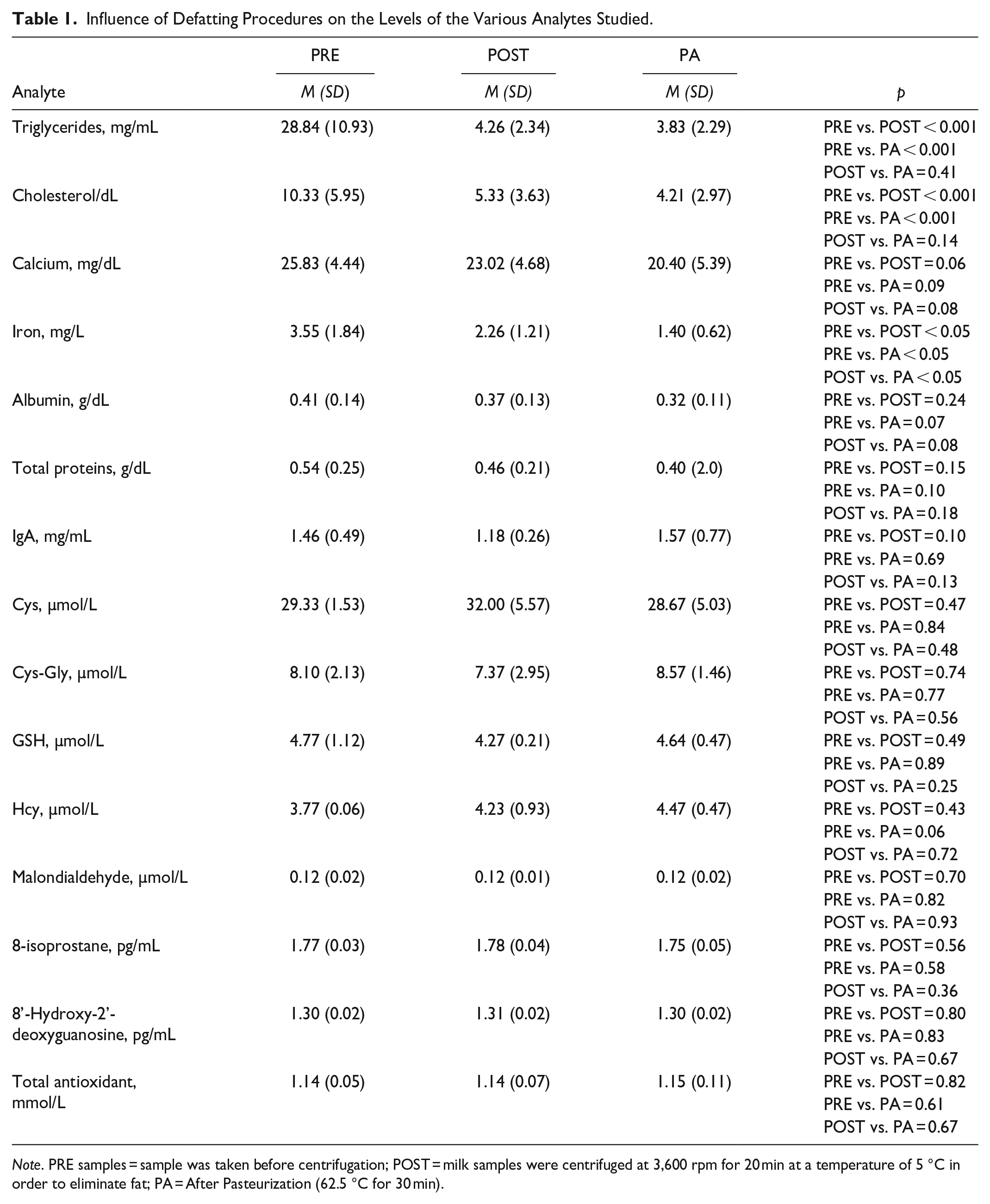
Note. PRE samples = sample was taken before centrifugation; POST = milk samples were centrifuged at 3,600 rpm for 20 min at a temperature of 5 °C in order to eliminate fat; PA = After Pasteurization (62.5 °C for 30 min).
Total Cholesterol, Triglyceride, Total Proteins, and Albumin Levels
Low-temperature centrifugation was very efficient, lowering the concentration of triglycerides by 85% and that of cholesterol by 50%. In particular, both triglyceride and cholesterol levels were significantly reduced after skimming (Figure 1, Panel A). Albumin and total proteins levels were also unchanged during the defatting procedures, as PRE and POST levels are equivalent (Figure 1, Panel B).
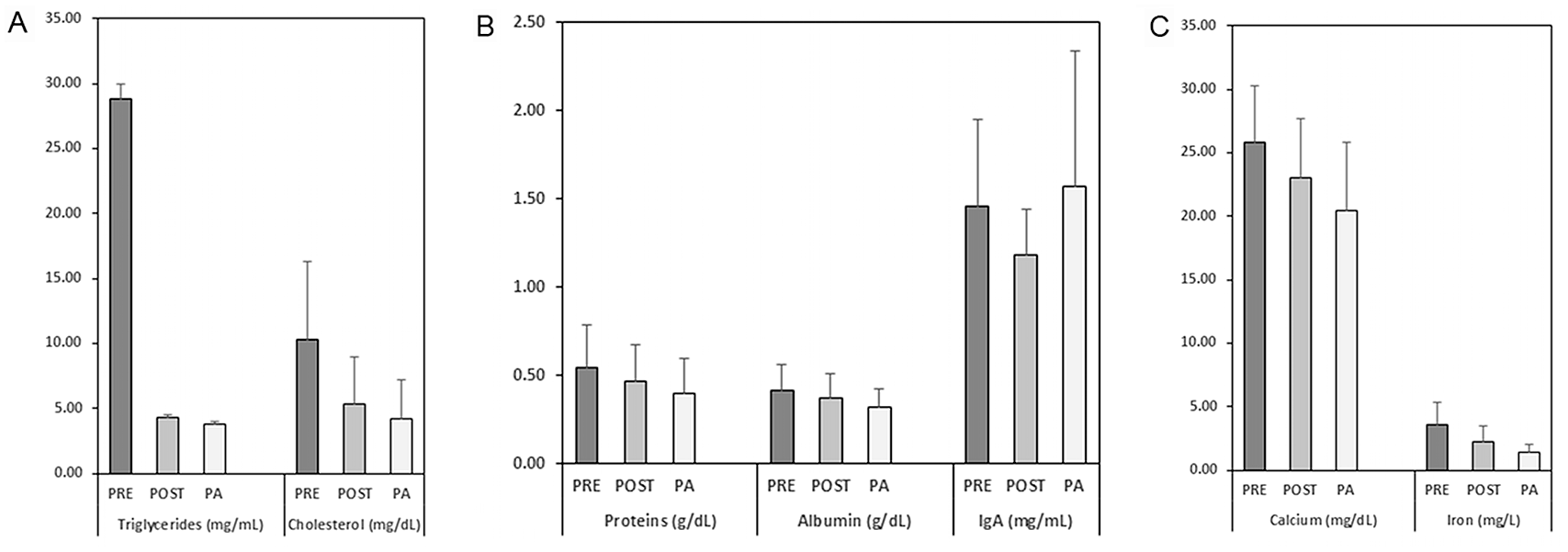
Values of Various Macro-(A-B) and Micro-(C) Nutrients Before Defatting Through Low Temperature Centrifugation (PRE), After Skimming (POST), and After Pasteurization (PA).
Calcium and Iron Levels
The tested micronutrients (calcium and iron) also decreased (Figure 1, Panel C). In particular, while calcium concentrations were reduced by 11%, iron decreased by 36%. Although there was a substantial loss of calcium due to the defatting procedures, the final product retained a reasonable amount (64%) of this key nutrient.
Total IgA Levels
We analyzed IgA levels in PRE, POST, and PA samples, and found that milk treatments did not cause any significant changes in the IgA content (Figure 1, Panel B). In particular, we found a reduction of about 20% of IgA levels after skimming, and an apparent rise of 7% after the pasteurization process. These differences fell within the coefficient of the inter-assay variation of the method and thus are not significant.
Total Antioxidant Levels and Oxidative Stress Markers
Figures 2 and 3 demonstrated that milk treatment (defatting with low temperature centrifugation and subsequent pasteurization) did not cause significant changes in the oxidative stress markers studied. In particular, as shown in Figure 2, Malondialdehyde concentrations (one on the marker of lipid peroxidation studied) remained identical during milk manipulation (Panel A). Although 8-isoprostane concentrations (the other marker of lipid peroxidation studied) were slightly changed, the differences did not reach statistical significance (Panel B). DNA/RNA oxidative damage marker levels, expressed as 8-Hydroxy-2’-deoxyguanosine levels, were also slightly different, but the differences did not reach statistical significance (Panel C). Also, total antioxidant levels, expressed as Trolox equivalents, were not perturbed by treatments (Figure 2, Panel D).
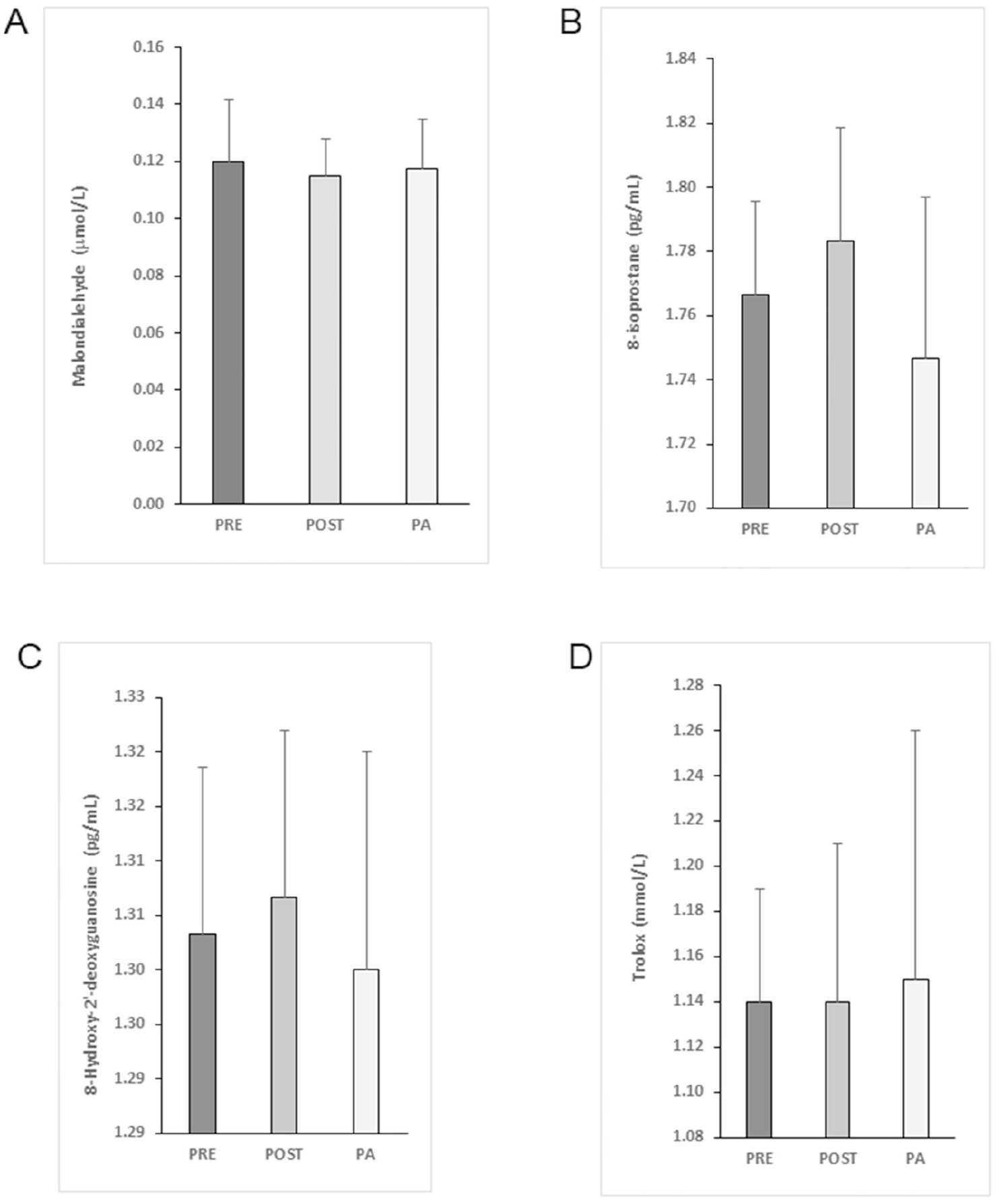
Oxidative Stress Markers (A-C) and Antioxidant Levels (D) in Milk Before Defatting (PRE), After Defatting (POST), and After Pasteurization (PA).
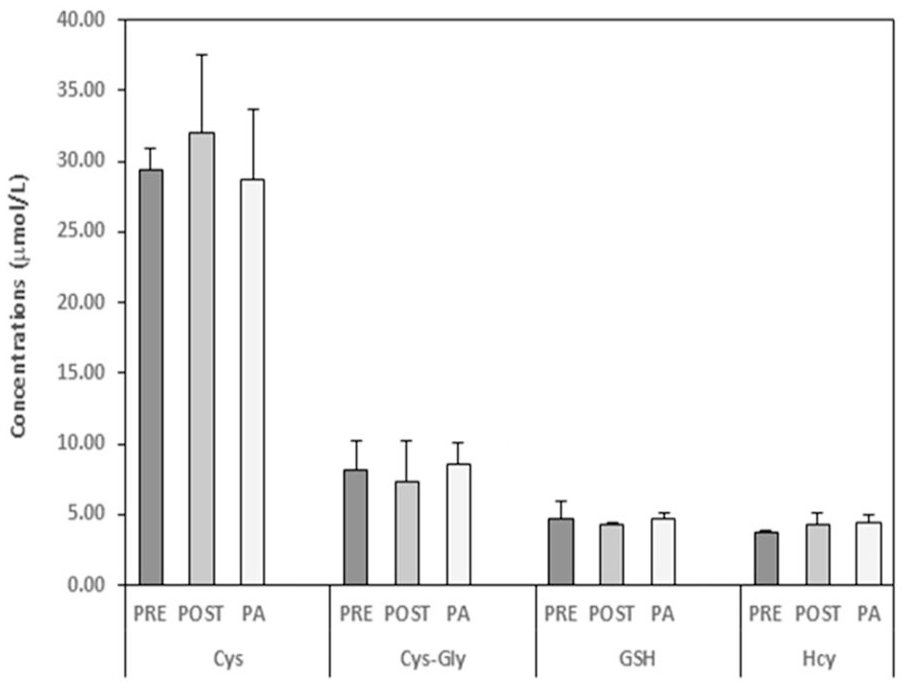
Thiols (Cysteine [Cys], Cysteinyl-Glycine [Cys-Gly], Glutathione [GSH], and Homocysteine [Hcy]) Levels in Milk Before Defatting (PRE), After Defatting (POST), and After Pasteurization (PA).
Thiols concentrations (the major non-enzymatic antioxidant compounds) did not change during milk manipulation (Figure 3). Indeed, Cys values were similar in PRE, POST, and PA samples, Cys-Gly levels were also unchanged, GSH values were even more similar during milk treatments, and Hcy PRE levels were quite similar to POST concentrations, whereas PA concentrations were slightly, but not significantly, higher than the PRE levels.
Microbiological Screening
Finally, the microbiological screening results were in agreement with the EMBA acceptance milk criteria (no bacteria identified in all samples).
Discussion
In this study, milk fat was lowered by cold centrifugation, obtaining an 86% reduction of triglycerides and a 50% reduction of cholesterol. Our results agreed with those reported by Neumann et al. (2020), who obtained an 83% reduction of total fat content by using the same defatting method. They reported that low-fat human milk is an effective and safe treatment option for newborns and infants with chylothorax, providing infants undergoing a low-fat diet with the benefits of human milk.
Regarding micronutrients, there is a lack of available data about the mineral composition of DHM, with only a few researchers who conducted small studies reporting on limited numbers of micronutrients (Dror & Allen, 2018; Perrin et al., 2020). In our study, we found that the calcium concentration in our PRE samples was similar to those reported, ranging from 21.3 to 35.9 mg/dl (Gates et al., 2021). Although the calcium concentration decreased after treatments, it still remained in the range reported (Gates et al., 2021).
While most newborns have sufficient iron stored in their bodies for about the first 6 months of life, preterm infants are prone to iron deficiency, as multiple factors influence their total body iron status (Sarkar et al., 2019); thus, iron supplements could be necessary. On the other hand, caution must be taken with iron supplementation due to both the oxidant role of free iron and the limited antioxidant capacity of the preterm infant (Perez et al., 2019). It is therefore of great importance to measure iron levels in milk samples during the defatting procedures, in order to be sure not to alter the levels of this crucial micronutrient. Iron concentrations in human milk are highly variable (range 0.047–1.96 mg/L; Trinta et al., 2020). In our study, PRE, POST, and PA iron concentrations were significantly different. In particular, Trinta et al. (2020) reported PRE iron concentrations well above the published milk’s iron content for preterm and for full-term mothers. These levels agreed with our POST and PA levels.
Human milk contains a huge assortment of proteins, contributing to its unique qualities. The digestion of some of these proteins provides a quality source of amino acids for infants. Other proteins, for example, lipase, amylase, beta-casein, lactoferrin, haptocorrin, and alpha1-antitrypsin, contribute to the digestion and utilization of milk’s micronutrients and macronutrients (Donovan, 2019). Protein concentrations in human milk are highly variable, influenced by large inter-individual differences, which was the case in our data. Our findings were similar to those of Friend and Perrin (2020), who reported a mean protein concentration of about 0.9 (0.1) g/dl. Other researchers have reported higher concentrations (Jackson et al., 2020). Albumin is also an essential protein. In our study, defatting of milk did not appear to cause protein or albumin loss. Accordingly, other researchers have demonstrated that the concentrations of protein in skimmed milk were at the levels expected for preterm milk. This is of fundamental importance, as human milk’s proteins hold beneficial properties. Indeed, beside the developmental and immunological benefits, proteins like κ-casein, lactoferrin, lysozyme, haptocorrin, α-lactalbumin, and lactoperoxidase, possess antimicrobial properties (Jackson et al., 2020). Since they are relatively resistant against proteolysis in the gastrointestinal tract in an intact or partially digested form, they could contribute to the host defense of breastfed infants against pathogenic bacteria and viruses.
Regarding human milk’s immunological properties, our study demonstrated that treatments did not decrease Immunoglobulin A (IgA) levels. Our results agreed with those reported by Jackson et al. (2020), which demonstrated that although defatted human milk contains significantly less leukocytes than full-fat milk, IgA concentrations were preserved.
As the manipulation of DHM could result in an increase of oxidative damage and/or a decrease in the antioxidant naturally present in human milk, we analyzed lipid peroxidation markers (T-BARS and 8-isoprostane levels), DNA/RNA oxidative damage, and thiols levels in PRE, POST, and PA milk samples. T-BARS are lipid peroxidation markers (expressed as malondialdehyde, MDA), whereas 8-isoprostane belongs to the isoprostanes family, which are eicosanoids of non-enzymatic origin produced by the random oxidation of phospholipids by oxygen radicals. To the best of our knowledge, this is the first time that these oxidative stress markers have been analyzed after the defatting procedure. Only a few researchers have reported the influence of pasteurization on some of the oxidative stress markers (Juncker et al., 2021). We demonstrated that the markers of oxidative stress, the total antioxidants, GSH, and other thiols levels remained stable during our milk manipulation procedures. Large randomized clinical trials are needed in the future to assess the long-term outcome and physical development of infants treated with low-fat human milk.
Limitations
The major limitation of this study was that we were not able to determine the influence of defatting on milk composition without the influence of other confounding variables (e.g., lactation stage). In addition, general applicability of our procedure was limited due to the small, predominantly white cohort within a select geographic region, as this study was conducted in a single HMB located in the center of Italy. Other limitations of this study could be that preterm milk’s fat composition could be different from term milk, thus leading to different results. In addition, a different fat composition could also be due to an incomplete breast expression, conceivably influencing the results of the defatting procedures. Finally, the measurements of the analytes studied could be influenced by potential measurement errors that limit the validity of the study.
Conclusions
In conclusion, low-fat human milk obtained through cold centrifugation and evaluated through the determination of triglycerides and cholesterol, could be considered as a useful treatment option for feeding newborn and infants, as it does not appear to be associated with significant changes in all the markers tested. Defatted milk is also safe. We demonstrated that, in our conditions, no microbial growth was found during the entire process of milk’s defatting.
Supplemental Material
sj-docx-1-jhl-10.1177_08903344231156894 – Supplemental material for Influence of Defatting and Pasteurization on Nutrients and Oxidative Stress Markers in Human Milk
Supplemental material, sj-docx-1-jhl-10.1177_08903344231156894 for Influence of Defatting and Pasteurization on Nutrients and Oxidative Stress Markers in Human Milk by Annamaria D’Alessandro, Anna Pastore, Patrizia Amadio, Matteo D’Agostini, Sara Terreri, Rita Carsetti, Marta Argentieri, Paola Bernaschi, Andrea Onetti Muda, Ottavia Porzio, Andrea Dotta and Guglielmo Salvatori in Journal of Human Lactation
Footnotes
Author Contribution(s)
Disclosures and Conflicts of Interest
The authors declared no potential conflicts of interest with respect to the research, authorship, and/or publication of this article.
Funding
The authors received no financial support for the research, authorship, and/or publication of this article.

Supplemental Material
Supplementary Material may be found in the “Supplemental Material” tab in the online version of this article.
References
Supplementary Material
Please find the following supplemental material available below.
For Open Access articles published under a Creative Commons License, all supplemental material carries the same license as the article it is associated with.
For non-Open Access articles published, all supplemental material carries a non-exclusive license, and permission requests for re-use of supplemental material or any part of supplemental material shall be sent directly to the copyright owner as specified in the copyright notice associated with the article.
