






Abstract
Aims:
Maternal work promotes household and child wellbeing but often presents barriers to optimal breastfeeding outcomes. Maternal work in the variable informal economy has less well-established impacts, but may facilitate breastfeeding when work is childcare compatible.
Methods:
We conducted survival analysis using data from 110 breastfeeding dyads to assess occupation’s effects on time-to-return to work, time-to-complementary feeding, and time-to-breastfeeding cessation in a mixed cash/subsistence economy of fishers, traders, and housewives. We drew on 5,874 hours of longitudinal time-diary data for 68 dyads to evaluate whether occupation and maternal work/childcare strategy (home with child, working with child in tow, or working without bringing child) predicted daily breastfeeding patterns.
Results:
Fishers returned to work significantly earlier postpartum than traders (p < .001) and began complementary feeding earlier than traders (p < .01) and housewives (p < .001). Occupation did not explain differences in breastfeeding cessation, though a higher proportion of fishers and housewives breastfed for at least 2 years compared to traders. Returning to work, with or without children, was negatively associated with total daily breastfeeding and with the percentage of breastfeeding occurring during daytime hours, with the greatest reductions for mothers working without children present (all p < .001).
Conclusion:
Working conditions that are compatible with childcare are beneficial for most breastfeeding outcomes, except exclusive breastfeeding. Our results emphasize the importance of childcare-compatible work that allows flexibility to breastfeed more frequently while working. Results also add to a growing call for institutional-level postpartum economic support for all women in the informal economy, regardless of their occupation’s compatibility with childcare.
This is a visual representation of the abstract.
Keywords
Background
Mothers’ work is often critical to their households, communities, and national economies (Holland & Ell, 2023; International Monetary Fund [IMF], 2018). Women’s engagement in the labor force is associated with greater autonomy and empowerment for women (UN Women, 2024), especially in low- and middle-income countries (LMIC), which can lead to better health and nutritional outcomes for children (Diiro et al., 2017; Sen, 1999; but see Starkweather et al., 2024). For these reasons, improving women’s access to employment and income-earning opportunities has been a primary focus for international development and aid organizations, and a policy goal in many countries around the world (e.g., Pratley, 2016; United Nations [UN], 2015; World Bank, 2014).
While socially and economically important, women’s work outside the home is often associated with declines in breastfeeding activity for infants and young children globally (Chatterji & Frick, 2005; Kim et al., 2019; Mgongo et al., 2024; Tomori et al., 2022; but see Oddo & Ickes, 2018). An earlier return to work postpartum can result in an earlier than optimal transition from exclusive breastfeeding (EBF) to complementary feeding (CF; nonhuman milk foods and liquids), including introduction of unsafe or non-nutritious foods or liquids, and earlier than optimal breastfeeding cessation for young children (Kim et al., 2019; Roll & Cheater, 2016). The World Health Organization (WHO) recommends EBF for the first 6 months of life, followed by the introduction of CF along with continued breastfeeding until 2 years (WHO, 2023). Following these guidelines can improve health and nutritional outcomes for children (e.g., Abdulla et al., 2022; Duijts et al., 2010; Hadi et al., 2021; Khan & Islam, 2017; Venu et al., 2017), which may be especially important in LMIC where undernutrition and infectious disease are among the leading causes of childhood morbidity and mortality (Bassat et al., 2023; Kortz et al., 2024; World Health Organization [WHO], 2022). Despite the many well-documented benefits of breastfeeding, self-reported prevalence of EBF is low globally, with 48% of infants under 6 months EBF in 2023 (UNICEF & WHO, 2023). In LMIC, rates for EBF were even lower, at 48.7% between 2010 and 2018 (Zong et al., 2021). South Asia has the highest rates of EBF, at 60% in 2024 (UNICEF South Asia, 2024), however, in Bangladesh, where this study takes place, nationwide rates of EBF for infants under 6 months were 55% in 2022, declining from 65% in 2017 and 2018, with only 25% of infants ages 4–5 months EBF (NIPORT, 2023). Rates of EBF are low globally in large part due to numerous structural barriers to breastfeeding (Pérez-Escamilla et al., 2023), including maternal work-related constraints like needing to return soon after giving birth, a lack of protected opportunities to express human milk, and extended separation from infants (see Kim et al., 2019; Pérez-Escamilla, 2020; Rivera-Pasquel et al., 2015, for more).
Key Messages
Women’s work is socially and economically important but is often associated with declines in breastfeeding activity globally, with women engaged in the informal economy and their infants disproportionately impacted by constraints of employment on breastfeeding. Greater flexibility in working conditions that allows women to bring infants and young children to work has been suggested as a potential solution to these constraints, but existing evidence of this is limited, and results are unclear.
For Bangladeshi Shodagor women, work that is compatible with childcare (fishing) is associated with shorter periods of exclusive breastfeeding than work that is incompatible with childcare (trading), but this is very likely due to traders returning to work significantly later than fishers and fishers who have returned to work not being able to breastfeed as often as they or their children prefer.
However, among women who have returned to work, childcare-compatible work facilitates breastfeeding during more hours of the workday, relative to incompatible work, and also contributes to prolonged breastfeeding, with 70% of fishers (compared to 55% of traders) breastfeeding for at least 2 years.
Our work supports previous calls for flexible working conditions that allow women to bring breastfeeding children along to work. However, we emphasize that this will not necessarily facilitate longer exclusive breastfeeding, which is critical to short- and long-term maternal–child health outcomes. We add to growing calls for policies that formalize institutionalized postpartum economic support for women working in the informal economy, including paid leave, to facilitate later returns to work and longer exclusive breastfeeding.
Women working in the informal economy are often disproportionately impacted by work-related constraints. The informal economy encompasses a broad range of income-generating activities operating outside (or out of sight) of formal regulatory frameworks, including domestic work, industrial/factory work, self-employment, and subsistence-oriented activities, and is usually characterized by low wages, limited social and legal protection, and precarious working conditions (ILO, 2018; Lee et al., 2020). Therefore, women working in informal settings often return to work earlier than those working in the formal economy (Horwood et al., 2020; Mgongo et al., 2024), which is a key driver of CF before 6 months and early breastfeeding cessation (Horwood et al., 2020; Mgongo et al., 2018; Steurer, 2017). Despite these constraints, informal work may also offer more flexibility than formal work (Lee et al., 2020; Mgongo et al., 2024; Rivera-Pasquel et al., 2015) and is more available to women worldwide, with 60% of women working outside the home (more than 740 million individuals) engaged in informal employment (Horwood et al., 2020). In Bangladesh, nearly all of women’s economic labor is performed in the informal sector, with rates as high as 95.96% in 2023 (Bangladesh Bureau of Statistics [BBS], 2024). The impacts of the constraints and flexibility associated with informal work on infant and young child feeding nevertheless remain understudied and poorly understood (Bhan et al., 2020).
Given the high variability in the types of work that comprise informal economies globally, it is important to examine the nuances of work, including how particular types of flexibility may impact breastfeeding. One such element of flexibility is the compatibility of a particular occupation or task with childcare (Brown, 1970; Popkin, 1980). In other words, are women able to bring infants and young children along with them when they go to work? Some have suggested that workplace policies allowing for greater childcare compatibility could improve breastfeeding outcomes, including for women in LMIC and those working in informal economic settings (Horwood et al., 2020; Nankinga et al., 2019; Popkin, 1980; Rivera-Pasquel et al., 2015; Van Esterik & Greiner, 1981). Additionally, prominent economic and evolutionary ecology theories (Becker, 1985; Gurven & Hill, 2009; Gurven et al., 2009) assert this is done both because of and in order to facilitate the intensive, “on demand” breastfeeding patterns that are considered typical of the human species (Hinde & Milligan, 2011; Martin, 2017; Sellen, 2007). Sellen and Smay (2001) introduce the “maternal work pattern” hypothesis, which predicts that the introduction of complementary foods and the cessation of breastfeeding will occur at earlier ages in populations where maternal subsistence activities necessitate or are associated with physical separation of mothers and infants for longer periods of time. In other words, childcare-compatible work should be associated with longer durations of EBF and later cessation of breastfeeding than childcare-incompatible work.
In this paper, we test the “maternal work pattern” hypothesis and ask Does childcare-compatible work lead to improved breastfeeding outcomes? to determine the utility of childcare-compatible working conditions for facilitating breastfeeding among working women in LMIC, and particularly those working in informal economic settings. We examine the impacts of childcare-compatible work on the relationship between work and breastfeeding among mothers and children from ethnically distinct Shodagor communities in rural Matlab, Bangladesh.
Shodagor fisher-traders represent a low-income, minoritized cultural group who engage in a mixed subsistence and cash economy as a part of Bangladesh’s informal economy. Women in these communities primarily work as fishers or traders, and a small portion are housewives who do not generate resources for their households. Shodagor women’s livelihoods (fishing, trading, housewife) differ in ways that have important implications for childcare (Starkweather et al., 2020) and child health outcomes (Starkweather et al., 2021, 2024), including breastfeeding (Starkweather et al., 2025). Specifically, fishing and being a housewife are compatible with childcare: Housewives stay home and care for children while also engaging in household tasks (cooking, cleaning, etc.), and women fishers typically work with their husbands and bring children of all ages along on the fishing boat, caring for them while engaging in fishing tasks. By stark contrast, trading is totally incompatible with simultaneous childcare: Women work long hours and often travel by foot throughout Matlab, carrying heavy baskets of trade goods on their heads. They report never bringing infants or young children along to work, so children of traders stay at home and are cared for by fathers, siblings, grandparents, or others during the day while mothers work (Starkweather et al., 2020, 2021, 2022, 2024). These within-community differences present an excellent opportunity to determine how occupational differences in childcare compatibility can impact the relationship between returning to work (or not working) and breastfeeding behavior.
To address our research question and test the “maternal work pattern” hypothesis, we first aim to assess the relationship among different work activities for Shodagor women and breastfeeding outcomes (Aim 1). Specifically, we model the impacts of childcare-compatible work (fishing) on the timing of postpartum return to work (RTW), cessation of EBF/introduction of CF, and total breastfeeding cessation, relative to childcare-incompatible work (trading) and to not working outside of the home (housewife).
Second, we aim to explore differences in daily breastfeeding patterns as potential drivers of the Aim 1 outcomes (Aim 2) by using longitudinal daily time-diary data to investigate whether women bringing infants and young children to work (fishers) breastfeed during more hours of the day than women separated from children during the workday (traders), and compare both groups to women who were not working outside of the home at the time of interview (i.e., housewives and mothers who had not yet RTW postpartum). We then evaluate the effects of these different work/childcare conditions on the proportion of daily breastfeeding occurring at night to elucidate how differences in diurnal feeding patterns could impact breastfeeding outcomes. We expect childcare-compatible work will be associated with breastfeeding occurring during more hours of the day, overall, and with a higher proportion of daytime hours than childcare-incompatible work.
Methods
Research Design
This study uses individual-level, cross-sectional, and longitudinal data collected between 2017 and 2025 as part of the Shodagor Longitudinal Health and Demography Project (SLHDP), a long-term project on Shodagor demographic processes, economics, childcare, and health. All data were collected in accordance with procedures approved by ANONYMOUS IRB.
Setting and Relevant Context
Shodagor communities in Matlab, Bangladesh, are traditionally boat-dwelling and semi-nomadic fishers and traders who are culturally distinct from the majority ethnicity in the country. Matlab is a rural area, located approximately 55–75 km south of Dhaka, the capital city of Bangladesh. It is located in the Meghna River floodplain, which experiences seasonal climatic change with flooded “rainy” seasons (approximately April–September) and “dry” seasons, in which flooding recedes (approximately October–March). Matlab is home to approximately 500 Shodagor families in addition to approximately 230,000 residents who work primarily as agriculturalists, wage laborers, and housewives (ICDDRB, 2018), and who do not identify with the Shodagor ethnicity. In 2017, there were around 150 Shodagor families living in five groups in Matlab who either currently lived on boats or had moved onto the land within the previous 15 years. Most of these families live in nuclear family households and extended family groups and are the primary focus of the SLHDP and this study.
Nearly all Shodagor adults (men and women) work in Bangladesh’s informal economy, with household livelihoods revolving around fishing and women’s trading. Most men in the community (90%) work as fishers for the majority of the year, and some also work as day laborers (11%) or do other types of work (2%) at various points throughout the year, with 18% reporting more than one occupation. Forty-five percent of Shodagor women in Matlab report that fishing is their primary occupation, and more than half (52%) primarily work as traders. Fishers, their husbands, and their children typically work year-round, spending long days on the water in small, wooden fishing boats. Husbands and wives cooperate to care for children while completing fishing tasks, and women with infants and young children report periodically pausing their work to care for and breastfeed them throughout the day. Traders usually work with other women, and traditionally, trading was done primarily during the dry season. Recently, women who trade reported working year-round more frequently than in the past. They leave home early in the day, travel up to 2 hours by rickshaw or motorized vehicle and by foot to distant villages in and around Matlab, where they will walk between homes and villages, selling the household goods they carry in baskets on their heads to non-Shodagor women. They often work more than 8 hours per day, returning home late in the afternoon or after dark. In addition to fishing and trading, a small portion (~3%) of women in the Matlab Shodagor communities report “housewife” as their primary and only occupation (i.e., they are not currently working outside of the home and do not plan to do so in the future), though many Shodagor women do not work for prolonged periods of time during different life stages (e.g., after marriage or giving birth). We expect the differences in these occupations to impact infant and young child feeding decisions and outcomes, though these are also likely affected by the larger socioeconomic setting in which Shodagor families are embedded.
Shodagor communities are medically underserved, reporting that they rarely seek preventative care of any kind, including pre- and postnatal care, despite the availability of government and private medical facilities in the Matlab area. They cite affordability and feelings of stigmatization as primary reasons for not accessing care. Additionally, Matlab, Bangladesh, is home to the International Centre for Diarrhoeal Disease Research, Bangladesh’s (icddr,b) health and demographic surveillance system (HDSS), which has provided maternal and child health care services to many Matlab residents since its establishment in 1966 (Alam et al., 2017). Such services include pre- and postnatal care and counseling, which include lactation and breastfeeding support, from trained community health workers. Shodagor families in this study are not included in the HDSS and, therefore, do not receive the associated services. Instead, Shodagor women report a strong cultural norm of intergenerational postpartum support, in which mothers or other older female relatives of the birthing parent provide advice and assistance, including intensive lactation support (see Scelza & Hinde, 2019, and Martin et al., 2016, for other examples of similar practices).
Among Shodagor people, human milk feeding occurs between the birthing/lactating parent and child directly at the breast. Pumping/storing milk for bottle feeding, wet/cross nursing, peer milk sharing from nonbirthing parents, including among kin, and the use of commercial formula milk are rarely practiced, so we use the term breastfeeding throughout the manuscript. Shodagor women express a strong preference for exclusive breastfeeding for 6 months and cessation of breastfeeding after 2 years. They also believe infants should be breastfed every hour or more in the first few weeks of life and “on demand” thereafter. Shodagor mothers breastsleep (McKenna & Gettler, 2016) with infants and young children, sharing a sleeping surface and breastfeeding throughout the night until complete cessation of breastfeeding occurs.
Statement on Use of Gendered Language
The individuals included in this study identify themselves and their children as Shodagor girls, women, wives, housewives, and mothers. As such, we use these same terms to refer to study participants, while acknowledging the importance of inclusivity and equity, including the use of gender-neutral language such as lactating parent/s, in the fields of reproductive health and lactation research more broadly.
Sample
The target population of this study is Shodagor mother–child dyads, with children born between 2015 and 2025 to mothers who were enrolled in the larger study and living in Matlab, Bangladesh. Inclusion criteria for the larger study were all adults who identified with the Shodagor ethnicity and were living in one of five communities in Matlab in which the majority of families had lived on boats within 15 years prior to 2017 (and were thus historically ineligible for inclusion in the icddr,b HDSS). Only mother–child dyads with missing data pertinent to the analyses in this paper were excluded from this study. Given the objective of including all eligible members of the target population in this study, a power analysis was not conducted. The final sample size for Aim 1 of the study, which used one-time, cross-sectional data, was 110 mother–child dyads (representing 110 singleton births to 94 mothers). The final sample size for Aim 2, which used longitudinal time-diary data, was 5,874 breastfeeding hours from 68 mother–child dyads. Given the descriptive aims of the study and the small size of the broader target population (~150 families), these sample sizes are adequate to provide insight into our outcomes of interest.
Data Collection
Recruitment and data collection for this study were conducted between March 2017 and July 2025 using two different structured interviews: one that collected one-time, cross-sectional, demographic data on respondents and their family members, and another that was conducted weekly (or every other week for respondents who could not be reached weekly) to collect longitudinal data. At the beginning of the study in 2017, all adults living in the five focal communities of the SLHDP were recruited, and those who agreed were enrolled, as were all children in households where guardians provided consent. Upon enrollment in the study, adult participants were administered the demographic interview, and weekly interviews began subsequently. Demographic interviews took approximately 1 hour to complete for each adult in the community, while weekly interviews lasted an average of 15 minutes each. Informed consent was obtained from all participants at the time of enrollment in the study, and participants periodically re-consented informally throughout the study. Trained Bangladeshi research assistants interviewed participants in or near their homes using paper surveys. Surveys were stored in a locked office at the host institution in Bangladesh (icddr,b), and only project personnel had access to study data. Each participant was assigned a unique alphanumeric ID by a senior project team member (KS or FTZ) to maintain confidentiality of study data. Throughout the study timeline, participants were compensated monthly at a rate of 100 Bangladeshi taka (BDT; around $1.00 USD) per hour of active study participation, roughly equivalent to the wages earned from trading or fishing.
Measurement
Demographic Data
The demographic interview was developed and pretested by the research team, adapted from a previously used demographic questionnaire (Starkweather, 2016). It was administered to all adult study participants upon their enrollment in the project and collected information about family sociodemographic characteristics, household economics, family members’ health histories, and women’s reproductive and breastfeeding histories (both of which were updated in July 2025). Birth dates for mothers and children were used to construct the following variables: maternal age (years) used in the Aim 1 models reflects each mother’s age at the time each child was born, and child age (months) categories used in the Aim 2 models (0–6 months, 6–12 months, and 12 months or older) reflect child age at each date breastfeeding was reported and were calculated by subtracting birth date from date of interview. Child age is reported as a continuous variable in descriptive statistics (Table 1B).
Reproductive histories were used to construct the following variables used in this study: time until return to work (RTW), indicating the number of months after giving birth after which a mother returned to work in their reported income-earning occupation (i.e., fishing, trading), and maternal occupation reflects mothers’ occupations following each birth (1 = fishing, 2 = housewife, 3 = trading), which sometimes changed between pregnancies.
Breastfeeding histories collected child age at complementary feeding (CF), the child’s age (in months) at which complementary nutrition (any liquid or solid substance besides mother’s own milk, including water; World Health Organization [WHO], 2023) was first given prior to breastfeeding cessation. These also collected child age at breastfeeding cessation, which is the age (in months) at which children no longer received any mother’s own milk in their diet (Theurich et al., 2025).
Weekly Interview Data
Weekly longitudinal interviews were also developed and pretested by the research team prior to implementation. Adult study participants were asked the same questions weekly or every other week to collect detailed longitudinal data on household economics, illnesses, and women’s daily time allocation, and to update household demographics (e.g., births, deaths, marriages) as applicable. Women’s daily time allocation was collected using the “time-diary method” (Robinson, 2002) in which women were asked to recall everything they did during the one day prior to the interview. This method allows respondents to describe their full 24-hour day, providing a sequential and comprehensive record of all activities (Bauman et al., 2019). For this study, women were asked to verify whether they were currently breastfeeding or not at the time of each interview and, if yes, were asked to report whether or not they breastfed their child during each hour of the previous day. All breastfeeding responses were collated, and these data were used to construct the daily breastfeeding hours variable. This variable thus reflects the hours during the previous day in which any time was devoted to breastfeeding (maximum value = 24) but does not capture how many times within an hour participants breastfed. Feeds occurring between 7:00 am and 7:59 pm were coded as daytime events to represent typical working hours, and feeds between 8:00 pm and 6:59 am were coded as nighttime events. Nighttime breastfeeding proportion reflects the proportion of total feeds reported in the previous 24-hour period that took place during nighttime hours.
The dates for which women reported breastfeeding were used along with the reported timing of postpartum return to work following each birth to create a categorical variable representing each mother’s current working/childcare situation at the time of each interview. Work/childcare status grouped observations into three categories: Group 1: Not RTW (anyone who was not presently working at the time of the interview, including housewives and income-earning mothers who had yet to return to work after birth); Group 2: RTW with child (anyone who had returned to work and brought their child along with them; women in this category were only fishers); and Group 3: RTW without child (anyone who returned to work and did not bring their child with them; primarily traders).
Finally, variables indicating season were coded based on the date of each event used in a given analysis (1 = dry season, 2 = rainy season).
Data Analysis
Statistical analysis was conducted using Stata/BE 19.5 for Windows (College Station, TX). We performed exploratory analyses using log-rank tests of equality of survivor functions, Kaplan-Meier plots, and Kruskal-Wallis equality-of-populations tests (output not shown). Statistical significance was determined at α = .05 (two-tailed) for all analyses.
For Aim 1, we employed survival analysis to assess the relationship between occupation and the timing of work and childcare decisions among Shodagor mothers. Survival analysis is appropriate for analyzing right-censored, time-to-event data such as our main dataset. Robust standard errors were specified (vce(cluster) in Stata) to account for participants with more than one child reported in the dataset. For Model 1, we used a Cox (proportional hazards) model with Breslow method for ties with timing of RTW postpartum (for fishers and traders) as the outcome and maternal occupation, age (years) at child’s birth, and season of RTW (dry = 1, rainy = 2) as covariates. Cox PH models were also used to assess the timing of CF initiation (Aim 1, Model 2) and the timing of full breastfeeding (BF) cessation (Aim 1, Model 3) for fishers, traders, and housewives, with maternal occupation, age at birth, and season (of CF introduction and BF cessation, respectively) as covariates.
For Aim 2, we used multilevel mixed-effects regression to determine whether maternal work/childcare group (1 = Not RTW, 2 = RTW with child, or 3 = RTW without child) predicts total daily breastfeeding and the proportion of nighttime feeds in the subset of dyads with longitudinal time allocation data. Multilevel mixed-effects models are appropriate given that there are repeat measures for individual offspring as well as more than one child per mother within the longitudinal dataset. Model 1 was a multilevel mixed-effects negative binomial regression of maternal work/childcare group (1–3) on daily breastfeeding hours with child age category (1–3), season, and a binary indicator of exclusive breastfeeding (EBF) status as covariates and random effects at the individual level. Negative binomial regression is used with count outcome data that are over-dispersed. Model 2 was a standard multilevel mixed-effects regression of maternal work/childcare group (1–3) on the proportion of daily breastfeeding hours occurring at night (a decimal value between 0 and 1) with the same covariates and random effects specified as in Aim 2, Model 1. There were no cases with missing data.
Results
Study Sample Characteristics
Participants in our sample ranged in age from 14 to 41 years old, and their primary occupation was reported as fishing in approximately one-third of breastfeeding dyads and as trading in 46.4% of dyads (Table 1A). Several multiparous participants reported different post-pregnancy occupations for different children. Housewives were overrepresented in the sample (20%) relative to the overall Shodagor population, as many women do not begin working outside the home until after their first child is born so report their occupation while caring for child #1 as a housewife but as a fisher or trader for subsequent children. Consistent with this, the mean age of housewives in the sample was younger than that of fishers or traders, and mean parity was lower (Table 1B). The mean child age at full breastfeeding cessation was 23.3 months (SD = 9.2) across the full sample. Maternal characteristics and breastfeeding histories of the primary sample (N = 110) are shown in Table 1B.
Breakdown of Maternal Occupation for 110 Breastfeeding Dyads from 94 Individual Mothers.

Descriptive Statistics for Continuous Variables Used in Analysis.
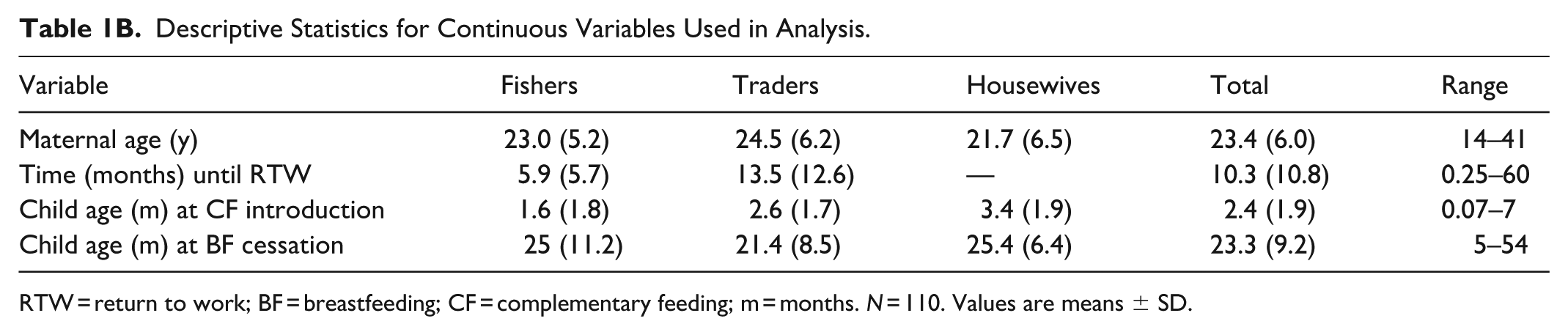
RTW = return to work; BF = breastfeeding; CF = complementary feeding; m = months. N = 110. Values are means ± SD.
Aim 1, Model 1: Occupation and Timing of RTW
Of the 88 cases included in the RTW model, four were children born relatively recently whose mothers had not yet returned to work. The failure curve demonstrated significant differences in the rate of RTW between fishers and traders, particularly within the first 12 months postpartum, consistent with our predictions (Figure 1). Traders were less than half as likely to return to work at a given time point as fishers (p = .001; Table 2). We found no effect of either maternal age or season on when participants returned to work.

Kaplan-Meier failure plot of the probability of mothers returning to work as a function of postpartum time in both fishers and traders (N = 88).
Hazard Ratios, Robust Standard Errors (RSE), 95% Confidence Intervals (CI), and Significance Values for Time-to-RTW.
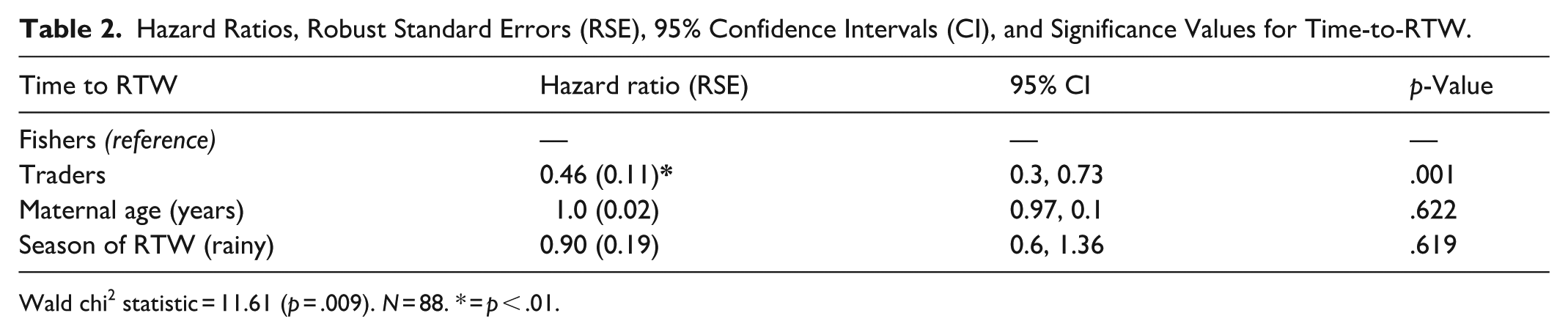
Wald chi2 statistic = 11.61 (p = .009). N = 88. * = p < .01.
Aim 1, Model 2: Occupation and Timing of CF
Of the 110 breastfeeding dyads included in the complementary feeding Cox model, only one child had not yet received any form of complementary nutrition by the final survey visit. Fishers and traders initiated CF significantly earlier than housewives (p < .001 and p = .009, respectively), with fishers being 2.5 times as likely to begin CF as housewives at any time point (Table 3). The probability of complementing breastfeeding with water or other non-breastmilk substances by 2 months of age was nearly 75% for fishers, <50% for traders, and <25% for housewives (Figure 2). Neither maternal age nor season was significantly associated with the timing of starting CF.
Hazard Ratios, Robust Standard Errors (RSE), 95% CI, and Significance Values for Time-to-CF.
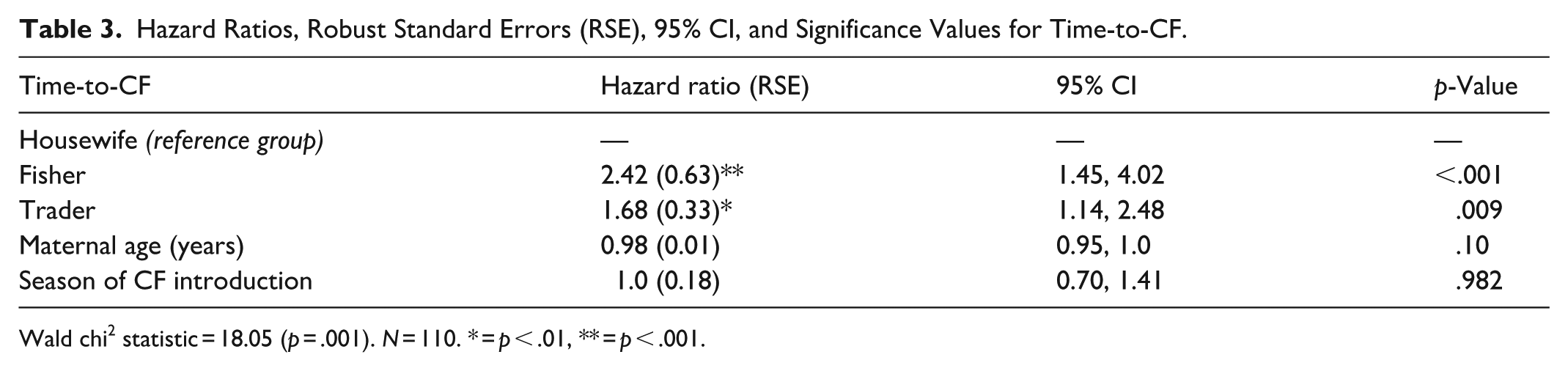
Wald chi2 statistic = 18.05 (p = .001). N = 110. * = p < .01, ** = p < .001.

Kaplan-Meier failure plot of the probability of initiating complementary feeding as a function of postpartum time in fishers, housewives, and traders (N = 110).
Aim 1, Model 3: Occupation and Timing of Breastfeeding Cessation
Twenty-five dyads (out of 110) had fully ceased breastfeeding by the survey endpoint. While the failure curve showed some differences in the time-to-breastfeeding cessation between occupational groups (Figure 3), these were not statistically significant in the Cox regression model with housewives set as the reference group (Table 4). While maternal age was a similarly weak influence on the timing of breastfeeding cessation, seasonality showed a strong effect. Holding all covariates constant, Shodagor mother–child dyads were 52% less likely to fully cease breastfeeding during the hot, rainy season than during the cooler, dry season (p = .002).

Kaplan-Meier failure plot of the probability of full breastfeeding cessation as a function of postpartum time in fishers, housewives, and traders (N = 110).
Hazard Ratios, Robust Standard Errors (RSE), 95% CI, and Significance Values for Time-to-Breastfeeding Cessation.
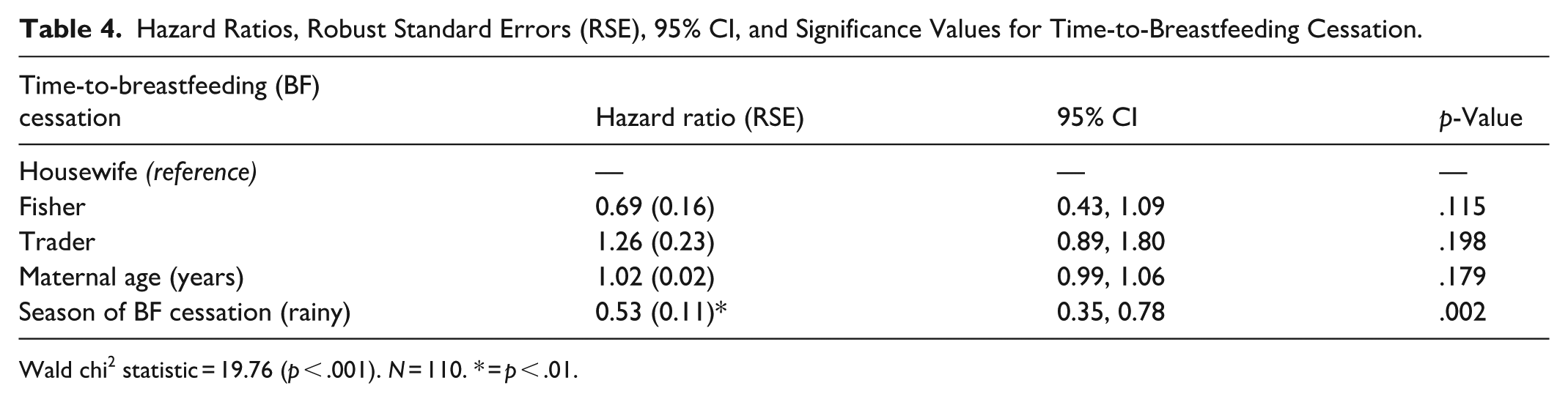
Wald chi2 statistic = 19.76 (p < .001). N = 110. * = p < .01.
Aim 2, Model 1: Work/Childcare Status and Daily Breastfeeding Time Allocation
Median daily breastfeeding hours in the daily time-diary dataset (N = 5,874) differed significantly between occupations and between work/care categories in Kruskal-Wallis rank tests (p = .001). In the multilevel mixed-effects negative binomial regression (Aim 2 Model 1), returning to work negatively predicted daily breastfeeding hours relative to being at home with children (p < .001; Table 5). Consistent with our expectations, returning to work without bringing children had a greater negative effect on daily breastfeeding than returning to work with children in tow, particularly in children under 6 months (Figure 4). All child age categories were strongly associated with daily breastfeeding in this model (p < .001), as were exclusive breastfeeding (EBF) status (p < .001) and season (p = .001).
Coefficients (β), Standard Errors (SE), 95% CI, and Significance Values for Daily Breastfeeding Time Allocation (hours, max. 24).
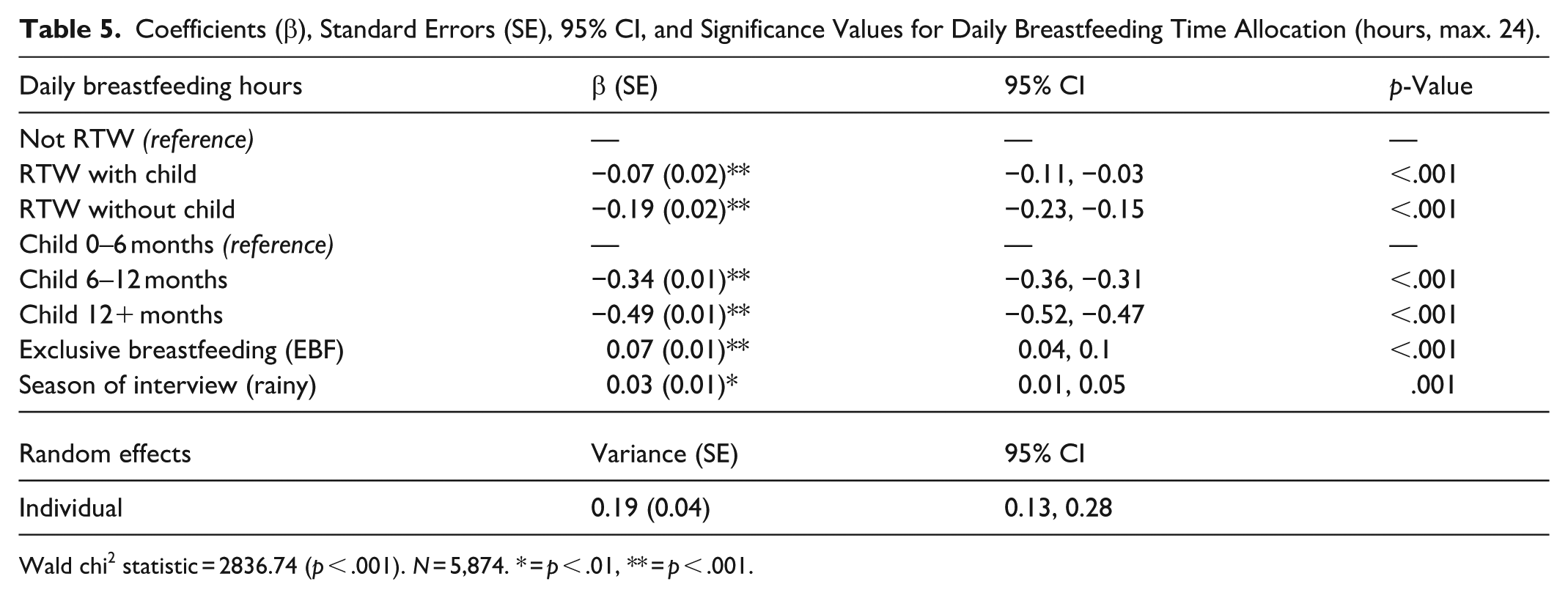
Wald chi2 statistic = 2836.74 (p < .001). N = 5,874. * = p < .01, ** = p < .001.

Predicted mean daily breastfeeding hours (with 95% CIs) (N = 5,874) by maternal occupation and work/childcare status across the 0–6 months, 6–12 months, and 12+ months child age categories. Not RTW = mother is not working and at home with child; RTW(c) = mother has returned to work and brings child; RTW(nc) = mother has returned to work and leaves child at home.
Aim 2, Model 2: Work/Childcare Status and Nighttime Breastfeeding
Returning to work, with or without children, was significantly associated with a higher proportion of daily breastfeeding occurring at night (Table 6). Children moving from the 0–6 months age category to the 6–12 months category predicted a relative decrease in nighttime breastfeeding (p < .001), with no notable effects in children over 12 months old. Children 12 months of age and older did not significantly differ from infants because many older children whose mothers work were only breastfed in the evenings (Figure 5). EBF status and season were not strong predictors of nighttime breastfeeding in this model.
Coefficients (β), Standard Errors (SE), 95% CI, and Significance Values for the Proportion of Daily Breastfeeding Done at Night.
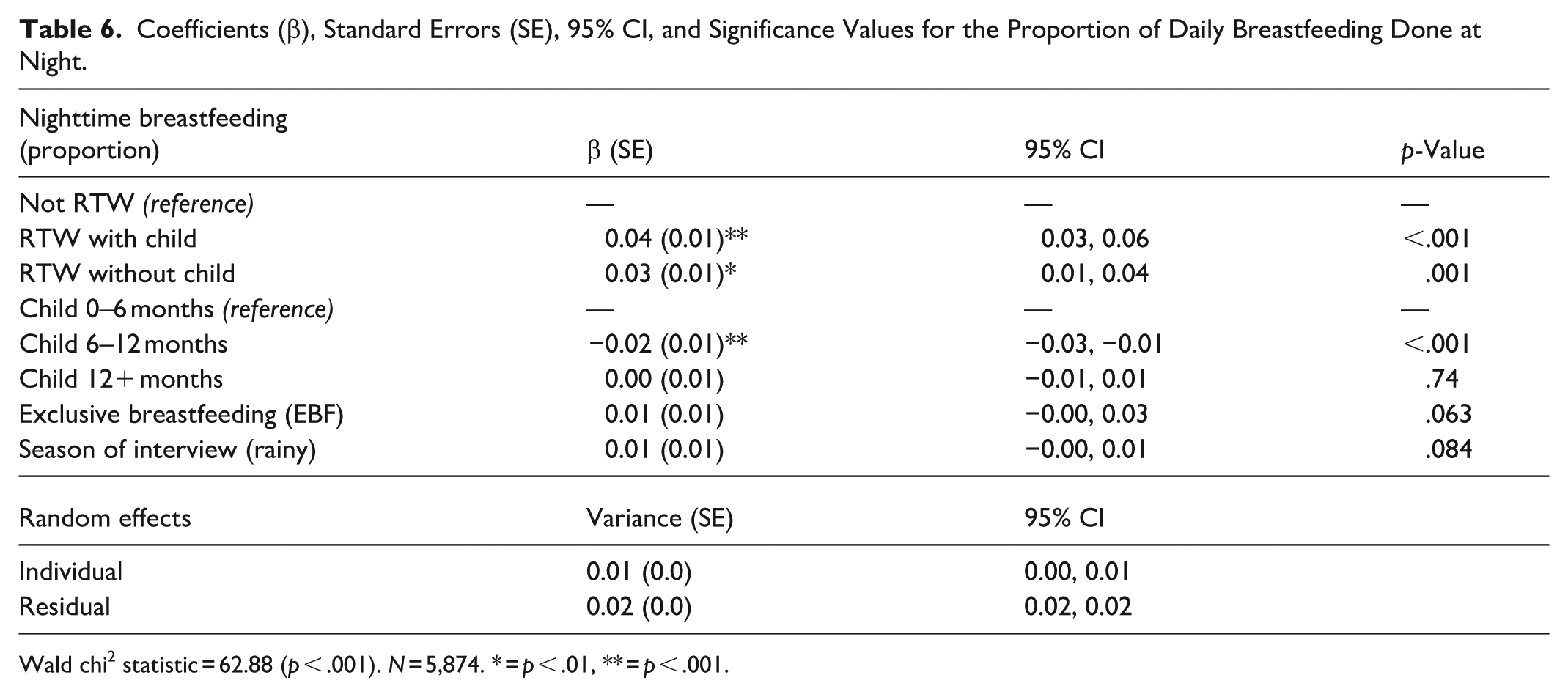
Wald chi2 statistic = 62.88 (p < .001). N = 5,874. * = p < .01, ** = p < .001.

Predicted proportion of total breastfeeding occurring at night (with 95% CIs) in relation to maternal work/childcare group, stratified by child age category (N = 5,874).
Discussion
In this study, we addressed the question, “For Shodagor women working in the informal economy, is childcare-compatible work associated with better breastfeeding outcomes than childcare-incompatible work?” Our results indicate mixed support for the “maternal work pattern” hypothesis and show that the timing of RTW and the compatibility of work with childcare both influence daily breastfeeding practices and breastfeeding outcomes.
Contrary to our expectations, childcare-compatible work (i.e., fishing) does not consistently lead to better breastfeeding outcomes than childcare-incompatible work (i.e., trading). Most notably, for exclusive breastfeeding (EBF)—the outcome with the strongest and most consistent positive impacts on child health and growth (Cohen et al., 1994; Da Costa et al., 2010; Kramer & Kakuma, 2012; Lamberti et al., 2011; Rowland et al., 1978; Underwood & Hofvander, 1982; Victora et al., 2016)—fishing had a strong negative effect, compared to trading or being a housewife: Fishers EBF for the shortest duration, introducing complementary foods and liquids (CF) to infants’ diets at the earliest average ages (Table 1B, Figure 2). While only 5% of dyads in our sample reported EBF for the WHO-recommended 6 months, there were major differences among dyads in time-to-CF based on mothers’ occupations (Table 1B). Unsurprisingly, housewives EBF for the longest mean duration, consistent with prevailing evidence showing that mothers not working outside the home tend to EBF for longer than those who do (e.g., Hunegnaw et al., 2017; Ong et al., 2005; Riaz et al., 2022; Yeneabat et al., 2014). While a valuable baseline for comparison in our study, being a housewife is not economically viable for many Shodagor women, or for most women in LMICs.
Given that traders are separated from their children during the workday, we anticipated that trading mothers would introduce CF earlier than fishers. To the contrary, our complementary feeding analyses indicated that by 1 month postpartum, 54% of fishers had introduced CF, compared to 27% of traders (and 18% of housewives). By 2 months, 73% of fishers had transitioned from EBF to CF, compared to 47% of traders (and 23% of housewives) (Figure 2). These findings contradict the “maternal work pattern” hypothesis (Sellen & Smay, 2001) and challenge prevailing economic and evolutionary-ecological theories positing that childcare-compatible labor does not require stark maternal trade-offs between work and childcare (e.g., breastfeeding), resulting in “better” outcomes for children (Becker, 1985; Gurven & Hill, 2009; Gurven et al., 2009).
Our analyses of time-to-RTW (Aim 1 Model 1) demonstrated that fishing women RTW significantly earlier than those who trade (Table 2). We found that by 1 month postpartum, 30% of fishers have RTW compared to 9% of traders. By 5 months postpartum, 44% of fishers and 24% of traders have RTW (Figure 1). This alone is insufficient to explain the difference in EBF patterns, however, as fishers are almost always accompanied by their children when at work and able to breastfeed throughout the day.
The daily breastfeeding hours model (Aim 2 Model 1) results indicate that women who have RTW with their children breastfeed during significantly fewer hours per day than women who are not currently working (those who have not yet RTW and housewives) (Table 5, Figure 4). This pattern is consistent across all child age categories, but the difference is greatest for infants 0–6 months old (Figure 4). Additionally, the proportion of nighttime breastfeeding model (Aim 2 Model 2) demonstrates that women who RTW with their children do a greater proportion of total daily breastfeeding overnight (8 pm–7 am) and outside of working hours, compared to women not currently working (Table 6). Together, our results indicate a clear trade-off for Shodagor women who bring children to work: They RTW earlier than those who do not bring children to work and are feeding during significantly fewer daytime hours while working. If this pattern results in longer intervals between feeds starting at an earlier age, these conditions could increase the likelihood that nonhuman milk foods and/or liquids are introduced earlier and suggest a likely mechanism leading fishers to stop EBF earlier than traders (and housewives).
These findings are consistent with reports from women across economic contexts, including Shodagor women, that illustrate why childcare-compatible work may facilitate less frequent breastfeeding during the workday. Among Tamang women in rural Nepal, agricultural labor is associated with less frequent breastfeeding sessions than animal husbandry work and is reportedly more demanding, requiring women to breastfeed based on “opportunity” rather than on “demand” (Panter-Brick, 1991). Working women in Ghana (Stumbitz et al., 2018) and Tanzania (Matare et al., 2019) report that while they can bring children to work, they cannot stop work to breastfeed as frequently as preferred. Similarly, in unpublished focus group discussions, Shodagor fishing mothers report that they cannot stop to breastfeed as frequently as they would like due to the demands of the work. Together, our data and corresponding reports from women doing informal work across LMICs suggest that childcare-compatible labor is not exempt from trade-offs nor does it necessarily support breastfeeding at ideal intensities. Childcare-compatible work is therefore not a “silver bullet” solution to facilitate optimal breastfeeding outcomes if earlier postpartum return to (childcare-compatible) work reduces the duration of EBF.
The timing of postpartum RTW also impacts Shodagor trading mother–child dyads. As shown, traders RTW far later on average than fishers, and the daily breastfeeding hours model shows that individuals who delay their RTW longer breastfeed for more hours of the day across all age groups compared to fishers or traders who have RTW (Table 5, Figure 4). Delayed RTW and a higher intensity breastfeeding pattern are likely key reasons traders have a longer mean EBF duration than fishers. Despite these advantages, once traders RTW, the number of hours per day in which they breastfeed is the lowest among the entire sample (Figure 4), and the proportion of nighttime feeding is highest (Figure 5), suggesting they likely breastfeed least frequently of any group, with the longest intervals between feeds during the workday. This may be particularly detrimental for infants whose mothers RTW as traders before 6 months postpartum, as longer intervals between feeds are expected to lead to earlier introduction of CF.
In addition to effects on EBF duration, postpartum RTW and maternal occupation influence total breastfeeding duration. Our analysis indicates that Shodagor traders, fishers, and housewives are predicted to conclude breastfeeding at similar child ages (Table 4), with some variation across time points. Nearly 48% of traders ceased breastfeeding by 18 months postpartum, compared to 29% of fishers and 22% of housewives, and by 24 months, 78% of traders had stopped breastfeeding, compared to 66% of fishers and 47% of housewives (Figure 3). Overall, only 55% of traders, 70% of fishers, and 73% of housewives breastfeed for at least 2 years, as recommended by the WHO (2023). These results suggest that traders may be at the highest risk of early cessation of breastfeeding, indicating that childcare-compatible work can facilitate longer total breastfeeding time in some instances than childcare-incompatible work. Results also demonstrate that early CF does not necessarily result in early breastfeeding cessation, as fishers are breastfeeding as long as (or longer than in some cases) other women in the study who introduce CF significantly later. This is consistent with the “maternal work pattern” hypothesis but is unexpected given fishers’ earlier RTW and CF, both of which are often closely linked to earlier cessation of breastfeeding (RTW: Chuang et al., 2010; Kimbro, 2006; Mandal et al., 2010; Ogbuanu et al., 2011; Skafida, 2012; CF: Aikawa et al., 2015; Dozier et al., 2018; Ekström et al., 2003; Howel & Ball, 2013; Ong et al., 2005). As with EBF, these disparities are likely due in part to daily breastfeeding patterns—specifically among women who work outside the home.
The daily breastfeeding hours model shows that among women who RTW, those who bring children along breastfeed for more hours of the day than those who do not bring children along, across all child age groups (Figure 4). Mothers who bring children to work also report doing a greater proportion of total daily breastfeeding during the workday (relative to nighttime) compared to those who leave children at home (Figure 5). For fishers, this could indicate breastfeeding more consistently throughout the workday than traders. Consistent breastfeeding is important for maintaining lactation, and this may facilitate the prolonged breastfeeding patterns seen in fishers. For some traders, longer intervals between feeds could contribute to earlier breastfeeding cessation. These results support the “maternal work pattern” hypothesis (Sellen & Smay, 2001) and suggest that although childcare-compatible work is not necessarily conducive to longer periods of EBF, the proximity of mother and child likely facilitates prolonged breastfeeding relative to childcare-incompatible work.
Limitations
Potential limitations of this study include our inability to determine more detailed measures of breastfeeding time allocation, such as total frequency or duration of breastfeeding sessions. While we can report daily hours in which breastfeeding occurred, diurnal patterns of breastfeeding, and daily minimum frequency of breastfeeding sessions, we cannot definitively confirm that any group of women breastfeeds more or less than another. We are careful to represent our data and results accurately in light of this. Additionally, our maternal work data do not reflect the nuances associated with RTW. Respondents indicate the age of their child upon RTW, but this does not reflect how much or often they worked. We expect that working fewer days per week or fewer hours per day would have less impact on breastfeeding than working 8+ hour days, 5+ days per week, as is common in this and many other communities. Another likely limitation is that Shodagor women are—for all intents and purposes—self-employed: They and their families have autonomy over decisions about how soon to resume work postpartum, how often to work, and for how long. Therefore, they are not subject to potential constraints associated with having an employer, and factors like risk of losing a job do not play a role in Shodagor women’s decision-making about returning to work or breastfeeding, unlike some women working in other sectors of the informal economy (e.g., Horwood et al., 2021; Luthuli et al., 2020). Finally, our data represent a small sample of mother–child dyads from a small cultural minority group (Starkweather, 2017). Despite these potential limitations to generalizability, our longitudinal data provide a highly detailed picture of daily/diurnal breastfeeding patterns. Additionally, the division of women’s work in Shodagor communities makes this an ideal setting to address our research question in a way that is often difficult in much larger samples. We identify likely mechanisms driving relationships between work and breastfeeding for women doing informal and subsistence labor and call for future research to examine these mechanisms on a larger scale.
Conclusion
Around the world, women’s work supports households, communities, and national economies, and is a critical component of women’s empowerment. However, it is also often associated with declines in breastfeeding activity, including in LMIC, and women working in the informal economy may be particularly vulnerable to some of the negative effects of work on breastfeeding. One proposed solution to balance labor and childcare needs is for mothers to do childcare-compatible work, bringing infants and young children along. However, our results show that while childcare-compatible work does not necessarily facilitate EBF, it can lead to more breastfeeding during the workday than childcare-incompatible work, which may ultimately support prolonged breastfeeding. This demonstrates the importance of supporting flexibility for mothers working in the informal economy to enable breastfeeding at regular intervals throughout the workday—especially in settings where breast pumps and refrigeration for safe human milk storage are not readily available. Our results also suggest that an earlier return to work for women doing both childcare-compatible and incompatible work can be detrimental to EBF, with infants likely to be most negatively impacted. As such, delaying RTW is critical for mothers in all occupations, and we add to a growing call by researchers (Mgongo et al., 2024; Pérez-Escamilla, 2020; Siregar et al., 2021) for greater economic support for postpartum women in the informal economy, including paid leave (ILO, 2016).
Footnotes
Acknowledgements
The authors thank the Shodagor communities in Matlab, Bangladesh, for their participation in this project and many others. We thank Siddiqudzaman, Laila Parveen, Ummahani Akter, Shahnaj Akter, and Mofazzal Hossain for their indefatigable efforts in data collection, and Hanif chacha, our longtime boatman and key informant. Thank you to Taslim Ali and the HDSS staff at ICDDR,B Matlab and Dhaka for providing logistical and field support. Finally, we are grateful to Richard McElreath, the late Julia Cissewski, and the Department of Human Behavior, Ecology, and Culture at the Max Planck Institute for Evolutionary Anthropology for long-term support of this project.

Author Contributions
Funding
The authors disclosed receipt of the following financial support for the research, authorship, and/or publication of this article: This research was funded by the Max Planck Institute for Evolutionary Anthropology’s Department of Human Behaviour, Ecology, and Culture and the National Science Foundation: SBE Postdoctoral Research Fellowship #1809186 and Senior Research Award #2149108
Declaration of Conflicting Interests
The authors declared the following potential conflicts of interest with respect to the research, authorship, and/or publication of this article: We disclose that Kathrine Starkweather was the postdoc mentor for Haley Ragsdale while this manuscript was being drafted and that Starkweather and Nurul Alam both served as supervisors of Fatema Tuz Zohora during her time at the International Center for Diarrhoeal Disease Research, Bangladesh.
Prior Publications Using Data in This Manuscript
Starkweather, K., Ragsdale, H., Butler, M., Zohora, F. T., & Alam, N. (2025). High wet-bulb temperatures, time allocation, and diurnal patterns of breastfeeding in Bangladeshi fisher-traders. Annals of Human Biology, 52(1), 2461709.