






Abstract
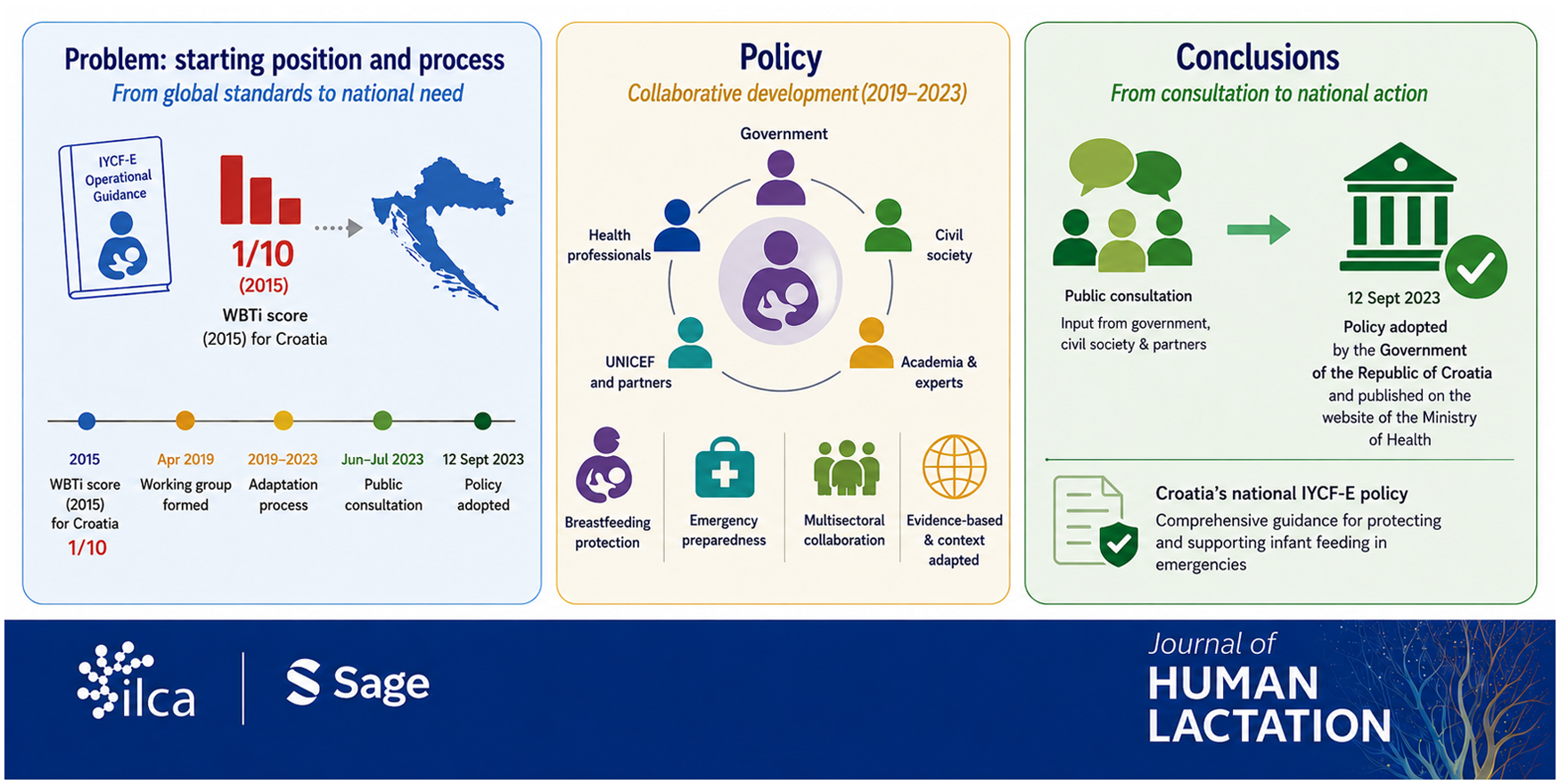
Emergency situations pose a serious threat to population health, especially of vulnerable populations. Hence, governments must be prepared to provide coordinated emergency relief, based on official guidance, which includes the protection of breastfeeding—a pillar of food security for infants and young children. The Republic of Croatia did not have a policy on infant feeding in emergencies, despite facing several disasters in the past. In the 2015 World Breastfeeding Trends Initiative Report, Croatia received only 1 of 10 points for “Infant feeding during emergencies.” Consequently, a multidisciplinary working group within the Ministry of Health was formed in 2019, with the task of preparing a national policy. The “Operational Guidance on Infant Feeding in Emergencies” (OG) was used as a template. This seminal document was translated and carefully adapted to the Croatian setting, which proved to be a lengthy, complex and consultative process. A draft was sent to relevant government departments and organizations for feedback, validation, and approval. The revised guidance was posted on the government’s official website for public consultation. On September 12, 2023, the Minister of Health of the Republic of Croatia adopted the document “Infant and young child feeding in emergency situations—Guidance for aid workers and program leaders in emergency situations.” Developing Croatia’s national guidance through a volunteer-based, multisectoral working group was cost-effective, relied on existing expertise, and fostered strong collaboration between government, civil society, and international organizations. Using the OG as the foundation ensured alignment with global standards and accelerated the drafting process.
Background
Emergency situations, whether natural or man-made, are occurring with increasing frequency, posing serious threat to population health and well-being. Those most affected are vulnerable groups, like the elderly, infants, and young children. In anticipation of future emergencies, governments must be prepared to provide coordinated emergency relief, including shelter, food, and health care.
Breastfeeding is a safe, reliable and sustainable form of infant and young child feeding (IYCF), providing a continuous source of clean, nutritionally complete food and water, alongside immunological protection and psychosocial support. Breastfeeding protects against infant morbidity and mortality, particularly from diarrhoeal disease and acute respiratory infections, in addition to protecting against malnutrition. This makes breastfeeding vital in emergency and humanitarian settings, where access to safe water, sanitation, and health services is often disrupted. Breastfeeding must therefore be recognized as a life-saving public health intervention and systematically protected, promoted, and supported through emergency preparedness, response, and recovery policies.
Preparedness for emergencies should begin well before they occur. To support countries in this effort the Infant Feeding in Emergencies Core Group published Version 3 of Operational Guidance on Infant Feeding in Emergencies (OG) in 2017. The first OG was published in 2001, as a result of the Balkans’ crisis, and was revised in 2010 when members of the World Health Assembly agreed to institute infant and young child feeding in emergencies (IYCF-E) planning, in line with the OG. This seminal document, aimed at policy-makers, decision-makers and program implementers working in emergency situations, outlines practical steps needed to prepare for, respond to, and recover from emergencies in order to minimize infant and young child morbidity and mortality associated with feeding practices and to maximize child nutrition, health, and development (IFE Core Group, 2017). This is in alignment with the Global Strategy for Infant and Young Child Feeding, a World Health Organization (WHO) and United Nations Children’s Fund (UNICEF) framework, that, to this day, underpins IYCF policy and practice (WHO, 2002).
Key Messages
● Emergencies pose serious risks to child health and survival, making breastfeeding protection and support a critical component of food security and humanitarian response.
● Croatia lacked any policy framework for infant feeding during emergencies, despite past experiences with disasters. A very low score for the indicator “Infant feeding during emergencies” in Croatia’s 2015 World Breastfeeding Trends Initiative country report provided the incentive to create a policy.
● Relying on existing expertise and altruism, a volunteer-based, multisectoral working group was formed within the Ministry of Health’s National Breastfeeding Committee. This was a cost-effective approach, and fostered strong collaboration between government, civil society, and international organizations.
● The use of the Operational Guidance on Infant Feeding in Emergencies (OG) as a template ensured alignment with global standards and accelerated the process of producing Croatian guidance. Public consultation and formal validation from relevant organizations enhanced transparency and legitimacy.
A 2020 report on European IYCF policies and practices, using the World Breastfeeding Trends Initiative assessment tool (WBTi, 2025) revealed that Europe was largely overlooking the risks associated with inappropriate IYCF in emergencies (Zakarija-Grković et al., 2020). Of the 10 policy and program indicators, “Infant and young child feeding during emergencies” scored the lowest, receiving an average score of only 1.6 of 10. In all, 16 of 18 European countries assessed, scored less than 5. Only one country—North Macedonia—satisfied most criteria, including a national policy on IYCF in emergencies (IYCF-E) that incorporated the essential components of the OG. However, Croatia performed poorly in the 2015 WBTi assessment scoring 1 out of 10, with no national policy, no persons tasked for coordination, no action plan, and no orientation/training materials. Prompted by this low score, Croatia’s National Breastfeeding Committee (NBC), established in 2007 by the Ministry of Health, included in its 2018–2020 National Breastfeeding Program an action point on the development of IYCF guidelines for emergency situations, along with accompanying training materials.
This paper aims to describe the process of developing a national policy on IYCF-E for Croatia, based on the OG. The experience shared here may serve as a practical resource for other countries seeking to develop their own national IYCF-E policies.
The Process of Developing Croatia’s National IYCF-E Policy
A working group of four NBC members was formed in April 2019, consisting of a breastfeeding physician/IBCLC, parenting organization representative, community nurse, and Ministry of Health (MoH) representative. A UNICEF staff member with extensive experience in child protection in emergencies was invited to join the group. The first meeting of the working group was held in October 2019 to develop a national IYCF-E policy for Croatia. Members met regularly thereafter, on a voluntary basis, mainly online.
The group agreed to base the national IYCF-E policy on the OG; hence, the first step was translation of the OG into Croatian. This was done by a professional translator who was funded by the Office for UNICEF in Croatia. The next step was adaptation of the translated OG to the Croatian context. This was a lengthy, complex, and consultative process. It involved adding an introduction reflecting Croatia’s experience with emergencies (e.g., the 1991–1995 war for independence, the 2014 floods, the 2015–2016 refugee and migrant influx, and the COVID-19 pandemic); defining key feeding terms; aligning content with Croatian and European Union laws and regulations; listing relevant local organizations; adjusting the processes to the national health system; replacing international contacts with national ones; and adding local references. Despite these modifications, the content remained aligned with the OG, addressing the full preparedness-response-recovery continuum. All practical steps, as described in the OG, are covered in Croatia’s policy: (1) Endorse or develop policies; (2) Train staff; (3) Coordinate operations; (4) Protect, promote, and support optimal infant and young child feeding with integrated multi-sector interventions; (5) Minimize the risks of artificial feeding; (6) Assess and monitor; (7) Key contacts.
Tasks were divided among group members according to expertise, with external experts consulted as needed. For example, a neonatologist contributed to the section on infectious disease outbreaks, a public health specialist advised on monitoring and assessment, and an epidemiologist reviewed content on HIV and infant feeding. A final draft was then sent to relevant government departments and organizations for validation and approval. Detailed feedback from the MoH’s Public Health Protection Service and the Croatian Institute of Public Health was carefully considered by the working group members, and incorporated—where appropriate—into the guidance. Finally, the guidance was posted on the government’s official website for public consultation from June 1 to July 1, 2023. No comments were received.
The final step in the national IYCF-E policy development involved technical preparation of the document for publication—that is, proofreading and graphic design. This was financed by the MoH. On September 12, 2023, the Minister of Health issued a decision on the adoption of the document “Infant and young child feeding in emergency situations—Guidance for aid workers and program leaders in emergency situations” (MoH of the Republic of Croatia, 2023). The formal statement, along with the policy document, was published on the MoH website the same day.
Training/capacity building in IYCF of all relevant emergency personnel is a core preparedness requirement for future emergencies. Hence, a new IYCF-E working group was formed in June 2025, as part of the latest National Breastfeeding Program (2024–2027), with the task of preparing an Action Plan for implementing the policy guidance and training materials for aid workers. Preparation and dissemination of training materials will be supported by the Office for UNICEF in the Republic of Croatia.
Developing Croatia’s national IYCF-E policy through a volunteer-based, multisectoral working group offered several advantages. The approach was cost-effective, relied on existing expertise, and fostered strong collaboration between government, civil society, and international organizations. Using the OG as the foundation ensured alignment with global standards and accelerated the drafting process. Public consultation and formal validation enhanced transparency and legitimacy, increasing the likelihood of policy acceptance and implementation.
However, this approach also had limitations. Progress was slow due to members’ voluntary status and competing professional obligations. Significant time and effort were required to translate, adapt and approve the document. Limited dedicated funding and absence of full-time coordination constrained the scope of activities, resulting in training materials not being produced as originally planned. Additionally, reliance on external experts for specialized input highlighted the need for broader institutional capacity in emergency preparedness. Finally, lack of engagement from the public was concerning, suggesting a possible lack of awareness and interest in the topic. This may undermine policy implementation and is therefore an area that will need to be improved.
Conclusion
Governments have a duty to ensure appropriate IYCF-E, and this needs to be regulated by appropriate policies. The OG serves as an excellent foundation for creating national policies. Forming a multidisciplinary working group of committed volunteers, with the full support of the MoH and the Office for UNICEF, resulted in the first national guidance on IYCF-E to be created in the Republic of Croatia. This guidance is fully aligned with WHO, UNICEF, and OG core IYCF-E components. Croatia is now better prepared for future emergencies, but more needs to be done, including raising public awareness of appropriate IYCF-E, and training of emergency relief personnel. Our experience may serve other countries seeking to develop their own national IYCF-E policies.
Footnotes

Author Contributions
Funding
The authors received no financial support for the research, authorship, and/or publication of this article.
Declaration of Conflicting Interests
The authors declared no potential conflicts of interest with respect to the research, authorship, and/or publication of this article.