







Abstract
It has been found that transformational and transactional leadership is positively related to the effectiveness of the leader, the subordinate’s effort, job satisfaction, and the subordinate’s organizational commitment. The purpose of this study is to examine the effect of transformational, transactional, and non-leadership on job satisfaction and organizational commitment. The population was teachers of all three levels of schooling (elementary, intermediate, and high school) in the province of Kermanshah, Iran in 2012–2013. The sample consisted of 387 teachers who were randomly selected from among 42 schools. The results seem to indicate that teachers experienced more value commitment than commitment to stay and job satisfaction. The results of the study revealed that charismatic leadership was a strong predictor of job satisfaction and value commitment, and laissez-faire leadership was a strong (negative) predictor of intent to stay.
Keywords
Introduction
The success of an organization depends largely on the quality of its leadership (Kurland et al., 2010; Yaakub and Ayob, 1993). Leadership is a combination of ability and knowledge in bringing a group of people together for a common purpose and galvanizing them into action with a view to realizing this purpose (Zembat et al., 2010).
According to Chen and Chen (2008), previous studies on leadership have identified different types of leadership styles which leaders adopt in managing organizations (Hirtz et al., 2007). Two major types are transformational leadership and transactional leadership. One of the main differences between these two leadership styles is that transformational leadership style is directed to the future, innovation, change, and reformation. On the contrary, transactional leadership style is based on the past and traditions (Oguz, 2010
Transformational leaders have a great ability to influence organizational commitment by promoting the values that are related to goal accomplishment, by emphasizing the relationship between employees’ efforts and goal achievement, and by creating a greater degree of personal commitment on the part of both followers and leaders. This results in the achievement of a common vision and goals (Shamir et al., 1998) ‘when one or more persons engage with others in such a way that leaders and followers raise one another to higher levels of motivation and morality’ (Burns, 1978: 20, cited in Rost, 1991: 83). In so doing, transformational leaders are able to foster followers’ commitment to the organization they are working for and inspire them to exceed their expected performance (Miia et al., 2006; Sivanathan and Fekken, 2002).
In contrast, leaders who behave according to the transactional leadership style use their authority to reward followers by giving them money and status so that they will expend greater effort (Oguz, 2010). Such leadership occurs when one person takes the initiative in making contact with others for the purpose of an exchange of valued things. The exchange could be economic or political or psychological in nature (Burns, 1978: 19, cited in Rost, 1991: 61). It has been found that transformational leadership is positively related to the effectiveness of the leader, the subordinate’s effort, job satisfaction, and the subordinate’s organizational commitment (DeGroot et al., 2000).
Two of the more popularly researched components of employee attitude are organizational commitment and job satisfaction (Kanungo, 1982; Porter et al., 1974). Transformational leadership is more significantly related to organizational commitment and job satisfaction (Emery and Barker, 2007). Transformational leadership is positively correlated with organizational commitment (Avolio et al., 2004). However, this stream of research has been very limited in educational settings in Iran. Within Iran, Ramezaninezhad et al. (2011) state that transformational leadership and transactional leadership have significant positive effects on the organizational commitment of Iranian schools sports teachers. Similarly, Lotfi et al. (2012) state that there is a positive relationship between the transformational and transactional leadership styles and the organizational commitment of faculty members.
The purpose of this study is to examine the effects of dimensions of transactional and transformational leadership styles on job satisfaction and organizational commitment in the public schools (teachers of all three levels of elementary, intermediate, and high school) in the province of Kermanshah, Iran in 2012–2013.
Background
Iran is an Islamic country situated in the Middle East (the Middle East being the region that encompasses Western Asia and part of North Africa). It shares common features with the majority of the Middle East countries (e.g. Islamic religion, traditions, and social organizations). Iran covers an area of 1,648,195 square kilometers. The capital is Tehran. In the 2011 census, the population of Iran was recorded as 74,961,702. About 62 per cent of the population lives in urban areas and the rest live in rural areas. According to the constitution, the official language and script of Iran is Persian (Farsi). Persian is also the medium of instruction.
The Iranian school system consists of 1 year pre-primary, 6 years primary (elementary), 3 years guidance (intermediate), and 3 years of high school. High school is divided into academic (theoretical), and technical and vocational branches. The academic program is divided into three major branches, namely mathematics–physics, experimental sciences, and literature and humanities. Students receive a diploma in one of the three branches after 3 years of study. After completing high school and receiving the high school diploma, students wishing to continue on to higher education should successfully pass the highly competitive university entrance examination (UEE) held annually across the country.
The Ministry of Education generally maintains centralized control of all aspects of education other than post high school. All decisions are made by the Ministry of Education, and delegated to the 31 provincial Boards of Education to execute. Within each province, the education authority is further subdivided into Districts of Education under the supervision of the Board of Education. The head teacher of each school is appointed by the local office, and an administrative team/assistant is given to him/her in proportion to the number of students. In other words, the greater the number of students, the greater is the number of personnel.
Theoretical framework
Dimensions of transformational leadership
Bass et al. (1987) proposed that transformational leadership is a behavior process comprised of three factors: charisma, individualized consideration, and intellectual stimulation. They define the first factor or charisma, with respect to how followers perceive and act toward the leader. For example, followers are seen as striving to emulate their charismatic leaders; they place a great deal of trust in their leader’s judgment as well as mission; they support the leader’s values and typically adopt them, and frequently form strong emotional ties to the leader (Conger and Kanungo, 1987). As to the second factor, individualized consideration means understanding and sharing others’ concerns and developmental needs, and treating each individual follower uniquely. Leaders act as coaches and advisors, not only to identify and satisfy each individual follower’s current needs, but also to attempt to expand and elevate the needs in order to assist followers to become fully actualized. By emphasizing followers’ personal career needs and providing them with a sense of increased competence to carry out duties, leaders could enhance followers’ commitment more and more (Bass, 1990). Intellectual stimulation is the third key component in the transformational leadership process. With intellectual stimulation, transformational leaders encourage followers to question their old way of doing things or ‘to break with the past’. Followers are supported for questioning their own values, beliefs, and expectations and those of the leader and organization, which may be outdated or inappropriate for current problems (Emery and Barker, 2007).
Dimensions of transactional leadership
Transactional leadership, on the other hand, is based on an exchange between the leader and followers. It is like an agreement where both the parties contract each other to work and receive rewards. The transactional style of a leader’s leadership is theorized to comprise two first-order factors: contingent reward and active management by exception. Contingent reward may be called a constructive transaction that identifies the leader’s behavior, focused on clearly identifying the tasks along with the expected rewards to be received on accomplishment, thus fulfilling the spirit of exchange between the parties (Antonakis et al., 2003). In other words, in contingent reward, the transactional leader provides rewards in exchange for achieving targets, and these targets are set on the basis of short-term and measurable goals (Hellriegel and Slocum, 2007). Management-by-exception (active) that is an active and corrective transactional role defines an active vigilance performed by leaders to ensure the right and timely accomplishment of planned objectives (Antonakis et al., 2003). In active management by exception, the leader monitors the subordinates’ performance and eliminates their deviation from the path that reaches the goal (Hellriegel and Slocum, 2007).
Non-leadership (passive leadership)
The non-leadership style of leaders refers to two first-order factors: (i) management-by-exception (passive), which is a passive and corrective transactional role, describes leaders who tend to interfere only if noncompliance with standards is identified or if the mistakes have already happened; and (ii) laissez-faire, which may also be called the absence of leadership; using neither a transformational nor transactional style, these leaders instead avoid involvement in making decisions, abdicate responsibility, and avoid using their authority. This is considered the most passive component and the least effective form of leader behavior (Antonakis et al., 2003; Shatzer et al., 2014).
In passive management by exception, the transactional leader interfaces in the matters of employees when subordinates show unacceptable performance (Hellriegel and Slocum, 2007). The laissez-faire leadership style ‘represents the absence of transaction of sorts with respect to leadership in which the leader avoids making decisions, abdicates responsibility, and does not use his/her authority’ (Antonakis et al., 2003: 265). Laissez-faire leadership is virtually an avoidance of leadership behaviors – avoidance of taking any action (Stewart, 2006). This style is also defined as non-leadership or the most passive leadership.
Job satisfaction
We can define job satisfaction as a positive or pleasing emotional state from the appraisal of one’s job or experience (Locke, 1976). This definition suggests that employees form their attitudes towards their jobs by taking into account their feelings, beliefs, and behaviors (Akehurst et al., 2009). If the employees find their job fulfilling and rewarding, they tend to be more satisfied with their jobs. Employees’ satisfaction is generally regarded as an important ingredient for organizational success (Spector, 1985). Successful organizations normally have satisfied employees, whereas poor job satisfaction can cripple an organization (Galup et al., 2008). Job satisfaction consists of overall or general job satisfaction, as well as a variety of satisfaction facets (Friday and Friday, 2003). It is influenced by various factors such as ‘supervisors’ displays of nonverbal immediacy’ (Madlock, 2008), humor (Avtgis and Taber, 2006), communication satisfaction (Hilgerman, 1998), effects of gender (Madlock, 2006), and supervisors’ communication style (Richmond et al., 1980). Job satisfaction affects levels of job dissatisfaction, absenteeism, grievance expression, tardiness, low morale, high turnover, quality improvement, and participation in decision-making (Lee and Ahmad, 2009). These in turn affect the overall performance of the organization (Page and Vella-Brodrick, 2008; Pitts, 2009; Riketta, 2008; Scroggins, 2008).
Organizational commitment
Organizational commitment has been defined and measured in several different ways. Attitudinal organizational commitment is the strength of an individual’s identification with, and involvement in, a particular organization (Leong et al., 1996).Two distinct theoretical orientations have emerged in defining organizational commitment: moral and calculative. Organizational commitment from a moral orientation point of view is measured along three attitudinal factors: identification, involvement, and loyalty. Identification is the degree to which employees accept the organization’s goals, values, and objectives as their own; this is the basis for attachment to the organization. Involvement is the intensity of the employee’s attachment to the organizational work role. Loyalty is an evaluation of the attachment to the organization as indicated by the employee’s warm, affective regard for the organization. The calculative perspective, on the other hand, assumes that individuals negotiate and bargain with their organization to produce a positive balance of rewards and costs that they incur in the organization. The greater the positive relationship, the more personal commitment there will be towards the organization (Barge and Schlueter, 1988).
Method
Sample and procedure for data analysis
The population consisted of teachers of all three levels of schooling (elementary, intermediate, and high school) in the province of Kermanshah, Iran in 2012–2013. A total of 431 survey responses were received from teachers, representing a return rate of 89.8 percent. The sample consisted of 241 male teachers (62.27 percent) and 146 female teachers (37.73 percent) who were randomly selected from 42 schools. The average age of the respondents was 36.7 years (ranging from 18 to 52 years). With regard to professional qualification, 27.3 percent had an associate’s degree, 59.4 percent had a bachelor’s degree and 13.3 percent had a master’s degree. The average length of service for teachers was 15.3 years. A school was considered eligible if the head of the school had been at the school for at least one calendar year, and at least 17 teachers had been at the school and had worked with the head of the school for at least one year.
Before undertaking the study, the researcher translated the questionnaire into the Persian language. After having the final questionnaire instrument, the main research was undertaken. Surveys sought responses from teachers, in areas such as demographic characteristics, dimensions of leadership styles (transformational, transactional, and non-leadership factors), and dimensions of organizational commitment and job satisfaction.
The gathered data were analyzed using SPSS (Release 20). To assess the effect of transformational and transactional leadership factors on job satisfaction and organizational commitment, multiple regression analyses were used.
Measures
For measurement of transformational and transactional and non-leadership, items were drawn from the MLQ (Bass, 1985), which has been elaborated by Bycio et al. (1995). Bycio et al. (1995) distinguished three factors of transformational leadership: charismatic leadership (17 items), individualized consideration (seven items), and intellectual stimulation (three items), and two factors of transactional leadership, that is, contingent reward (seven items) and management by exception. According to Hater and Bass (1988) and Bass (1999), active management by exception (four items) differed from passive management by exception (four items) and laissez-faire leadership (four items).
The reliability of these subscales has been found to be satisfactory (Bass, 1985; Bycio et al., 1995; Hater and Bass, 1988). For example, in Hater and Bass’s (1988) study the reliability coefficients (Cronbach’s alpha) for the transformational, transactional, and non-leadership distinct subscales (charismatic leadership, individualized consideration, intellectual stimulation, contingent reward, active management by exception, passive management by exception, laissez-faire) varied between 0.67 and 0.94.
Job satisfaction was measured using the Minnesota Satisfaction Questionnaire (MSQ) developed by Weiss et al. (1967). According to Arvey et al. (1989), the manual for MSQ indicates that the general satisfaction scale is simply a summation of the 20 items and can be viewed as a composite of intrinsic and extrinsic job satisfaction. Thomas et al. (2002) have recently used the MSQ scale in their research, and they tested the reliability of the instrument and found a Cronbach alpha coefficient of 0.88 for the general job satisfaction scale.
Organizational commitment was measured using the Organizational Commitment Questionnaire (OCQ) developed by Mowday et al. (1982). According to Angle and Perry (1981: 5–6), the 15 questionnaire items measure two subscales of organizational commitment, which include value commitment and commitment to stay. The reliability of the OCQ subscales has been found to be satisfactory, and Cronbach’s alpha coefficients of reliability have ranged from 0.70 to 0.93 (Angle and Perry, 1981).
Results and discussion
In this section we report the results. First, the reliability coefficients (Cronbach’s alpha), sample of items, and number of items of all study variables are presented. Second, the means, standard deviation, minimum and maximum scores for the variables, and correlations of all study variables are presented. Third, we present the results of regression analyses showing the effect of the transformational, transactional, and non-leadership factors on teachers’ job satisfaction and organizational commitment.
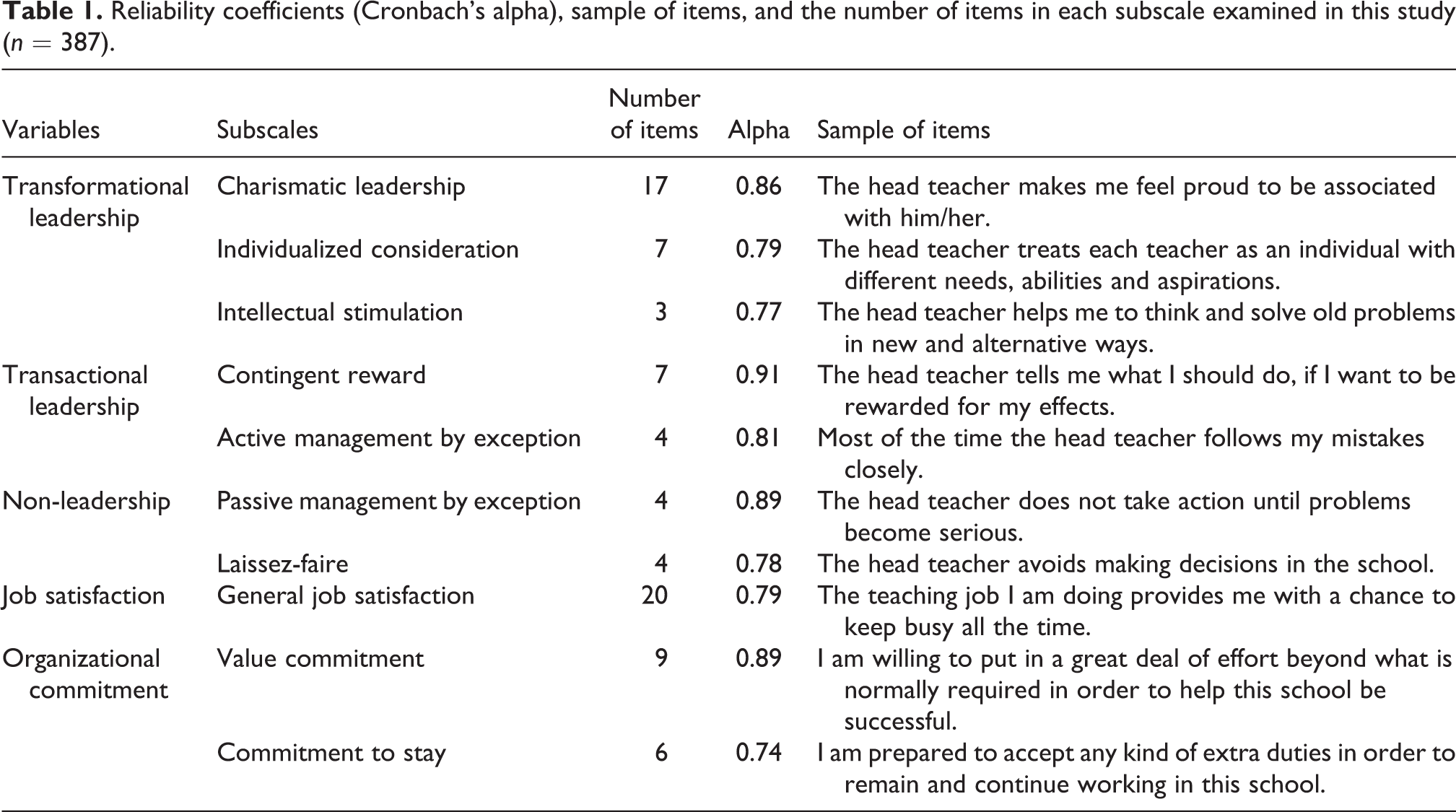
In this study, the reliability coefficients (Cronbach’s alpha) for the transformational, transactional, and non-leadership distinct subscales varied from 0.77 to 0.91. Also, the reliability coefficient (Cronbach’s alpha) for the general job satisfaction scale was 0.79. The reliability coefficients for the organizational commitment questionnaire sub-scales ranged from 0.74 to 0.89 based on Cronbach’s alpha (see Table 1 for all reliability estimates, sample of items, and number of items). Responses are given on a 5-point scale, from 1 (strongly disagree) to 5 (strongly agree).
Reliability coefficients (Cronbach’s alpha), sample of items, and the number of items in each subscale examined in this study (n = 387).
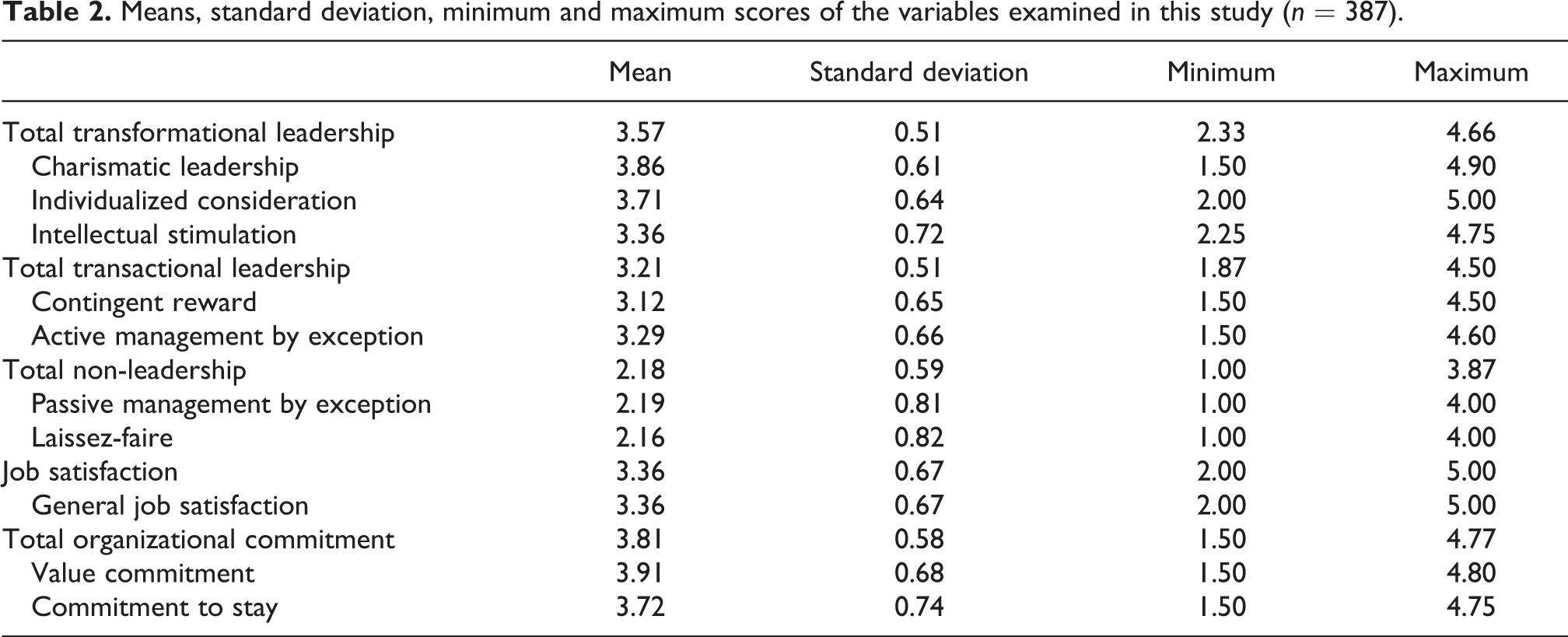
Descriptive statistics (means, standard deviations, and minimum and maximum respondent means) of the variables were reported in Table 2. The means ranged from 2.16 to 3.91. The three transformational leadership factor dimensions were rated high. From the results, it seemed that teachers experienced more value commitment (M = 3.91) than commitment to stay (M = 3.72) and job satisfaction (M = 3.36). The higher mean scores on value commitment imply that teachers felt proud to be associated with their schools. The lower scores for commitment to stay can be explained by the fact that school teachers in Kermanshah do not choose schools where they want to teach. Furthermore, the low scores on job satisfaction might suggest that teachers felt less satisfied with the various aspects of their teaching job. One of the job satisfaction items rated lowest by the teacher was related to the salary that teachers receive. This item, which reads, ‘I like the teaching job because the salary I get as a teacher is equal to the amount of work I do’ was rated lowest (M = 1.3). The lower rating of this item indicates that teacher felt they did not receive a fair salary for the amount of work they did.
Means, standard deviation, minimum and maximum scores of the variables examined in this study (n = 387).
From Table 3 we observe that all the transformational leadership factor scales correlated positively with the two transactional leadership factors of contingent reward and active management by exception. Also, all transformational leadership factors correlated negatively with the other two non-leadership factors of passive management by exception and laissez-faire leadership. Almost all of the correlations were found to be significant and point in the expected direction. Transformational leadership factor scores were almost uniformly correlated more strongly with higher ratings of teacher’s job satisfaction, value commitment, and commitment to stay. Transactional leadership factors and the contingent reward factor were positively correlated with higher levels of teacher’s job satisfaction, value commitment, and commitment to stay, which was less strong compared to the three transformational leadership factors. As expected, the two non-leadership factors of passive management by exception and laissez-faire leadership both had negative correlations with all the outcome variables of teacher’s job satisfaction, value commitment, and commitment to stay. However, active management by exception was not significantly correlated with either job satisfaction or commitment to stay. Moreover, all the intercorrelations among the dependent variables were positive and statistically significant.
Correlations between variables in the study.
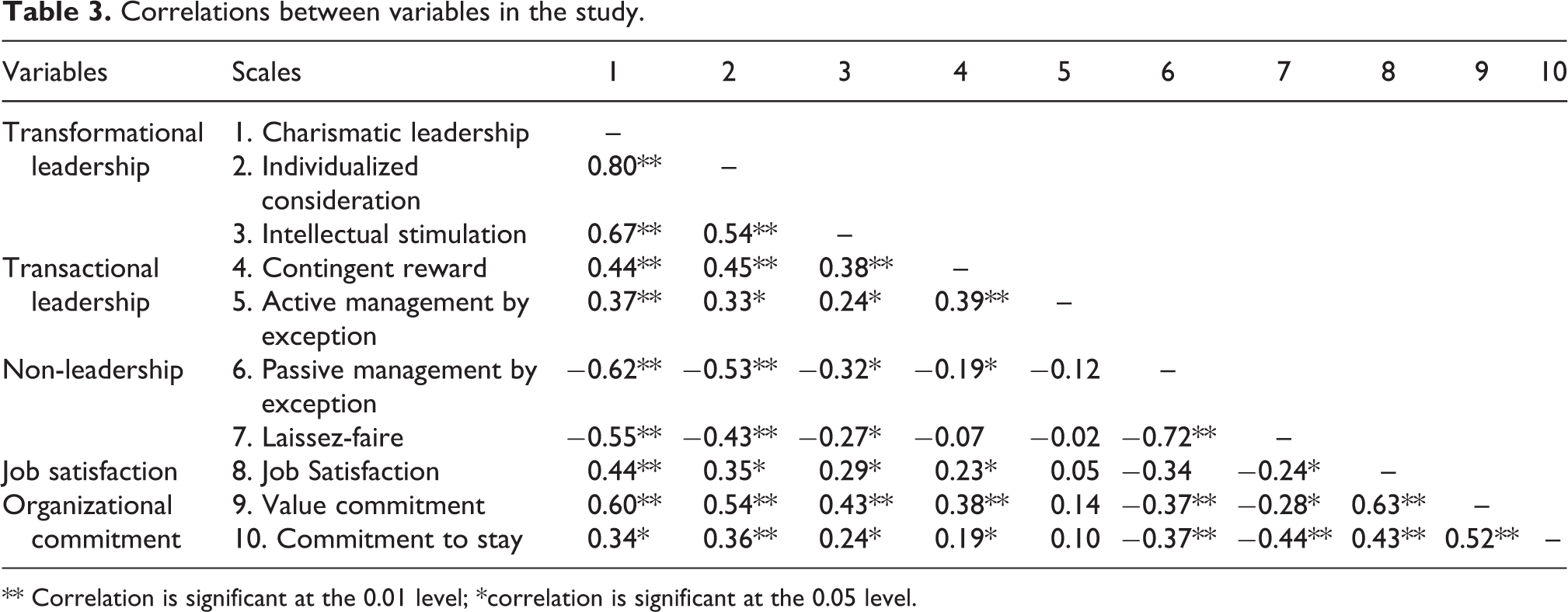
** Correlation is significant at the 0.01 level; *correlation is significant at the 0.05 level.
The effect of transformational, transactional, and non-leadership on teachers’ job satisfaction
The regression analysis reported in Table 4 indicates that the transformational, transactional, and non-leadership factors explain 25 per cent of the variance in teachers’ job satisfaction. The positively significant regression coefficients for charismatic leadership indicate that the higher the level of this experienced transformational factor, the higher the amount of job satisfaction. Research in the mid-twentieth century, on which this study is mainly based, has produced strong evidence that school administrators have effective influences on teachers’ extrinsic motivation and job satisfaction (Brown, 1967; Greenfield, 1968; Keeler and Andrews, 1963). Similar studies in the field also show that there is a significant relationship between leaders’ behavior, operating as extrinsic motivation, and teachers’ job satisfaction (Brown, 1967; Reyes and Shin, 1995).
Regression analysis of the effect of transformational, transactional, and non-leadership factors on job satisfaction.
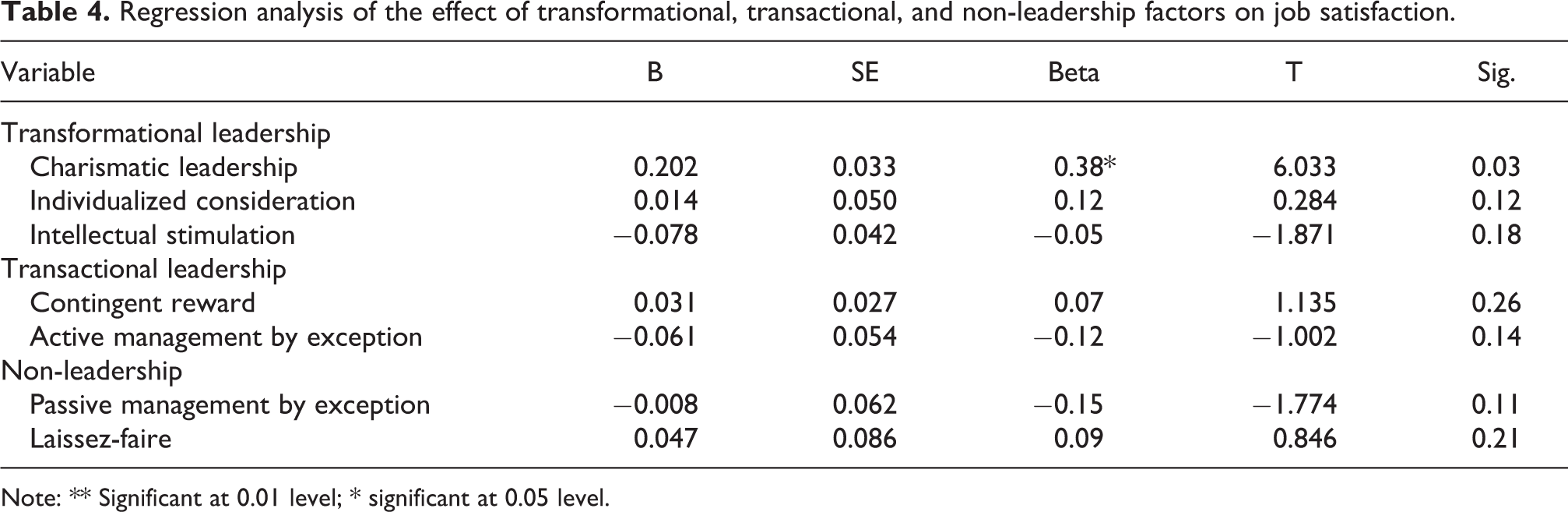
Note: ** Significant at 0.01 level; * significant at 0.05 level.
The effect of transformational, transactional, and non-leadership on teachers’ organizational commitment
The regression analysis reported in Table 5 indicates that the transformational, transactional, and non-leadership factors explained 40 per cent and 23 per cent of the variance in teachers’ value commitment and commitment to stay, respectively. The positively significant regression coefficient for charismatic leadership indicates that the higher the level of this experienced transformational factor, the higher the amount of value commitment. Contrarily, the significant negative regression coefficient for laissez-faire leadership indicates that the higher the level of this experienced non-leadership factor, the lower the amount of commitment to stay. Contributions to the explained variance of groups of transformational, transactional, and non-leadership factors suggest that teachers’ value commitment was more positively affected by transformational leadership factors, whereas commitment to stay was more affected by non-leadership factors, albeit in a negative way. Lok and Crawford (2004) have reported that organizational commitment of followers is influenced by transformational leadership. Also, Walumbwa et al. (2004) used data from China and India and found that transformational leadership was positively related to organizational commitment and job satisfaction, and negatively related to job and work withdrawal.
Regression analysis of the effect of transformational, transactional, and non-leadership factors on organizational commitment factors.
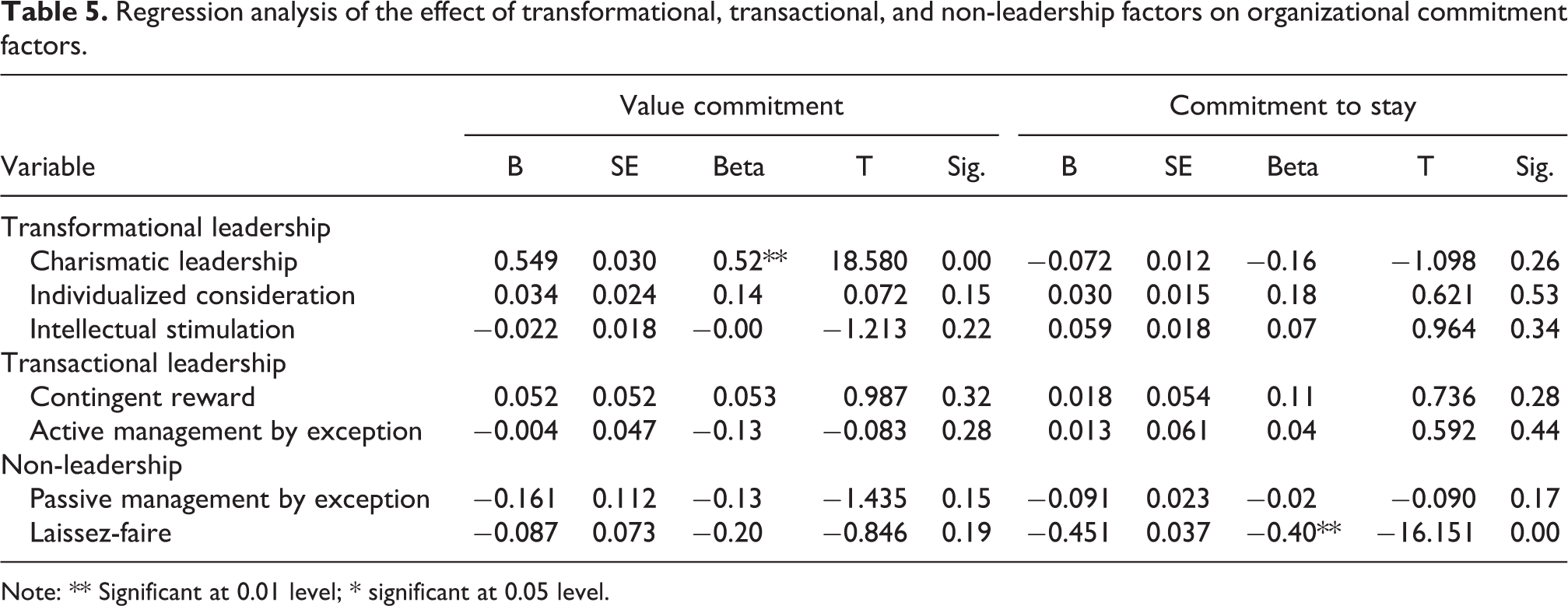
Note: ** Significant at 0.01 level; * significant at 0.05 level.
Conclusion
The purpose of this study was to determine the aspects of transactional, transformational, and non-leadership that affect teachers’ job satisfaction and organizational commitment in the public schools in Iran. Overall, the results of our study showed that both transformational (charismatic leadership, individualized consideration, and intellectual stimulation) and transactional leadership factors (contingent reward and active management by exception) had positive effects on teachers’ job satisfaction and organizational commitment. More specifically, our findings showed that charismatic leadership among transformational leadership had significant effects on job satisfaction and value commitment; however, it had no significant effects on commitment to stay. Moreover, it is important to note that these strong positive effects of transformational leadership on teacher’s job satisfaction and value commitment are independent of the effects on transactional and non-leadership.
According to the results, in the three regressions, only charismatic leadership emerged as a significant predictor of job satisfaction and value commitment, and laissez-faire turn out to be a significant (negative) predictor of commitment to stay. These findings are consistent with those of other researchers (Clabaugh et al., 2000; Hindua et al., 2009; Patten, 1995), which found significant positive relationships between the dimensions of transformational leadership and job satisfaction.
The study provided evidence to support the use of transformational leadership to increase job satisfaction. Along the same lines, various studies conducted on leadership style (Bateman and Strasser, 1984; Decotiis and Summers, 1987; Mathieu and Zajac, 1990) claim that there is a strong positive relationship between leadership and organizational commitment. Also, the results are consistent with the findings found in Iran by Ramezaninezhad et al. (2011), who state that transformational leadership and transactional leadership have significantly positive effects on the organizational commitment of school sports teachers. Similar findings were reported by Lotfi et al. (2012), when they found that there is positive relationship between transformational and transactional leadership styles and organizational commitment; the only difference was that their study was concerned with faculty members.
Based on the results of this study, one could pay more close attention to the importance and application of transformational leadership and non-leadership. Transformational leaders are attentive to the needs and motives of followers and try to help followers reach their fullest potential (Northouse, 2007). Leaders with transformational leadership behavior can direct their organization toward effectiveness and productivity. They can motivate followers toward extra effort, increase their job satisfaction, improve their performance beyond expectation, and cultivate creativity and innovation in organization (Walumbwa et al., 2004). The findings demonstrated positive correlations between transformational leadership and overall satisfaction. It means that when heads of schools concentrate on teachers’ needs and concerns, satisfy their requirements and necessities, inspire teachers to go beyond what they are expected, and encourage teachers to be innovative and present new suggestions to resolve schools’ problems, teachers’ job satisfaction increases. Transformational leadership increases followers’ motivation, job satisfaction, job performance, and organizational commitment (Bono and Judge, 2003).
Also, laissez-faire gives complete freedom to their followers to make decisions by providing them with all necessary tools and resources. In this case, expectations from followers become very high to solve their own problems, but when they go through the process and ultimately make a decision the whole process becomes a good learning opportunity to develop and to know about necessary organizational tools. Laissez-faire leadership style also becomes useful in the situations when there are large numbers of decisions, decision-making is easy, and followers have to perform routine tasks with fewer complexities and less demanding criteria or when rules and regulations are pre-determined (Eagly et al., 2003). Such employees require high relationship orientation with their managers and leaders (Zareen et al., 2014). Laissez-faire leadership style becomes more effective in the situations when followers are highly skilled, motivated, capable, and willing to do things on their own (Chaudhry and Javed, 2012).
Study limitations and implications for future research
First, future studies conducted with larger sample sizes might use structural equation modeling (SEM). Second, the correlation between CL and IC is quite high (0.80); therefore, because of some multicollinearity in the data, regression results for these two variables should be interpreted cautiously.
Footnotes
Acknowledgments
The author would like to thank the editors and the anonymous reviewers for their constructive feedback on the previous manuscript. Also, I would like to express my gratitude to Dr Borhan Mansouri for their advice and guidance.
Declaration of Conflicting Interests
The author declared no potential conflicts of interest with respect to the research, authorship, and/or publication of this article.
Funding
The author received no financial support for the research, authorship, and/or publication of this article.