







Abstract
Mobile and location-based media refer to technologies that can openly and dynamically portray the characteristics of the users and their mundane life. Facebook check-ins highlights physical and informational mobility of the users relating individual activities into spaces. This study explored how personality traits like extraversion and narcissism function to influence self-disclosure that, in turn, impacts the intensity of check-ins on Facebook. Using survey data collected through Facebook check-in users in Taiwan (N = 523), the results demonstrated that although extraversion and narcissism might not directly impact check-in intensity on Facebook, the indirect effects of self-disclosure and exhibitionism were particularly salient. Moreover, a complete path from extraversion to Facebook check-in through self-disclosure and exhibitionism was discovered. Theoretical implications on human mobility and selective self-presentation are also discussed.
The worldwide popularity of social networking sites (SNSs) has significantly extended the scope of users’ own social networks. Advances in mobile communication technology have facilitated new forms of social interaction, enabling the maintenance of social capital within large distributed networks of contacts (Ling, 2004). The release of the global positioning system (GPS)-enabled operating systems such as iOS and Android in 2008 accompanied by the convergence of applications with location-based services (LBS) and SNSs has bridged users’ physical and social worlds. The contemporary social life is organized around human motilities rather than fixed locations or bounded communities (Urry, 2000). While mobile phones connect users directly to individuals (Wellman, Boase, & Chen, 2002), location-aware technologies facilitate human connection to places (Sutko & de Souza e Silva, 2011).
LBS are defined as services or applications that extend spatial information processing, or geographic information capabilities, to end users via the Internet or wireless network (Koeppel, 2000). Location-based social networking provides users with location-specific information for social actors to locate each other’s physical space through their representation on a map on the screen of their mobile devices. Facebook Places, a GPS-LBS, was announced on August 10, 2010. Users are able to check in to Facebook via their mobile devices, tag friends who are with them, and let their friends know where they are and what they are up to. Facebook later added a more general location-tagging feature, allowing users to share their location on status update, photo, or wall post. The new feature not only emphasizes present location, but also users can tag locations from their past or even a future event. However, this study focuses on smartphone users who check in to announce their arrival during activities, rather than a retrospective past experience or an expectation of a future plan.
The adoption of the check-in function on an SNS suggests that a new method of mobile-mediated relationships is emerging as users are equipped to integrate location-aware mobile communication into their social lives while moving through physical space. Mobile devices and ubiquitous communication rely on wireless networks that are spatial in coverage and thus have implications for the global space of flows and the local place of mundane life. The social–spatial dimensions have been addressed through analyzing users’ geographical and social relationships to understand human mobility and social life (Lindqvist, Cranshaw, Wiese, Hong, & Zimmerman, 2011). The human mobility empowered by ubiquitous networks facilitates more physical and informational freedom as well as exposure to forms of control and monitoring in urban spaces (Lyon, 2006). However, the type of users who tend to share their tractable physical locations with friends, and the extent to which their individual characteristics affect their use of the check-in function, remains unexplored. In other words, what are the interpersonal motives that drive users to register online to say where they are in the off-line world while moving through physical places? In a general sense, the goal of this study is to investigate how check-in on Facebook influences the relationships between location and communication for social actors. In particular, this study explores the extent to which social–psychological drivers may motivate self-disclosure behavior on Facebook, and what mediating variables contribute to the use of the check-in feature.
Research Background
The notion of a location service is defined as a shared object providing information about the physical location of located objects (Leonhardt, 1998). Leonhardt (1998) distinguishes between outward and inward location, with the former requiring mobile communication at least on a local scale, while the latter is a mobile user’s awareness of their environment and context. Researchers (e Silva & Frith, 2010) identified three characteristics of location-based mobile social networking: mobility, use of paths, and potential for communication created by the mapping of friends on the interface of the mobile device. Social location-based activities can be better understood in line with the idea of the “landscape character” that involves exploration on the ground, mobility mediated through material, and narrative resources such as maps, photos, and face-to-face interactions, all shaping a “sense of place” (Büscher & Urry, 2009).
Mobile devices provide omnipresent connections across urban physical spaces. Mobile and location media refer to technologies that can openly and dynamically portray the characteristics of the users and of their mundane life. People report their progress in traffic, or arrange meetings on their mobile phones as assurance (Lyon, 2006), although such calls may not inherently offer details to the called party about the particular location of the person communicating. Space awareness is a cause of object perception and a cause of the ability to make accurate verbal expressions about a perceived object (Campbell, 2007). In other words, individuals’ experiences in physical space enable them to form a sense and awareness of their location and to further describe their observations and perceptions.
Human mobility involves actively developing and performing memories that can be recovered from photographs, letters, images, souvenirs, or objects deployed within large social gatherings (Larsen, 2005). Molz’s (2006) study on round-the-world travel websites demonstrates how travelers update their journal entries, maps, itineraries, photographs, and records of their activities and feelings on the road as a reflexive text for their online audience (family, friends, and strangers) to watch, follow, and monitor. Travelers are, in fact, encouraged by this new form of digital surveillance and willingly share their experience to satisfy their desire to share the story across the traditional boundaries of public and private spaces (Ahmed & Stacey, 2001). In this sense, people have a tendency to describe what surrounds them through environmental perception and cognition, map perception, or location interpretation, to maintain social relations with geographically distant individuals.
Social life is a continual shift between intermittent presence and modes of absence, depending upon multiple technologies of travel and communication that move objects, people, ideas, and images across varying distances (Büscher & Urry, 2009). Self-presence is achieved or performed through mobility, observation, and communication with other social actors. A study (Smith et al., 2005) on a social location disclosure service, Reno, suggests that location-awareness applications on mobile devices enable not only explicit social interaction but also more subtle purposes. Location disclosure can serve as a reminder and awareness mechanism of the whereabouts of the other person and defines new places that can be used for future location disclosures (Smith et al., 2005). The immediacy, interactivity, and availability of communication technologies fulfill the human desire to present oneself and thereby allow various forms of social interactions to occur, and this is the matter of primary interest to this study.
The Presentation of Self on Facebook
Goffman’s (1959) dramaturgical approach explains how an individual engages in self-presentation as a strategic activity to “convey an impression to others which it is in his interests to convey” (p. 4). The Presentation of Self in Everyday Life sheds light on viewing the self within the social context through exploring the relationship between the performance and the front stage. Here, human interaction is called “performance” influenced by environment and audience. The goal of social actors is to impart “impressions” to keep their coherence and adjust to the different settings available to them. Oftentimes, an individual presents an “idealized” version of self as “a performer engenders in his audience the belief that he is related to them in a more ideal way than is always the case” (Goffman, 1959, p. 56). Goffman (1959) believes that in an attempt to maintain positive impressions, an individual conceals or underplays activities, facts, and motives which are incompatible with the idealized self.
In line with Goffman’s approach (1959), self-presentation is a critical component of sociality. People are found to be motivated to perform desired impressions through various self-presentation strategies to present themselves in favorable ways (Leary & Kowalski, 1990). In the computer-mediated communication (CMC) context, the hyperpersonal perspective (Walther, 1996) suggests that the relatively asynchronicity and anonymity of online environments allow individuals control over information that they give about themselves in order to construct idealized self-presentations. Individuals have tendencies toward ideal self-presentation online as they have greater control over the information they disclose (Walther, 1996). For example, researchers have found that personal home pages, or websites, allow users a higher level of control over the information they disclose and thus enable users to engage in strategic self-presentation (Papacharissi, 2002; Vazire & Gosling, 2004). In the online dating sites, people are found not only to present carefully crafted images of themselves but to engage in self-enhancement of presentations (Ellison, Heino, & Gibbs, 2006).
While online environments facilitate the creation of multiple representations of oneself (Turkle, 1997), SNSs complicate the process by allowing others to contribute information to one’s profile in relatively anonymous settings. Facebook, in particular, provides a naturalistic and socially consequential setting for researchers to study identity presentation (Wilson, Fornasier, & White, 2010). Some researchers found that Facebook profile owners are more likely to portray their real selves (Back et al., 2010; Waggoner, Smith, & Collins, 2009), whereas others (Mehdizadeh, 2010; Zhao, Grasmuck, & Martin, 2008) suggest that Facebook provides an ideal environment for individuals to present the “hoped-for possible selves.” Although the Facebook setting places certain constraints on the presentation of self, it is possible that users engage in portraying enhanced self-images (Buffardi & Campbell, 2008) or emphasize socially valued qualities, such as beauty for women and occupation for men, to activate ideal selves (Gonzales & Hancock, 2011). One general conclusion is that Facebook users are able to effectively use impression management strategies to enhance desired traits.
The hyperpersonal model (Walther, 1996) further explains that the technological aspects of CMC can facilitate overattribution and exaggerated, or idealized, perceptions of others. For example, the physical attractiveness of one’s Facebook friends, and the comments made by those friends (Walther, Van Der Heide, Kim, Westerman, & Tong, 2008) as well as the number of one’s Facebook friends (Tong, Van Der Heide, Langwell, & Walther, 2008; Walther et al., 2008), are related to the other’s perception of the profile owner’s physical and social attractiveness. Thus, individuals’ Facebook identity tends to be made socially desirable by emphasizing their popularity, thoughtfulness, and well-roundedness (Zhao et al., 2008).
Facebook check-in is a method of impression management through selectively revealing some locations over others. Impression management strategy is the conscious effort individuals make to control selected behaviors to present their desired selves to a specific audience. Therefore, this study extends the idea of presentation of the self to understand how impressions may be formed through information that explicitly focuses on physical places. Goffman (1959) distinguishes the impression one gives from those one gives off, as the former is used intentionally and the later is inadvertent. More recent research suggests that the concept of “presentation of place” theorizes a relationship between the nature and appearance of a place via location-aware technologies (Sutko & de Souza e Silva, 2011). It argues that the design and environment of the place are the given impression, while the reputation spread by others is the given-off impression. To this point, impression given and given-off are almost inseparable from the place itself, as people can infer characteristics about others based on places. Location check-ins can be understood to go beyond adding a digital layer to urban spaces, to the context of continual communication and sharing within one’s social networks (Barkhuus et al., 2008).
Regarding the performative aspects, researchers found the specific features of the check-in function attract users with performative needs (Lindqvist et al., 2011). One-to-many location sharing on Facebook is socially driven and can enhance self-presentation (Tang, Lin, Hong, Siewiorek, & Sadeh, 2010). Unlike profile photos, wall postings, and status updates, the central component of Facebook check-in is for users to selectively disclose a specific location to their audiences, using portable devices on the go that may have implications in showing their social life, lifestyle, and tastes. For Goffman (1959), individuals engage in strategically disclosing or concealing information so as to present themselves in a desirable manner. Information disclosure and control on Facebook may be affected by different aspects of personality (Christofides, Muise, & Desmarais, 2009) and that needs further investigation.
Self-Disclosure and Personality Traits
Self-disclosure is the revealing of previously unknown information so that it becomes shared knowledge, often with the goal of creating bonds and developing trust (Joinson & Paine, 2007). Off-line self-disclosure leads to intimacy and relational development (Taylor & Altman, 1987), and both depth and breadth of disclosure increase across time as relationships develop (Levinger & Snoek, 1972). Early research on CMC has shown that due to anonymity and reduced cues, online communication can foster greater self-disclosure than the off-line environment (Joinson, 2001) and that in turn may lead to liking and intimacy among interactants (McKenna, Green, & Gleason, 2002). More recent research (Jiang, Bazarova, & Hancock, 2011) finds that disclosure breadth or frequency regulation in the CMC context is more related to the perceived value of the desired outcome, such as interpersonal bonding and emotional support. Although the frequency of both intimate and superficial disclosure is higher in CMC than in the off-line condition, CMC alone may not stimulate more intimate disclosures (Jiang et al., 2011). In this sense, in the online dating environment, anticipated future relationships may play a crucial role in participants’ self-disclosure strategies (Ellison et al., 2006), and they tend to engage in an uncertainty reduction process to validate the private information of others, which in turn prompts their own disclosure (Gibbs, Ellison, & Lai, 2011).
However, users are more likely to communicate with others they actually know via Facebook (Ellison, Steinfield, & Lampe, 2007) than to meet new people for romatic interactions or relationships. It has been argued that the Facebook environment differs from other online settings that encourage information disclosure across different age groups (Christofides, Muise, & Desmarais, 2012). On Facebook, disclosure is a necessary strategy of identity construction (Zhao et al., 2008). According to Wheeless and Grotz (1976), self-disclosure is conceptualized at two levels: the first level refers to a general disclosiveness or openness to other people. The second level is a communication phenomenon occurring between specific individuals. In other words, unlike self-disclosure to a particular individual for intimate relationships that may place more emphasis on the depth of disclosure content, self-disclosure on Facebook may be seen as a general behavior pattern in the context of very large audiences.
As users are exposed to the disclosures of others, and users’ identities are jointly constructed, Facebook also enhances the importance of popularity (Christofides et al., 2009). The public nature of one’s impression may motivate Facebook users to manage their impression more carefully, while future interactions with their friends also increase the motivation to monitor their impressions more closely (Rosenberg & Egbert, 2011). That is, Facebook users who have a strong desire to be liked by others tend to use tactics that are seen as positive and worth replicating to showcase desirable traits and behaviors and thereby reach a larger audience (Rosenberg & Egbert, 2011). Earlier research sheds light on linking personality traits to goals as predictors of self-presentation strategies on Facebook. People are likely to reach different types of goals when they disclose information to others. Research has examined how the Big Five personality traits relate to the use of Facebook to fulfill users’ self-presentation needs through general self-disclosure, such as posting information about oneself (Seidman, 2012).
The relationship between self-disclosure and extraversion has been widely discussed (Cuperman & Ickes, 2009). Extraversion is a multifaceted personality trait and is the tendency to be concerned with obtaining gratification from that which is outside the self (Costa & McCrae, 1992). Individuals who are high in extraversion are more often characterized as active, assertive, outgoing, talkative and enthusiastic, and they tend to display a higher degree of sociability (Costa & McCrae, 1992). Extroverts are sociable and comfortable with having people around them and need to have people to talk to, and extraversion is also a trait related to strategic self-presentation (Seidman, 2012). In the CMC context, past research has shown that extroverts communicate more with others than their counterpart introverts do, as the online environment increases their opportunities to make friends (Peter, Valkenburg, & Schouten, 2005).
As with other SNSs, the settings on Facebook are essentially built around users’ interpersonal relationships, and so, by design, it is not an anonymous environment. Rather, Facebook provides a platform where impressions can be formed and managed through selective self-presentation of self-generated content (Walther, Van Der Heide, Hamel, & Shulman, 2009). Although it is in the nature of Facebook to allow users to display their positive images to a potentially larger audience than they could access off-line, Facebook also provides a fertile field through which narcissists can promote themselves (Buffardi & Campbell, 2008). Researchers have suggested that in addition to the five-factor model, other more specific personality characteristics, such as narcissism, may be more influential and need to be explored (Ross et al., 2009).
Narcissism is formally defined as a pervasive pattern of grandiosity, self-focus, self-importance, lack of empathy, and a need for admiration (American Psychological Association, 2006). Narcissism, as a human personality trait, is typically characterized by a positive and inflated self-concept, egocentrism, and a sense of uniqueness, superiority, and authority (Foster & Campbell, 2007). There is a tendency for narcissists to display an exaggerated sense of self-importance, fantasies of fame, power, omnipotence, and success (Campbell, Foster, & Finkel, 2002). Individuals who are high in narcissism have a constant need for attention and admiration, and they tend to boast about their accomplishments and show a relatively arrogant attitude regarding their abilities (Carlson, Vazire, & Oltmanns, 2011).
Narcissists are, however, also linked to high levels of extroversion and openness (Carlson et al., 2011) and low levels of social anxiety, depression, guilt, and embarrassment (Twenge & Campbell, 2003). Narcissism in individuals is negatively related to long-term, interpersonal relationships (Campbell et al., 2002), but they use social relationships as a means of showing off (Buffardi & Campbell, 2008). Facebook provides a platform for maintaining existing ties, and for developing relationships, and is therefore particularly attractive to people who need a large audience. Researchers have found a positive relationship between the level of narcissism of a Facebook user, the number of times he or she checks Facebook per day, and the time spent on each session, such as status updates, viewing photos and notes (Mehdizadeh, 2010).
One of the key characteristics of the social media is its user-generated content. SNSs, such as Facebook, consist predominately of identity claims and self-controlled statements, allowing users to create impressions in such a manner that they are generally very aware of their self-presentation tactics (Rosenberg & Egbert, 2011; Tong et al., 2008). To elaborate, researchers have revealed that individuals who are higher in narcissistic qualities are more likely to engage in self-promotional content or behavior on Facebook and to present themselves better to a large social-network base of superficial relationships (Carpenter, 2011; Mehdizadeh, 2010; Ong et al., 2011). Impression management motives, in turn, lead to the selection of less restrictive privacy settings for narcissistic users of SNSs (Utz & Kramer, 2009).
Taken together, Facebook check-in feature allows the users to create highly self-controlled content to selectively present themselves, so that viewers may form their impressions based on the information selected for disclosure. Self-disclosure is the act of making the self known to others, and it can serve to strengthen relationships; however, narcissists are known to use it to enhance their feelings of self-importance and to meet their constant need for admiration and attention. It is highly likely that these two variables, narcissism and self-disclosure, are correlated. In other words, because narcissists have a tendency to broadcast their activities through SNSs, and tend to make themselves visible and known among ever-widening circles of contacts, they will likely disclose their physical locations through the check-in function as a trade-off for attention. However, mixed results have been generated when studying Facebook for self-disclosure and extroversion. For example, extroverts engage in higher levels of self-disclosure through self-generated content, such as wall postings (Bibby, 2008), and extroverts are also more willing to post photos on Facebook (Muscanell & Guadagno, 2011; Ross et al., 2009). Extroversion can predict not only the frequency of Facebook usage but also engagement in the site; extroverts are more likely to be involved in maintaining an up-to-date presence and commenting on others’ wall postings (Gosling, Augustine, Vazire, Holtzman, & Gaddis, 2011). In contrast, other researchers found no support for the statement that extroverts self-disclose more on Facebook (Amichai-Hamburger &Vinitzky, 2010; Moore & McElroy, 2011). Although it is unclear whether extroverts disclose more on Facebook, one general conclusion is that they do maintain more Facebook friends than introverts (Amichai-Hamburger &Vinitzky, 2010; Gosling et al., 2011; Moore & McElroy, 2011). Extroversion is most accurately extracted from SNS profiles as extroverts tend to be as consistent with socialization online as they are in the off-line context, and they are more engaged during the online social experience (Gosling et al., 2011). Extroverts are likely to use the same self-presentational strategies online as they do off-line, thus presenting the same traits that they present in person (Seidman, 2012). Therefore, this study will test the relationship between two personality traits, extroversion and narcissism, and Facebook self-disclosure. The relationship between traits and preferences for Facebook check-in is unclear and should also be further examined. Thus,
Hypothesis 1: There will be a positive relationship between extroversion and check-in behavior on Facebook.
Hypothesis 2: There will be a positive relationship between narcissism and check-in behavior on Facebook.
Hypothesis 3: Extroversion will be positively related to self-disclosure on Facebook.
Hypothesis 4: Narcissism will be positively related to self-disclosure on Facebook.
Hypothesis 5: Self-disclosure on Facebook will be positively related to check-in behavior on Facebook.
Hypothesis 5a: Extroversion and check-in behavior will be mediated by the level of self-disclosure on Facebook.
Hypothesis 5b: Narcissism and check-in behavior will be mediated by the level of self-disclosure on Facebook.
Exhibitionism and Location Check-In
The decision by individuals to present their private lives in public is considered a form of exhibitionism (Koskela, 2004). Overt narcissism leads to the direct expression of exhibitionism, self-importance, and preoccupation with others’ attention and admiration (Wink, 1991). A combination of self-absorption, vanity, superiority, and exhibitionistic tendencies that illustrates the features of self-love and theatrical self-presentation is labeled grandiose exhibitionism (Ackerman et al., 2011). Grandiose exhibitionism is particularly associated with less behavioral regulation and with lower scores on hiding the self (Ackerman et al., 2011). These findings are in line with earlier studies that found positive relationships between narcissism and exhibitionism, as narcissists, who are preoccupied with dreams of success, power, beauty, and brilliance, live perpetually on the interpersonal stage, displaying exhibitionistic behavior (Morf & Rhodewalt, 2001). Exhibitionists demand social attention, and they may try in every possible way to attract attention and to occupy the spotlight.
The prevalence of surveillance cameras, blogs, mobile phones, and reality television has further promoted exhibitionism (Koskela, 2004) and fostered the notion of “digital exhibitionism” (Schmidt, 2007). Central to exhibitionism is the social–psychological aspect of self-disclosure. Although the advent of technology has made it possible for everyone to get heard, and to present themselves easily, past research has shown that the online environment facilitates self-disclosure and that many people are willing to seize the opportunity offered for online-mediated exhibitionism (Qian & Scott, 2007). However, self-disclosure and self-exhibitionism have become prevalent, not only because of the private expressions of self that can easily be posted online but also because they promote online sociability with “networked publics” (Boyd, 2008). Calvert (2004) has noted that the psychology of self-disclosure serves internal (self-clarification and social validation) and external (relationship development and social control) purposes, that all possibly lead the individual to “overshare.” In this sense, the tendency to disclose information is not only associated with the presentation of oneself but also represents the audience’s expectations (Ploderer Howard, Thomas, & Reitberger, 2008).
Take blogs, for example. They serve as individual public spheres for sharing personal information within an extended network of strong and weak ties and can reconfigure the context for identity and relationship management. Hollenbaugh (2011) found that exhibitionism was one of the new motives not found in earlier literature, telling bloggers how to maintain personal blogs. This study demonstrated that bloggers who were high in exhibitionist tendencies blogged for attention, and they assumed that people liked to read things about them. Bloggers who scored high in exhibitionism also tended to reveal private information that might entertain others to gain popularity or fame.
Carpenter (2011) adapted the grandiose exhibitionism scale for the narcissistic personality trait and found that it significantly predicted users’ Facebook behaviors, such as status updates, photos of the profile owners, and profile information updates. This study indicated that Facebook users who were high in exhibitionism revealed self-promoting information frequently to receive attention from their audiences. In general, as Ryan and Xenos (2011) demonstrated, Facebook users have higher levels of narcissism, exhibitionism, and leadership than nonusers, while individuals with higher scores for exhibitionism also showed higher preferences for adding photos and status updates. Thus, the easy accessibility of social media platforms, such as Facebook, gratifies the narcissistic individual’s need to engage in self-promoting and superficial behavior that ultimately reveals his or her exhibitionist tendencies. That is to say, narcissists enjoy the exhibitionistic nature of SNSs and desire to present the most attractive version of themselves, promoting the narcissistic traits of exhibitionism and vanity.
As stated earlier, extroverts are typically characterized by sociability, gregariousness, exhibitionism, and assertion, and they tend to maintain a larger social network. Higher levels of extroversion and narcissism are therefore related to heightened exhibitionism. Additionally, while self-disclosure on Facebook may be a predictor of check-in behavior, the intensity of check-in on Facebook may depend on the extent of the users’ exhibitionistic motives to further disclose about themselves through highlighting their mobilities. Thus,
Hypothesis 6: There will be a positive relationship between extroversion and exhibitionism.
Hypothesis 7: There will be a positive relationship between narcissism and exhibitionism.
Hypothesis 8: The level of self-disclosure on Facebook will be positively related to exhibitionism.
Hypothesis 8a: The level of extroversion and the level of exhibitionistic motivation will be mediated by the level of self-disclosure on Facebook.
Hypothesis 8b: The level of narcissism and the level of exhibitionistic motivation will be mediated by the level of self-disclosure on Facebook.
Hypothesis 9: The level of exhibitionism will be positively related to the intensity of check-in behavior on Facebook and thus,
Hypothesis 9a: The level of extroversion and the intensity of check-in behavior will be mediated by exhibitionism.
Hypothesis 9b: The level of narcissism and the intensity of check-in behavior will be mediated by exhibitionism.
Hypothesis 9c: The level of self-disclosure on Facebook and the intensity of check-in behavior on Facebook will be mediated by the level of exhibitionistic motivation affecting check-ins.
A model including the hypothesized paths is proposed and is illustrated in Figure 1.
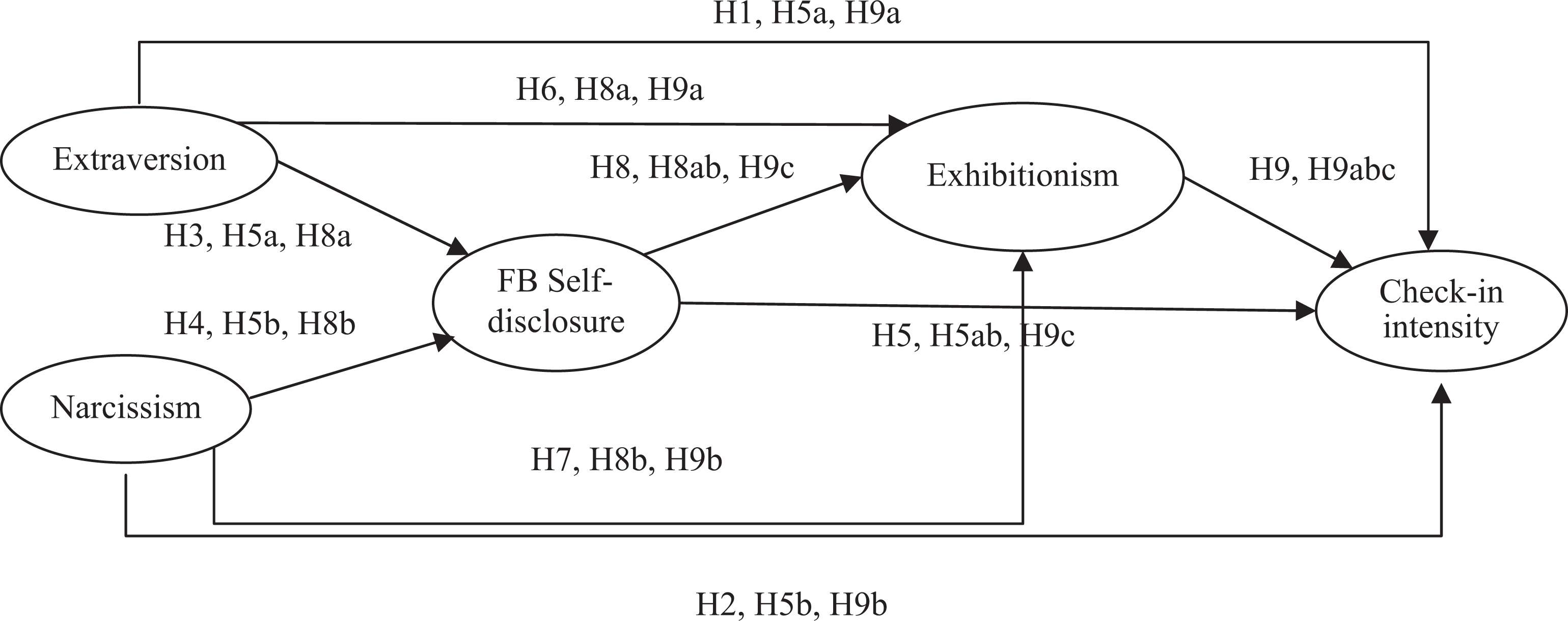
Conceptual model of proposed relationships.
Method
Pretest
A pretest was conducted in December 2011 for 2 days by sending the measurements to convenience samples that check-in on Facebook. A total of 50 respondents completed the questionnaire. This study was conducted in Taiwan, and some items adapted from previous studies were translated into Chinese. Items that did not hang together reliably with the rest of the scale, due to translation problems, were dropped from the survey, based on an analysis of the pretest. In the pretest, all construct reliabilities exceed .70, except for self-disclosure on Facebook. After suggestions were collected from some of the respondents, wording changes were made on some questions of the self-disclosure measurement tool. A revised version of the self-disclosure measurement was used in the formal survey.
Survey and Sample
To test the proposed model and hypotheses, an online survey was hosted on a popular survey hosting site in Taiwan. This was fielded in January 2012 for 3 weeks. Survey announcements were made through popular portal sites, such as Mobile01 and Sogi, as well as through the PTT Bulletin Board System (BBS), the largest BBS in Taiwan. Participants who visited the online survey link through any of the announcement channels were directed to a short description of the study, information about confidentiality, and incentives. As a reward, all participants were eligible to participate in a raffle of 100 gift certificates valued at the equivalent of between U.S.$3 and U.S.$10.
After 22 duplicate responses were removed, 523 respondents (43.6% male; 56.4% female), ranging in age from 19 to 25 years and mostly college students or graduates (96.9%), were retained for analysis. On average, they had 430.64 (median = 400, mode = 500, SD = 262.18) Facebook friends. The mean was skewed as 25 respondents reported having more than 1,000 friends; and among them 8 individuals reported having between 1,200 and 1,500 friends, while 1 reported 2,000 friends. Respondents reported having had, on average, 3 to 6 months’ experience of smartphone use (Table 1). The top five most frequent check-in locations were restaurants (16%), scenic areas (13%), movie theaters (9%), department stores or shopping malls (8%), and night markets (7%).
Sample Demographics (N = 523).
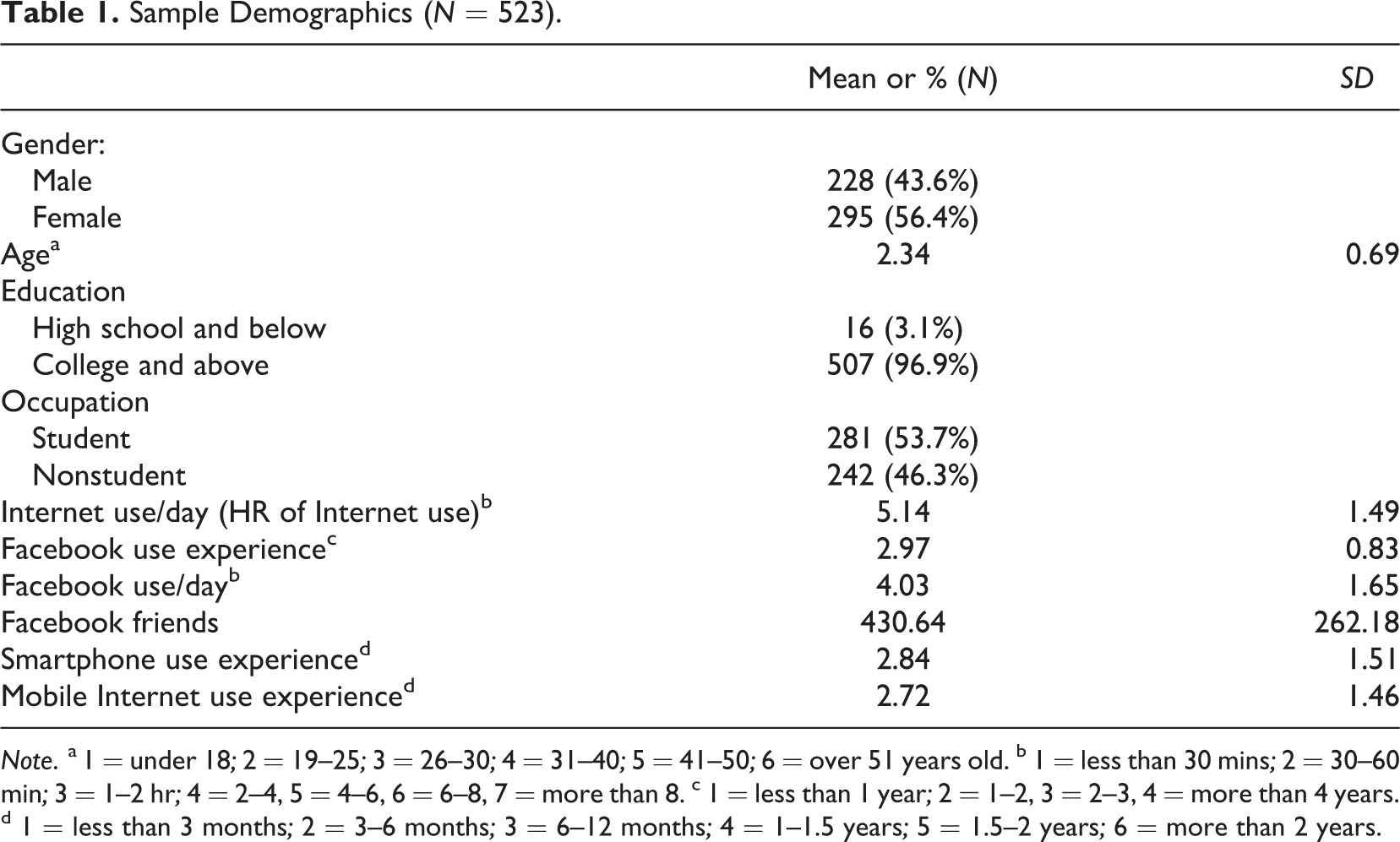
Note. a 1 = under 18; 2 = 19–25; 3 = 26–30; 4 = 31–40; 5 = 41–50; 6 = over 51 years old. b 1 = less than 30 mins; 2 = 30–60 min; 3 = 1–2 hr; 4 = 2–4, 5 = 4–6, 6 = 6–8, 7 = more than 8. c 1 = less than 1 year; 2 = 1–2, 3 = 2–3, 4 = more than 4 years. d 1 = less than 3 months; 2 = 3–6 months; 3 = 6–12 months; 4 = 1–1.5 years; 5 = 1.5–2 years; 6 = more than 2 years.
Measures
All scale items in this study were measured on a 5-point Likert-type scale, ranging from 1 (strongly disagree) to 5 (strongly agree). Participants were asked to rate the extent to which they agreed or disagreed with each statement.
Extroversion
The extroversion subscale of the Five-Factor Inventory (Costa & McCrae, 1992) was adopted to measure the personality trait of extroversion. The Big Five scale is not only frequently used in personality and clinical research but has also recently been employed to investigate the use of certain forms of social media (Correa, Hinsley, & De Zuniga, 2010).
Narcissism
Narcissism was assessed using the Narcissism Personality Inventory (NPI)-16. The NPI is widely used in social–psychology research as a self-report measure of narcissism. The NPI-16 (Ames, Rose, & Anderson, 2006) is a shorter measure derived from the NPI-40 (Raskin & Terry, 1988) and the measures are correlated (Mehdizadeh, 2010). Although the NPI is a forced-choice, dichotomous measure of narcissism, the NPI has been presented in a Likert format in communication and social–psychology research (Aviram & Amichai–Hamburger, 2005; Penney & Spector, 2002).
Self-Disclosure on Facebook
To measure the extent to which respondents were engaged in self-disclosure on Facebook, the General Disclosiveness scale (Wheeless & Grotz, 1976) that measures people’s self-disclosure patterns with others in general was adapted. Items were modified with wording changes to refer to Facebook interactions. Respondents were instructed to imagine the updates they posted on Facebook when answering these items: (1) I often talk about my feelings on Facebook; (2) I often post something about my relationships and private life on Facebook; (3) I often post photos of me and my friends on Facebook; (4) I often express my thoughts and true self completely on Facebook.
Exhibitionism
To measure respondents’ tendency toward exhibitionism when checking-in on Facebook, this study adapted 4 items from the subscale of blogging motives (Hollenbaugh, 2011) with wording changes. An additional 4 items were created to offer insight into the degree to which respondents check in as a way for exhibitionism. The final measure consisted of the following 4 items after scale validation: (1) I check in because I like when people read things about me; (2) I check in to gain fame; (3) I check in so people know I am with friends; (4) I expect friends to “like” or leave comments on my check-in status on Facebook.
Facebook Check-In Intensity
Items were developed to measure the extent to which respondents engaged in checking in on Facebook. This measure includes the following self-reported assessments of check-in behavior: (1) Whenever I arrive at my destination, I check in on Facebook right away; (2) I am the one to check in and tag everyone else on Facebook at social gatherings; (3) Whenever I arrive at the gathering place of friends, I check in on Facebook right away. In addition, respondents were asked to recall how often they had checked in on Facebook per week, over the past few months.
Model Fitness and Reliability and Validity Tests
The normality of all variables was checked before the measurement, and models were tested. Structural equation modeling (SEM) with LISREL 8.8 and the model parameters using robust maximum likelihood method were employed to analyze the data (Jöreskog & Sörbom, 2006). A confirmatory factor analysis (CFA) was conducted to assess model fitness and to determine the validity and reliability of the constructs. The initial model fitness was unsatisfactory based on a variety of fit measures following the recommendations from a number of researchers (Table 2). Factor loadings, unique variances, and modification indices were then computed and items with factor loadings less than 0.5 were deleted. This process resulted in deleting 1 item of extroversion, 4 items of narcissism, 4 items of Facebook self-disclosure, 2 items of exhibitionism, and 1 item of check-in intensity.
CFA Model Fitness.
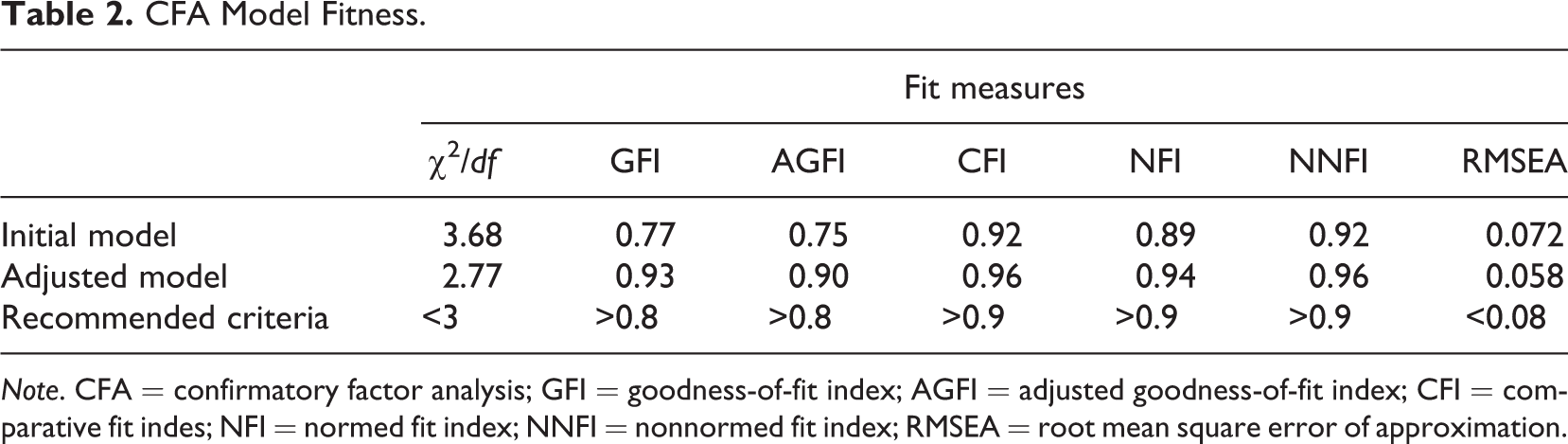
Note. CFA = confirmatory factor analysis; GFI = goodness-of-fit index; AGFI = adjusted goodness-of-fit index; CFI = comparative fit indes; NFI = normed fit index; NNFI = nonnormed fit index; RMSEA = root mean square error of approximation.
To examine whether the adjusted measurements after item reduction can reflect the meaning of each construct effectively, a Pearson correlation test using Statistical Package For The Social Sciences, Version 14 was conducted to compare the initial items with the reduced items of each construct. All the correlation values were above .80, indicating the initial items and reduced items of each construct were highly correlated. Thus, the adjusted measurements can still explain the initial meaning of each construct.
After the items were deleted, the CFA was repeated, and the model fitness increased. All the fit statistics demonstrated that the adjusted measurement model was appropriate for measuring the constructs (χ2 = 392.84 with df =142; χ2/df = 2.77; Table 2). Thus, the evaluation of construct reliability, convergent and discriminant validity can proceed. Table 3 presents the descriptive statistics and the correlations among the constructs.
Item Descriptives, Reliabilities, and Zero-Order Correlation Coefficients.
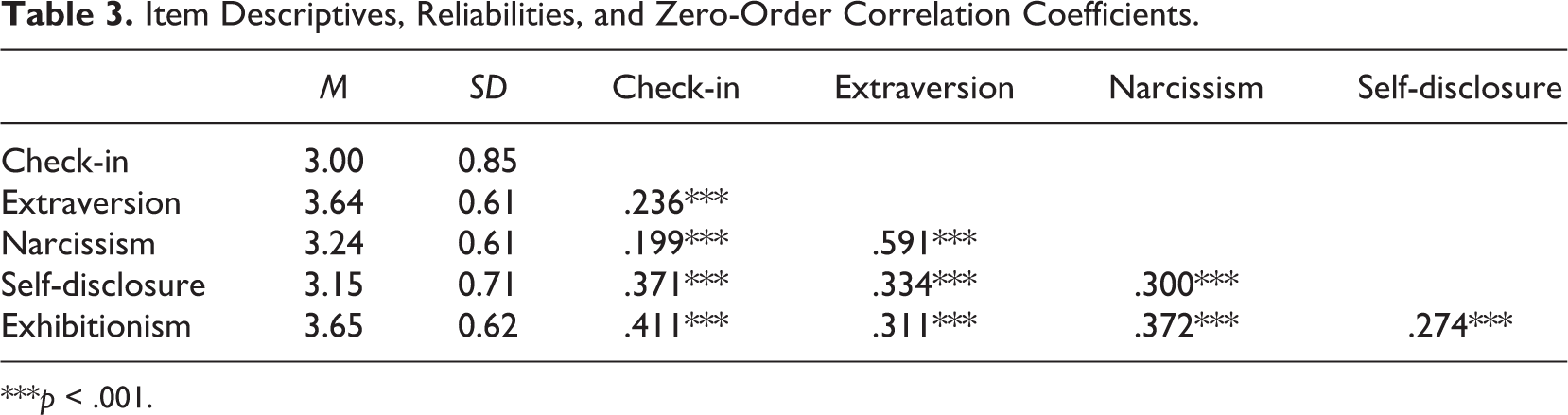
***p < .001.
Internal consistency and convergent validity were examined based on Cronbach’s α coefficients, factor loadings, composite reliabilities, and average variance extracted (AVE). The value of Cronbach’s α for each construct surpassed .70 and was statistically acceptable. Moreover, all factor loadings were significant and higher than .50, composite reliabilities exceeded .70, and AVE by each construct exceeded .50, providing evidence of convergent validity and item and scale reliability (Table 4).
Analysis of Construct Reliability and Validity.
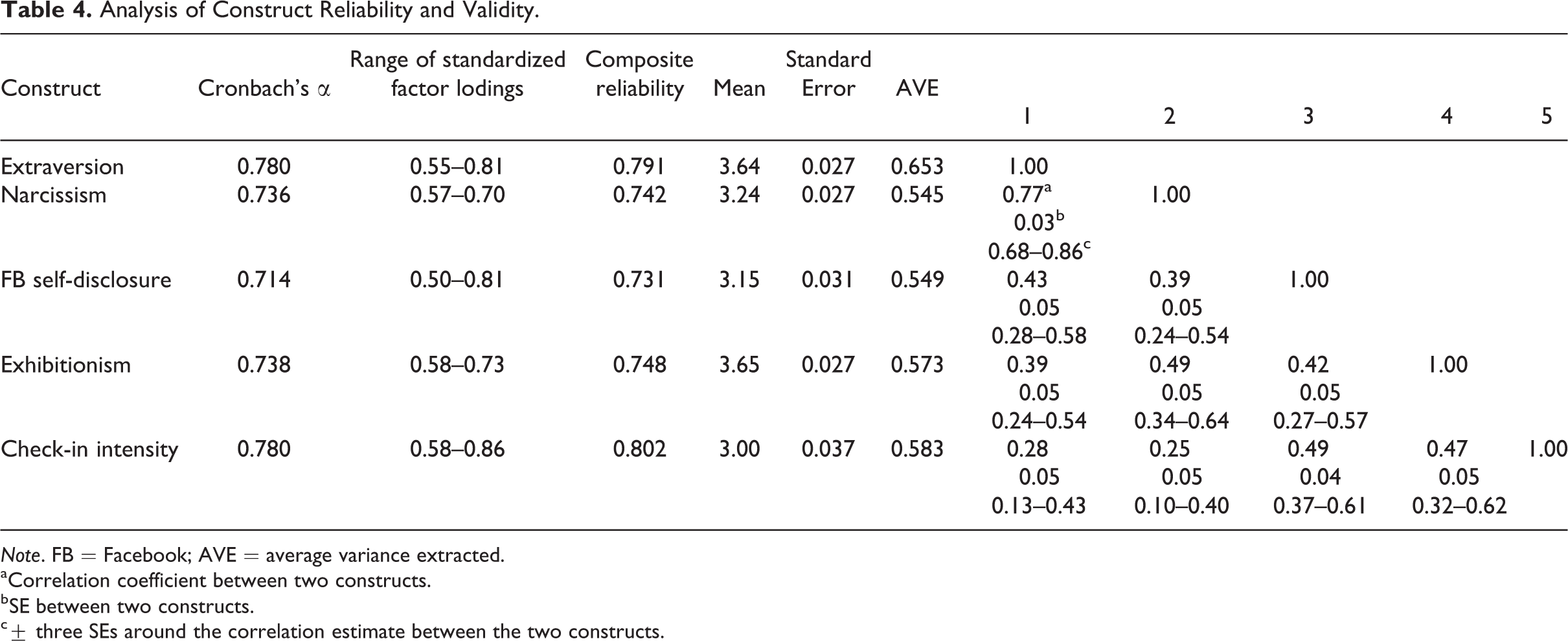
Note. FB = Facebook; AVE = average variance extracted.
aCorrelation coefficient between two constructs. bSE between two constructs. c± three SEs around the correlation estimate between the two constructs.
Discriminant validity was tested by comparing the shared variance between constructs with the AVE of the individual constructs. The AVE of the individual constructs was greater than any squared correlation among the constructs, confirming discriminant validity. Further, a complementary assessment of discriminant validity was to determine whether the correlation coefficient between any two constructs plus or minus two standard errors did not include one. This study computed three standard errors to increase the confidence interval to 99% (Table 4).
Results
Following the assessment of the constructs and measurements, the research hypotheses and the hypothesized model in Figure 1 were tested using path analysis. Paths between constructs indicate individual hypothesis, and this study estimated each for statistical significance of the path coefficient. The analysis of this model produced a chi-square of 392.84 (df = 142; χ2/df = 2.77; p value = .00). In addition, the fit indices suggested a quite reasonable good fit to the data (goodness-of-fit index = .93; adjusted goodness-of-fit index = .90; comparative fit indices = .96; normed fit index = .94; nonnormed fit index = .96; root mean square error of approximation = .058).
The analysis also provided results for all hypotheses (Figure 2). The paths between extroversion and the intensity of check-in (β = .08, t = .78) and narcissism and the intensity of check-in (β = −.12, t = −1.10) were not significant, so Hypotheses 1 and 2 were rejected. Hypotheses 3 and 4 proposed a positive relationship between the level of extroversion and self-disclosure on Facebook as well as a positive relationship between narcissism and self-disclosure. The results supported the route between extroversion and self-disclosure on Facebook (β = .33, t = 3.03, p < .01) but yielded no support for narcissism and self-disclosure (β = .13, t = 1.22). Thus, Hypothesis 3 was supported and Hypothesis 4 was rejected. Further, the result of a significant positive path connecting the level of self-disclosure and the intensity of check-in on Facebook (β = .33, t = 3.03, p < .01) indicated support for Hypothesis 5.
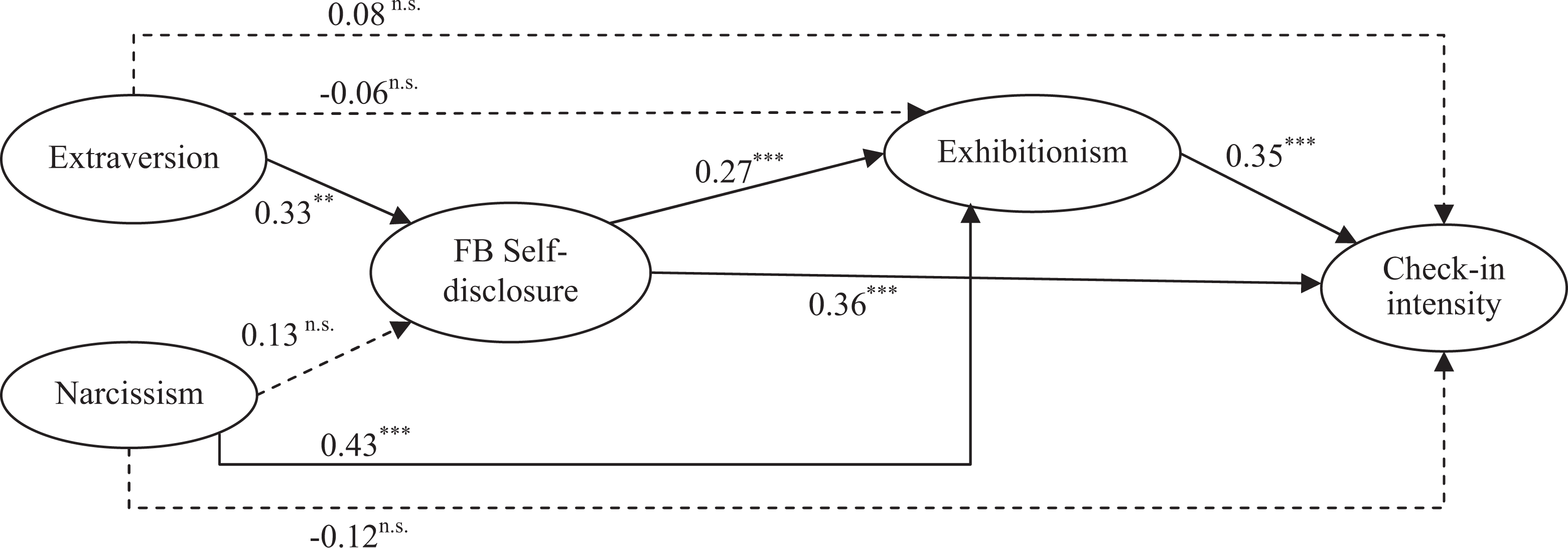
Path coefficients for the proposed model. Note. n.s. = nonsignificant, **p < .01, ***p < .001
The path coefficient from narcissism to exhibitionism was statistically significant (β = .43, t = 3.77, p < .001), but there was no significant result between extroversion and exhibitionism (β = .08, t = .78). Thus, Hypothesis 7 was supported, but Hypothesis 6 was rejected. Hypotheses 8 and 9 were also supported, confirming the positive relationship between self-disclosure and exhibitionism (β = .27, t = 4.32, p < .0001) as well as exhibitionism and Facebook check-in intensity (β = .35, t = 5.78, p < .0001).
This study further examined the indirect effect followed by the Sobel (1982) test. According to Iacobucci, Saldanha, and Deng (2007), while SEM provides a state-of-the art approach for assessing mediated relationships among constructs or variables, the follow-up z test is sensitive to the presence of the mediation effect. As shown in Figure 2, the mediated path, extroversion–self-disclosure on Facebook and self-disclosure on Facebook–check-in intensity, was significant but the direct path, extroversion–check-in intensity, was not. The Sobel (1982) test (z = 4.685, p < .0001) confirmed the mediation was complete, supporting Hypothesis 5a. As the indirect path, narcissism–self-disclosure on Facebook, and the direct path, narcissism–check-in intensity, were not significant, Hypothesis 5b was rejected.
The same procedure was conducted to test Hypotheses 8a and 8b, the complete mediation effect of extroversion–self-disclosure on Facebook–exhibitionism was confirmed (z = 4.045, p < .0001), while Hypothesis 8b was rejected. Hypothesis 9a was rejected as there was no direct correlation from extroversion to exhibitionism. Although the indirect path, narcissism–exhibitionism and exhibitionism–check-in intensity, was significant, neither z nor the direct path, narcissism–check-in intensity, was significant; partial mediation was achieved. Thus, Hypothesis 9b was supported. Finally, as the direct path, self-disclosure on Facebook–check-in intensity and the Sobel test (z = 4.747, p < .05) were significant, partial mediation was confirmed. Hypothesis 9c was thus supported.
Discussion
This study explored how the personality traits of extroversion and narcissism function to influence self-disclosure, which, in turn, impacts the intensity of check-in on Facebook. Moreover, the possibility that exhibitionism might mediate the relationship between self-disclosure and intensity of check-in behavior on Facebook was also considered. The results demonstrated that extroversion and narcissism might not directly impact check-in intensity on Facebook. Findings were in line with arguments that other motivational factors may be more influential in understanding Facebook use (Ross et al., 2009). Thus, this study went one step further to explore whether other meditational variables affect the use of the check-in function, and it found that the indirect effects of self-disclosure and exhibitionism were particularly salient in predicting the intensity of check-ins. This study found that self-disclosure not only had a significant direct effect on Facebook check-in intensity but also had a significant indirect effect on check-in intensity through exhibitionism. There was also a significant direct effect from extroversion to self-disclosure that contributed to a complete path from extroversion to Facebook check-in, through self-disclosure and exhibitionism.
Moreover, although there was no direct effect of narcissism on Facebook self-disclosure, a path from narcissism to check-in intensity through exhibitionism was discovered. Past research into the relationship between narcissism and self-generated content on Facebook found that narcissistic individuals tended to display more attractive profile pictures and engage in more frequent status updates (Ong et al., 2011). The findings of this study also illustrated that narcissism may not directly predict general Facebook self-disclosure behavior but that there may be other factors involved in predicting Facebook use. In this case, higher levels of extroversion may lead to higher levels of general self-disclosure behavior on Facebook, but narcissism may be too complicated to be identified solely on the basis of preference for general online behaviors. Facebook check-in may be considered as intensive exposure with both geographical positioning and contextual sensitivity. For more narcissistic users, who particularly appear to crave attention and fame, check-in leads to a direct expression of exhibitionism by providing tractable information for others to follow or praise.
Researchers also found that Facebook use may not be predicted solely on the basis of personality traits (Ross et al., 2009), suggesting that the relationship between traits and online behavior should go beyond simple bivariate comparisons. In addition, more and more social psychologists are focusing on mediational models of social behavior where a mediator is a variable that can explain the psychological mechanism between two other variables (Baron & Kenny, 1986). The current study has advanced the literature by exploring more sophisticated paths to understand the linkage of personality traits, motives, and human behavior. It contributes to the growing body of research on personality traits and Facebook use and develops a conceptual model in which self-disclosure on Facebook and exhibitionism are identified as two mediators between two personality traits, extroversion and narcissism, and check-in intensity. Here, the intensity of using certain Facebook features may not directly reveal the extent of the individual’s traits. Personality traits, however, may serve as antecedent factors to reinforce certain behavioral tendencies that ultimately trigger the individual’s extensive online behavior.
The samples for this study tended to be college students or older, and this can be understood as, unlike other SNSs that have first become popular among teenagers, the users of socially driven location applications, such as Foursquare, are typically older than college students (Lindqvist et al., 2011). Additionally, this study, as well as other market research (JiWire, 2011; Socialbakers, 2012), found that restaurants, pubs, movie theaters, scenic areas, or even transportation stations were the most popular locations people checked in from onto Facebook, and this finding indicates that people tend to share things about their entertainment and recreation activities. They prefer not to check-in at places considered embarrassing, such as fast food restaurants, or boring like school and office (Lindqvist et al., 2011). The implications are twofold: first, this explains why respondents are predominantly college students or older, as older and more educated users would be more likely to have the economic freedom to spend money pursuing a variety of activities. Second, because physically and socially active recreational and leisure activities are pleasurable and enjoyable, checking-in on Facebook can serve as a mode of self-presentation adopted to show the taste and lifestyle of the user to an audience in a manner that contributes to the respondents’ exhibitionism.
Theoretical Implications
The hyperpersonal model (Walther, 1996) suggests that the technological aspects of the CMC allow individuals greater possibilities for strategically developing and editing their self-presentations, thereby enabling selective and optimized self-images. Like most research done on Facebook, this study is generally conducted within the users’ social context. However, a check-in also conveys more clues than text or a photo display by explicitly emphasizing physical location. That is, self-generated text messages tell people what the message sender thinks, and photos tell people how the photo owner looks. Location check-ins, on the other hand, not only tell people whereabouts but also provide clues to leisure activities and lifestyle that can enable the recipients to exaggerate subtle social and personality cues, as suggested in the hyperpersonal model (Walther, 1996). The findings of this study support the hyperpersonal perspective, in general, and add more contextual paths in predicting behavior for individuals who differ in their level of particular traits and motives in the context of location check-ins. Although a fruitful line of research has examined how CMC users develop impressions and relations through text- or photo-based clues (Wang, Moon, Kwon, Evans, & Stefanone, 2010), the current study further extends the hyperpersonal model and suggests location sharing is not only the expression of whereabouts but may also be seen as social-driven information for impression management.
As demonstrated in this study, self-disclosure on Facebook plays an important role in predicting respondents’ levels of exhibitionistic motivation and the intensity of their check-in behavior on Facebook. Self-disclosure on Facebook may be a strategy of selectively presenting oneself for savvy users, to satisfy their exhibitionistic motives regarding impression formation, and that ultimately drives the way users manipulate their communication tools, in this case by selectively disclosing their locations and activities through the check-in function to share positive or favorable experiences. While an earlier study found that maintaining a personal blog (Hollenbaugh, 2011) especially appealed to people with exhibitionistic tendencies, the current study found a positive relationship between the level of exhibitionism and check-in intensity. This suggests that check-in on Facebook may provide a forum not only for selective self-presentation but also for the presentation of leisure activities with GPS identifiable data. Checking-in may provide nuanced understanding of the use of physical spaces as a means for sociability and identity formation. It may not be perceived as a reflection of one’s routine status; rather, it may be considered as an even more meticulous presentation and as a means for shaping one’s image. Self-portrayal through check-in information may thus be seen as an even more carefully crafted opportunity for the individuals to open themselves up in real time.
From the performative perspective, check-in users tend to disclose locations that may be inferred to reflect their social and leisure life and that the connection to larger audiences via Facebook may lead to even more performative uses. Forming a desirable self-presentation through checking-in at specific places may be understood as a means for enhancing one’s status within the social network. While the fundamental advantages of SNS can be referred to as dynamic matrices of information through which users can observe others, edit and update status, and exhibit and expand their social network (Beer & Burrows, 2007), checking in may facilitate a new level of exhibitionism to satisfy the need to express one’s chosen identity, to validate oneself within the social matrix (Calvert, 2004), and to disclose location information as a method of forging social identities.
Limitations and Future Directions
The limitations of this study included the fact that only Facebook check-in users were questioned and that the study did not compare the personality traits of users with those of nonusers. Thus, this study explains only the extent to which personality traits, motives, and check-in behavior interplay with one another but does not suggest that check-in users are higher in extroversion and narcissism than nonusers. Moreover, this study did not examine all the dimensions of the Big Five personality traits (Costa & McCrae, 1992), nor did it examine all possible motives. Instead, the study investigated only those traits and motives that may be relevant, based on the existing literature. Given the constraints of conducting this research, full scales could not be used.
This study drew upon the performative perspective of check-in users; how check-ins are perceived by the audience may also be interesting to explore. The data and results are also limited because the occupation of nonstudent participants was not measured and could not be addressed. More exploratory research in the future may discover other dimensions to help explain the observed phenomena. In addition, the cross-sectional nature of this study implies that causal inference cannot be established. Finally, the data were based solely on participation recruitment through certain online channels, and the final sample yielded a large proportion of more highly educated respondents. Although Facebook users tend to be better educated, this should be noted as a possible limitation of this study. Future research may also want to examine other age groups, such as adolescents, to explore whether they are more narcissistic than adults.
Conclusion
The proposed model for this exploratory research demonstrates how particular personality traits may influence Facebook users’ self-presentation strategies by selectively disclosing physical locations to the audience within their social networks. Facebook check-in can provide a rich context to understand digitally mediated social interactions and physically separated urban spaces, as it may be considered a mechanism through which a complex relationship of self-presentation, social presence, and personality traits interplays with space and place. Checking-in involves the announcement of a simultaneous presence of locations, activities, as well as social actors, thus increasing the potential for social interaction and impression to be developed. Self-presentation and places are therefore closely connected. Location check-in may foster a self-presentation that is performed by constructing the meaning of places. With the development of mobile communication technologies, the sociospatial relationship has become an essential factor in the articulation of identities and information disclosure.
In the broader context, little empirical evidence has provided understanding or modeling of human mobility and online behaviors. This study attempts to bridge the gap and to link human mobility, personality traits, and impression management on Facebook. Mobile communication marks a way in which the notion of time and space can be altered and encourages ongoing conversations between social actors. More precisely, with an accessible GPS function, smartphone users are offered even greater levels of identifying and exposing their space–time aspect so as to offer a new means of connection and communication. It is not just about how information circulates in cyberspace but also about how information transits through everyday life and places. Facebook check-in highlights the physical and informational mobility of the users, relating individual activities to spaces so that concrete locations can be exaggerated into abstract meanings. The meaning of a location check-in on Facebook may be less about tracking and tracing but more about how the information is perceived, interpreted, and manipulated. It is also less about the affordability of technology but more about strategically sharing place-specific occurrences online in order to evoke awareness of off-line identity.
Footnotes
Authors’ Note
The earlier version of this paper received Gene Burd Award for Top Faculty Research Paper at the Annual Convention of the Association for Education in Journalism and Mass Communication, 2012.
Declaration of Conflicting Interests
The author(s) declared no potential conflicts of interest with respect to the research, authorship, and/or publication of this article.
Funding
The author(s) disclosed receipt of the following financial support for the research, authorship and/or publication of this article: This study is fully funded by Aim for the Top University Project of Electronic Commerce Research Center, NSYSU.