







Abstract
Most tertiary students now work to support themselves, but some are motivated by improving their employability and career development. However, many work in precarious jobs and the relationship between job quality and career development is poorly understood. We tested how precarious employment related to career capital, whether perceptions of organisational career growth (i.e. goal progress and ability development) explained this, and whether meritocratic beliefs (i.e. in a just society) moderated these relationships in working university students (N = 214; 78% female; MAge 20 years). Precariousness was related to less career capital, which was explained partially by perceiving fewer organisational career growth opportunities. Meritocratic beliefs buffered the negative precariousness-career growth relationships and boosted the positive career growth-career capital relationships. Overall, 52% of the variance in capital was explained. Results point to how career practitioners might assist precariously employed students to successfully engage in career self-management.
Keywords
Precarious jobs are insecure, poorly paid, lack rights and protection, and expose workers to environments that are detrimental to their wellbeing (Kreshpaj et al., 2020). This includes non-standard (e.g. temporary, casual, on-call, and ‘gig economy’) jobs that have grown over the past few decades at the expense of standard (full-time, permanent) jobs. This growth has been driven by technological developments, macro-economic disruptions, labour market deregulation, and demographic shifts (Hood & Creed, 2019; ILO, 2020; Quinlan & Rawling, 2024). Around 50% of Australian workers lack paid leave entitlements, which the government uses as a proxy for casual or other non-standard employment (ABS, 2024). Similar rates are seen globally (e.g., 40-60% workers in the EU; Zwysen, 2025). Youth are particularly at risk due to the decline in decent entry-level jobs, their lack of work experience, and their under-developed job skills (Chesters & Wyn, 2019). As a result, in Australia, 15 to 24 year olds are over-represented in precarious forms of employment (ABS, 2024).
Working students form an important part of the youth workforce. They are a critical labour source for retail, accommodation, and hospitality sectors that rely on cheap, flexible, and disposable workers (Campbell & Price, 2016). In Australia, 86% of university students work while studying (YouthInsight, 2023), comprising 20% of the casual workforce (cf. 1.3% of the permanent workforce; Gilfillan, 2021). Similarly, 74% part-time US college students (NCES, 2022) and 69% UK university students (NUS, 2023) work. Students’ primary work motive is to meet living and educational costs, but 28 to 70% are motivated to gain labour market and career experience and improve their CV and employability (Gilfillan, 2021; Oertelé, 2019; Wright et al., 2025).
Precarious employment in young workers is linked to poorer wellbeing and delayed adult development (Bell & Blanchflower, 2011; Cuervo & Chesters, 2019; Laß, 2020). The “scarring” effects of early precarious employment have been linked also to adverse long-term work and career consequences, such as more difficulty entering the full-time labour force (Cebulla & Whetton, 2018), greater risk of ongoing precarious work (Xu et al., 2022), less well-defined future work self-concepts (Hardgrove et al., 2015), more negative labour market perceptions (Wong & Au-Yeung, 2019), impaired career progress (Stuth & Jahn, 2020), and lower lifetime income (Bell & Blanchflower, 2011). Precarious employment in working students has been related to sleep disruption (Creed, Hood, Selenko, et al., 2022), less study engagement (Creed et al., 2015), poorer wellbeing (Creed et al., 2015, 2020; Creed, Hood, Selenko, et al., 2022; Goldrick-Rab et al., 2020), and less job crafting, career agency, and career capital (Creed et al., 2026; Hood et al., 2025).
We extend this literature by examining further the relationship between working students’ perceived job precariousness and career capital. To date, most studies have based their conclusions on outcomes of precariousness by examining between-group differences comparing, for example, workers on standard versus casual or other non-standard contracts. This does not consider the individual’s own appraisal of their employment precariousness (Jiang & Lavaysse, 2018). We contribute by taking a psychological perspective and assessing working students’ perceptions of their job precariousness. We also assessed organisational career growth (i.e. OCG; perceived workplace career development opportunities; Weng & McElroy, 2012) as a potential intervening variable between perceived precariousness and career capital, and meritocratic beliefs (i.e. causal beliefs about merit and social status; Heckhausen & Shane, 2015) as a potential moderator of these direct and indirect paths.
Theoretical Background
Career self-management is a suitable theoretical framing for understanding how job precariousness is related to accumulation of career capital. Career self-management involves proactive, agentic behaviours that enable acquisition, management, and use of resources to achieve career goals and wellbeing (King, 2004; Wilhelm & Hirschi, 2019). King (2004) noted this is critical in more chaotic or challenging career contexts. She identified strategic investment in human capital and active network development as important positioning behaviours in career self-management. More broadly, Lent and Brown’s (2013) social cognitive model of career self-management emphasised the role of contextual and individual factors in personal agency and adaptive career behaviours that, in turn, are relevant to career development and transitions. Similarly, Wilhelm and Hirschi (2019) noted that contextual factors, such as the labour market structure and OCG, affect career self-management and subsequent outcomes including perceived employability, engagement, and satisfaction.
Career self-management has been examined mainly in standard employment. However, Retkowsky et al. (2023) examined this in temp agency workers. These precariously employed workers engaged short-term and reactive career self-management behaviours aimed at survival and gaining stable employment. Instead, these reactive behaviours were associated with ongoing precarious employment and resource loss during unemployment. We extend career self-management theory to job precariousness and career capital in working students.
Precarious Work and Career Capital
Career capital refers to the non-financial resources (i.e. skills and knowledge) needed for career performance and success that individuals accumulate over their working lives (Jokinen et al., 2008). Thwarted accumulation or erosion of existing capital is associated with having to take jobs for which one is over-qualified (e.g. migrant workers, Eggenhofer-Rehart et al., 2021) and precarious jobs in which there is less training (Connell & Burgess, 2006) and constrained development of transferable competencies (e.g. gig workers, Duggan et al., 2021). Similarly, job insecurity is linked to impeded accumulation of career capital via less opportunity to build skills, networks, knowledge of the ‘how’ and ‘who’ of career progression, and a competitive CV (Broadbent & Strachan, 2016; Colakoglu, 2011). In working students, perceived job precariousness was related to lower career capital, both directly and indirectly via less job crafting (Hood et al., 2025). Thus, we hypothesised that:
Perceived job precariousness is related negatively to acquired career capital.
Organisational Career Growth (OCG) as an Intervening Explanatory Variable
OCG is the perception that work offers opportunities to develop skills and knowledge that advance individual career goals (Weng et al., 2010). This can be via formal training, mentoring, learning on-the-job, and rotating interesting and challenging work allocations. OCG benefits not only workers but organisations via higher worker engagement and productivity (Spagnoli, 2020) and facilitation of career self-management behaviours that improve worker’s commitment and success (De Vos et al., 2009; Wilhelm & Hirschi, 2019).
We found no studies that directly tested how job precariousness related to OCG. However, job insecurity was related to less OCG (Broadbent & Strachan, 2016; Colakoglu, 2011; Kang et al., 2020), fewer formal and informal career development practices (De Cuyper et al., 2019), and less career-enhancing supervisor support (Akbiyik, 2016) and networking (Nabi, 2003). Young workers in low-level jobs reported less access to OCG (Agut et al., 2009; Seong et al., 2021).
OCG has been related to aspects of career capital, such as competency mobilisation (Kang et al., 2020) and career resilience (Okon et al., 2025). In addition, workplace training was related to objective and perceived career success (Fang et al., 2009; Moon & Choi, 2017), whereas lack of supervisor support for skills development was related to poorer career decision-making (Henninger et al., 2019). Aspects of OCG also explained links between job insecurity and career success (Nabi, 2003), commitment (Akbiyik, 2016; Yoon et al., 2018), and capital (Broadbent & Strachan, 2016; Colakoglu, 2011). Therefore, we expected that:
Perceived job precariousness is related negatively to career capital via OCG.
Meritocratic Beliefs as a Conditional Variable
Meritocratic beliefs refer to ‘belief[s] in a just world’ (Lerner, 1980, p. 9), in which individual reward is related to ability and effort, and social advantage, biased social structures, or chance do not determine life opportunities. They are beliefs that means-end relationships are controllable by personal effort (Goode et al., 2014), so have an important role in goal setting and regulation (Shane & Heckhausen, 2016). These beliefs have increased in prevalence, especially in western countries, including Australia, where around 90% believe that people ‘get ahead’ primarily because of hard work (Mijs, 2021).
Meritocratic beliefs are associated with higher educational aspirations (Kay et al., 2016) and stronger learning intentions (Reynolds & Xian, 2014). In career development, they are associated with greater exploration and engagement; goal clarity, striving, and optimism for goal attainment; and job search and career success (Hu et al., 2020; Shane & Heckhausen, 2016). These beliefs also moderated the direct and indirect paths from core self-evaluations to career attitudes via career adaptability (Du et al., 2022). In contrast, beliefs that life success is due to external factors, and not to merit, were related to adverse outcomes for young people at workforce entry, including lower pay, status, and agency (Kay et al., 2017).
However, in low SES adolescents, stronger meritocratic beliefs predicted more likelihood of being in precarious jobs and less likelihood of full-time work in adulthood (García-Sierra, 2023). In high SES adolescents, these had the typical positive outcomes; that is, stronger meritocratic beliefs predicted less likelihood of precarious employment (not related to full-time status). In general, though, these beliefs bolstered self-esteem, self-efficacy, hope, and optimism and motivated goal engagement and persistence in lower SES workers (Bahamondes et al., 2019; Hu et al., 2020). However, precarious employment has been shown to erode meritocratic beliefs. Parental job insecurity eroded young people’s beliefs in hard work (Barling et al., 1998) and low-quality jobs eroded women’s work and other aspirations (Kozan et al., 2020).
Notwithstanding some evidence of demographic differences, most evidence suggests that stronger meritocratic beliefs benefit young people’s educational and career goal striving, but that precarious employment might erode these beliefs. We extended the current literature by examining whether meritocratic beliefs moderate the proposed negative links from perceived job precariousness to career capital via OCG in a relatively advantaged group; namely, working students in higher education. We expected that:
Holding stronger meritocratic beliefs buffers the negative job precariousness to OCG relationship (H3a), strengthens the positive OCG to career capital relationship (H3b), and buffers the indirect relationship between precarious employment and capital via OCG (H3c).
Method
Participants
We recruited 219 working students (78% female; M age 20.14, range 17–23 years) from urban and regional campuses at one Australian university, although we excluded 5 cases due to incomplete or patterned responding (N = 214). Most (88.3%) were domestic, with the rest being international students studying in Australia. Just over half (58.4%) were enrolled part-time (1 or 2 courses), with the remainder full-time (3-5 courses). Average work hours per week was 20.94 (SD 10.13, range 2.5-50), with 86.4% working 1 job, 11.7% 2 different jobs, and 1.9% 3 or 4 jobs. Mean subjective social status (SSS, representing family of origin standing in society based on income, education, and occupational status; 0 = at bottom, 100 = at top; Adler & Stewart, 2007) was 62.86 (SD 18.14). For current financial situation, 32.7% were living comfortably on present income, 45.3% were coping, 17.3% were finding it difficult, and 4.7% were finding it very difficult (European Social Survey, 2022).
Materials
Job Precariousness
Creed et al. (2020)’s 12-item Job Precariousness Scale captures perceived precariousness in job security, conditions, remuneration, and flexibility (e.g. ‘To what extent are you concerned about losing your current job in the near future?’; 1 = not at all to 6 = a great extent; higher scores reflect more precariousness). In Australian working university students, Creed et al. provided evidence of reliability (α = .83) and validity via positive associations with financial strain and negative associations with workplace support. Our alpha was .86.
Organisational Career Growth
We used Weng and Hu’s (2009) OCG Career Goal Progress (OCG-P; 4 items, e.g. ‘My present job moves me closer to my ultimate career goal’) and Professional Ability Development subscales (OCG-A; 4 items, e.g. ‘My present job encourages me to gain new and job-related skills’). Higher scores reflect more OCG (1 = strongly disagree to 6 = strongly agree). Spagnoli and Weng (2019) supported content and factor validity in workers. In working students, Creed, Hood, Bagley et al. (2022) found excellent reliability (α = .95). Our alphas were .95 (OCG-P) and .94 (OCG-A).
Career Capital
Jokinen et al. (2008)’s 23-item Career Capital Scale assesses the accumulation of 3 broad areas of career-related knowledge and skills; knowing why, how, and who (e.g. ‘[Learning about] knowledge of norms or informal rules central to your desired career’; 1 = very little to 6 = a great deal; higher scores reflect more capital). With university students, reliability was high (α = .93; our α = .96) and validity was supported by positive correlations with career success and psychological capital (Huang & Lin, 2013).
Meritocratic Beliefs
Shane and Heckhausen’s (2016) 4-item Merit subscale of the Societal Beliefs Scale measures means-ends-beliefs as to why people do well in society (e.g. ‘Where I end up on the social status ladder will be determined by my hard work and effort’; 1 = strongly disagree to 6 = strongly agree; higher scores reflect stronger merit beliefs). With university students, reliability is sound (αs .76-.81; Hu et al., 2020; Zhang et al., 2025; our α = .93). The authors supported validity via positive associations with goal engagement.
Procedure
The study was approved by the authors’ university ethics committee. Students were contacted via course websites and provided with study details and a link to an anonymous, online questionnaire. They could enter a draw to win one $50 voucher (200 entered).
Data Management
Hayes’ (2018) PROCESS macro for SPSS enables testing of moderated mediation (or conditional process) models using ordinary least squares regression and observed variables. Inferences about test statistics are based on bootstrapping making it ideal for small samples such as ours. We used 5,000 bootstrapped samples and 95%ile bootstrapped confidence intervals (CIs), with significance indicated by CIs that did not contain zero. With a single line of syntax, PROCESS yields relevant test statistics, path coefficients, standard errors and bootstrapped CIs, and conditional direct and indirect effects. PROCESS Model 4 was used to test the indirect relationships between job precariousness and career capital via organisational career growth. We then applied PROCESS Model 59 to assess moderated mediation by meritocratic beliefs on the direct and indirect relationships, probing all significant interactions using the Johnson-Neyman technique to identify effect sizes for different outcome levels.
Results
Descriptive Statistics and Correlations (N = 214)
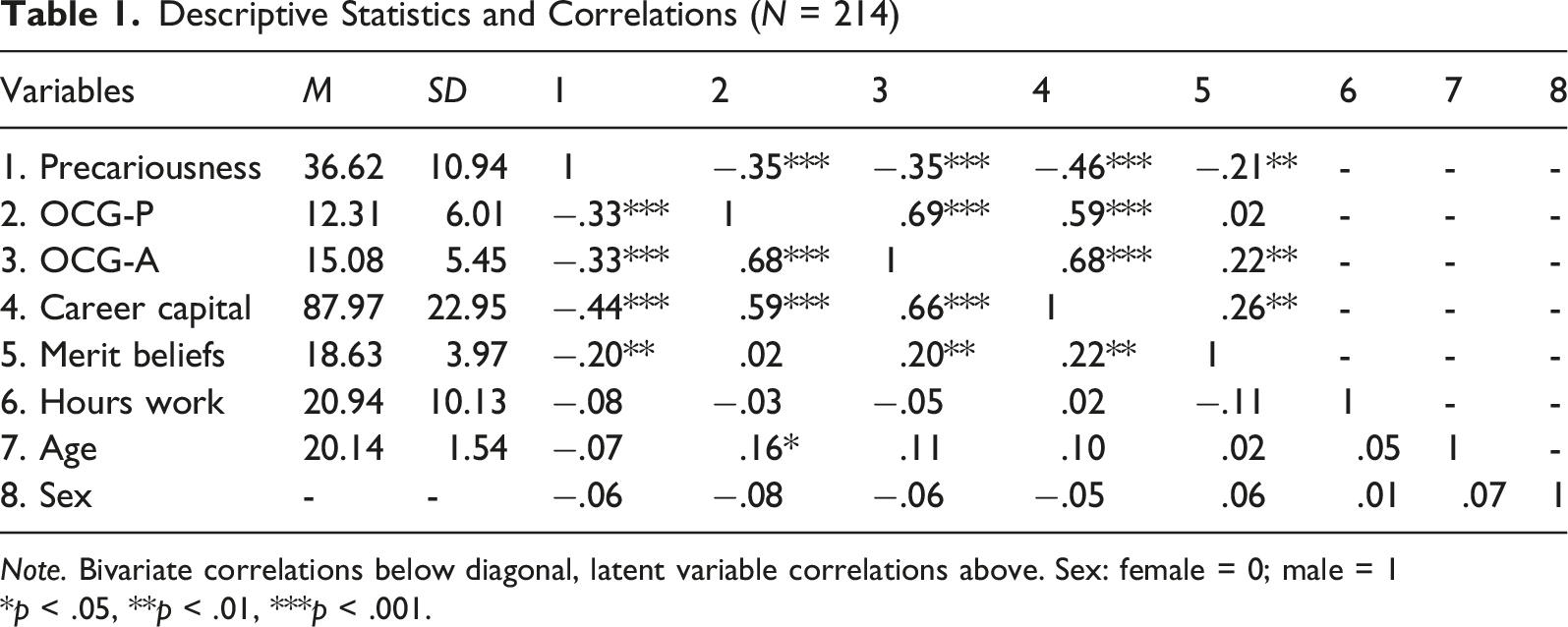
Note. Bivariate correlations below diagonal, latent variable correlations above. Sex: female = 0; male = 1
*p < .05, **p < .01, ***p < .001.
Indirect Effect of OCG-P and OCG-A on the Relationship between Job Precariousness and Career Capital (N = 214)
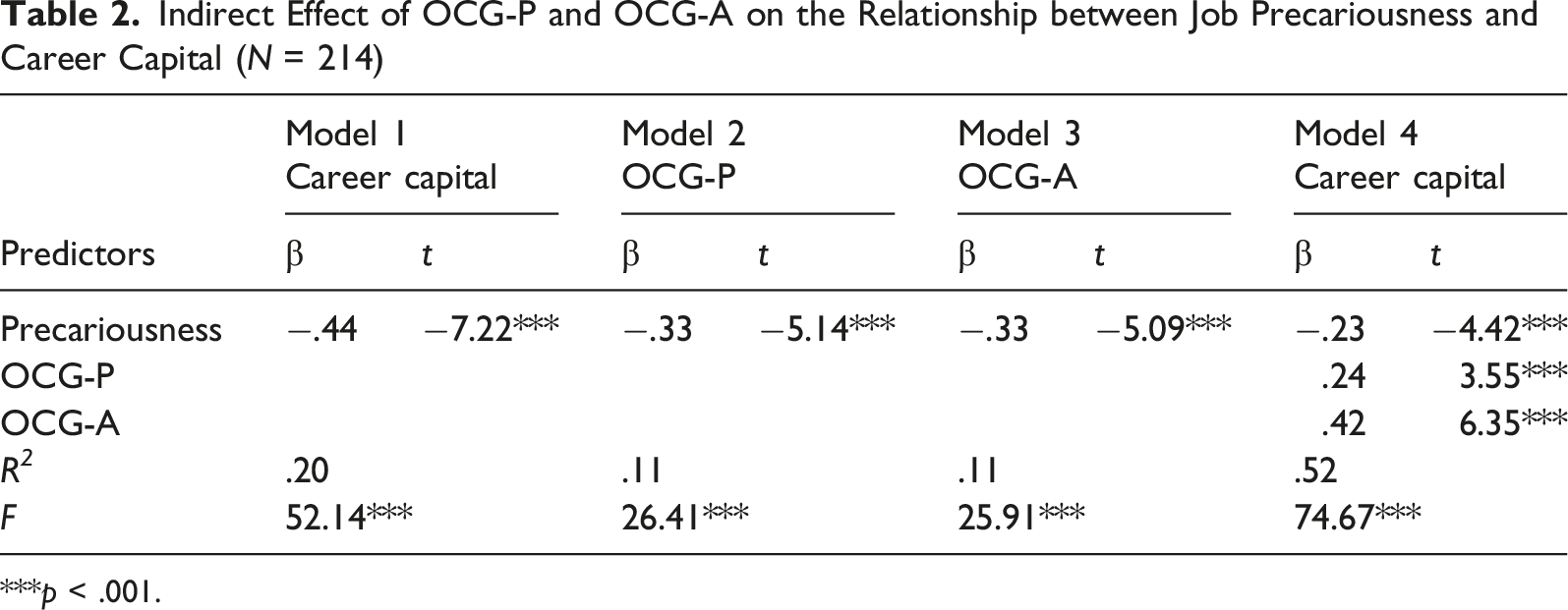
***p < .001.
Effect of Meritocratic Beliefs on Direct and Indirect Relationships between Job Precariousness and Career Capital via OCG-P and OCG-A (N = 214)
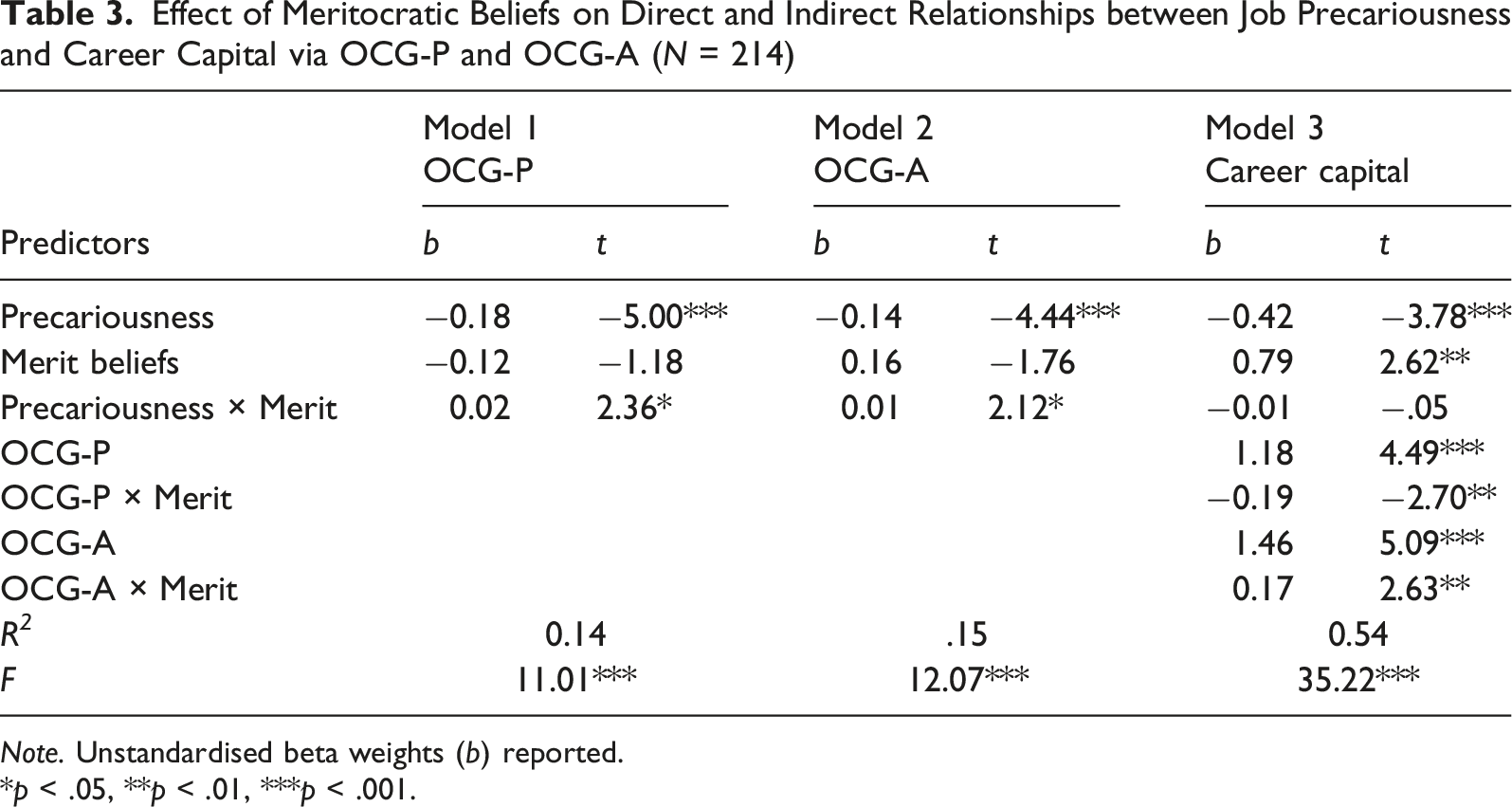
Note. Unstandardised beta weights (b) reported.
*p < .05, **p < .01, ***p < .001.
In Model 1, OCG-P was predicted by precariousness, B = −.1805 [CIs −.2516 to −.1093], p < .001, and precariousness x meritocratic beliefs, B = .0177 [CIs: .0029 to .0324], p = .019, but not by meritocratic beliefs, B = −.1192 [CIs: −.3182 to .0798], p = .24. The interaction explained 2.29% more variance in OCG-P than the main effects. Moderation of the precariousness-OCG-P relationship was significant at all levels of beliefs up to 4.48 SDs above the mean (87.85% of sample). Figure 1a shows that as precariousness increased, OCG-P decreased. However, meritocratic beliefs buffered this. The negative precariousness-OCG-P relationship was weakest when beliefs were high (b = −.11, p = .024), and strongest when beliefs were low (b = −.25, p < .001). Moderation effects by meritocratic beliefs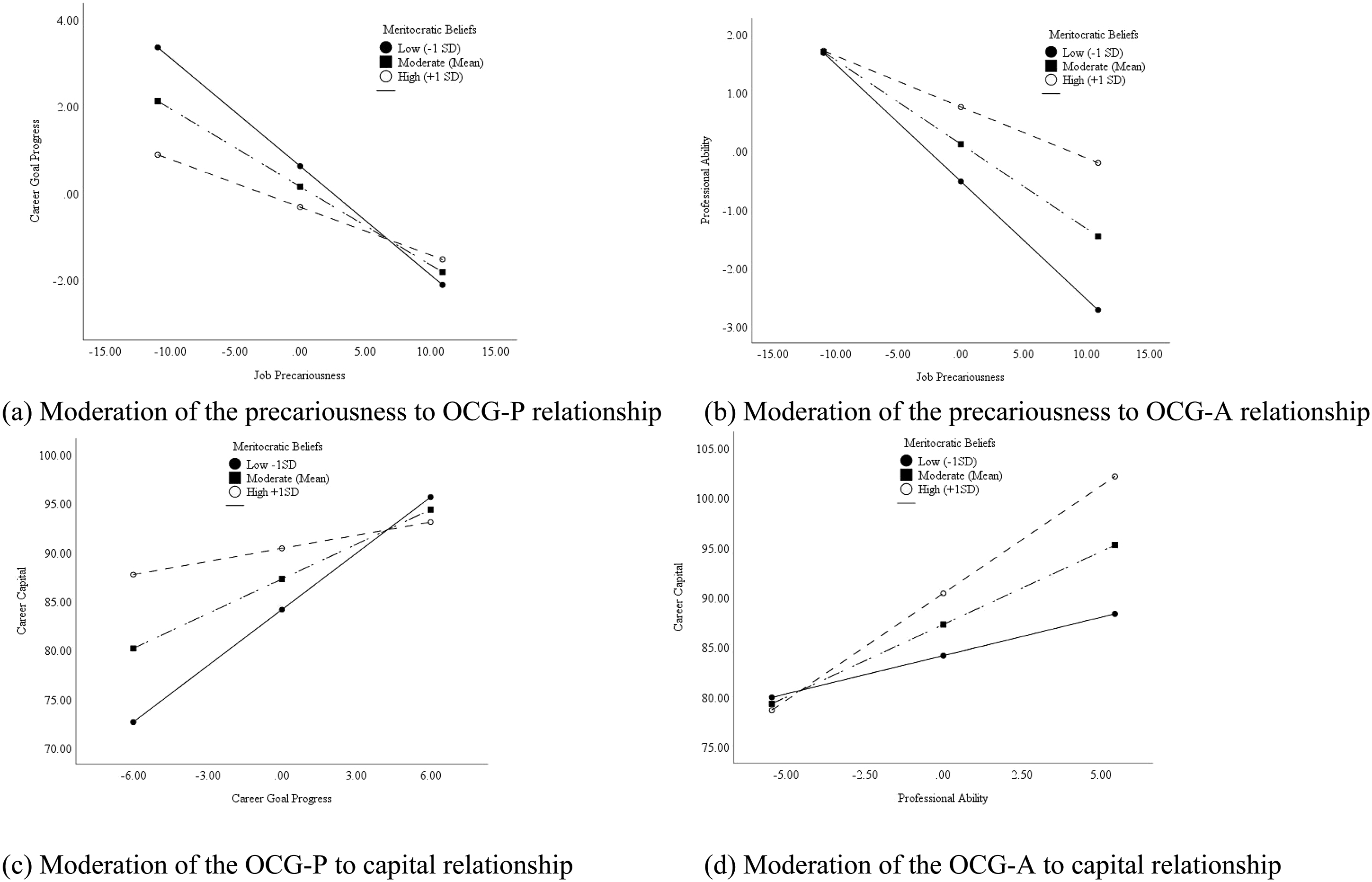
In Model 2, precariousness, B = −.1443 [CIs: −.2084 to −.0802], p < .001, and the precariousness x meritocratic beliefs interaction, B = .0143 [CIs: .0010 to .0276], p = .035, predicted OCG-A, but meritocratic beliefs did not, B = .1608 [CIs: −.0186 to .3401], p = .08. The interaction explained an extra 1.83% of the variance, with the interaction significant at all levels of beliefs up to 4.00 SDs above the mean (85.51% of sample). Figure 1b shows that OCG-A decreased with increasing precariousness. When beliefs were high, this decrease in OCG-A as precariousness increased was marginal (b = −.09, p = .048), but when beliefs were low, this negative relationship was strongest (b = −.20, p < .001).
In Model 3, precariousness, B = −.4167 [CIs: −.6343 to −.1992], p < .001; meritocratic beliefs, B = .7890 [CIs: .1952 to 1.3827], p = .009; OCG-P, B = 1.1804 [CIs: .6623 to 1.6986], p < .001; and OCG-A, B = 1.4611 [CIs: .8947 to 2.0275], p < .001, predicted career capital. There were significant interactions of OCG-P x beliefs, B = −.1895 [CIs: −.3200 to −.0499], p = .008, and OCG-A x beliefs, B = .1745 [CIs: .0435 to .3056], p = .009, but not precariousness x beliefs, B = −.0013 [CIs: −.0570 to .0545], p = .96. Beliefs modified the OCG-P-capital relationship at all levels up to 3.23 SDs above the mean (79.44% of sample); Figure 1c. This interaction explained 1.61% more variance in capital. When beliefs were high, OCG-P was unrelated to capital, b = 0.4469 [CIs: −.1920 to 1.0858], p = .17; capital was high regardless. However, when meritocratic beliefs were low, career capital increased steeply as OCG-P increased, b = 1.9140 [CIs: 1.0759 to 2.9752], p < .001. Beliefs influenced the relationship between OCG-A and capital at all levels of beliefs >3.70 SDs below the mean (90.01% of sample); Figure 1d. This interaction explained 1.52% more variance in capital. When beliefs were high, capital increased as OCG-A increased (b = 2.1533 [CIs: 1.4646 to 2.8420], p < .001). However, when beliefs were low, capital was not significantly related to OCG-A (b = 0.7689 [CIs: −0.0724 to 1.6102], p = .07), remaining low regardless.
Conditional Direct and Indirect Effects
There were significant negative conditional direct effects of precariousness on capital when beliefs were low, B = −0.4116 [CIs: −0.7412 to −0.0820], p = .015; moderate, B = −0.4167 [CIs: −0.6343 to −0.1992], p < .001; and high, B = −0.4218 [CIs: −0.7113 to −0.1323], p = .005. The conditional indirect path from precariousness to capital via OCG-P was significant under low [CIs: −0.7715 to −0.2286] and moderate [CIs: −0.3583 to −0.0975], but not high [CIs: −0.1417 to 0.0094] beliefs. The indirect effect was stronger when beliefs were low. The conditional indirect path from precariousness to capital via OCG-A was significant at moderate [CIs: −0.3526 to −0.0959], but not low [CIs: −0.3889 to 0.0427] or high [CIs: −0.4052 to 0.0048] beliefs. Thus, H3 was partially supported.
Discussion
Despite university students often working in precarious jobs, little was known about how this related to their career development, especially organisational opportunities for career growth and the accumulation of career capital. Framed by career self-management theory (King, 2004; Wilhelm & Hirschi, 2019), we addressed this by testing the relationships between perceived job precariousness and career capital via two aspects of OCG – career goal progress and professional ability development – and the role of meritocratic beliefs in modifying these. There was a moderate-to-strong negative path from precariousness to capital, explained partially by lower OCG. Meritocratic beliefs did not moderate this overall indirect path but buffered the negative precariousness to OCG and OCG to capital paths.
First, we found that perceptions of higher job precariousness (i.e. insecure, low pay, inflexible, and with poor conditions) was related to working students reporting less accumulation of career capital. Hood et al. (2025) also found this. These findings add to previous evidence of adverse relationships between early precarious employment and a broader range of career development and success measures (Bell & Blanchflower, 2011; Cebulla & Whetton, 2018; Creed et al., 2026; Hardgrove et al., 2015; Stuth & Jahn, 2020; Wong & Au-Yeung, 2019; Xu et al., 2022). Young people are particularly vulnerable to precarious employment conditions as many lack the skills and resources to negotiate improved conditions (Xu et al., 2022) and perceive that the organisational climate as not conducive to proactive job redesign (Hood et al., 2025). Thus, working students, and their families, educational institutions, and employers, need to be mindful that not all work experiences advantage their career development and long-term success; poor quality jobs can scar. This is particularly relevant given the proportion reporting a secondary work motivation to improve employability and career prospects (Gilfillan, 2021; Oertelé, 2019; Wright et al., 2025).
We provide some insight into what might explain the negative relationship between job precariousness and capital. Appraisals of career-related opportunities available at work (i.e. OCG) partially explained the precariousness-capital link. Students who perceived their jobs as more precarious reported fewer opportunities to develop their professional abilities or progress their career goals. Previous studies also have shown that more precarious jobs offer fewer opportunities to develop and strengthen career-related skills (De Cuyper et al., 2019; Kang et al., 2020) and that young non-standard workers receive less investment in their training and development (Agut et al., 2009; Seong et al., 2021). These results complement Creed, Hood, Bagley et al.’s (2022) findings that for working students OCG partially explains the positive relationship between desirable job characteristics (supervisor support, relevance to their study) and perceived future employability.
These findings need to be considered in the context of significant moderation by meritocratic beliefs. Believing that merit drives success was related directly to reporting more career capital, suggesting that if working students view effort and hard work as beneficial to improving their social status, they strive to acquire more capital, even in jobs that are secondary to their study and long-term career goals. This is consistent with the existing literature that these beliefs are related to general advancement (Mijs, 2021). Meritocratic beliefs are thought to influence setting of higher goals, expending more effort on achieving them, and persisting in the face of setbacks (Hu et al., 2020; Shane & Heckhausen, 2016). Our findings add a positive association with career capital to the existing literature that has found positive associations with a range of other desirable career outcomes (Du et al., 2022; Hu et al., 2020).
Meritocracy beliefs buffered the negative relationships of precariousness with OCG-P and OCG-A as expected. The decline in both indicators of OCG with greater precariousness was steeper when working students did not believe that effort and hard work pay off. It appears that those who do not espouse beliefs in merit benefit more from OCG when jobs are less precariousness. This is likely because there is more investment in workers’ career development in less precarious jobs (De Cuyper et al., 2019; Kang et al., 2020) and personal beliefs about working hard and putting in effort to get ahead are less relevant. However, there were different patterns for each OCG indicator. Interestingly, higher meritocratic beliefs was related to lower OCG-P compared to those with lower beliefs when jobs were less precarious. This might reflect that those students did not see these temporary jobs as so relevant to progressing their career goals as they believe that their hard work and effort will pay off in other ways, possibly via their study or broader networking. However, the decline in OCG-P was less sharp for them as precariousness increased than for those who held low meritocratic beliefs. Thus, these beliefs buffered the adverse impact of increasing precariousness on OCG-P. In contrast, regardless of precariousness, stronger meritocratic beliefs were related to greater OCG-A and less decline as precariousness increased.
As expected, meritocratic beliefs strengthened the positive relationship between OCG-A and career capital. However, when beliefs were low, capital accumulation did not grow regardless of the amount of OCG-A they reported. The pattern was different for OCG-P. The career capital of working students with low meritocratic beliefs benefited most from more organisational opportunities for career goal progress, whereas the career capital of those with higher beliefs did not benefit from more OCG-P. These results also suggest that those who do not believe they will get ahead by their own merit rely more on organisational facilitation.
Our findings that meritocratic beliefs are related directly to career capital and buffer the adverse impact of job precariousness on opportunities for career growth are consistent with Shane and Heckhausen (2016) who showed that meritocratic beliefs were related to greater career engagement and more positive appraisals of their future social status. Importantly, they highlight that those who do not believe in merit are most vulnerable to the scarring effects of these employment contexts on their career development, but that they benefit when organisations support career growth. Our results were not consistent with García-Sierra (2023). However, she found detrimental effects of stronger meritocratic beliefs only when SES was low, and over the longer-term. Our sample were more advantaged, given they were in higher education, so it is likely that these beliefs will help them also longer-term.
Practical Implications
University students not only work to support themselves financially, but some seek career and work experience that they believe will benefit their CVs and future employability (Gilfillan, 2021; Oertelé, 2019; Wright et al., 2025). That is consistent with career self-management and a motivation to accumulate career capital. Career practitioners can play an important role in supporting them to self-manage and maximise OCG opportunities and capital, especially when their jobs are typically more precarious and may not invest in them.
University counselling and careers services practitioners can support students to identify and advocate for access to learning and career development opportunities at work. They might focus on enhancing students’ career self-management positioning behaviours (King, 2004), such as building networking skills and helping them identify opportunities at work to develop their abilities, progress career goals, and build capital. This could include formal activities (e.g. gaining a workplace mentor), but also raising students’ awareness that informal work networks can yield unanticipated benefits (e.g. a co-worker has a connection that they can introduce who is relevant to the student’s future career area). Practitioners could conduct job or career crafting workshops to assist working student’s to proactively engage in career self-management behaviours that build capital (Hood et al., 2025).
However, Hood et al. (2025) found that precariously employed student workers perceived their organisational climate was less conducive to innovation and proactive job re-design. Thus, organisations also need to be educated about how they would benefit from enabling more proactive career self-management by, and investing in career growth of, their nonstandard, including student, workers, who typically miss out (Kuvaas et al., 2013). Benefits for the organisation include higher worker engagement, productivity, and commitment (De Vos et al., 2009; Spagnoli, 2020; Wilhelm & Hirschi, 2019). Along with university career practitioners, workplace supervisors, mentors, and human resources staff can help student workers develop shared goals (i.e. that are mutually beneficial to the organisation and individual) and map out desired work experiences. Ensuring access to appropriate ongoing training, providing opportunities to diversify and increase responsibility over time, and assisting networking via allocation to appropriate teams and supervisors/mentors (Czabała et al., 2011) are important in career self-management and to foster capital.
Our results also highlighted the important buffering effects of meritocratic beliefs. Career counsellors can assist working students to explore, clarify, and strengthen their beliefs that merit (e.g. hard work and effort) facilitates social advancement. Ensuring reward and success are tied to individual merit can strengthen these motivational beliefs, which, in turn, benefit career development and success (Du et al., 2022; Hu et al., 2020). However, García-Sierra’s (2023) findings (see also McCoy et al., 2013) suggest that career practitioners should be cautious in promoting meritocratic beliefs to lower SES students, especially female, for whom structural obstacles related to their social disadvantage might impair long-term career success due to frustration, lack of perceived control, and erosion of self-efficacy and self-esteem. For those students, focussing on enhancing their career capital more directly through work and study strategies might be more beneficial than strengthening these beliefs.
Remenick and Bergman (2021) made several recommendations for university practitioners on supporting working students. They recommended pairing students’ work experiences with their studies so they gain credit from work for their study, but that could also involve enabling students to use work tasks for study assessments, thereby reducing work-study conflicts (e.g. Creed et al., 2015). Perceiving that their work can benefit their study directly might improve their job perceptions and enable greater accumulation of career capital. They also recommended that career services assist students to find suitable jobs. Counsellors would benefit from understanding which jobs students perceive as more precarious and what aspects students see as beneficial. However, accessing decent jobs is a challenge in the face of rising employment precariousness, especially for youth (ABS, 2024).
Limitations and Future Directions
Our study was cross-sectional, although we tested a plausible process model derived from career self-management theory. Thus, we could not make strong causal statements. Future studies need to assess these relationships over time to confirm, for example, that perceiving one’s job as precarious with fewer career growth opportunities leads to accumulating less career capital, and not the reverse where less career capital leads to more precarious employment with less opportunities for OCG. Collection of fully cross-lagged multi-wave data would allow testing of full mediation and alternative reverse-order models.
Our results support that not all student work experiences are beneficial to career development. However, we used a global measure of perceived job precariousness and this is a multi-dimensional construct. Future studies need to examine which specific aspects of precariousness are most detrimental to working students’ career development. Vives et al. (2010) examined six precarious job characteristics in adult workers and found remuneration had the strongest association with workplace opportunities for development. However, remuneration might not be the most critical characteristic of precariousness for students. Creed et al. (2020) examined four precarious job characteristics in working students and found that conditions and flexibility were more important predictors than remuneration of workplace supervisor and co-worker support. Similarly, Creed, Hood, Selenko, et al. (2022) found that it was insecurity and not remuneration that was the important predictor of job strain, sleep disruption, and burnout. Identifying the most detrimental aspects of precarious employment for working students’ career growth and capital accumulation is important to inform more targeted interventions for this population. A similar limitation applies to the career capital construct, which is also multi-dimensional. Future studies need to tease out the relationships between different aspects of both precariousness and capital. Last, we used an existing measure of OCG that was devised for adults, not students (although reliable for student use; Creed, Hood, Bagley, et al., 2022). Other aspects of OCG might be relevant for students (e.g. how well workplace opportunities enable use of, or augment, skills and knowledge learned at university) and these need to be considered.
Replication with other student samples is needed to demonstrate generalisability of findings beyond a single university. In addition, females were over-represented in our sample. While we found no strong sex effects, replication with larger, more representative samples is needed to test for sex differences in the model. Future studies should also test for SES differences in the model based on findings that meritocratic beliefs might have adverse employment outcomes for those with lower SES (García-Sierra, 2023; McCoy et al., 2013).
While we found buffering effects of meritocratic beliefs, these were weak. Future studies need to consider other conditional variables that might ameliorate the negative relationships between job precariousness and career development. One option would be to assess buffering effects of more direct measures of agency and autonomy. For example, proactive personality, which is the propensity to tackle problems directly and seek out opportunities to meet one’s goals, has been related, both directly and indirectly, to several aspects of career self-management: goal setting, progress management, and subsequent career success (Jiang et al., 2023). Examining its role in buffering the precariousness-growth-capital relationships would help clarify the role of person variables in these relationships.
Conclusion
We demonstrated that perceiving their job to be more precarious is associated negatively to several career-related variables in working students. We also found support that holding meritocratic beliefs buffered these adverse relationships, although the effects were weak. Our results provide suggestions for career practitioners at universities to support students to self-manage their careers through highlighting both formal and informal opportunities at work for career growth and accumulation of career capital. However, we argue that employers need to recognise that facilitating growth activities for students and other non-standard workers benefits both the individual and the organisation. Working while studying is now near universal, and investing in these young people should be a priority.
Footnotes

Funding
The authors received no financial support for the research, authorship, and/or publication of this article.
Declaration of Conflicting Interests
The authors declared no potential conflicts of interest with respect to the research, authorship, and/or publication of this article.