






Abstract
Objective:
This study aimed to assess the impact of area under the curve (AUC)-based vancomycin monitoring on pharmacist-initiated dose adjustments after transitioning from a trough-only to an AUC-based monitoring method at our institution.
Methods:
A retrospective cohort study of patients treated with vancomycin for complicated methicillin-resistant Staphylococcus aureus (MRSA) infection between November 2013 and December 2016 was conducted. The frequency of pharmacist-initiated dose adjustments was assessed for patients monitored via trough-only and AUC-based approaches for trough ranges: 10 to 14.9 mg/L and 15 to 20 mg/L.
Results:
Fifty patients were included: 36 in the trough-based monitoring and 14 in the AUC-based-monitoring group. The vancomycin dose was increased in 71.4% of patients when troughs were 10 to 14.9 mg/L when a trough-only approach was used and in only 25% of patients when using AUC estimation (P = .048). In the AUC group, the dose was increased only when AUC/minimum inhibitory concentration (MIC) <400; unchanged regimens had an estimated AUC/MIC ≥400. The AUC-based monitoring did not significantly increase the frequency of dose reductions when trough concentrations were 15 to 20 mg/L (AUC: 33.3% vs trough: 4.6%; P = .107).
Conclusions:
The AUC-based monitoring resulted in fewer patients with dose adjustments when trough levels were 10 to 14.9 mg/L. The AUC-based monitoring has the potential to reduce unnecessary vancomycin exposure and warrants further investigation.
Introduction
Vancomycin is a glycopeptide antibiotic used for the treatment of gram-positive infections including methicillin-resistant Staphylococcus aureus (MRSA). The pharmacodynamic parameter associated with vancomycin effectiveness against MRSA is the ratio of the area under the area under the curve (AUC) to minimum inhibitory concentration (MIC; AUC/MIC). 1 –3 Consensus guidelines from the American Society of Health-System Pharmacists, Infectious Diseases Society of America, and the Society of Infectious Diseases Pharmacists, recommend troughs between 15 and 20 mg/L as a surrogate marker for achieving an AUC/MIC ≥400 in patients with deep-seated MRSA infection due in part to the perceived impracticality of obtaining multiple serum concentrations from which to calculate AUC. 1 Recent data, however, suggest a poor association between trough values and AUC, with evidence that troughs <15 mg/L frequently achieve AUCs >400. 4 –6 Additionally, the clinical benefits of maintaining higher vancomycin troughs are not well supported, with only 2 studies demonstrating improved outcomes with vancomycin troughs between 15 and 20 mg/L. 7,8 Given that trough-based monitoring may not be ideal, others have proposed using a 2-sample method or Bayesian method to estimate AUC. 9 Recently, Bayesian approaches to estimate vancomycin exposure from limited pharmacokinetic sampling have been described. 10,11 Bayesian estimation software, however, is not routinely used in most clinical settings and is largely unfamiliar to most pharmacists. The AUC can be estimated using a more familiar approach to pharmacists that uses 2 vancomycin serum concentrations and simple pharmacokinetic equations. 9 The AUC estimates using this approach are highly correlated with a Bayesian approach. 9 Given the poor association between vancomycin trough and AUC, and the familiarity of our pharmacists with pharmacokinetic calculations, we transitioned from trough-only monitoring to a 2-sample AUC estimation method for complicated MRSA infections beginning July 2016. The purpose of our study was to demonstrate the practicality of this method and to assess the impact AUC estimation has on the frequency of pharmacist-initiated vancomycin dosing alterations when compared to a trough-only assessment.
Methods
Study Setting and Design
A retrospective chart analysis was conducted at Upstate University Hospital in Syracuse, New York, a 472-bed tertiary care academic medical center with a decentralized pharmacy model. Vancomycin dosing and monitoring is handled autonomously by satellite pharmacists and/or pharmacy residents during first shift hours and by the central pharmacy on second and third shifts. Initial dosing and dosing alterations are determined by the pharmacist’s clinical judgment. In general, patients do not receive loading doses and are dosed with approximately 15 mg/kg per dose based on actual body weight with the frequency determined according to renal function. Pharmacists adjust doses based on an assessment of serum levels, renal function, and clinical status rather than using a prescriptive approach such as a nomogram. We changed from trough-only to AUC-based monitoring in July 2017. No changes were made to the initial dosing strategy after AUC-based monitoring was implemented, but subsequent dosing adjustments were determined using AUC rather than just trough. The institutional review board granted exempt status for this study.
Patient Selection
The medical record was queried for adult patients with a positive MRSA culture obtained from any site. Positive cultures obtained between November 2013 and January 2015 were assessed for inclusion into the trough cohort. Positive cultures obtained between July 2016 and December 2016 were assessed for inclusion into the AUC cohort. The year and a half gap between data assessment periods was intentional and serves as a washout period to prevent the potential for overlapping methods. Inclusion criteria for both the trough and AUC-based monitoring groups included complicated MRSA infection which included bacteremia, endocarditis, osteomyelitis, and hospital-acquired pneumonia, and vancomycin trough concentrations between 10 and 20 mg/L. For the AUC cohort, 2 vancomycin serum concentrations were required for inclusion. Serum concentrations were ordered as peaks and troughs and must have been drawn at steady state which was defined as the third dose or beyond. To be included, peak levels were required to have been drawn at least 2 hours after the end of the vancomycin infusion. For both cohorts, trough levels were included if they were collected within 1 hour of the scheduled time of administration and prior to the dose being given. Exclusion criteria included uncomplicated MRSA infection, receipt of renal replacement therapy, and unstable renal function. Unstable renal function was defined as a fluctuation in serum creatinine (SCr) of >0.2 mg/dL prior to the steady-state measurement, as this could represent a significant change in vancomycin clearance in a patient with normal renal function and may have influenced the pharmacist’s decision to alter the dosing regimen.
Outcome Analysis
The primary outcome was to assess the frequency of pharmacist-initiated vancomycin dosing alterations using the AUC estimation method compared to the conventional trough method for patients with troughs between 10 and 20 mg/L.
Calculations and Definitions
The Sawchuk-Zaske method was used to calculate the elimination rate constant (Kel), maximal concentration (Cmax), and minimum concentration (Cmin). Vancomycin AUC was then calculated using a validated 2 sample modified trapezoidal rule. This equation is highly correlated with a Bayesian AUC estimation approach, widely considered to be the gold standard method. 9 An internally developed calculator was developed in Microsoft® Office Excel® 2007 (Redmond, WA) to assist with calculations. The estimated AUC/MIC was calculated by dividing the AUC by the MIC of the patient-specific MRSA isolate. Vancomycin MIC was determined by VITEK-2 (BioMerieux, Durham, North Carolina).
Data Collection and Statistics
All data were collected by a single reviewer trained in data collection using a standardized data collection tool. The reviewer was blinded to the study purpose at the time of data collection. The corresponding author intermittently reviewed data collection for accuracy. Data collection included patient demographics such as age; gender; height; weight; body mass index; SCr; vancomycin dosing information such as dose, dose in mg/kg, frequency, and serum concentrations; and infection characteristics such as site of infection and isolate vancomycin MIC. Categorical variables were compared using either the chi-square test for independence or Fisher exact test. Continuous variables were compared using either the Student t test or Mann-Whitney U test. Comparisons of continuous variables and site of MRSA infection were 2-tailed assessments. Comparisons of outcome variables were 1-tailed assessments. A P value <.05 was considered statistically significant. Calculations were performed using SPSS version 23 (SPSS Inc, Armonk, New York).
Results
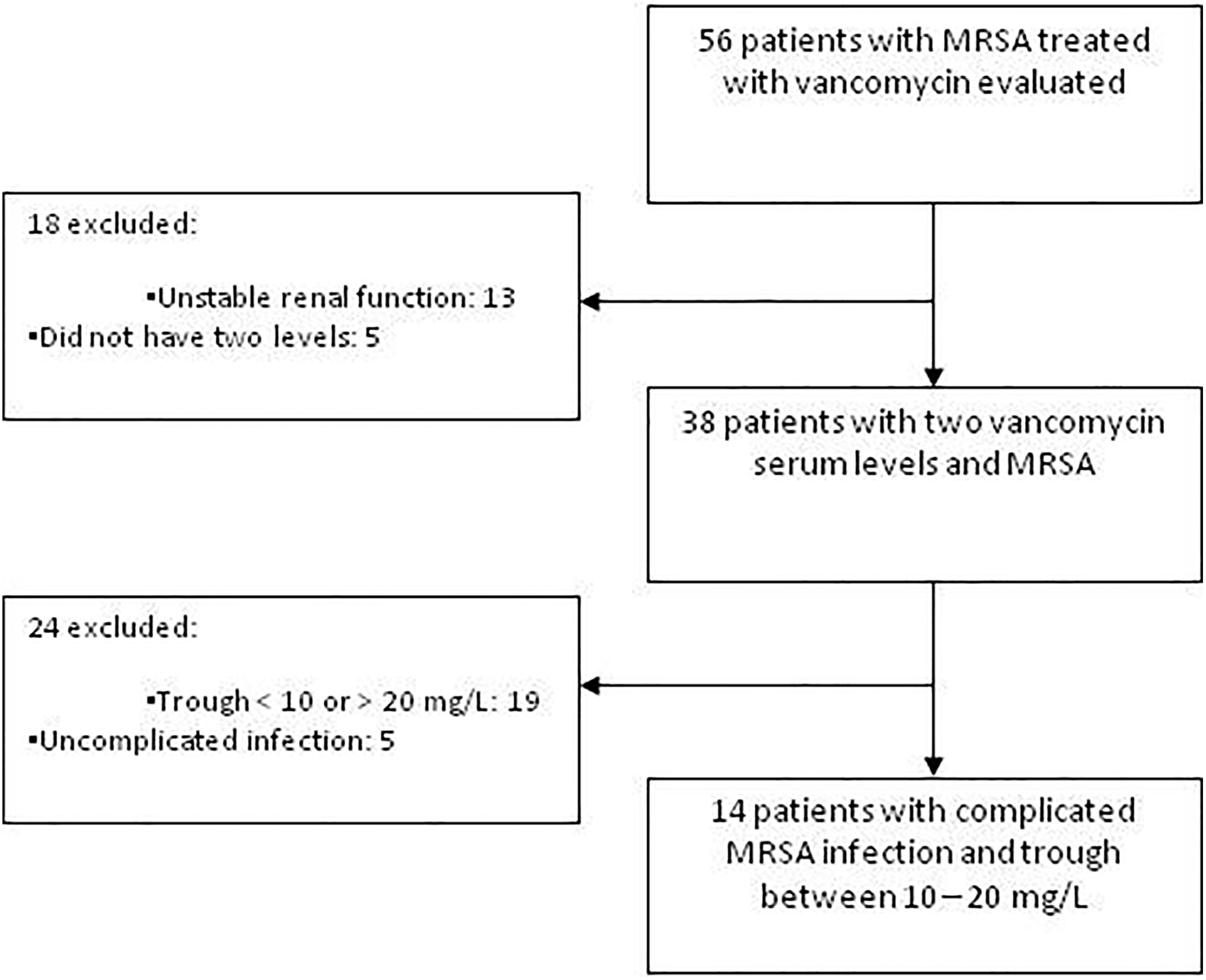
Subject screening and study inclusion are depicted in Figures 1 and 2. Baseline demographics, vancomycin dosing information, and infection characteristics for both are shown in Table 1 and were similar between groups with the exception of MIC (AUC-group 1 mg/L [0.5-1 mg/L] vs trough-group 1 mg/L [1-1 mg/L]; P = .026) and infection site. Bacteremia/endocarditis occurred more frequently in the AUC-group (AUC-group 64.3% vs trough-group 19.4%; P = .005) and osteomyelitis occurred more frequently in the trough-group (AUC-group 0% vs trough-group 33.3%; P = .012). Though statistically significant, the difference in MIC is not clinically relevant as all vancomycin MICs were ≤1 mg/L, and all isolates with an MIC of 0.5 mg/L had an AUC >400.

Patient inclusion November 2013 to January 2015 (trough-based group).
Patient inclusion July 2016 to December 2016 (AUC-based group).
Baseline Demographics and Clinical Characteristics.

Abbreviations: IQR, interquartile range; MIC, minimum inhibitory concentration; MRSA, methicillin-resistant Staphylococcus aureus; SCr, serum creatinine; SD, standard deviation.
Three-quarters (75%) of the AUC-group achieved an AUC/MIC ≥400. The primary outcome can be found in Figures 3 and 4. When the trough value was 10 to 14.9 mg/L, doses were increased in 25% of patients in the AUC-based group and in 71.4% of patients in the trough based group (P = .048). Within this trough range, patients in the AUC-based group only had a dose increase if the estimated AUC/MIC <400. A statistically similar proportion in each group had their vancomycin regimen reduced when the trough concentration was 15 to 20 mg/L (AUC-group 33.3% vs trough-group 4.6%; P = .107). All patients in the AUC group within this trough range who had dose reductions had a projected AUC/MIC ≥400 with the new regimen.
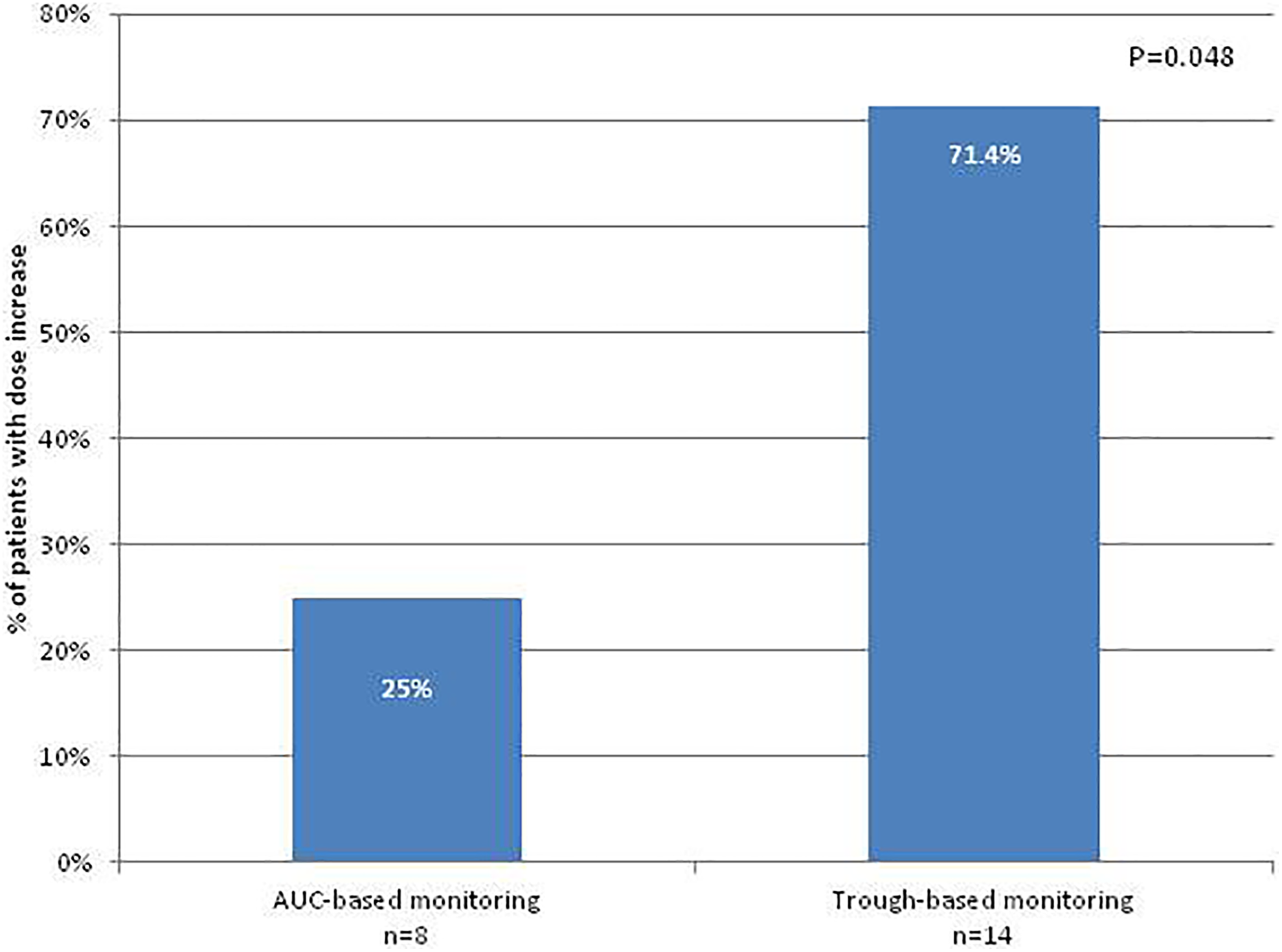
Percentage of patients with a vancomycin dose increase (trough 10-14.9 mg/L).

Percentage of patients with a vancomycin dose decrease (trough 15-20 mg/L).
Discussion
Our study is unique in 2 ways. First, we are unaware of any studies describing the implementation of institutional AUC-based vancomycin monitoring. AUC-based monitoring has traditionally been considered impractical due to the requirement for multiple serum concentrations. 1 This impractically, however, is based on the assumption that a trough concentration of 15 to 20 mg/L is a strong surrogate for attaining an AUC/MIC ≥400. This assumption has largely been shown to be untrue, as many found frequent achievement of an AUC/MIC ≥400 with trough concentrations <15 mg/L. 4 –6 AUC-based monitoring may, therefore, represent a more meaningful vancomycin monitoring method. Many clinicians may be hesitant to use AUC-based monitoring due to perceived complexity. Though this may be true with complex single concentration Bayesian assessments, we do not feel this is the case for approaches utilizing simplified trapezoidal estimates, such as the one we used. A variation in these calculations has been previously utilized to estimate trough concentration in obese vancomycin patients and uses equations similar to those commonly employed with aminoglycoside monitoring. 10 Pharmacists at our institution, utilizing a programmed calculator, performed 56 AUC-assessments over a 6-month period, which equates to 8.5 assessments per month. We observed a similar frequency of trough assessments (12.7 assessments per month) during the period of trough-only monitoring. Our data, therefore, demonstrate pharmacists could utilize an AUC-based approach with similar frequency to a trough-based approach in clinical practice.
Secondly, we found that when an AUC estimate was available, vancomycin doses were changed less frequently when troughs were between 10 and 14.9 mg/L. In this group, regimens were only changed if the estimated AUC/MIC was <400, indicating pharmacists relied on the AUC estimate to determine whether a dose change was necessary. Additionally, we observed a numerically greater percentage had dose reductions with trough concentrations of 15 to 20 mg/L when AUC was estimated. Though this more than 25% absolute difference was not found to be statistically significant, this was likely due to our small sample and that this difference could be of clinical significance. It should also be noted that the education provided to pharmacists regarding AUC-based monitoring emphasized targeting an AUC/MIC ≥400, but an upper limit had not been formally established. The frequency of dose reductions may have been greater had an upper limit been established. The clinical implications of these observations are unclear, but it appears AUC-based monitoring has the potential to reduce unnecessary vancomycin exposure. By establishing a therapeutic range utilizing AUC rather than trough, it may be possible to minimize unnecessary exposure as an incremental benefit from increasing AUC/MIC beyond 400 has not been established, but the risk of toxicity has been established, especially with AUCs >600. 12 Further research is required to firmly identify the therapeutic AUC range and effect of AUC-based monitoring on clinical outcomes.
There is little evidence suggesting benefit with trough concentrations of 15 to 20 mg/L. The majority of information suggests this trough range is associated with no additional benefit when compared to lower concentrations, but toxicity risk is increased. 13 Simply readjusting the target trough range of 10 to 20 mg/L is not advisable either since trough concentrations of 10 to 15 mg/L do not achieve an AUC/MIC ≥400 with high enough frequency. 4 –6 Patient-specific pharmacokinetic data can more precisely define vancomycin pharmacodynamics in individual patients. Hong and colleagues used a 2-sample measurement approach in obese patients to improve subsequent target trough concentration after the initial measurement. 14 They found that 31% of patients had a trough within the therapeutic range when the trough-only method was used, compared to 62.2% in the 2-sample group, P = .024. Similar to this study, our study demonstrates the utility of patient-specific pharmacokinetic data in adjusting vancomycin doses. Based on our experience, we found an AUC-based monitoring method to be practical and influential in pharmacists’ decisions to increase doses, especially when trough levels were 10 to 14.9 mg/L, a gray zone when it comes to whether a dose increase is necessary.
Limitations
Our study had some notable limitations; it was retrospective and had a limited sample size. Additionally, pharmacists at our institution use their clinical judgment to make decisions about dosing alterations rather than following a prescriptive approach. Given the retrospective nature, it is possible that considerations other than the vancomycin monitoring method affected the pharmacist’s assessment of the vancomycin regimen. This study also did not directly assess clinical outcomes such as efficacy and nephrotoxicity but instead focused on the effect AUC-based monitoring had on pharmacists’ dose adjustments. We agree that further research is needed to determine whether AUC-based monitoring affects efficacy or nephrotoxicity, but our study supports the idea that an estimated AUC provided additional objectivity beyond that provided by only a trough and has the potential to assist in dosing decisions, particularly to limit unwarranted dose increases when the trough is 10 to 14.9 mg/L. As a result, it is reasonable to hypothesize that AUC-based monitoring could result in less nephrotoxicity. A recent study that demonstrated that AUC-guided dosing was independently associated with lower nephrotoxicity supports this hypothesis. 15
Conclusions
When an AUC estimate was available, vancomycin doses were changed less frequently when troughs were between 10 and 14.9 mg/L, a trough range previously considered subtherapeutic. The effect that AUC-based monitoring had on dose adjustments when troughs were 15 to 20 mg/L was statistically nonsignificant, but this may be secondary to the small sample size and lack of formally established upper limit to the desired AUC range. Although a Bayesian method may be the gold standard for estimating AUC, a 2-sample AUC estimation method is a practical method that can readily be implemented in most hospital settings and has the potential to reduce nephrotoxicity. Future studies are needed to establish the effect of AUC-based monitoring on clinical outcomes and nephrotoxicity.
Footnotes
Authors’ Note
Paper presented at: MAD-ID 2017 Annual Meeting; May 10-13, 2017; Orlando, FL, USA.
Declaration of Conflicting Interests
The author(s) declared no potential conflicts of interest with respect to the research, authorship, and/or publication of this article.
Funding
The author(s) disclosed receipt of the following financial support for the research, authorship, and/or publication of this article: Andrew M. Stoessel received financial support in the form of a travel grant to attend the Making a Difference in Infectious Diseases (MAD-ID) 2017 Annual Meeting.