






Abstract
Propylene glycol is a rarely reported toxicity from high-dose administration of certain intravenous drugs, including lorazepam and pentobarbital. We present a case of iatrogenic propylene glycol toxicity secondary to a high-dose pentobarbital infusion for the treatment of refractory intracranial hypertension due to cerebral venous sinus thrombosis. The patient developed metabolic acidosis and acute kidney failure secondary to propylene glycol toxicity. After initiation of continuous renal replacement therapy, the patient’s acute renal failure and lactic acidosis resolved. Using the Naranjo scale, this case received a score of 5, defining it as a “probable” adverse drug event. In patients who develop lactic acidosis and acute renal failure after initiation of high-dose pentobarbital, propylene glycol toxicity should be higher up in the differential diagnosis. Monitoring the serum osmolality while on pentobarbital could help provide valuable information to prevent iatrogenic propylene glycol toxicity.
Keywords
Introduction
Pentobarbital is a short-acting barbiturate that is Food and Drug Administration approved as an antiepileptic and sedative agent but has also shown efficacy for inducing burst suppression in refractory status epilepticus and reducing intracranial pressure (ICP) in severe intracranial hypertension. It is usually employed when other treatment modalities have failed. 1 Use of pentobarbital has been shown to reduce ICP but may produce cerebral hypoxia. 2 This has been associated with numerous adverse effects, including hemodynamic instability, respiratory depression, and increased risk of infection. 2,3
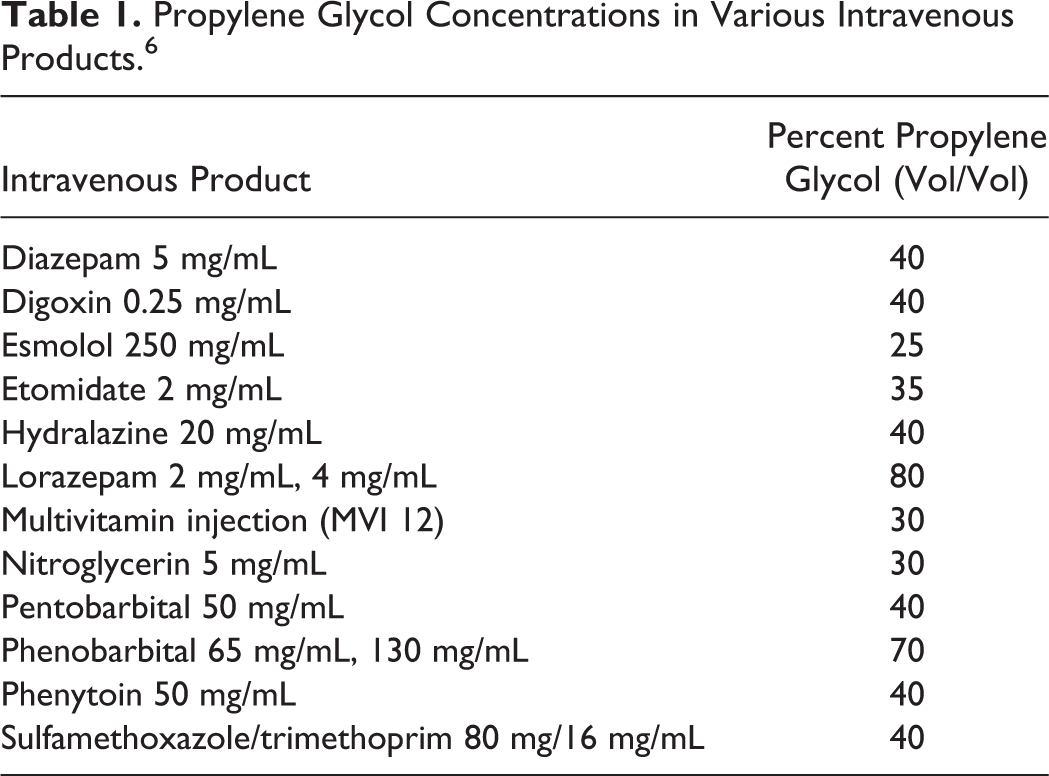
Pentobarbital is a commercially available sterile solution for intravenous injection and each milliliter contains 50 mg of pentobarbital sodium in a vehicle of 40% propylene glycol, 10% alcohol, and water. 4 Propylene glycol is a clear, colorless, viscous organic solvent and diluent used as a vehicle in the formation of several intravenous medications, including lorazepam, etomidate, sulfamethoxazole/trimethoprim, and phenytoin (Table 1). 5,6 It is generally considered safe; however, in large doses, it can be toxic with the development of hyperosmolality, lactic acidosis, and renal failure. In adults, the terminal half-life of propylene glycol ranges from 1.4 to 3.3 hours, and renal clearance decreases as the dose administered increases. 5,7 An acceptable concentration of propylene glycol has not been defined, but some studies have reported that the risk of toxicity increases with serum concentration greater than 25 mg/dL. 6,8 A maximum daily threshold for oral propylene glycol exposure has been recommended at 23 mg/kg/d, and although this refers specifically to oral exposure, it has generally been extrapolated to intravenous exposure as well. 9
Propylene Glycol Concentrations in Various Intravenous Products. 6
During a literature search, propylene glycol toxicity has been reported with intravenous use of lorazepam and in a few cases of pentobarbital. We present a case of iatrogenic propylene glycol toxicity in a patient receiving a continuous infusion of intravenous pentobarbital for refractory intracranial hypertension.
Case Report
A 19-year-old 100-kg female with no significant past medical history presented to the emergency department around 6
During the first 3 days in the NSICU, the patient had consistently elevated ICPs, with a maximum value of 38 mm Hg in the first 24 hours. The patient’s fentanyl infusion was titrated to a maximum dose of 1.5 µg/kg/h, and a midazolam infusion was titrated to a max of 10 mg/h to help control the patient’s ICP. In the first 72 hours, the patient also received multiple boluses of fentanyl (a total of 2050 µg in 24 divided doses), midazolam (a total of 47 mg in 13 divided doses), rocuronium (50 mg bolus × 1 and 100 mg bolus × 1), and a single 120 mEq bolus of 23.4% hypertonic saline. On hospital day 2, when the patient’s ICP reached a max of 30 mm Hg, the decision was made to administer a 10 mg/kg pentobarbital bolus and initiate an infusion for management of refractory intracranial hypertension. The pentobarbital infusion was titrated to an ICP goal of less than 20 mm Hg, and the patient rapidly reached a maximum dose of 5 mg/kg/h. The patient still required three 120 mEq boluses of 23.4% hypertonic saline, three 100 mg boluses of rocuronium, and a single 100 mg bolus of ketamine to maintain control of her ICP, which ranged from 14 to 32 mm Hg during this time period.
On the morning of hospital day 3, the patient was taken for a cerebral angiogram with dural sinus angioplasty, thrombolytic infusion, and mechanical thrombectomy. Partial recanalization of the bilateral transverse sigmoid and straight sinuses was achieved; however, due to the patient’s large clot burden, there was still complete occlusion of the superior sinus. After the case, the patient’s ICP rose to 50 mm Hg, and after another 120 mEq bolus of 23.4% saline, she was taken to the operating room emergently for a right decompressive hemicraniectomy.
After 24 hours of the pentobarbital infusion, the patient’s serum lactate level began to increase from her baseline of 1.5 mmol/L, rising to 3.7 mmol/L and continuing to increase to a max of 16.2 mmol/L on hospital day 7. She also developed hypotension refractory to fluid challenges that required vasopressor support with norepinephrine. Her hypotension continued to worsen, eventually requiring the addition of vasopressin on hospital day 4 and phenylephrine on hospital day 6. Due to concern for accumulation of pentobarbital causing severe hypotension, a drug level was drawn on hospital day 5. Throughout this period, the patient developed a mixed anion gap/nonanion gap metabolic acidosis from hyperlactatemia and hyperchloremia, in addition to an acute kidney injury (AKI; Table 2). Fluids and broad-spectrum antibiotics (cefepime, metronidazole, and vancomycin) were administered on hospital day 5 for suspected septic shock, and trauma surgery was consulted for bowel distention on abdominal X-ray and possibility of bowel ischemia, due to the high lactic acid. Furthermore, propylene glycol toxicity was discussed as a possible reason for lactic acidosis and AKI. Because of these toxicity concerns and improvement in ICP, the pentobarbital infusion was weaned down to 2.5 mg/kg/h and then discontinued on hospital day 6. On hospital day 7, when the lactic acid level reached 15 mmol/L, the decision was made to perform a bedside laparotomy, which found no signs of bowel ischemia. The following day, propylene glycol toxicity moved higher up on the differential diagnosis; therefore, a propylene glycol level and a serum osmolality were drawn and an osmolar gap (OG) was calculated (Table 2).
Laboratory Values Through Hospital Stay.
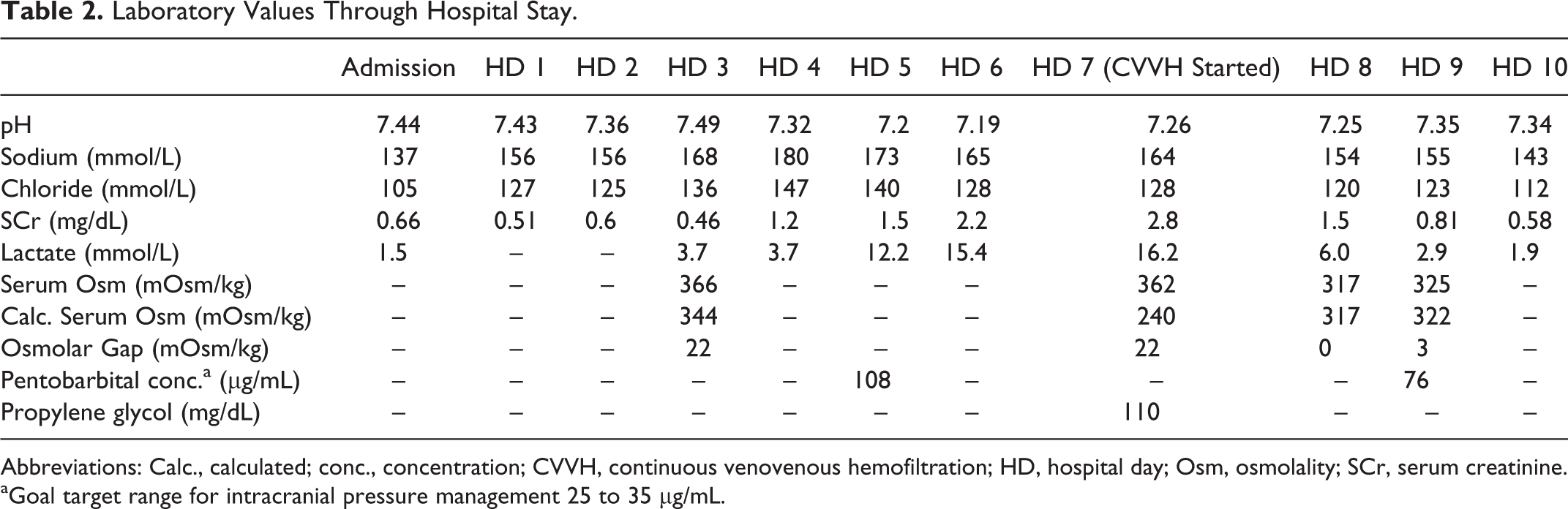
Abbreviations: Calc., calculated; conc., concentration; CVVH, continuous venovenous hemofiltration; HD, hospital day; Osm, osmolality; SCr, serum creatinine.
aGoal target range for intracranial pressure management 25 to 35 µg/mL.
Due to the presence of an OG and high-dose pentobarbital infusion, the lactic acidosis was determined to be due to iatrogenic pentobarbital-related propylene glycol toxicity. Continuous venovenous hemofiltration (CVVH) was initiated on hospital day 7 to eliminate the toxic alcohol from her bloodstream. By hospital day 9, the patient’s OG had closed, serum creatinine had decreased, and lactate was nearing normal levels. The patient remained on renal replacement therapy through hospital day 11 for management of AKI in addition to propylene glycol toxicity. On hospital day 36, the patient was discharged from the NSICU to a long-term acute care hospital with a tracheostomy and a percutaneous endoscopic gastrostomy tube. At discharge, the patient had a Glasgow Coma Scale of 11 T and was following commands for the first time during her hospital stay.
Discussion
Most cases in the literature of pentobarbital induced propylene glycol toxicity have been reported in the setting of refractory status epilepticus. 1,3,5,8 These patients required high doses of pentobarbital for extended periods of time to achieve burst suppression on electroencephalogram and prevent seizure activity. In our patient, pentobarbital was used to manage refractory intracranial hypertension secondary to an extensive cerebral venous sinus thrombosis. Many interventions were attempted before initiating a pentobarbital infusion. The patient’s ICP increased from 17 to 38 mm Hg despite multiple fentanyl and midazolam boluses, in addition to induced hypernatremia with hypertonic fluids. A pentobarbital infusion was initiated with the goal of controlling the patient’s intracranial hypertension. Patients with refractory status epilepticus most often achieve electroencephalogram burst suppression at doses between 1 and 5 mg/kg/h; however, our patient required 5 mg/kg/h continuously for over 4 days.
In patients with normal renal and hepatic function, propylene glycol is metabolized rapidly to lactate, which is then hepatically cleared. 10 Drug that is not hepatically metabolized is renally excreted unchanged or as a glucuronidated conjugate. 5 In the setting of propylene glycol overload or hepatic insufficiency, the body is unable to keep up with the clearance of the lactic acid metabolite, causing a lactic acidosis. In addition, higher doses of propylene glycol are associated with reduced renal clearance, pushing the metabolic pathway to compensate with more hepatic metabolism, further worsening the lactic acidosis. The pathophysiology of acute kidney failure in patients with propylene glycol toxicity has not been fully elucidated; however, one hypothesis is that propylene glycol may cause proximal renal tubular cell injury. 11,12
Propylene glycol is well known as a vehicle in the formulation of intravenous lorazepam, but few are aware of its presence in pentobarbital. 13 -16 There are few reported cases of propylene glycol toxicity with intravenous pentobarbital, and the authors did not identify any in the setting of refractory intracranial hypertension. These case reports have associated propylene glycol toxicity with serum hyperosmolality, elevated serum creatinine, and renal failure, all of which were seen in this case. It is estimated that the serum osmolality increases approximately 1.31 mOsm/kg for every 10 mg/dL increase in propylene glycol concentration. 17 Our patient’s propylene glycol level reached a peak of 110 mg/dL, with an OG of 22 mOsm/kg and lactic acid level of 16.2 mmol/L.
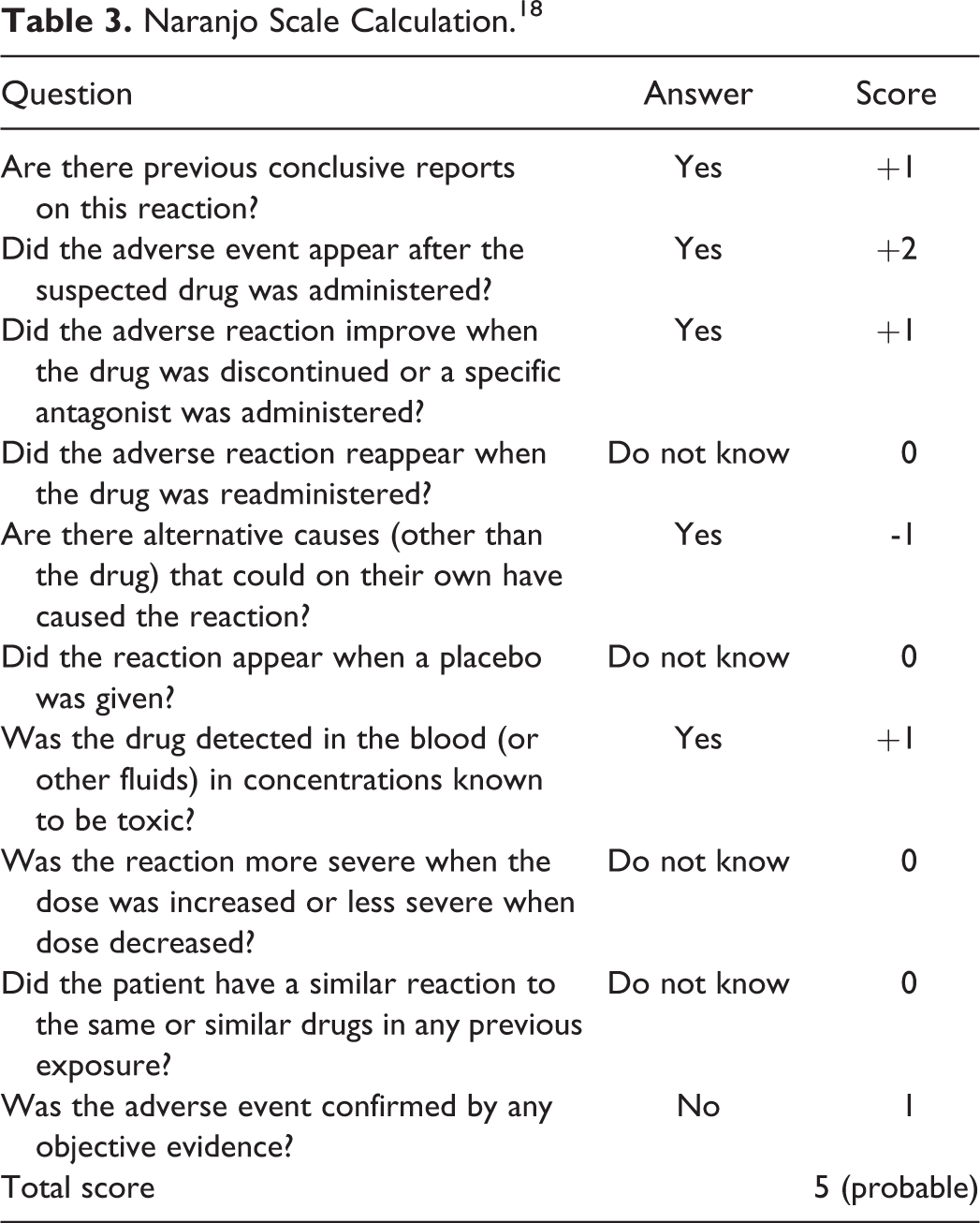
When identifying possible adverse drug reactions (ADRs), it is important to rule out other causes that may contribute to the symptoms that the patient exhibited, such as sepsis. Once the pentobarbital was discontinued, the lactic acidosis resolved with CVVH. When completing an ADR assessment using the Naranjo scale, this case received a score of 5, defining it is as a “probable” ADR (Table 3). Unfortunately, our patient was subjected to broad-spectrum antibiotics and a bedside exploratory laparotomy, both of which could have been prevented if propylene glycol toxicity had been placed higher on the differential diagnosis.
Naranjo Scale Calculation. 18
Conclusion
Propylene glycol toxicity from iatrogenic intravenous medications is an adverse event that can become severe when overlooked by medical providers. We present a case of propylene glycol toxicity in a patient receiving intravenous pentobarbital which, to our knowledge, is the first reported in the setting of refractory intracranial hypertension. It is important for health-care providers to be familiar with intravenous drugs containing propylene glycol and the signs and symptoms associated with toxicity. Propylene glycol toxicity should be placed higher on a provider’s differential when a patient is receiving a medication that contains propylene glycol in the formulation, especially when metabolic acidosis, hyperosmolality, and an elevated creatinine are unexplained.
Footnotes
Declaration of Conflicting Interests
The author(s) declared no potential conflicts of interest with respect to the research, authorship, and/or publication of this article.
Funding
The author(s) received no financial support for the research, authorship, and/or publication of this article.
