






Abstract
Keywords
Introduction
Ceftriaxone, a third-generation cephalosporin, is one of the most common antibiotics used for treating community-acquired infections in the inpatient setting.1-3 This widespread use is primarily due to ceftriaxone’s favorable pharmacokinetic profile, which allows for dosing with minimal or no consideration of renal or hepatic function.1,4 Ceftriaxone effectively covers both gram-positive organisms such as Streptococcus spp. and gram-negative organisms except for non-lactose fermenters. 1 Its excellent tolerability and mild side effect profile make ceftriaxone a preferred option for many clinicians.
Regarding dosing, 1 gram or 2 grams once daily are typically used for treating bacteremia; there is limited evidence to determine which dose is more appropriate. Previous studies have primarily focused on gram-negative bacteremia and predicting risk factors for clinical failure, defined as the need for antibiotic escalation or transfer to intensive care.2,4,5 There is a notable lack of evidence regarding bacteremia caused by other pathogens, particularly gram-positive bacteria, and factors influencing the specific dose required.
While higher dosing is indicated for conditions such as endocarditis or meningitis, 1 dosing for bacteremia secondary to other sources of infection is not as standardized. This can lead to variations in ceftriaxone dosing, even within the same institution. Given that bacteremia is one of the most common indications for ceftriaxone in hospitalized patients, it is crucial to determine whether 1 gram or 2 grams is more effective. This study aims to comprehensively examine the factors that could affect the appropriate dosing of ceftriaxone for bacteremia.
Methods
Study Design and Data Collection
This IRB-approved retrospective cohort study evaluated patients admitted to any of the following three Long Island Jewish (LIJ) hospitals: LIJ Valley Stream, LIJ Forest Hills, and LIJ Medical Center. Among the five hospitals within the LIJ system, these three hospitals were selected because they primarily service adult patient populations and have no restrictions on intravenous administration. We included patients admitted in 2022 who were diagnosed with bacteremia and received ceftriaxone for at least 72 hours. We excluded the following patients: those who received ceftriaxone for endocarditis or meningitis, those who received ceftriaxone for less than 72 hours, and those with ceftriaxone-resistant isolates. Data collected for baseline characteristics included age, gender, race, body mass index (BMI), and beta-lactam allergy. The screening procedure is illustrated in Figure 1. Study Population.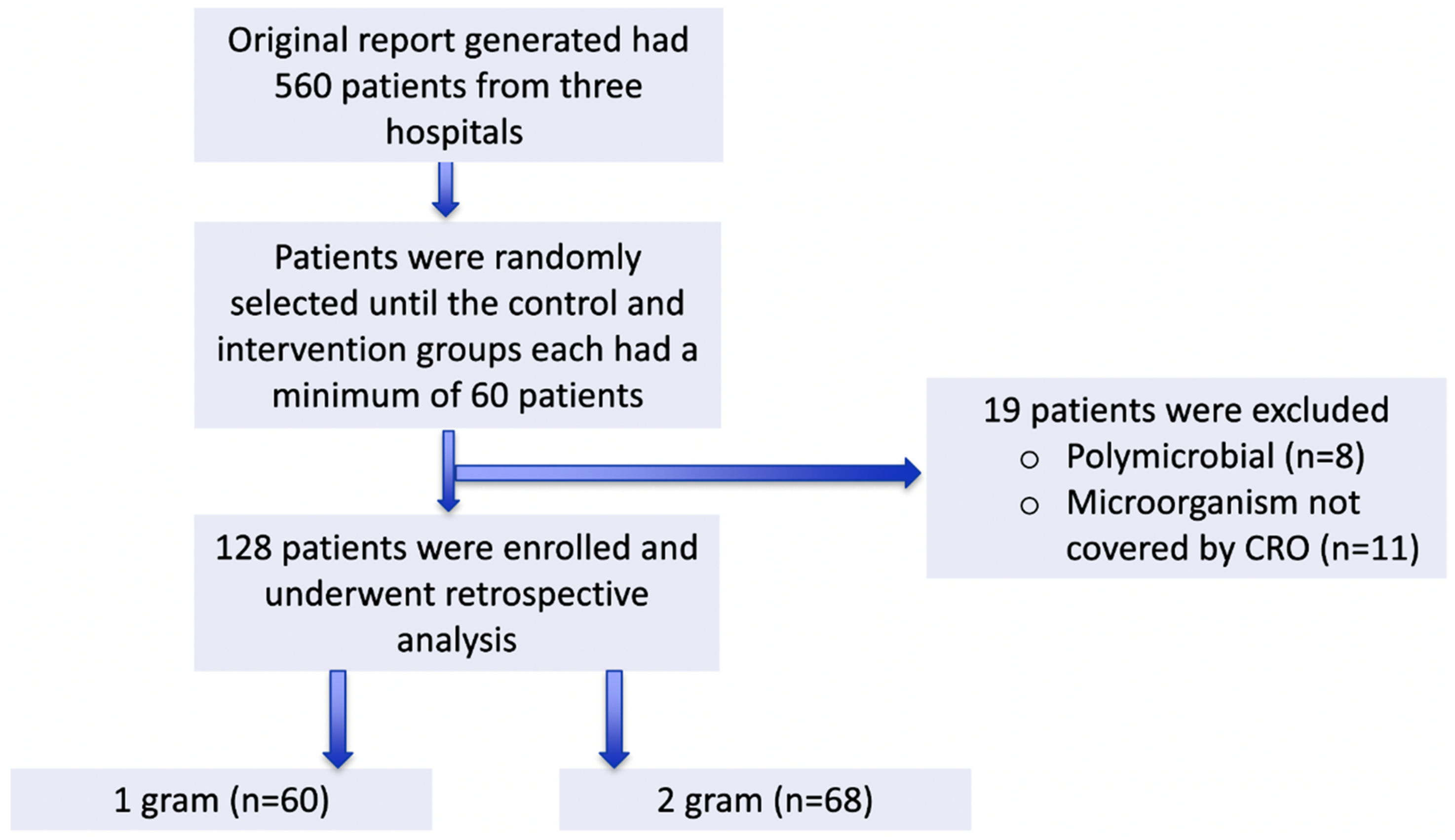
Outcomes
The primary outcome of this study was clinical failure defined as antibiotic escalation, escalation to intensive care, or 30-day readmission due to an infectious cause. The secondary outcomes included duration of therapy, total hospital length of stay, time to defervescence, source of infection, blood culture organism, and the presence of an infectious disease consult.
Statistical Analysis
Descriptive statistics, frequencies, and percentages for categorical variables were calculated for each group. Chi-square tests and Fisher’s exact tests were used to analyze the primary outcome, source of infection, and microorganism by blood culture. The primary outcome was reported as an odds ratio with the corresponding 95% confidence interval. The remaining secondary outcomes were evaluated using the Wilcoxon rank sum test. A significance level of 5% was used, and all statistical analyses were performed using SAS version 9.4.
Results
Baseline Characteristics.

Primary Outcome.

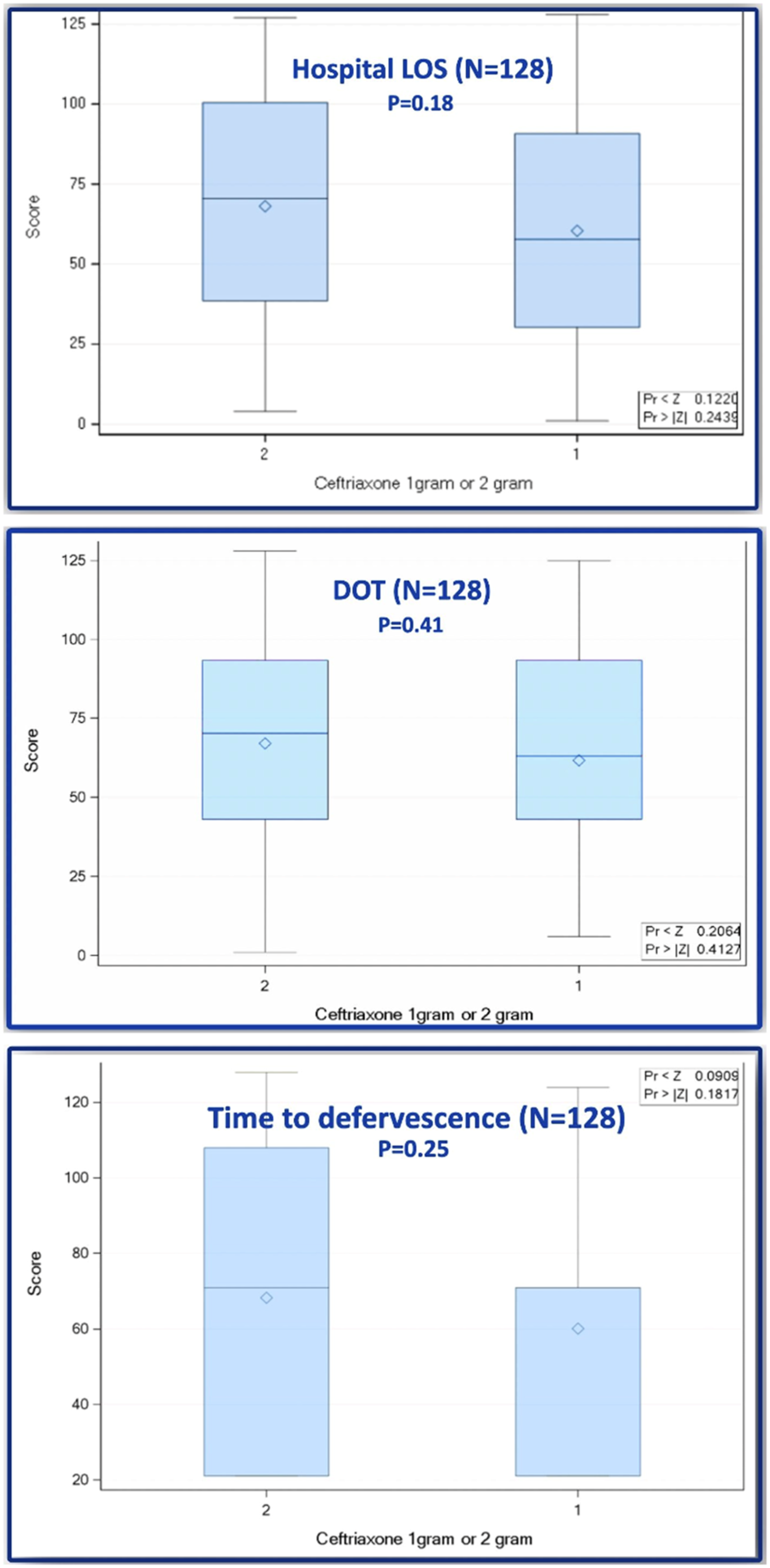
Secondary Outcomes.
Secondary Outcomes.

Prevalence of Gram-Negative and Gram-Positive Organisms in Two Ceftriaxone Dosage Groups.

Discussion
In this retrospective study, we found no significant difference in the clinical failure rate between 1 gram and 2 grams of ceftriaxone daily for treating bacteremia. Previous research focused on the optimal ceftriaxone dose for specific gram-negative bacteremia or the duration of therapy.2,4 Our study aimed to find the optimal ceftriaxone dose for patients with ceftriaxone-susceptible bacteremia caused by either gram-negative or gram-positive organisms. Most patients had E. coli or Klebsiella spp. infections (74%), with urinary source being the most common (75%).
Baalbaki et al 4 aimed to compare clinical failure between two different doses of ceftriaxone in Enterobacterales bacteremia and found no significant differences between the 1 gram and 2 gram doses. Alhadad et al also showed no difference in the rate of early clinical failure within 72 hours. Our study differed by including both gram-positive and gram-negative pathogens and showed no significant differences in primary and secondary outcomes. An odds ratio of 0.51, favoring the 1 gram group, was surprising as more clinical failures were anticipated with lower dosing. Given that 6 times more patients in the 2 gram group had gram-positive bacteremia, it is possible that patients in this group had more severe infection.
Limitations
The study had several limitations. It was a retrospective study relying solely on chart review, and the relatively small sample size may limit the ability to detect significant differences. The absence of important factors like albumin may have contributed to the lack of significant difference between the two dosing regimens, as the study by Baabalki et al showed that hypoalbuminemia appears to increase the risk of clinical failure. Additionally, the mean BMI in both groups was less than 30 kg/m2. 6 A previous study involving obese patients with a median BMI greater than 30 kg/m2 showed that a higher dose resulted in improved therapeutic effects and clinical outcomes. 6 Caution should be exercised when applying these results to the obese population. Lastly, a few outcomes were not included in the final analysis. One of the primary outcomes, escalation to the ICU, was excluded due to the fact that only 13.2% of patients had documented APACHE scores, which prevented an adequate assessment of baseline disease severity. Similarly, one of the secondary outcomes, the presence of infectious disease consult, was not included because of the small number of documented consults, which was comparable to the limited availability of APACHE scores.
Conclusion
The findings of this study showed no statistically significant differences between ceftriaxone 1 gram and 2 grams daily for the treatment of bacteremia. Further studies focused on ceftriaxone use for gram-positive bacteremia are warranted.
Footnotes
Acknowledgments
The authors gratefully acknowledge the contributions of Margaret Gorlin, MS and Cristina Sison, PhD from the Feinstein Institutes for Medical Research, for their contributions to this project.
Declaration of Conflicting Interests
The author(s) declared no potential conflicts of interest with respect to the research, authorship, and/or publication of this article.
Funding
The author(s) received no financial support for the research, authorship, and/or publication of this article.
