







Abstract
Rates of unintended pregnancy continue to remain high in the United States. Pharmacist-prescribed hormonal contraception offers an accessible option for preventing mistimed or unintended pregnancies, leading to better reproductive health outcomes. Specifically in Indiana, studies show patient interest in this service, however, overall pharmacy implementation and patient awareness has been low. This project aims to explore strategies for educating pregnancy-capable people in Indiana about the availability of pharmacist-prescribed birth control. The Social Marketing Theory guided development of a focus group/interview guide to identify themes on how best to educate pregnancy-capable individuals on pharmacist-prescribed hormonal contraception. The sessions were conducted virtually by one investigator and transcripts were analyzed by three investigators using inductive thematic analysis. Four focus groups and four interviews were conducted with a total of 12 English-speaking participants. Identified themes included Prior Understanding of Pharmacy Services, Pharmacy Service Characteristics, Knowledge or Education, and Preferred Advertising Method and Content. Results showcased that there was an overall lack of knowledge about this service and that strategies for educating the community would be through social media, pharmacy flyers, campus outreach, and health fairs. Pharmacists play a key role in addressing reproductive healthcare gaps. As new services are implemented, consideration should be given as to how best to educate the community through modalities such as social media, pharmacy flyers, campus outreach, and health fairs. Strategic community engagement for pharmacist-prescribed contraception services may help to overcome access barriers and ultimately reduce the incidence of mistimed or unwanted pregnancies in Indiana.
Keywords
Background
Rates of unintended pregnancy in the United States have been declining, yet more than one-third (35.7%) of pregnancies remain mistimed or unwanted. 1 In Indiana, the unintended pregnancy rate was nearly 50% in 2010, with unpublished data suggesting an increase to 53% in more recent years. 2 Correct use of birth control can help to prevent unintended pregnancies and contribute to appropriate pregnancy spacing, which can prevent complications and lead to better health outcomes for both the mother and the baby. 3 Expanding access to contraceptive services, such as through pharmacist prescribing of hormonal contraception, is one approach to help pregnancy-capable individuals receive care and reduce the incidence of unplanned pregnancies.
Pregnancy-capable people face a myriad of barriers to contraception access including lack of access to a provider, extended wait times to be scheduled with a provider, and cost. 4 Pharmacies and pharmacists may offer more accessibility given extended hours compared to traditional healthcare clinics, widespread proximity including in rural areas, and no need for appointments. As of 2025, 34 states have adopted legislation allowing pharmacists to prescribe and dispense certain types of birth control. 5 In Indiana, a statewide standing order was enacted on September 1, 2023, authorizing pharmacists to prescribe self-administered hormonal contraception, including pills, patches, rings, and the injection.6,7 These services have expanded access for people capable of pregnancy by allowing them to see their pharmacist for advice, prescribing, and dispensing of birth control.
Studies have shown that pharmacists and student pharmacists are eager to provide hormonal contraception prescribing, acknowledge its benefits to people in their communities, and feel adequately trained to offer these services.8,9,13 Moreover, physicians support pharmacist-prescribed hormonal contraception and recognize the expanded access it would provide for their patients and community.13,14 Many patients who face obstacles to receiving care and want to avoid getting pregnant, have indicated an interest in having pharmacists prescribe hormonal contraception. 10 Additionally, patients believe that pharmacists are knowledgeable and trustworthy, and would be willing to consult their pharmacist for their birth control needs.11,12
Despite the desire of pharmacists to prescribe contraception, and positive perceptions from both providers and patients, the overall implementation and uptake of pharmacist contraception prescribing services has been low.15,18 Barriers to this implementation and uptake include limited resources, lack of reimbursement, liability, concerns for health risks, cost, and most importantly, lack of perceived customer interest/knowledge.15-18
Additionally, given the recent implementation of the standing order allowing pharmacists to prescribe hormonal contraceptives in Indiana, it is possible that pregnancy-capable people in Indiana are not aware of this service at their local pharmacy and the specific types of birth control available. Accessibility and knowledge about hormonal contraceptives are crucial for reproductive health, but there is still a need to effectively inform the public about this service and the available contraceptive options.
Objective
The objective of this project was to explore the most desirable strategies for educating pregnancy-capable people in Indiana about the availability of pharmacist-prescribed birth control, with the aim of enhancing the education, awareness, and accessibility of these contraceptive options.
Methods
Study Design
This was a cross-sectional qualitative study. Semi-structured focus groups and interviews were conducted virtually via Zoom, each lasting approximately 30-60 minutes. Interviews were used in addition to focus groups for participant convenience and scheduling conflicts. The study was approved by the Purdue University Institutional Review Board (IRB protocol 2024-1404).
Conceptual Framework
The Social Marketing Theory was utilized as the framework for developing questions for the focus groups/interview sessions and to guide data analysis. The Social Marketing Theory focuses on the 4 P’s (Product, Price, Place, and Promotion). 19 It also ensures that creating audience awareness, targeting the right audience, reinforcing the message, cultivating images or impressions, stimulating interest, and inducing the desired result are achieved. 20
Focus Group Guide Development
A standardized focus group/interview guide was developed in English and Spanish to guide and direct discussions and ensure consistency across sessions (supplementary appendix). Prior to the start of data collection, the guide was pilot tested with a single focus group composed of eligible individuals that would otherwise not participate in the study. Focus group guide items included questions and prompts designed to identify how to best inform and educate pregnancy-capable people about pharmacist-prescribed birth control services available in Indiana.
Focus group/interview guide questions were aligned to each “P” of the Social Marketing Theory. Questions related to “Product” sought to gather perceptions on the service of pharmacist-prescribed hormonal contraception. “Price” focused items evaluated thoughts on costs or perceived barriers. Items for “Place” looked at preferences on characteristics about the pharmacy and individual uses. Lastly, questions pertaining to “Promotion” evaluated preferred methods of advertisement or education for pharmacist-prescribed contraception in Indiana.
Study Participants and Recruitment
An interest form containing a brief survey to gather demographic and contact information was available in English and Spanish and distributed across all HealthLinc clinics (Federally Qualified Health Centers) located in Northern Indiana (Centennial, East Chicago, Knox, IUSB Medical, La Porte, Michigan City, Mishawaka, Southeast, and Valparaiso) as well as posted on community bulletin boards near Butler University, Manchester University, and Purdue University. Eligible participants were individuals aged 18-44 years, capable of becoming pregnant, and proficient in either English or Spanish. A Qualtrics survey collected demographic information to be used for scheduling focus groups with participants having similar characteristics (eg, age and language). Additional items collected included race, ethnicity, hormonal contraceptive use, and type of hormonal contraceptive currently or previously used (supplementary appendix). Eligible participants were contacted via the email provided in their survey response to schedule a focus group or interview session. A total of two attempts were made to contact the individual with the second attempt occurring 5-10 days after the first. The number of focus groups and participants targeted was consistent with what is acceptable to capture 90% of themes for qualitative research. 21
Data Collection
Focus groups and interviews were conducted virtually between February and May 2025. All sessions were led by a single investigator (A.B.) and lasted 30-60 minutes. Participants were assigned a unique ID number and given the option to turn off their cameras to maintain confidentiality and anonymity. Prior to recording, participants were informed about the voluntary nature of the study and their right to discontinue at any time. All audio recordings were securely stored using Box, a HIPAA-compliant platform. 22 Transcription was performed by Infraware, another HIPAA-compliant service. 23 Participants received a $20 digital Amazon gift card as compensation for their time.
Data Analysis
To enhance credibility and minimize bias, three researchers (A.B., A.H.M., A.W.) collaboratively participated in the transcript analysis process, using inductive thematic analysis to identify themes and patterns within the data. Microsoft Office tools were utilized to track and organize identified themes within the transcriptions.
Each team member independently reviewed one transcript from the 18-30 years age group and one from the 31-44 years age group, identifying potential themes. They then met to compare findings and identify overarching themes. Once themes were established, one researcher (A.B.) analyzed all eight transcripts. To ensure consistency, a second researcher (A.H.M) reviewed the four transcripts from the aged 18-30 years group, while a third researcher (A.W) did the same for the aged 31-44 years group. This approach ensured that each transcript was reviewed by at least two researchers. All researchers then reconvened to compare findings and reach consensus on the identified themes.
Results
Participant Demographics
Demographic Characteristics of Participants (N = 12)
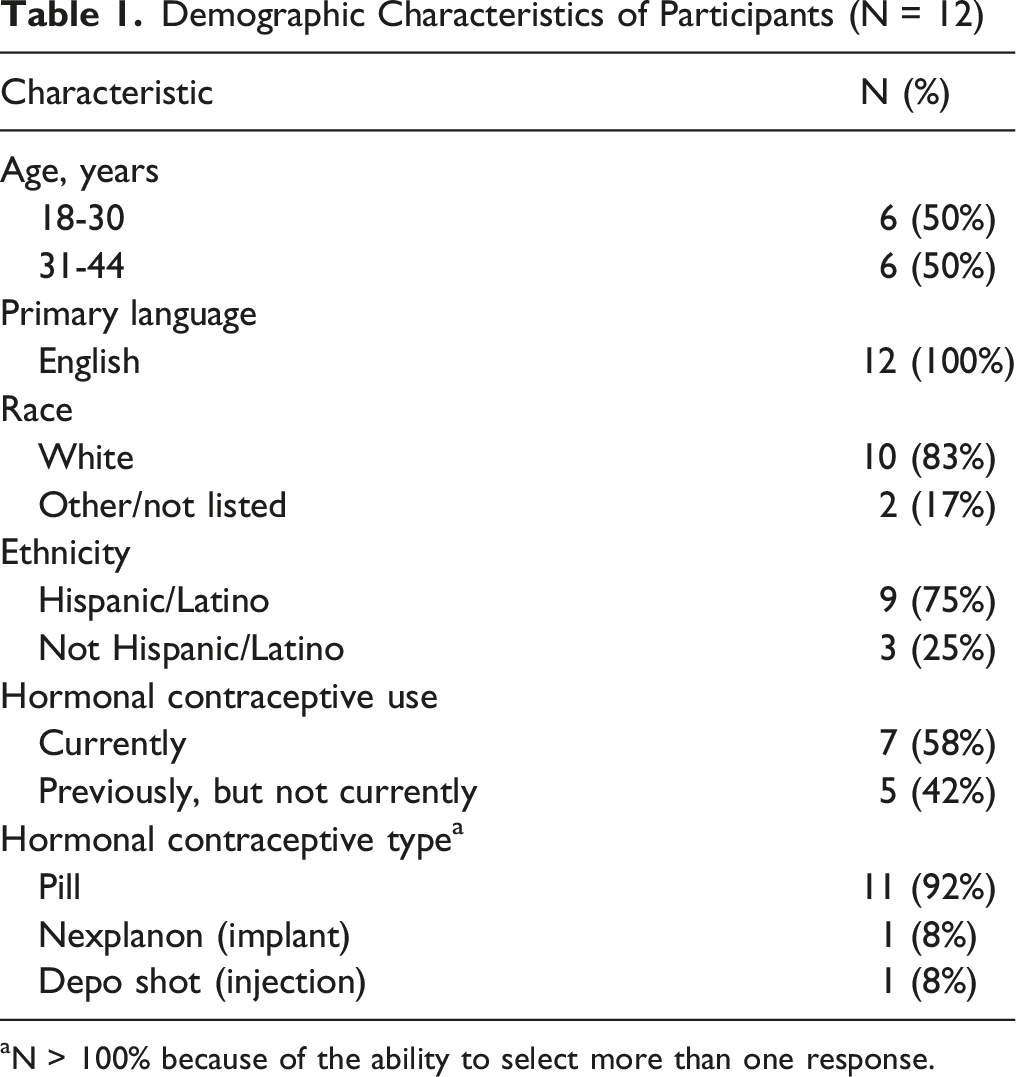
aN > 100% because of the ability to select more than one response.
A total of four primary themes were identified surrounding participants' awareness and use of community pharmacy, characteristics that would be perceived as facilitators or barriers for pharmacist contraception prescribing, what they would like to know about the service, and how they would like to be informed of the service.
Prior Understanding and Utilization of Pharmacy Services
Most participants reported limited prior engagement with pharmacy services, primarily using pharmacies to pick up prescriptions, receive vaccines, or get over-the-counter medications. Overall, awareness of pharmacist-prescribed hormonal contraception service was low among the participants. Several noted they had only learned about the service after seeing the interest form for this project, while a few had heard about it during school.
When asked about their comfort discussing contraception with a pharmacist, many responded positively. One participant shared, “I would. I mean, I feel like they’re there to help and it’s just another medication. It’s nothing to feel weird about.”
Pharmacy Service Characteristics
Participants expressed they would consider utilizing the pharmacist-prescribed birth control service if they experienced barriers to receiving contraception, such as lack of access to a provider or long wait times for an appointment. Convenience and cost were repeatedly discussed as factors influencing participants’ willingness to use the service. As one participant stated, “I feel like most people just want convenience and what’s easily accessible, so if you can skip going to your doctor to get this prescription and run in and talk to your pharmacist, I think a lot more people would be willing to do that.” Additionally, several participants raised concerns regarding the cost of the service, specifically with both the consultation fee and the cost of the selected product.
All participants cited geographic location, open hours, and wait times as reasons for selecting their current pharmacy. Views were mixed on whether a lack of required appointments was a benefit. Some felt it would be convenient, with one participant stating, “I could go whenever I wanted. I don’t even have to make any sort of appointment.” However, others expressed a preference for having an appointment time with one participant commenting, “I want an exact appointment time, I don’t want to have to walk in and wait an unknown amount of time.”
Potential barriers to pharmacist-prescribed contraception services included concerns about cost (especially in comparison to Obstetrician-Gynecologist (OB/GYN) or Primary Care Provider (PCP) visits), potential lack of insurance coverage, lack of privacy, time required for the visit, and uncertainty about pharmacists’ knowledge. Lack of privacy was an issue for many, with one participant stating, “The pharmacy environment being open, not having a quiet corner is probably the biggest issue.” A couple participants also expressed a preference for a female pharmacist stating: “I think I would feel more comfortable if it was a female pharmacist. Male pharmacists just don’t get it sometimes.”
Knowledge or Education
While participants expected that pharmacists could prescribe pills or patches after learning about the protocol in Indiana, most wanted additional education on the full range of available options, their pros and cons, and what methods would require a referral. Some questioned whether pharmacists were required to offer this service, with one participant stating, “I’m not sure if this is an opt-in or mandated situation for pharmacists but knowing that they opted in or knowing that they’re choosing to do this [prescribing] would make me feel better.” Trust in the pharmacist’s training was also critical as illustrated by one participant stating, “…if I found a pharmacist that I knew was reputable and knew that they had trainings or were at least unbiased in their feelings about reproductive health, then yes, I would [see them for birth control prescribing]”.
Preferred Advertising Method and Content
Participants offered several suggestions for strategies to provide awareness on the service of pharmacist-prescribed hormonal contraception in Indiana, including utilizing social media, flyers in the pharmacy, and campus presentations and/or health fairs. They also discussed that showcasing the ease of access and pharmacist qualifications on these marketing materials would be more effective. One participant noted, “I feel like you could get a lot of people really interested by advertising that pharmacists have the ability to prescribe birth control… with emphasizing the accessibility of it.”
When presented with color options for the marketing materials, most participants were drawn to blue or red for their visibility and how it made them feel: “blue, it’s just a pretty color, it feels calming,” and “red because it is brighter”. Additionally, they felt it would be helpful to have key phrases such as, “take charge of your health,” “women’s health, women’s choice,” “knowledgeable pharmacists,” and “accessible to everyone,” to draw individuals’ attention. Participants also recommended using a QR code that linked to informative resources that explain available options, the pros and cons of each, pricing, and the steps involved. Participants felt that this would help keep the marketing materials simple while still providing the education and information they desired.
Discussion
To our knowledge, this was the first study to evaluate strategies for educating pregnancy-capable individuals in Indiana about pharmacist-prescribed birth control. Despite widespread support among patients, physicians, pharmacists, and student pharmacists for pharmacist prescribing, our findings show that awareness among participants was low.8-14 Participants had minimal prior knowledge of pharmacist-prescribed contraception but responded positively once informed about the service during the session. Like prior studies, convenience, cost, and accessibility were shown as primary factors that influenced individuals’ willingness to use pharmacy services for contraception.10-12 These insights reinforce the role of community pharmacies as accessible healthcare providers, especially for individuals facing barriers to reproductive healthcare.
Several participants expressed concern about privacy, pharmacist expertise, and lack of knowledge on the process of this service. While lack of privacy aligned with findings from prior studies, additional barriers reported in the literature, such as pharmacists being too busy, lack of a pharmacist-patient relationship, and concerns about patient health were not identified by participants in this study.17,24 These factors may continue to be barriers to care if not addressed.
Participants suggested that pharmacies could consider showcasing birth control prescribing training certificates, availability of pharmacist prescribing, and promoting female pharmacist availability when possible. Additionally, it is important that there is a designated space that is private for these conversations to occur. This will allow patients to feel more comfortable and that their information is protected. It will also help create an environment where they are able to speak more openly about their history, questions, and/or concerns to provide more individualized care. While it may not be possible for each pharmacy to have a dedicated consultation room, there are ways to create more private spaces within the pharmacy through the use of temporary walls, sound barriers, and re-arranging of computers to guide customer flow.
Participants identified social media, flyers in the pharmacy, campus outreach, and health fairs as preferred educational opportunities. Materials that highlight the ease of access, pharmacist qualifications, and patient-centered care stood out the most. This is similar to overall healthcare marketing strategies that appear to be effective in promoting health-related products and/or services.25,26 Participants also discussed including a QR code linking to more information such as available methods, side effects, cost, and the process of the service. These preferences align with the Social Marketing Theory framework, emphasizing the importance of message clarity, delivery method, and audience targeting.19,20 Future research could look at exact marketing materials for pharmacies currently providing this service to see which methods were most effective to recruit patients.
Limitations
This study was limited to a small, English-speaking sample and despite providing recruitment materials and offering focus groups in Spanish, no Spanish-speaking participants enrolled. Recruitment through HealthLinc clinics and nearby college campuses may have also encountered bias, as these participants may be more engaged in healthcare and may not face barriers to care, which is what pharmacist-prescribing is aiming to overcome. Additionally, the lack of racial minority groups and restriction to one state, Indiana, reduces the overall generalizability of the results and emphasizes the importance of ensuring greater diversity is included in future research.
Conclusion
Pharmacist-prescribed hormonal contraception provides opportunities to expand access and address barriers and gaps in reproductive healthcare. However, lack of public awareness and concerns regarding privacy, cost, and pharmacist expertise remain significant barriers to the uptake and utilization of the service. Findings from this study suggest that education should extend beyond just awareness of this service, but also include the description of the service, available contraceptive options, pricing, and pharmacist training.
Participants continually expressed the desire to have accessible, patient-centered educational materials, such as through social media, flyers, campus outreach, and health fairs to educate and promote the accessibility, convenience, and benefits of this service. They also suggested messaging that describes convenience, privacy, contraceptive options available, and pharmacist qualifications. By incorporating QR codes linked to this detailed information, it may further enhance understanding while keeping the marketing materials in one simple, easily accessible format.
Pharmacists have an important role in reducing unintended or mistimed pregnancies. With this approach, community pharmacies in Indiana can improve awareness, trust, and ultimately utilization of pharmacist-prescribed contraceptive services, which may lead to improved reproductive health outcomes.
Supplemental Material
Supplemental Material - Exploring Strategies to Educate Reproductive-Aged Individuals About Pharmacist-Prescribed Hormonal Contraception in Indiana: A Qualitative Study
Supplemental Material for Exploring Strategies to Educate Reproductive-Aged Individuals About Pharmacist-Prescribed Hormonal Contraception in Indiana: A Qualitative Study by Alyssa D. Barnes, Alexander Wilcox, Laura Vives, Ashley H. Meredith in Journal of Pharmacy Practice.
Supplemental Material
Supplemental Material - Exploring Strategies to Educate Reproductive-Aged Individuals About Pharmacist-Prescribed Hormonal Contraception in Indiana: A Qualitative Study
Supplemental Material for Exploring Strategies to Educate Reproductive-Aged Individuals About Pharmacist-Prescribed Hormonal Contraception in Indiana: A Qualitative Study by Alyssa D. Barnes, Alexander Wilcox, Laura Vives, Ashley H. Meredith in Journal of Pharmacy Practice.
Supplemental Material
Supplemental Material - Exploring Strategies to Educate Reproductive-Aged Individuals About Pharmacist-Prescribed Hormonal Contraception in Indiana: A Qualitative Study
Supplemental Material for Exploring Strategies to Educate Reproductive-Aged Individuals About Pharmacist-Prescribed Hormonal Contraception in Indiana: A Qualitative Study by Alyssa D. Barnes, Alexander Wilcox, Laura Vives, Ashley H. Meredith in Journal of Pharmacy Practice.
Supplemental Material
Supplemental Material - Exploring Strategies to Educate Reproductive-Aged Individuals About Pharmacist-Prescribed Hormonal Contraception in Indiana: A Qualitative Study
Supplemental Material for Exploring Strategies to Educate Reproductive-Aged Individuals About Pharmacist-Prescribed Hormonal Contraception in Indiana: A Qualitative Study by Alyssa D. Barnes, Alexander Wilcox, Laura Vives, Ashley H. Meredith in Journal of Pharmacy Practice.
Footnotes
Acknowledgements
The investigator would like to acknowledge the Purdue Research Project Development Program Series led and facilitated by Dr Margie E. Snyder in addition to the Purdue-affiliated PGY-1 Community-Based Residents for their continuous feedback on this research project.

Ethical Considerations
This study was approved by the Purdue University Institutional Review Board (protocol 2024-1404) on November 20, 2024.
Consent to Participate
All participants provided written informed consent prior to participating.
Author Contributions
Alyssa D. Barnes: Conceptualization, methodology, investigation, formal analysis, writing original draft, review and editing of draft, visualization, project administration, funding acquisition. Alexander Wilcox: Conceptualization, methodology, formal analysis, review and editing of draft, supervision. Laura Vives: Methodology, review and editing of draft. Ashley H. Meredith: Conceptualization, methodology, formal analysis, review and editing of draft, supervision.
Funding
The authors disclosed receipt of the following financial support for the research, authorship, and/or publication of this article: This research project was funded by a 2024-2025 American Pharmacists Association Foundation Incentive Grant.
Declaration of Conflicting Interests
Ashley H. Meredith has received grant funding from the Indiana Department of Health. She serves on advisory committees for Planned Parenthood and Birth Control Pharmacist. She has received honoraria from Pharmacy Times continuing Education and the American College of Clinical Pharmacy and is a member of the American College of Clinical Pharmacy Speaker’s Bureau.
Data Availability Statement
Due to the small number of participants and qualitative nature of the research, the data is not publicly available.
Supplemental Material
Supplemental material for this article is available online.
References
Supplementary Material
Please find the following supplemental material available below.
For Open Access articles published under a Creative Commons License, all supplemental material carries the same license as the article it is associated with.
For non-Open Access articles published, all supplemental material carries a non-exclusive license, and permission requests for re-use of supplemental material or any part of supplemental material shall be sent directly to the copyright owner as specified in the copyright notice associated with the article.
