







Abstract
The objective of this study was to evaluate owner assessment of appetite, demeanor, and mouth soreness following dental extractions in dogs receiving either bupivacaine hydrochloride (BH) or liposomal encapsulated bupivacaine (LEB) for dental blocks. Thirty healthy, adult dogs requiring dental extractions were enrolled in the study. All procedures were completed with dogs under general anesthesia. A non-steroidal anti-inflammatory drug was administered subcutaneously in the preoperative period. Dogs were randomly assigned to receive BH or LEB. An owner assessment to evaluate appetite, demeanor, and soreness of mouth was completed at the end of both the first and second day after discharge from the hospital. The total of the owner assessments for day 1 and both days combined was significantly lower for dogs receiving LEB (P = .007). There were no differences in the number of extractions (P = .21), time from block to evaluations (P = .07), in-hospital pain assessments (P = .99), or number of dogs requiring rescue analgesia (P = .99). This study concluded, dogs that received LEB for dental blocks had improved appetite and demeanor, and reduced soreness of mouth, as evaluated by the owner two days postoperatively, when compared to dogs who received BH.
Introduction
Periodontal disease is common in small animal veterinary medicine. 1 Comprehensive oral health assessments often result in exodontic therapy. Providing analgesia before a noxious stimulus reduces the need for post-operative analgesic medications. 2 Without pre-emptive analgesia, there may be extended hospital stays, additional analgesia, and need for feeding assistance. 2 Providing multi-day regional analgesia may improve time taken to return to normal function, improve recovery quality, and reduce the number of re-dosed medications during the postoperative phase.
Local anesthetics provide complete analgesia and are recommended whenever possible. 3 The use of local blocks has been associated with reduced requirements for both inhalant anesthetic and systemic analgesia.2,4 Use of long-acting local anesthetics such as bupivacaine are associated with reduced post-operative analgesic requirements. 2 Regional blocks using a long-acting local anesthetic, non-steroidal anti-inflammatory drugs (NSAIDs), and opioids are all recommended for dogs undergoing dental extractions.2,3,5
Liposomal encapsulated bupivacaine (LEB) is a prolonged-release formulation used as an infiltrative block during surgery site closure that may provide analgesia for surgical repair of cranial cruciate ligament rupture for up to 72 h.6,7 When compared with dogs receiving bupivacaine hydrochloride (BH), dogs that received LEB required fewer opioids and were discharged sooner from the hospital. 8 Pain associated with oral surgery is evident in the first 24 to 72 h. 5 Using LEB could provide analgesia to relieve the initial phase of pain. Good safety profiles have been reported for LEB via the intravascular, epidural, and intrathecal routes in dogs. 9 Perineural injection of LEB is an off-label and novel use. Efficacy of LEB has not been studied for use in dental blocks for dogs.
The purpose of this study was to assess the in-hospital and at-home comfort of dogs after receiving either BH or LEB for dental extractions. The hypothesis was that LEB would provide superior owner-assessed comfort after discharge from the hospital compared to BH.
Materials and Methods
Ethical approval was obtained by Midwestern University Institutional Animal Care and Use Committee (2906). Thirty variable breed adult dogs undergoing a comprehensive oral health assessment with exodontic therapy were enrolled in the study. Informed client consent was obtained and an incentive of a $50 gift card upon return of the complete survey was offered. Dogs were considered healthy based on physical examination as well as complete blood count, biochemistry panel, and urinalysis. Enrolled dogs had an American Society of Anesthesiologist (ASA) status of 1 to 2. Exclusion criteria included health conditions preventing the use of the standardized anesthetic protocol or dogs on analgesic medications other than a NSAID and/or tramadol.
Dogs were randomly assigned in blocks of two to receive 0.5% BHa or LEBb. Dose and volumes of each are described in Table 1. The dose of BH and LEB did not exceed 2 and 5.3 mg/kg, respectively. Local anesthetic drugs were prepared by pharmacy technicians and the syringes were masked by using an opaque sticker. All investigators were blinded to the treatment type. Three investigators (TJ, RC, KT) were responsible for performing the pain assessments and dental blocks. Two investigators were involved in each case: one for the dental blocks and one for pain evaluation.
Dose and Volume of Local Anesthetic Administered.
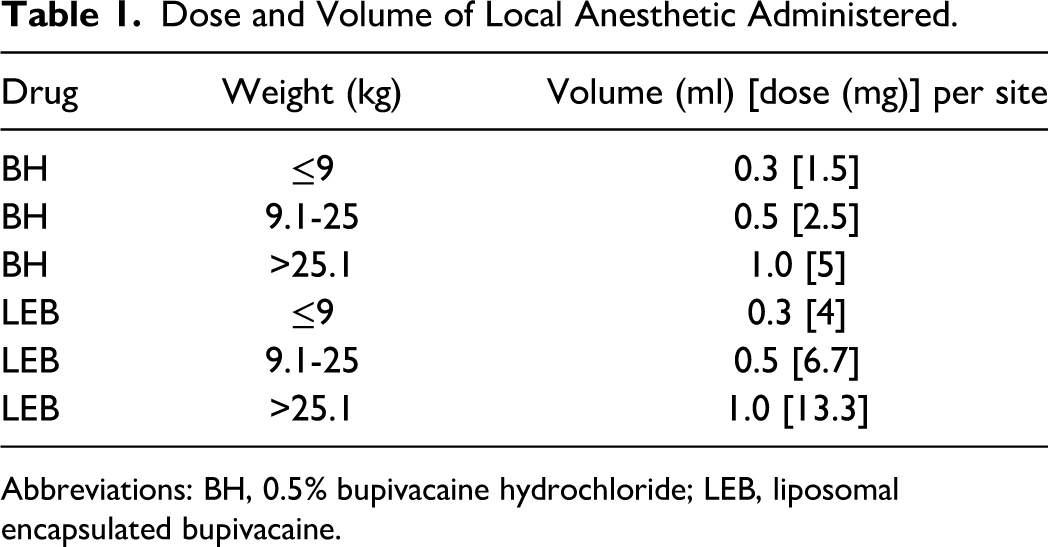
Abbreviations: BH, 0.5% bupivacaine hydrochloride; LEB, liposomal encapsulated bupivacaine.
Dogs were fasted the night before but were allowed access to water. All dogs were premedicated with dexmedetomidinec 0.01 mg/kg and buprenorphined 0.02 mg/kg given by the intramuscular route. Dogs also received a NSAID with the premedication; either carprofene 4.4 mg/kg or meloxicamf 0.2 mg/kg given by the subcutaneous route at the discretion of the attending clinician. Once sedate, a 22-18 G 1.0 inch intravenous (IV) over the needle catheterg was aseptically placed in a cephalic vein. Dogs were preoxygenated via a face mask with 100% oxygen at 4 L/min. A reflectance pulse oximeter probeh was placed at the base of the tail, electrocardiogram and oscillometric blood pressure cuffh measuring 30% to 40% of the circumference of the leg were attached to the patient. Anesthesia was induced using propofoli 6 mg/kg IV, given to effect. The dogs were intubated using a cuffed endotracheal tubej of an appropriate size, which was inflated to create a seal when a positive pressure breath was given to a pressure of 15 cmH2O. Anesthesia was maintained with isoflurane in oxygen to effect as monitored by fourth-year veterinary students under the supervision of a board-certified anesthesiologist. Intravenous fluidsk were administered at 5 mL/kg/hr for the duration of the procedure. Conductivel and convectivem heating devices were used to maintain body temperature. Heart rate, respiratory rate, non-invasive blood pressure, pulse oximeter, end tidal carbon dioxide, and vaporizer percentage were recorded every 5 min. Oxygen flow, rectal temperature, and anesthetic depth were recorded every 15 min. Any anesthetic complications were treated by the attending anesthesiologist as deemed necessary.
Full mouth dental radiographs were obtained for each patient. Dental blocks were performed by one of the investigators using the assigned masked local anesthetic. The inferior alveolar block was performed using previously described landmarks. 5 A modified caudal maxillary block was performed using an infraorbital approach using an IV catheter. 10
Pain Assessment
All dogs were assessed for pain before premedication, immediately after extubation, 1, 2, and 4 h post-extubation and the following day using the Short Form of the Glasgow Composite Pain Scale (GPS). A survey based on a previous study 11 was sent home with the owner to evaluate appetite, demeanor, personality and activity, and soreness of the mouth at the end of each of the first and second days after discharge (Figure 1). Buprenorphine 0.01 mg/kg given IV was the rescue analgesic administered intraoperatively if deemed necessary or postoperatively if GPS was ≥ 5/20 or ≥ 6/24.
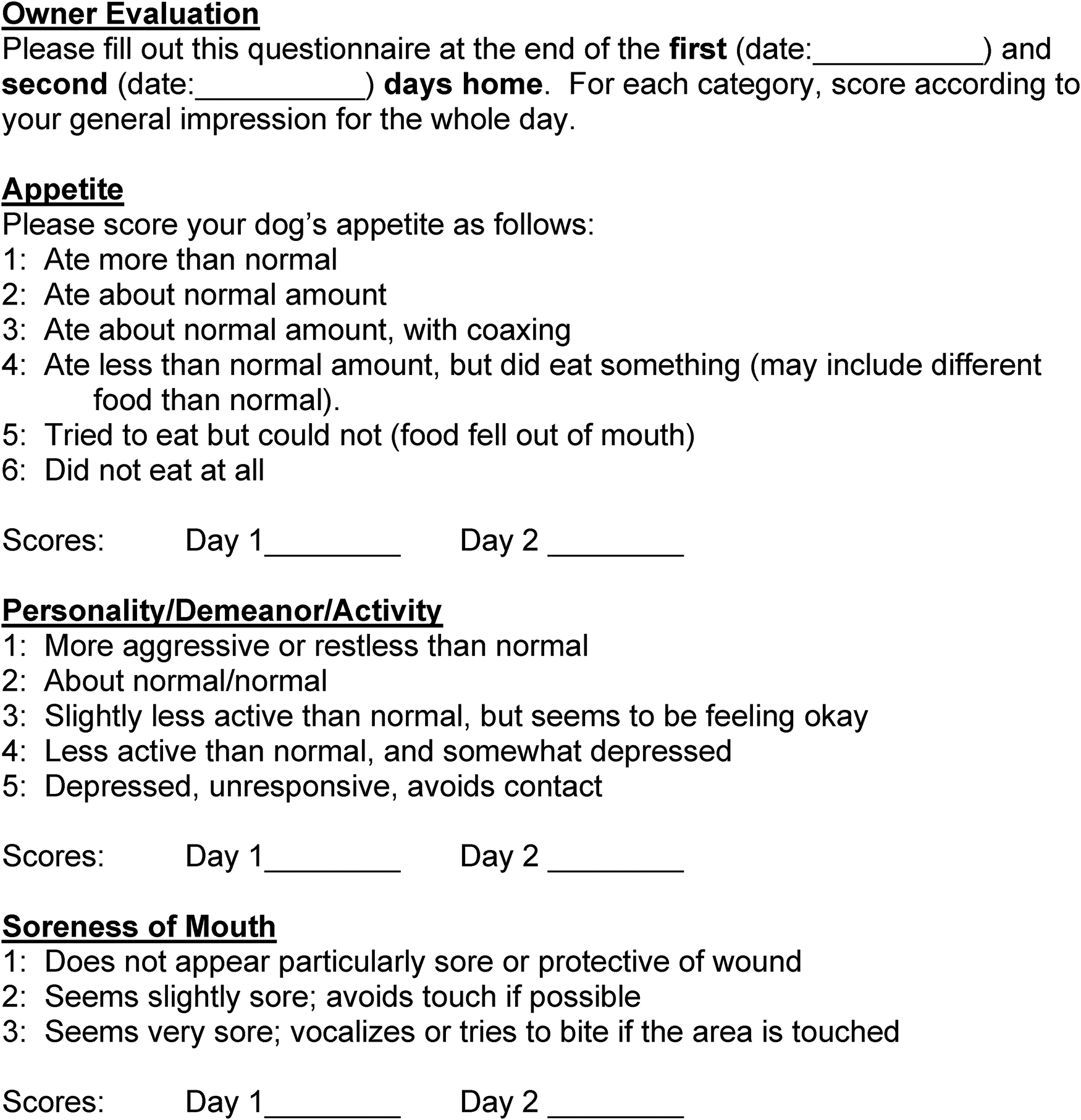
Owner assessment survey of appetite, personality, and soreness.
Statistical Analysis
Data are presented as mean ± SD. Normality was confirmed using the D’Agostino-Pearson test and visual examination of Q-Q plots. At-home appetite, demeanor, and soreness between groups were compared using a Mann–Whitney U test. Total at-home scores were compared between groups using a t-test. An area under the curve (AUC) was generated for each dog's in-hospital pain score, and these were compared using a t-test. A Fisher's Exact Test compared the number of animals receiving rescue analgesia between groups. Significance was set at P < .05. All statistical tests were performed using GraphPad Prism 8.0n. A prospective power analysis was conducted using an online calculatoro. Data from dogs undergoing cranial cruciate ligament surgery and receiving LEB 6 was used to calculate the sample size. To detect the same difference between treatment and control groups using the previously published standard deviation at extubation, three animals would have been required in each group. To allow for greater variability in the data and minimize the likelihood of Type II error, a sample size of 15 per group was chosen.
Results
The dogs weighed from 2.2 to 37.8 kg and were 2 to 13 years old. There were no significant differences in the number of teeth extracted (P = .21), volume of local anesthetic used (P = .35), and time from block(s) to extubation (P = .07) between groups. There was a significant difference in the grade of dental disease between groups (P = .05). The first group (BH) had 7.6 ± 5.7 teeth extracted, dental disease of grade 2.6 ± 0.8, 1.3 ± 0.6 mL BH used and there were 224 ± 109 min between the block(s) and extubation. The second group (LEB) had 9.5 ± 7.4 teeth extracted, dental disease of grade 3.3 ± 1.0, 1.5 ± 1.2 mL LEB used and there was 312 ± 139 min between the block(s) and extubation.
Average pain scores for in-hospital evaluations are presented in Table 2. Areas under the curve for in-hospital scores were 24.3 ± 18.4 for Group BH and 24.2 ± 13.5 for Group LEB. The areas were not significantly different between groups (P = .99). Incidence of rescue analgesia did not differ between groups (P = .99). Six dogs in the BH group received rescue analgesia: two intraoperatively and four postoperatively. Five dogs received rescue analgesia in the LEB group: two intraoperatively and three postoperatively. There was no difference in the number of teeth extracted and the use of rescue analgesia. Three dogs in the BH group were receiving carprofen prior to the study. No dogs were receiving tramadol prior to the study.
In-Hospital Evaluations Using the Short Form Glasgow Composite Pain Scale.

Data expressed as mean ± standard deviation. Abbreviations: BH, 0.5% bupivacaine hydrochloride; LEB, liposomal encapsulated bupivacaine.
Individual scores for appetite, demeanor, and soreness for the at-home evaluation did not significantly differ between groups for each day (Table 3). Total at-home scores for day 1 were significantly less for Group LEB (P = .02). Total at-home scores for all categories on both days for Group BH were 14.3 ± 3.2 and Group LEB were 11.9 ± 5 and they were significantly different between groups (P = .007).
At-Home Owner Evaluations at the End of Day-1 and Day-2 Post Procedure.
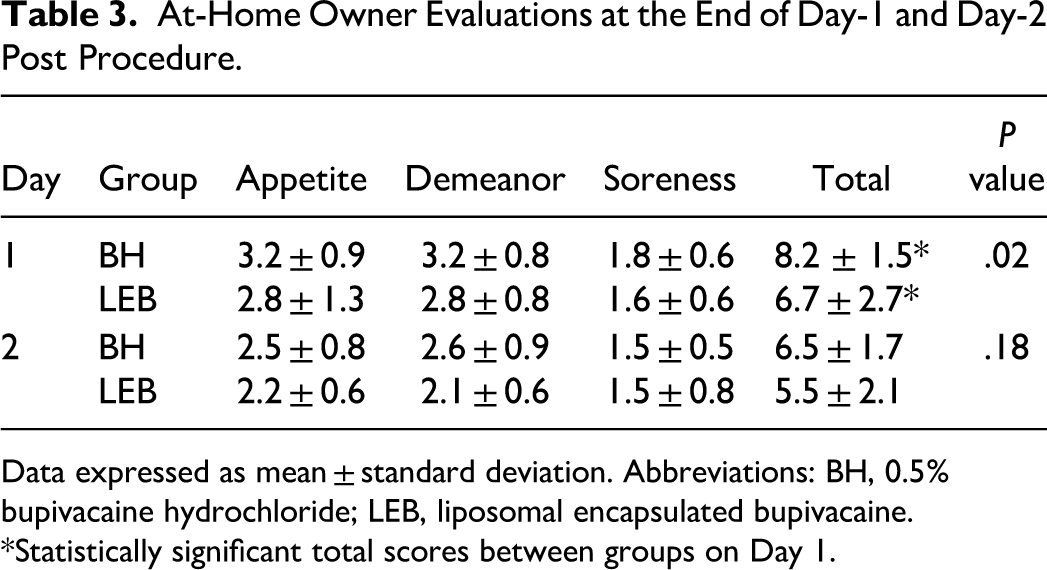
Data expressed as mean ± standard deviation. Abbreviations: BH, 0.5% bupivacaine hydrochloride; LEB, liposomal encapsulated bupivacaine.
*Statistically significant total scores between groups on Day 1.
There were no complications, including reports of hematoma or infection related to the administration of BH or LEB. Additional comments from both groups for the day 1 at-home evaluation included remarks of lethargy but comfortable and some reluctance to eat. Comments from day 2 for both groups included the return to normal energy level, appetite, and ability to consume food.
Discussion
Dogs receiving LEB had lower (better) overall at-home scores with improved appetite, demeanor, and less soreness compared to dogs receiving BH.
The inflammatory phase of healing can result in pain within the first 24 to 72 h post-operatively. 5 Pre- and intra-operative analgesics are usually adequate for control of the response to noxious stimuli during the surgery; however, postoperative analgesia should be provided to reduce the likelihood of peripheral and central sensitization. 5 Dogs which have undergone oral surgery may be difficult to medicate at home. 2 Improved at-home scores with LEB in this study demonstrate that LEB may help bridge the gap between in-hospital and at-home analgesia.
There are no studies regarding time to onset of BH or LEB for dental blocks in dogs. One study reported sensory blockade within 8 min for BH. 2 Duration of action of BH when injected into a foramen has been reported to last up to 6 to 8 h. 5 There were no differences in the intraoperative requirements for rescue analgesia in this study and the blocks were not repeated in any dogs. Therefore, the LEB appeared to be effective at providing analgesia for the intraoperative phase as well.
Desensitization and subsequent trauma of the tongue in horses by inadvertent anesthesia of the lingual nerve using mepivacaine has been reported. 12 There are no reports of this complication in dogs. This could be a serious complication when using LEB for the inferior alveolar block. There were no complications with its use in this study and no dogs had self-inflicted lingual damage.
A limitation of this study was the use of a pain scale and survey to determine analgesic efficacy and comfort after discharge from the hospital. There is currently no validated pain score for dental extractions in dogs. Postoperative pain scores did not differ between groups, likely due to buprenorphine and NSAID used for pre-medication. The at-home survey included palpation of the mouth and behavioral evaluation of personality and demeanor which have been reported to assess comfort after dental extractions.2,5,11 All owners were given the same survey and were blinded to the treatment group; therefore, the improved patient comfort and demeanor can be attributed to the use of LEB. By only performing a post-procedure evaluation, improvement in soreness of the mouth, appetite, and demeanor in comparison to pre-procedure state could not be evaluated. The volume of injection was consistent between groups which resulted in differing doses (mg/kg) of local anesthetic between dogs based on differing weights. The LEB group had an overall high dose due to the higher concentration, which may have influenced the overall better scores in recovery based on owner evaluations. Time from administration of the local anesthetic to extubation and subsequent pain evaluation varied depending on the length of the procedure, however, there was no significant difference between groups. The grade of dental disease was based on gross examination pre-operatively. Although there was a significance (P = .05) found between the two groups, the number of teeth surgically extracted did not differ. Given that the requirements for extraction were based on radiographic evidence and an in-depth assessment of the oral cavity, the grade of dental disease was considered of minor clinical importance.
LEB may be beneficial in providing a prolonged duration of analgesia for dogs with advanced generalized periodontal disease that requires exodontic therapy.
Footnotes
Acknowledgments
We would like to acknowledge Dawn Boczulak and Teri Sorensen for preparation of drugs, Stefanie Perry for assistance with patient recruitment, Brea Craigen for data entry and Amanda Amore for patient recruitment.
Materials
Bupivacaine hydrochloride injection USP, Hospira, Lake Forest, Illinois Nocita, Aratana, Leawood, Kansas Dexdomitor, Zoetis, Espoo, Finland Buprenorphine HCl, Par Pharmaceutical, Chestnut Ridge, NY Rimadyl, Zoetis, Kalamazoo, Michigan Metacam, Boehringer Ingelheim, Duluth, Georgia BD Insyte, Becton Dickinson Infusion Therapy Systems Inc., Sandy, Utah Lifewindow Lite, Digicare, Boyton Beach, Florida Propofol, Hospira, Kalamazoo, Michigan Endotracheal Tube, Vet One, Boise, Idaho Lactated Ringer's Injection USP, Hospira, Overland Park, Kansas Hot Dog Patient Warming Device, Augustine Biomedical + Design, Eden Prairie, Minnesota Baja Desert Breeze Forced Air Blower, Baja Warming GraphPad Prism Version 8.3.0
Declaration of Conflicting Interests
The authors declared no potential conflicts of interest with respect to the research, authorship, and/or publication of this article.
Funding
The authors received no financial support for the research, authorship, and/or publication of this article.
