






Abstract
In this article, the question of whether differences in four structural models of charitable behavior make any difference to the findings regarding the major determinants of philanthropic contributions is addressed. Using data from Independent Sector’s Giving and Volunteering Survey, giving and volunteering equations using the standard Tobit model, the “Heckit” model, the Cragg model with uncorrelated errors, and the Cragg model with correlated errors are estimated. Results indicate that the generalized two-stage approaches are far superior to the standard Tobit model for both monetary donations and volunteer time. For monetary giving, parameter estimates of the second-stage contribution equations are similar across the three alternative two-stage methods and there is no evidence of correlation between the first- and second-stage error terms. Second-stage estimates for volunteering from the Heckit and Cragg models with correlated errors are also similar and offer compelling evidence of correlated error terms.
Much of the empirical literature on charitable giving and volunteering, most recently represented by Brooks (2005), Brown and Ferris (2007), and Wang and Graddy (2008), makes use of the standard Tobit method of estimation. This, of course, is motivated by the fact that much of the time a nontrivial fraction of values for the dependent variables (monetary donations and volunteer time) is zero. In such cases, it is well known that the conditional expectation of the dependent variable is not linear and that the application of least squares produces biased and inconsistent parameter estimates. 1 However, the simple application of Tobit under such circumstances is also subject to criticism. In particular, using Tobit to estimate a monetary donation and/or a volunteer time equation implicitly presumes that the decisions of whether to donate money and time are impacted by the explanatory variables in exactly the same way as the decisions about how much money and time to donate. 2 This seems to be a rather severe limitation especially in the current context where it is quite likely that the socioeconomic and demographic characteristics of households differentially affect the decision of whether to donate at all and the subsequent decision of how much to donate given that they choose to donate. 3
In response, a number of researchers, e.g., Brammer and Millington (2005), Carroll, McCarthy, and Newman (2005), Chang (2005), Jones (2006), have chosen to employ the generalized or “Type 2” Tobit model (Amemiya, 1985) with sample selection, variants of which include the Heckman or “Heckit” model (Heckman, 1979) and Cragg’s specification (Cragg, 1971). These are two-stage models in which the first-stage decision of whether to donate or not is estimated with probit and the second-stage decision of how much to donate incorporates the results of the first-stage selection. A major difference between the two generalized models is that the Heckman approach assumes the first-stage decision to be dominant. In other words, once the decision (not) to contribute is made then the amount of contribution in the second stage must be (zero) positive, that is, a zero contribution results only from a first-stage decision not to contribute. Selection bias is only a problem in the Heckman model if the error terms of the first-stage and second-stage equations are correlated. Cragg’s model, however, presumes the conditional independence of the first- and second-stage errors but allows for the possibility of observing zero contributions in the second stage of the decision making process. The approach can also be extended to incorporate a nonzero correlation of the first- and second-stage error terms. Of the literature cited above, only Carroll et al. (2005) in their analysis of charitable contributions in the Republic of Ireland make use of Cragg’s specification. The remainder rely on the Heckit formulation. None extend testing to the Cragg model with correlated error terms. 4
In this article, we explicitly address the question of whether the differences in the four structural models of charitable behavior make any difference to the findings regarding the determinants of philanthropic contributions. Using data from Independent Sector’s latest Giving and Volunteering Survey and explanatory variables that are commonly found in the empirical research on charitable contributions, we estimate giving and volunteering equations using the standard Tobit model, the “Heckit” model, the Cragg model with uncorrelated errors, and the Cragg model with correlated errors. The results indicate that the generalized two-stage approaches are far superior to the standard Tobit model for both monetary donations and volunteer time. For monetary giving, parameter estimates of the second-stage contribution equations are similar across the three alternative two-stage methods and there is no evidence of correlation between the first- and second-stage error terms. Second-stage estimates of the amount of volunteering from the Heckit model and Cragg model with correlated errors are also similar and do offer compelling evidence that the error terms of the first- and second-stage equations are correlated.
The remainder of the article is organized as follows. The section on major theoretical perspectives on charitable contributions briefly reviews the three major perspectives on charitable contributions and enumerates the set of causal factors that logically follows. The alternative econometric models are outlined in the section on alternative econometric models. The Independent Sector data is described and the explanatory variables are explicitly defined in the section on data and variable definitions. The section on estimation results presents and discusses the results and the last section offers a brief summary and conclusion.
Major Theoretical Perspectives on Charitable Contributions
In determining the causal influences on charitable donations, analysts have generally relied on the three dominant theoretical perspectives offered by economics, psychology, and sociology. The economics literature, with its focus on rational choice and constrained optimization models, stresses the benefits and costs of charitable donations within the utility maximizing paradigm. From this perspective, the primary causal influences that emerge are tastes and preferences, income and wealth, and the marginal tax price of charitable contributions. Psychology researchers generally emphasize individual altruistic personality traits and individual perceptions of charitable/nonprofit institutions. Major causal factors which are identified include psychological inclinations and demographics. Finally, the sociological perspective advances the importance of social networks and social trust, that is, social capital, in driving charitable behavior.
Consistent with these three perspectives, as well as with past empirical analyses, we identify a number of explanatory variables that are (potentially) relevant to decisions regarding charitable contributions of money and time. Economic variables include gross household income, binary variables indicating the itemizing of tax deductions and homeownership status, and human capital as proxied by educational level. 5 Demographic variables include marital status, the presence of children, gender, age, and race/ethnicity. Psychological and social capital variables include the degree of confidence in charitable organizations, the degree of trust in others, voting behavior, the degree of involvement in organizations as a youth, and religiosity as measured by the frequency of church attendance. A full listing of the variables and their labels are provided in the section on data and variable definitions.
A Brief Overview of Alternative Econometric Models
Traditionally, the Tobit model has been used when a nontrivial number of the values of a dependent variable are zeroes. The standard Tobit model (Tobin, 1958) with left censoring at zero can be written as follows:

where

where the first (second) summation is over all zero (nonzero) observations, Φ is the standard normal cumulative distribution function, and φ is the standard normal density function. The questionable aspect of the Tobit model in the context of charitable donations is that it implicitly presumes that the stochastic process which determines the level of giving also determines the choice of whether to give or not in the first place. But what if this is not the case?
Heckman (1979) addressed the issue by proposing the following two-stage model:
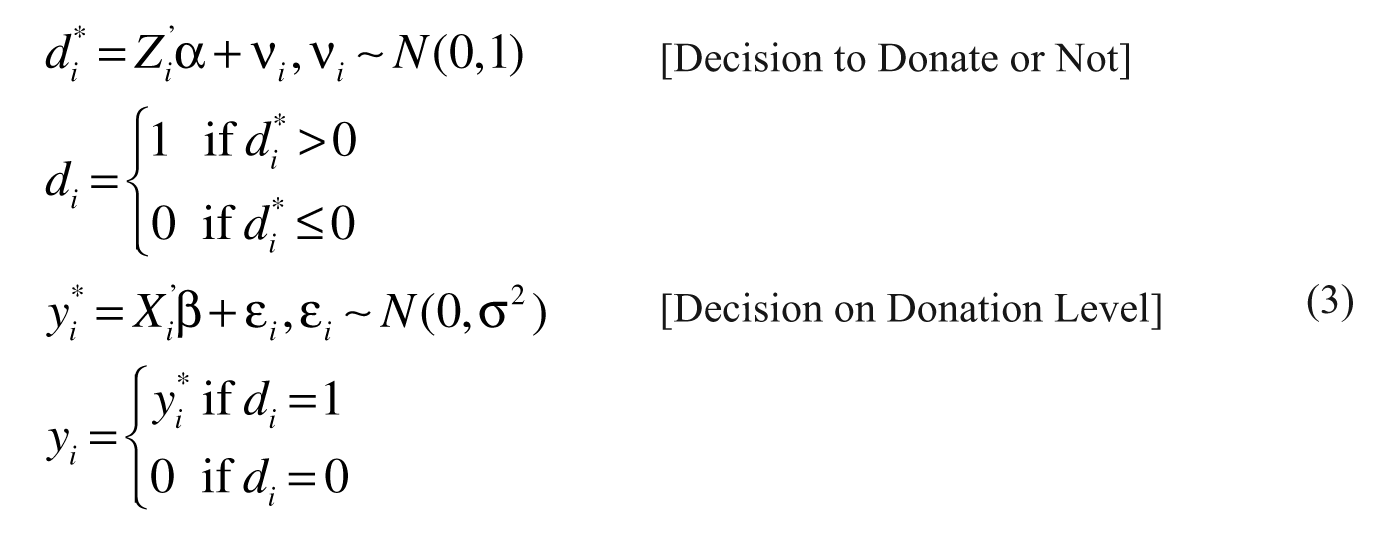
where

that is,
where ρ is the correlation coefficient. The log-likelihood function for the Heckit model can be written as,

Equation 4 presumes first-stage dominance. In other words, a zero value for yi results solely from a decision not to donate, that is, di = 0, and a positive value of yi results solely from a decision to donate, that is, di = 1. Individuals identified as potential donors in the first stage cannot choose to donate nothing in the second stage.
Cragg (1971) relaxes Heckman’s first-stage dominance assumption. Within the current context, Cragg’s specification allows a potential donor identified in the first stage to choose a zero donation level in the second stage. In Cragg’s original specification, the error terms are assumed to be uncorrelated (ρ = 0). Most applications of this model in the charitable giving literature have maintained that assumption. The log-likelihood function is given by,

Note that unlike in Equation 4, both summations are now dependent on Φ (

The Tobit, Heckman, and both Cragg models will be estimated using maximum likelihood for charitable donations of both money and volunteer time.
Data and Variable Definitions
The data source for our empirical analysis is the 2001 Giving and Volunteering Survey conducted for the Independent Sector by Westat, Inc. 6 The survey contains information gathered from a representative national sample of 4,216 adults, 21 years of age or older, on household giving and individual volunteering, indicators of relevant motivations, household characteristics, selected demographics, and economic factors for the 2000 calendar year. A complete listing of the variables used in this article along with their definitions appears in Table 1. Note that all variables are binary except the total number of formal volunteer hours by the respondent in the past month (HoursVolunteered), total formal household giving for the 2000 calendar year (TotalMoney Donations), age of the respondent (Age), and gross household income (HouseholdIncome) in 2000. Following common practice, the dependent variables for the monetary donation and volunteer time second-stage level equations are measured as ln(1 + TotalMoneyDonations) and ln(1 + HoursVolunteered), respectively, where the prefix ln denotes the natural logarithm. The corresponding first-stage dependent binary variables are GiveOrNot and VolunteerOrNot.
Variable Labels and Definitions
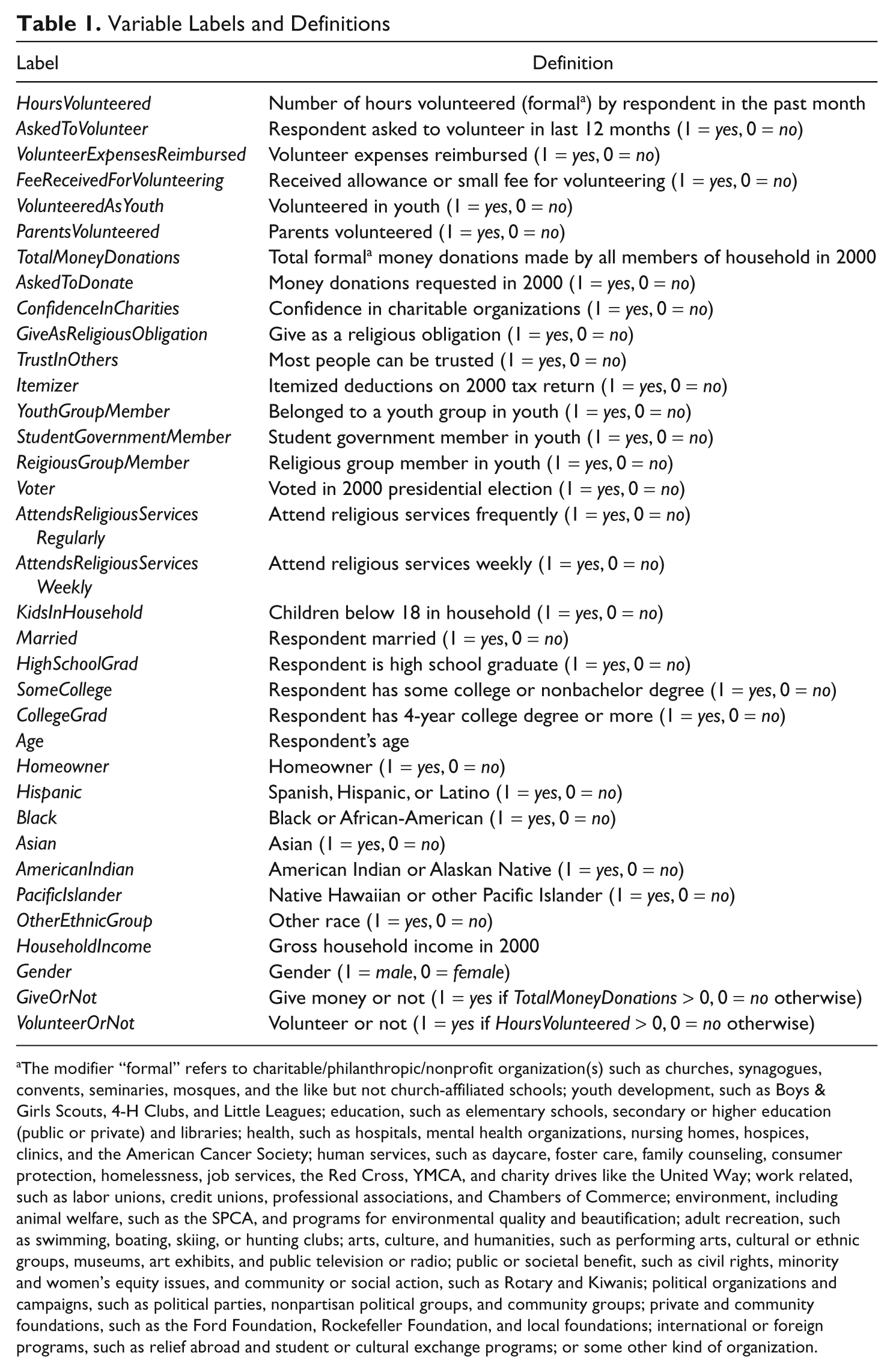
The modifier “formal” refers to charitable/philanthropic/nonprofit organization(s) such as churches, synagogues, convents, seminaries, mosques, and the like but not church-affiliated schools; youth development, such as Boys & Girls Scouts, 4-H Clubs, and Little Leagues; education, such as elementary schools, secondary or higher education (public or private) and libraries; health, such as hospitals, mental health organizations, nursing homes, hospices, clinics, and the American Cancer Society; human services, such as daycare, foster care, family counseling, consumer protection, homelessness, job services, the Red Cross, YMCA, and charity drives like the United Way; work related, such as labor unions, credit unions, professional associations, and Chambers of Commerce; environment, including animal welfare, such as the SPCA, and programs for environmental quality and beautification; adult recreation, such as swimming, boating, skiing, or hunting clubs; arts, culture, and humanities, such as performing arts, cultural or ethnic groups, museums, art exhibits, and public television or radio; public or societal benefit, such as civil rights, minority and women’s equity issues, and community or social action, such as Rotary and Kiwanis; political organizations and campaigns, such as political parties, nonpartisan political groups, and community groups; private and community foundations, such as the Ford Foundation, Rockefeller Foundation, and local foundations; international or foreign programs, such as relief abroad and student or cultural exchange programs; or some other kind of organization.
The same set of explanatory variables is used for the standard Tobit model and the second-stage level equations of the Heckman and Cragg models. Explanatory variables common to both the monetary and time donation level equations are lnHouseholdIncome, Homeowner, Married, KidsInHousehold, Gender, lnAge, HighSchoolGrad, SomeCollege, CollegeGrad, TrustInOthers, ConfidenceInCharities, YouthGroupMember, StudentGovernmentMember, ReligiousGroupMember, Voter, Hispanic, Black, Asian, AmericanIndian, PacificIslander, OtherEthnicGroup, GiveAsReligious Obligation, AttendReligiousServicesRegularly, and AttendReligiousServicesWeekly. Additional variables specific to the level of money donations are AskedToDonate and Itemizer and to the amount of volunteer time are AskedToVolunteer, Volunteer ExpensesReimbursed, FeeReceivedForVolunteering, VolunteeredAsYouth, and ParentsVolunteered.
For the first-stage binary decision equations, we began with the entire set of variables just described. Through a sequence of probit maximum likelihood estimations and corresponding likelihood ratio tests, we settled on a set of first-stage regressors that is common across the Heckman and Cragg models. 7 For the GiveOrNot equations, this includes AskedToDonate, HouseholdIncome, Itemizer, Homeowner, HighSchoolGrad, SomeCollege, CollegeGrad, TrustInOthers, ConfidenceInCharities, YouthGroupMember, ReligiousGroupMember, Voter, Black, and GiveAsReligiousObligation; for the VolunteerOrNot equations, the set is composed of AskedToVolunteer, Volunteer ExpensesReimbursed, Married, Gender, SomeCollege, CollegeGrad, ParentsVolunteered, TrustInOthers, ConfidenceInCharities, StudentGovernmentMember, Voter, Black, and AttendReligiousServicesWeekly. 8
Estimation Results
Monetary Donations
Maximum likelihood estimates for the parameters of the monetary donation level equation for each of the models are presented in Table 2. Reported standard errors are robust to both heteroscedasticity and autocorrelation. Inspection of the table reveals both striking similarities and differences between the standard Tobit model and the three alternative two-stage models. From a statistical significance perspective, the reported results are remarkably robust across the models with only a few exceptions. The estimated coefficients on the economic variables, gross household income (lnHouseholdIncome) and the tax benefits from itemizing deductions (Itemizer), are consistently positive and highly significant. 9 Parameter estimates on the religiosity variables, giving viewed as a religious obligation (GiveAsReligiousObligation) and frequent attendance at church services (AttendReligiousServicesRegularly and AttendReligiousServicesWeekly), shows consistently positive impacts on gifts of money with strong statistical significance. Higher levels of human capital as proxied by SomeCollege and CollegeGrad have positive and significant impacts on monetary donations across all models. This result is also consistent with the social capital perspective as recent research by Oreopoulos and Salvanes (2009) suggests that more education leads to more trust and social interaction. The belief that charitable organizations can be trusted (ConfidenceInCharities) is shown to have a highly significant, positive effect on the level of monetary donations across all models. Religious and secular group involvement in one’s youth (StudentGovernmentMember and ReligiousGroupMember) is positively and significantly related to gifts of money across all specifications as is the measure of current political involvement (Voter). Not surprisingly, being solicited for monetary donations (AskedToGive) has positive and highly significant effects on gifts of money. Finally, all specifications imply that men give more than women (Gender) and that the older one is the more one gives (lnAge).
Maximum Likelihood Estimates—Monetary Donations

Note: Number of observations = 3,624; censored observations = 453.
Significant at .1, two-tailed. ** Significant at .05, two-tailed. *** Significant at .01, two-tailed.
The differences between the standard Tobit model and the two-stage alternatives, however, are stark. First, we note that the log-likelihood value of the standard Tobit model is considerably smaller than those of all the two-stage alternatives. This suggests that the differences between Tobit parameter estimates and those of the two-stage alternatives are indicative of (upward) biases as a result of the Tobit specification. Table 3 provides the 95% confidence interval estimates for the coefficients on those explanatory variables identified as statistically significant by all models. The Tobit intervals are characterized by lower and upper bounds of greater magnitudes that do not overlap the others and/or intervals that are overlapping but are considerably wider than the others.
Comparison of 95% Confidence Intervals—Monetary Donations
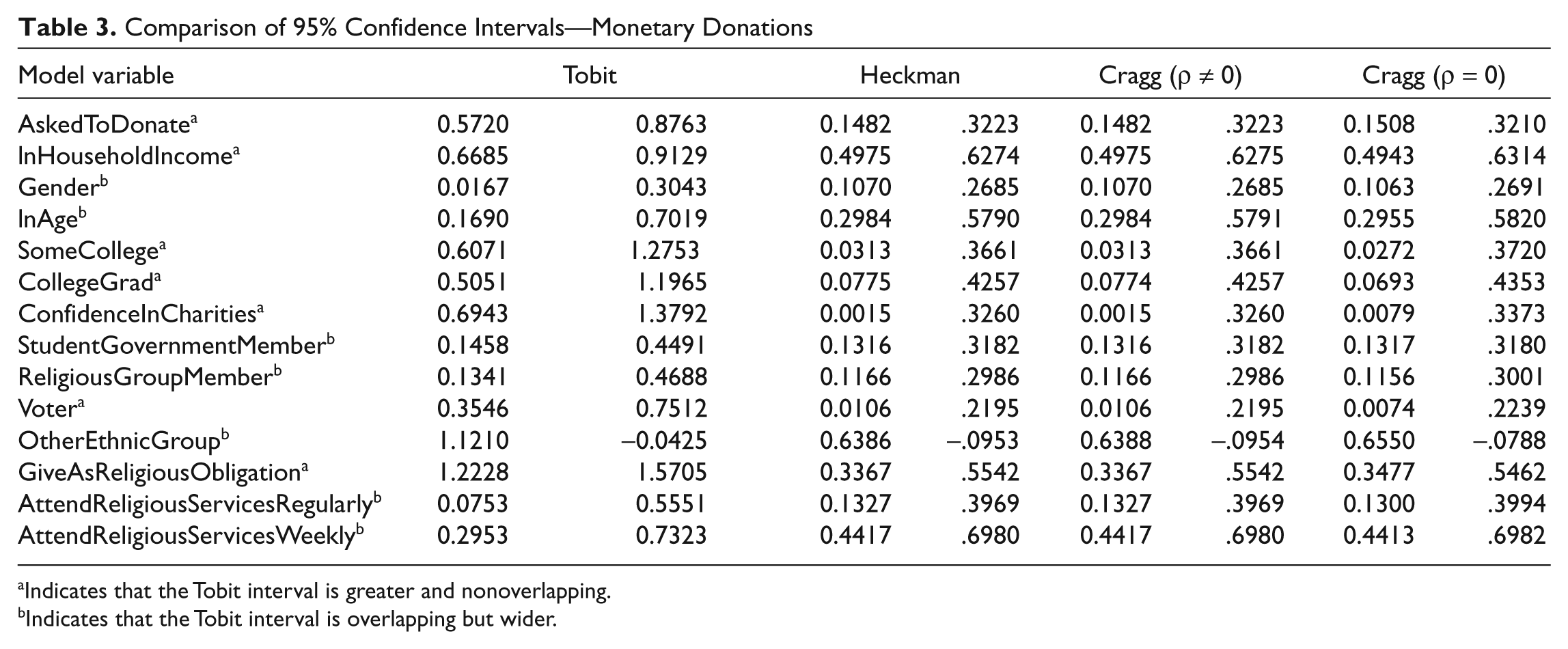
Indicates that the Tobit interval is greater and nonoverlapping.
Indicates that the Tobit interval is overlapping but wider.
It is clear then that the standard Tobit model is inferior to the two-stage alternatives in modeling of monetary donations. The best choice among the two-stage alternatives, however, is unclear. The log-likelihood values are virtually identical and hence are of no use in distinguishing among the three alternatives. 10 As neither the Heckman nor the Cragg (ρ ≠ 0) specifications provide statistically significant evidence that the error terms are correlated, the two logical candidates are Heckit with zero-error correlation and the Cragg model with ρ = 0. 11 At least for this data set, however, there is no basis on which to decide between them.
Volunteer Time
Table 4 reports the maximum likelihood estimates for the parameters of the volunteer effort equation under each of the specifications. Again, there are a number of similarities across the models in terms of statistical significance though there now appears to be a number of differences that were not present in the monetary donations results. Except for the second Cragg specification, respondents who are asked to volunteer (AskedToVolunteer) more time. Interestingly, respondents who are partially reimbursed for expenses incurred in volunteering (VolunteerExpensesReimbursed) donate more time, a result that is very robust across all models. The human capital variables SomeCollege and CollegeGrad have positive and highly significant impacts on volunteering across the models, again except in the second Cragg specification. In addition, as for monetary giving, all models report a positive and highly significant impact of weekly church attendance on volunteer effort (AttendReligiousServicesWeekly). However, though the standard Tobit results point to the importance of a number of other demographic variables (Married and Gender), social capital variables (Trust InOthers, ConfidenceInCharities, ParentsVolunteered, and Voter), and race/ethnicity variables (Black and Hispanic), the two-stage models generally do not. In contrast, the two-stage models strongly suggest that respondents who receive a small allowance or fee for volunteering (FeeReceivedForVolunteering) donate more time as do respondents who are Native American (AmericanIndian). They also generally report the (marginal) significance of homeownership (Homeowner) and the respondent’s age (lnAge) on the level of volunteer time.
Maximum Likelihood Estimates—Volunteer Time

Note: Number of observations = 3,624; censored observations = 1,030.
Significant at .1, two-tailed. ** Significant at .05, two-tailed. *** Significant at .01, two-tailed.
In line with our results for monetary giving, the Tobit point estimates are generally well above those of the other models. An examination of the 95% confidence intervals (unreported) again reveals that the Tobit intervals are characterized by lower and upper bounds of greater magnitudes that do not overlap the others and/or intervals that are overlapping but are considerably wider than the others. Finally, consistent with the previous results, the log-likelihood values for the two-stage alternatives are much superior to that of the standard Tobit model. Consequently, modeling donations of time with a standard Tobit specification will likely provide results that should be treated with a degree of skepticism.
As for the two-stage alternatives in modeling volunteer effort, both the Heckman and Cragg (ρ ≠ 0) specifications offer convincing evidence that the error terms of the two equations are indeed correlated. Specifically, for the Heckman (Cragg [ρ ≠ 0]) model, a likelihood ratio test of the null hypothesis that ρ = 0 reports a χ2(1) value of 5.51 (22.31) with a p value of .019 (.000), strongly rejecting the null hypothesis of zero correlation. There is little that distinguishes one from the other statistically. Their log-likelihood ratios are virtually identical, the statistical significance of the explanatory variables is the same (except for a marginal difference for ParentsVolunteered), and point estimates are similar. The main implication here seems to be that for modeling volunteer effort a two-stage alternative with nonzero correlation between the errors is critical.
Selection Equation Results
Tables 5 and 6 report the parameter estimates for the probit selection equations for monetary giving and volunteering, respectively, common to the Heckman and Cragg specifications. Table 5 offers statistically compelling evidence that the probability of making a donation is higher for households that are solicited (AskedToGive), households that have higher gross incomes (HouseholdIncome), and households that itemize deductions (Itemizer). More human capital, as proxied by the education variables HighSchoolGrad, SomeCollege, and CollegeGrad, has a positive and highly significant impact on the likelihood of making charitable gifts of money. The social trust variables, trust in others (TrustInOthers) and confidence in charitable organizations (ConfidenceInCharities), as well as the proxies for the degree of social networking and involvement (YouthGroupMember, ReligiousGroupMember, and Voter) are also shown to have positive and significant impacts on the choice of whether to give or not. Households with the greatest positive and significant impact on the probability of giving, however, are those with respondents who view charitable gifts of money as a religious obligation (GiveAsReligiousObligation). Interestingly, the two other religiosity proxies, frequent church attendance (AttendReligiousServicesRegularly) and weekly church attendance (AttendReligiousServicesWeekly), which were shown to have highly significant positive impacts on the amount of household monetary donations have no discernable impacts on the decision of whether to give or not.
Probit Selection—Monetary Donations
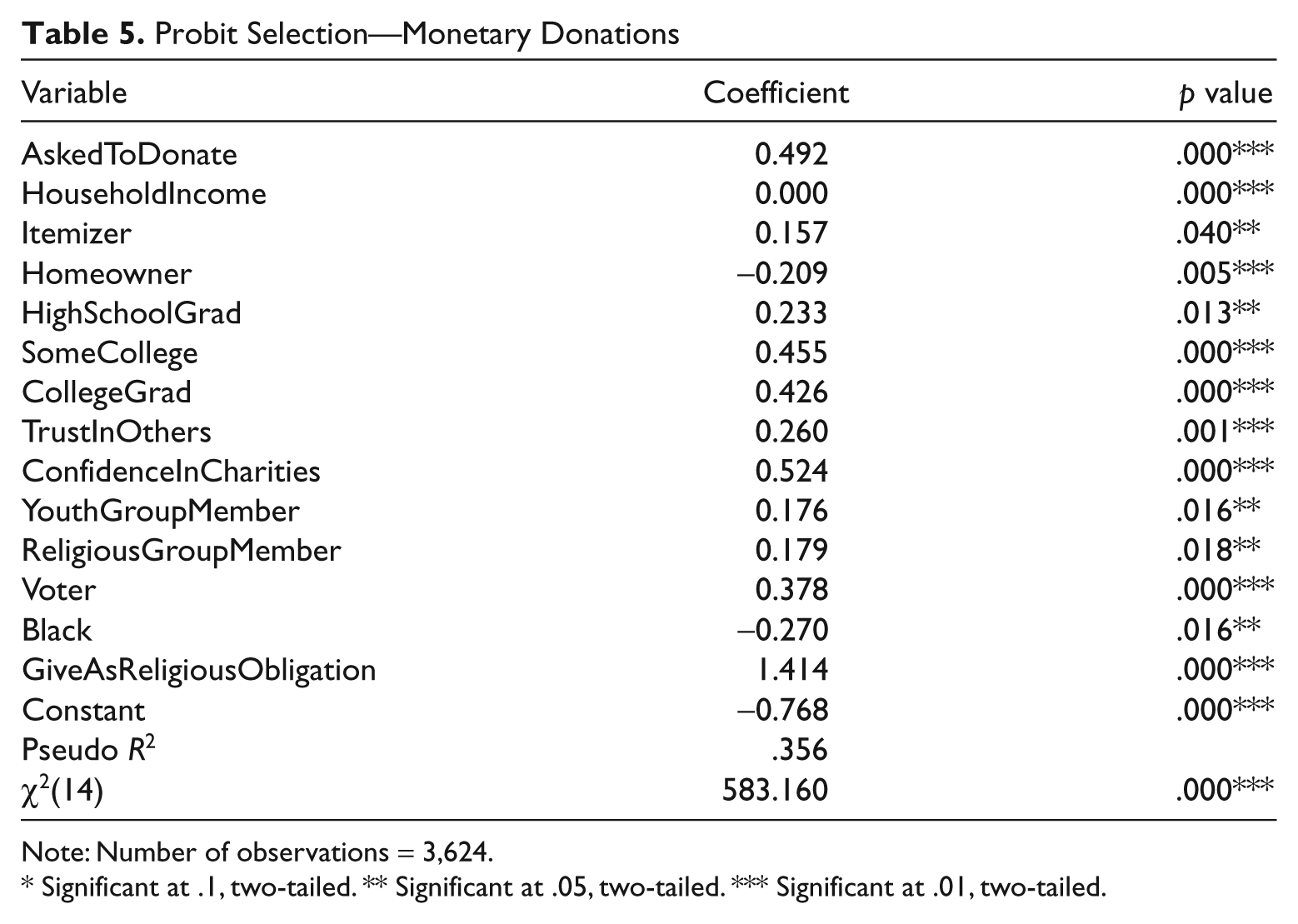
Note: Number of observations = 3,624.
Significant at .1, two-tailed. ** Significant at .05, two-tailed. *** Significant at .01, two-tailed.
In deciding whether to volunteer or not, the results reported in Table 6 show evidence that respondents who are asked to volunteer (AskedToVolunteer) and who are reimbursed for expenses incurred in volunteering (VolunteerExpensesReimbursed) are more likely to volunteer. The economic variables have no statistically significant impact on the decision. Respondents who are married (Married) are more likely to volunteer whereas male respondents (Gender) are less likely than females to donate time for charitable purposes. Increased human capital (SomeCollege and CollegeGrad) has a positive and significant impact on the probability of volunteering as do trust in others (TrustInOthers) and in charitable organizations (ConfidenceInCharities). Having had parents who volunteered (ParentsVolunteered) and having been involved in student government as a youth (StudentGovernmentMember) both increase the likelihood of volunteerism. Respondents who exercise their civic duty (Vote) are also more inclined to take part in volunteer efforts. Last, we note the large, positive, and highly significant impact of weekly church attendance (AttendReligiousServices Weekly) on the likelihood of volunteering.
Probit Selection—Volunteering
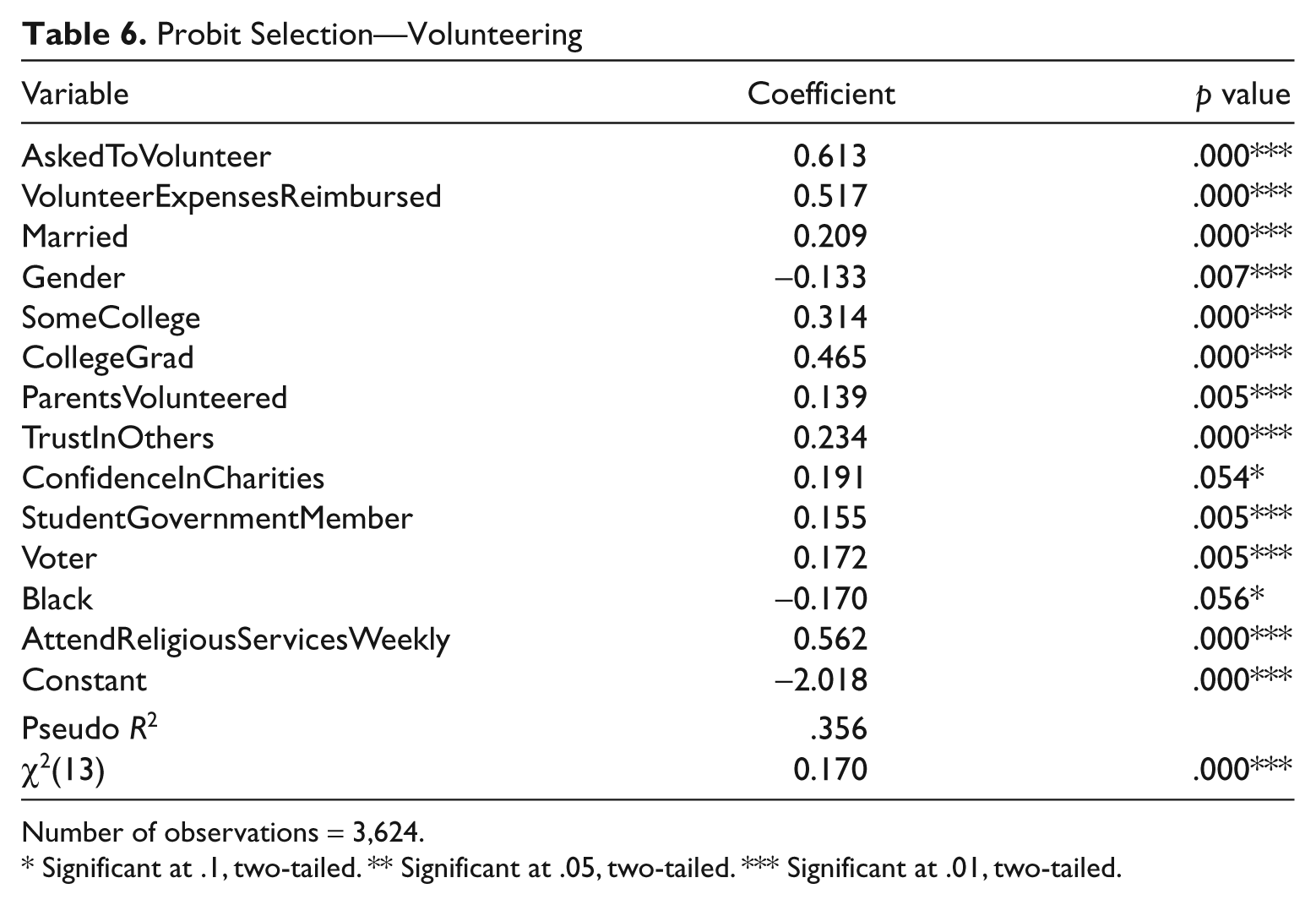
Number of observations = 3,624.
Significant at .1, two-tailed. ** Significant at .05, two-tailed. *** Significant at .01, two-tailed.
Summary and Conclusions
In this article, we have attempted to ascertain whether different structural models of philanthropic behavior really matter to statistical analyses of donations of money and time. Much of the research has employed the standard Tobit model in analyzing giving and volunteering behavior due to the typically nontrivial portion of observations with zero values for the dependent variable(s). However, the Tobit model presumes that the stochastic process determining the amount of giving is the same one that determines the decision of whether to give or not. Using Independent Sector data on giving and volunteering by households, we have estimated the standard Tobit model and three two-stage alternatives, the Heckman model and the Cragg model both with and without nonzero correlation between the error terms. The results reported for charitable gifts of money clearly indicate the inferiority of the standard Tobit model. However, our results provide little evidence of a correlation between the decision to give and how much to give. Consequently, for modeling charitable gifts of money, the Heckman and Cragg specifications with ρ = 0 appear to be the better choices.
The article’s results regarding volunteer effort again point to the inferiority of the standard Tobit framework. Moreover, our estimates from the Heckman and Cragg (ρ ≠ 0) specifications offer compelling evidence of a nonzero correlation between the error terms of the selection and level equations indicating that accounting for selectivity bias is critical when modeling volunteering behavior. As a result, the Heckit or Cragg specifications with ρ ≠ 0 should be considered the more reliable alternatives.
The results also indicated the importance of economic, human capital, social capital, and religiosity variables on the decision to give and/or on the decision of how much to give, regardless of formulation. This has significant implications. Asking people to donate is most significant in raising the probability that they will donate. Enhancing human capital, social capital, and social networks improves the chances of giving as does the degree of civic engagement. These results demonstrate the importance of fostering the civic mindedness, the civic engagement, and the social trust of young people to the philanthropic community at large.
We conclude the article by noting that it has only addressed one possible source of selection bias—the decision to “give or not.” Yet one should recognize that a number of other sources of selection bias may exist and be of consequence to how we model charitable giving. Does the decision of whether to attend church services cause selection bias? It may be there are unobservable factors that simultaneously influence the decisions to attend services, to give or not, and the decision of how much to give. Are there unobservables that impact both who gets asked to donate and how much one donates? 12 To the extent that such biases are present and quantitatively important, our results may reflect only correlation and not causality. In addition, disaggregation by the type of giving and volunteering might shed light on the nature of selectivity bias and hence on the best way to model charitable behavior. Such issues constitute some of the topics for future research.
Footnotes
Acknowledgements
The authors would like to thank the participants in the brown bag seminars sponsored by the Institute for Policy Research and Catholic Studies at The Catholic University of America for their helpful comments on an earlier draft of this article.
The authors declared no potential conflicts of interest with respect to the authorship and/or publication of this article.
The authors acknowledge a grant from the Catholic University Faculty Research Fund in partial support of this research.