






Abstract
This study investigates how women influence charitable giving in a large, international voluntary service organization—Lions Clubs International (LCI). Data were collected from a survey of Lions clubs members in 14 countries to assess the impact of both micro- and macro-level factors on charitable giving. Probit and Tobit models are used to determine the probability of giving as well as the amount of money donated to the Lions Clubs International Foundation. Results indicate that belonging to a club where at least half of the members are female and where we see an increase in the percent growth in female membership in the respondent’s country are associated with both a greater likelihood of donating as well as giving more to this international service club. Findings from our study have direct implications for voluntary service organizations, particularly with regard to issues of organizational culture, as more service organizations recruit female members.
Introduction
Nonprofit membership associations are defined broadly as formally organized groups, most of whose members are not financially remunerated for their participation (Knoke, 1986). These associations include a variety of organizations with numerous purposes and membership structures (Tschirhart, 2006). In this highly diverse group of membership associations, voluntary service clubs play a unique and important role in civil society, with the primary purpose of serving the public interest. Service organizations are one of the major types of 501(c)(4) organizations in the United States. Most of these organizations were formed in the early 1900s as a mechanism for business networking and friendly mutual support (Charles, 1993; Hoolwerf & Schuyt, 2010). Later in the 1910s and 1920s, serving the community was adopted as the core philosophy of service clubs (Putney, 1993). After World War II, service clubs expanded their operation well beyond the border of the United States (Wikle, 1999; Charles, 1993), where serving communities locally and globally became the paramount tenet of service clubs. The “big three”—Lions Clubs International (LCI), Rotary International, and Kiwanis International—alone formed clubs in 70 countries worldwide by 1937, then expanded to 188 countries in 1997, and grew to 206 countries in 2011 (Wikle, 1999). Service clubs also increasingly adopted more international projects beginning in the 1980s (Hoolwerf & Schuyt, 2010). Since then, service organizations have actively engaged in a variety of charitable activities in communities worldwide and have partnered with other organizations to address community needs.
Despite the critical role that voluntary service clubs play in philanthropy, few empirical studies have examined the philanthropic dimension of these nonprofits (Hoolwerf & Schuyt, 2010; Tschirhart, 2006), particularly within the international context (Schofer & Fourcade-Gourinchas, 2001). Data on these organizations and their activities are largely unavailable (Hoolwerf & Schuyt, 2010). Nevertheless, U.S. scholars have analyzed the historical development of service clubs within and outside the United States (e.g., Charles, 1993; Goff, 2008; Putney, 1993; Wikle, 1999). However, existing research often consolidates studies of 501(c)(4) organizations with other types of nonprofits, primarily focusing on lobbying and advocacy (e.g., Boris & Mosher-Williams, 1998; De Vita, Mosher-Williams, & Stengel, 2001). Moreover, little academic research has paid attention to the roles female members play in membership associations. Yet, service clubs have experienced significant changes in the past two decades, with female membership growing substantially in many countries.
This study investigates how women influence the charitable giving behavior of members at an international voluntary service organization—LCI. First, we examine whether there are gender differences in the likelihood and amount of giving by service club members. Second, we examine whether the representation of female members within individual clubs affects members’ charitable giving. And third, we explore whether the growth in female membership at the country level has any influence on members’ giving. Data were collected from a survey of members in 14 countries who belong to LCI. Using cross-national data allows us to assess the impact of both micro- and macro-level factors on charitable giving. This study, therefore, contributes to existing research in three areas: giving behavior of voluntary service clubs’ members, the interplay of gender and giving across countries, and the effect of country-level factors on giving.
Background
LCI represents an ideal case to examine the research questions posed in our study due to its international presence as a well-known service organization and its rapid growth in female membership over the past two decades. Formed in the United States in 1917, LCI today is the world’s largest voluntary service organization with 1.35 million members in more than 46,000 clubs found in more than 206 countries and geographic areas. LCI’s mission is “to empower volunteers to serve their communities, meet humanitarian needs, encourage peace and promote international understanding through Lions clubs” (LCI, 2012). Following the motto “We Serve,” Lions clubs members actively engage in philanthropy by contributing time and money for various community service projects around the world. LCI became international in 1920 by establishing the first club in Canada. Mexico followed in 1927, and the 1950s and 1960s witnessed accelerated international growth in Europe, Asia, and Africa.
As late as 1987, women were almost completely excluded from service clubs. These once all-male clubs did not fully open to women until 1987 when the U.S. Supreme Court ruled that Rotary clubs may not restrict membership based on gender. In July 1987, LCI formally amended its constitution and bylaws, removing “male” as a qualification for membership (Nathan, 2009). Since then, female membership at LCI has grown steadily both within and outside the United States, reaching 260,824 in 2008, and representing nearly 23% of total worldwide membership (LCI, 2008). As a catalyst for women’s participation, LCI’s Family and Women’s Membership Development Chairperson Positions established district goals and action plans for the recruitment of women and assisted in the development of community projects geared toward women and families. LCI participation by women and families represents the largest potential means for club expansion and is viewed as critical to LCI’s overall health and vitality. From 1996 to 2011, female membership increased substantially in all of the 14 countries surveyed in the study, especially in developing countries, such as China (1,661%), India (796%), Mexico (371%), Kenya (369%), and Nigeria (306%).
Our study focuses specifically on charitable giving made to Lions Clubs International Foundation (LCIF), rather than giving by Lions clubs members to other charitable causes. LCIF is the official charitable organization of LCI. It supports various projects in four focus areas—restoring sight, providing disaster relief, serving youth, and addressing other humanitarian needs. LCIF receives donations from Lions clubs members around the world, totaling approximately US$48 million in fiscal year 2010-2011. Contributions made to LCIF are used for charitable projects around the world, so in this sense, these donations are made for the global common good, rather than for local benefit. Second, charitable giving is often deeply embedded in the particular traditions of each country and thus differs around the world. By studying giving to LCIF, a specific well-defined purpose that is consistent for all Lions clubs members across countries, the institutional context is the same for all members. This allows us to investigate the potential effects of various individual- and country-level institutional factors that may influence charitable giving, while holding the institutional setting constant.
Why Gender Is Important
A substantial literature exists as to gender differences in altruism, empathy, prosocial values, and other motives for helping behavior from the economic, sociology, biology, and psychology disciplines, as well as the philanthropic studies literature. Much empirical research finds women to be more selfless, prosocial, nurturing, empathetic, and/or generous than men (e.g., Andreoni & Vesterland, 2001; Baron-Cohen, 2003; Cox & Deck, 2006; Croson & Buchan, 1999; Eagly & Crowley, 1986; Eagly & Koenig, 2006; Eckel & Grossman, 1998; Einolf, 2011; Eisenberg & Lennon, 1983; Erdle, Sansom, Cole, & Heapy, 1992; Hoffman, 1977; Jolliffe & Farrington, 2005; Kottasz, 2004; Mesch, Brown, Moore, & Hayat, 2011; Mills, Pedersen, & Grusec, 1989; Piliavin & Charng, 1990; Piliavin & Unger, 1985; Skoe, Cumberland, Eisenberf, Hansen, & Perry, 2002). In general, we see a strong and positive relationship between these prosocial values and philanthropy (e.g., Bekkers & Wiepking, 2011; Bennett, 2003; Mesch et al., 2011; Simmons & Emanuele, 2007; Wilhelm & Bekkers, 2010).
Most of the empirical research exploring gender differences has been conducted in the United States. However, according to the World Values Survey (2006), data indicate that globally, more women than men believe that service to others is very important; women are more likely to state that it is very important to provide basic needs; women are more likely to believe that the poor are poor because of unfairness rather than laziness; and women are more likely to indicate that the government is not doing enough to fight poverty (as cited in Themudo, 2009). Given the empirical research findings on gender differences in both attitudes and behaviors, more cross-national research examining gender, voluntary action and the nonprofit sector is warranted (Themudo, 2009)—particularly in service organizations where women may be more predisposed toward helping others in need.
Recent research, however, does provide some evidence of cross-national gender differences in philanthropy (e.g., Feingold, 1994; Schwartz & Rubel, 2005; Themudo, 2009; Wiepking & Einolf, 2011). Using cross-national data, Themudo (2009) finds a positive and significant relationship between women’s empowerment, voluntary action, and the strength of the nonprofit sector. Specifically, the results indicate that women’s empowerment globally is strongly associated with women’s volunteering across all types of charities in the nonprofit sector—globally, the strength of the nonprofit sector is directly related to women’s empowerment even when controlling for other possible factors. Similarly, Wiepking and Einolf (2011) analyze data from the Gallup World View Survey and the World Database of Happiness, revealing gender differences in charitable giving across countries. Women are more likely to give in some countries because they are more empathic and religious than men, while men are more likely to give in other countries because they are more able to give (due to income and wealth) and are more frequently asked (Wiepking & Einolf, 2011). Schwartz and Rubel (2005) assess gender differences in values across 19 countries using the 2002-2003 European Social Survey. Among other findings, their study reveals that men attribute more importance than women to self-enhancement values, such as power and achievement that encourage pursuit of one’s own interests; whereas women rate benevolence and universalism values higher, which emphasize concern for the welfare of others.
Female Representation and Influence
This article also draws on the literature on female representation and influence. The dynamics within a group are often shaped by the relative numbers of people of different social or cultural backgrounds (Kanter, 1977). In a skewed group, where the proportion of one type of individual far exceeds another, the majority members are more likely to influence the group. However, as the number of minority members increase, the group becomes more balanced and moves from “tokenism” toward more inclusion of minority norms, where the minority gains more power in influencing the culture of the group (Bear, Rahman, & Post, 2010). Following Kanter’s (1977) work on tokenism, researchers have examined male-female interaction in different group settings and have found support for this concept in such diverse areas as state legislatures (Kathlene, 1994; Saint-Germain, 1989), corporate boards (Erkut, Kramer, & Konrad, 2008; Rosener, 1997), school boards (Schwarz, 2010), and partnerships at elite law firms (Chambliss & Uggen, 2000). Similarly, gender effects have been found, for example, in decision-making in public policy (Beaman, Duflo, Pande, & Topalova, 2006; Keiser, 1997; Swers, 2001), and regarding corporate financial performance (Ahern & Dittmar, 2012; Campbell & Mínguez-Vera, 2008; Matsa & Miller, 2013; Verstegen, 2011), corporate giving (Marquis & Lee, 2011; Wang & Coffey, 1992; Williams, 2003), and corporate social responsibility ratings (Bear et al., 2010). More specifically, Marquis and Lee (2011) found that the increased presence of female senior managers and board of directors resulted in greater corporate philanthropic contributions. These studies suggest that the proportion of females is significantly linked to the amount of influence women hold. Prior research further suggests that women tend to have favorable experience when their representation exceeds 15% in a group, especially when their representation reaches a threshold of about 35% to 40% (Yoder, 2001). Very limited research exists, however, on the effects of female representation in service organizations, although there is growing evidence of the role gender plays in other arenas.
Method
Data Collection and Sample
Data were collected through an online survey of Lions clubs members in 14 countries from five world regions: North America (including United States and Canada), Central and Southern America (including Brazil and Mexico), Europe (including France, Ireland, and Turkey), Asia Pacific (including Australia, China, India, Japan, and Philippines), and Africa (including Nigeria and Kenya). Each of these countries represents a unique philanthropic culture and a distinctive socioeconomic environment for nonprofit organizations.
The survey, translated into five languages other than English, was sent to a random sample of more than 24,000 Lions clubs members between February and April 2011. 1 At least two follow-up reminder emails were sent to each country’s members. A total of 2,820 individuals responded to the survey. 2 The final sample size in this study is 1,672 individuals, after we excluded individuals who did not provide answers for key variables.
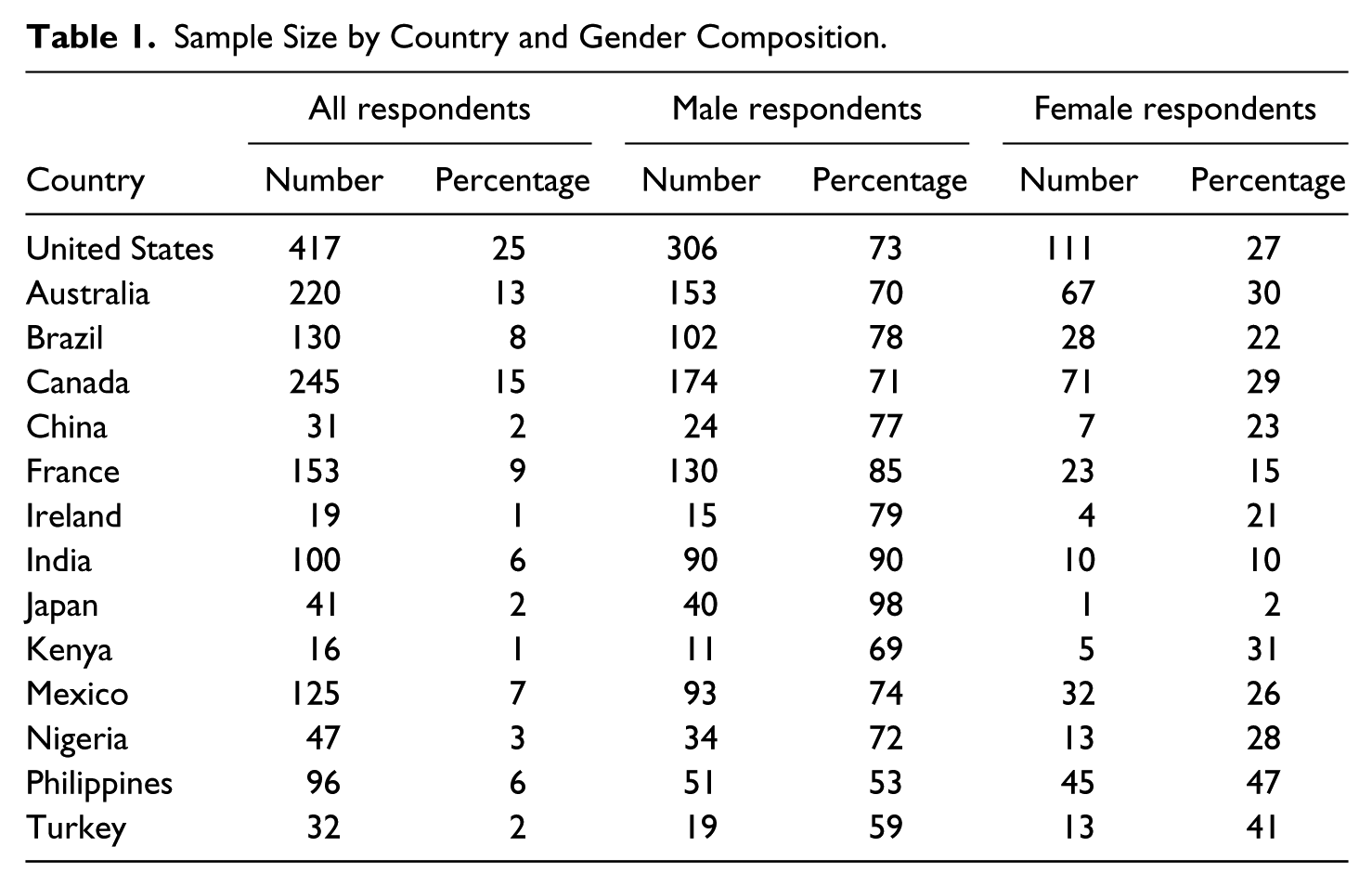
Table 1 displays the sample size and gender composition for each of the 14 countries represented in our sample and indicates the following: (a) about 25% of the respondents (n = 417) are from the United States, (b) the majority of the respondents across countries are male, and (c) the Philippines has the highest percentage of female respondents (47%), while Japan has the lowest percentage (2%). We compared the gender representation of our sample with Lions clubs membership in each country. In general, we find the gender composition of our sample to be consistent with the 2011 Lions clubs membership data. For instance, for the three countries with the highest response rate, United States, Canada, and Australia, the data are as follows: (a) about 27% of the members in the United States in our sample are female, while the percentage of U.S. female Lions clubs members was about 26%; (b) for Canada, about 29% of our sample is female, compared with 25% for the national membership data; and (c) for Australia, 30% of our sample is female, compared with the 28% for the national membership data. We also compared other member characteristics in our sample with previous studies conducted with U.S. Lions clubs members. We find that U.S. survey respondents hold similar characteristics in gender, age, marital status, education, and household income to previous studies of Lions clubs members.
Sample Size by Country and Gender Composition.
Survey Questions
The survey asked members about their household charitable giving, both through and outside of LCI during the past 12 months, as well as individual and club characteristics, and social trust. Regarding charitable donations made to LCIF, the survey first asked respondents whether they (and their households) made any charitable contributions directly to LCIF during the past 12 months, and then asked them to estimate the total cumulative amount that they donated to LCIF during the past 12 months.
Dependent Variables
We measure charitable giving to LCIF by Lions clubs members surveyed using two key dependent variables—the incidence of giving to LCIF, defined as a binary variable, and the amount donated to LCIF during the past 12 months. Respondents were asked to estimate the amount of their donations in local currency in each country surveyed. The amounts were later converted to 2010 U.S. dollars from the respondent’s local currency.
Independent Variables
Gender
This study is unique in that we examine the impact of gender on charitable giving to LCIF from three perspectives: (a) member characteristics—the respondent’s gender, (b) club characteristics—whether or not females consist of at least half of the members of the respondent’s local club, 3 and (c) country-level environment—the percent growth in female Lions clubs membership in each country from 1996 to 2011. These measures allow us to examine the effect of gender on charitable giving in a membership organization that goes beyond simply controlling for the sex of each respondent. As such, we are able to more fully explore the role that gender plays within a larger context.
Demographic variables
We also include other demographic variables found in the philanthropic literature that can potentially influence charitable giving—age, education (high school graduate or less, some college/university, associate or bachelor’s degree, and advanced degree), marital status (married/living with a partner, divorced/separated, widowed, and never married), and household income (converted into 2010 U.S. dollars) of survey respondents. Income is expressed in tens of thousands of U.S. dollars in the analysis.
Social trust
Social trust for each respondent is included in our study. This measure is a way to account for individual differences in willingness to contribute to charitable causes. Social trust has been found to be positively related to giving in previous studies, especially giving to secular nonprofits (Bekkers & Wiepking, 2007). Studies using data from the United States and the Netherlands find that charitable giving increases with the level of social trust (Bekkers, 2007; Brooks, 2005; Wang & Graddy, 2008). In particular, the effect of education on giving is found to be mediated by social trust (Bekkers, 2006; Brown & Ferris, 2007). In our survey of Lions clubs members, questions on social trust were modeled after questions asked in the World Values Survey, which has been widely replicated in many cross-national studies (e.g., Crepaz, & Polk, 2009; Guiso, Sapienza, & Zingales, 2010).
In our sample, Lions clubs members exhibit higher levels of social trust than the general population in most countries, according to data from the fifth wave of the World Values Survey. Nevertheless, it is unclear how associational membership interacts with trust and charitable giving. Prior research reveals mixed results on the relationship between trust and associational membership. Some studies find that associational membership promotes the growth of trust (Stolle, 1998), while others find that trust in fact encourages associational membership because people who are more trusting are more likely to join voluntary associations (Sønderskov, 2011). As suggested by Sønderskov (2011), more research is needed to further explore the interaction among trust, different types of associational activity, and collective action.
The survey included six questions that compose the trust scale, asking respondents “how much you trust people from various groups.” These groups include “your family,” “your neighborhood,” “people you know personally,” “people you meet for the first time,” “people of another religion,” and “people of another nationality.” Respondents were asked to rank their level of trust using a 4-point scale from do not trust at all to trust completely. “I don’t know” answers were coded as missing values. Factor analysis on the social trust scale revealed that the largest eigenvalue is 2.12, and this is the only eigenvalue greater than 1. The largest factor loading for the first factor is 0.75, while the smallest factor loading for the first factor is 0.28. The Cronbach’s alpha value is .75. The overall trust scale was standardized to have a mean of zero and a standard deviation of one before inclusion in the models.
Country of member
We estimate models that include indicator variables for country of residence, where the United States is the omitted category. We also estimate country fixed effects models to control for unobserved country specific heterogeneity.
Descriptive Statistics
The summary statistics for this sample are found in Table 2. Of the 1,672 individuals analyzed in this study, about 26% of the respondents are female. About 28% gave to LCIF, and the average amount given to LCIF among all respondents in our sample, including those who did not give, is US$262.40. The percentage of men (27%) and women (28%) that gave to LCIF are similar. However, the unadjusted, mean amounts given to LCIF, including those who did not give, reveal that men (M = US$322.20) gave more than women (M = US$89.66). The average household income is US$46,557.83, while men’s average income is US$48,070.03 and women’s average income is US$42,190.04. Approximately 41% of respondents (n = 684) belong to a local Lions club where at least half of the members are female. However, about 66% of the women (n = 285), while only 32% of the men (n = 399), belong to a local Lions club where at least half of the members are female. Across the 14 countries, the average percent growth in female Lions clubs membership is 443.57%, while the average percent growth in overall Lions clubs membership is −0.30%.
Summary Statistics.

Empirical Specification
A Probit model is used to analyze the probability of giving to the LCIF. We use Tobit regressions to analyze the amount of money donated to the LCIF because charitable giving is censored at zero. To account for unobserved heterogeneity at the country level, conditional logistic regression and ordinary least squares (OLS) country fixed effects models are also estimated.
Models used in analysis
We use three different models for the Probit and Tobit analysis. All models control for the key factors known to affect giving: age, marital status (never married is the omitted category in the models), education (high school graduate or less is the omitted category in the models), and household income. We also include gender and social trust in all of the models. The two other gender-related variables in our models are a binary variable for whether or not at least half of the members are female at the respondent’s local Lions club and the percent growth in female Lions clubs membership in the respondent’s nation. Finally, we estimate models that include binary variables for the respondent’s country of residence, where the United States is the omitted category. Because the percent growth of female membership is only available by country, the main effects of this variable cannot be included in models that also include the binary country variables in order to prevent perfect collinearity. However, in models that do include the country binary variables, we interact the percent growth of female membership variable with the social trust scale. The percent growth of female membership is expressed in terms of 10 percentage points, and the interaction term between social trust and the growth in female membership is divided by 10 to reduce the number of decimal places for the marginal effects.
Results
Probit Analysis: Probability of Giving to LCIF
The marginal effects from the Probit models are found in Table 3. 4 Model 1 in Table 3 includes gender, the control variables, and social trust. In this model, two of the three education binary variables are statistically significant. Having an associate or bachelor’s degree (p < .01) and having an advanced degree (p < .01) are both positively associated with giving to LCIF compared with those who have a high school education or lower. Income (p < .01) is also positively associated with giving to LCIF, while social trust is positively related to giving and is marginally significant (p < .10). Gender is not significant in this model.
Probit Marginal Effects, Giving to LCIF.

Note. Marginal effects; standard errors in parentheses. (d) for discrete change of dummy variable from 0 to 1. The trust scale is standardized to have a mean of zero and a standard deviation of one.
p < .10. **p < .05. ***p < .01. ****p < .001.
In Model 2, we include female membership in the respondent’s local club and the countrywide percent growth of female Lions clubs membership variable. The marginal effect for female membership is significant and positively related to giving toLCIF (
The final model in Table 3 adds the country variables. We also include the percent growth in female Lions clubs membership for each country interacted with the social trust scale, and we omit the main effect for the growth in female membership variable. This allows us to include the country dummy variables. The marginal effect for female membership composition is
We also analyze the percent growth of overall Lions clubs membership, instead of the percent growth of female Lions clubs membership. Likewise, we interact the percent growth of overall Lions clubs membership with the social trust scale. These results are shown to be insignificant. This suggests that the effect of the growth in female membership on charitable giving to LCIF is different from the effect of the growth of overall membership on charitable giving to LCIF.
Tobit Regression Analysis: Amount Given to LCIF
The marginal effects for the Tobit regressions are found in Table 4. The marginal effects are presented conditional on giving: E(y | y > 0). 5 As seen in Table 4, the base model (Model 4) includes gender, the control variables, and social trust. Having an associate or bachelor’s degree (p < .01) and having an advanced degree (p < .01) are both positively related to the amount given to LCIF when compared with individuals who have a high school degree or less. Income (p < .01) and trust (p < .05) are both positively associated with the amount given to LCIF as well. Gender is not significant in this model.
Tobit Marginal Effects, Conditional on Giving to LCIF.

Note. Marginal effects; standard errors in parentheses. (d) for discrete change of dummy variable from 0 to 1. The trust scale is standardized to have a mean of zero and a standard deviation of one.
p < .10. **p < .05. ***p < .01. ****p < .001.
In Model 5, we add the club’s gender composition and the percent growth in female Lions clubs membership variable. Belonging to a club where at least half of the members are female is positively and significantly associated with the amount given to LCIF (
The final model in Table 4 includes the country binary variables. As in the Probit analysis, we omit the main effect of the percent growth in female membership by country in order to avert perfect collinearity, but we include the interaction between the percent growth in female membership by country and the trust scale. In this model, all of the control variables and the main effect for trust are insignificant. However, the marginal effect for the club’s gender composition variable remains positive and significant (
As in the Probit analysis, the models that include the percent growth of overall membership, instead of the percent growth of female membership, and the interaction between percent growth of overall membership and trust yield no significant association between these variables and the amount given to LCIF.
Country Fixed Effects Models
Estimating models with country fixed effects allows us to study the relationship between charitable giving and the independent variables in our model, while holding other unobserved country specific characteristics constant. This is important because we want to rule out the interpretation that other country-level, unobserved characteristics (such as education, level of development, and wealth), but not growth in female membership, are responsible for differences in giving behavior. To control for country fixed effects, we also analyze models using conditional logistic regression for the binary decision to donate to LCIF and OLS country fixed effects for the amount given to LCIF. These models include the same independent variables from Models 3 and 6.
The results obtained when we control for country fixed effects are similar to the results in Model 3 for the Probit and Model 6 for the Tobit analyses. For the conditional logistic regression analysis, having a club with at least half of the members who are female (OR = 1.357 and p < .05) and the interaction term for the growth in female membership and trust (OR = 1.004 and p < .05) are both positively related to giving to LCIF. For the OLS country fixed effects analysis, the binary variable for at least half of the members being female is positive and significant (β = .348 and p < .01). The interaction term for the growth in female membership and the social trust scale is also positive and significant (β = .007 and p < .001). The similarity between the results that control for country fixed effects and the results from the Probit and Tobit analyses suggests that the percent growth in female membership and the club’s gender composition are related positively to the decision to donate and the amount donated to LCIF. As the interaction terms for growth in female Lions clubs membership and trust are positive and significant in both the OLS country fixed effects and conditional logistic models, individuals with high levels of trust are more likely to donate and donate larger amounts in countries with high growth in female membership. This result holds even after we control for unobserved country specific heterogeneity through the fixed effects models. 9
Discussion and Conclusion
A growing body of demographic data and research suggests that women’s philanthropy is an important aspect of philanthropy globally, and it has the potential to transform how philanthropy is practiced in the future. According to a Barclay Wealth’s (2010) study of 2,000 millionaires around the globe, “men are more active philanthropists in developed countries, but in emerging countries, women take the lead” (p. 2). Our study adds to the growing literature on the impact of women on philanthropy worldwide, where women are increasingly playing an active role in solving social problems in their communities.
This study provides support for the important role that women play in service organizations. The results of our study demonstrate that female membership in a large international service organization has a significant impact on the charitable giving of its club members. In our study, we investigate the effect of female membership, as well as the percent growth in female membership in each country to determine whether club composition affects charitable giving. Our findings indicate that belonging to a club where at least half of the members are female and where we see an increase in the percent growth in female membership in the respondent’s country are associated with both a greater likelihood of donating as well as giving more to this international service club. These results are robust to specifications that control for country fixed effects.
Our study supports the growing literature conducted in other areas of group dynamics, showing that behaviors change as group composition changes. Previous research indicates that the proportion of females is critically linked to the degree of women’s influence and suggests that, when the relative number of women reach a critical mass (not necessarily a larger proportion than men), they have an increasing impact on organizational performance and outcomes. For instance, in the study of Erkut et al. (2008), having three or more women on a corporate board can have a substantial influence on the content and process of board discussions. Similarly, Marquis and Lee’s (2011) study found that corporations with a greater proportion of women senior managers or female board of directors made significantly higher charitable contributions. They reason that the presence of women in these positions may, in large part, be due to “the frequently-demonstrated relationship between gender and philanthropic orientation” (p. 18).
Furthermore, consistent with prior studies, our analysis of charitable giving by Lions clubs members shows that social trust is positively related to both the likelihood and the amount of giving. Interestingly, in our study, the main effect of trust disappears when the interaction term for growth in female Lions clubs membership within a country and trust is included in Models 3 and 6, suggesting the importance of macro environmental characteristics when examining individual giving behavior.
Findings from our study have direct implications for voluntary service organizations. As membership grows internationally, voluntary service organizations may need to pay significant attention to member recruitment and retention. Our analysis reveals the positive impact that the substantial presence of female members within a club or a country has on members’ charitable giving. Organizations can benefit from strategically encouraging women’s participation and cultivate a nurturing and welcoming environment for women. As female membership grows, service organizations need to think differently about the changing culture within the organization and pay more attention to the unique motivations and preferences of women regarding philanthropy. Moreover, such women’s empowerment may further foster the development of the nonprofit sector as a whole, as suggested by the study of Themudo (2009). Prior research reveals that women’s voluntary groups have a powerful influence on promoting welfare policies (Skocpol, Abend-Wein, Howard, & Lehmann, 1993) and founding public service structures (Scheer, 2002) in the United States during the early 1900s. The growing female membership in voluntary service clubs also may have far-reaching influence in driving social change in local communities, especially in countries where the nonprofit sector is in its early stage of development.
Service clubs such as LCI also offer rich opportunities for members’ personal growth. This opportunity is particularly crucial in developing countries where women tend to have fewer opportunities in the public and business arenas. Through Lions clubs membership, women have the opportunity to develop professional skills, undertake leadership roles, and, as our study suggests, have an impact on their clubs in promoting philanthropy. More importantly, this growing number of female professionals who have been trained in service clubs may redefine women’s role in society in countries where women traditionally have limited influence outside their families.
As in any field study, there are some limitations in generalizing results. Although our study focused on one organization, LCI is a large and well-known service organization that is international in scope. It requires further exploration to generalize findings of the positive impact of female membership on giving from this study to other types of membership organizations. More research also is needed to identify the “tipping point” in which female representation begins to change the culture within a service organization. In addition, our analysis relies on self-reported survey data from members in 14 countries, where the sample sizes in a few countries (especially in Kenya and Ireland) are rather small. An important concern may be selection bias in several countries where we conducted our research. Future research should explore charitable giving by members of voluntary service organizations with larger sample sizes within similar countries, or expand the study to other countries. In addition, conducting qualitative studies can provide insights into the perception and values of members at voluntary service organizations.
Female membership at voluntary service organizations such as Lions, Rotary, and Kiwanis has grown steadily, both domestically and globally, particularly since 1987 when U.S. service clubs started to accept women as full-fledged members. With the global expansion of voluntary service organizations, more research is needed to better understand how the growing representation of women at these organizations, particularly those in developing countries, impacts civil society. More importantly, researchers should pay attention as to how other macro-organizational characteristics, such as club- and country-level factors, affect philanthropy in this growing sector. Longitudinal data also are crucial for investigating how individual philanthropic behaviors change over time as individuals become more involved in voluntary service organizations.
Footnotes
Authors’ Note
The study collected and analyzed data from a survey of Lions clubs members.
Declaration of Conflicting Interests
The author(s) declared no potential conflicts of interest with respect to the research, authorship, and/or publication of this article.
Funding
The author(s) disclosed receipt of the following financial support for the research, authorship, and/or publication of this article: This study was supported by Lions Clubs International and CCS.