






Abstract
Philanthropy for women’s and girls’ causes is a growing area of interest among donors and fundraisers. However, beyond foundation giving, limited research has been conducted to understand who gives to women’s and girls’ issues and donors’ motivations for such support. Using the frameworks of collective identity and the social identification theory of care, we conducted a sequential mixed-methods study in the United States to investigate donors’ characteristics and experiences. Through a national survey, we find that women are more likely to give to women’s and girls’ causes and that age and income are the most significant determinants of this giving. In focus groups, donors report giving to women’s and girls’ causes based on three motivational themes: personal experiences of gender inequality, a belief that supporting women’s rights is beneficial for society, and the perceived effectiveness of nonprofit organizations, largely supporting the social identification theory of giving.
In the past 40 years, charitable giving to women’s and girls’ causes has become an active funding area for individuals, foundations, and corporations. Growing evidence suggests that investing in women and girls promotes a ripple effect of positive changes throughout families, communities, and even entire countries (Duflo, 2011; Foundation Center & Women’s Funding Network [WFN], 2009). Women have even been called “the most powerful engine of global growth” (“A Guide to Womenomics,” 2006). Today, more than 100 women’s funds around the world make grants to further women’s economic security and reproductive health, among other causes (WFN, 2015). Individual donors are also active funders, both to women’s foundations and directly to female-serving organizations. For example, more than 250 members of Women Moving Millions have collectively contributed over US$600 million to issues affecting women and girls (Women Moving Millions, 2016). Through both foundations and individuals, giving to women and girls is part of a larger social movement to attain women’s rights and gender equality worldwide.
Donors’ philanthropic commitments to women and girls reflect two broader trends: the increasing educational, income, and wealth attainment of women, and the global focus on investing in women and girls to improve development and address poverty (Bureau of Labor Statistics, 2011; Chaaban & Cunningham, 2011; Friedberg & Webb, 2006). Academic research has shown that economic development alone will not raise women’s status and that a focus on gender equality is essential (Duflo, 2011). While women’s and girls’ issues have been an important area for public policy research and global development, philanthropic giving to women and girls is understudied. In fact, beyond institutional giving by foundations, we know very little about the donors who support such causes.
In studies of philanthropic giving, researchers have focused on specific charitable sectors, such as giving to human services (Marx, 2000) or education (Rooney, Brown, & Mesch, 2007), to better understand donors to that particular area, yet no known national surveys have specifically categorized individuals’ giving to women and girls. Large-scale surveys such as the Philanthropy Panel Study (PPS) do not provide a category for giving to support women and girls. Instead, the PPS asks respondents to group their giving into 11 broad categories, such as religion, education, health, or arts and culture. Tracking “movement-specific” funding poses a greater challenge for researchers to understand and study, as giving is spread across charitable subsectors.
To understand who gives to women’s and girls’ causes and what motivates such giving, we conducted a sequential, mixed-methods study in the United States. This first study of its kind includes both men’s and women’s giving to these causes. We turn next to our theoretical framework and the literature on women’s and girls’ funding and gender differences in giving. Subsequent sections describe the methodology, findings, conclusions, and areas for future research.
Conceptual Framework
In social movements, the notion of collective identity has been described as encompassing two dimensions: belonging and action (Holland, Fox, & Daro, 2008). First, an individual’s moral, cognitive, and emotional connection with a broader community originates from perception of a shared status and positive feelings toward other members of the shared group (Polletta & Jasper, 2001). As participants’ identification grows, they function as a unified, dynamic force acting to achieve common goals (Holland et al., 2008). Taylor and Whittier (1992) identified factors that contribute to the formation of collective identity as an ongoing process: (a) the creation of boundaries that differentiate the group from the dominant society; (b) the development of a group consciousness; and (c) the use of symbols and politicized actions to protect the group’s essential differences and resist extant systems of domination.
To date, research on women’s social movement philanthropy has largely focused on foundation giving to women’s and girls’ causes (Brilliant, 2000; McGill, Shah, & Weisblatt, 2011). Beginning in the 1970s, a number of women-specific social change funds were established that aimed to decrease the gender gap in philanthropic giving (Brilliant, 2000; Rose, 1994). These public charities and funds within community foundations eventually became members ofthe WFN to form an identified women’s funding movement (Brilliant, 2000). Researchers contend that a women’s fund is different from other foundations because “women raise the dollars and decide how they’re spent; grants and allocations support programs that assist women and girls in overcoming racial, economic, political, sexual, and social discrimination” (National Network of Women’s Funds as cited in Rose, 1994, p. 230). Today, the WFN includes more than 100 women’s funds in more than 30 countries that “define fund-raising and fund allocation as a strategy for empowering women and achieving social change” (Brilliant, 2000, p. 554; WFN, 2013).
Unlike past research, we focus at the individual-donor level instead of the institutional set of women’s funds. An individual’s social identification is an emergent product of the internal–external dialectic processes inherent in identity formation (Jenkins, 2004). For this study, we draw on Schervish and Havens’ (1997, 2002) social identification theory of care to explain why women would be more likely than men to support women’s and girls’ causes. In this relational theory, based on both quantitative and qualitative data, the researchers find that “empathetic identification with the needs of others generates philanthropic responsibility” (Schervish & Havens, 2002, p. 49). Schervish and Havens (2002) describe this as a process whereby community participation builds relationships, relationships lead to identification, and identification motivates giving to “those we view as part of us, like us, or like those we love” (p. 50), even if they are beyond our immediate circle. Importantly, this means that donors’ identities, or sense of belonging, influence the action to give. More recently, Drezner and Garvey (2015) used this theory to explain what motivates lesbian, gay, bisexual, transgender, and queer (LGBTQ) donors to give back to their alma maters and specifically, to LGBTQ needs on campus. Using Schervish and Havens’ theory here, we postulate that, not only are women more likely to be donors to women’s and girls’ causes, but charitable giving could be further motivated by an experience of gender-based discrimination or “difference” that highlights donors’ gender identity.
While research has not explored who among individual donors gives to women’s and girls’ causes, some charitable giving surveys have asked respondents to prioritize social issues, including women’s rights. The Women’s Philanthropy Institute found, in both general population and high-net-worth samples, 1 that single women are more likely to prioritize women’s rights than single men (Mesch, Osili, Ackerman, & Dale, 2015). When samples of married or cohabitating couples are divided by the charitable decision-making model they use (husband or wife solely decides, jointly decide, separately decide), couples where the wife solely decides also are more likely than jointly deciding couples to prioritize women’s rights (Mesch et al., 2015). However, existing data do not allow researchers to link these issue preferences to giving behaviors.
A well-established literature showing gender differences in charitable giving finds that women are more likely to give and give higher amounts than men, controlling for factors such as age, education, and income (e.g., Mesch, 2010; Mesch, Rooney, Steinberg, & Denton, 2006; Piper & Schnepf, 2008). Women donors in the United States and the United Kingdom also tend to spread their giving across more organizations, giving smaller amounts to each (Andreoni, Brown, & Rischall, 2003; Mesch, 2010; Piper & Schnepf, 2008). 2
Previous research finds that women are more concerned with the well-being of others (Mesch, Rooney, Chin, & Steinberg, 2002; Willer, Wimer, & Owens, 2015) and relates that to both incidence and amount of giving (Mesch, Brown, Moore, & Hayat, 2011) and dispersion of giving (De Wit & Bekkers, 2016; Piper & Schnepf, 2008). However, the specific motivations for giving to women’s and girls’ causes have not yet been explored. Past studies in the United States and the Netherlands have found that women express higher empathic concern and that empathy is positively correlated with charitable giving (De Wit & Bekkers, 2016; Mesch et al., 2011; Wilhelm & Bekkers, 2010). Yet how is an empathic response also a function of one’s gender identity?
The complex interaction of factors that affect the decision to give reveals that the relationship between gender and giving is not straightforward. The tendency of female donors to disperse their funds across a range of organizations could be a result of empathy (De Wit & Bekkers, 2016), marital status (Andreoni et al., 2003), or interactions with social capital determinants (Brown & Ferris, 2007; Wang & Graddy, 2008). We contend that giving to women’s and girls’ causes can best be explained through donors’ identities as women who are motivated to help other women and work for gender equality. To explore the role of identity in giving to women and girls, we investigate the following research questions:
These questions will help to determine whether giving to women’s and girls’ causes is driven by factors such as gender or other life experiences.
Method
We designed a sequential, mixed-methods study to investigate these questions, collecting quantitative and then qualitative data. This approach provides enhanced rigor and multiple data points, which yield a more complete understanding (Creswell, 2014). First, we surveyed a representative sample of the national U.S. population as part of the GfK KnowledgePanel Omnibus (KPOmni) survey to address our first and second research questions. Respondents were asked about their total giving and giving to women’s and girls’ issues and ranked a series of social issue priorities. The survey included key questions from the PPS to benchmark results.
Table 1 provides summary statistics for the Survey on Giving to Women and Girls, which includes 959 total observations. The respondents were 52% female and 48% male. Sixty percent were in couples. Around one third were non-White. The mean age of the sample was 46 years, ranging from 18 to 88 years; the mean reported income was around US$72,000. Thirty percent had a bachelor’s degree or higher.
Summary Statistics for Survey on Giving to Women and Girls.
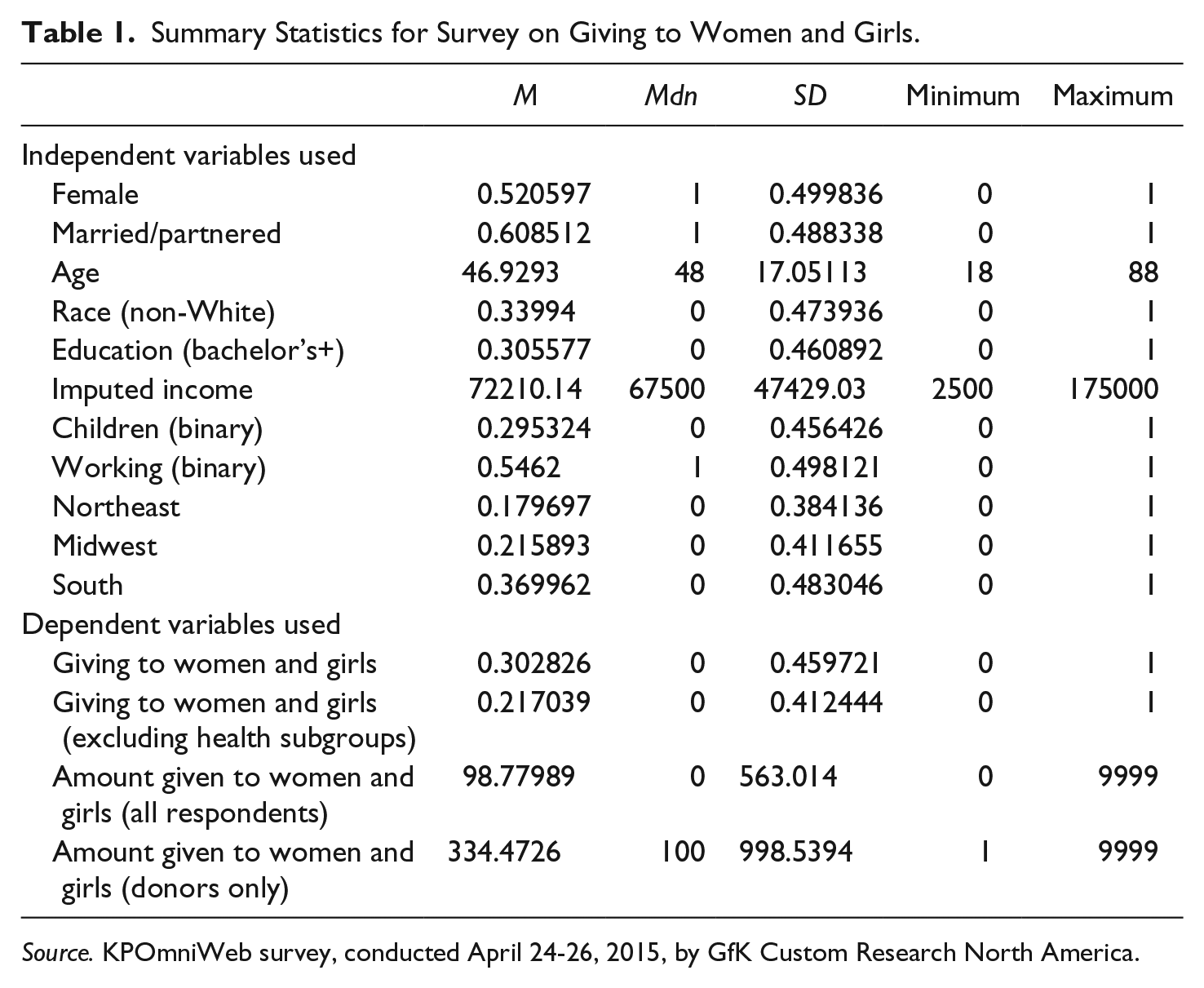
Source. KPOmniWeb survey, conducted April 24-26, 2015, by GfK Custom Research North America.
Thirty percent of survey respondents indicated they had given to a women’s and/or girls’ cause in the past year, and the average amount given to such causes approached US$335. When excluding women’s general health and cancer research, the proportion of donors giving to women’s and girls’ causes dropped to 21%. We report results both with and without giving to women’s general health and cancer research because they are most likely to be conflated with non-gender-related causes.
Following the national survey, we partnered with three United Way agencies and three WFN members to host donor focus groups on the East Coast, West Coast, and Midwest. We held a focus group at each organization’s headquarters, with the exception of the Midwestern United Way, where participants were divided into two groups due to the large number of participants. City selection was based on a criterion of geographic diversity and the relationships of the research team with organizations willing to contact their donors. Each focus group had six to eight participants and ranged from 60 to 80 minutes. By hosting a focus group of donors from each organization, we were able to examine the role of donor selectivity, contrasting responses from donors who self-identified as supporting women and girls (women’s fund donors) and those who are philanthropic but support a broader set of community needs (United Way donors). We asked partner agencies to invite donors who gave at least US$1,000 annually. Unlike the survey, the focus groups were not meant to be a representative sample of the general population but a purposeful sample of donors who were highly philanthropically engaged. To distinguish women’s and girls’ causes from other kinds of giving, in both the survey and focus groups, we provided a list of 15 causes that related specifically to women’s and girls’ issues (see the appendix).
The focus groups had 51 participants. Twenty-nine participants attended United Way focus groups: 17 women and 12 men ranging in age from 29 to 83 years. Twenty-one participants identified as White and eight as Black or African American. Sixteen participants were married, and 19 had one or more children. Twenty-one had annual household incomes above US$100,000, and 27 had a bachelor’s degree or higher.
Twenty-two participants attended the women’s fund focus groups, all women ranging in age from 37 to 88 years. Seventeen participants identified as White, four as Black or African American, two as Hispanic or Latino, two of multiple races, and one as other. Eighteen participants were currently married, and all had been married at some point. Eighteen participants had one or more children, and all 22 had household incomes above US$100,000 a year and a bachelor’s degree or higher.
Data Analysis
We analyzed survey data using a series of logistic regressions to predict incidence and amount of giving. To understand the relationship between giving to women’s and girls’ issues and giving to other causes, we used bivariate correlation analysis.
Each focus group was recorded and transcribed verbatim. Each organization was identified with a specific code, with contributions numbered sequentially. 3 Two researchers independently engaged in open, line-by-line coding of two transcripts. The researchers then convened to compare codes and developed a working list of 122 codes to use for the remaining transcripts. Codes were grouped into 15 larger categories, which were used to construct themes.
Results: Who Gives to Women and Girls?
Around 70% of all households we surveyed indicated that they gave to charity in 2014, higher than the 58% of households reporting giving in the 2013 PPS, but closer to the 63% average over seven waves of PPS data. Women reported giving at a higher incidence than men (72.1% of women compared with 66.9% of men); however, men reported giving larger dollar amounts on average. Married or cohabitating (“coupled”) households were more likely to give compared with single female- or male-headed households and gave higher average amounts. Women reported giving to women and girls at a higher incidence than men: 33.3% of all female respondents compared with 24.2% of all male respondents.
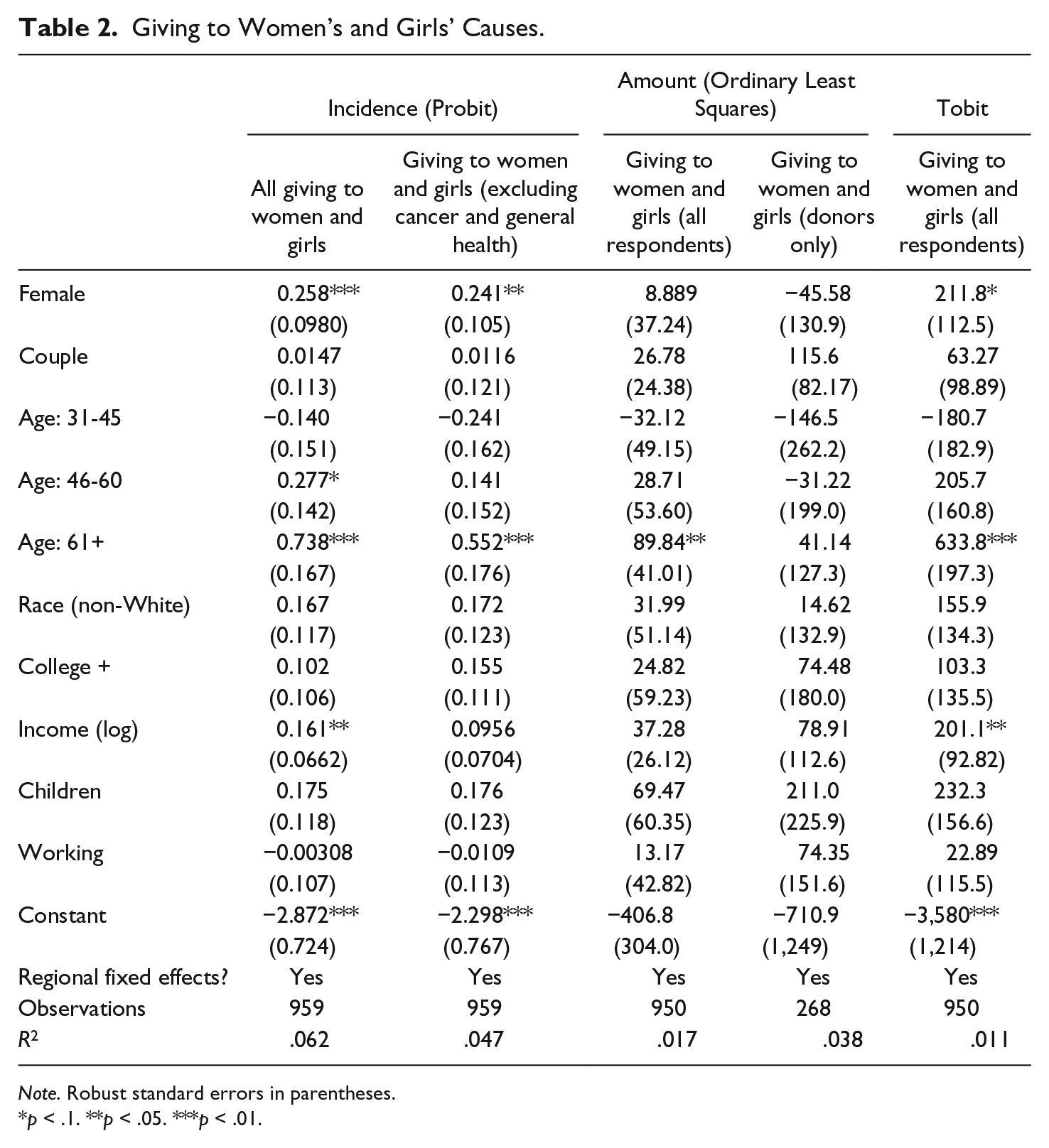
Table 2 provides results of our baseline regression analysis on the incidence and amount of giving to women’s and girls’ causes. First, we have results that include giving to all causes related to women and girls. Then we removed women’s health-related causes from the analysis (general health and cancer research). Table 3 displays results for the incidence of giving to the top five issues affecting women and girls based on survey responses. Data on the dollar amounts given to women’s and girls’ causes were only asked of survey respondents’ overall giving and not giving to specific issues.
Giving to Women’s and Girls’ Causes.
Note. Robust standard errors in parentheses.
p < .1. **p < .05. ***p < .01.
Giving to Specific Women’s and Girls’ Issues.
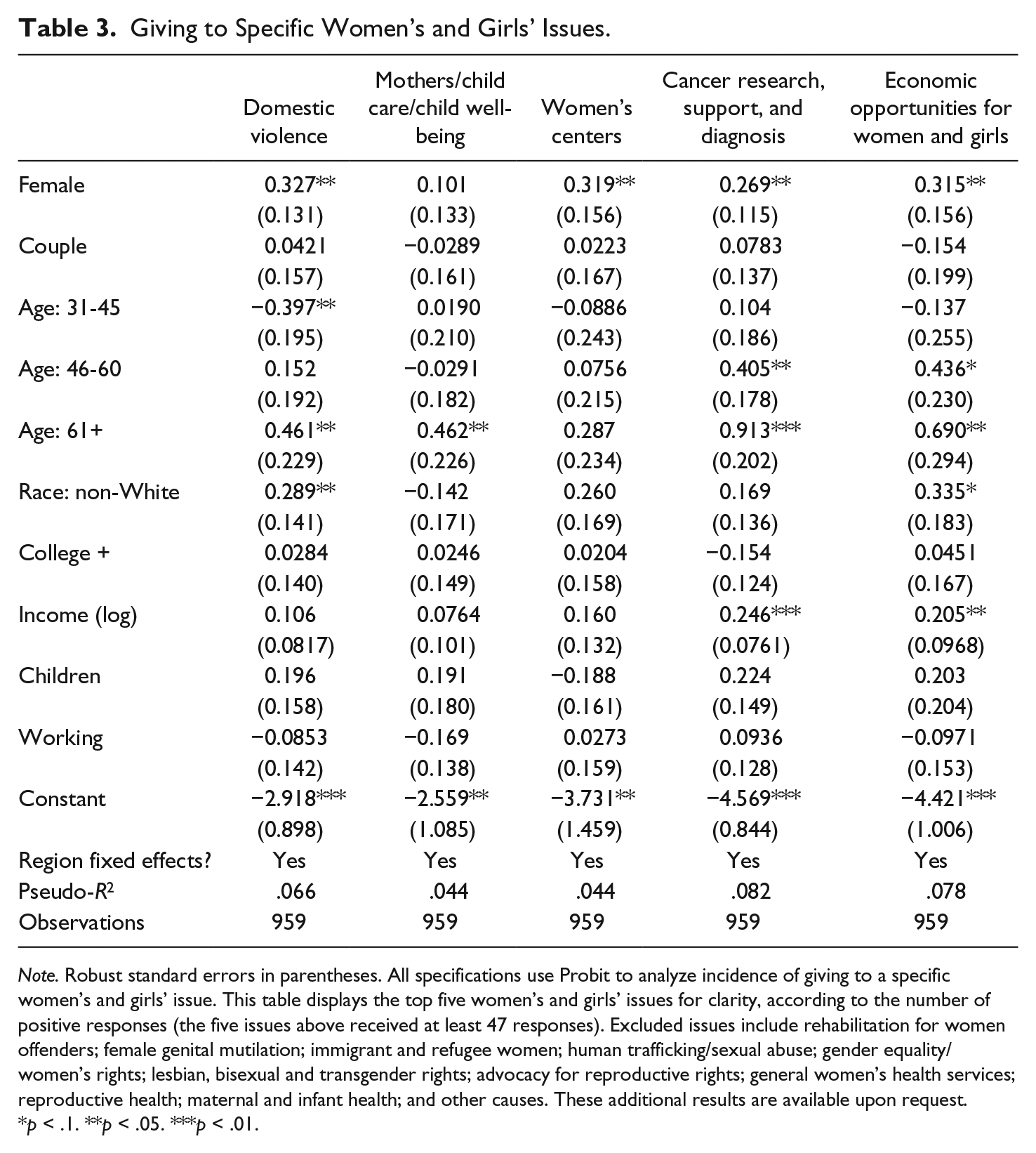
Note. Robust standard errors in parentheses. All specifications use Probit to analyze incidence of giving to a specific women’s and girls’ issue. This table displays the top five women’s and girls’ issues for clarity, according to the number of positive responses (the five issues above received at least 47 responses). Excluded issues include rehabilitation for women offenders; female genital mutilation; immigrant and refugee women; human trafficking/sexual abuse; gender equality/women’s rights; lesbian, bisexual and transgender rights; advocacy for reproductive rights; general women’s health services; reproductive health; maternal and infant health; and other causes. These additional results are available upon request.
p < .1. **p < .05. ***p < .01.
Gender differences
Table 2 indicates that overall, female respondents are more likely than male respondents to give to women’s and girls’ causes, although women are not necessarily more likely to give larger amounts. When women’s cancer research and general health causes are excluded, the relationship between gender and incidence of giving decreases, but not significantly. Table 3 indicates that women are more likely than men to give to domestic violence; women’s centers; cancer research, diagnosis, and support; economic opportunities for women and girls; and lesbian, bisexual and transgender rights (not shown). These results include both single-headed and married-couple households and examine differences based on the gender of the respondent.
Marital status
Marital status was not associated with overall giving to women’s and girls’ causes or specific issues, independent of gender: Coupled households are not statistically significantly more likely to give to women’s and girls’ causes compared with single-headed households, holding other factors constant.
Age
Age has a strong, positive relationship with giving to women and girls. In Table 2, respondents 61 and older are more likely to report giving to women’s and girls’ causes, and respondents aged 46 to 60 years are marginally more likely to give to women and girls’ causes. Furthermore, the Tobit analysis indicates that, taking into account that those 61 years and older are more likely to give to women’s and girls’ causes, they also tend to give higher amounts to those causes.
With respect to giving to specific women’s and girls’ issues, Table 3 shows that as age increases, respondents’ likelihood to give to more women’s and girls’ issues also increases. Younger respondents (age 31-45 years) are significantly less likely to give to domestic violence and advocacy for sexual and reproductive rights, while respondents aged 46 to 60 years are more likely to give to reproductive health and cancer research, diagnosis, and support. Respondents over 61 years are strongly inclined to give to cancer research, diagnosis, and support; domestic violence; mother and child care and child well-being; economic opportunities for women and girls; and general women’s health.
Income
Income is significantly related to giving to women’s and girls’ causes in select cases. As a respondent’s household income increases, the household is more likely to give to women’s and girls’ causes, holding other factors constant. This effect may be due in part to giving to women’s health-related causes, as when those causes are excluded, household income loses its significance. The Tobit analysis also indicates that, taking into account that income affects the likelihood of giving, those with higher incomes also tend to give higher amounts to women’s and girls’ causes. As income increases, respondents are also more likely to give to the specific issues of cancer research, diagnosis, and support, and economic opportunities for women and girls, and are marginally more likely to give to lesbian, bisexual, and transgender rights (Table 3).
Race, education, children, and employment
While gender, age, and income have a significant relationship with giving to women and girls, variables that are not significant also provide interesting context. In Table 2, we observe that race, education level, the presence of children below 18 years in the household, and employment status do not appear to impact the incidence or amount of giving to women’s and girls’ causes. Table 3 shows that being non-White is positively related to giving to domestic violence and is marginally significant for giving to economic opportunities for women and girls. Additional results not shown in Table 3 include attending college being associated with the likelihood of giving to lesbian, bisexual, and transgender causes; families with children below 18 years at home are marginally more likely to give to maternal and infant health; and households where the respondent is employed are more likely to give to prevent human trafficking/sexual abuse and exploitation.
We also performed basic one-tailed t tests to determine differences between smaller portions of the sample (results available upon request); 4 t tests confirm the regression findings above, showing that overall, female respondents are significantly more likely to give to women’s and girls’ causes than male respondents, and they are more likely to give to a number of particular issues. Furthermore, these t tests also indicate that single women are more likely to give to women’s and girls’ causes than single men, and married women report their households are marginally more likely (p < .1) to give to women’s and girls’ causes than married men. These findings hold true for a number of specific issues within giving to women and girls. Single women are more likely than single men to give to mother and child care and child well-being; cancer research, diagnosis, and support; and economic opportunities for women and girls. Married women are more likely than married men to report giving to domestic violence and women’s centers and are marginally more likely to give to gender equality and women’s rights. There are few women’s and girls’ issues where couples’ giving differs from single-headed households, except that coupled households are less likely to give to maternal and infant health.
We also examined coupled households by charitable decision-making style (husband or wife solely decides, jointly decide, separately decide) and find no overall difference in the likelihood of giving to women’s and girls’ causes between couples based on decision-making style. However, we find some differences for specific issues relating to women and girls. Jointly deciding couples are marginally more likely (p < .1) to give to domestic violence. Households where the wife is the sole decider are more likely to give to cancer research, diagnosis, and support and to economic opportunities for women and girls.
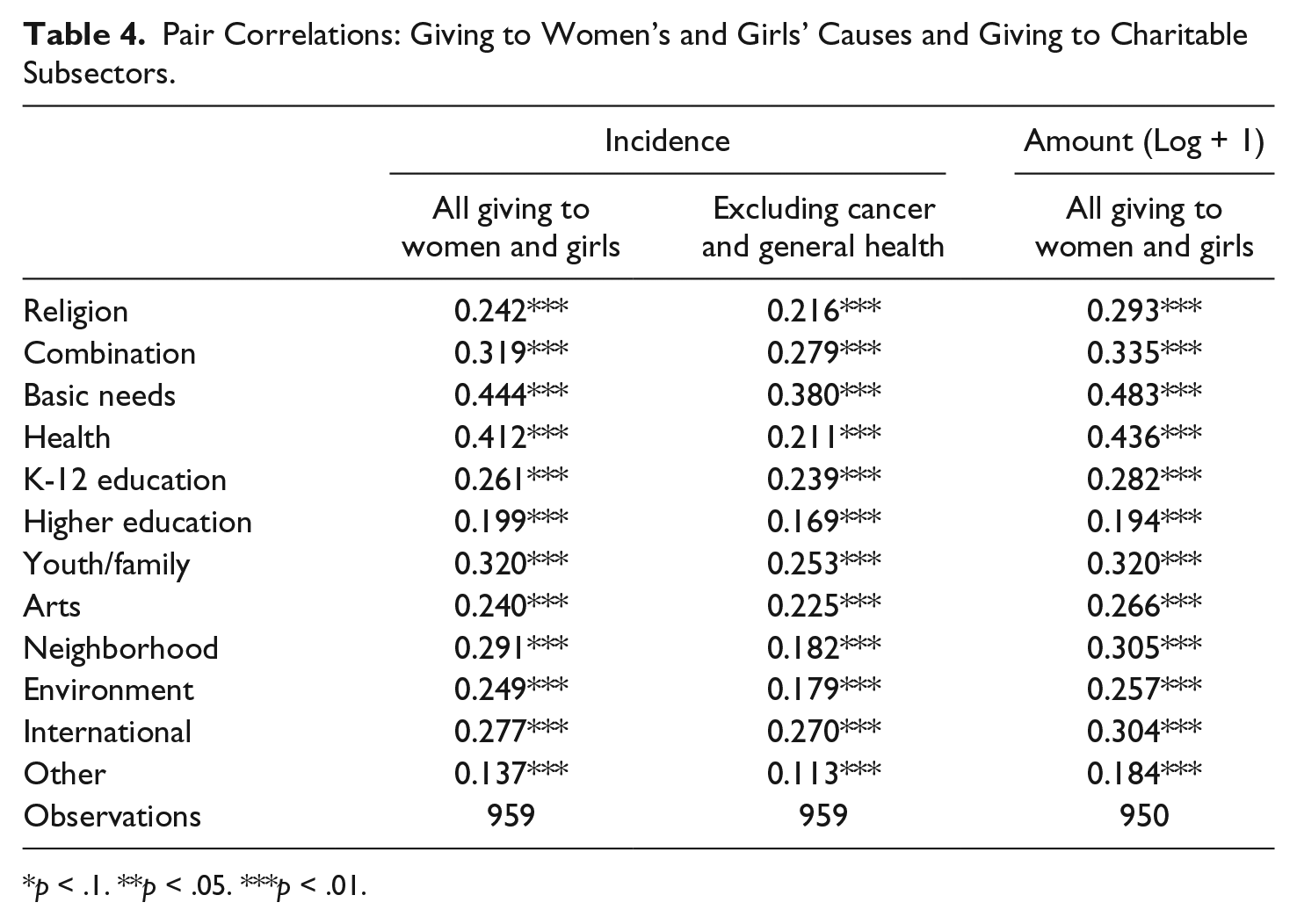
To answer our second research question, how giving to women’s and girls’ causes is related to giving to other philanthropic causes, we conducted bivariate correlation analysis including all subsets of women’s and girls’ causes as well as subsets excluding giving to women’s general health and cancer research (Table 4). We find significant correlations between giving to women and girls and the incidence and amount of giving to all subsectors, meaning that being a donor to any cause is associated with an increased likelihood of giving to women and girls. However, the magnitude of the correlation varies. Donors who give to basic needs have the strongest correlation with giving to women and girls. The incidence and amount of giving to all women’s and girls’ causes are also higher for donors to health; youth and family; and combination organizations. In contrast, donors to higher education and the arts are still positively associated with giving to women and girls but at a lower level. When women’s health categories are excluded, basic needs has the greatest correlation with the incidence of giving to women and girls, followed by combination, international, and youth and family organizations.
Pair Correlations: Giving to Women’s and Girls’ Causes and Giving to Charitable Subsectors.
p < .1. **p < .05. ***p < .01.
Additional Specifications
We conducted additional analysis interacting female with income, education, and age. The most interesting results involve interacting female and age; other results were less significant and are available upon request.
Interacting gender and age continued to show gender differences in different age groups. Respondents 61 years and older are more likely than younger people to give to women’s and girls’ causes and give higher amounts. The effects of the interaction of gender with age provide a general pattern of negative coefficients in different age groups, significant for amounts of giving by women 61 and older. This means that, while women give at higher levels with very little variations in giving incidence or amounts during their lifetime, men tend to be more likely to give and give more to women’s and girls’ causes as they age. By the time men and women reach their late 50s, their incidence of giving to women’s and girls’ causes is roughly equal.
We also interacted gender and age to predict the incidence of giving to specific women’s and girls’ issues. Results for specific issue areas—lesbian, bisexual, and transgender rights; maternal and infant health; and economic opportunities for women—mirror results for overall giving to women’s and girls’ causes. For these causes, men’s incidence of giving begins lower than women’s at early ages, before “catching up” at later ages.
Robustness Checks
Finally, we tested several specifications for robustness. Age, in continuous form, showed the standard positive relationship with giving. However, when we include both age and age-squared, we found a negative relationship with age but a positive relationship with age-squared. We found a particularly strong relationship with giving concentrated at the higher end of the age distribution, so we divided the variable into (roughly equal) quarters (ages 18-30, 31-45, 46-60, and 61 years and older) to highlight this relationship the most cleanly. Results using the other age specifications are available upon request.
Results: Motivations for Giving to Women and Girls
Focus group data demonstrated how donors who gave to women and girls varied from donors who gave to broader issues, highlighting unique qualities of donors to women’s funds. In both sets of focus groups, donors shared the primary organizations they supported, from churches and synagogues to educational institutions, human service nonprofits, and health organizations to women’s organizations. As expected, the focus groups yielded two different types of donors: donors who made giving to women and girls a focus of their philanthropy (women’s fund donors) and donors who gave to a range of causes, with no particular focus on women and girls (United Way donors).
A strength of the qualitative research is in its ability to investigate social identification theory beyond the characteristics of age and gender highlighted above. Among donors who support women and girls, we identified three distinguishing motivational themes: (a) giving based on the personal experience of being a woman, (b) a belief in the relationship between supporting women’s equality and societal progress, and (c) perception of organizational effectiveness and leadership. The first two themes provide more nuanced evidence of how the identification theory of care takes place in practice, while the third theme speaks to the importance of organizational efficacy.
Motivation 1: Women Donors’ Personal Experiences
A number of donors to women’s and girls’ causes linked their giving to their own experiences of being a woman, including experiencing gender disparities and/or gender discrimination, and wanting to give their children equal opportunities. Several participants described knowing and experiencing gender discrimination firsthand. For example, one participant from the United Way talked about her bias toward giving to women’s causes because of the “gaps and the disparities as it relates to [women’s] salaries” (UWM1, 44).
A primary source of personal experience was through one’s career. This could be a positive experience, as one donor, a banker, learned that “investing in women and girls is both a good thing to do and a profitable thing to do” after financial institutions began reaching out to female customers after the Equal Credit Act, and then she felt she could support change that was consistent with her values (WFE, 67). However, several women described discriminatory experiences in business and seeing inequalities firsthand. Two participants described being the only woman “at the table” in their professions and feeling that women were treated unequally or had fewer role models.
[I]n my corporate life, I was the only woman executive. That was a time in the late ’70s, early ’80s, which was quite different for women in business. So I think what draws me is the fact that the girls’ and women’s organizations are underfunded, they’re the underdogs, and I’m very drawn to supporting things to lift them up. (WFM, 51)
Similarly, a woman who had helped establish the local women’s fund in the early 1990s said that her involvement was motivated by the fact that women’s issues were often hidden from public conversation and underfunded.
Second, having children, particularly daughters, motivated women to support women’s and girls’ rights and opportunities, wanting to create a more equitable world for their daughters. As one women’s fund focus group participant expressed, “Being a girl myself wasn’t enough to kick me over the goalpost of supporting women’s philanthropies until I had two daughters, and that was really the turning point for me” (WFM, 50). Having children was also a motivating factor for a donor in a United Way focus group to reconsider her support. She said, “I’m pregnant with my first child, so I think some of these [issues] really will speak to me a lot more in the next few years than they have in the past” (UWW, 123).
Motivation 2: Belief in the Link Between Women’s Equality and Societal Progress
A number of donors to women’s and girls’ causes were motivated by the need for women to have equality of opportunity at a societal level, reflecting a broader belief or value. Both current donors and nondonors explained they were motivated to give because of research showing that investing in women and girls yields greater social return, including addressing underlying issues such as poverty and a lack of education. First, several participants described their personal beliefs around woman’s rights. One participant expressed, “I think parity in all walks of life is so important. And that women have an equal footing. Until that happens, then my donations will be to groups that serve women and girls” (WFW, 67). Another said,
There is no doubt in my mind that all of the research, if you have a more equal society, you have political and economic stability. […] So that’s what drew us initially to women and girls. I truly, truly believe there is no place else you can put your funding. (WFE, 71)
This idea was also voiced by those who were not currently giving to women and girls but would consider doing so. One United Way participant said, “I’ve read convincing things that suggest that when women get more access to education and reproductive rights, then that’s good for the population as a whole, economically” (UWW, 97). Another participant said, “[T]here’s a fair amount of evidence that supports that if we strive to empower and educate the female sector of the world, many of these things […]get addressed […]because an empowered female, an educated female, tends to overcome the pitfalls” (UWW, 101).
Some women’s fund donors specifically saw supporting women and girls as breaking the cycle of poverty. One participant said, “I’m focusing [on women] because I think that women are key to making those girls important as they grow up and be women that we don’t have to support” (WFE, 94).
Motivation 3: Perception of Organizational Effectiveness and Leadership
Donors in both sets of focus groups discussed what would encourage them to support women’s and girls’ causes or increase their support. Current donors identified organizational characteristics that kept them engaged as donors and led them to increase their support over time, including a strong mission, vibrant leadership, a commitment to advocacy, and a belief in the organization’s future. Donors to women’s funds also viewed the fund as a locus of expertise that could help direct their philanthropic gifts effectively. As one donor explained, she was involved in the women’s fund “simply because of its strong mission for women and girls and the leadership” (WFW, 14).
Barriers to Giving to Women and Girls
Focus group participants also discussed what prevented them from supporting women’s and girls’ causes. One rationale for not giving to women and girls was the idea that complicated issues like women’s equality and domestic violence cannot be separated from many other societal issues. When faced with such significant problems, donors often either choose to attempt to make a difference for even just one person or try to effect large-scale systems change. But these different approaches can produce tension. Participants who felt some connection to women’s causes expressed concern over how to appropriately direct their philanthropy. A women’s fund donor said that while she supports women’s and girls’ causes, it was not the only approach she took to solving social problems: “I’d say it’s important, but it’s not critical. If someone said it deals with women and girls, I’d probably say, ‘Well, I’m interested.’ […]But I’m certainly open to a lot of other things to make change” (WFE, 94).
For some donors, giving to women and girls was no more of a priority than helping men and boys. Other donors preferred to support initiatives addressed to both sexes, particularly when children were involved. Both male and female participants expressed this attitude; however, it was more dominant among United Way focus group participants.
I’m always skeptical about girls’ initiatives because I guess, even though I am a girl, I think about [how] I have tutored so many boys who need so much support and as much as girls. So I wouldn’t be turned off, but I would need to hear a lot of information to understand why is it a girls’ initiative and not a children’s initiative. (UWM2, 35)
Several donors raised the issue that, in some spheres, such as college graduation rates, women were now doing better than men and felt that men needed specific philanthropic initiatives as well. Finally, other donors felt that organizations that focus on women’s and girls’ causes will not be as successful without also educating and involving men.
A third barrier was that many women’s issues are currently contested social issues. Several participants noted that giving to women and girls could not be separated from its political components. While the politics surrounding issues such as reproductive rights or lesbian, bisexual, and transgender rights may increase support among some donors, it can also turn other potential donors away. As one United Way donor explained,
The philanthropic conversation about reproductive rights or women’s centers or immigrant services is not just about the philanthropy; it’s also about the public policy and the attitudes, and you can’t separate them […]I think that makes it a challenge because we can’t have a political conversation about anything. (UWM1, 86)
Political issues are not just contentious in the larger society, but among individual family members too. One participant mentioned how different generations within the same family may view issues differently, which can lead to difficulty in discussing certain philanthropic priorities. Another participant said, “Some of these are very value-loaded conversations for people, and that makes it difficult sometimes to talk about the issue or the problem or the challenge” (UWM1, 82).
Discussion and Conclusion
This study is the first to examine who, among individual donors, gives to women’s and girls’ causes and what motivates such support. Our survey findings demonstrate that women are more likely than men to give to women’s and girls’ causes overall, and especially to domestic violence; women’s centers; lesbian, bisexual, and transgender rights; cancer research, diagnosis, and support; and economic opportunities for women and girls. We also find that single women are more likely to donate to women’s and girls’ causes than single men, supporting previous research about gender and giving by single adults (Mesch et al., 2006). These gender-based findings support prior work in the study of new social movements, which illustrate how collective identities derive from common experiences, interests, and solidarity (Ferree & Roth, 1998; Rupp & Taylor, 1999; Taylor, 1989; Whittier, 1995). As Mansbridge (1986) found in her study of the U.S. women’s movement and donors in the women’s fund focus groups echoed, a shared experience of gender is particularly inclusive. Such inclusivity can counter effects of exclusivity from other collective identities, thus demonstrating the “strength of weak ties” (Granovetter, 1973). Furthermore, these findings align with Schervish and Haven’s social identification theory, which explains that giving occurs through a donor’s identification with the recipient, in this case, another woman or girl.
In the focus groups, many donors to women’s funds and causes reported supporting these causes based on their experiences as women or mothers, an example of collective identity. This affirms previous research that giving is associated with donors themselves or the experiences of people close to the donor (Schervish & Havens, 1997; Small & Simonsohn, 2008). Donors explained their giving through experiences of discrimination, positive or negative experiences as women in the workplace, or becoming mothers, identifying these events as central to their decisions to give to a women’s cause.
Second, we find that, in addition to gender, age and income are the strongest determinants of giving to women’s and girls’ causes. In the survey, older men and women and individuals with higher household incomes were more likely to support women and girls. Although most studies find that age and income are positively related to charitable giving, we believe two potential relationships should be explored further. First, as described by focus group participants, women in their 60s and older lived through the second wave of the U.S. women’s movement and had firsthand knowledge of discrimination prior to changes in federal legislation. Therefore, researchers should investigate the influence of societal and political changes on the decision to give, particularly among donors of different generations. Second, when we tested the interaction of gender and age, we found that women’s giving to women’s and girls’ causes tends to remain stable throughout their lifetimes, whereas men’s giving to these causes starts lower than women’s but increases as they age. Perhaps this can be attributed to women’s influence on men over time, as well as men’s relationships to women, such as being husbands, fathers, and brothers. We postulate that as men form more personal relationships with women throughout their lives, they are more inclined to give.
While we expected to see gender-based giving differences in the survey, we also note that racial differences and whether a participant had children had less of an impact. Similarly, marital status does not seem to be related to giving to women’s and girls. Although previous studies (e.g., Mesch et al., 2015) have found that couples where the wife solely decides are more likely than jointly deciding couples to prioritize women’s rights, couples’ decision-making style did not seem to affect overall giving to women’s and girls’ causes. Several married men in the focus groups shared they would confer with their wives before deciding whether they would donate to women’s and girls’ causes.
In focus groups, donors to women’s and girls’ causes expressed their desire for women to have equal opportunities at a societal level. Echoing previous studies (e.g., Small & Simonsohn, 2008; Wilhelm & Bekkers, 2010; Willer et al., 2015), this finding seems to be one type of empathic concern for the well-being of others, which has been found to play an important role in influencing prosocial behaviors. However, empathy cannot be easily disentangled from identity theories of giving to women by women who see themselves in the recipient.
In addition, focus group participants expressed that giving to women and girls was related to their knowledge that the organization is well-run and their belief that their gift will make a difference, a perception of efficacy noted as one of the eight mechanisms of giving by Bekkers and Wiepking (2011). These findings expand on prior research among high-net-worth donors, showing that women are more likely than men to consider organizational efficiency and sound business practices when deciding whether to donate to an organization and have higher confidence in the ability of nonprofit organizations to solve social problems (Center on Philanthropy at Indiana University, 2011; Indiana University Lilly Family School of Philanthropy, 2016). While we did not initially hypothesize the role of this motivation, the work of women’s funds to support women’s and girls’ causes in the 1990s and early 2000s demonstrate a track record of trust and success. In fact, consistent donor support has created a number of high-performing women’s funds and organizations that have grown considerably since their founding.
Finally, our correlation analysis shows that giving to women and girls is embedded with other types of giving, particularly giving to basic needs. One interpretation is that donors’ motivations for giving to women’s and girls’ causes are similar to motivations for giving to other causes. However, the fact that women are more likely to give to particular causes indicates the possibility that to a certain extent, other factors, like identification with the problem, social networks, and civic engagement, are also related to the incidence of giving (Brown & Ferris, 2007; De Wit & Bekkers, 2016; Schervish & Havens, 2002; Wang & Graddy, 2008). Focus groups revealed that some donors were re-evaluating their philanthropic strategies to address efforts that support all children. The concern over exclusionary or targeted support may be related to the inability to separate women’s issues from larger political debates and the complexity of social problems—two barriers of giving identified in our research.
This study provides a valuable assessment of donor motivations and behavior as it relates to funding women’s and girls’ issues. Our mixed-methods approach provides both a broad and in-depth perspective, which yields a robust initial picture of donor support for women’s and girls’ causes. While these findings draw on a nationally representative survey and qualitative focus groups of engaged donors, both data sets were collected at a single point in time and do not show trends over time. We believe more research is needed to determine whether the focus group findings are multigenerational, because the average participant age was 46 years. Exploring generational dimensions may illuminate how pervasive motivations such as experiences of discrimination are, particularly among younger women born after the second wave of the women’s movement.
Finally, while this research is the first step in understanding how individual donors think about and contribute to causes concerning women and girls, we believe it begets more questions regarding the specific inflection points that influence giving to women and girls and how more donors can be encouraged to support such causes. If, as philanthropist Sara Blakely says, investing in women “offers one of the greatest returns on investment” (Blakely, 2013, p. 2), we hope this research can contribute to bolstering that effort.
Footnotes
Appendix
Acknowledgements
The authors wish to thank the Bill and Melinda Gates Foundation for their support of this research and the editor and three anonymous reviewers for their helpful feedback and suggestions on earlier drafts of this article.
Declaration of Conflicting Interests
The author(s) declared no potential conflicts of interest with respect to the research, authorship, and/or publication of this article.
Funding
The author(s) disclosed receipt of the following financial support for the research, authorship, and/or publication of this article: This research was completed with funding from the Bill & Melinda Gates Foundation. The findings and conclusions contained within are those of the authors and do not necessarily reflect official positions or policies of the Bill & Melinda Gates Foundation.