







Abstract
In this article, we extend Wilson and Musick’s concept of cultural capital, which was defined as the culture of benevolence, to a multilevel concept and build a multilevel cultural capital theory about individual (nonmandatory) volunteering based on religious beliefs, political values, belief in social justice, and belief in social trust in the context of volunteering in China. Data from the 2012 Chinese General Social Survey, China’s national and comprehensive large-scale social survey project, are used to empirically investigate the influences of individual-level cultural capital (values of benevolence) and contextual-level cultural capital (cultural climate of benevolence) on individual volunteering. In terms of individual-level cultural capital, membership in the Chinese Communist Party (China’s ruling party), belief in social justice, and belief in social trust have significant positive relationships with individual volunteering. In terms of contextual-level cultural capital, the religious climate and justice climate in a province have significant positive effects on individual volunteering.
Introduction
Since the 1980s, the study of volunteering has been the core theme of nonprofit and philanthropic studies (Ma & Konrath, 2018). In the research on this theme, the factors affecting individual volunteering have received much scholarly attention. Many widely accepted theories have been proposed to explain individual volunteering, considering the influences of individual education, income, nationality, age, social trust, religion, and other factors on volunteering (Wilson & Musick, 1997). However, the existing studies mainly focus on the influences of individual factors at the micro level and pay insufficient attention to contextual factors at the macro level. Only in recent years, as more studies have emphasized the importance of contextual-level factors in volunteering, have scholars begun to pay attention and respond to this issue. Relevant studies have analyzed the contextual-level factors affecting individual volunteering across different spatial units, such as country (Glanville et al., 2016), state (Rotolo & Wilson, 2012), city (Rotolo & Wilson, 2014) and community (Dury et al., 2016), and considered different regional factors, such as the economic level, education level, social capital, religion, and social heterogeneity. Although these studies present some mixed or even contradictory conclusions, they agree that it is unreasonable to ignore the relationship between individual volunteering and the environment and that individual volunteering cannot be separated from the influence of context.
Cultural capital theory is an important perspective of volunteering research. Wilson and Musick (1997) first defined cultural capital in the context of volunteering as the culture of benevolence supporting people to engage in volunteering. Following this definition, a series of studies have shown that individual volunteering is driven by individual-level cultural capital, such as religious beliefs (Harflett, 2015). However, cultural capital is a multilevel concept, and how contextual-level cultural capital affects individual volunteering has not been fully studied. In particular, it is necessary to combine the two levels of cultural capital into a volunteering model for multilevel research to distinguish the effects of individual-level and contextual-level factors on volunteering (Glanville et al., 2016; Rotolo & Wilson, 2012). Another noteworthy phenomenon is that the existing studies on the influence of cultural capital on individual volunteering have mainly focused on Western volunteering, and similar research in Eastern countries has not received enough attention. However, Eastern and Western countries have different cultural backgrounds in which cultural capital is embedded. Therefore, it is necessary to study the influence mechanism of cultural capital on individual volunteering in the Eastern social and cultural context to enhance the geographical and cultural diversity of volunteering research (Ma & Konrath, 2018).
In response to this research need, this article selects China as the context to study the multilevel effects of cultural capital on individual volunteering. In recent years, volunteering in China has experienced rapid development. A survey showed that the volunteering rate in China was 25.5% in 2016, 1 but differences in volunteer rates have been observed across regions. Residents in the eastern, northern, and northwestern regions are more likely to participate in volunteering (Zou et al., 2018). Does cultural capital contribute to the differences in volunteering among regions in China? How is this difference affected by individual-level and regional-level cultural capital? The answers to these questions are of great practical significance for Chinese policy makers in the formulation of relevant policies on volunteering and the promotion of volunteering. However, at present, these problems have not been sufficiently studied. One of the important reasons for this gap in research is that volunteering in China is developing more slowly than in Western countries, where volunteering is more common; thus, the theoretical research on volunteering in China lags behind. Only in recent years have scholars analyzed volunteering in China from an individual-level perspective (Lin, 2019; F. Liu & Zhang, 2020; Z. Wu et al., 2018), and they call for further analyses of the impacts of context-level factors (Z. Wu et al., 2018).
To answer these questions, we extend Wilson and Musick’s (1997) concept of cultural capital to a multilevel concept and build a theoretical framework based on four components, namely, religious beliefs, political values, belief in social justice, and belief in social trust, to assess the effects of individual-level and contextual-level cultural capital on volunteering in China. The provinces in mainland China are chosen as the regional units of this study. Although the Chinese government has been trying to promote balanced regional development, significant differences in economic development levels, population composition, and social environment still exist among Chinese provinces. These differences at the provincial level provide a research space for a study of the impacts of contextual-level factors on individual volunteering. In terms of research methods, we choose a hierarchical model to distinguish the influences of individual-level and contextual-level cultural capital on volunteering. Data from the 2012 Chinese General Social Survey (CGSS), 2012 Chinese Statistical Yearbook, the 2019 Online Spiritual Atlas of China, and official news reports about the number of Chinese Communist Party (CCP) members are used to empirically investigate the research hypotheses.
The remainder of the article is organized as follows. In the next section, we introduce the theoretical background and theoretical framework. The “Data and Methods” section explains the data collection and the research method used, and the “Results” section reports the results of the analysis. In the final, “Discussion and Conclusion” section, we discuss the findings.
Theoretical Background and Theoretical Framework
Chinese Volunteering
The development of “volunteering” in China was not achieved overnight. Its concept and mode are constantly being developed and enriched along with the transformation of China’s social structure. After the birth of the People’s Republic of China in 1949, the Chinese government established an omnipotent government to control all means of production. The state organized and mobilized people to participate in a series of “voluntary labor” for free aim to quickly achieve communism (Hu, 2020). This means that people need to work “selflessly” for the state and the collective outside their regular work (Zhang & Yang, 2013). To encourage the people to participate in “voluntary labor,” the state has implemented extensive ideological education, the most representative of which is the “Learn-from-Lei-Feng” campaign started in 1963 (Y. Li, 2003). As an ordinary soldier, Lei Feng has been modeled as an example for the people to learn from. “Lei Feng Spirit”—the spirit of serving the people wholeheartedly—has also become the core spiritual element of volunteering in China. However, “voluntary labor” is not volunteering in the modern sense because it is mandatory.
Modern volunteering did not arise in China until the 1980s (Hu, 2020). With the implementation of the “Reform and Opening Up” strategy, the relationship between the state and society has been reconstructed (F. Liu & Zhang, 2020), and the concept and model of overseas volunteering have been introduced into China. As a result, Chinese citizens’ long suppressed volunteerism began to revive, and grassroots volunteering based on a bottom-up mobilization strategy began to appear, but their influence was still very limited (She, 2013). Government-organized volunteering based on a top-to-bottom mobilization strategy dominated volunteering in China at that time (F. Liu & Zhang, 2020). During this period, modern volunteering concepts, such as voluntary (nonmandatory) participation, began to spread in China.
In 2008, the social fashion of Chinese citizens participating in volunteering was opened. In this year, millions of volunteers spontaneously participated in the Wenchuan earthquake relief effort, which “suggested the great potential for volunteering in China’s third sector” (F. Liu & Zhang, 2020, p. 2). The year 2008 was also called the “First Year of Voluntary Service” in China. Since then, the enthusiasm of Chinese citizens to participate in volunteering has been inspired, and grassroots volunteering has developed rapidly in China and become a volunteering force that cannot be ignored, coexisting with government-organized volunteering.
In summary, volunteering in China embodies the unique cultural connotation and institutional imprint of China. In contrast to the volunteering in Western countries that originated at the grassroots level, volunteering in China has experienced a transformation from government-led volunteering to the coexistence of government-organized volunteering and grassroots volunteering, and from mandatory participation to voluntary participation.
Unless specified otherwise, the term “individual volunteering” used in this study refers to a process in which an individual voluntarily chooses to act to respond to social needs without considering monetary benefits.
Cultural Capital and Individual Volunteering
The concept of cultural capital was proposed by Bourdieu to explain why children from different social classes have achieved different academic achievements. He regards cultural capital as the individual’s mastery of the upper culture of society, including the behaviors, habits, and attitudes conforming to the upper culture (Bourdieu, 1986). Since then, cultural capital has been interpreted and developed in different disciplines, such as sociology, education, and economics. Scholars generally agree that cultural capital is the unique cultural characteristic of specific groups that can create social and economic benefits. It includes not only tangible cultural capital, such as cultural heritage, cultural goods, and cultural industries but also intangible cultural capital, such as value preference, moral ethics, and religious beliefs (Bourdieu, 1986; David, 1999). Cultural capital is also a multilevel concept. From the perspective of sociology, scholars pay more attention to the influence of individual-level cultural capital, such as beliefs and attitudes, on individual behavior and decision-making. They believe that cultural capital will bring benefits to individuals and society (David, 1999; Wilson & Musick, 1997). From the perspective of economics, scholars pay more attention to the influence of regional-level cultural capital, such as regional trust and regional religious beliefs, on regional development. They propose that cultural capital is an important public goods that can promote economic growth and improve social welfare by reducing transaction costs (David, 1999).
Wilson and Musick (1997) extended Bourdieu’s class perspective of cultural capital and first defined the connotation of cultural capital in the context of volunteering. They regard volunteering as ethically guided work that requires cultural capital. From this perspective, they argue that a common culture exists that makes people have a preference for volunteering, which is the culture of benevolence. In other words, the culture of benevolence is cultural capital possessed by volunteer groups. The reason why this culture of benevolence is called “capital” is that it is a resource that will enable people to obtain and consume volunteering as symbolic goods. In turn, volunteering not only provides people with the opportunity to express their values but also improves their social esteem (Wilson & Musick, 1997). Subsequent studies examining the relationship between volunteering and cultural capital in the United States accept the concept of cultural capital proposed by Wilson and Musick and use religious beliefs as the measure of cultural capital (Harflett, 2015; Parboteeah et al., 2004). As religious practices are the origin of American volunteering, religion is considered the only important source of the culture of benevolence in these studies. In contrast to volunteering in Western countries, which originated from religion, we think that the culture of benevolence that drives Chinese citizens to participate in volunteering comes from three aspects. First, the five major religions in China, which comprise native religions and introduced Western religions, generally require followers to believe in the culture of benevolence. Therefore, religious belief is an important source of Chinese citizens’ benevolence culture. Second, due to the consistency between the values of the CCP (China’s ruling party) of “serving the people wholeheartedly” and the value of benevolence, volunteering has become an important way for Party members to practice the values of the CCP. Therefore, the political values of the CCP are an important source of its members’ culture of benevolence. Third, with the acceleration of the market economic system reform and urbanization process in China, China is changing from an acquaintance society to a stranger society, and the pattern of interest distribution has also undergone major changes, with serious differences in social interests. In this context, social justice and social trust have become two important issues facing China and have become important factors influencing people’s participation in collective behavior, including volunteering. Therefore, we argue that, in addition to religious belief and the values of the CCP, the belief of social justice and belief in social trust are also important sources of the individual culture of benevolence in contemporary China. Thus, in the context of volunteering in China, we measure cultural capital with religious beliefs, political values, beliefs in social justice, and beliefs in social trust. In addition, individual volunteering is affected not only by personal values but also by the surrounding volunteering cultural atmosphere (Dean, 2015). However, in the context of volunteering, cultural capital has not been clearly understood as a multilevel concept. Therefore, we extend the concept of cultural capital proposed by Wilson and Musick (1997) to a multilevel concept. At the individual level, cultural capital is the values of benevolence that drive individuals to engage in volunteering. As these values are more dominant in a region, they are expected to create a culture in which volunteering is viewed as more positive and desirable. Thus, at the regional level, cultural capital refers to the cultural climate of benevolence that supports individual volunteering (Parboteeah et al., 2004).
Religious Beliefs
As the most commonly used indicator of cultural capital, religion has a role in shaping people’s values of benevolence. Many types of religions are practiced in China, including both native religions and introduced Western religions. Among these religions, Buddhism, Taoism, Catholicism, Christianity (Protestantism), and Islam have the greatest influences, and they are known as the five major religions in China. Although the five religions emphasize different rituals and beliefs, their doctrines advocate the culture of benevolence and attach importance to caring for others and sharing wealth. For example, Buddhism advocates that believers should do good deeds. Taoism emphasizes that people should contribute to society to change social injustice. Catholicism and Christianity (Protestantism) advocate the spirit of universal fraternity. Islam also embodies the benevolent culture of helping the poor and needy, believing that wealth is not the ultimate goal of life but a way to help others attain happiness (Zhou, 2015). These religions not only require believers to have a culture of benevolence in mind but also hope that they will practice this culture through their own actions. Therefore, Buddhism and Taoism have a tradition of giving food to the poor, providing free medical care, and helping vulnerable groups. Catholicism, Christianity (Protestantism), and Islam have also promoted a large number of voluntary activities after entering China and have brought the concept of modern volunteering to China. From the value-orientation perspective, belief-based theory was proposed to explain the relationship between religion and volunteering. The reason why religious individuals are more likely to participate in volunteering than nonreligious individuals is that the culture of benevolence in religious individuals is consistent with altruism of volunteering, and volunteering is the best practice of their religious beliefs (Yeung, 2018). At the individual level, we propose the following hypothesis:
Individual volunteering is influenced by not only religious belief but also the religious climate in a region (Ruiter & De Graaf, 2006). For religious people, network explanation theory holds that the social networks and contacts of believers are promoted through their religious participation, which will increase their opportunities of being asked to participate in volunteering (Yeung, 2018). In addition, areas with a stronger religious climate may have stronger social norms for volunteering, which place greater pressure on religious people who will suffer damage to their personal reputation if they do not follow such social norms (Bailey & Young, 1986). Therefore, the stronger the religious climate in a region, the more actively will religious individuals obey the norms of religious altruism (Wuthnow, 1991). For nonreligious people, the religious climate may have a spillover effect on the likelihood of volunteering. On one hand, in areas with a stronger religious climate, more religious believers will be present in the social networks of nonreligious individuals, and the recruitment of these religious believers will inevitably increase the probability of participation in volunteering (Ruiter & De Graaf, 2006). At the regional level, we propose the following hypothesis:
Political Values
According to the theory of cultural capital, an important source of intangible cultural capital, such as personal values, attitudes, and beliefs, is the values and collective norms of the group to which people belong (David, 1999). Therefore, as the cultural capital that drives people to participate in volunteering, the value of benevolence may also be derived from party values. Every political party has its own values, which also reflect the different attitudes of political parties toward charity activities such as volunteering. The theory of social norms holds that group members will act according to the values advocated by the group. Therefore, similar to the impact of religious values on the individuals’ volunteering, members are more likely to participate only when volunteering conforms to the group norms of political parties (Haski-Leventhal, 2009). According to prior studies, individuals with different political values exhibit differences in charitable participation (Brooks, 2006; Brown & Taylor, 2019; Kaikati et al., 2017; Van Oorschot et al., 2006). However, these studies have not put political values into the perspective of cultural capital to analyze their impact on individual philanthropy. From the perspective of cultural capital, we argue that the different degrees of compatibility between the values of political parties and the values of benevolence lead to the differences in volunteering of political parties. If the values of a political party are more consistent with the values of benevolence, the party is more likely to internalize the values of benevolence to its members through collective norms, thus enhancing the cultural capital of members’ participation in volunteering.
As the ruling party in China, the CCP has played an important role in volunteering, especially in government-organized volunteering. The reason why the CCP attaches importance to volunteering is that volunteering embodies its party values and ruling ideas. First, one of its values is to “serve the people wholeheartedly,” advocating that party members have the “spirit of dedication” and a sense of social responsibility. These values are internally consistent with the culture of benevolence that supports volunteering, and they have been instilled into the members since they joined the CCP. Therefore, volunteering helps party members fulfill the party’s values (Hu, 2020). Second, “Mass line” is the fundamental work line of the CCP, which means that the CCP should maintain close contact with the masses. Volunteering helps party members better understand the needs of the masses, and thus it is an important method for the CCP to carry out grassroots work and cultivate a good relationship between the CCP and the masses. In China, “volunteering of Party members” has become a term for volunteering named after political parties, which specifically refers to volunteering provided by CCP members. In the form of participation, due to the political identity of the Communist Party members, mandatory volunteering was widespread before the reform and opening up. However, with the popularization of the modern concept of volunteering, the Chinese government has clearly prohibited mandatory volunteering, and the people’s right to choose is fully respected (State Council of China, 2017). At the individual level, we believe that, due to the high consistency between the values of the CCP and the values of benevolence, CCP members are more likely to internalize the values of benevolence than non-CCP members, and thus they are more likely to participate in volunteering. Therefore, we propose the following hypothesis:
The CCP (China’s ruling party) not only requires its members to regulate their own behavior in accordance with its political values but also encourages them to take the lead and positively influence the behavior of others. With regard to volunteering, CCP members are encouraged to not only actively participate in volunteering but also motivate other members and the masses to participate in volunteering. Therefore, we argue that the greater the number of CCP members in a region, the more the party’s volunteering will influence people and the more likely that people will be recruited to volunteer, which will lead to a higher volunteering rate in the region. Thus, we propose the following hypothesis:
Belief in Social Justice
Belief in social justice reflects the subjective perception of the degree of social justice realization, which is influenced by the dominant view of social justice (Sabbagh & Schmitt, 2016). The dominant view of social justice in China has long been influenced by Confucius’ thought of “not fear of poverty, but fear of inequality.” This “principle of equality” has been further strengthened by the planned economic system implemented during the socialist era since the 1950s, emphasizing that social resources should be distributed equally, or according to needs, to social members. With an emphasis on efficiency in the economic reform in the late 1970s, China’s dominant view of social justice has gradually emphasized the “principle of desert,” which holds that a person’s return should be consistent with his investment and contribution (X. G. Wu, 2009). Under the influence of the dominant view of social justice and social comparison, individuals will form their beliefs regarding social justice (Adams, 1965). Individuals with a high social justice belief tend to believe that they live in a just society—a society in which the social environments around them are stable and orderly and they get what they deserve and deserve what they get (Lerner, 1980). Belief in social justice will enhance individuals’ sense of identity and belonging to the society in which they live, which will further stimulate their collective consciousness and encourage them to participate in public cooperation (Tyler, 2012). Individuals will even sacrifice their own interests to avoid or eliminate some unjust events and maintain justice in society (Lerner, 1980). Therefore, when faced with the need for volunteering, people with a high belief in justice are more altruistic and are willing to donate their time and money to meet the needs of the people they serve to restore social justice. Conversely, individuals with a low social justice belief tend to think that society is unjust, perhaps because their experience of injustice causes them to feel that their efforts are not rewarded. They are more inclined to act selfishly and in service of their own interests (Zitek et al., 2010).
At the social level, a climate of justice is regarded as the convergence of individuals’ beliefs in social justice (Thornton & Rupp, 2016). This climate will also affect an impact on the individual’s behavior decisions. Thus, in a more just society, more people are involved in maintaining social order. People with high justice beliefs not only avoid unjust behavior themselves but also punish those who violate the norms of justice. As a result, individuals who violate social justice will face more external pressure (Camerer et al., 2004). Based on the aforementioned analysis, we propose the following hypotheses:
Belief in Social Trust
The reform of China’s market economy system and the process of urbanization have accelerated the population flow, transforming China from an acquaintance society to a stranger society and increasing social heterogeneity (Z. Liu & Jia, 2020). Therefore, in modern China, as a belief that strangers or the majority of people in society can be trusted (Coleman, 1990), social trust is an important factor affecting people’s participation in volunteering. Volunteering usually entails interacting with strangers, and people with a high degree of social trust are more likely to have a belief in “human kindness” and to be more tolerant of others who are different from them (Uslaner, 2008). As a result, these people are more generous in helping others and cooperating with strangers.
Notably, macro social trust is not the simple accumulation of individual social trust in the collective; rather, it exceeds the impact of individual social trust (Glanville et al., 2016). Higher levels of social trust in a region create a more general belief in a shared fate among people (Uslaner, 2008); thus, people expect others to act on behalf of the common good (Neilson & Paxton, 2010). Therefore, an improvement in regional social trust may reduce individuals’ worries about risks and uncertainties because regions with higher levels of social trust will include more honest people. Therefore, in areas with a higher level of social trust, people who participate in volunteering are less likely to speculate on or doubt the behavior of other individuals and organizations, and they will be more confident that their volunteering efforts will be properly managed (Glanville et al., 2016). Generally, social trust in a region creates a culture of trust, such that people will participate in volunteering, the cost of participating in volunteering will be reduced, and volunteering behavior will therefore increase. Based on the analysis described above, we propose the following hypotheses:
Data and Method
Data
The data for individual-level variables are from the 2012 CGSS conducted by Renmin University of China, which is a nationwide and comprehensive large-scale social survey project in China. One overall requirement of this survey is the ability to reflect the different social development levels of the regions in China. Therefore, these data are particularly suitable for studying the influences of individual-level and regional-level cultural capital on individual volunteering. The “social welfare and charity” module was added to the survey data in 2012. The survey was conducted in 29 provinces, municipalities, and autonomous regions (excluding the Tibet Autonomous Region and Hainan Province) in mainland China, using a multilevel stratified random sampling framework. The investigation included 488 neighborhood committees throughout the country, 25 families from each neighborhood committee, and one interviewee who was randomly selected from among the family members aged 18 years or older, among which 5,819 observations were randomly selected for inclusion in the survey on “social welfare and charity.” After removing the observations with missing data, 4,131 observations were finally obtained for empirical analysis. All results are weighted estimates.
Many prior studies have measured contextual-level variables by aggregating the values of individual variables, which may lead to problems of mismatches between measures and constructs (Lim & MacGregor, 2012). Therefore, it is best to measure contextual-level variables using regional data independent of individual survey data. However, some data cannot be obtained independently. Therefore, this article integrated two methods to measure contextual-level variables. The justice climate and trust climate were measured by aggregating the individual data from the 2012 CGSS. Other contextual-level variables were obtained or calculated through the data sources independent of the 2012 CGSS.
Measures
Dependent variables
The dependent variable of this study is individual volunteering. Volunteering is measured by asking individuals whether they have participated in any (nonmandatory) unpaid volunteering (volunteering here refers to voluntary activities aimed at society or specific groups and individuals) in the past 12 months, including eight different types of fields: (a) education, (b) anti-poverty/disaster relief, (c) medical and health care, (d) religious, (e) environmental protection/animal protection, (f) culture and art conservation, (g) community services, and (h) any other activities similar to those described above. “No” is coded as 0 and “Yes” is coded as 1.
Individual (Level 1) independent variables
Individual cultural capital
We used the five religions to measure religious belief. Religion is coded as 1 if the respondent believes in one of the five religions and 0 otherwise. CCP membership is coded as 1 if the respondent is a member of the CCP and 0 otherwise. Belief in social justice is measured by asking individuals whether they think this society is just, with the answers ranging from completely unjust to completely just on a 5-point scale. In the 2012 CGSS, individuals were asked how much they trusted 16 different groups of people: relatives, friends, neighbors, colleagues, strangers, doctors, bank clerks, senior managers in the companies, journalists, leaders in nonprofit organizations, teachers, local government officials, central government officials, police officers, military officials, and judges, with four response options: 1 = totally distrust, 2 = less trust, 3 = relatively trust, and 4 = totally trust. Belief in social trust is the mean of the responses to 16 questions (Cronbach’s α = .86).
Control variables
We added the following individual control variables to the model: age (continuous variable), gender (male = 1, female = 0), race (Han Chinese = 1, other race = 0), marital status (married = 1, unmarried = 0), employment (employed = 1, unemployed = 0), education (less than junior college = 0, junior college or higher = 1), and family income (measured by the natural log of the average monthly family income). Previous studies have shown that social network is positively associated with volunteering in the Chinese context (Lin, 2019; Z. Wu et al., 2018). This study uses group involvement to measure the social network. Group involvement is a count of nine different types of formal groups in which the individual is involved: political organizations, social organizations, social welfare organizations, consumer rights organizations, religious organizations, alumni associations, recreational groups, labor force organizations, and associations.
Regional (Level 2) independent variables
Regional cultural capital
According to the theory of the religious market (Stark & Finke, 2000), the supply of religion determines the number of believers and, when the supply increases, the number of believers will increase, indicating that religious sites have a strong correlation with regional religious beliefs. Therefore, the religious climate is measured by the number of religious sites (limited to five major religions) per 10,000 people in a region. Data for religious sites in China were obtained from the 2019 Online Spiritual Atlas of China created by the Center on Religion and Chinese Society (CRCS) at Purdue University (F. Yang et al., 2019). The number of CCP members is measured by the proportion of CCP members in the total population in the region. Due to the lack of official public data on the number of CCP members in each region, we collected the number of CCP members in every province, municipality, or autonomous region at the end of 2011 by querying official news reports. Referring to the measurement methods used in previous studies (Glanville et al., 2016; Lim & MacGregor, 2012; Ruiter & De Graaf, 2006), justice climate and trust climate are measured by the average scores for belief in social justice and belief in social trust in the region, respectively. Due to the multilevel stratified random sampling framework adopted by the 2012 CGSS, the justice climate and trust climate can be estimated reliably by aggregating individual responses in each region.
Control variables
Previous studies have found that regional economic development and social heterogeneity will affect individual volunteering (Hussein & Manthorpe, 2014; Rotolo & Wilson, 2012). Economic development and social heterogeneity are included in the research model as control variables. Economic development is measured by the gross domestic product (GDP) per capita of a province (in log form). Lieberson’s (1969) index of diversity is used to measure social heterogeneity. The following formula was used:
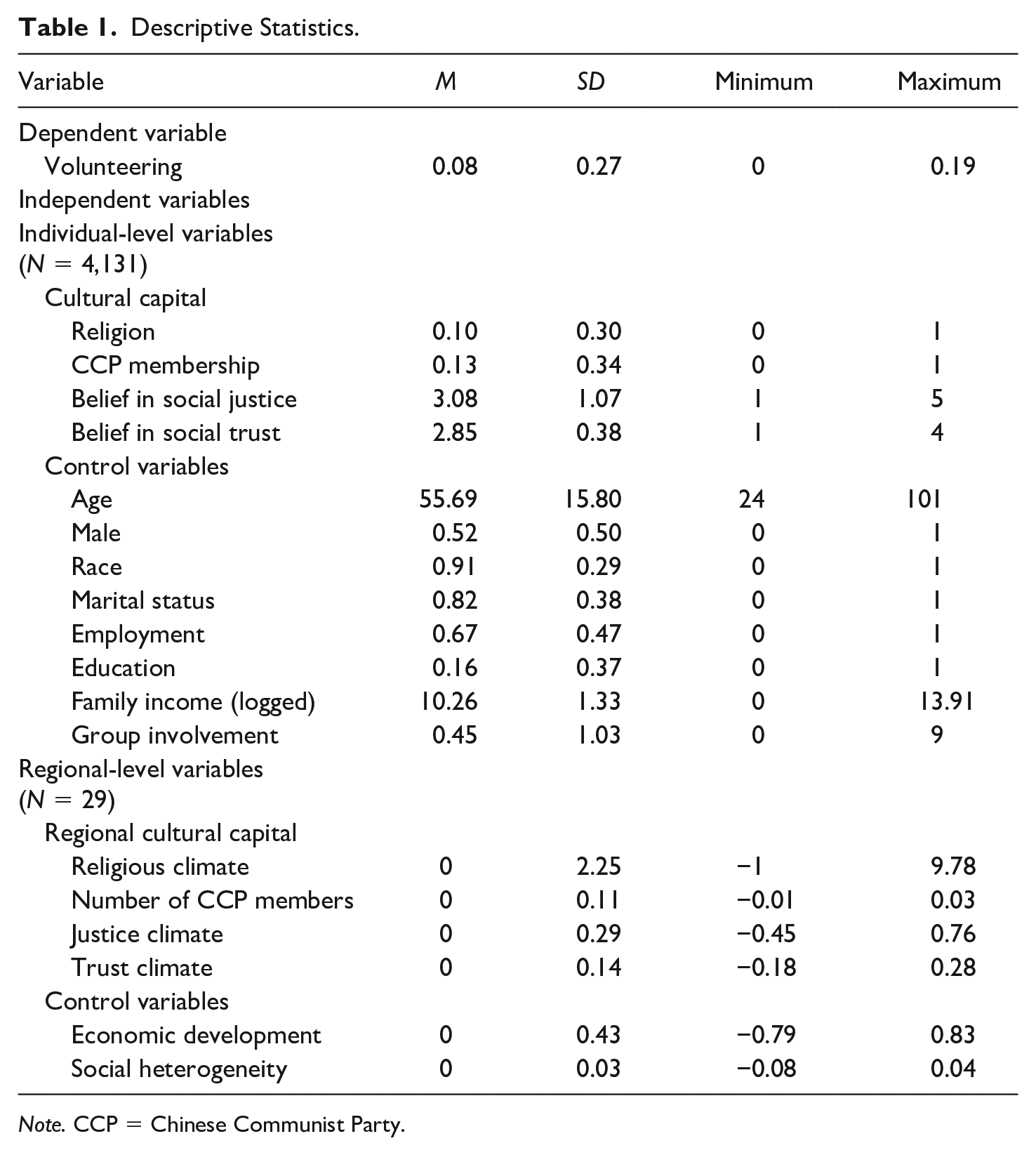
Table 1 presents descriptive statistics of all variables. As shown in Table 1, the volunteering rate of the respondents was only 8%. Further analysis shows that the volunteering rate differs notably across the 29 provinces (municipalities or autonomous regions) studied in mainland China. The volunteering rate of the Inner Mongolia Autonomous Region is 0, and the highest rate is observed in Beijing (19%).
Descriptive Statistics.
Note. CCP = Chinese Communist Party.
Analytical Method
In this article, we hypothesize that both individual-level and regional-level cultural capital affect individual volunteering, and that individual behaviors nested within the same region may be correlated with each other, namely, the observation samples do not conform to the hypothesis of ordinary least squares (OLS) independence. Considering this hierarchical nature of the data, we performed our analysis using a hierarchical nonlinear model: Level 1 analyzes the influence of individual-level cultural capital on volunteering in a region, and Level 2 analyzes the influence of regional-level cultural capital on individual volunteering. As the dependent variables are binary variables, the hierarchical nonlinear model with a logit link of HLM6 is used for the estimation. All variables included in Level 1 are group-mean centered, and all Level-2 variables are grand-mean centered.
Results
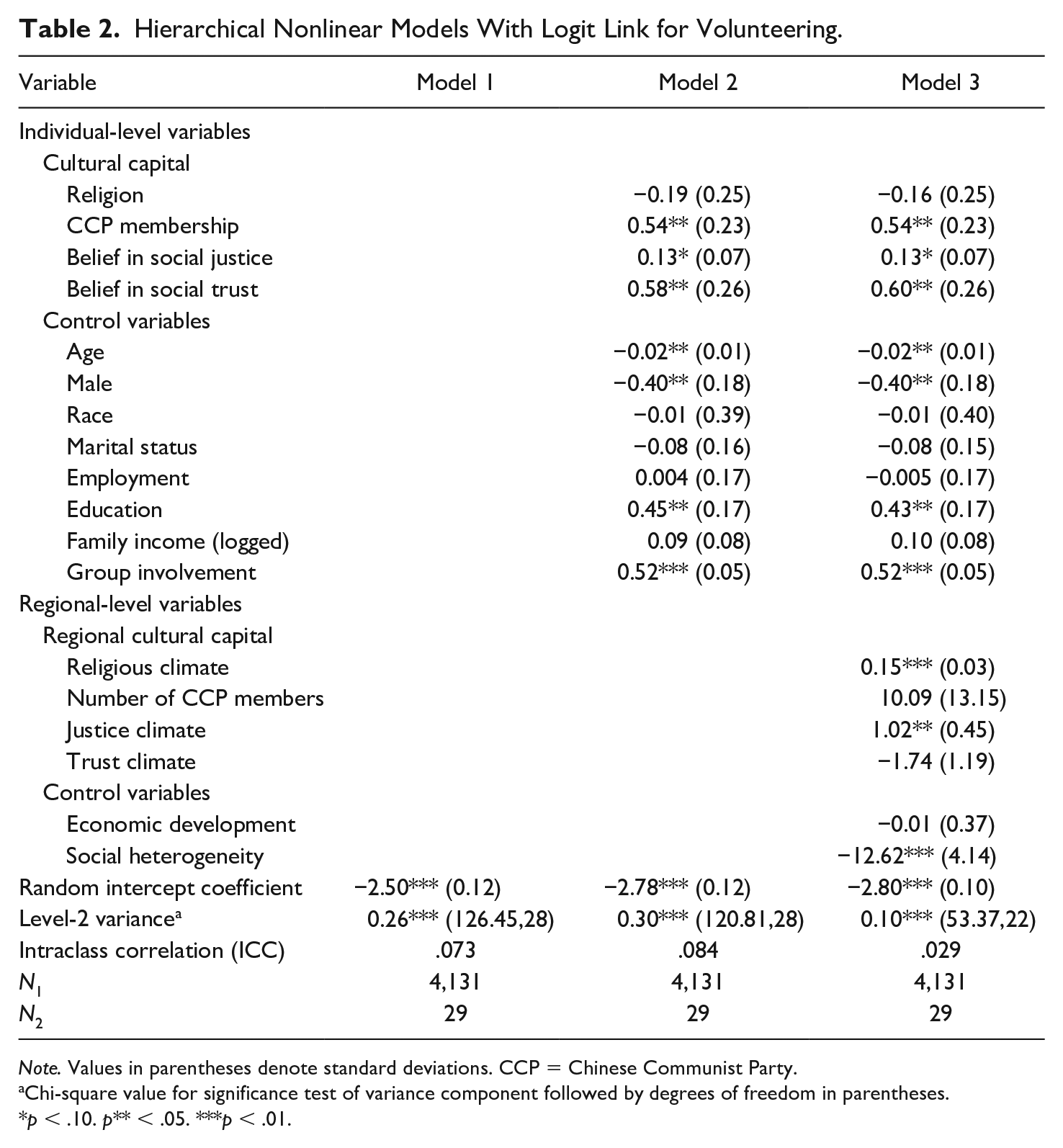
Table 2 shows the analysis results of Models 1 to 3. Model 1 is a null model that does not contain any variables at the individual or regional levels. The purpose of the model is to test whether there are significant differences in individual volunteering between provinces. According to the results of Model 1, the regional-level variance component is significant (.26, p < .001), which indicates that individual volunteering varies between provinces (municipalities or autonomous regions). The intraclass correlation (ICC) is .073, meaning that 7.3% of all individual differences in volunteering can be attributed to the province (municipality or autonomous region) in which they live, and 92.7% of the variance resides between individuals.
Hierarchical Nonlinear Models With Logit Link for Volunteering.
Note. Values in parentheses denote standard deviations. CCP = Chinese Communist Party.
Chi-square value for significance test of variance component followed by degrees of freedom in parentheses.
p < .10. p** < .05. ***p < .01.
To estimate the effect of individual-level cultural capital, we added variables at the individual level but did not include variables at the regional level in Model 2. Religion does not have a significant influence on individual volunteering. Therefore, Hypothesis 1a is not supported. Hypothesis 2a predicted that CCP members are more likely to participate in volunteering than non-CCP members. The results in Model 2 verify this hypothesis (coefficient = 0.54, p < .05), and the probability of volunteering will be 71.6%
We added variables at the regional level in Model 3 to test Hypotheses 1b, 2b, 3b, and 4b. As reported in Table 2, the religious climate and the justice climate in a region are significantly positively associated with volunteering, indicating that individuals in a region with a stronger religious climate and higher justice climate are more likely to participate in volunteering. Therefore, Hypotheses 1b and 3b are supported. Hypotheses 2b and 4b hold that individuals in a region with more CCP members and with a higher level of social trust are more likely to participate in volunteering. However, the results do not support either hypothesis.
In addition, the results show that females are more likely to volunteer than males, and education level and social network have significant positive relationships with volunteering. We also found that social heterogeneity (coefficient = −12.62, p < .01) is a restraining factor for individual volunteering in the context of China, whereas the relationship between economic development and individual volunteering is not significant.
Discussion and Conclusion
The difference in volunteer rates between regions has prompted scholars to change their perspective of volunteering research from the individual level to the regional level. This study aims to fill this gap in the research on Chinese volunteering. By combining the existing research literature and Chinese situations, we constructed a multilevel theoretical framework from the perspectives of cultural capital. Multiple data sources were integrated to empirically analyze the influences of individual-level and contextual-level cultural capital on individual (nonmandatory) volunteering with a hierarchical model.
We first examined the effects of individual religious beliefs and the regional religious climate on individual volunteering. In previous studies, religious belief was an important factor influencing people’s volunteering (Ruiter & De Graaf, 2006; Wilson & Musick, 1997; Yeung, 2018). However, our study found that, in China, religious belief is not an effective predictor of individual volunteering. An interesting finding in this study, however, is that the regional religious climate has a significant impact on individual volunteering. These results indicate that a religious climate creates a culture of benevolence, which promotes individuals’ volunteering in the region, regardless of whether they have religious beliefs. This phenomenon may be related to the religion in Chinese society. In China, in addition to the five major religions, which are highly organized and independent of secular society, folk beliefs are also highly developed. Although folk belief lacks organization, it has been integrated into Chinese secular society, affecting the moral values and behavioral decision-making of ordinary people. It is also known as diffused religion. Therefore, strictly speaking, this study only shows that institutional religious belief has no effect on individual volunteering in China, but it cannot be said that religious belief has no relationship with individual volunteering. Although there are differences between institutional religion and diffused religion, there is interaction between them. Institutional religion will affect diffused religion, and diffused religion will also accept the moral values of institutional religion (C. K. Yang, 1961). For example, “karma” (yin guo bao ying) from Buddhism, which means that if people want to reap personal benefit, they should do more good, has become a common belief among Chinese people. Therefore, people’s moral values may be affected by the regional institutional religious climate, whether they are followers of institutional religion or not. This reminds us that we should not deny the influence of religiosity on the development of volunteering in China just because individual institutional religious belief does not have a significant impact on volunteering. Instead, we should examine the role of religion in Chinese volunteering more systematically.
Regarding political values, this study identified a significant positive relationship between an individual’s CCP membership and individual volunteering. This finding suggests that political values are an important cultural capital for individual volunteering. This outcome may apply not only to China but also to other countries. For example, Van Oorschot et al. (2006) found that people with a left-wing political orientation were more active participants in voluntary organizations in Europe. This may be because left wingers have stronger collectivist values, whereas right wingers have stronger individualistic values; therefore, left wingers are more willing to serve the collective through volunteering. From the perspective of cultural capital, this conclusion is consistent with our finding; that is, when political values are more consistent with the culture of benevolence that supports individuals’ volunteering, party members are more likely to participate in volunteering. However, after controlling for individual CCP membership, the number of CCP members in a region has no significant effect on improving individual volunteering. This finding suggests that the group of CCP members in a region has not formed regional cultural capital that affects the volunteering of the surrounding masses. This may be because, in China, “volunteering of Party members” is the main form for Party members to participate in volunteering. This kind of voluntary activity does not fully absorb the masses, so it cannot effectively infect the volunteering of the surrounding masses. In addition, the influence of regional political values on individuals’ volunteering may be different between one-party ruling and multiparty ruling countries. After all, in multiparty ruling countries, the influence of multiparty competition on individual charity behavior may be more complex (Paarlberg et al., 2019). Thus, the influence of political values under different political systems on volunteering is worthy of further study.
The third cultural capital indicator in our study is belief in social justice. Although previous studies have found that belief in social justice has a positive impact on people’s prosocial behavior (Zitek et al., 2010), there is a lack of understanding about the relationship between belief in social justice and volunteering. This article provides empirical evidence for this. The results show that when individuals believe that the society is more just, the probability of their participation in volunteering will be greater. Furthermore, after controlling for individual beliefs in social justice, the regional justice climate has an additional positive impact on individual volunteering. In other words, even if a person’s belief in social justice is not high, if they live in an area with a strong justice climate, they are more likely to participate in volunteering. Thus, the regional justice climate can be regarded as a public goods that can improve the level of volunteering in the region. An important enlightenment from these findings is that the stability of a society depends on social justice to some extent. When people believe that society is just and that the justice climate in the region is strong, people will be more willing to maintain social order and promote social justice by participating in collective activities such as volunteering. Therefore, in modern China, the old adage “not fear of poverty, but fear of inequality” should be more appropriately expressed as “fear of inequality, but more fear of injustice” (L. L. Li et al., 2012). Of course, whether the relationship between the belief in social justice and volunteering can be generalized to other social contexts remains to be verified. For example, compared with individualistic culture, the relationship between the beliefs in social justice and individual behavior may be strengthened in collectivistic culture (Fischer, 2013). Therefore, more research from different social contexts will help to improve our understanding of the relationship between the beliefs in social justice and volunteering.
Consistent with the conclusions of previous empirical studies of volunteering in China (Lin, 2019; Z. Wu et al., 2018), we also found that individual belief in social trust is positively correlated with volunteering. However, the regional trust climate has no significant impact after controlling for the individual belief in social trust. In other words, the “spillover effect” of the regional trust climate on individual volunteering reported in the study by Glanville et al. (2016) was not verified in the Chinese context. In the context of China, the relationship between social trust and volunteering is still worth further study. Better measures of regional trust climate independent of the survey data may help us find more evidence for the importance of social trust in volunteering in China. In addition, similar to the phenomenon in charitable donations (Evers & Gesthuizen, 2011), social trust may have different effects on volunteering in different fields.
We also found that social heterogeneity reduced individual volunteering, which is consistent with the conclusion of previous studies (Rotolo & Wilson, 2012; Tolsma et al., 2009). According to this “heterogeneity aversion” interpretation (Alesina & Ferrara, 2000), social heterogeneity will lower people’s trust and social interaction, reduce their attention to the welfare of others, and thereby lower their level of civic participation. Due to the damage to the social environment, such as social solidarity, social justice, and social trust, brought by high social heterogeneity, the influence of individuals’ cultural capital on their volunteering may be reduced. Thus, it is necessary to study whether social heterogeneity has a moderating effect on the influence of individual cultural capital on individual volunteering.
This study makes three theoretical contributions. First, by extending the concept of cultural capital proposed by Wilson and Musick (1997) to a multilevel concept, it constructs a multilevel cultural capital theory about individual volunteering to reveal the influences of individual-level and contextual-level cultural capital on individual volunteering. Second, in contrast to the existing studies that mainly measure cultural capital through religious beliefs, it expands the measurement of cultural capital through four indicators: religious values, political values, belief in social justice, and belief in social trust. It provides a systematic research framework for future research on the relationship between the cultural capital and volunteering. Third, it extends the research on the influence of multilevel cultural capital on individual volunteering to non-Western countries, responding to the call of Rotolo and Wilson (2012, p. 453) “to explore area or regional differences in volunteerism in other countries and to develop more sophisticated theories to explain them.” Therefore, this study enhances the geographical and cultural diversity of volunteering research by contributing empirical evidence from China (Ma & Konrath, 2018).
This study still has some research limitations and topics that require further attention. First, this article measures only cultural capital based on four indicators. In the future, we should explore more indicators to continuously improve the theory of cultural capital in the context of volunteering. In populations with different cultural backgrounds, the measurement indicators of cultural capital may be different. Therefore, we should build the measurement indicators of cultural capital for specific cultural backgrounds. Second, due to the limitation of data, this article uses a simple yes/no question to measure individual religious belief. In the future, more sophisticated measures such as “the frequency of participating in religious activities” can be used to measure individual religious belief to more accurately reveal the relationship between religious belief and volunteering. Third, cultural capital is only one of the contextual-level factors affecting individual volunteering. Other regional factors that affect individual volunteering, such as the demand for regional volunteering and regional human capital, may also exist. Further analyses of whether individual volunteering is oriented to local needs or driven by local resources are worthwhile. Finally, the contextual-level factors studied in this article are at the provincial level; however, previous studies have shown that contextual-level factors at different levels may have different influences (Lim & MacGregor, 2012). Therefore, we should conduct a comparative analysis at different levels to further clarify the influence of contextual factors.
Footnotes
Declaration of Conflicting Interests
The author(s) declared no potential conflicts of interest with respect to the research, authorship, and/or publication of this article.
Funding
The author(s) disclosed receipt of the following financial support for the research, authorship, and/or publication of this article: This work was supported by the Guangdong Provincial Education Department Foundation, under Grant No. 2017WTSCX013; Guangdong Provincial Social Science Foundation, under Grant No. GD21CGL19; and National Natural Science Foundation of China under Grant No. 71673091.
