






Abstract
Social enterprises address societal problems with conventional business models. While scholars have extensively theorized the trade-offs between social and financial goals, little is known about the factors that affect the co-existence of these dual objectives. We theorize social enterprises’ ability to balance their social and financial performance as a function of their size and experience. We argue that the acuteness of social-financial trade-offs varies across organizations and that social enterprises get better at balancing their dual objectives as they grow larger and older. We study microfinance institutions (MFIs), which are social enterprises that provide financial services to the poor. Using data on 611 MFIs, the empirical analysis confirmed our predictions. We attribute our findings to learning effects and efficiency gains. Overall, in contrast to studies that gloss over heterogeneities among social enterprises, our study shows that the ability of these organizations to balance their dual goals depends on firm-level characteristics.
Introduction
Social enterprises are organizations with a dual bottom line in the sense that they seek to reach both social and financial objectives simultaneously (Davies et al., 2019; Mair & Marti, 2006; Pache & Santos, 2013; Sakarya et al., 2012). While the universe of social enterprises is broad and rife with diverse types of developmental interventions (Defourny et al., 2021; Defourny & Nyssens, 2010; Searing et al., 2022; Young & Lecy, 2014), more than half of all investments in social entrepreneurship go into microfinance alone (Ashta, 2020), and thus making it a good setting when studying questions relevant to social enterprises. In this paper, we focus on microfinance which is a notable type of social entrepreneurship that is widely studied in the literature (Battilana & Dorado, 2010; Randøy et al., 2015; M. Zhao & Han, 2020). Microfinance is the provision of financial services in small amounts to economically poor individuals, families, and micro-enterprises (Pollinger et al., 2007; E. Y. Zhao & Lounsbury, 2016). Most microfinance institutions (MFIs) seek to combine financial sustainability goals with the social objective of contributing to the fight against poverty (Morduch, 1999). An extensive body of microfinance research shows that there is a trade-off between these two sets of goals (Saebi et al., 2019; Wry & Zhao, 2018), with only a few MFIs managing to achieve strong social and financial performance simultaneously (Van der Auwera et al., 2024). In this study, we examine how experience and size may improve MFIs’ ability to balance the conflicting goals.
The trade-off between social and financial objectives is obviously of interest to both policy makers and practitioners; although some MFIs focus on traditional profit maximization without explicit social objectives, one may claim that most MFIs would only regard themselves as successful if they achieve a proper balance between financial and social objectives (Pollinger et al., 2007). A weakness with much of the existing literature is that financial performance and social performance are assessed individually (Wry & Zhao, 2018). By such an approach, MFIs’ possible increased focus on financial performance is generally considered “bad,” whereas increased focus on social performance is considered to be “good.” An important message of our study is that MFIs’ overall performance level can be assessed only through a simultaneous analysis of social and financial performance. In fact, many MFIs start out with social performance goals that may be too ambitious because they are not financially sustainable. For such MFIs—if the alternative is that the entity will cease to exist (Ngo et al., 2014)—increased focus on financial performance at the expense of social performance can lead to increased impact in the fight against poverty.
Therefore, we argue, there is a need to assess financial and social performance simultaneously when investigating social enterprises such as MFIs (Churchill, 2020). We agree with Saebi et al. (2019) who in their call for more research on social enterprises argue that “we advocate a view of social entrepreneurship as a hybrid form, where the dual mission of social and economic value creation acts as an essential criterion to delineate social entrepreneurship from other related phenomena” (Saebi et al., 2019, p. 89). Although some studies on the balancing of social and financial performance within the microfinance industry do exist, Wry and Zhao (2018) contend that microfinance research has largely overlooked how trade-offs between these dual objectives may vary between institutions and contexts. Another critical perspective is proposed by Ashta (2020), who argues that social entrepreneurship research in general is too static. Obviously, the balancing of financial and social objectives is an example of an issue that is highly dynamic, and many questions on the dynamics of social enterprises remain unexamined (cf. discussion by Young & Kim, 2015).
As a response to these weaknesses of prior research but still building on important previous studies (e.g., Hermes & Hudon, 2018; Wijesiri et al., 2017) of the microfinance industry, this study investigates the balancing of social and financial objectives in MFIs. We maintain that most MFIs would agree that they should preserve their original dual objectives while improving over time their ability to balance these two sets of objectives. We propose that MFIs’ capacity to balance financial and social objectives is positively related to their experience and size. Such an approach answers the call of Ashta (2020) for more dynamic research in microfinance and social entrepreneurship in general, as well as the proposition of Wry and Zhao (2018) that trade-offs between financial and social objectives are more dependent on firm-level characteristics than traditional research has assumed.
Using data from a global sample of 611 MFIs, our empirical analysis supports the proposed hypotheses. We find that both experience and size negatively moderate the relationship between financial and social performance. In other words, older and larger MFIs appear to be better at balancing the goals of financial sustainability and outreach to poor people, ceteris paribus. For any given level of financial performance, older and larger MFIs are able to reach poorer people by offering smaller loan amounts. Several mechanisms driving the results are discussed in this study, but we believe learning effects from more experience and economies of scale from larger size are the main explanations of the findings. The findings are robust to alternative estimation techniques and metrics of both financial and social performance. Our study enlightens the discourse on social-financial trade-offs by providing nuanced perspectives on understanding the phenomenon. We extend previous studies such as those of Zhao and Wry (2016), Wry and Zhao (2018), and Nyarko (2022), which highlighted contextual variations in microfinance outcomes and in the manifestation of social-financial trade-offs. In view of this, we show that even in the same context, the acuteness of social-financial trade-offs can vary significantly among organizations with different sizes and experiences.
Moreover, our analyses revealed that the positive effects of size and experience on balancing social and financial performance are amplified in MFIs with robust governance structures and leadership by internal figures, such as internally hired CEOs and founder CEOs. This finding highlights the importance of not only focusing on performance metrics but also on the organizational systems, processes, structures, and leadership dynamics that shape an MFI’s direction, accountability to diverse stakeholders, and ability to balance social and financial objectives as they grow and mature. More broadly, these insights contribute to the understanding of social enterprises, particularly in terms of their “hybridity”—a concept central to social enterprises that encapsulates the co-existence of dual goals within the same organization (Doherty et al., 2014). Specifically, we suggest that the hybridity of social enterprises is closely tied to the interplay between their governance structures and their maturity and growth trajectories.
On this issue, Ebrahim et al. (2014) theorize the role of corporate governance, particularly organizational boards, in sustaining social enterprises’ hybridity by aligning the often-conflicting interests of various stakeholder groups. Our findings indicate that in integrated hybrid social enterprises, such as MFIs, governance’s role in balancing competing logics is shaped by the organization’s experience and size. This conclusion aligns with corporate governance literature, which highlights the effectiveness of governance in more mature organizations accountable to larger stakeholder groups (O’Connor and Byrne, 2015a). Our study also provides empirical support for Young and Kim’s (2015) theoretical prediction regarding the role of corporate governance in the resilience of social enterprises. In addition, it complements the work of Ometto et al. (2019), who emphasize the importance of “herding spaces” for learning from external networks, and Battilana et al. (2015), who stress the significance of internal negotiation spaces where organizational members reconcile competing logics, as well as the lasting imprint of organizational founders.
Our findings have substantial implications for MFIs and their stakeholders. First, microfinance investors aiming for both social and financial returns can derive valuable insights from our research. Our findings emphasize the importance of prioritizing larger and more experienced MFIs with robust governance mechanisms. This recommendation also applies to donors, who, while primarily concerned with social impact, also value the long-term financial stability of the MFIs they support. For MFIs themselves, our research suggests that leveraging existing resources, capabilities, and experience can lead to efficiency gains when implementing growth strategies. In addition, our findings should encourage managers of MFIs with aligned missions to explore synergies and opportunities through mergers, allowing them to capitalize on the size-related benefits that foster more resilient organizations.
Hypothesis Development
Overall, the tension between social and financial objectives for social enterprises is well-documented (e.g., see the studies by Davies et al., 2019; Doherty et al., 2014; Smith et al., 2013). For MFIs, Reichert (2018, p. 430) summarizes the tension as follows: “Aiming to achieve rapid growth, increase their client base, improve portfolio quality, and become financially sustainable, MFIs must also ensure they are meeting their development goals of poverty reduction, financial inclusion, and female empowerment.” In microfinance research, this tension has mainly been discussed in the so-called mission drift literature (Armendàriz & Szafarz, 2011; Copestake, 2007; Mersland & Strøm, 2010; Mia & Lee, 2017; Serrano-Cinca et al., 2023). Mission drift is defined as “[MFIs moving] away from serving their poorer clients in pursuit of commercial viability” (Cull et al., 2007, p. 108). The mission drift phenomenon supposes that MFIs commence as socially driven and donor-dependent organizations, but they become increasingly commercial when subsidies dry up, when they face intense competition, and when they are under pressure from stakeholders, among other drivers (D’Espallier et al., 2017b; Kent & Dacin, 2013).
Importantly, we acknowledge that MFIs are hybrid organizations that need to be financially sustainable to fulfill their social objectives (Morduch, 1999). In contrast to mere non-profit organizations, MFIs cannot seek to maximize their social performance per se. Social objectives can be reached only if the organizations are sustainable from a financial perspective. Hence, we regard the optimal balancing of social and financial objectives to be the key to success in the microfinance industry. We maintain that an improvement in financial performance should not be interpreted as negative from a social performance perspective as this is the means for MFIs to stay true to their mission of providing financial services to poor segments in a sustainable way.
The focus on optimal balancing of social and financial performance—as opposed to maximizing one or the other—is a vital element in our study. Many new MFIs start out with overly ambitious social performance goals that cannot be supported by financial sustainability. For instance, a natural objective of MFIs is to offer small loans at low interest (Pollinger et al., 2007). But obviously, for an organization that covers expenses with revenues rather than donations, there is a limit both on the smallness of the loans the MFI can provide and on the lowness of the interest level it can offer. The contention that increased commercialization is actually required for many MFIs has been acknowledged in parts of the mission drift literature (e.g., see the studies by D’Espallier et al., 2017b; Mia & Lee, 2017; Serrano-Cinca et al., 2023; Tavanti, 2013). For instance, increased commercialization may lead to increased efficiency and potential for both larger outreach and long-term survival (Shahriar et al., 2016). This aspect is also acknowledged by the Microfinance Social Performance Task Force, as the ability to balance social and financial performance is included in the six Universal Standards for Social Performance Management for MFIs (Beisland et al., 2021). But obviously, from a social perspective, the development can go too far; for some MFIs, there is little doubt that profit-maximizing objectives to a large degree have displaced original missions to lift people out of poverty (Copestake, 2007; Cull et al., 2007; Serrano-Cinka & Gutiérrez-Nieto, 2014).
If an MFI is to stay true to its mission, it needs to preserve its original purpose of making significant contributions to poverty eradication from the early stages of its life cycle (Ashta, 2020). MFIs need to steadily improve their ability to reach out to poor people in practice, using financially sustainable products and marketing strategies. All organizations face external adversity and inner tensions, but social enterprises such as MFIs are especially challenged to maintain stability as they are often pulled in two different directions (Smith et al., 2013). Balancing social and financial performance is an obvious difficulty for social enterprise managers due to the natural divergence between these dual goals (Davies et al., 2019). But like Wry and Zhao (2018), we argue that the intensity of this divergence, or more precisely trade-off, between social and financial goals varies across organizations. We maintain that social enterprises are heterogeneous organizations, and some are better at balancing the dual objectives than others. Building on the work by Hermes and Hudon (2018), we study two factors, experience and size, that may increase the likelihood that MFIs stay true to the mission of providing sustainable financial services to the poor.
MFIs’ Experience and the Balancing of Social and Financial Objectives
Our first hypothesis relates to experience; we believe that, like other social enterprises (Defourny et al., 2021; Haugh et al., 2022), MFIs can be expected to be better at balancing social and financial objectives as they gain experience. According to Haugh et al. (2022) experience increases social enterprises proficiency in “accessing resources, acquiring skills and expertise, leveraging professional advice and trade associations, and constructing supportive networks” (p. 1235). Experience lays the foundation for constructive learning (Wijesiri et al., 2015; Wijesiri et al., 2017). However, there may be significantly different learning processes related to financial as compared to social performance. Learning effects related to financial performance can be rather short term in nature. As discussed by Smith et al. (2013), social enterprises can easily measure revenues and costs in the short term. Nonetheless, for MFIs, it can be expected that learning effects on financial performance arising from the actual consequences of different choices—related to, say, products, terms, and marketing strategies—are more long term in nature. However, we agree with Smith et al. (2013) that social mission outcomes in general are even more long term, often significantly more so, than mere financial outcomes. Possible effects on poverty alleviation do normally require rather substantial time horizons. In general, when time horizons are sufficiently extended to capture more long-term experience, we expect to see MFIs’ ability to balance social and financial performance improve.
Theorizing on how social enterprises can integrate social and financial objectives, Young and Kim (2015) highlight the role of innovation. While innovation can certainly drive organizations away from their original mission, it can also strengthen their ability to improve the balancing of possibly conflicting goals. Young and Kim argue that if social enterprises discover new ways of doing business, broadly interpreted, this may allow “greater achievement of social and market goals with the same level of resources” (Young & Kim, 2015, p. 247). Obviously, learning and innovation are two highly related concepts.
Organizational learning from experience is a common phenomenon across various industries. Similar to firms in conventional sectors, the learning processes of social enterprises, including MFIs, can be understood through the lens of the life cycle theory (Ashta, 2020). This theory posits that businesses progress through distinct phases over time, typically including launch (embryonic), growth, shake-out, maturity, and decline (Hasan & Cheung, 2018). Each phase is characterized by specific events and outcomes related to expenses, investments, sales, and profitability (Arikan & Stulz, 2016; Hasan & Cheung, 2018), thus encompassing the entire lifespan of products, organizations, and industries in the marketplace (Fujimoto, 2014).
Ashta (2020) developed the dynamic life cycle theory of social enterprises, suggesting that in the embryonic phase, social enterprises begin as non-governmental organizations (NGOs) with a vision to address social issues faced by specific segments of society. During this stage, enthusiastic storytelling plays a crucial role in securing capital and rallying stakeholders around the project. As the enterprise matures, it may transition into for-profit and eventually commercial organizations that compete with other hybrid firms. The literature highlights the significance of organizational learning throughout the firm life cycle (Agarwal & Gort, 2002; Bennett & Levinthal, 2017; Oliver, 2001; Phelps et al., 2007). Ashta (2020) argues that as social enterprises evolve, documenting results becomes essential, encompassing both financial returns and social impact. Through the process of outcome measurement, learning effects emerge from experiences related to “what works and what does not work.”
Experience might also be related to organizations’ governance mechanisms. Governance mechanisms dictate the day-to-day and future direction of organizations and may also determine their ability to learn and improve over time (Young & Kim, 2015). Prior studies have highlighted the relationship between the quality of corporate governance and the life cycle of firms, suggesting that corporate governance mechanisms adapt and evolve in response to changes in principal-agent relationships across the corporate life cycle (Black et al., 2006; Esqueda & O’Connor, 2020; Filatotchev et al., 2006). This body of literature suggests that corporate governance tends to improve as firms progress along the corporate life cycle toward maturity (O’Connor & Byrne, 2015b). For example, O’Connor and Byrne (2015a, p. 23) examined 205 firms across 21 emerging market countries and found that “mature firms tend to exhibit better overall corporate governance practices.”
Drawing on the above, we posit that as social enterprises, in our case MFIs, progress through their life cycle, governance mechanisms are expected to improve (Ashta, 2020). The relationship between governance and performance has been widely studied in the microfinance literature. Several governance metrics are found to be positively associated with performance, but most studies examine financial and social performance separately and do not examine the balancing of the two goals. One exception is the study of Hartarska and Mersland (2012), which combines cost minimization and outreach into an efficiency measure. The study concludes that “MFI efficiency is affected by certain governance mechanisms as suggested in the literature” (Hartarska and Mersland, 2012, p. 219). Hence, we can relate performance improvement resulting from experience to governance mechanisms as well as to learning effects. But improved governance may also be a result of learning, so the two effects are likely intertwined.
Learning effects in microfinance have not only been documented at the firm level. Individual employees are also found to change their behavior as they gain experience (Beisland at al., 2019). For instance, Agier (2012) constructs a measure of credit officer ability and finds this measure to be positively associated with experience. A key employee in any organization is the CEO. Young and Kim (2015) recognize leadership as a vital factor in aligning social and financial objectives (see also the study by Randøy et al., 2015). Mersland, Beisland, and Ndaki (2019) find that MFIs with internally recruited CEOs have higher financial performance and lower risk than MFIs with externally recruited CEOs. The findings are attributed to longer experience in the organization being associated with better firm-specific skills, such as improved knowledge with respect to product lines, rivals, clients, and own workforce’s abilities, as well as better access to network resources (see also the study by Haugh et al., 2022). Likewise, Ndaki et al. (2018) find that the tenure of the CEO has a positive association with an MFI’s debt ratio, and they attribute their finding to experience. Ndaki et al. (2018) also argue that funding is important for the success of MFIs. Specifically, they contend that MFIs need to access debt and cheaper funding in general to scale up operations and grow portfolios, and thereby fulfill the mission of expanding their services to more poor clients.
In light of the above arguments, we expect that the ability of MFIs to preserve their mission through achieving an alignment between social and financial performance is directly related to their experience. Hence, we propose the following hypothesis:
MFIs’ Size and the Balancing of Social and Financial Objectives
Our second hypothesis relates economies of scale to MFI size. In theory, it is expected that MFIs increase their commercial focus as they grow larger and as they advance through their life cycle (Ashta, 2020). Moreover, in the empirical literature, several studies have shown evidence of economies of scale in the microfinance industry; for example, see the study by Hartarska et al. (2013), who document how scale of operations positively affects efficiency and profitability. Again, the microfinance literature tends to assume that such commercialization is always positively associated with financial performance and negatively associated with social performance (e.g., see the study by Hermes et al., 2011; Mia & Lee, 2017; Serrano-Cinka & Gutiérrez-Nieto, 2014). The transformation of many MFIs from NGOs into shareholder corporations (Ashta, 2020) is generally assumed to reinforce this mission drift (D’Espallier et al., 2017a).
However, there are two questions that naturally arise from this research. First, as discussed above, is a shift in focus toward financial performance, motivated by scaling up, necessarily negative per se? For some MFIs, increased focus on financial sustainability can be a question of survival (Ngo et al., 2014; Pollinger et al., 2007). Second, do aspects of the commercialization process lead to improved balancing of social and financial performance? It has not been shown in the literature that MFIs achieve an optimal balance of social and financial performance in the initial stages of their life cycle. In what follows, we propose that economies of scale are positively associated with the balancing of social and financial objectives. Commercialization need not always put a strain on social performance; in fact, scale effects can be positive for social and financial performance simultaneously (Wijesiri et al., 2017).
First, we note that when financial performance is evaluated in isolation, there is a positive association between economies of scale and financial performance. Actually, economies of scale are positively associated with financial performance by definition because increased volume of output leads to lower average costs and hence higher financial performance (Chandler, 1990; Mourão & Enes, 2017). The relation between economies of scale and social performance is less obvious, as is the relation between economies of scale and the balancing between financial and social performance. However, several microfinance studies have investigated MFIs’ organizational efficiency, a concept that is highly related to economies of scale. Young and Kim (2015, p. 245) state that “the degree to which a social enterprise can maintain its intended balance of social and market performance depends in part on how efficiently it performs as an organization.” Moreover, they argue that greater efficiency may increase the possibility of maintaining social enterprise stability in general. Implicitly, therefore, the study of Young and Kim (2015) suggests that there is a positive association between economies of scale and the balancing of social and financial performance, as proposed by our hypothesis. Mersland and Strøm (2010) put forward a similar argument. They contend and empirically document that lack of efficiency is the main reason why some MFIs drift away from their original social mission.
The mechanisms underlying the positive effects of economies of scale are several. For instance, from a financial perspective, larger MFIs may have better access to capital and hence have a lower cost of capital (Hartarska et al., 2013). Larger MFIs may afford more advanced technology and also be better able to quickly apply new technology, which may decrease the number of employees needed to serve a given loan portfolio (Hermes et al., 2011). From a social perspective, improved efficiency and lower costs of capital may pave the way for lower interest rates on microcredit for poor customers (Beisland et al., 2019). Growth in the number of relatively wealthy clients may enable MFIs to cross-subsidize poorer clients (Armendàriz & Szafarz, 2011; Davies et al., 2019; Reichert, 2018), which may lead to an increased number of poor clients, as well as lower interest rates for these clients. Economies of scale may also encourage MFIs to seek out new markets with their products, so that new, vulnerable groups of clients may access financial services (Beisland et al., 2019).
In light of the above arguments, we expect that MFIs’ size—through economies of scale—has a positive association with their ability to preserve their mission by improving the balancing of their social and financial performance goals. Hence, we propose the following hypothesis:
Research Design and Data Sample
Research Design
We analyze the data using random-effects generalized least squares (GLS), which is a panel data regression technique (Wooldridge, 2010). Before making this choice, we compared pooled and panel estimation methods by performing a Breusch and Pagan Lagrangian multiplier test (Baltagi & Li, 1990). The test outcome showed that a panel technique was appropriate for modeling the data (χ2 = 1113.18, p < .000). In addition, a Hausman test supported the preference for random-effects GLS over fixed effects (χ2 = 29.11, p < .6615). The random-effects GLS allows us not only to estimate the coefficients of non–time-varying regressors but also to exploit both the cross-sectional and the time-series variations in our data. To check the robustness of the results, we also ran the models using an alternative standard panel data regression technique, Hausman–Tailor regressions (Hausman & Taylor, 1981), and compared the results across the different estimations. We account for temporal effects by including time dummies in all models. We also include regional dummies to control for other unobserved heterogeneity in the data. We run all models with robust standard errors (serial correlation and heteroskedasticity-corrected) clustered at the level of MFIs. We estimate the following basic model:

where OSS refers to operating self-sufficiency, and it is the financial performance metric; ALS refers to average loan size (ALS; divided by gross national income (GNI) per capita), and it is the social performance metric; and the interaction terms between ALS and age and size test the ability of MFI age and MFI size to moderate the balancing of financial and social performance; see Hypotheses 1 and 2. The term
Data Sample and Model
To test our hypotheses, we use data on MFIs, which are a type of social enterprises that provide financial services to small businesses and the unbanked poor. We created our dataset using hand-collected information from the rating reports of five recognized microfinance rating agencies, namely Microfinanza, MicroRate, Planet Rating, CRISIL, and M-CRIL. Our dataset covers a global sample of 611 MFIs in 88 countries for the period 1998–2015. MFIs can undergo two kinds of ratings: social and institutional. We used information from both the social and institutional rating reports to construct our dataset. The social rating involves an evaluation of the management systems an organization has in place to fulfill its social mission. The institutional rating concerns risk assessment and evaluation of governance systems and procedures and is quite similar to the traditional company rating carried out by agencies like Standard & Poor or Moody’s (Beisland & Mersland, 2012). During the period under study, many MFIs underwent multiple ratings.
Compared to self-reported data, rating data offer several advantages. First, it is of high quality as it is audited, and it undergoes third-party verification during the rating process. For this reason, rating data are generally more likely to be free of errors (Hudon & Traca, 2011). Second, rating data are deemed the most representative of the global microfinance industry as it contains information on MFIs whose stated intention is to be a hybrid organization pursuing dual objectives (D’Espallier et al., 2013). Finally, MFIs in our rating dataset are transparent organizations as they have decided to undergo a rating process often of both a social and financial character (Beisland et al., 2014). As typical with other microfinance datasets (Nyarko, 2022), the geographical spread of the MFIs in the dataset is as follows: Latin America and Caribbean (42.4%), Sub-Saharan Africa (23.3%), Europe and Central Asia (15.1%), Southeast Asia and the Pacific (14.0%), and Middle East and North Africa (5.2%).
A weakness of our dataset is that it includes only MFIs that undergo either social or institutional rating, which may possess certain unique characteristics, such as size and level of professionalization. Thus, it excludes many small-scale credit and savings groups and cooperatives, as well as mega-size MFIs that provide lending services to the financially excluded poor (Mersland & Strøm, 2012). To address this limitation and to verify the robustness of our findings, we complement our analysis with data sourced from the Microfinance Information Exchange (MIX). While it is important to acknowledge that the MIX dataset relies on self-reported data from MFIs and may therefore be subject to potential errors, it is widely utilized in microfinance research due to its expansive coverage (Blanco-Oliver et al., 2023; Cull et al., 2007; D’Espallier et al., 2017b; Wry & Zhao, 2018). Moreover, one of its key strengths lies in its larger sample size. The MIX dataset is obtained from the World Bank’s data catalog (https://databank.worldbank.org/source/mix-market).
We follow Wry and Zhao (2018) and use OSS as our main metric for financial performance. OSS takes into account that the objective of many social enterprises is financial sustainability and not profit maximization as such. That being said, OSS is a meaningful metric even for-profit maximizers as it is highly correlated with traditional metrics for financial performance from the banking industry such as return on assets (ROA). OSS is defined as operating revenue divided by the sum of financial expenses, loan loss provisions, and operating expenses. As a robustness check, we use ROA as an alternative measure of financial sustainability (Churchill, 2020). ROA equals net operating income divided by average assets.
Our main metric for social performance is ALS (Bennouri et al., 2024; Mersland, Nyarko, & Szafarz, 2019; Wry & Zhao, 2018). ALS is divided by GNI per capita to account for differences in living standards across countries. ALS is a measure of the poverty level of clients and the most used proxy for social performance in microfinance research (see the study by Beisland et al., 2021, for more detailed discussions of this metric). ALS is reverse-coded so that higher values of ALS are associated with higher social performance (as in Wry & Zhao, 2018). In line with the literature, we expect a negative relationship between ALS and OSS (Churchill, 2020; Hermes et al., 2011; Wry & Zhao, 2018). We use the proportion of female clients as an alternative social performance metric in robustness tests (Bennouri et al., 2024; Churchill, 2020). Because women are generally poorer and more vulnerable than men in developing countries (Garikipati et al., 2017), the proportion of female clients is another frequently used metric for poverty level, and hence social performance in microfinance research (Bennouri et al., 2024; Mersland & Strøm, 2010; Nyarko, 2022). As is common in microfinance literature (e.g., Hermes et al., 2011; Ngo et al., 2014), our two test variables, experience and size, are proxied by age (i.e., the number of years an MFI has been actively offering microfinance services) and total assets (Wijesiri et al., 2017). Following standard convention, we use the log of assets to limit scale effects in the multivariate tests. Our empirical modeling of the relation between social and financial performance in MFIs follows the work of Wry and Zhao (2018). Like these authors, we use OSS as the dependent variable and ALS as the independent variable and then interact the moderators (age and size) with ALS to examine how the relation between social and financial performance may vary across MFIs.
The control variables are generally self-explanatory and are those typically included in MFI performance research. For definitions of all variables, see Table 1. The reader should note that Portfolio at Risk 30 (PaR30), the proportion of the loan portfolio that is overdue by more than 30 days, is the commonly used risk metric in microfinance research (D’Espallier et al., 2013). Moreover, we would like to point out that in addition to MFI-specific variables, we also control for geographical and macroeconomic factors by including five country-level variables (Ahlin et al., 2011; Wry & Zhao, 2018). The first, Gross Domestic Product (GDP) per capita, measures a country’s wealth and development, and it is obtained from the database of the World Bank. The second, Democracy, measures the degree of a country’s participation in democratic governance, and it is obtained from the Political Regime Characteristics and Transitions dataset of the Polity IV Project. The third, official development assistance (ODA), measures the amount of foreign aid (relative to GNI per capita) that a country receives from its bilateral partners, and it is obtained from the World Bank’s database. The fourth, political instability, is an overall measure of the political climate in a country. This variable is a composite index that is calculated as the average magnitude of four state failure events—ethnic wars, revolutionary wars, adverse regime change, and genocide and politicide—that are reported in the State Failure Problem dataset of the Political Instability Task Force. The final macro-level variable is the Economic Freedom Index, which measures the extent of economic liberalization of a country. The Economic Freedom Index is obtained from the database of the Heritage Foundation.
Summary Statistics.

Descriptive Statistics
Table 1 presents descriptive statistics for the variables used in the analyses. The average of the OSS variable in our sample is 1.12, where OSS above 1 signals that an MFI is sustainable from an operating perspective. We note that the spread of OSS is large as it ranges from 0.2 to 2.2. The ALS scaled by GNI per capita has a mean of 0.22. A more intuitive number is the average unscaled loan size, which in our sample is 1,457.94 USD (unreported); low loan amounts are a characteristic of the microfinance industry. The mean log of assets is 15.43, but a more meaningful number is the mean of untransformed value of assets, which is 13.6 million USD. We note the relatively large standard deviation for this number. The distribution of total assets is skewed to the right as some MFIs are considerably larger than the rest. The average of the age variable is 11 years. Note that some institutions may be older than suggested by the age variable; as mentioned, we follow standard practice in microfinance research and consider only the years that the institution has been actively offering microfinance services.
As for the control variables, we note that about 37% of the MFIs are regulated by public banking authorities, 61% offer individual loans, and 39% were founded by an international actor. The proportion of the loan portfolio that is overdue by more than 30 days (PaR30) is 6.2%, which is similar to the average reported in the study by Wry and Zhao (2018) and illustrates that the risk level in the microfinance industry is relatively low, even though most loans are unsecured. The debt-to-equity ratio of 2.8 is higher than that in many industries but considerably lower than that of traditional banking. About 33.6% of the MFIs of the sample offer their clients the possibility of voluntary saving, and 32.8% require mandatory savings. While voluntary savings is demand-driven, mandatory savings serves a hidden security for loans (Cozarenco et al., 2016). About 46% of the MFIs are NGOs, 17% are cooperatives, and the rest (37%) are shareholder corporations. The average GDP per capita of the countries in which the MFIs are located is about 6,300 USD, illustrating that MFIs primarily operate in relatively poor countries. Regarding the other country-level control variables, the average country in the data has a democracy score of 4.749 and receives foreign aid that is approximately 5% of the GNI per capita. The mean political instability of 0.976 is fair as it represents the average score for stable and unstable regimes. The economic freedom index has a mean of 58.366, which is only a few points above the midpoint of 50.0.
Table 2 presents correlation coefficients for the explanatory variables of our study. We note that ALS and size have a negative correlation coefficient, but recall that ALS has been reverse-coded, so that social performance is negatively related to the size of the MFI. This result is expected, yet it should be noted that the relation is not very strong, statistically speaking. In Table 2, we also note that ALS is unrelated to age in the bivariate analysis. As expected, there is a significantly positive correlation between size and age, but a correlation coefficient of only 0.35 illustrates that the variables capture distinct characteristics of the MFIs.
Correlations and VIF.

Table 2 presents the pairwise correlations between variables along with the variance inflation factors (VIF).
and ** indicate statistical significance at the 1% and 5% levels, respectively.
From a statistical perspective, the individual correlation coefficients of Table 2 are generally low or moderate. However, several of the MFI characteristics (regulation, voluntary and mandatory savings, individual lending, and MFI legal incorporation) are significantly related to each other. Some of the significant correlations are intuitive, for example, between mandatory and voluntary savings. We also note that some of the country-level variables have significant correlations. Nonetheless, overall, multicollinearity does not seem to be an issue of concern in our study as the correlation coefficients are lower than the recommended maximum value of 0.9; the highest correlation (in absolute terms) in Table 2 is −0.720 (between GDP and ODA). All variance inflation factors (VIFs) are substantially below acceptable thresholds of 10 as proposed in the econometrics literature (Hair et al., 2010; Kennedy, 2008). The highest VIF in Table 2 is 3.28.
Empirical Results and Discussion
We present the results of our empirical analysis in two subsections: “Main Analyses,” which details the findings of our main tests, and “Additional Analyses,” which presents the results of our robustness checks. Our hypotheses predict that experience and size reduce trade-offs and help MFIs to balance their social and financial performance. Following the work by Wry and Zhao (2018), we test this by interacting age and size with ALS and including these interaction terms (ALS × Age and ALS × Size) in the models. Because ALS is reverse-coded, a negative coefficient on this variable suggests a trade-off between social and financial performance. Therefore, for our hypotheses to be supported, we need significantly positive coefficients on the interaction terms as this would signify that age and size mitigate the negative relationship (trade-off) between ALS and OSS. In other words, a positive coefficient on ALS × Age and ALS × Size means that age and size enhance the balancing of social and financial performance.
Main Analyses
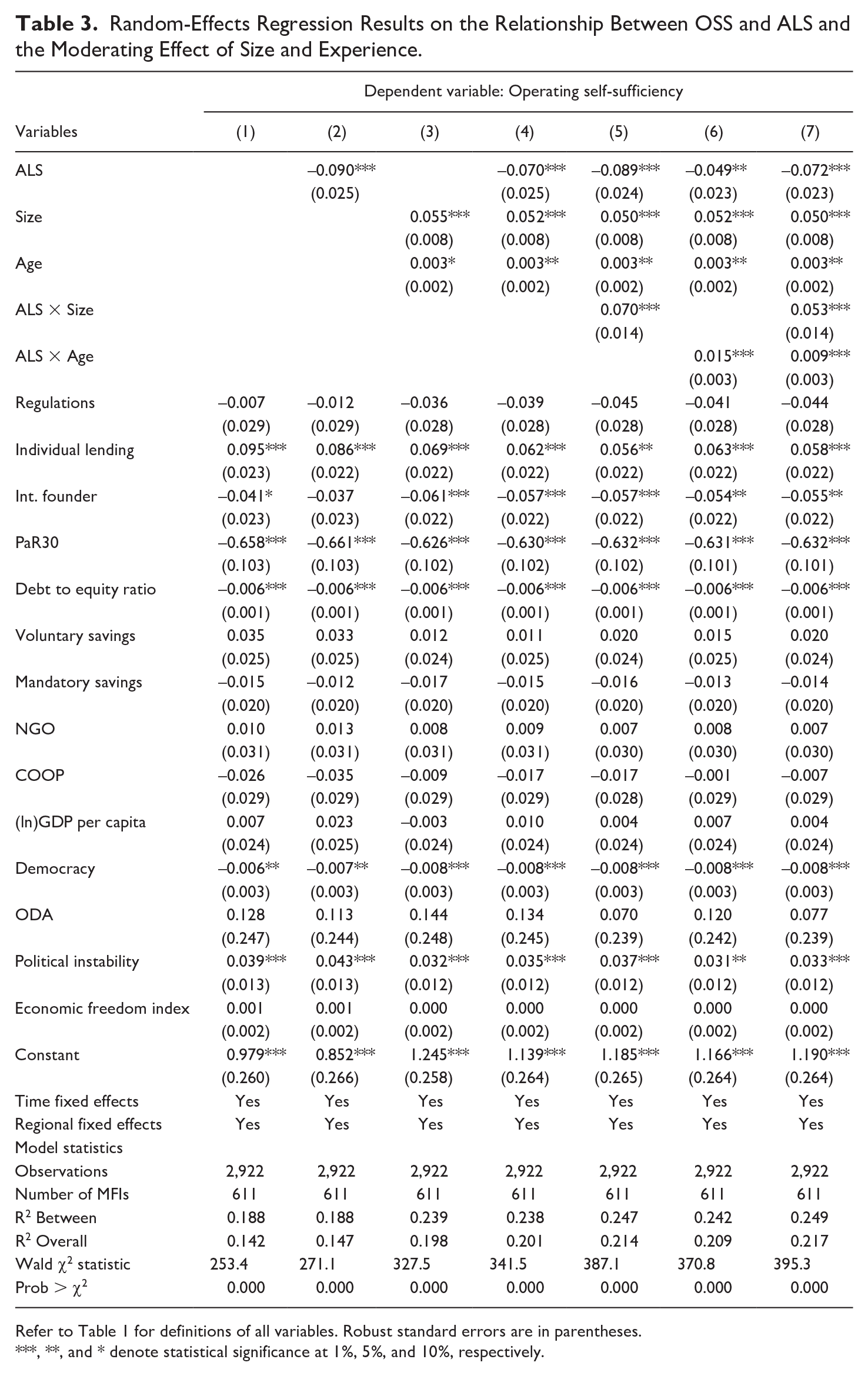
As explained earlier, random-effect regressions are our preferred alternative for testing the hypotheses. The results of these regressions are presented in Table 3.
Random-Effects Regression Results on the Relationship Between OSS and ALS and the Moderating Effect of Size and Experience.
Refer to Table 1 for definitions of all variables. Robust standard errors are in parentheses.
, **, and * denote statistical significance at 1%, 5%, and 10%, respectively.
In Table 3, Column (1) is the baseline model, which includes control variables. From Columns (2) to (7), the test variables are included successively from the left to the right in the table to test the stability of the results. The regression coefficients and their associated significance levels turn out to be stable and consistent across the different regression specifications. Hence, we focus the discussion on Column (7), which is the complete regression specification.
We did not hypothesize the direct effects of ALS, Age, and Size on OSS, as this is not the main focus of the paper. Yet the results relating to the direct effects of these variables are foundational to the hypothesized relationships and hence worth mentioning. In accordance with the literature, we observe a negative coefficient on ALS, confirming that there is a trade-off between our metrics for financial and social performance when these are each considered in isolation (e.g., Hermes et al., 2011; Wry & Zhao, 2018). Ceteris paribus, the positive coefficients on Size and Age are also expected. The positive relation between Size and OSS can be attributed to economies of scale (Hartarska et al., 2013) but is also consistent with economies of scope in the microfinance industry (Hartarska et al., 2010). Regarding Age, Hermes et al. (2011) document that number of years of operation is negatively related to total costs.
Our hypotheses relate to the moderating effect of experience and size on the trade-off between financial and social performance, and therefore, the main focus of our discussion is on the interaction terms included in the regression analysis. Hypothesis 1 relates to the effect of experience proxied by Age. We note a significantly positive coefficient on the interaction term between Age and ALS (ALS × Age). This means that Age weakens the negative influence of ALS on OSS. Simply put, the results of Table 3 suggest that experience mitigates the negative relationship between financial and social performance; therefore, MFIs get better at balancing financial and social performance objectives as they grow older.
The results on Age are in support of Hypothesis 1. Hypothesis 1 attributes the positive moderating effect of age on the ability of an MFI to balance social and financial performance to positive effects from experience. As noted earlier, experience is significantly related to learning. Therefore, it is possible that over time, MFIs learn how to provide small loans without sacrificing financial sustainability. Alternatively, it is possible that over time, for a given level of financial sustainability, MFIs learn how to increase outreach to poorer segments of the population. Our results suggest that learning effects may become more significant as MFIs advance through their life cycle (Ashta, 2020). Learning effects can be individual and exist on both an employee and a manager level (Agier, 2012; Mersland, Beisland, & Ndaki, 2019). However, as Ashta (2020) notes, there are also formal organizational changes that may be relevant. As legal incorporation may change an MFI from a more informal cooperative or NGO to a formal shareholder MFI, stakeholders may become more demanding and professional, access to capital may become easier, and governance structures may improve (Black et al., 2006; Kent & Dacin, 2013; O’Connor & Byrne, 2015a).
Hypothesis 2 predicts a positive moderating effect of size on the ability to balance financial and social performance. Consistent with this hypothesis, Table 3 shows a significantly positive coefficient on the interaction term between ALS and Size, suggesting that Size mitigates the negative relation between ALS and OSS. Therefore, the increased size of MFIs appears to improve their ability to be financially viable and, at the same time, reach poor clients through small loan amounts. In other words, ceteris paribus, larger MFIs are better at aligning their dual objectives by minimizing trade-offs between financial and social goals than smaller MFIs.
The regression results do not indicate the underlying causes for the above relations, but as explained in the Hypothesis Development section, we expect that economies of scale play a vital role (Hartarska et al., 2013). Larger MFIs are able to offer loans, inclusive of small loans in monetary terms, at lower interest rates. Larger MFIs may have lower costs because of better technology that allows for more clients per employee, and they may also have lower costs of capital (Beisland et al., 2019; Hermes et al., 2011). Economies of scope in the industry may also play a role (Hartarska et al., 2010). Economies of scope entail harnessing synergies between activities and resources within a firm’s production process to reduce overall costs (Mourão & Enes, 2017). Larger MFIs may be more likely to offer savings options, have a larger number of loan products, or provide more advanced payment/money transfer services. Moreover, we cannot rule out the possibility that scaling is associated with outreach to relatively wealthy clients that give particularly socially concerned MFIs the possibility of cross-subsidizing poorer clients (Armendàriz & Szafarz, 2011).
To further illustrate our findings, we plot the significant interactions in Models (5) and (6) and compare the relationship between ALS and OSS at observable minimum and maximum levels of Age and Size. The interaction plots are shown in Figures 1 and 2 for Age and Size, respectively. Both Figures 1 and 2 show that the relationship between ALS and OSS is significantly mitigated in MFIs with maximum Age and Size (compared to MFIs with minimum Age and Size). 1 The figures further show that the relation turns positive in very large and very old MFIs. Thus, by scaling and gaining experience over time, some MFIs can develop into more ideal hybrids where social and financial performance reinforce each other.

Plot of Moderating Effect of Size on the Relation Between Social and Financial Performance of MFIs.

Plot of Moderating Effect of Age on the Relation Between Social and Financial Performance of MFIs.
A brief look at the control variables shows that many of these are insignificant in the regression analysis. On the other hand, some variables are highly significant. Individual lending is positively associated with OSS. The result is probably due to more resources being needed to handle group lending. The international founder variable has a negative regression coefficient, which may be due to a greater social focus among international investors than among local ones as reported by Mersland et al. (2011). Risk, as measured with PaR30, is as expected negatively related to our measure of financial performance (Wry & Zhao, 2018). The debt-to-equity ratio is negatively related to OSS, but this follows from the calculation of the OSS metrics where debt expenses are included in the denominator of the ratio (Bogan, 2012). Finally, we note that MFIs situated in less democratic and more politically unstable countries have higher OSS. A possible explanation is that higher risk in such countries requires higher OSS for an MFI to be financially viable in the long term (Ahlin et al., 2011).
Additional Analyses
Alternative Estimation Methods
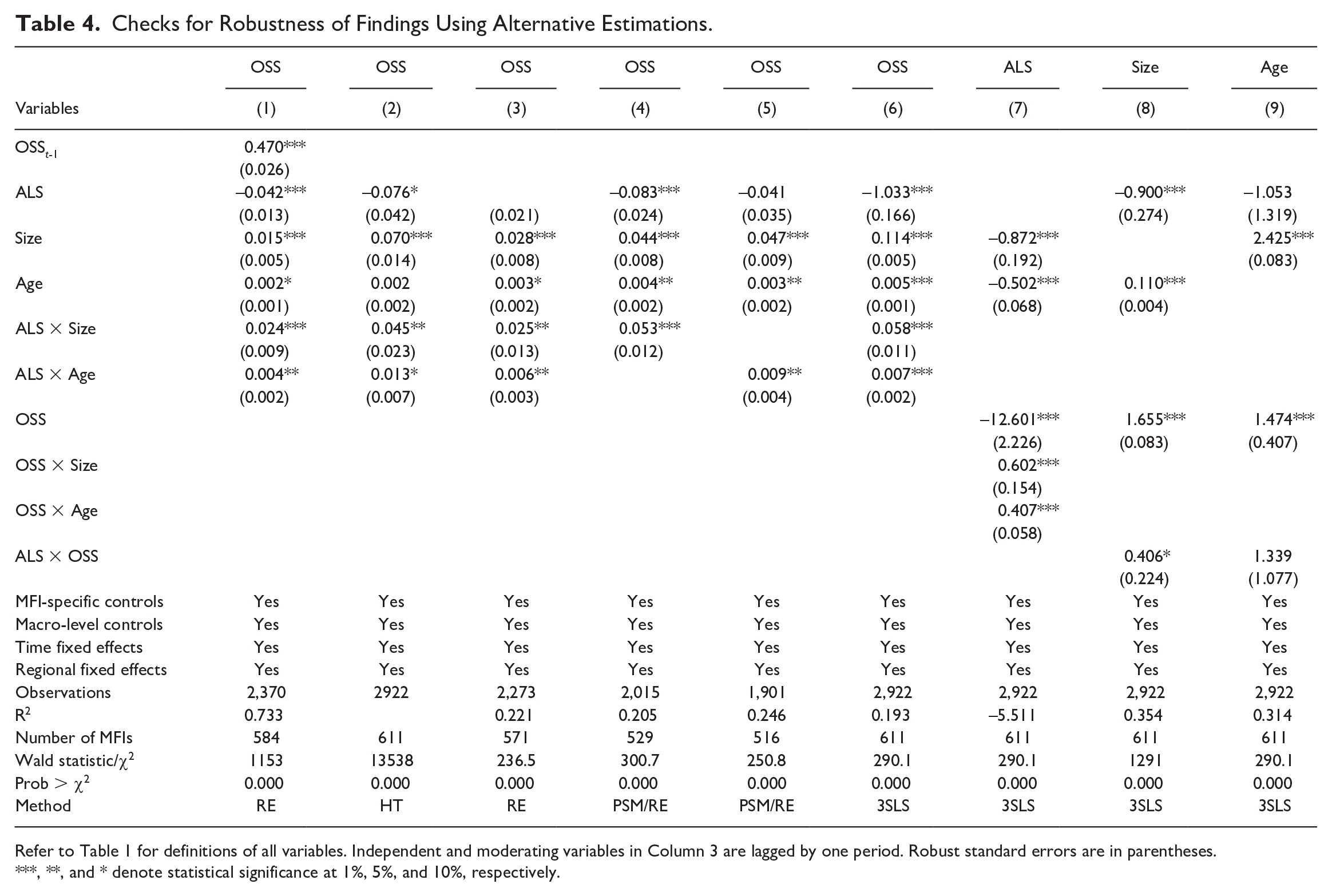
The relationship between size and age and the balancing of social-financial trade-offs, as depicted in Equation (1), may be endogenous. For instance, the random-effects GLS assumes a zero correlation between covariates and the error term, a condition whose violation can lead to omitted variable bias. Moreover, it is conceivable that MFIs capable of balancing their social and financial performance are those that attain long-term success and thus experience greater size and maturity, a scenario that can lead to reverse causality. In addition, social and financial performance may be concurrently determined. We address these possible endogeneity concerns in five ways. First, we include the lag of the dependent variable as an additional covariate and re-ran the model using random-effects GLS. This approach controls for the effects of all unobserved non–time-varying heterogeneity across MFIs on OSS. The results, reported in Column (1) of Table 4, remain unchanged. Second, we run the regressions using an alternative estimation method, the Hausman–Taylor regressions (Hausman & Taylor, 1981). This is an instrumental variable estimator that uses the exogenous regressors in the model as instruments for the endogenous ones. This technique allows for the estimation of the coefficients of time-invariant regressors while relaxing the strict assumption of exogeneity under random effects. The results confirm the main analyses and are reported in Column (2) of Table 4.
Checks for Robustness of Findings Using Alternative Estimations.
Refer to Table 1 for definitions of all variables. Independent and moderating variables in Column 3 are lagged by one period. Robust standard errors are in parentheses.
, **, and * denote statistical significance at 1%, 5%, and 10%, respectively.
Third, we lagged the independent and moderating variables by one period and re-conducted the regressions using random-effects GLS. This step assists us in addressing simultaneity. The outcomes, presented in Table 4 (column [3]), align with those outlined in Table 3, thereby affirming the consistency of our conclusions.
Fourth, we employed the propensity score-matching technique to select comparable groups of MFIs for our analysis. The procedure was conducted twice, focusing on two variables of interest: Size and Age. In the first procedure, we selected comparable larger MFIs (MFI-year observations above the median value of assets of 4,682,992) and smaller MFIs (MFI-year observations below the median value of assets of 4,682,992), resulting in 529 MFIs, 2,015 MFI-year observations, and 85 countries. The second procedure selected comparable older MFIs (MFI-year observations above the median age of 10) and younger MFIs (MFI-year observations below the median age of 10), resulting in a sample of 516 MFIs, 1,901 MFI-year observations, and 83 countries. We estimated Equation (1) based on the resulting samples using random-effects GLS. The results reported in Table 4 show that the coefficients of ALS × Size (Column [4]) and ALS × Age (Column [5]) are positive and significant, consistent with those reported in Table 3.
Fifth, we specify the following three additional models where ALS, Size, and Age are the respective dependent variables:


Equations (1) and (2) model the effect of Size and Age on the balancing of social-financial performance, respectively; Equation (3) estimates the effect of the balancing of social and financial performance on Size; and Equation (4) estimates the balancing of social and financial performance on experience (Age). We jointly ran Equations (1–4) as a system of simultaneous equations using three-stage least squares (3SLS) (Zellner & Theil, 1962). In this procedure, we treat ALS, Size, and Age as endogenous covariates in Equation (1); OSS, Size, and Age as endogenous covariates in Equation (2); OSS, ALS, and Age as endogenous covariates in Equation (3); and OSS, ALS, and Age as endogenous covariates in Equation (4). The three-stage least-squares technique allows us to account for the correlations between OSS, ALS, Size, and Age, while analyzing the hypothesized relationships. The outcomes of the 3SLS, presented in Table 4, validate our hypotheses that Age and Size contribute to enhancing the balancing of social and financial performance in MFIs, as evidenced by the positive coefficients of ALS × Size and ALS × Age in Columns (6) and OSS × Size and OSS × Age in Column (7). However, in Columns (8) and (9), we do not observe compelling evidence for the impact of the balancing of social and financial performance on the size and experience of MFIs. Specifically, we note that the coefficient of ALS × OSS is positive in both Columns (8) and (9), albeit only moderately significant (p < .1) in Column (8).
Alternative Proxies for Financial and Social Performance
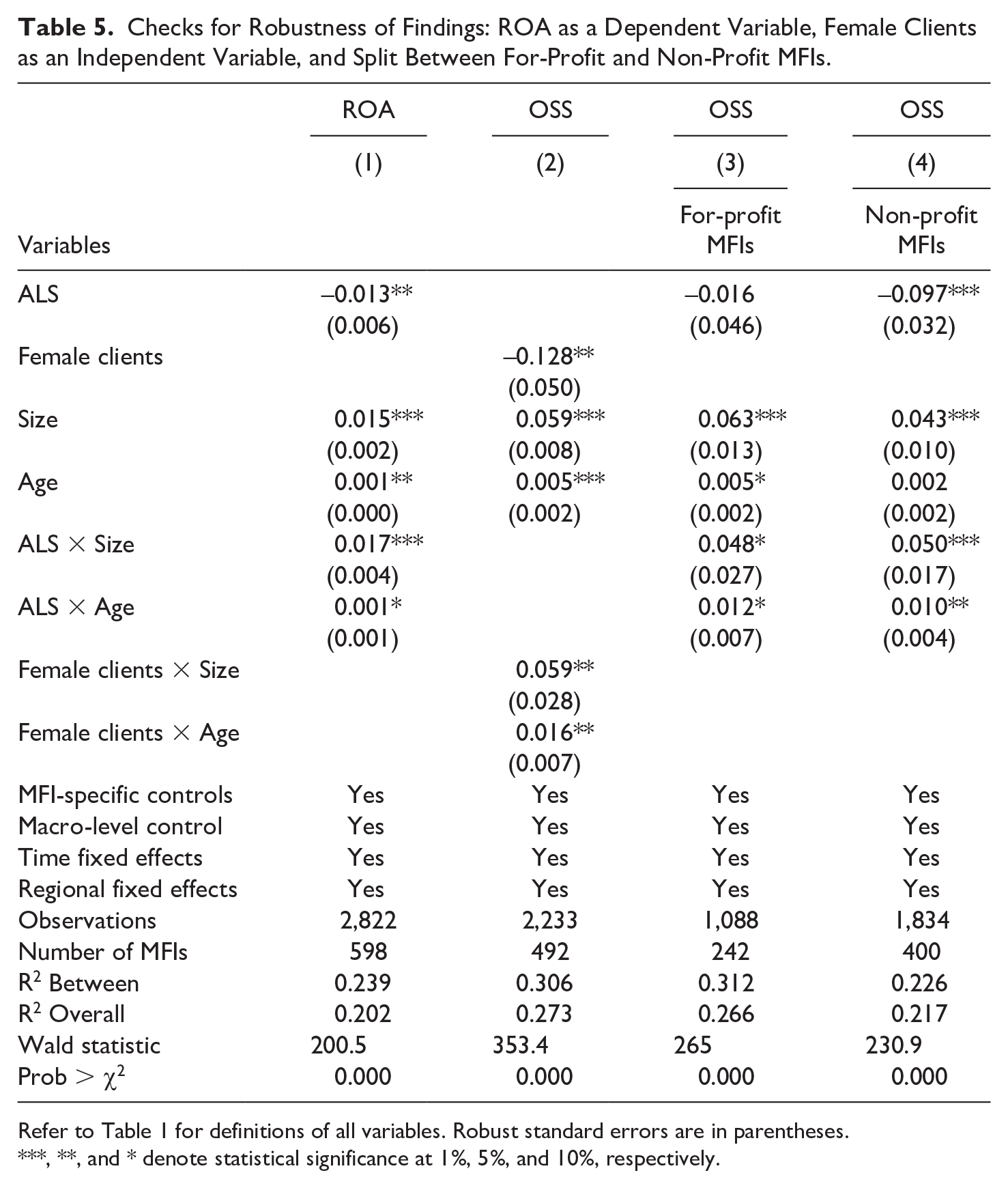
A much-used financial performance metric in the banking industry is ROA. Therefore, we repeat the main analysis using ROA as our financial sustainability proxy. The results, displayed in Column (1) of Table 5, are similar to those of the main analysis reported in Table 3. Because average assets are used in the computation of ROA, one can expect a direct relation between Size and ROA. In an untabulated analysis, we proxy size with total number of clients (log transformed) and rerun the regressions. The results are consistent with our main findings. We earlier mentioned that OSS and ROA are expected to be significantly correlated. Hence, these results are not surprising. Nonetheless, given that financial sustainability and not profit maximization is the main financial objective for many MFIs, we regard OSS at the preferred performance metric.
Checks for Robustness of Findings: ROA as a Dependent Variable, Female Clients as an Independent Variable, and Split Between For-Profit and Non-Profit MFIs.
Refer to Table 1 for definitions of all variables. Robust standard errors are in parentheses.
, **, and * denote statistical significance at 1%, 5%, and 10%, respectively.
We also use an alternative proxy for the measurement of social performance. Because women in developing countries are generally poorer and more vulnerable than males (Garikipati et al., 2017), a much-used proxy is the proportion of female clients in an MFI’s client base (Mersland & Strøm, 2010; Nyarko, 2022). We repeat the main analysis using proportion of female clients as the social performance metric. The results, reported in Column (2) of Table 5, 2 show that the results do not change when we change the social performance metric. As before, age and size improve MFIs’ ability to balance their social and financial performance. In other words, MFIs’ ability to take on more female clients while simultaneously maintaining the ability to be financially sustainable improves as MFIs get older and bigger. This conclusion does not change when ROA replaces OSS as the financial sustainability metric.
Split Sample Into Non-Profit and For-Profit MFIs
Although we include a wide range of MFI-specific controls in our empirical models, there are reasons to suggest that our findings may vary among MFIs with certain stable characteristics. For example, client-targeting strategies can vary between non-profit (cooperatives and NGOs) and for-profit (banks and non-banking financial institutions) MFIs: the former usually have more extensive social outreach than the latter (Roberts, 2013; Shahriar et al., 2016). On the flip side, for-profit MFIs are usually more financially sustainable than their non-profit counterparts. Moreover, for-profit MFIs are usually regulated by local banking authorities, and this allows them to provide other banking services in addition to credit. These factors can affect not only their organizational learning process but also their scaling opportunities. Thus, there may be differences between the extent to which experience and size influence the balancing of social and financial objectives.
To investigate the stability of our findings, we separate non-profit and for-profit MFIs and re-run the analyses on each subsample. Columns (3) and (4) of Table 5 show the results for the for-profit and non-profit samples, respectively. In the table, we observe that though age and size help MFIs to balance social and financial objectives, these effects are stronger in non-profits than in for-profits. Thus, non-profit MFIs benefit more from age and size than their for-profit counterparts. This may suggest that MFIs with extensive social outreach often face sustainability challenges, but they improve over time especially as they increase their asset base. In unreported analyses, we also split the sample by lending method (group versus individual lending), regulation status (regulated versus unregulated), and savings mobilization (whether the MFI accepts deposits) and re-run the analyses on the subsamples. These factors could influence lending risk and operational efficiency of MFIs and thereby influence the ability of MFIs to balance their social and financial performance. The results across the different subsamples were qualitatively similar to those reported in Table 3.
Corporate Governance
Just like in traditional firms, governance mechanisms play a crucial role in distinguishing one MFI from another. Governance acts as an internal compass, guiding organizational direction and shaping outcomes aligned with the institution’s goals and mission (Gull et al., 2018; Young & Kim, 2015). Young and Kim (2015) propose that corporate governance significantly impacts the resilience of social enterprises, such as MFIs, in effectively balancing their dual objectives, while Cornforth (2014) discusses the role of governance in safeguarding social enterprises against the risk of mission drift. Previous research in microfinance has consistently demonstrated the significant influence of corporate governance mechanisms on both the social and financial performance of MFIs (Bennouri et al., 2024; Mersland & Strøm, 2009; Périlleux & Szafarz, 2022).
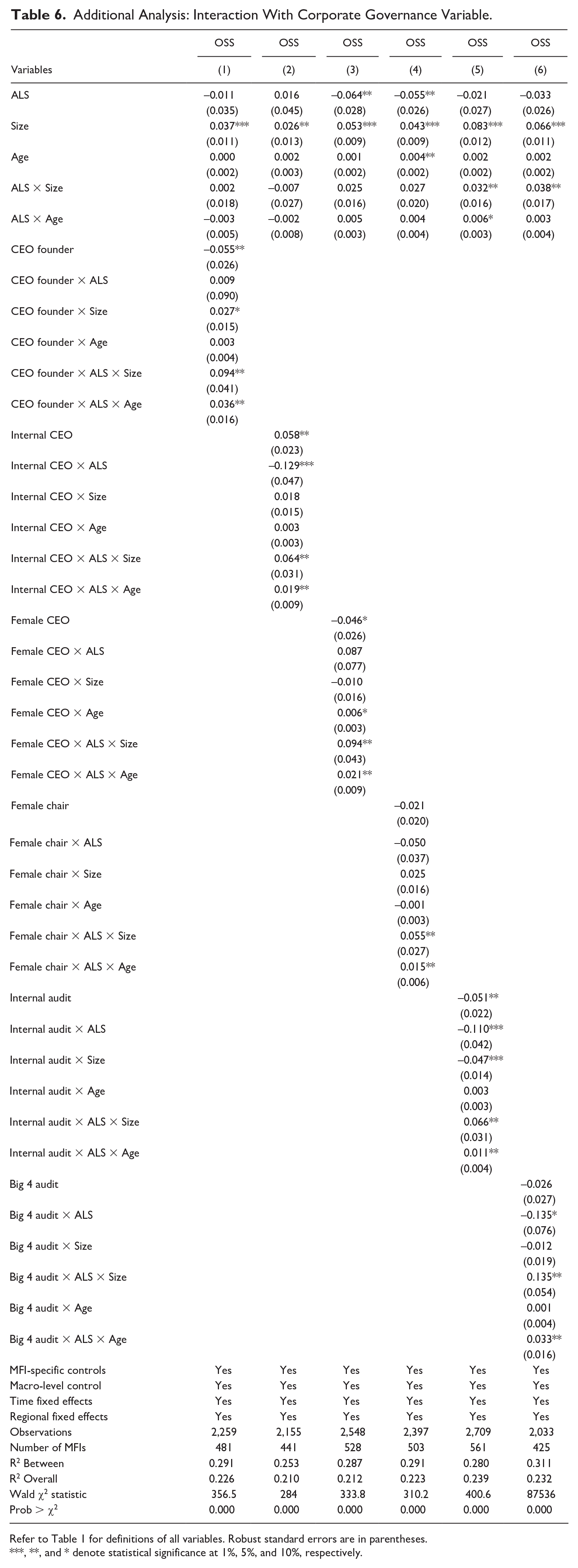
In light of the foregoing, we conducted additional investigations to determine whether our findings are contingent upon the governance structure of MFIs. Leveraging our comprehensive rating dataset, which encompasses various governance variables, we explored whether the moderating effect of Age and Size on social-financial trade-offs varies among MFIs with different governance mechanisms. To achieve this, we employed three-way interaction models, interacting our variables of interest with several governance mechanisms. Consistent with prior research in microfinance, we focused on key aspects such as female leadership (female CEO and female board chair) (Hartarska et al., 2014; Périlleux & Szafarz, 2022; Strøm et al., 2014), the presence of an internal CEO (Mersland, Beisland, & Ndaki, 2019), the presence of an internal audit function (Mersland & Strøm, 2009), audit by a big-4 firm (Beisland et al., 2015), and the presence of a founder CEO (Randøy et al., 2015).
The results, as presented in Table 6, with Columns (1) through (6) showing the outcomes for the interactions with CEO founder, Internal CEO, Female CEO, Female chair, Internal audit, and Big 4 audit, respectively, reveal that the mitigating effect of size and age on social-financial trade-offs is more pronounced in MFIs led by women either as CEOs or chairs of the board, those led by an internal CEO, those with good audit quality (existence of internal audit and audit by a big 4 audit firm), and those led by founders. 3 These findings suggest that size and age are likely to mitigate social-financial trade-offs when MFIs implement robust corporate governance mechanisms. Consequently, MFIs may face the risk of mission drift if they pursue aggressive growth strategies without establishing strong governance safeguards (Cornforth, 2014). For example, Ometto et al. (2019) stress that scaling-up can lead to compartmentalization, potentially disrupting existing structures, weakening internal cohesion, and distracting social enterprises from their core mission, thereby elevating the risk of mission drift. To reconcile social and financial objectives, these authors highlighted the importance of integrating negotiation spaces—an internal forum for organization members to discuss and resolve social-financial tensions—and herding spaces—a mechanism that connects social enterprises to their institutional context in a way that fosters learning from other social enterprises and stakeholders.
Additional Analysis: Interaction With Corporate Governance Variable.
Refer to Table 1 for definitions of all variables. Robust standard errors are in parentheses.
, **, and * denote statistical significance at 1%, 5%, and 10%, respectively.
Using MIX Dataset
We assess the robustness of our findings using data sourced from the MIX Market. It is important to note that the publicly available version of the MIX dataset lacks information regarding the age of MFIs. As a result, we confined our analyses to testing Hypothesis 2, and the outcomes, which consist of random-effects regression results, are presented in Table 7. The analysis is based on a sample of 1,630 MFIs, encompassing 10,918 MFI-year observations across 102 countries, covering the period from 2000 to 2018. Notably, the coefficient of the interaction term, ALS × Size, is found to be positive and statistically significant (p < .001), indicating that MFI size mitigates the trade-offs between social and financial performance. These findings align with those presented in Table 3 (columns [6] and (7)), which are derived from our rating dataset. We also note that the coefficients of ALS and Size are consistent in Tables 3 and 7. In additional analyses, we re-ran all the preceding robustness checks―using alternative estimation methods, alternative proxies for social and financial performance, and splitting the sample into non-profit and for-profit MFIs―using the MIX dataset. The unreported results confirm those reported in Tables 4 and 5.
Random-Effects Regression Results Based on MIX Dataset on the Relationship Between OSS and ALS: The Moderating Effect of Size and Experience.

Table 7 presents the outcomes of supplementary analyses for checking the robustness of our findings using the MIX dataset. Refer to Table 1 for definitions of all variables. Robust standard errors are in parentheses.
, **, and * denote statistical significance at 1%, 5%, and 10%, respectively.
Concluding Remarks
As MFIs advance through their life cycles, there is a push toward increased commercialization (Ashta, 2020). However, being social enterprises, it is vital for MFIs to avoid mission drift by keeping their social and financial performance goals in balance despite pressure to the contrary from stakeholders and adversity in the business environment (Serrano-Cinca et al., 2023). MFIs’ ability to stay true to their initial dual objectives is affected by their capacity to resist forces that push the institutions away from the original mission (Kent & Dacin, 2013; Xu et al., 2016; Young & Kim, 2015). Therefore, from a policy perspective in the microfinance industry as well as for social enterprises in general, a major research question should be to investigate which organizational characteristics are associated with MFIs’ ability to preserve their original mission of providing sustainable banking services to the poor.
We propose that experience and size improve MFIs’ ability to balance social performance and financial sustainability. The empirical tests provide strong support for our hypotheses. Our study contributes to a better understanding of the MFIs’ ability to remain mission-focused while being financially sustainable (Hermes & Hudon, 2018; Young & Kim, 2015). Nonetheless, more research is needed to explore the underlying mechanisms driving the results. For example, it is possible that the process of learning associated with financial performance is different from the one associated with social performance. Also, decisions affecting the balance between social and financial performance are strategic in nature as they involve the direction of the organization. To this end, the balance could be affected by short- and long-term strategies adopted by MFIs as well as by the expectations of dominant stakeholders (Ebrahim et al., 2014; Sakarya et al., 2012; Serrano-Cinca et al., 2023; Wry & Zhao, 2018), but our empirical analysis does not capture these specific mechanisms. In this regard, Sakarya et al. (2012) discuss how social enterprises build social alliances with regular businesses, while Ometto et al. (2019) demonstrate how social enterprises learn from each other through a mechanism they term as herding spaces. We believe learning effects and economies of scale may be the main explanations for our findings, but we propose the use of survey evidence to further investigate the issues of our study.
Our findings carry significant implications for MFIs and their stakeholders. First, microfinance investors seeking both social and financial returns can glean valuable insights from our research. Impact investing organizations in Europe and the United States, which support financial inclusion initiatives in developing countries through various financial instruments such as equity and concessionary loans, aim to generate social impact while earning financial returns on their investments (Mersland et al., 2020). These organizations should find our findings useful for informing their investment decisions. Specifically, prioritizing larger and more experienced MFIs with stronger governance mechanisms in place would be advantageous for this investor class. This recommendation also extends to donors, who, while primarily focused on social impact rather than direct financial returns, still value the long-term financial stability of the MFIs they support. Therefore, an MFI’s ability to balance social and financial performance can serve as a key differentiator in attracting donor support. Moreover, our core findings suggest that donors and regulators should favor organic growth over setting up new entities, as this can lead to a more sustainable delivery of financial services to the poor and unbanked.
Second, our findings also hold implications for MFIs themselves, particularly in their expansion strategies. MFIs stand to gain efficiency by leveraging their existing resources, capabilities, and experience. External resource providers may exert pressure on pro-social organizations, and over-reliance on such resources to fund growth prospects can exacerbate social-financial tensions, leading to the risk of mission drift (Cornforth, 2014; Ometto et al., 2019). Promoting internal members to top-level positions, such as the CEO, could contribute to balancing social and financial performance in larger and more experienced MFIs. Similarly, retaining founders in management positions can be beneficial. Overall, the practice of retaining employees and filling management positions internally could help MFIs achieve hybrid performance, as suggested in previous studies (Godfroid et al., 2022).
Third, our findings offer valuable insights for microfinance managers, particularly as the microfinance industry matures across various markets. With the sector becoming more established, it has become increasingly challenging for new MFIs to achieve growth using the same business models as their more experienced counterparts. New MFIs, lacking the experience, market knowledge, and brand recognition of established institutions, may encounter lower profit margins and difficulty in balancing social and financial performance. To succeed, managers of new entrants must innovate their business models and differentiate themselves from competitors. For instance, He et al. (2022) demonstrate, through case study evidence, how digital innovation can be harnessed to harmonize competing institutional logics by fostering a mutually reinforcing interaction between social and financial objectives. Innovation is critical in the microfinance sector, where traditional loan products and methodologies are often labor-intensive and rigid, leading to high-cost loans that may not match clients’ cash flows or financing needs. By embracing technologies such as artificial intelligence, mobile lending, and other fintech solutions, MFIs can create innovative, client-centric offerings. However, beyond technology, younger MFIs should focus on engaging more closely with their target clients. Collaborating with clients to co-design methodologies that balance the needs of both parties is essential. In this regard, today’s MFIs can still draw valuable lessons from ancient indigenous practices, such as ROSCAs (Rotating Savings and Credit Associations) and similar informal financial systems. These systems inspired pioneers like Yunus in the 1970s, and even today, they remain the primary financial mechanisms in many African countries. Revitalizing these practices could spur new innovations in microfinance.
In addition, Mersland, Nyarko, and Szafarz (2019) note that several MFIs share common social missions. In this regard, our findings should motivate managers of MFIs with similar missions to consider opportunities for mergers, allowing them to benefit from economies of scale and build more resilient organizations.
In this paper, we have mainly focused on traditional proxies for assessing the social and financial performance of MFIs. However, we acknowledge that poverty, the main social issue MFIs wish to address, is multidimensional, and its measurement requires a more variegated approach (Hermes & Hudon, 2018; Rawhouser et al., 2019). ALS is used by academics and practitioners to gauge MFIs’ social outreach performance, but this proxy is noisy as it is sensitive to practices such as progressive lending and cross-subsidization (Armendàriz & Szafarz, 2011; Hermes & Hudon, 2018). Ongoing industry efforts such as the creation of universal standards for social performance management 4 aim at addressing the multiple facets of social performance and the ethical issues involved. Indeed, providing sustainable financial services to the poor raises several ethical considerations (Hudon et al., 2020; Hudon & Ashta, 2013). We encourage future studies to build on our study but to use standard social performance proxies that become available in the future. Also, future studies are needed to establish the influence of experience and size on MFIs’ compliance with ethical standards in the industry.
Our main analyses relied on a dataset compiled from social and institutional rating reports, sourced from reputable microfinance rating agencies. While this dataset is commonly utilized in previous studies, acknowledged for its quality, and considered comparable to the publicly available MIX (Hudon & Traca, 2011), it does have certain limitations. Notably, it does not encompass many small savings and credit cooperatives, which typically do not undergo ratings, nor does it include larger microfinance banks often rated by traditional agencies such as Standard & Poor’s (Mersland & Strøm, 2012). Despite utilizing MIX as an alternative dataset, we encourage future studies to delve deeper into the drivers of social-financial trade-offs using high-quality country-level data provided by regulatory institutions, as well as in-depth case studies (Battilana & Dorado, 2010). Such approaches hold promise for uncovering new and insightful perspectives on the manifestations and management of social-financial trade-offs.
While the subject of balancing social and financial performance is common to all forms of social enterprises (Doherty et al., 2014), we acknowledge the need for caution when generalizing our findings to other social enterprises. Our empirical analysis focused solely on one type of social enterprise, namely MFIs, whose primary value proposition lies in financial intermediation. Consequently, MFIs differ from other social enterprises, such as work integration social enterprises providing employment opportunities to socially excluded groups (Battilana et al., 2015), and fair-trade social enterprises supporting marginalized farmers by offering them development opportunities and better trading conditions (Mason & Doherty, 2016). In this regard, our findings are more applicable to social banks which are also social enterprises involved in financial intermediation (Cornée et al., 2020).
Finally, we recommend further research on how regulation and market competition affect the balance between social and financial objectives in MFIs and social enterprises in general. The theory of institutional isomorphism suggests that organizations tend to become increasingly similar in competitive and regulated environments. How do the forces of isomorphism affect trade-offs in social enterprises? Furthermore, MFIs are conceptualized as integrated hybrids, which are social enterprises achieving their social and developmental goals by integrating beneficiaries and customers and pursuing social and economic goals through the same activities (Battilana et al., 2012). This distinguishes them from differentiated hybrids where customers and beneficiaries are distinct groups targeted with distinct activities (Ebrahim et al., 2014; Mason & Doherty, 2016). Integrated and differentiated hybrids are organized differently (Ebrahim et al., 2014), suggesting that our findings may be more applicable to the former than the latter. Given the diverse nature of the social entrepreneurship field (Defourny et al., 2021; Defourny & Nyssens, 2010; Searing et al., 2022; Young & Lecy, 2014), we encourage future research to expand our study to other domains within the field, such as work integration (Battilana et al., 2015), food security (Searing et al., 2022), among others. Such endeavors will contribute to a more comprehensive understanding of the mechanisms underlying the balancing of social and financial outcomes in social enterprises across various contexts and models.
Footnotes
Acknowledgements
The authors extend their gratitude to Trond Randøy, R. Øystein Strøm, Kjetil Andersson, Marit Kringlen, the editors Jaclyn Piatak and Joanne Carman, the three anonymous referees, and participants at the Center for Research on Social Enterprises and Microfinance (CERSEM) workshop (Norway), the internal seminar at the Norwegian School of Economics (NHH), the staff seminar at UiA School of Business (Norway), and the 8th European Research Conference on Microfinance (Italy) for their valuable feedback. This study was conducted within the framework of the MBS School of Business Social and Sustainable Finance Chair, funded by Caisse d’Epargne Languedoc Roussillon and BNP Paribas. The first author is also affiliated with LabEx Entrepreneurship, funded by the French government (LabEx Entreprendre, ANR-10-Labex-11-01).
Declaration of Conflicting Interests
The author(s) declared no potential conflicts of interest with respect to the research, authorship, and/or publication of this article.
Funding
The author(s) received no financial support for the research, authorship, and/or publication of this article.
