







Abstract
Minimum wages legislation in the United Kingdom applies to those aged 16 years or older. Evidence is presented that children believe that their wage levels should be ‘fair’. On one hand, such views have emerged from focus groups of working children. On the other, various pressure groups representing young people are seeking to establish fair payment to child workers. It is argued that the government, trade unions and other bodies have failed to adequately address the protection of young workers.
Introduction
More than two decades of research has consistently shown that part-time work for pay by UK secondary school students, still in full-time education, is common. The most recent large-scale systematic study (Howieson et al., 2006) confirmed the findings from earlier research that by the end of compulsory secondary education, most school students will have experience of paid employment. A dominant question for child employment research, both in the United Kingdom and further afield, has been whether the experience of work is beneficial or harmful to the young worker. A number of studies have considered the relationship of part-time work to educational outcomes (Holford, 2015; McKechnie and Hobbs, 2001) and health and safety (see, for example, Heptinstall, 1998 and Hobbs et al., 2009). However, an issue that has yet to gain traction is young workers’ pay. Wage legislation in the United Kingdom currently protects only those aged 16 years or older. However, there is some evidence that the issue may be relevant to younger workers under the age of 16 years. In this article, we explore the issue of wage protection for adolescent workers. Our principal sources are, on one hand, political action by young workers or groups concerned with their interests, and, on the other hand, the outcomes of focus groups comprises school-aged workers. Bourdillon et al., (2010) suggest that ‘economic exploitation’ is a difficult concept to employ when assessing the rights and wrongs of children working. Nevertheless, we shall argue that it is appropriate to consider it as a possibly significant feature of the work undertaken by young people in the United Kingdom.
Political action
In 2010, a petition was presented to the Scottish Parliament by two school students. It is filed as Petition PE1317. The petition and responses to it are to be found on the Scottish parliament’s website (Scottish Parliament, 2010). It called upon the parliament to urge the Scottish government to ensure that the rights of school aged workers in part time employment are protected so that employers cannot impose excessive working hours to the detriment of the workers academic studies and bring about greater transparency in the distribution of tips (i.e. gratuities) to young workers in the hospitality trade.
It may be noted that the petition acknowledges the importance of education and that the objective is couched in terms of the ‘rights’ of school-aged workers. The reference to tips may superficially appear odd, given that there is no general statement about payment. However, it is reasonable to assume that here the impact of direct personal experience is playing a part. Whereas in a questionnaire response about payment, the main influence is a general principal, here we may be seeing the impact of a young worker’s perceived lack of fairness based on experience. A similar perception was cited by the response of the Scottish Youth Parliament (SYP) to the petition: When I was 16, I started a part time job, but didn’t get the half hour break for every four and a half hours I worked because I was told it ‘wouldn’t be fair’ to older workers. However, I was paid less and had some of the worst jobs, like scraping chewing gum off chairs. Young people are taken advantage of because of their age.
In general, the responses to this petition published on the website suggest that the issues raised are not ones to which the individuals and bodies concerned have paid much attention previously. A Scottish government minister rather defensively pointed out that the government had no statutory duty to check whether local authorities were carrying out their responsibilities in this area. However, the final considered response did imply that it might be appropriate for the government to concern itself with such issues (although no action has since been made public). Since the minimum wage is a United Kingdom rather than a Scottish responsibility, the UK Department of Business Innovation and Skills was invited to comment, but the response does little more than acknowledge inaction, as is the case with the response of the Low Pay Commission.
The petition just discussed was presented in the names of two individuals. However, there has since been political action aimed at fairer pay for young workers which has been undertaken by organisations claiming to be more representative. They are among a substantial number of bodies which claim to be run by young people and aimed at facilitating the expression of young people’s opinions. The oldest is the British Youth Council. Initially established by the British government, it eventually became an independent charity (British Youth Council, 2010a). The British Youth Council has a campaign, Equal Pay for Equal Work, based on breaking the current link between wages and age. However, the way in which its goals are expressed explicitly excludes school-aged workers: ‘equal National Minimum Wage for everyone aged over 16’ (British Youth Council, 2010b). Such wording might even be said to distract attention from wages for younger workers as an issue.
In contrast to the British Youth Council, two other bodies, the SYP and Kent Youth County Council (KYCC), have taken up the issue of pay for younger workers. It should be stressed that the titles adopted by some of these organisations are potentially misleading. For example, the two bodies whose actions we are about to consider include in their names the words ‘Parliament’ and ‘County Council’. In the United Kingdom, ‘Parliament’ and ‘County Council’ are terms which refer to bodies with actual legislative powers. The bodies whose actions we shall now consider are pressure groups whose only powers lie in their abilities to be persuasive. Both have been set up to encourage political awareness among young people. They share with legislative bodies the fact that they are elected, although the constitution of their electorates is less formally defined. Among the aims of the SYP are to truly involve young people in ‘the decision-making process’ and to allow young people to ‘give their views to policy makers without hindrance, fear or barriers’ (SYP, 2013a). However, it should be noted that the ‘involvement’ mentioned in the earlier aim amounts essentially to the opportunities to give their views. KYCC also has this limitation on its role. It could be argued that there is a lack of clarity in the description of the roles of these bodies, and others like them, which is regrettable from the point of view of increasing analytical awareness of the realities of power in society.
The SYP for a time had a policy that there should be a standard minimum wage, irrespective of age. This thus involves an objection to the current UK minimum wage legislation which differentiates between workers aged 21 years and over, 18–20 years and 16–17 years. The phrasing of a motion from two members before it in 2013, calling for a ‘suitable’ minimum wage for workers aged 13 years and over (SYP, 2013b), may be indicative of an awareness that the SYP policy might be less acceptable if a standard minimum wage were to apply to workers as young as 13 years of age. Currently, the SYP has a campaign focussing on a ‘fair’ wage, rather than the setting of a minimum wage. This parallels general campaigning in the United Kingdom in favour of a ‘Living Wage’.
The strategy adopted by KYCC is rather different, perhaps due to awareness of the difficulty of having a policy of simply extending a standard minimum wage down to younger workers. KYCC invites employers to subscribe to a voluntary ‘KYCC Certified Youth Employment Code’ (Kent Youth County Council, 2013). Among the provisions is a minimum wage of £2.60 per hour for under 16s. This was more than £1 per hour less than the current nationally enforced rate for 16- to 17-year-olds. When launched in November 2012, it was claimed that the Code already had the support of ‘the largest employers in Kent, including well-known high street brands’. It would appear that the KYCC is ahead of the SYP in attempting to find practical ways of avoiding the economic exploitation of younger workers, although it is too soon to tell how effective its Code will be in practice.
Focus group research
The political activity discussed above does not necessarily reflect the views of adolescent employees. Accordingly, it seems appropriate to compare this political action with the standpoints expressed by young workers in the course of an investigation of their views on how their work should be regulated.
The Department of Education commissioned research on the regulation of child employment in England because of an awareness that the current method of regulating it is ineffective (McKechnie et al., 2011). British law on child employment refers to children who are subject to compulsory education, that is, those aged under 16 years. Regulation is supposedly administered by local education authorities but research has repeatedly shown that most working children have not obtained the required permission from those authorities to take up employment (Hobbs and McKechnie, 1997; Howieson et al., 2006). Local authorities are thus not in a position to monitor whether the work undertaken is within the legally proscribed limits. The research involved obtaining information from different parties, including local authorities, employers and children, on the working of the present system and discovering their opinions on various options for change. Children generally have few opportunities to express their views about part-time employment. Accordingly, if their beliefs and opinions are to be discovered, careful interviewing or group discussion techniques need to be employed. Previous research has indicated that interviews, focus groups, essays and photography can be informative if appropriately prepared (see, for example, Hobbs et al., 2007, 2009, for interviews, Howieson et al., 2006, for focus groups, Morrow, 1992, for essays, and Mizen, 2005, for photography).
The primary aim of the focus groups in this study was set by the sponsor, the Department of Education (McKechnie et al., 2011). It was to obtain evidence of the views of young people of school age on issues concerning the regulation of child employment. However, the research technique allowed issues to emerge from the participants which had not necessarily been the primary interest of the investigators. As will be seen, financial unfairness was one such issue. We shall briefly describe the methods and general findings before considering this aspect of the school students’ views.
Participants were recruited in the following way. An initial survey was carried out in two secondary schools. The target groups were all school students in school years 9 through to 11, their ages being approximately 13–15 years. The sample size was 809. On the basis of information supplied in the survey on their experience of paid employment, students were then invited to participate in focus groups. The intention was to include in the groups those students who had worked in the different types of jobs undertaken by people of this age range. Actual final membership was dependent on willingness to participate and parental permission.
In addition to asking students about their work experiences, the survey also contained a set of questions aimed at eliciting opinions about child employment and its regulation. Students were asked to indicate their agreement/disagreement on a 5-point Likert scale to a series of statements relating to the regulation of child employment. Analysis of the responses to these questions allows us to explore the extent to which views expressed by participants in the focus groups correspond to those of their peers generally. In total, three focus groups were run consisting of 6–8 participants. There were 20 focus group participants in all, 10 males and 10 females. Their ages ranged from 13 to 15 years. Most were currently working in delivery (9), hotel and catering (5) and retail (4). Some had experience in more than one sector.
The focus group procedures were designed to encourage thought and expression of ideas. The time was split between discussion, which was recorded, and the filling in by each member of the group of a workbook. The workbook consisted of a set of tasks such as indicating the advantages/disadvantages of part-time employment. The recordings and the workbooks together provided the basis for subsequent analysis and interpretation. The focus group recordings were transcribed, and responses to each discussion point were thematically analysed to allow for the identification of common themes across the three focus groups. Student workbooks were evaluated by identifying common responses to the tasks. In the case of the workbooks, responses were collated on the basis of frequency of occurrence.
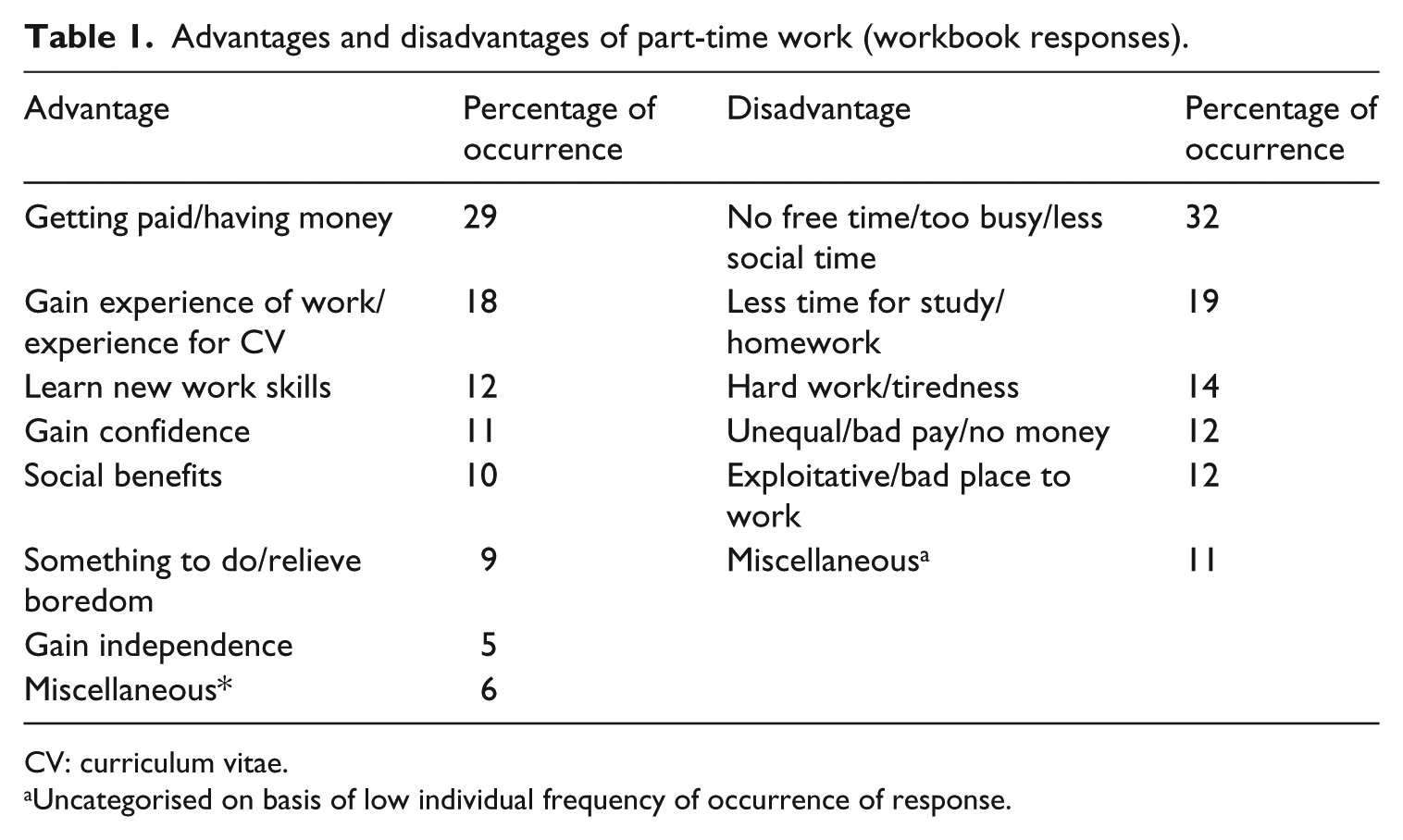
A commonly expressed reason for working in all three focus groups was the financial reward. In discussion, the first motive given for working was invariably ‘money’. Another frequently occurring concept is ‘experience’ which is employed in different ways. It may refer to developing an understanding of the world of work, to specific skills or to social learning. For example, one participant working in a hotel said, ‘It’s really good … getting used to talking to new people and handling yourself in different situations …’. Another said, ‘preparing you for later life’. Several mentioned the benefits of having experience to ‘put on their CV’s’. Others referred to personal gains in terms of building confidence: ‘You’re more confident to go and see people …’. However, it was evident from the focus groups that pay is a dominant theme in terms of motivation to work.
The importance of monetary reward is also reflected in the workbook responses. Participants were asked to identify the advantages/disadvantages of part-time work. Table 1 provides a summary of the responses.
Advantages and disadvantages of part-time work (workbook responses).
CV: curriculum vitae.
Uncategorised on basis of low individual frequency of occurrence of response.
Positive aspects of receiving a wage include the general description of ‘getting money’, some refer to getting ‘extra money’, for others it is their ‘own money’ which provides some level of independence from their parents. Independent purchasing power and the ability to save money for the future also feature commonly in the benefits of earning money. However, participants also recognised the potential exploitative nature of earning. Several references were made to ‘bad pay’ and ‘low wages’. Workers’ powerlessness against ‘unfair’ or ‘unequal’ wages was acknowledged, ‘[you] can’t do anything about it’. Other participants alluded to an acknowledgement of their vulnerability to various forms of exploitation. Several references were made to ‘not nice’ or ‘bad employers’. Others referred to ‘unfair treatment’ and not being ‘respected’ at work.
In the workbook responses, the issue of pay emerged as a disadvantage. In terms of comments, just under a quarter indicated concerns related to pay (e.g. unequal pay) and exploitative behaviours linked to pay, hours and poor work practices.
The theme of exploitation was further reflected in the focus group discussions. In general, the members of the focus groups recognised the need for child employment to be regulated. ‘You should be allowed to work as much as you like’ was a rare, isolated point of view. The majority of participant’s comments related to the need for regulation to protect young workers.
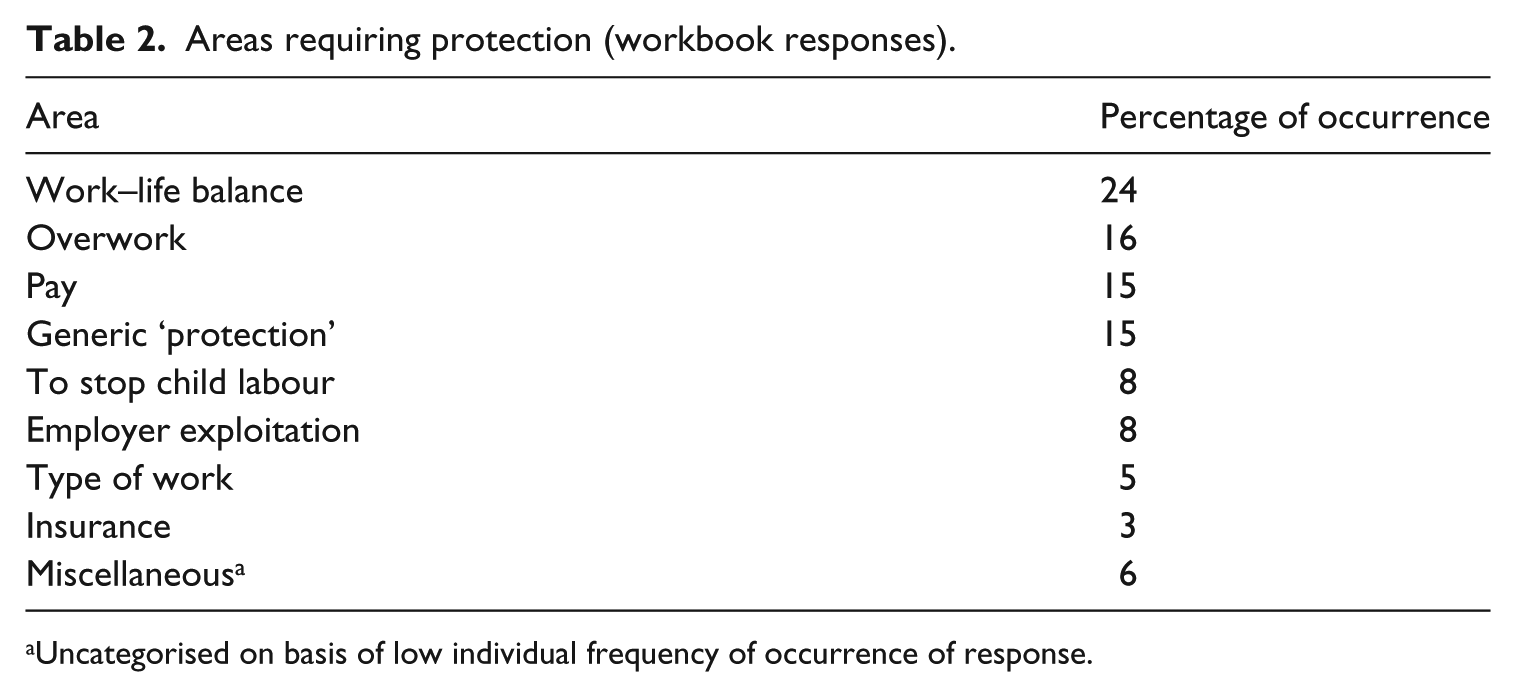
The issue of protection emerged in the workbook responses when participants were tasked with identifying the purpose of child employment regulation. A dominant theme to emerge was that of protecting child employees. Table 2 provides a summary of the areas where workers needed protection.
Areas requiring protection (workbook responses).
Uncategorised on basis of low individual frequency of occurrence of response.
The most common protective aspect participants identified was the need to ‘have a balance of hours’ between different elements of their lives; ‘school’, ‘exercise’, ‘social life’ and ‘hobbies’ are mentioned by two-thirds of the focus group members. Related to this is an acknowledgement that hours of work should be restricted to ‘prevent being overworked’ and ensure adolescents ‘get enough rest’. The need for protection in these areas is recognised by the current legislation.
One of the most common categories of response consisted of references to ‘pay’, and more specifically to ‘fair pay’. The issue of fairness was a key concern for participants. In the focus group discussions, child employees, comparing themselves to other part-time workers, made comments such as ‘We’re doing the same job just for less pay basically’. One goal for regulation which was suggested was to ensure ‘equal pay for the same job’. In all three focus group discussions, participants referred to the notion of a minimum wage. In one group, an employer was mentioned who only advertises and employs children so they ‘don’t have to pay minimum wage’. In contrast to the previous areas requiring protection, the issue of pay and a minimum wage is something which current legislation does not actually cover.
There is also awareness that employers cannot necessarily be assumed to have the child’s welfare at heart. This is shown in references to ‘dodgy employers’, ‘funny employers’ and ‘abuse’. Some employers were seen as paying low wages because ‘they know they can get away with it because you’re young’.
Despite the acceptance of a need for protection, there is also the view that a job may be advantageous because there may be some risks involved: ‘I think we should still be able to work because then we’ve got experience of not just being in a completely safe environment …’.
It is possible that our focus group participants were not reflecting common concerns. We were able to check this by returning to the survey which was completed by all the school students (n = 809). As noted earlier, school students responded to a series of ‘opinion’ statement in the survey. Answers to ‘opinion’ items in the survey suggest that there are broad areas of agreement between the focus group participants and their peers. On pay, it was found that there was strong support for a minimum wage for under 16s, 67% either agreeing or strongly agreeing. On restrictions to working hours, 60% favoured the current embargo on work earlier than 7:00 a.m. However, only 40% agreed with the restriction on working after 7:00 p.m. and more opposed the 2-hour limit on Sunday working than supported it (41% against and 32% in favour, the remainder being undecided or failing to respond).
As we noted, the purpose of the focus groups was to explore the issue of child employment regulation. The fact that issues of fair pay and equality of treatment emerged is notable and indicates that these are areas of concern for young workers. We conclude that there is congruence between the political claims discussed previously and concerns about unfair payment expressed by the focus group members.
Governmental responsibilities
The United Kingdom is a signatory to the United Nations Convention on the Rights of the Child. However, we should question whether the United Kingdom, in fact, meets one of the obligations: protection of working children against ‘economic exploitation’ (CRC, 1989: Article 32). The convention treats as a child anyone aged less than 18 years. For practical purposes, a working ‘child’ in the United Kingdom has until recently been anyone who has not yet reached the end of compulsory schooling, namely, the first official school leaving date after the 16th birthday. Legislation is in place to regulate the employment of such children.
The Children and Young Persons Act, 1933, has from time to time been amended but remains the basic framework for the legal status of child employment in Britain. The types of work which may be undertaken by children and the hours of work are specified nationally, and there is provision for local authorities to make more stringent conditions. For a child to be employed, the legislation requires that permission first be obtained from the local education authority. This in theory allows the authority to check whether the employment is likely to be harmful to a child’s education, health or well-being.
It should be noted that it is now widely recognised that regulation is ineffective (see, for example, Howieson et al., 2006; McKechnie et al., 2011). Less than 20% of children with jobs have the necessary work permits and, even where permission has been obtained, it is not clear that careful checks on the possible impact of the job are always made. Although this is clearly a failing, it may at least be said that the legislation is in place, and successive governments have from time to time considered possible improvements. However, it may also be said that in neither the legislation nor the implementation is any attention paid to economic exploitation.
As noted earlier, research on working children in Britain has considered the relationship between employment and both education and health but in what sense can it be said that any of these young workers are economically exploited?
The meaning of exploitation
Some consideration must now be given to what the phrase means. As pointed out by Bourdillon et al. (2010), ‘exploitation’ is frequently used in discussions of children’s work to refer to any undesirable effect. Indeed, one collection of articles on child labour is simply entitled ‘The Exploited Child’ (Schlemmer, 1996, in French, and 2000, in English). This broad meaning is not how the term is used in the CRC (1989) because ‘economic exploitation’ appears in a list of effects against which working children need to be protected: State Parties recognize the right of the child to be protected from economic exploitation and from performing any work that is likely to be hazardous or to interfere with the child’s education, or to be harmful to the child’s health or physical, mental, spiritual, moral or social development. (Article 32)
The European Union (EU) Directive on the Protection of Young People at Work (EU, 1994), to which the United Kingdom is also required to conform, has similar wording.
What is the implication of the qualifying adjective ‘economic’? In its first appearance in English, according to the Oxford English Dictionary (OED) (1933), ‘exploitation’ referred to making use of a resource, such as raw materials or land. However, the word took on particular judgemental implications when employed to refer to human work. In 1834, the phrase ‘exploitation de l’homme par l’homme’ was used in this way in French (Dauzat et al., 1971), that is, the exploitation of man by man. The earliest text cited in OED, which similarly refers to how human beings are treated, dates from the 1840s and deals with slavery. Thus, a moral judgement was implied. Classical Marxist writers, including Marx himself, treat exploitation as referring to the gap between what is paid to workers and the value of the product, the gap being how capital is accrued: The rate of surplus-value is therefore an expression for the degree of exploitation of labour power by capital, or of the worker by the capitalist. (Marx, 1976: 326)
Although Marx was attempting a scientific analysis of economic relations, his conception of the exploitation of labour was taken up as part of the moral critique of capitalism, treating it as a fundamental unfairness at the heart of the system. In response to such a view, the Keynesian economist, Joan Robinson (1964) has famously suggested, As we see nowadays in South-East Asia or the Caribbean the misery of being exploited by capitalists is nothing compared to the misery of not being exploited by capitalists. (p. 46)
Harm may come not only from being part of the capitalist process of production but also from being excluded from it.
We conclude that the technical meaning of ‘exploitation’ in economic literature is not what is meant by ‘economic exploitation’. We also note that, as pointed out by Levison (2000), economists on the whole have not treated children as economic agents. Thus, there is not an appropriate literature which could throw light on ‘exploitation’ of child workers, equivalent to economists’ discussions of exploitation of labour generally. A number of sociologists have emphasised the economic activity and agency of children (see, for example, Nieuwenhuys, 2005; Wintersberger, 2005; Zelizer, 1985, 2005). However, these authors have little to say about the level of pay and reward for economic activity.
When considering ‘economic exploitation’, it would appear that the term is used to refer to judgements about the pay child workers receive. Clearly, such judgements are likely to be open to debate. However, in Britain, no sustained debates of this sort appear to be taking place. There is, as we have shown earlier, evidence that some child workers in the United Kingdom consider their payment to be unfair. We suggested that with reference to child employment, ‘economic exploitation’ refers to ‘unfair’ wages for the work done; however, the estimation of the fairness or unfairness is arrived at. Thus, when child workers complain of ‘unfair’ wages, they may be seen as raising issues of economic exploitation of a sort which are generally overlooked in Britain.
Control of payment for work
It should be noted that in modern times, British politicians have explicitly excluded children from legislation laying down standards for payment. When Minimum Wage legislation was introduced in Britain in 1998, initially it was for those aged 18 years and over. This was only later extended down to 16-year-olds. Those aged under 16 years are thus still not protected by this legislation. Consideration of minimum wage regulation raises another issue. Why are wages related to age? Younger workers may have less well-developed skills for the job or may require to spend some of their time at work being trained. If this applies to 16-year-olds and 18-year-olds, it would presumably also apply to 14-year-olds. This would imply that a minimum wage could be set at a lower level for younger workers. However, this has not happened, no level at all being specified for school-aged workers.
There may be another implicit assumption in the failure to set wage levels for younger workers. It may be thought that wages are of relatively little significance for them, as they would be contributing little to a typical family income. In other words, children working are not seen as economic entities. A related assumption is that few children in Britain work. This was argued by government ministers when the EU directive was first introduced (see Hobbs and McKechnie, 1997). Subsequent research evidence showed them to be wrong (Hibbett and Beatson, 1995; Hobbs and McKechnie, 1997; Howieson et al., 2006).
Although the phrase ‘economic exploitation’ does not appear either in the focus groups or in the petition, we suggest that both of the sources we have cited indicate that working children believe that they are treated unfairly financially. Yet, there is little public awareness of this as an issue. Bodies which might be expected to concern themselves with economic exploitation of children are largely silent. In the 1980s and 1990s, the British Low Pay Network sought to raise awareness of child employment. The Low Pay Unit based in London published a number of local studies demonstrating the extent to which children were in employment (e.g. MacLennan, 1982, MacLennan et al., 1985; Pond and Searle, 1991). These were followed by further local studies by other parts of the Low Pay Network (e.g. Lavalette et al., 1991, from Scotland, and Lavalette, 1994, from Greater Manchester). The main purpose of these reports was to draw attention to a neglected topic, and in this, they could be said to have been partially successful. Much stress was laid on demonstrating the existence of child employment. Wage levels were reported as generally low, but not given particular attention. This was in part due to the discovery that legislation to limit types and hours of work was not being enforced. This clearly influenced the recommendation made as a result of these investigations, which concentrated on resources for enforcement and raising awareness of existing laws rather than proposing legal steps on economic exploitation. In 1995, a government-sponsored study by Hibbett and Beatson confirmed that these various local studies were representative of the country as a whole. However, support for the Low Pay Network fell with the introduction of Minimum Wage legislation, which has led to a decline in their activities, including the closure of some regional units. A statement of its activities by the Low Pay Unit (LPU) dating from 1999 but still available on the Internet (Low Pay Unit, 1999) lists five achievements, one of which is ‘better protection for children in employment in the United Kingdom’. Whether this claim is justified is open to debate but it certainly cannot be claimed to be true with regard to protection against unfair rates of pay. In 1998, Chris Pond, a newly elected Labour Member of Parliament (MP) who had been Director of the Low Pay Unit, introduced a Private Member’s Bill on child employment. At the request of the government, he withdrew his bill, having received an assurance that the government would put pressure on the local authorities responsible for enforcing the law and set up an interdepartmental enquiry (Hansard, 1998). These assurances are presumably the basis for the LPU’s claimed ‘achievement’. However, the pressure on local authorities did not produce any clear improvement in effective regulation, and the enquiry report was shelved. Its findings only became public as a result of a request made under the Freedom of Information Act (see Hobbs et al., 2007).
For many years, the United Kingdom had machinery for protecting workers from extremely low rates of pay. Industrial sectors which had had traditionally low pay were covered by Wages Councils which set minimum levels of payment. These have largely been abolished, the sole remaining example of such a body, is the Agricultural Wages Board. As of October 2013, this body’s powers no longer extend to new workers entering the industry. Different Wages Councils operated according to different principles. In the case of agriculture, wage rates were set for workers of school age. It was pointed out by Chris Evans MP in the House of Commons Committee discussing agricultural wages that this group of workers would be particularly affected by the proposal as, unlike older workers, they are not currently protected by the minimum wage legislation (They Work For You, 2012).
As organisations with the specific aim of protecting the interests of workers, trade unions might be expected to be the natural bodies to look after the economic interests of these young workers. However, there appears to be a number of reasons why this does not happen. Most young people work in sectors such as retail and hotel and catering, where trade union membership is generally low. Furthermore, the relevant union may not consider it appropriate to devote resources to non-members, as most school students presumably will be. In fact, however, this might be a short-sighted policy, since poorly paid young workers are rivals for employment to older workers who must receive the minimum wage.
Evidence suggests that British trade unions are not successful in recruiting younger workers, even when these are defined as those aged 16 years and over (Labour Research, 2012). Whatever reasons give rise to this situation, the possibility of recruiting even younger workers seems small. It may be relevant here to note that older workers have seen apprenticeship not simply as a learning experience but as a rite of passage. Formal ceremonies common in the past have probably largely disappeared but tricks played by adult workers on new apprentices appear to show the continuation of the attitude at least until the mid-20th century (Carter, 1962). Union membership could thus have been regarded as an attribute of the ‘time-served’ worker. Jimmy Reid, later a charismatic workers’ leader, has recalled how, when as an apprentice he asked for a union application membership form, he was told ‘Don’t worry about that, son, you will have plenty of time for the union when your time is out’ (Reid, 1961).
Conclusion
Recent years have seen a case being made for social policy makers to pay more attention to the views of children. See, for example, Hearing the Voices of Children (Hallett and Prout, 2003). Here, we have the voices of children on the financial reward they receive for work, expressed in different ways. This is an issue on which the British government is obliged to take action under international agreements to which it is committed. Nevertheless, it makes no effort to protect children’s rights in this respect. This should not surprise us, as it is clear that there is a gap between government’s acknowledgment of children’s rights and the implementation of action that demonstrates that those rights are being respected. This situation is not unique to Britain.
Kaufman and Rizzini (2009) have argued that within any country, there are a number of potential barriers that can impede the implementation of rights. Economic, social and political conditions may constrain or impede the level of action that is taken on children’s rights. As such, we need to focus on the context to understand the legislative and policy responses to the rights of children. We also need to understand the position of young people in terms of their capacity to influence or provide input to the decision-making processes within their country. In seeking to have their rights respected, young people will be limited by their level of input to the decision-making process and by the extent to which they can access resources to further their goals (Kaufman and Rizzini, 2009). Against this background, what should be done regarding the issue of financial reward for work?
We would suggest that there is a need for others, such as academics, to provide additional research to explore this issue. In addition, young people require partners or advocates to access the decision-making processes.
Two types of research are required. First, attempts should be made to establish how representative the views noted above are of child workers generally. Second, and perhaps more important, more detailed investigations than have hitherto been carried out should be made into what these young workers are actually paid. Making a case to protect workers aged under 16 years by the mechanism of Minimum Wage regulations would be strengthened by the presentation of evidence about prevailing conditions.
Who might be expected to make a case on behalf of these young workers? The Low Pay Network, which has in the past concerned itself with school-aged workers, has collapsed in the face of the belief, probably mistaken, that Minimum Wage regulations have largely tackled the problems of low pay. Trade unions have occasionally interested themselves in the issue (see, for example, Trades Union Congress [TUC], 1997), but their involvement has probably been limited by their natural tendency to concentrate on the rights of their members. These young people are generally not union members and, as previously noted, most work in industrial sectors such as retail and hospitality, where union strength is generally low. This probably means that for children’s voices on their pay to be heard effectively will require supportive action from other bodies that concern themselves generally with the welfare of young people.
We would suggest that these two conditions, additional research work and supportive action from other bodies, will need to be met. Supportive action, provided by such bodies as trades unions and their youth wings, could then draw on an evidence base on pay to raise awareness of young workers rights and treatments.
Acknowledging the contribution of young workers to the workplace has the potential to stimulate a wider discussion of their contribution to the economy. For the purposes of this article, we have focussed on paid employment; however, others have argued for a broader interpretation of the ‘work’ of children. For example, Qvortrup (2000) argues that in contemporary society, the educational activity of children should be viewed as work. For Qvortrup, this ‘work’ is not recognised as it is viewed as part of children’s socialisation and preparation for productive adulthood. Liebel extends this argument by pointing to the ‘hidden’ work of children within schools. For Liebel, the growth of partnerships between schools and businesses provides examples where schoolchildren are involved in tasks or projects that ultimately benefit businesses by providing them with information, yet the children are not rewarded for this ‘work’ (Liebel, 2007). Based upon this, our understanding of the work–school relationship in the context of childhood deserves to be reconsidered.
It is not our case that economic exploitation should take precedence over interest in other aspects of the child’s work, but rather that it be given due recognition as one of many potentially significant factors. As Woodhead (2004) has argued, child work is complex. His review of the psychosocial impact of work covers many issues including the financial relationship with the employer. No research so far undertaken on children’s work in Britain comes near to recognising the full range of variables Woodhead proposes. This is in part due to the limited interests of the bodies funding the research. There is a need for the complex nature of the impact of work on British children to be more fully explored and for the issue of the economic exploitation of such workers to be addressed.
Footnotes
Funding
The focus group research referred to in this article was part of a wider project funded by Department of Education (Project Ref: EOR/SBU/2009/194).