







Abstract
The career decision-making process for college students is often a challenging journey in terms of having a more reflective, systematic and progressive guidance towards their career paths. The study attributes this to a severe lack of discernment in their career journey which focuses on more academically driven goals instead of being purpose driven. Based on the literature review done, this conceptual paper aims to provide a discernment-driven career decision-making model for tertiary students so that they can be guided systematically, intrinsically and mindfully through the process of deep self-reflection and career discernment, which will ultimately lead to career confidence and assurance. It is hoped that this framework could be utilised by career counsellors, educators and practitioners to facilitate an effective process of career decision-making among tertiary students towards a more discerning career-fit as they guide students in their future career pursuits meaningfully.
Keywords
Introduction
The stage of career decision-making for post-secondary or college students can be a confusing and conflicting process for the individual. Pivotal moments in life that call for action would include career decision-making, considered one of the crucial decisions to be fulfilled by each individual (Bowen et al., 2009; Bubic, 2014; Duran et al., 2022). Iyer and Siddhartha (2021) asserts that the ultimate career chosen has a significant impact on their personal lives, relationships, families and surroundings. Zhou et al. (2024) acknowledged previous research that exploring, selecting and committing to a profession is a major developmental task for emerging adults.
Young adults are increasingly facing internal and external challenges in career-decision making and are at times clueless or lost in navigating their career pathways. Baharudin and Chin (2023) addressed the issue of students being clueless in choosing a career which impairs the complexity of transitioning from school to work life, suggesting a lack of preparedness in making career decisions. Many young adults reportedly struggled in making career decisions (Gati et al., 2011). Career indecision is described as a state of being undecided about one’s educational, occupational, or career-related paths (Xu and Bhang, 2019) while few recognised it as the inability to make an occupational or educational decision, causing delays in the career decision-making process (Osipow, 1999; Slaney, 1988).
Tokar et al. (2003) identified career decision-making difficulties as one’s lack of ability to commit to a career choice, while Zhang et al. (2016) explained that career decision-making challenges include all the problems individuals encounter in different stages of their careers, which can overwhelm and inhibit acceptance of a conclusive career decision. Career researchers have noted that indecision during career decision-making is a significant concern, as it often prevents individuals from making choices about their careers (Kelly and Lee, 2005). The situation persists in more recent times where students experience challenges deciding on a career (Kulcsár et al., 2020). The study of Atuahene (2021) showed that students demonstrated levels of difficulty in committing to a particular field of study at the start of their college, while Azhenov et al. (2023) revealed that the difficulties in career decision-making students faced were generally indecisiveness, lacking of information about self, and internal conflicts, which means that students typically face a contradiction from within. Zhou and Xu (2013) explore reasons to include the lack of information needed to make a choice, or the lack of a clear sense of self, and the lack of motive to think it through. Though this issue has existed for years judging from literature, career indecisiveness seems to be discussed with even more depth and prominence of late (e.g. Fajriani et al., 2024; Wang et al., 2023).
Undergraduate students face significant dilemmas in career decisions (Kulcsár et al., 2020) in terms of the uncertainty and anxiety associated with aligning their interests and aspirations with available academic options for their careers. It was highlighted that these difficulties may arise from an array of reasons, including lack of readiness, lack of information, and inconsistent information (Gati et al., 2011). Several researchers have highlighted the internal difficulties among students like understanding themselves, their needs, strengths, and weaknesses (Atuahene, 2021; Azhenov et al., 2023; Gati and Saka, 2001). Students also tend to focus too much on external factors beyond self. A study by Ran et al. (2023) which was conducted on 273 undergraduate students in China revealed that students who received career education have a higher level of career adaptability, marking a notable positive relationship between career education learning and the development of career adaptability. Thompson and Feldman (2010) recognised that despite efforts like self-assessments, job search tools, and professional guest lectures, many college students still seek guidance on deeper issues of meaning and calling beyond career decisions.
Thus, such career-related difficulties and employment pressures are complex processes that have become a concern for young adults, parents and higher education institutions. Information accessibility and overemphasis on specific careers can feed on the internal confusion faced by prospective college students who just want to be assured and confident of their career choices. According to Biemann et al. (2012), varied, limitless and more flexible career paths are gaining more prominence, but this trend only magnifies the uncertainties and insecurities in the career decision-making phase. Atuahene (2021) specified that among notable reasons, indecisiveness about a major and career path due to lack of readiness to commit to a particular specialisation was also connected to students’ internal conflicts. This shows that career indecision among college students not only remains a significant matter but stresses the need for inward discernment i.e. to look closer within, with facilitated help.
In the Malaysian scenario, it has been reported that students after graduation aged 22–27 face a quandary in the transition from tertiary education to employment (Abdul Wahab, 2017). This is indicative on prospective graduates who have difficulties making career decisions and the dilemma they might face (Kulcsár et al., 2020). Özek and Ferraris (2018) emphasised that self-awareness is crucial for students to make informed career choices and develop confidence in their decision-making abilities. However, many college students fail to reflect or discern on themselves adequately, often leading to a clueless state, a lack of direction and more likely to experience difficulties in making informed career choices. Students may seem lost or clueless if their perspective of making a career choice is mainly an academic goal rather than a mental or emotional process focusing on meaning and a purposeful mission. Krannich et al. (2019) confirmed that important aspects of the career-related decision-making process are not restricted to information about the profession and students’ learning abilities, but also their motivation and emotional experiences.
It becomes more of an academic pressure to select a major for short-term purposes compared to a more futuristic outlook. From a local perspective, Mohd Zaini et al. (2021) had acknowledged studies that recognised the association between academic performance and students’ career decisions (e.g. Igere, 2017). Furthermore, thoughtful career exploration is deemed beneficial to students in terms of mental health, sense of belonging, satisfaction with their chosen specialisation and persistence in college (Bubic, 2014). Afterall, a career as performed work, profession and the career process itself are the most important elements that shape and define the identity of individuals (Duran et al., 2022). It implies that career decisions are often more academically driven as in ‘what I want to study’ and ‘what subjects I wish to do’, rather than what envisions or crystalises the individual’s future contributions which facilitates the immersion of deep thought.
This research addresses the above challenges in career decision-making with career discernment, which is a process where a career path is pursued with intentionality and is associated with progressive self-awareness and reflection (Jackson and Hyslop, 2016). Hermans (2021) partly defines ‘discernment’ as the individual and communal practice of decision-making that is oriented on the future (educational aims) and acknowledges the contribution of Christian spirituality to the historic application of the term ‘discernment’. Thundiyil and Pandian (2023) describes career discernment in a broader application, which is helping people to be aware of its importance in their career decision-making. College students go through stages when considering their majors linked to their career prospects. Wang and Jiao (2023) acknowledged that in a college student’s career exploration, they face many career tasks such as acquiring job skills, career decision-making, and career planning, all in their transition from school to employment. A contemporary study by Zhou et al. (2024) recognised that career decision-making is difficult and complex, as individuals must not only consider the career itself, but factors of fit for oneself.
This paper on career discernment aims to address the realities of career indecisiveness experienced by college students characterised by a lack of deep reflection and low self-awareness in the career decision-making process. As this study emphasises the need for a deeper reflective process of discernment, it also serves to propose a guided solution for career discernment that could aid a more assured, confident and purposeful career decision. While career discernment plays a significant role in career decision-making, there has been inadequate studies done in in this area (Yip et al., 2021). There are limited papers published on career discernment, indicating an acute lack of explored discussions on the links between discernment in career decisions for undergraduates. The research associated with career-decision making for college and university students seem to explore concepts and terms which do not necessarily emphasise the connection between these and the outcomes. Hence, the term ‘career discernment’ and its practice deliver an intriguing concept that is not researched with depth in the past, which is explored more in this research as a proposed solution to difficulties in career decision-making among college students.
Theoretical perspectives in discernment driven career decision-making
Career discernment scale
The Career Discernment Scale (CDS) developed by Yip et al. (2021) is a study that extends traditional career decision-making models emphasising logic and intuition by adding two additional aspects: advice seeking and spiritual discernment. It was designed to measure how individuals engage in reflective, value-based decision-making about their careers, which emphasises self-awareness, clarity of values, confidence in career direction, as well as emotional and cognitive readiness. The authors validated the scale through empirical testing, confirming its reliability and construct validity across diverse samples. The CDS has been developed and validated to assess the multidimensional aspects of career decision-making, particularly focusing on the integration of logic, intuition, spirituality, and advice-seeking in the career discernment process.
Summary of other career decision-making scales since 1980.
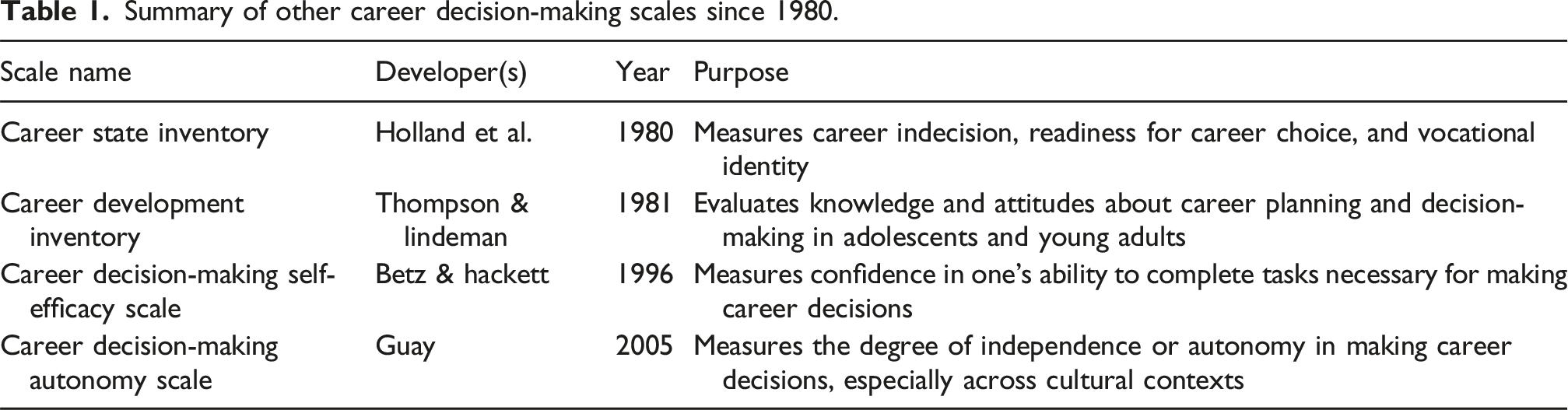
The CDS is highly applicable for the purpose of this research because of its broader conception of ‘discernment’, integrating rational, intuitive, interpersonal or advice-seeking, and spiritual ways for people to either discern or decide on career choices with empirical backing. It also looks at internal modes of career decision-making, indicating a more holistic approach. Though critiques of the unidimensional approach have pointed out methodological and conceptual flaws, reinforcing the view that the CDS is better understood as a multidimensional construct (Shimizu et al., 1994), it brings merit to this research as the basis of examining the significance of ‘discernment’ linked to other aspects of dimension used in this study.
In summary, the CDS represents an advanced tool in career assessment by incorporating diverse psychological and spiritual dimensions of career decision-making. It provides counsellors and researchers the measure that goes beyond simply assessing indecision to understanding the complex processes individuals undergo in discerning their career paths. This multidimensional perspective aligns with contemporary views in career counselling that emphasise holistic approaches to career development and is significant to the framework as it is one of the few articles in career development research that brings the notion of ‘discernment’, defines and explores application to the career decision making process.
Self-regulation theory
Self-regulation theory is primarily attributed to several key researchers, with Albert Bandura being one of the most influential figures. Bandura (1991) elucidated how individuals regulate their behaviour through self-regulation processes. He proposed that following self-observation and self-judgment, individuals experience internal reactions known as self-response such as self-satisfaction, pride, or self-criticism. These emotional responses, termed ‘self-reaction’, are influenced by the individual’s evaluation of their behaviour. Additionally, the sense of meaning and well-being that individuals derive from their actions is an internal experience closely associated with self-regulation. This framework established self-regulation as an active, cognitive mechanism for behaviour control (Ran et al., 2023).
Zimmerman and Schunk (2012) further developed the theory in educational psychology, detailing specific psychological processes involved in self-regulated learning, which closely align with self-regulation theory’s broader principles. Zhou et al. (2024) applied the self-regulation theory to career development, explaining how career exploration through self-observation and self-reflection enhances carer adaptability. It highlights the cyclical process of self-observation, self-judgment, and self-reaction within the context of career. This theory has been applied in career development frameworks related to goal-setting and self-monitoring to enhance career counselling (Rezaiee and Kareshki, 2024), and how career exploration and self-reflection within the self-regulation framework enhance individuals’ sense of career calling and career adaptability (Ran et al., 2023). The self-regulation theory, since its inception, has formed the basis of many new developments and discoveries. Its foundational basis and principles in evaluating ‘self’ with scrutiny would thus be applicable to this research, particularly in the aspect of personal growth (self-awareness and reflection), with adaptability and well-being in fostering career confidence, which is an outcome of the proposed framework.
The ’Ikigai’ concept
There are contemporary concepts that have underlying principles relating to the framework of this research. These modern theories have implications to career exploration and development, namely the ‘Ikigai’ concept. According to Sartore et al. (2023), ‘Ikigai’ was introduced in Japanese literature and broadly refers to having a ‘reason for living’, a purpose in life or a reason for being (Millán et al., 2023). Although the concept has deep roots in traditional Japanese values, it has gained wide recognition in application and practice, namely in personal and professional growth (Oe, 2025). Kumano (2006) found that the central notions of ‘Ikigai’ were life affirmation of goals and dreams, the meaning of existence, a sense of fulfilment and commitment. It is represented by a Venn diagram of four circles consisting of what you love, what you are good at, what the world needs and what you can get paid for helping to identify a person’s passion, mission, profession and vocation. The ‘Ikigai’ framework integrates passion, mission, vocation, and profession to help individuals achieve professional fulfilment. Additionally, it promotes aligning personal strengths with societal needs which influences students’ motivation (De Carvalho and Raimundo, 2025), and thus intensifies the meaningful pursuit of purposeful mission, a component discussed in the proposed framework leading to career confidence and resilience.
Looking at the connection with ‘Ikigai’ and in the career decision-making context, there seems to be scarce research on how it can be employed as a basis in career exploration for college students except for Millán et al. (2023) on vocational guidance and Hall et al. (2023) on the impact of ‘Ikigai’ on developing future-ready graduates with self-leadership skills. Perhaps, being a culturally and traditionally rooted concept, it may not have been academically adapted extensively by career practitioners. Its potential is highlighted by Oe (2025), that as educational institutions globally face challenges of student engagement, burnout, and purpose-driven learning, there is a crucial need to develop more effective frameworks that can employ the wisdom of ‘Ikigai’ into practical pedagogical approaches.
The closest link that solidifies ‘Ikigai’ concept into a purely academic theory is the alignment with Career Construction theory by Savickas (2005), whose notion is that people build or actively construct their careers through a sense of meaning and clarifying future directions. According to Wang and Li (2024), the theory includes three parts: vocational personality, career adaptability, and life theme pronouncing personalisation and creating meaning out of work and life. The connection between ‘Ikigai’ and this article is significant, that there is an active process of exploration linking between self-awareness, self-development and career decision-making in active and meaningful pursuit. Hence, it is closely related to the discernment process and purposeful mission, a perspective magnified in this research framework.
Dimensions of discernment-driven career decision-making
The conceptual focus is approach that is built by a progressive development of specific key concepts that interplay within the process referred to here as dimensions. This conceptual review necessitates the breakdown of the proposed Discernment-Driven Career Decision-Making dimensions to theorise, integrate and bring cohesion the practical application on how it facilitates effective career decision-making for tertiary students.
Career exploration
Career exploration is the examination of various vocational options by gaining a clear understanding of one’s self-concept in professional settings, exploring occupations that align with this self-concept, and actively engaging in experiences that apply this knowledge (Kosine and Lewis, 2008). According to Pham et al. (2024), career exploration is a lifelong process of prompting and maintaining interest in a field or environment to increase knowledge which relates to gathering information about career goals. For Ran et al. (2023), career exploration encompasses the exploration of one’s career interests and capabilities, making it an instrumental aspect of career decision-making. The significance was pronounced on how individuals’ attitudes, behaviours, and other work-related outcomes are influentially shaped by how effectively this exploration is managed as a process (Jiang et al., 2019). There is positive effect of career exploration on future work self which was made evident by Guan et al. (2017) and Xiao et al. (2021), which merits career exploration as integral in the career decision-making process and influential for career discernment.
Self-awareness
Gafoor (2012) explains awareness as the ability to perceive, feel, and be conscious of objects, events or sensory patterns characterised with a level of basic consciousness, whereas Mubiana (2010) sustains that self-knowledge enhances career-decision making, while Geida (2019) affirms that self-knowledge promotes awareness of early career choice. In terms of self-awareness, Goodman et al. (2018) emphasised the critical role of self-awareness and professional growth, while Jackson and Hyslop (2016) recognises that the path to self-awareness is nonlinear and is crucial for effectively creating and accomplishing goals throughout an individual’s career.
Research by Choi et al. (2011) focuses on career decision self-efficacy instead, closely linked to self-awareness and discusses the essential role of self-appraisal in making career decisions indicating that insufficient self-awareness can impede effective career decision-making. Asma et al. (2024) also discusses career decision-making self-efficacy, magnifying the role of self-assessment, gathering career information and selecting goals as part of career decision-making. This implies that students lacking these self-awareness activities may struggle with career decisions, which was affirmed by Dierdorff and Rubin (2015) in that high self-awareness leads to better decision making.
Deep self-reflection
Kolb (2013) asserts that reflection is perceived as positive and provides a road to self-consciousness and a route to learning. Reflection can be defined as “a person’s intentional and systematic consideration of an experience, along with how that person and others are connected to that experience” (Cress et al., 2013: 96). Reflection has been incorporated in learning and experiential learning theories in terms of how it can effectively influence outcomes, which compels students to think deeply and ask questions on their learning experiences (Goodman et al., 2018). Newman and Nezlek (2019) recognised that self-reflective individuals are more inclined to seek meaning and have a stronger sense of meaning in life, while Stein and Grant (2014) reveals that self-reflection can enhance the level of well-being through insight. Also, Ran et al. (2023) discusses self-reflection as self-judgment and a regulatory process that facilitates more adaptive career behaviours and decision-making. A recent publication by Tol et al. (2025), specifically on reflective practice in career decision-making explores the role of reflection and self-awareness in the career decision process, reinforcing the concept that deep self-reflection supports better career choices through enhanced insight and self-understanding. Aligned with self-regulation theory, Ran et al. (2023), asserted that self-reflection is a significant predictor of career adaptability among college students.
From a technical perspective, Mezirow et al. (2012) broke down deep self-reflection as achieving any of the three stages (conceptual reflectivity, psychic reflectivity, or theoretical reflectivity) of the critical consciousness level, based on the Mezirow’s model of reflexivity. Deep self-reflection, as indicated in the framework, is a process of contemplation where individuals critically examine their own assumptions and actions to gain profound self-awareness and facilitate personal growth. One of the barriers to deep self-reflection is that it is time consuming and could probably explain why there appears to be limited research of deep self-reflection towards career-decision making of tertiary students who prefer quick and fast solutions. However, the contribution of deep self-reflection to the conceptual framework proposed in this research is integral in the career exploration process as critical self-reflection is questioning one’s assumptions, presuppositions, and meaning perspectives (Mezirow, 2006), crucial to the process.
Career discernment
Martin (2010) stated that the term ‘discernment’ represents the inclusion of spirituality as a decision style and at that time has had limited consideration in career research. It is often associated to a search for an ultimate purpose in life (Fry, 2003) and has been known to influence work in terms of optimism (Sethi and Seligman, 1993), work engagement (Bickerton et al., 2015), well-being, and health outcomes (Koenig et al., 2001). While Thundiyil and Pandian (2023) simplifies discernment as the developmental process where an individual perceives and decides their career, there is a deeper connotation to the terminology. Jackson and Hyslop (2016) explores the impact of intentionality of knowing oneself, building meaningful relationships and understanding the impact relationships have on career discernment. These themes and topic areas connect to the Jesuit concepts of discernment and cura personalis (care of the whole person) with its origins rooted and used mostly in the spiritual context (Angeli et al., 2023; Hermans, 2021).
Career discernment seems to be tied to vocational discernment identified as the alignment of a person’s gifts and talents with the meaning and purpose of their life’s work. A more secular concept was given in the notion of the research article by Yip et al. (2021) that career discernment is the ability to integrate logic and intuition in career decision-making, including reflective thinking and emotional insight to navigate complex career choices effectively. It was also acknowledged by Goetsch et al. (2017) that students’ participation in vocation and job discernment activities is most likely related to their transition to adulthood, thus indicating it as a natural process, though the article does not explore the term ‘discernment’ further. In a recent study by Chan & Hedden (2023), the role of discernment was discussed throughout the article which examined career advisors in undergraduate business schools. However, the terminology was not broken down or defined to give clarity on the practical application of discernment in the context aligning values in career advising, yet it does gives credit to the discernment process itself in career decision-making of undergraduates. This terminology offers a unique but less explored approach to help tertiary students make career decisions, as there are limited research and discussion on how discernment is applied in career decision making for tertiary students and how it can facilitate. It therefore reveals a significant knowledge gap that is addressed in this research.
Career confidence
Based on his article in a college career guide, Kevin Gaw distinguished career confidence from self-confidence or self-assurance, whereby career confidence “involves passion, purpose, and a realistic career plan” (Nassau Community College, 2015: 9). According to Caza et al. (2015), many institutions are concerned with students’ satisfaction and career confidence. B´enabou & Tirole (2002) asserts that a high level of confidence can motivate individuals to work harder, overcome obstacles and take risks, while Stajkovic (2006, 1221) stated that by “studying confidence as a mechanism that psychologically enables one’s potential, we may be better able to discover the best people have to offer”. In recent research developments, confidence is also synonymous with self-efficacy (Archer and Yates, 2017; Paulsen and Betz, 2004).
There have been contemporary references to the term ‘employability confidence’ (Shen et al., 2021), which defines employability confidence as individual perceptions of the capacity to gain employment (Rothwell et al., 2008). Although the focus of literature on this term is on being employable and ready for the workforce, past research acknowledges that lack of confidence acts as a significant barrier to employability (Pool and Sewell, 2007; Yorke and Knight, 2007) due to confidence affecting a person’s motivation to work on assigned tasks and persistently pursue goals despite challenges (B´enabou & Tirole, 2002). Archer and Yates (2017) did conclude that the definition of career confidence is a complex one, both in theory and in practice, though recent studies have included it in consideration for career development and decision-making.
Career resilience
Based on a systematic literature review done by Mishra and McDonald (2017), career resilience is described as “a developmental process of persisting, adapting, and/or flourishing in one’s career despite challenges, changing events, and disruptions over time.” (pp. 216, 218). Resilience has drawn the attention of researchers in the field of career consulting and is characterised as a personal attribute of an individual’s ability to thrive in adversity (Connor and Davidson, 2003). London (1983) was one of the first to identify career resilience as a domain for career motivation, and he defined this term as “a person’s resistance to career disruption in a less-than-optimal environment” (p. 621). While career resilience is a complicated construct, it is essential for the current complex career landscape (Mishra and McDonald, 2017). Resilience was also integral as one of the elements of Stajkovic’s (2006) conceptualisation of career confidence -self-efficacy, optimism, hope and resilience.
In a more recent study, the importance of resilience to students’ career decision-making was affirmed and it reduces the students’ career decision-making difficulties (Pang et al., 2021). This is especially pivotal in the post-COVID era and the ever-changing landscape of industries According to Seibert et al. (2016), resilience in the context of career is referred to as the ability to pursue career goals using the resources and strategies available. Brewer et al. (2019) also defined career resilience as the ability to adapt positively to adverse career events, setbacks, and uncertainties, while Mishra and McDonald (2017) agree that career resilience is the career determination to cope with possible difficulties, changes, and setbacks. Therefore, this conceptual paper is necessary to provide perspectives that would build the bridge between these dimensions as grounded in supporting theories before a systematic and directed empirical testing can take place.
Conceptual framework: Discernment-driven career decision making model
The conceptual review in this paper integrates the distinguished dimensions into one single coherent model which supports the rational for theoretical contribution and practical application on how it works. The proposed model outlines three stages in the career decision-making process, from sparking self-awareness through the career exploration stage, leading to the significant career discernment stage of purpose and calling, to a stage of assurance and resilience as an intended outcome of the process. Hence, discernment is the antecedent. The conceptual framework is thus illustrated in Figure 1. Discernment-driven career decision making model.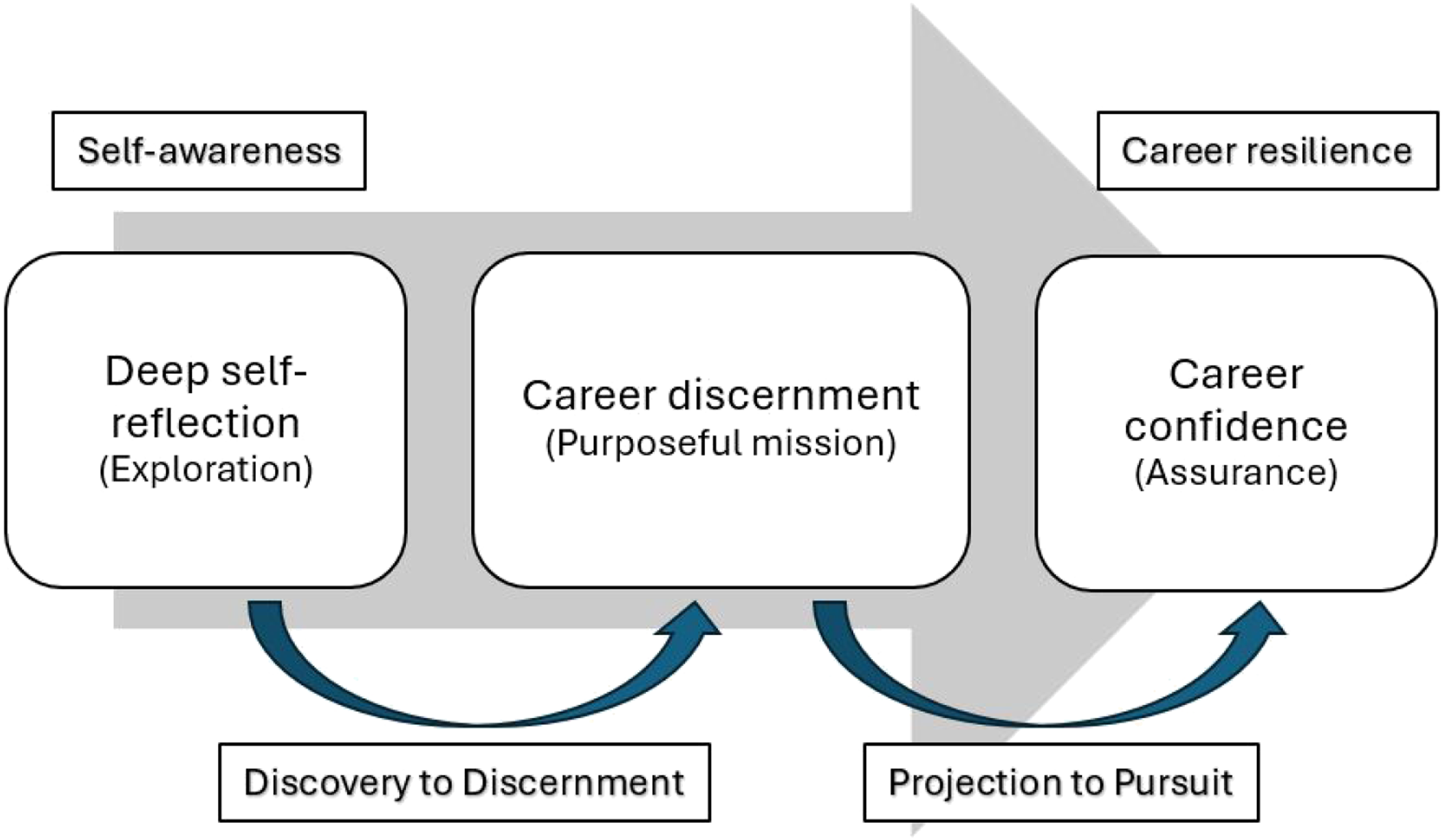
First stage: Deep self-reflection with exploration
The framework in Figure 1 proposes that a student’s career decision-making process should start and be aimed at increasing self-awareness (the outcome) through deep exploration of self-reflection on personal strengths, skillsets, personality, interests and values. At this stage, a tertiary student would embark on a journey of exploration and reflection to heightened self-awareness. Career exploration and self-reflection can aid in obtaining information from various perspectives thus increasing the certainty in career selection with self-questioning to seek meaning and calling (Taveira and Moreno, 2003). Having a specially crafted module or enrichment course that is non-examinable but tailored for career clarity can get students facilitated into self-awareness. Students’ awareness of self and clarity of their own personal brand is crucial to facilitate their stages in career decision-making especially in assessing internal factors of the individual student. Jiang et al. (2019) also asserted that career exploration facilitates extensive career information and influences the development of career adaptability.
As the framework suggests, in the first stage of exploration and discovery, self-awareness is an outcome of this stage. Supported by the notions of self-regulation theory, the practical aspect of this framework is when college students develop a strong consciousness of all aspects of ‘self’. Self-awareness is described as “how clearly we see our values, passions, aspirations, fit with our environment, reactions, and impact on others”, which is internalised while recognising the external view others have on self (Eurich, 2018: 4). This requires deep reflection and thought. Hence, the model proposes this stage to be made more tangible, as in having the students record it down through a facilitated process to ensure deep reflection. Through guided reflective practices such as written narratives, strengths identification, visual mapping of personal attributes, vision boards, and contemplative journaling, tertiary student becomes mindful and conscious to aspects of self. Deep self-reflection involves higher-level cognitive process where individuals critically assess their preconceived judgments and experiences with self-observation and self-evaluation. To enhance students’ career decision-making, fostering self-concept is essential in higher education settings (Mohd Zaini et al., 2021).
Referring to the first discovery stage of the model, their accumulative exposure and experience should be identified, captured and pronounced. Hence, this stage should be a guided and facilitated approach so students can effectively associate with their own personal brand through consistent self-reflection. Jurgens (2000) found that students who had low levels of career certainty experienced increased certainty and decision-making in their career planning if they participated in several guided and structured processes such as workshops, career counselling, professional forums or online career planning sessions.
Second stage: Career discernment with purposeful mission
The framework proposes that after deep reflection through effective exploration, there is an accumulation of insights and information gathered about the individuals themselves which aids the pursuit of a purposeful and clear mission. Thus, with more clarity of personal attributes, students would develop depth of understanding themselves. The authors establish that this stage of career discernment is the ‘anchor’ or catalyst for effective and meaningful career decision-making.
In attempting to define career discernment more astutely, the authors consider the spiritual and emotional connotation to the terminology. The spiritual sense of the term discernment would be exploring life purpose and meaning as indicated in the historical definition from the literature review. However, the authors recognise the significance of the emotional aspect in career discernment as with Krannich et al. (2019) and Yip et al. (2021). Career discernment, as articulated by Yip et al. (2021) is the ability to integrate logic and intuition in career decision-making, which includes reflective thinking (first stage of this model) and emotional insight (second stage of this model) to navigate complex career choices effectively.
Aligned with the Career Discernment Scale, this stage would be from the ‘undecided’ to ‘discerning’, as to whether the students’ decisions come from what they truly value and understand about themselves from the first stage, or just from external pressures or confusion. By this stage, if facilitated properly with guided outputs of the process, students would effectively have clarity towards certain fields they see themselves fit. Students could then narrow down their options or field of study that they see as fit or matched at this point, to which the purpose would be more validated with more meaning, associated with a sense that people examine, contemplate and assess their lives facilitating the processes that require thinking about self (Newman and Nezlek, 2019). Purpose, however, is defined as people’s affinity to highly valued goals that will connect them to a sense of existence (Kosine et al., 2008; Steger et al., 2012), which is also supported by the ‘Ikigai’ concept. The search for purpose and meaning is thus an expected and attainable outcome after the first stage of exploration and discovery. The association of both elements of purpose and meaning was highlighted in a research study that affiliated an individual’s purpose as a stable and generalised intention to achieve a meaningful and significant goal for themselves and their contribution to the world (Summers and Falco, 2020). Some may relate to the term ‘calling’ in the context of ‘meaning’ and ‘purpose’ as pointed out by Dik and Duffy (2009), acknowledging that purpose and meaning can be cultivated in the workplace through the development of a sense of calling, namely the pursuit of certain career choice that aligns with a broader life purpose (Dik and Duffy, 2012, 2015). Hence, the authors of this paper propose a conceptual definition of career discernment within the context of career decision-making, which can be holistically explained as an internalised, reflective and mindful process of attaching meaning and aligning purpose to one’s career calling that resonates towards an authentically meaningful career, combining reason, emotion, and intuition.
Shen et al. (2021) posits that career calling partially mediates the relationship between core self-evaluation and career decision-making challenges, which is likely what tertiary students would face in the second stage. Thus, this enhances college students’ core self-evaluation (first stage), strengthens their career calling and helps them to address career decision-making difficulties. Examining the role of lasting job satisfaction may seem presumptuous at this stage but Weston et al. (2021) established that high levels of a sense of purpose were positively correlated to work satisfaction. Hence, it would be worth heightening the emphasis on pursuing a purposeful mission in career decisions at the tertiary level.
To articulate this stage based on the Career Discernment scale (Yip et al., 2021), there would be some consistency of thought on areas of study, and students would need to express and exude their calling besides learning about the career field or industry itself. For instance, ‘what can I do’ and going further to capture ‘why it is important for me’ as much as it is to others. Interestingly, in his attempt to explain the concept of purpose-based careers, Otu (2024) linked purpose to spirituality in the aspect of one’s own existence and the Creator. Tertiary students should discern about their careers with more clarity of thought and consistency for their career literacy, not limiting their approach to a mere academic decision but to be conscious of their psychological thought-process (identity, values), their emotional terrain (intent, sentiment, feelings, intuition) engaged with cognitive (critical self-evaluation) and mental (well-being, contentment) states in the entire process. The idea of offering purposeful career development exercises via multiple means is also advocated by Buford et al. (2022). This is achieved throughout their pre-university or undergraduate years through exposure, experience and experimentation.
Third stage: Career confidence with assurance
The third stage would be that the students transition from projections of career options or fields explored and arrive at a point of being more career-assured and confident, having found their purpose. In Figure 1, it is indicated as a process of projection to pursuit, as career confidence increases incrementally till the individual is substantially assured. The stage of career assurance would be ideally securing their purpose or calling, which would not only give them career confidence but make them more career resilient as an outcome. While realistically many adults find their calling later in life, to arrive at a stage of career confidence and assurance, there needs to be follow-up interventions with tertiary students where students take initiative or exhibit proactive behaviours. This could be in the form of students becoming career advisors or career ambassadors themselves, sharing and guiding how they find their assured career path. Second- or third-year tertiary students could plan and deliver significant service-learning projects where they apply their chosen career choices to help the community or meet societal needs. From empirical research, Gai et al. (2022) applied Career Construction Theory to design a peer motivational interview program where senior students guided juniors through one-on-one sessions involving engagement, focus, arousal, and planning to which results indicated this approach boosted students’ career control and confidence. In fact, the final stage of career adaptability in the career construction model is confidence (Kara, 2024).
This Discernment-Driven Career Decision-Making framework proposed has taken into account the internalised psychological, emotional and spiritual aspects of the Career Discernment Scale (Yip et al., 2021), as well as the deep reflective emphasis influencing cognition and behaviour from the Self-Regulation theory (Ran et al., 2023). It also extensively resonates with the ‘Ikigai’ concept of self-awareness, purpose in life and pursuit of meaning, fostering career confidence and resilience, where Paul and Suki (2018) asserts that an increase in self-awareness and career confidence give students the ability to cope with their known career paths, leading to a more self-actualised and informed graduate. This can be witnessed in a student who might have experienced part-time work or internship and can articulate how aspects of their academic content relate to their real-world experience. If there is a progressive career programme, the student would be able to express and exude attributes of their personal brand at this stage and position themselves to be successful in any career pursuit (Parmentier et al., 2013). While self-understanding, confidence, and the timing of career education can influence undergraduate students’ career decision-making process (Thornton, 2017), it is important to note that career discernment is the anchor that facilitates the achievement of these outcomes.
Career resilience, which is touted as “an essential survival skill in the 21st century” (Cascio, 2007: 552), represents an intended outcome of the career confidence with assurance stage. As discussed in the literature review, career resilience considers the ability to adapt to setbacks and challenges as students experience deeper connection to their chosen career path. When students exercise deep self-reflection based on explorations done regarding their career paths, being led by a purposeful mission in their career discernment resulting in assured career confidence, they are then able to be resilient in the event of career shocks. These include the struggle in securing employment, the aftermath of a senior career mentor leaving the company, the inability to seize promotion or career progression opportunities, and the unsatisfactory appraisal scores from superiors (Seibert et al., 2016).
Research significance and contributions
Traditional career planning and development approaches often emphasise skills and labour market trends of external factors while internal aspects of self were recognised by other researchers, but hardly in multi-dimensional holistic model. The Discernment-Driven Career Decision-Making framework shows ‘how to take a harder look at self’ through a progressive, reflective and adaptive lens that serves to align personal dimensions as deeply interconnected inputs. By crafting the definition of ‘career discernment’ from concept to practice, this research gives prominence to developing career confidence and resilience incrementally from heightened self-awareness through a reflective and guided process that is supported by theories and concepts mentioned.
From higher education research perspectives, it appears that career discernment is hardly explored or extensively discussed, except for just a few studies mentioned in this research. Therefore, the paper magnifies the prominence of career discernment as an anchor, from the self-reflection or exploration stage itself. The authors introduce a systematic and progressional mechanism for guiding students through the complicated career decision-making process with a holistic multi-dimensional approach of cognitive, psychological, emotional and spiritual aspects. It gives students a clearer mechanism and tool to actualise and solidify their career path with authenticity for long-term career contentment through a better career-fit instead of merely job-focussed.
The proposed conceptual framework is deemed to have a significant contribution to higher education institutions, as it gives insights into the processes of career discovery to discernment, as well as career projection to pursuit, leading to career confidence and resilience. As such, these institutions could consider academic courses which are tailored to career discovery and discernment among tertiary students, so that they could make informed decisions towards their career goals via these career literacy modules (Oskar et al., 2022). Programmes and schools in higher education institutions could emphasise on a more structured and systematic discernment process for effective career guidance for their students by embedding the framework proposed. It could be considered in curriculum design for additional complementary or enrichment modules. For example, in Malaysian higher education there are compulsory modules called Matapelajaran Umum (MPU), in which such modules can be developed to assist students’ career development.
Besides, career development centres and career coaches in higher education institutions can potentially adopt this framework into their career counselling and consultancy sessions with students who need career guidance, enabling them to practise deep self-reflection and cultivate self-awareness to exhibit career discernment to make career decisions towards their future careers. This can be done progressively during the students’ college years in higher education, as it is possible that the students need to seek regular intervals of counselling in this area, be it in their first or final year of studies. Career guidance counsellors could also be trained in terms of understanding how the conceptual framework operates so that they can be better equipped in advising students on their career pathways.
Limitations and future research directions
Nonetheless, there are several limitations to this paper. Firstly, it is a conceptual paper, which has not been substantiated by empirical research involving data as evidence. The Discernment-Driven Career Decision Making Model which is proposed as the conceptual framework in this study has only been supported by the review of the body of literature so far, which necessitates further investigation for the model to be validated.
Secondly, while the model contains major domains such as career resilience as the outcome from having career confidence, other emerging terminologies regarding career research such as career adaptability are not explored deeply in this paper. However, it is argued that as the focus of this paper is towards tertiary students, career adaptability is deemed to be more relevant when they enter the world of work.
Moving forward, this conceptual framework could be explored further and validated by empirical research. Qualitative studies could be done on college students in the form of focus groups or one-on-one interviews to investigate their perspectives on deep self-reflection, career discernment and career confidence. Quantitative studies involving surveys could also be used to test the framework’s generalisability and rigour on larger sample sizes.
Besides this, a longitudinal study could also be done for students through their studies in higher education to the workforce, so that a more comprehensive understanding on the process of deep self-reflection and career discernment even after they start their careers. Also, it is worth studying college students in different countries as they would potentially generate diverse insights which will strengthen the model. Future research and practice should explore how this model can be operationalised through structured interventions, reflective exercises, and supportive counselling environments to cultivate authentic, well-informed career decisions among emerging adults.
Conclusion
To conclude, the discernment-driven career decision making model for tertiary students, presented herein offers a transformative paradigm for tertiary students navigating the complexities of career choice. It centres the whole person in the process and provides a guide to their future career endeavours by integrating and consciously engaging psychological, emotional, cognitive, and mental facets of the individual, cementing its merits as a holistic approach. It is not merely a framework for career choice, but a pathway towards true discernment–empowering students to engage and align their psychological landscape, the emotional terrain, the cognitive processes, and the mental state towards a better career-fit. It therefore holds practical implications on students, educators, counsellors and curriculum developers in enhancing career development with discernment-driven dimensions mentioned in this research.
It is hoped that this framework could be used in higher education institutions and career development centres in their efforts to ensure that college students are career-ready with deep self-reflection, purposeful mission and having the assurance on their chosen career paths. This model serves as a vital resource for students, educators, and counsellors alike, fostering career decisions that are not only informed but also deeply meaningful and conducive to long-term well-being and professional success.
Footnotes

Funding
The authors received no financial support for the research, authorship, and/or publication of this article.
Declaration of conflicting interests
The authors declared no potential conflicts of interest with respect to the research, authorship, and/or publication of this article.