







Abstract
This study aimed to evaluate the effectiveness of a Psychological Capital (PsyCap) training program in enhancing job satisfaction and reducing burnout among healthcare professionals. A pretest–posttest design was employed to evaluate changes in participants before and after the intervention. The study involving 732 healthcare workers at Time 1 (T1) and 653 at Time 2 (T2) across several public hospitals in Italy. Participants completed a 4-months structured training program targeting the core components of PsyCap: hope, efficacy, resilience, and optimism. Standardized self-report measures were used to assess psychological capital, job satisfaction, and burnout levels. The PsyCap training program led to a statistically significant increase in participants’ PsyCap scores, a reduction in burnout symptoms, and an improvement in overall job satisfaction. Mediation analyses revealed that PsyCap significantly mediated the relationship between the training intervention and the outcomes of burnout and job satisfaction. Multigroup analyses supported the effectiveness of the intervention, confirming significant differences between pre- and post-training conditions. Psychological Capital is a measurable and developable resource that plays a crucial role in promoting employee well-being and organizational health. Implementing PsyCap development programs may offer healthcare organizations a sustainable and evidence-based strategy to tackle burnout and enhance job satisfaction among frontline staff.
Keywords
Introduction
In recent years, the public healthcare sector has undergone significant changes, both in terms of reclaiming its core values and striving to improve the efficiency and wellbeing of its workforce. These efforts have become urgent in light of the COVID-19 pandemic, which has placed extraordinary demands on healthcare systems globally, often with limited resources. Frontline medical personnel were required to provide continuous, close-contact care to patients, which frequently exposed them to health risks. 1 This situation has contributed to increased stress levels among healthcare workers, not only due to fears of infection but also because stress tends to emerge when individuals perceive external demands as exceeding their coping resources. 2 Stress in healthcare settings arises not only from individual vulnerabilities but also from organizational conditions. For instance, Rice et al. 3 found that high stress levels experienced by healthcare personnel during the SARS outbreak were largely attributed to adverse working conditions. Participants reported greater difficulty maintaining physical and psychological wellbeing, identifying a lack of organizational support as a key stressor. Furthermore, evidence from the MERS epidemic underlines the critical role of psychosocial support systems: healthcare workers exposed to MERS were at an increased risk of developing post-traumatic stress disorder, regardless of being quarantined or not. A key vulnerability factor identified was the absence of adequate psychological support. Notably, MERS patients who received psychological assistance displayed lower levels of distress, suggesting that active support mechanisms may be more effective in mitigating stress than mere removal from the stressful environment. 4
The relationship between stress, job satisfaction, and burnout is particularly salient in healthcare. Chronic stress can evolve into burnout, a syndrome characterized by emotional exhaustion, depersonalization, and a diminished sense of personal accomplishment. 5 Burnout not only undermines workers’ psychological health but also adversely affects job satisfaction and organizational commitment. 6 Burned-out employees are more likely to report dissatisfaction with their roles, higher absenteeism, reduced engagement, and a decline in patient care quality.
Addressing burnout thus requires a multifaceted strategy, including adequate organizational support, access to professional development, promotion of work-life balance, and fostering a positive, inclusive workplace. 7 By prioritizing healthcare workers’ wellbeing, organizations can foster greater job satisfaction and system sustainability. 8 Building on previous research, interventions grounded in work and organizational psychology have the potential to complement structural changes by strengthening healthcare workers’ internal coping resources.
A deeper understanding of effective coping strategies reveals that emotional responses to stress are shaped by the individual’s cognitive appraisal and problem-solving capabilities. 2 Among the various coping strategies, one promising avenue is the development of Psychological Capital (PsyCap), a core construct of Positive Organizational Behavior (POB). PsyCap is defined as “the study and application of positively oriented human resource strengths and psychological capacities that can be measured, developed, and effectively managed for performance improvement in today’s workplace” (p. 698). 9 According to POB criteria, PsyCap must be state-like, measurable, developable, and positively related to performance. This construct consists of four interrelated components: Hope, Efficacy, Resilience, and Optimism (H.E.R.O.), which contribute to improving attitudes, behaviors, and psychological wellbeing. 10
Hope is the belief that one could create pathways to achieve goals and motivate oneself via agency thinking to pursue those goals. 11 Higher levels of hope are associated with more adaptive responses to challenges and increased satisfaction with organizational life. 12
Self-efficacy refers to confidence in one’s abilities to mobilize the motivation and cognitive resources necessary to successfully execute specific tasks. 11 It predicts performance, learning outcomes, and adaptive behaviors. 13
Resilience denotes the capacity to rebound from adversity, failure, and even positive events, progress, and increased responsibility. 11 Resilient individuals are more adaptable to change and tend to exhibit openness and perseverance.
Optimism reflects a positive attribution to succeeding now and in the future. 11 It is linked to higher self-esteem, creative problem solving, and better psychological health. 14
Research has consistently shown that PsyCap positively influences job satisfaction, employee engagement, and organizational performance. 15 Specifically, hope, optimism, and resilience are significantly associated with improved work outcomes, while high levels of PsyCap correlate with better self-esteem, a stronger capacity to manage stress, and enhanced job satisfaction. 16 However, despite the growing empirical support for PsyCap as a protective psychological resource, relatively few studies have examined the effectiveness of structured PsyCap training interventions within healthcare settings, particularly using pre–post designs focused on both burnout and job satisfaction. More specifically, the study examines whether participation in the intervention leads to increases in PsyCap and whether such increases are associated with reductions in burnout symptoms and improvements in job satisfaction before and after the training. By adopting a pretest and post-test design, this study contributes to the literature on positive organizational interventions by empirically testing PsyCap as a developable and mediating psychological resource in a high-demand healthcare context.
Theoretical development and hypotheses
From a theoretical perspective, PsyCap is conceptualized as a malleable psychological resource that can be enhanced through targeted training interventions. Previous studies have demonstrated that PsyCap development programs, particularly those based on micro-interventions and experiential learning approaches, are effective in increasing individuals’ levels of hope, efficacy, resilience, and optimism.10,11,15 In particular, Luthans and colleagues showed that PsyCap can be intentionally developed through short and structured interventions capable of producing measurable improvements in employees’ psychological resources and work-related outcomes. 11 These findings support the assumption that PsyCap is not a fixed trait but rather a dynamic resource that can be strengthened over time through structured interventions. Accordingly, we hypothesize that participation in the PsyCap training program will result in a significant increase in participants’ psychological capital levels. This assumption is grounded in Positive Organizational Behavior theory, according to which PsyCap represents a state-like resource rather than a fixed personality trait.9,10 Unlike stable dispositional characteristics, PsyCap can be strengthened through targeted developmental activities aimed at enhancing cognitive flexibility, motivational processes, and adaptive coping capacities. 11 Previous intervention studies have reported significant increases in PsyCap following structured training programs across organizational contexts. 15
Participation in the PsyCap training program will lead to a significant increase in psychological capital levels.
High levels of PsyCap have been consistently associated with more effective coping strategies and greater resistance to occupational stressors. In demanding work environments such as healthcare, PsyCap enables individuals to maintain goal-directed motivation, confidence in their professional abilities, adaptive responses to adversity, and a positive outlook toward future outcomes. These psychological resources are particularly relevant in buffering the negative effects of chronic stress and preventing its progression into burnout. High levels of PsyCap have been consistently associated with more effective coping strategies and greater resistance to occupational stressors. In demanding work environments such as healthcare, PsyCap enables individuals to maintain goal-directed motivation, confidence in their professional abilities, adaptive responses to adversity, and a positive outlook toward future outcomes. These psychological resources are particularly relevant in buffering the negative effects of chronic stress and preventing its progression into burnout.
From a psychological perspective, individuals with higher levels of PsyCap are more likely to perceive stressful situations as manageable and temporary rather than overwhelming and uncontrollable. Specifically, hope promotes perseverance toward goals and the identification of alternative pathways when obstacles arise, whereas self-efficacy strengthens confidence in one’s ability to manage demanding situations successfully. 11 Resilience supports adaptive recovery following adversity, while optimism fosters positive expectations about future outcomes. 14 Collectively, these psychological resources facilitate emotional regulation, adaptive coping, and resistance to prolonged occupational stress, thereby reducing vulnerability to burnout symptoms in high-demand healthcare settings.2,10,17
Therefore, it is reasonable to expect that healthcare workers with higher levels of PsyCap will experience lower levels of burnout.
Increased PsyCap levels will be associated with a significant reduction in burnout symptoms.
Job satisfaction reflects employees’ overall evaluation of their work experience and is influenced by both environmental conditions and individual psychological resources. Research suggests that employees with higher levels of PsyCap tend to report more positive work attitudes, greater engagement, and stronger satisfaction with their jobs. By fostering optimism, confidence, and resilience, PsyCap may enhance healthcare workers’ ability to derive meaning and fulfillment from their professional roles, even under challenging conditions. Employees with higher PsyCap generally report more positive emotional experiences at work and greater confidence in their ability to manage professional demands effectively. 15 In healthcare settings, these psychological resources may strengthen workers’ sense of meaning, competence, and professional accomplishment despite exposure to stressful conditions. Moreover, optimistic and resilient employees are more likely to perceive organizational challenges as opportunities for growth rather than sources of frustration, which contributes to higher levels of job satisfaction and work engagement.16,18
Increased PsyCap levels will be associated with a significant improvement in job satisfaction.
Beyond its direct effects, PsyCap may also function as a key psychological mechanism linking burnout and job satisfaction. Drawing on positive organizational behavior, and the Conservation of Resources perspective, PsyCap can be understood as a psychological resource reservoir that helps individuals preserve and regenerate personal resources in the presence of chronic occupational stressors. In this sense, PsyCap is expected to mediate the relationship between burnout and job satisfaction by reducing the negative impact of burnout on employees’ evaluations of their work (Figure 1). Theoretical model.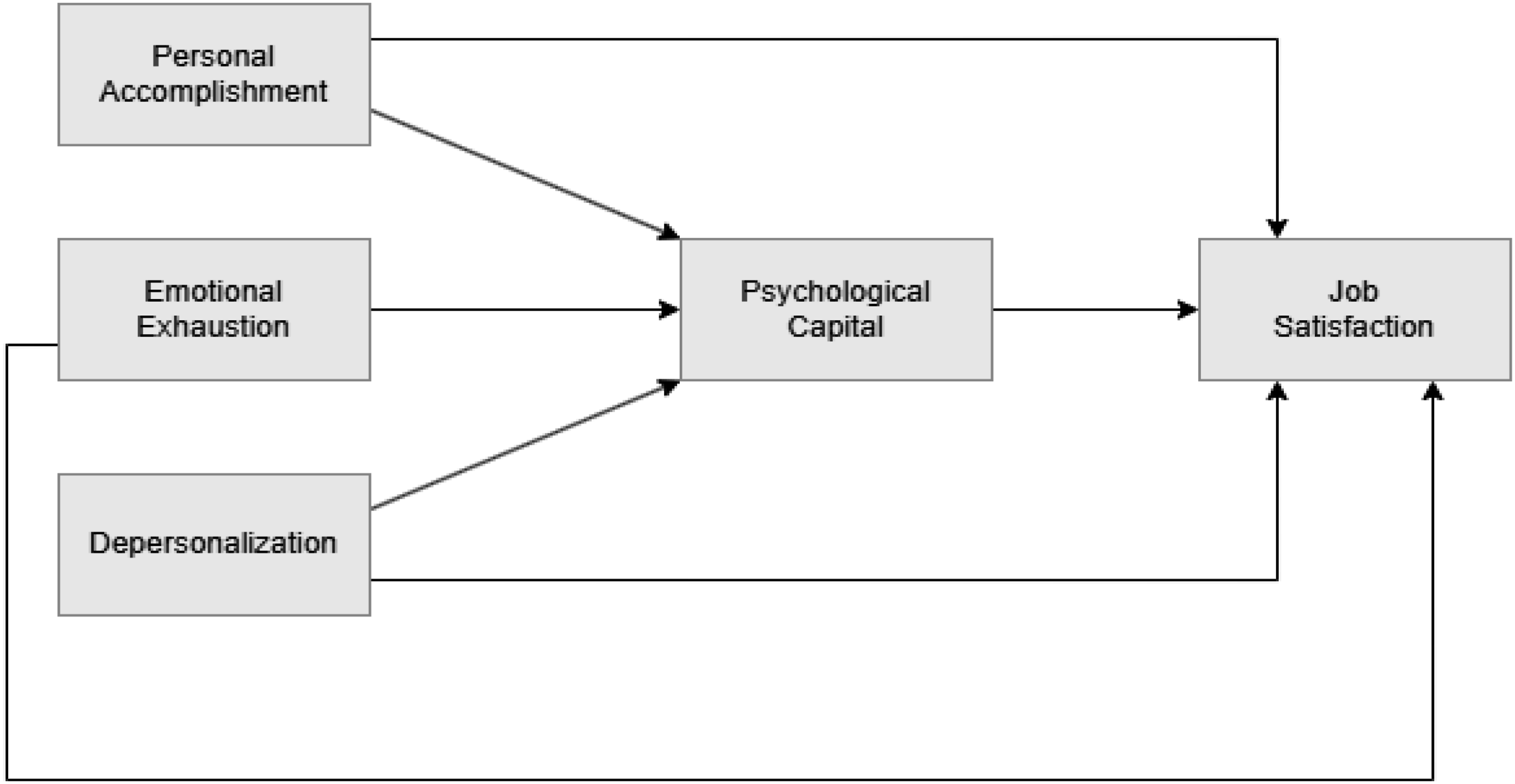
Psychological Capital will mediate the relationship between burnout and job satisfaction.
Method
Participants & procedure
The study involved a total of 732 healthcare professionals at Time 1 (T1) and 653 participants at Time 2 (T2), following the implementation of a structured training intervention. The sample was composed of 43% male and 47% female participants, with ages ranging from 28 to 61 years (M = 42.3, SD = 12.8). The majority of participants were physicians (52.3%), followed by nurses (38.7%) and healthcare assistants (9%). Participants were recruited from multiple public hospitals across different regions of Italy, including the North (35%), Centre (27%), and South (38%).
Between T1 and T2, all participants engaged in a 4-month Psychological Capital (PsyCap) training program. The training program was explicitly grounded in the Psychological Capital framework and structured according to the H.E.R.O. model (Hope, Efficacy, Resilience, and Optimism). The intervention was designed following established PsyCap development guidelines and focused on experiential and reflective learning strategies aimed at enhancing state-like psychological resources. Each biweekly session targeted one core PsyCap component and lasted approximately 2 h. Overall, participants were involved in approximately 4 h of training per month throughout the 4-month intervention period. Through a combination of psychoeducational input, guided group discussion, and practical exercises. Specifically, hope was developed through goal-setting activities, pathway identification, and agency-based reflection exercises aimed at enhancing participants’ ability to define meaningful work-related goals and identify alternative strategies to achieve them. Self-efficacy was fostered through mastery experiences, peer feedback, and the analysis of successful work-related experiences to strengthen confidence in professional competencies. Resilience was addressed through stress management techniques, cognitive reframing, and reflection on past experiences of adversity, with a focus on adaptive coping and recovery processes. Finally, optimism was enhanced by promoting positive future-oriented thinking, attributional style awareness, and exercises aimed at reinterpreting challenging work situations in a more constructive manner. Sessions were conducted in small groups of 10 to 15 individuals to encourage active participation, peer exchange, and reflection on real-life clinical experiences. The sessions were led by trained facilitators, including senior healthcare professionals and certified experts in workplace well-being and professional development. Between sessions, participants were invited to apply the techniques learned in their daily work activities and to reflect on their experiences during subsequent meetings. The overall structure of the intervention aimed to facilitate the transfer of psychological resources into everyday professional practice.
Data collection occurred between May 2021 and April 2023. All research procedures complied with the ethical guidelines of the Italian Association of Psychology (AIP) and its Ethics Council. Prior to participation, all individuals provided written informed consent in accordance with ethical research standards.
Measures
For the measurements of the factors evaluated in the study, a self-assessment scale was used to evaluate the exposure to burnout of the participants in the sample. Two specific factors of the work context were also measured: job satisfaction and social capital.
Burnout
Burnout was measured using the Maslach Burnout Inventory-Human Services Survey (MBI-HSS), 5 which includes 22 items. Participants responded to each item on a seven-point Likert scale ranging from 0 (Never) to 6 (Everyday), reflecting how frequently they experienced each statement. The MBI-HSS consists of three subscales: Personal Accomplishment (PA) with eight items, Emotional Exhaustion (EE) with nine items, and Depersonalization (DP) with five items.
In the original validation study, regarding reliability, Cronbach alpha is estimated to be .90 for Emotional Exhaustion, .76 for Depersonalization and .76 for Personal Accomplishment.
Job satisfaction
Job Satisfaction Survey (JSS) 19 was used to assess Job Satisfaction, which consists of 36 items -each is rated on a six-point Likert scale from 1 to 6, indicating how frequently each statement applies according to the participant’s perception-examining nine aspects of work life: Nature of Work, Operating Conditions, Employees, Promotion, Fringe Benefits, Supervision, Contingent Rewards and Communication. Each facet is assessed with four items, and a total score is computed from all items. 20 For each of the nine factors different scores indicate different levels of satisfaction: 4 to 12 = dissatisfaction; 12 to 16 = ambivalence; 16 to 24 = satisfaction. Cronbach alpha is estimated to be .90.
Psychological capital
Compound PsyCap Scale (CPC-12) 21 was used to assess Psychological Capital. The scale consists of 12 items -each answered on a seven-point Likert scale, ranging from 1 (strongly disagree) to 6 (strongly agree), indicating the frequency of truth for each statement as perceived by the subject-, three for each of the four components of PsyCap (Hope, Self-Efficacy, Resilience, and Optimism). Cronbach alpha is estimated to be .92.
Data analysis
We conducted a comprehensive statistical analysis to assess the psychometric properties of the measures and test our hypotheses. First, we calculated descriptive statistics, examined discriminant validity, assessed reliability, and computed correlations between variables, following the guidelines outlined by Byrne. 22 To ensure reliability, we evaluated convergent validity by calculating the average variance extracted (AVE) and construct reliability (CR). We adopted the commonly accepted thresholds of AVE >0.50 and CR >0.60, as suggested by Fornell and Larcker. 23 Additionally, we assessed discriminant validity by conducting a chi-squared difference test, comparing unconstrained (baseline) and constrained models to determine whether the constructs were distinct. For the mediation analysis, we applied two simultaneous regression models, hypothesizing that the total effect of the independent variable on the dependent variable would differ from the direct effect. A bootstrap resampling approach with 2.000 samples was used to esteem indirect effect, applying a percentile method corrected for 95% bias to ensure robustness.
To examine moderation effects between groups, we performed invariance tests and multigroup analyses, following the methodology proposed by Hayes and Sharkos. 24 We used the maximum likelihood (ML) estimation method, adjusting each model individually for different groups by removing elements that did not enhance model fit. Finally, we tested model estimation consistency across groups, in line with the best practices outlined by Malhotra et al. 25
Results
Descriptive statistics and intercorrelation between variables of the study
Mean values, standard deviation, and bivariate correlation of the variables measured at T1 (N = 732).
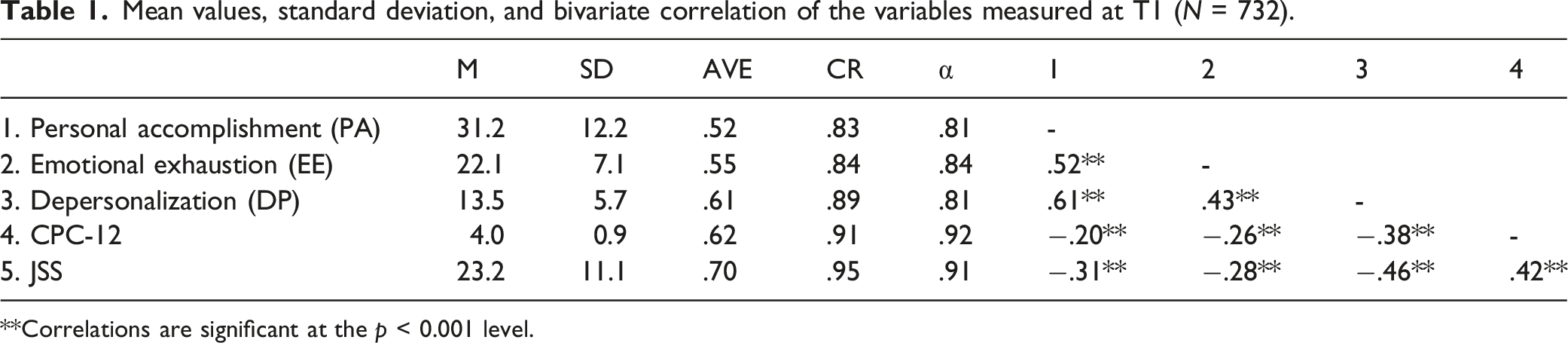
**Correlations are significant at the p < 0.001 level.
Mean values, standard deviation, and bivariate correlation of the variables measured at T2 (N = 653).
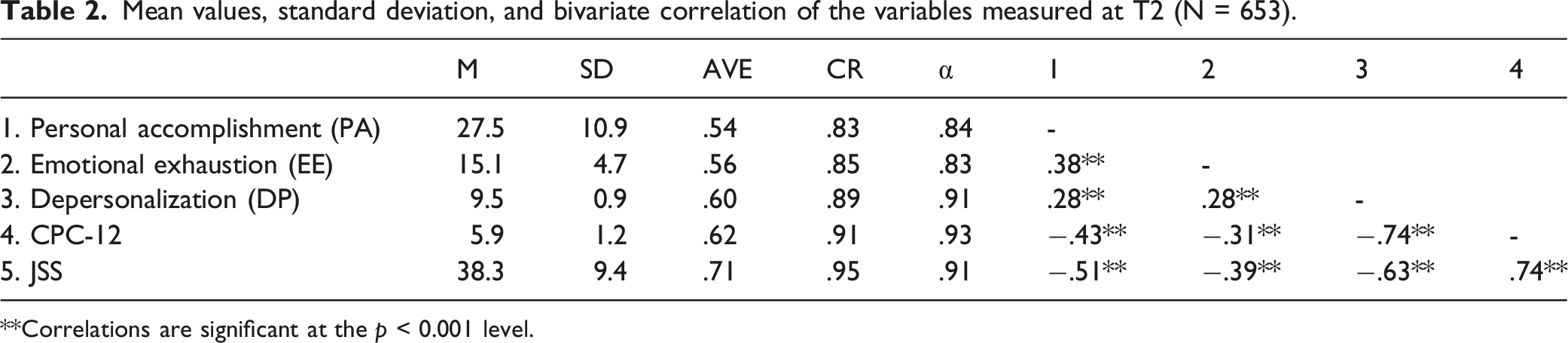
**Correlations are significant at the p < 0.001 level.
The mean difference was 1.90 (SD of the differences ≈.82), and the effect size was very large, Cohen’s d = 2.32, suggesting a substantial improvement in psychological capital over time. This finding suggests that the intervention (or the passage of time, depending on context) had a strong and meaningful impact on participants’ psychological capital.
CFA-Harman single factor test
To validate our model, we compared it with an alternative model using Harman’s single-factor test to evaluate the presence of common method variance, as suggested by Malhotra et al. 25 Our initial model, which included three antecedent factors (Personal Accomplishment, Emotional Exhaustion, Depersonalization), Psychological Capital as a mediator, and Job Satisfaction as the outcome variable, demonstrated a better fit across all confirmatory factor analysis (CFA) fit measures when compared to the alternative model. Using robust maximum likelihood estimation, we assessed the construct structure and compared our model to a single-factor model where all items loaded onto one factor. The first model, consisting of five factors, fit the data well: χ2 [188, n = 732] = 452.05, p < 0.001, χ2/df = 2.40, RMSEA = .06 (95% CI: .054−.065), CFI = .92, GFI = .92, SRMR = 0.04. The AIC and BIC values were 99.684 and 136.258, respectively. In contrast, the second CFA model, which assumed a single-factor structure, demonstrated poor fit: χ2 [185, n = 732] = 1815.94, p = 0.021, χ2/df = 9.82, RMSEA = .19 (95% CI: 0.173–0.198), CFI = .84, GFI = .84, SRMR = .08, AIC = 551.147, BIC = 791.102. The fit indices and the chi-square difference test (Δχ2 (3) = 1363.89, p < 0.001) indicated that the second model fit the data significantly worse than the first model, thus providing evidence against common method bias in our data.
Psychological capital: Mediating effect in the burnout-job satisfaction relationship
Standardized indirect effects from burnout to job satisfaction of life through Psychological Capital at time T1 and time T2.
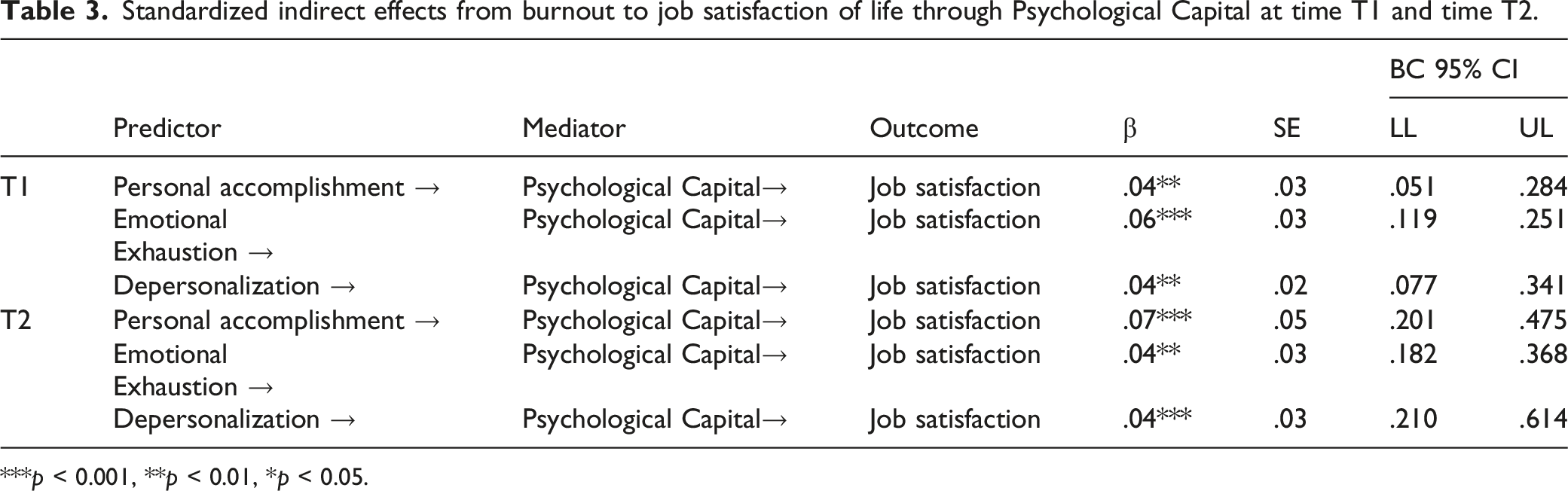
***p < 0.001, **p < 0.01, *p < 0.05.
The indirect effect was calculated at two distinct times (T1, T2) to verify whether, after the training session, psychological capital had indeed managed to produce a more significant effect in the burnout-job satisfaction relationship. Results revealed that at time T2 all the negative effects of the variables on psychological capital and job satisfaction decrease, while the effect that psychological capital has on job satisfaction increases. Interestingly, at time T2, the effect of psychological capital as mediator increases, also producing a total mediation effect of reduced personal accomplishment on job satisfaction (β = .07, SE = .05, p < 0.001, [C.I. LL = .201, UL = .475]), (see Table 3).
Multigroup analysis: Comparison of the two different measurements before and after the training program on psychological capital
To determine if there were differences before and after the training program in the effect of psychological capital on the burnout-job satisfaction relationship among healthcare personnel, we conducted a multigroup analysis to examine individual path differences. To verify these differences, 26 it was essential to establish that they stemmed from structural variations in the path coefficients across groups. Before testing the equality of the structural paths (a test of structural invariance), we first needed to confirm that the measurement parameters operated similarly for both groups (test of measurement invariance).
Multigroup analysis: Testing for measurement invariance across workers at time T1 (ex-ante) (N = 732) and workers at time T2 (ex-post) (N = 653).
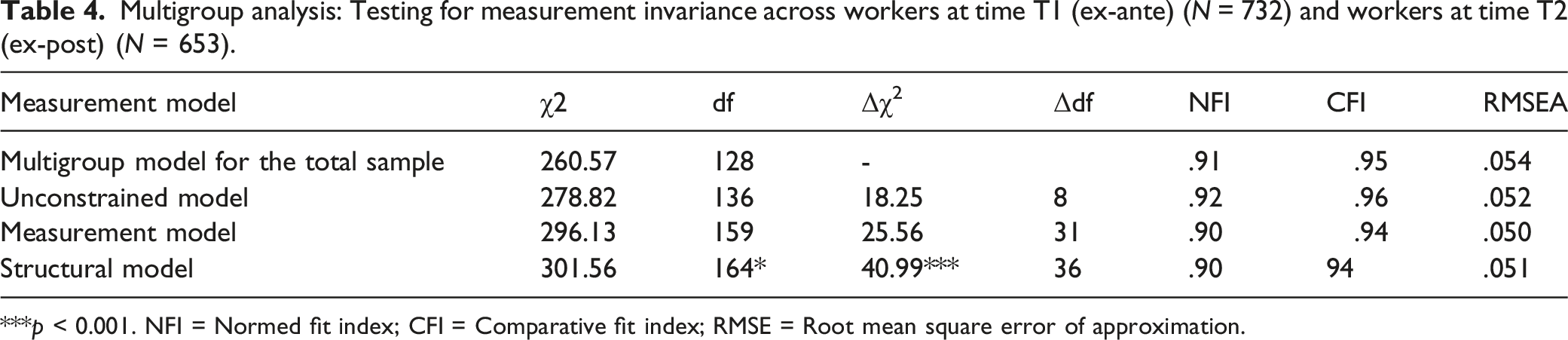
***p < 0.001. NFI = Normed fit index; CFI = Comparative fit index; RMSE = Root mean square error of approximation.
To further examine the interaction effects, the regression model was visualized at two levels of the moderating variable (e.g., ±1 SD from the mean). As depicted in Figure 2, the overall structural model was similar across both groups; the analysis revealed statistically significant variations in individual path relationships between the two groups. Reveal that at time T2, all negative effects of the variables on psychological capital and job satisfaction decrease, while psychological capital’s effect on job satisfaction increases. Therefore, psychological capital proves to be an appropriate strategy and methodology in the sample we considered for reducing burnout’s impact on healthcare workers’ job satisfaction. (1) Workers at time T1 (ex-ante, N = 732); (2) Workers at time T2 (ex-post, N = 653); *p < 0.05, **p < 0.01.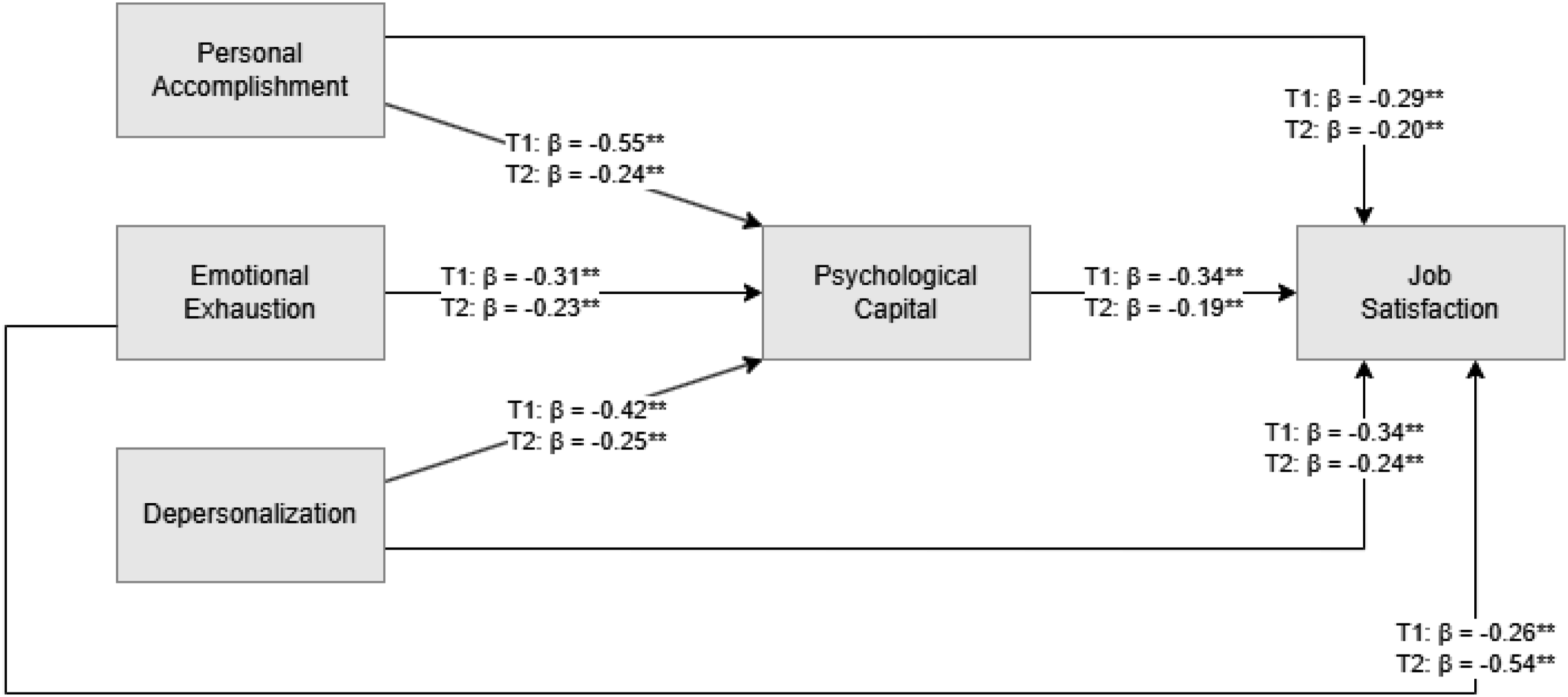
Discussion & conclusion
The primary aim of this study was to examine the relationships between Psychological Capital (PsyCap), burnout, and job satisfaction among healthcare workers, and to evaluate the effectiveness of a PsyCap-focused training intervention in reducing burnout and enhancing job satisfaction within healthcare workers who are particularly vulnerable to occupational stress.
The findings demonstrate that the training program, designed to cultivate the four core components of PsyCap: hope, efficacy, resilience, and optimism (H.E.R.O.) 10 resulted in a significant reduction in burnout levels and a corresponding increase in post-intervention job satisfaction. Furthermore, mediation analyses revealed that PsyCap served as a significant mediator in the relationship between burnout and job satisfaction. Specifically, the intervention not only decreased the negative effects of burnout on job satisfaction but also strengthened the positive influence of PsyCap on job-related outcomes.
These results are consistent with previous research indicating that higher levels of PsyCap are associated with greater psychological well-being, increased engagement, and improved workplace performance. 26 In line with Capone et al. 27 and Platania and Paolillo, 21 our findings confirm that burnout is negatively associated with job satisfaction both before and after intervention. The protective function of PsyCap in buffering the negative effects of burnout is well-documented in the literature, 17 and our findings provide additional empirical evidence to support the existing body of research by showing that targeted PsyCap development can mitigate burnout while simultaneously enhancing job satisfaction.
Also, these insights provide support for the mediating role of PsyCap between burnout and job satisfaction. This mediating effect was more pronounced following the training intervention, suggesting that the structured development of these psychological resources leads to more adaptive coping and improved work-related well-being. Prior studies have highlighted the positive associations of hope and optimism with effective coping strategies and increased job satisfaction, 18 which aligns with our findings.
This could be explained by the fact that PsyCap acts as a positive psychological resource, enabling people to view adversity and negative past, present and future events in a more positive light, thereby promoting well-being and satisfaction at work. In other words, PsyCap empowers healthcare workers to focus on, interpret and retain positive memories and emotions, which they can draw on to mitigate the emotional exhaustion, depersonalization and reduced personal accomplishment (i.e., burnout) associated with negative experiences. 1110 For healthcare workers who experience high levels of work-related stress due to adverse conditions caused by a lack of resources, states of emergency and pandemics, developing personal resources (i.e., PsyCap) through training may offer viable ways to manage work-related stress. By adopting a positive mindset, they can tackle burnout stemming from these stressors and negative events, and find fulfilment in their work.
This research expands the current body of literature on PsyCap-based interventions. Firstly, this paper demonstrates for the first time the positive impact of an intervention designed to encourage healthcare workers to tap into their personal psychological resources to cope with adversity in health emergencies, thereby ensuring they remain satisfied with their job. In healthcare settings, the use of PsyCap-based interventions could be crucial, as workers tend to find themselves under severe stress in both emergency and non-emergency situations due to a lack of organizational support, demanding workloads, and exposure to infection. By developing hope, efficacy, resilience and optimism in healthcare workers, they could be better equipped to manage stressful working conditions on a daily basis by drawing on their personal psychological resources. Secondly, this study addresses the need to explore which psychological competencies healthcare workers should develop to cope effectively with unexpected emergency events. Previously, Leonelli et al. 28 identified resilience as a valuable skill for medical staff when confronted with unforeseen challenges. Building on this, our study suggests that healthcare workers should be supported in nurturing their PsyCap, so that they can draw not only on resilience, but also on other personal resources such as hope, self-efficacy and optimism.
In conclusion, this study confirms the value of PsyCap as a strategic and evidence-based intervention to reduce burnout and promote job satisfaction in the healthcare sector. More specifically, these findings expand the range of psychological skills — beyond resilience — to include hope, self-efficacy and optimism. Cultivating these skills prepares workers to face challenges, emergencies and resource shortages confidently and positively, thereby increasing job satisfaction. By investing in the development of PsyCap, healthcare organizations may foster workplaces consisting of resilient, self-efficient, hopeful and optimistic workers.
Future directions
Future research should investigate the long-term effects of PsyCap interventions, examining whether improvements in PsyCap and reductions in burnout are sustained over time. It would also be necessary to examine whether such interventions reduce staff turnover, which is common in the healthcare sector due to numerous stressors such as heavy workloads, demanding shifts, staff shortages and emergencies. Additionally, studies could explore potential differences in intervention effectiveness across different professional roles (e.g., physicians vs nurses) and work settings (e.g., emergency vs primary care) to determine the generalizability and specificity of PsyCap-based programs. Also, it is important for researchers to evaluate and compare the effectiveness of PsyCap interventions in various healthcare settings across different European and non-European countries. This would help to verify the usefulness of developing such personal resources for healthcare workers across the globe. Finally, scholars should consider applying these interventions to other sectors that report high levels of stress and burnout, such as education, emergency services, hospitality, and construction.
Limitations and practical implications
This study is not without limitations, which should be considered when interpreting the findings and designing future research.
First, a limitation concerns the external validity of the results. The study was conducted exclusively within the Italian public healthcare system, and the findings may not be generalizable to other national contexts where healthcare structures, cultural norms, and organizational practices differ. Future studies should aim to replicate the intervention in international or cross-cultural settings to enhance the generalizability of the outcomes.
Second, the study relied exclusively on self-report measures, which introduces the potential for common method variance and response biases. Although self-report questionnaires are commonly used in organizational research, future studies should consider integrating multi-method approaches, such as supervisor evaluations or objective performance indicators, to strengthen the validity of the findings.
Another limitation is that the study focused solely on PsyCap as a protective factor. While PsyCap plays a central role in resilience and well-being, other psychological resources such as self-esteem, emotional intelligence, or perceived organizational support were not examined. Future interventions could explore whether training programs based on different or additional protective factors yield similar or complementary benefits in mitigating burnout and improving job satisfaction among healthcare workers.
From a practical standpoint, it is also important to assess whether the improvements observed are sustainable over time. Longitudinal follow-up studies are necessary to evaluate the durability of PsyCap-related gains and whether they can be maintained through ongoing organizational support and the implementation of evidence-based workplace practices. Designing and adopting a practical, integrative model could help employees consolidate and apply the skills and insights gained from the intervention within their daily professional routines.
In conclusion, the most significant contribution of this study lies in demonstrating that interventions grounded in work and organizational psychology can offer not only theoretical insights but also concrete, applicable solutions to promote employee well-being. PsyCap-based training interventions represent a promising strategy for improving psychological health and organizational outcomes within healthcare settings.
Footnotes

Ethical considerations
This study has been approved by University of Catania- Department of Educational Science and the research procedures adhered to all the guidelines provided by the AIP and its Ethics Council.
Consent to participate
Participants completed informed consent forms prior to participating in the research.
Funding
The authors received no financial support for the research, authorship, and/or publication of this article.
Declaration of Conflicting Interests
The authors declared no potential conflicts of interest with respect to the research, authorship, and/or publication of this article.
Data Availability Statement
The datasets generated and analyzed during the current study are available from the corresponding author upon reasonable request.