







Abstract
What is the relationship between policy positions taken in campaigns and those proposed in bargaining when the final policy outcome depends on other political actors? Why do candidates sometimes advocate policies in their campaigns that are unlikely or impossible to pass given the preferences of other actors in the government? We analyze a model in which candidates make non-binding policy platform announcements and then bargain with a Veto player over the final policy if they take office. In the model, a candidate has private information that is related to the policy preferences of a key citizen group and engages in bargaining with a Veto player who is responsive to this information. When the citizen’s group sometimes interprets campaign promises naively, elections are more likely to allow information revelation. Furthermore, in this case, politicians overpromise: the politician’s platform is outside of the range of feasible bargaining outcomes.
The Democratic Presidential Primary of 2020 was seen by many observers as a clash between progressives and moderates, with candidates most clearly identified by their positions on health care reform. The leftmost candidates supported Medicare for All—a universal health care system that would have eliminated private insurance—while the moderate candidates advocated a public option that would compete with private plans in the marketplace (Goodnough and Gabriel, 2019). Alexandria Ocasio-Cortez, a Democratic Representative from New York, a vocal advocate of Medicare for All, and surrogate for one of the progressive candidates stated ‘A President can’t wave a magic wand and pass any legislation they want…. The worst-case scenario? We compromise deeply and we end up getting a public option. Is that a nightmare? I don’t think so’ (Rummler, 2020).
These comments by Representative Ocasio-Cortez raise several issues that deserve theoretical attention. First, when politicians decide what policy positions to run on during an election they may think ahead to the policy bargaining they will have to conduct with other political actors should they win office. Second, some politicians find it advantageous to run on positions that are more extreme than what they believe they will actually achieve through the political bargaining process. How might positions taken during the campaign affect what is possible in political bargaining? Might politicians sometimes need to advocate extreme positions that are infeasible as bargaining outcomes to get final outcomes closer to their preferred policies?
We provide some answers to both of these questions by analyzing a model of non-binding campaign promises and policy bargaining. A politician with information about key constituents’ preferences over some policy issue takes a public position on that issue during the campaign. If that politician wins the election, then they make a proposal regarding which policy to implement that is subject to the approval of a Veto player (e.g., a pivotal Senator or other political actors). The Veto player is assumed to be responsive to information that also affects the key constituents’ preferences. Therefore, campaign promises may affect bargaining outcomes if they reveal information about these constituents’ preferences.
We analyze the model under two different assumptions. In the model, campaign announcements may affect bargaining outcomes by revealing information about constituents’ preferences. To see why, consider a simple stylized example using the healthcare policy debate. Suppose that a candidate, by virtue of going out and talking to a lot of constituents, has a good understanding of whether a particular group of citizens tend to prefer extreme changes to healthcare policy (Medicare for All) or a more moderate position (public option). The candidate themself is known to prefer the extreme position. Suppose that a Veto player in the Senate is initially predisposed toward a moderate position but is persuadable if it turns out that this group of voters supports the extreme position. If the candidate were to speak directly to the Veto player after taking office, there would be a credibility problem: the candidate would always want the Veto player to believe that voters supported the extreme position, and so the Veto player should not believe anything the candidate says. Elections, however, provide a check on the candidate’s incentive to exaggerate: if the candidate tries to exaggerate and key voters worry that the Veto player will believe the exaggeration, then this group of voters might conclude that the resulting bargaining outcome would be more extreme than they can tolerate, and might choose not to support the candidate. Under some conditions, this is enough of a check that campaign platforms can credibly reveal private information about constituents’ preferences.
The logic described above only works to the extent that this key group of voters chooses their support for the candidate in a way that reveals their private information. We show that, in a standard model, this limitation is significant in the sense that it implies that the candidate can typically only reveal information when the voter group would have revealed it anyway. However, we consider a realistic change to the standard model: we consider that the group of voters may sometimes interpret campaign announcements literally and treat them like binding promises of a final policy outcome. We call such groups credulous, and show that the existence of credulous citizen groups expands the set of circumstances under which campaign announcements are informative. Furthermore, we show that, in a range of circumstances, equilibria supported by credulous citizen groups must involve campaign announcements that are more extreme than any feasible bargaining outcome.
We contribute to existing theoretical work in political science in several ways. First, we add to theoretical work in which voter preferences are communicated to politicians. The literature considers how politicians might learn about voter preferences from voting outcomes themselves (Meirowitz and Shotts, 2009; Myatt, 2017) or mobilization (Gause, 2022; Hill, 2022) in order to better respond to public opinion. We consider the behavior of a politician who may have private information about some constituents’ preferences relative to other politicians, perhaps as a result of constituent service or activist work. Our results emphasize how the electoral process may enhance the credibility of statements about voter preferences from politicians who may otherwise be tempted to exaggerate. Electoral mechanisms also increase the credibility of policy statements in Schnakenberg and Turner (2021). Our model is also similar to that of Meirowitz and Shotts (2009) in that voters may consider the impact of their vote on the beliefs of politicians when choosing between candidates.
Second, we contribute to the literature on communication in electoral campaigns. One part of the literature considers whether cheap talk can be informative in elections (Alesina, 1988; Harrington, 1992). Banks (1990) shows that the high costs of lying in electoral campaigns might prevent some candidates from pandering to the moderate positions. Callander and Wilkie (2007) and Kartik and McAfee (2007) both show that the existence of candidates who engage in cheap talk during the electoral competition might reveal information about other candidates who do not. Panova (2017) shows that the expected benefit from reelection can make cheap talk informative in elections and can partially bind the candidate to their cheap talk once they get elected. Schnakenberg (2016) shows that cheap talk in elections featuring a multidimensional policy space can be partially informative by revealing the direction of the candidates’ policy preferences while retaining information on who is more extreme. Kartik and Van Weelden (2019) show that cheap talk in election campaigns can reveal information about candidates’ policy preferences and how the candidates will behave after getting elected in cases when candidates have a temptation to pander. Though these works focus on the communication of politicians’ preferences to voters, we focus on a different way that electoral statements might be informative: by revealing information about constituent preferences to other political actors.
Third, our model relates to empirical work on the relationship between campaign promises and real policy outcomes. With a laboratory experiment, Woon and Kanthak (2019) shows that candidates are induced to lie in their campaign promises in some election settings. However, different studies have shown how political communication between politicians and the public is closely related to the policy outcomes to some extent in real life. Both Grimmer (2013) and Sulkin (2011) show that the communication between legislators and their constituents can predict the legislators’ policy priorities after they get elected to office. Other works show that, more often than not, campaign promises in policy areas such as environmental protection policy (Ringquist and Dasse, 2004) and education policy (Marschall and McKee, 2002) are kept after candidates get elected. Our model focuses on when politicians might overpromise. That is, politicians may accurately convey policy priorities but make statements suggesting they can achieve outcomes that are not feasible bargaining outcomes. The model is also related to empirical work by Meisels (2023) comparing campaign positioning (i.e. campaign statements) to revealed preferences in office (e.g. roll call votes).
Fourth, our analysis is related to prior work analyzing the consequences of the fact that a single representative cannot fully control the outcome on campaign platforms. Patty and Penn (2019) show that this can lead voters to prefer candidates with more extreme platforms. These results are driven by the fact that candidates do not control the distribution of agenda items they may decide over. Similarly, Kedar (2005) shows that the multiparty bargaining process leads voters to prefer parties with extreme positions to compensate for the compromise from the negotiation. The mechanism in this paper is very different since we are focused on what information is transmitted by non-binding platform announcements.
Fifth, our work extends the literature on bargaining with a Veto player. Several studies in the literature have examined how the bargaining process between the proposer and the Veto player affects the policy outcome. For example, Romer and Rosenthal (1979) illustrates how the veto power of bureaucratic threats can result in local expenditures that are larger than desired by the median voter. On the other hand, scholars have explored whether the proposer can leverage its private information on its type to compromise its proposal (Matthews, 1989) or persuade the Veto player to agree with the outcome that is optimal for the proposer (Kim et al., 2023). While our model shares similarities with these works, we differ by focusing on a particular application without commitment.
Finally, other work considers credulity as a behavioral characteristic of interest in political economy models. Prior work analyzes sender–receiver games in which the receiver may naively trust the sender’s messages and shows how this can increase information transmission (Ottaviani and Squintani, 2006; Kartik et al., 2007; Chen, 2011). Little (2017) introduces credulous citizens into a model of propaganda and shows how rational citizens sometimes imitate the behavior of credulous ones due to coordination incentives. Our paper shows how credulity on the part of the group sometimes enhances information transmission from the candidate to the Veto player compared to the same situation with a fully rational group.
The model
Let
Elections and policymaking proceed as follows. First, the Challenger announces a policy platform
Preferences and behavioral types
The preferences of the players are as follows. The Group’s preferences are represented by the utility function

The Veto player cares about policy but is also responsive to the state. We represent this idea by writing the Veto player’s ideal point as

The Challenger is motivated by policy preferences that are independent of the state. The Challenger’s ideal point is

Solution concept
Our equilibrium solution concept is similar to sequential equilibrium (Kreps and Wilson, 1982) with the exceptions that the credulous Group takes platform announcements literally and that the ‘trembles’ used to define consistent beliefs are slightly modified to account for the Challenger’s infinite action set.
An assessment is
An equilibrium is an assessment for which:
When the group The Veto player’s beliefs
The consistency condition for beliefs is stronger than what is required for perfect Bayesian equilibrium, requiring not only that beliefs are consistent with Bayes rule on the path of play but that all beliefs are consistent with a limit of Bayesian beliefs for a sequence of fully mixed strategies converging to the equilibrium. Though perfect Bayesian equilibrium would have been sufficient for some of the analysis, the main added benefit in this paper to using sequential equilibrium is that it ensures that the Veto player would update its beliefs reasonably from Group behavior even when the Challenger’s strategy also resolves uncertainty about the state.
3
The assumptions of the model are made to make the mechanisms supporting our results as transparent as possible. Several aspects of the model are worthy of additional comment. First, the Challenger has private information about the preferences of the group relative to the Veto player. This may have one of two main interpretations, both of which we consider reasonable in different applications. One interpretation is that the Challenger is close to a particular set of activists and therefore has better insights into what they will think about a given issue. This may be true, for example, of a labor-friendly candidate who has spent time discussing issues with union leaders and has relied on them for campaigning. Another interpretation is that
Second, the Veto player is somewhat dependent on campaign issues and electoral outcomes to learn about
Third, we point out a few choices related to the credulity assumption. We assume the Group may sometimes be ‘credulous’ meaning that they interpret campaign statements as literal promises about what will happen if the Challenger is elected. This assumption is made for fidelity with the motivating cases, where in our view relevant actors behaved as if all policy proposals were feasible. For instance, in the case of the Democratic primary mentioned in the introduction, candidates and advocates devoted significant time to working out finer details of competing Medicare for All plans. However, the credulity assumption is also more or less equivalent to a situation in which the Group may have expressive preferences, depending not on the actual final policy but on the policy expressed in the campaign. Relatedly, we assume that the probability of the Group being credulous, is common knowledge but that the Challenger and Veto player both do not learn whether the Group is or was credulous. Allowing players to be uncertain about the value of
Fourth, we offer the simplest version of post-election bargaining we can by allowing the Challenger to make a take-it-or-leave-it offer in an ultimatum bargaining fashion. A more complex bargaining structure with an open rule or allowing some back and forth may provide some other insights, but our goal is to represent in the simplest way possible that there are other political actors constraining what is feasible for the electoral candidates to do in office. Relatedly, we assume a particular spatial configuration of preferences, with the Veto player and Group each between the Incumbent (implicitly represented by the status quo policy
Fifth, for the sake of parsimony, we assume the Group’s support is pivotal for the Challenger: the Challenger gains office with the support of the Group but not without it. The proofs of our results would not need to change significantly if the support of the Group simply increased the probability of winning the election, but this would add parameters to the model without adding very much insight. For instance, we could assume that the Challenger required support from the Group to gain office but that, given Group support, only won the election with some probability of less than one. In most equilibria, this would simply lower the Challenger’s expected utility with no tangible effect on the Challenger’s choice problem. The exception is the mixed strategy equilibrium discussed in Proposition 2, this would also quantitatively affect the probability of overpromising but the qualitative aspects of the equilibrium remain the same.
Sixth, we assume that the Veto player, such as the Group, places some weight on the policy state. The Veto player’s preferences can be interpreted in a couple of ways. One interpretation is that the Veto player cares directly about the preferences of the Group, for instance, if the Group is also electorally important to the Veto player. An alternative interpretation is that the state captures substantive information about the effect of the policy about which the Veto player is directly concerned. Relatedly, even though the Challenger’s utility function is independent of the state, knowledge of the state clearly affects the Challenger’s behavior via electoral considerations.
Analysis
We will analyze the game starting with the bargaining stage and working backwards to the Challenger’s platform announcement. The analysis reflects the idea that the Veto player’s beliefs affect bargaining outcomes. As a result, the Challenger has an interest in affecting the Veto player’s beliefs conditional on winning the election: the bargaining outcome is more favorable to the Challenger if the Veto player believes that the state is further to the left (i.e. that
Bargaining outcomes
We begin by characterizing the bargaining outcomes when the Challenger wins the election. Let
First, consider what happens when the Veto player’s beliefs degenerate at the bargaining stage, starting with the case where
Second, consider the case where the Veto player’s beliefs
We have shown that the bargaining stage in which Challenger has beliefs
In any bargaining stage in which Challenger initially holds beliefs
Assumption 1 simplifies the remaining analysis to allow us to focus on the informativeness of campaign announcements and vote choices.
To provide a useful benchmark for the rest of the analysis, we start by analyzing the case in which
(Rational Group benchmark)
Let If If Letting
One way to interpret Proposition 1 is that, with no chance of credulous citizen groups, there is very little scope for the Challenger’s platform to increase the level of information transmission in this setting. The condition
Equilibria with credulity
We now turn to the broader model in which there is a positive probability that the Group behaves credulously. A credulous Group chooses whether or not to support the Challenger as if the announced policy platform will become the final policy in the event that the Challenger is elected. One immediate consequence of this is that some platform announcements elicit informative behavior from the credulous Group regardless of bargaining outcomes. Furthermore, this creates the possibility of credible information transmission from the Challenger which was not possible before.
What platform announcements induce informative voting from a credulous Group? The set of policies preferred by the Group to the status quo is
One immediate consequence of the reasoning above is that there cannot be a fully uninformative equilibrium. Consider an assessment for which the Veto player never learns anything about the state. This must mean that the Challenger’s platform is never in the interval
The possibility of a credulous Group instead expands the possibilities for informative policy platforms from the Challenger. This is easiest to see in the case where all equilibria are uninformative in the benchmark with fully rational groups, but in which
Let There does not exist an uninformative equilibrium. If If If If
The equilibria described in both Propositions 1 and 2 are visualized in Figure 1, varying the credulity level (
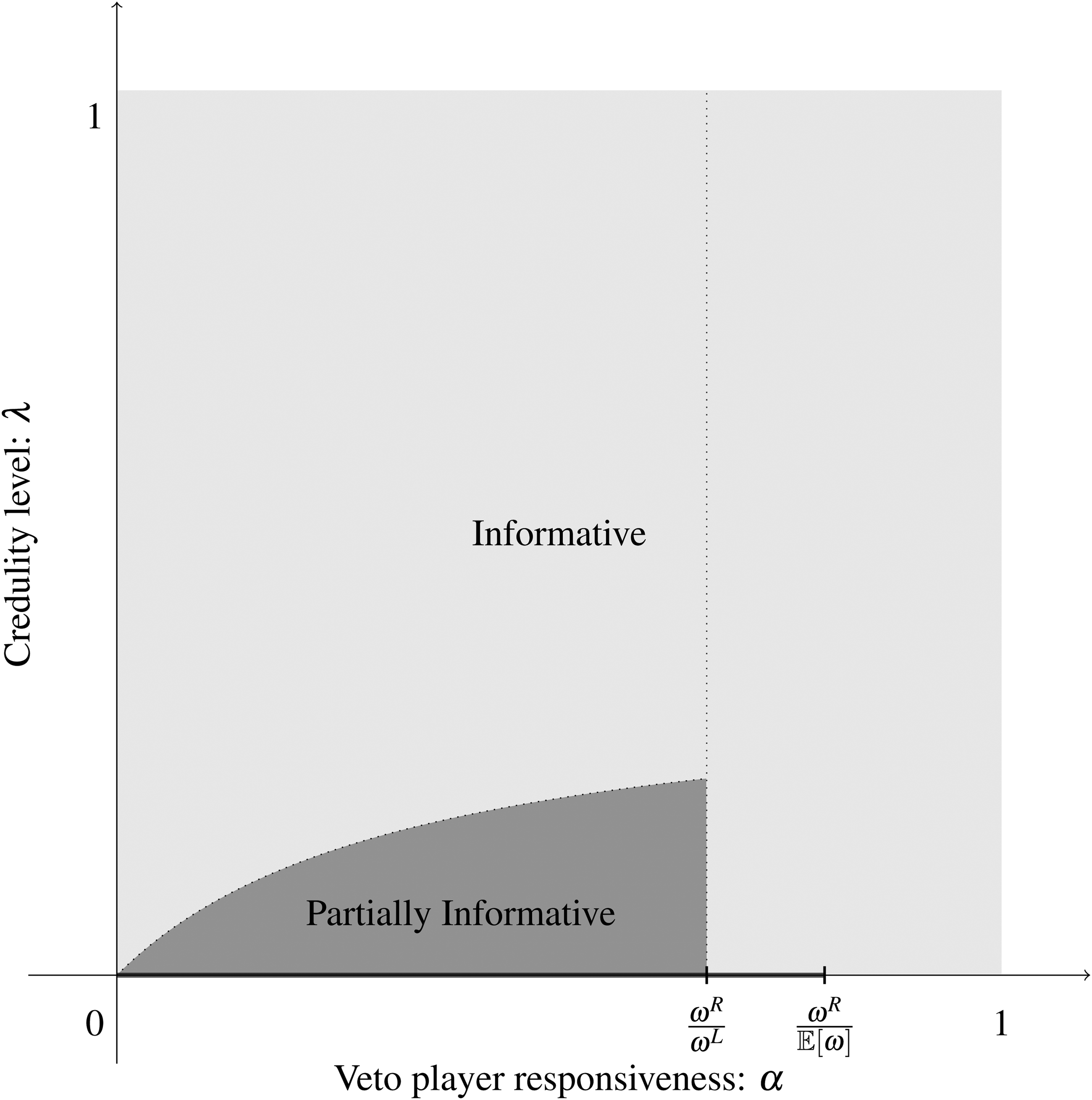
Regions associated with each type of equilibria, for hypothetical parameter values. Note. The dark line represents the region in which an uninformative equilibrium exists when
One implication of Proposition 2 comes from comparing the results to what would happen if the Group was allowed to simply communicate about
We now return to one of the questions that motivated this paper: When do candidates overpromise, in the sense of making promises that are more extreme than any feasible bargaining outcome? To answer this question, recall that the bargaining outcome is
Having defined the leftmost possible bargaining outcome, we then ask: when must equilibrium announcements include statements to the left of the leftmost bargaining point? Our equilibrium in Proposition 2 requires an announcement in the interval

Let
Two implications of Proposition 3 merit discussion. First, the condition in the proposition makes clear predictions about when we might expect to see overpromising: this strategy is most likely to be observed when the Veto player is not too responsive to information about the state or when the possible states are not too different. Returning to the opening example, let us examine how these conditions weigh on that case. Consider the claim of overpromising on healthcare policy by a socialist candidate for whom labor unions are a pivotal Group. The state may relate to the effects of a universal healthcare plan on labor union members: when
A second implication of Proposition 3 comes from comparing the condition for overpromising to the equilibrium conditions in Proposition 1 and Proposition 2. The condition that
The benefits of credulity
We close by analyzing the ex ante expected utility of the Group across different parameters of the game. Our goal is to show that the Group may benefit from an increased probability of being the credulous type. Thus, we restrict our attention to the case of
The effect of increasing
As Proposition 4 shows the favorable effect of increasing
Let
Proposition 4 suggests that, even in the absence of genuine credulity, a group may benefit if they can commit themselves to act as if they are credulous. For instance, opinion leaders in a particular group may benefit from promoting a way of thinking about politics that does not account for constraints on individual policymakers. Doing so may surprisingly make it easier for the policymaker to sway Veto players to choose policies more preferred by the Group.
One caveat for Proposition 4 is that the result depends more than the others on the behavioral interpretation of
Discussion and conclusions
We put forth a simple model of communication in electoral campaigns, in which a politician uses campaign statements to communicate to a Veto player about the popularity of that politician’s preferred policies. The idea is that having an audience with whom the politician must gain favor in order to take office limits the ability of the politician to exaggerate when she may otherwise do so. This is especially true when some audience members may be credulous, meaning that they naively believe campaign promises, even those that cannot be achieved by bargaining. The existence of credulous voters not only increases the informativeness of campaign statements, but also plays a central role in explaining overpromising by politicians. Without credulous voters, the true state (the optimal policy for the Group) can be revealed only when the Veto player is sufficiently responsive to the Group in relation to the difference between two possible states. However, the existence of credulous voters releases the above conditions and thus expands the set of informative equilibria since they would take the campaign statements seriously. Moreover, the existence of credulous voters incentivizes politicians to overpromise, since doing so increases the information about the state transmitted to the Veto player. On the contrary, overpromising would not benefit the politicians much when the Group is perfectly rational and the Veto player does not learn about the state from the announced platform and the election results.
Footnotes
Declaration of conflicting interests
The authors declared no potential conflicts of interest with respect to the research, authorship, and/ or publication of this article.
Funding
The authors received no financial support for the research, authorship, and/or publication of this article.
