







Abstract
In this work, the effects of dendrimer-functionalized magnetic iron oxide nanoparticles (Fe3O4@D-NH2) on improving thermal and mechanical properties in epoxy networks (ENs) are investigated. Magnetic iron oxide nanoparticles are prepared by coprecipitation of iron (II) chloride tetrahydrate with iron (III) chloride hexahydrate. Poly(amido-amine) dendrimer is synthesized by Michael addition reaction from diethylenetriamine with methyl acrylate. The fabricated dendrimer has been used to stabilize and functionalize magnetic nanoparticles. Then, magnetic iron oxide nanoparticles are encapsulated within the dendrimer and subsequently loaded into diglycidyl ether of bisphenol A (DGEBA) epoxy resin in two different contents, that is, 5 and 10 wt%. The amine groups of dendrimer-functionalized magnetic iron oxide nanoparticles allow them to be covalently linked to the polymer matrix alongside the main amine hardener. The resulting epoxy/magnetic iron oxide nanocomposites are thoroughly characterized by X-ray diffraction analysis, field emission scanning electron microscopy, and Fourier transform infrared spectroscopy. Probing the thermal behaviors of the epoxy/magnetic iron oxide nanocomposites by thermogravimetric analysis indicated that the temperature of 10% decomposition and the temperatures of the maximum decomposition rate values of Fe3O4@D-NH2@EN series increased up to 20 and 10°C, respectively. Dynamic mechanical thermal analysis also indicated that the organo-magnetic iron oxide nanoparticles can lead to an excellent interaction between the nanoparticles and the resulting DGEBA/isophorone diamine ENs.
Keywords
Introduction
Epoxy resins are widely applied as adhesives, 1 coatings, and matrix in polymer composites due to its low viscosity, good insulating properties even at high temperatures, and good chemical and thermal resistance. However, most of the epoxy systems are brittle. 2 –6 A variety of approaches have been proposed to enhance the epoxy systems mechanical and thermal properties. In this regard, incorporation of nanofillers in to the epoxy systems has drawn a special attraction. 7 –9
Embedding organic/inorganic nanoparticles in matrices composed of cured epoxy resins can significantly reinforce some of their properties such as tensile strength, storage modulus, and fracture toughness. 10 In the last decade, many authors became interested in magnetic nanoparticle-strengthened polymer composites. 11,12 However, magnetic nanoparticle-strengthened polymer nanocomposites suffer some problems; for example, the interfacial bonding between polymer resin and strengthened nanoparticle is frail and dispersion of magnetic nanoparticles in organic media is difficult. 13,14 For this reason, Fe3O4 nanoparticles are agglomerated in the polymer and become defects in the Fe3O4/polymer nanocomposites. 15,16 This is due to initial incompatibility during polymerization. 17,18 So, much research has sought to develop effective methods for the dispersion Fe3O4 in the polymer matrix. 19
Modifying the surface of Fe3O4 by organic compounds is applied to disperse Fe3O4 in the matrix. 20 The modification of Fe3O4 not only hinders agglomeration and improves their dispersion stability in various systems but also comforts further functionalization to use them in different applications. Fe3O4 nanoparticles can be suitably modified with different structures. In this regard, different structures have been applied to modify Fe3O4 nanoparticles such as inorganic silica, 13,21 organic polymers, 22,23 and so on. In this work, stabilization and functionalization of the magnetic iron oxide nanoparticles were done by the poly(amido-amine) dendrimer (PAMAM) dendrimer via encapsulation within dendrimer. Dendrimers are highly branched macromolecules possessing a large surface area to volume ratio with well-defined interior and exterior regions compared with different structures. In addition, a large number of terminal groups on the dendrimers are available for the further functionalization, and these end groups influence the solubility and adhesive properties of the dendrimers. 24,25 Further studies are required to understand the characteristics of dendrimers of this class of macromolecules. There are reports of several attempts for using the multi-valency of dendrimers as new functional materials. The terminal groups on the dendrimers in dendrimer-functionalized magnetic iron oxide nanoparticles allow them to be covalently linked to the polymer matrix alongside the main amine hardener. This can guarantee their permanent immobilization inside the epoxy network (EN).
This work aims to employ dendrimer-functionalized magnetic iron oxide nanoparticles as new inorganic Co-hardener in curing process of diglycidyl ether of bisphenol A (DGEBA) resin for preparing covalently linked epoxy-Fe3O4 thermosetting composites and to investigate the influence of this surface treated nanofiller on the thermal and thermomechanical behavior of the EN. The resulting epoxy/Fe3O4 nanocomposites designated by Fe3O4@D-NH2@EN 5 wt% and Fe3O4@D-NH2@EN 10 wt% are thoroughly characterized by Fourier transform infrared (FTIR), X-ray diffraction (XRD), and field emission scanning electron microscope (FE-SEM) techniques. Thermal behavior of the resulting nanocomposites is studied by thermogravimetric analysis/differential thermogravimetric analysis (TG/DTG). Also, the storage moduli (E′ values) and the loss factors are investigated by dynamic mechanical thermal analysis (DMTA) measurements.
Experimental
Materials
DGEBA resin with epoxide equivalent weight of 170 g/mol was supplied from Sigma-Aldrich Chemical Co (USA). Isophorone diamine (IPD; equivalent weight = 42.5 g eq−1) was obtained from Merck Chemical Co. Ferric chloride hexahydrate (FeCl3-6H2O, 99%), ferrous chloride tetrahydrate (FeCl2-4H2O, 99%), and ammonia (NH3) were obtained from Merck Chemical Co. Methyl acrylate (MA, 99%), diethylenetriamine, and ethylenediamine were supplied from Sigma-Aldrich Chemical Co. All these chemicals were used without any further purification.
Fe3O4 nanoparticles fabrication procedure
FeCl3·6H2O (2 mmol, 0.54 g) and FeCl2·4H2O (1 mmol, 0.20 g) were dissolved in 20 mL of deionized water in a round-bottomed flask placed in an ultrasonic bath with mechanical stirring at 70–80°C and then 5 mL of aqueous ammonia solution (25%) was added drop wise to the solution with vigorous stirring within 60 min. The black fine magnetite precipitate was separated from the solution using a magnet and washed several times with ethanol and deionized water. Then, it was dried in vacuum for 6 h at 50°C.
Synthesis of PAMAM dendrimer
In this work, Michael addition method was applied starting from a multifunctional core (diethylenetriamine) with branching monomers. 26 Diethylenetriamine (1.0 g, 9.7 mmol) dissolved in 20 mL of dried methanol was mixed with 10.53 mL (10 g, 0.116 mol) of methyl acrylate. The resulting reaction mixture was stirred at 25°C under inert atmosphere for 5 days. The first generation with 5-OCH3 terminated groups was obtained after evaporation of all volatiles in oil pump vacuum. To this, 20 mL of dried methanol and 44 mL of ethylenediamine (0.5 mol) were added and stirred under inert atmosphere for 6 days. The unreacted ethylenediamine and excess of methanol were eliminated under liquid nitrogen (N2) in vacuum. The first-generation dendrimer bearing 5-NH2 end-grafted groups was obtained, which was purified till all the traces of organic volatiles were fully removed. The first-generation dendrimer 6.74 g (0.01 mol) and methyl acrylate 33 mL (0.36 mol) were added in a single portion and again stirred for 7 days to grow the obtained dendrimer to the next generation. A thick yellowish liquid of the 10-arm –OCH3 terminated dendrimer was obtained, which was again purified under liquid N2 in vacuum to remove the excess of methyl acrylate and methanol. To this thick yellow liquid, 70 mL ethylenediamine (in excess) was added and stirred under inert atmosphere for 8 days. The reaction solution was then purified and thus the desired second-generation dendrimer with 10-NH2 terminal groups was obtained as pale yellow oily substance.
Proton nuclear magnetic resonance (400 MHz, CD3OH): δ 2.35 (m, 30 H), 2.71 (m, 58 H), 2.87 (m, 10 H), 3.34 (m, 30 H), 8.21 (bs, 4 H, D2O exchangeable); carbon-13 nuclear magnetic resonance (100 MHz, D2O, ppm) δ 32.73, 32.92, 35.55, 35.58, 34.99, 39.90, 39.94, 40.97, 41.8, 41.80, 42.88, 43.84, 44.57, 44.76, 44.83, 45.51, 46.43, 47.16, 47.45, 48.82, 49.02, 49.20, 49.25, 51.83, 53.54, 55.19, 174.63, 174.68, 174.73, 174.94, 174.99, 175.19, 175.61; 180.09; IR (KBr, cm−1): 3280, 2926, 2829, 1640 (CONH), 1543, 1435, 1356, 1241, 1118, 1032, 771; Anal. Calcd. for C79H163N33O15: C = 52.28, H = 8.99, N = 25.48; Found: C = 51.11, H = 9.38, N = 26.65.
Typical procedure for the preparation of dendrimer-functionalized magnetic nanoparticles
Fe3O4 (2.50 g) were thoroughly suspended in deionized water (50 mL) using an ultrasonic bath at 80°C for 20 min. Next, this suspension was slowly added to 7.0 mL dendrimer dissolved in 10 mL of deionized water and again sonicated for 6 h at 50°C. The resulting Fe3O4@D-NH2 nanoparticles were separated from the solution using a magnet and washed several times with ethanol and deionized water. Finally, it was dried in vacuum for 6 h at 50°C.
Fabrication of epoxy/magnetic nanoparticles sheets
Fe3O4@D-NH2@EN 5 wt% epoxy sheet with the dimensions of 30 × 10 × 2 mm3 was fabricated as follows: In a 10-mL flask, DGEBA resin (12 meq, 2.02 g) was stirred at 80°C for 15 min. Fe3O4@D-NH2 (0.125 g) was added to the resin and thoroughly homogenized for 30 min by an ultrasonic. The mixture was mechanically stirred at 80°C for 15 min. Then, IPD as the main hardener of the resin (12 meq, 0.55 mL) was poured into the reaction beaker and mechanically stirred for 20 min. The resulted viscose suspension was poured into a preheated Teflon-coated mold with the dimensions of 30 × 10 × 2 mm3. The curing process was carried out at 80°C for 1 h and then at 180° for 2 h. Finally, the bubble-free pale yellow sheet with2 mm thick was finally brought out from the molds. Fe3O4@D-NH2@EN 10 wt% and neat EN were also fabricated by a similar manner. For the latter, no Fe3O4@D-NH2 powder was added to DGEBA resin. The curing process for all of them was exactly equal.
Characterization
FTIR spectra were obtained with a Perkin Elmer spectrum RX I FTIR infrared spectrophotometer (Waltham, Massachusetts, USA) in the range of 400–4000 cm−1 using potassium bromide (KBr) pellets. MIRA3 LM TESCAN FE-SEM (Czech) was used for FE-SEM analysis. Prior to the capturing, the samples were attached to double sided carbon tape and coated with <10 nm gold using a DC sputtering coater. Wide-angle XRD patterns were recorded at room temperatures with film specimens on a Bruker Advance D8 X-ray diffractometer (Billerica, Massachusetts, USA) with Ni-filtered Cu/Kα radiation (30 kV, 25 mA). The patterns were collected in the range of 2θ = 20–70°. TGA/DTG was performed using a BAHR-Thermoanalyse-Simultaneous Thermal Analyzer STA 503 (Hullhorst, Germany) under argon inert atmosphere. The samples were heated from 25°C to 800°C at a heating rate of 10°C min−1 with Al2O3 as a reference. Homogenization of the samples was done with a BANDELIN SONOREX DIGITEC DT 102 H ultrasonic bath at 40°C with power and frequency of 140 W and 35 kHz, respectively. Triton Technology was used for dynamic mechanical analysis. Temperature sweeps were operated at a heating rate of 3°C min−1 using a frequency of 1 Hz, at a temperature range of 25–200°C.
Results and discussion
In this study, PAMAM dendrimer was used to functionalize the magnetic iron oxide nanoparticles and also as Co-hardener alongside the main amine hardener. Figure 1(a) shows synthesis of Fe3O4 and then Fe3O4@D-NH2. Magnetic iron oxide nanoparticles are encapsulated within the dendrimer. The second part of the work was the incorporation of Fe3O4@D-NH2 into a DGEBA-based EN during the curation process. To attain this object, the organically modified Fe3O4 nanoparticles were sonically dispersed within the resin, and then a stoichiometry amount of the amine hardener was added. To cure the resin by IPD hardener, a conventional two-step thermal procedure was followed. 27 Figure 1(b) schematically shows the synthesis of Fe3O4@D-NH2-loaded DGEBA/IPD ENs. The terminal groups on the dendrimers in dendrimer-functionalized magnetic iron oxide nanoparticles allow them to be covalently linked to the polymer matrix alongside the main amine hardener. This can guarantee their permanent immobilization inside the EN. The low weight percent of Fe3O4@D-NH2 (5 and 10 wt% relative to the total weights of DGEBA and IPD) and consequently the negligible equivalent of amine groups of the Fe3O4@D-NH2 minimizes the disbalancing between amine and epoxide groups during the curation process. To compare the results, in addition to the epoxy-based composites, the neat ENs were also synthesized by a similar manner.
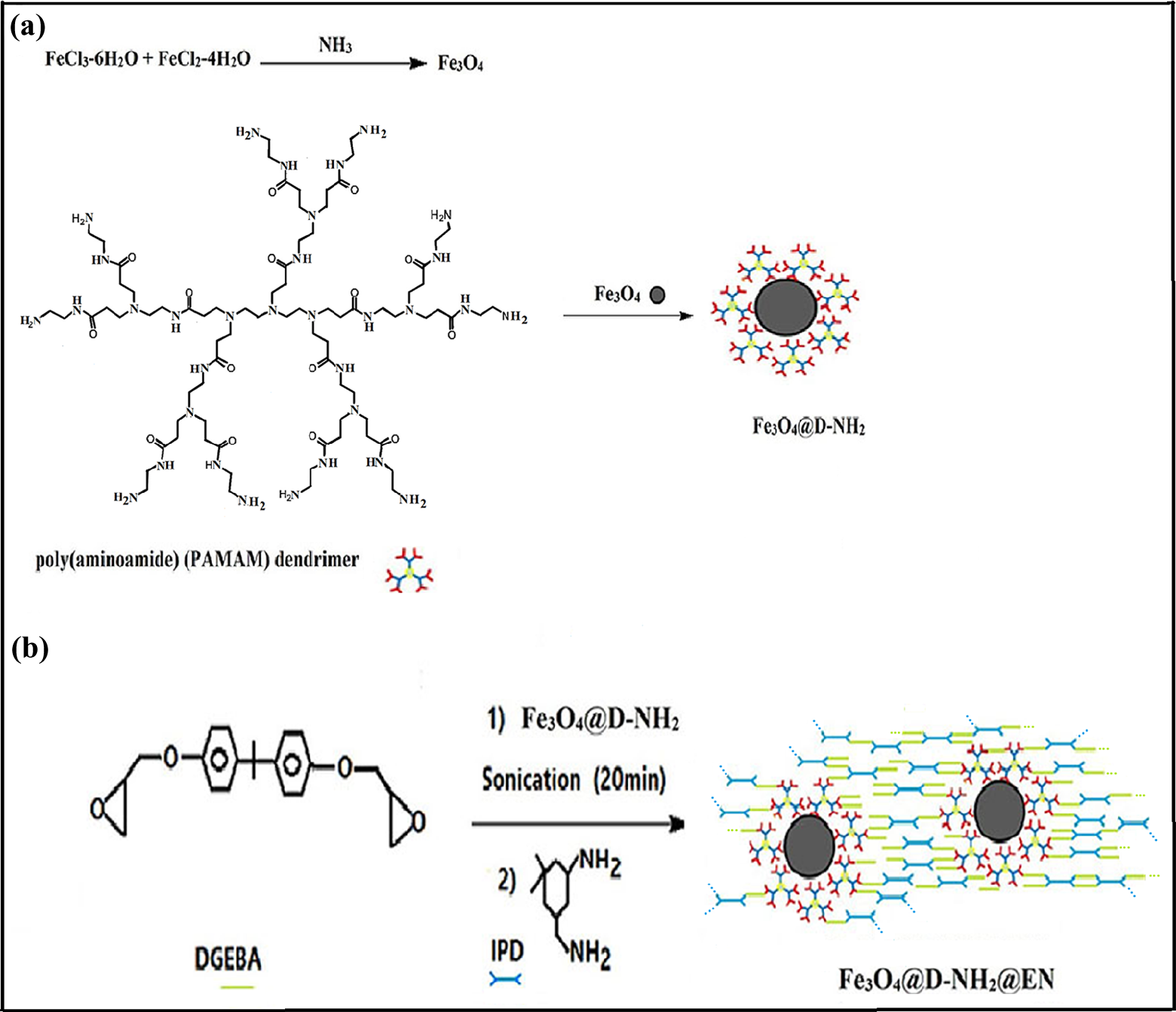
(a) Synthesis of Fe3O4 nanoparticles and dendrimer-functionalized magnetic Fe3O4 nanoparticles (Fe3O4@D-NH2) and (b) schematically presentation of Fe3O4@D-NH2-loaded DGEBA/IPD epoxy networks. Fe3O4@D-NH2: dendrimer-functionalized magnetic iron oxide nanoparticles; DGEBA: diglycidyl ether of bisphenol A; IPD: isophorone diamine.
Figure 2 shows FTIR spectrum of the Fe3O4, Fe3O4@D-NH2, EN, Fe3O4@D-NH2@EN 5.0, and Fe3O4@D-NH2@EN 10.0. The strong absorption peaks in the range of approximately 3400 cm−1 for Fe3O4 and Fe3O4@D-NH2 indicate the presence of OH vibration. The peak at 530–632 cm−1 corresponds to Fe–O stretching modes. In the spectrum of Fe3O4@D-NH2, besides of the peaks belonged to the Fe3O4, there are short-height peaks of approximately 2950 cm−1 assigned to –CH2– groups appeared. The peaks attributed to the NH2 end groups of the organic moiety as well as the remaining OH groups of the nanoparticle surface overlap with each other at above 3300 cm−1. Also, the peak appeared at about 1700 cm−1 could be attributed to C=O vibration of the formed urea linkages.

FTIR spectrum of Fe3O4 and Fe3O4@D-NH2, and Fe3O4@D-NH2@EN 5, Fe3O4@D-NH2@EN 10, and the neat epoxy. Fe3O4@D-NH2: dendrimer-functionalized magnetic iron oxide nanoparticles; FTIR: Fourier transform infrared; EN: epoxy network.
As shown in the figure, the FTIR spectrum of Fe3O4@D-NH2@EN series is similar to neat epoxy (EN). No absorption was observed for any of the polymers at 915 cm−1, which is the characteristic absorption of the epoxy group. This indicates that the epoxy has completely reacted with the curing agents (IPD and Fe3O4@D-NH2). Instead, the OH groups formed due to the reaction between curing agents and epoxy resin are found around 3400 cm−1. The emergence of peaks at 2872 cm−1 and 2959 cm−1 signifies symmetric and asymmetric C–H stretching vibrations, respectively. The peak appeared at 2065 cm−1 due to sp2–CH bending vibrations. Moreover, the peaks at 3387 and 1622 cm−1 present N–H bond present in cured DGEBA. The distinctive peak at 1474 cm−1 was due to C–N stretching vibration of cured DGEBA. Moreover, the C–O peak appeared at 1250 cm−1.
FE-SEM images of the organically modified nanoparticles (Fe3O4@D-NH2) clearly showed that Fe3O4@D-NH2 could lead to a significant increase in the mean size of the initial nanoparticles, from 10 to 20 nm of about 25 nm. Figure 3 exhibits FE-SEM images of Fe3O4 and Fe3O4@D-NH2 nanoparticles. Micrograph b displays the spherical morphology of Fe3O4 after surface modification with dendrimer. Figure 4 exhibits FE-SEM images of EN and Fe3O4@D-NH2@EN series. Continuous texture of neat epoxy (micrographs a and b) is somewhat disturbed by the addition of these organically modified nanoparticles. The presence of Fe3O4@D-NH2 within epoxy matrix is clearly detectable in micrographs d to f. Fe3O4@D-NH2 nanoparticles showed good miscibility with the epoxy background due to the stronger interactions between them. Clearly, more homogeneity in the composition of the network possessing aminated nanoparticles.
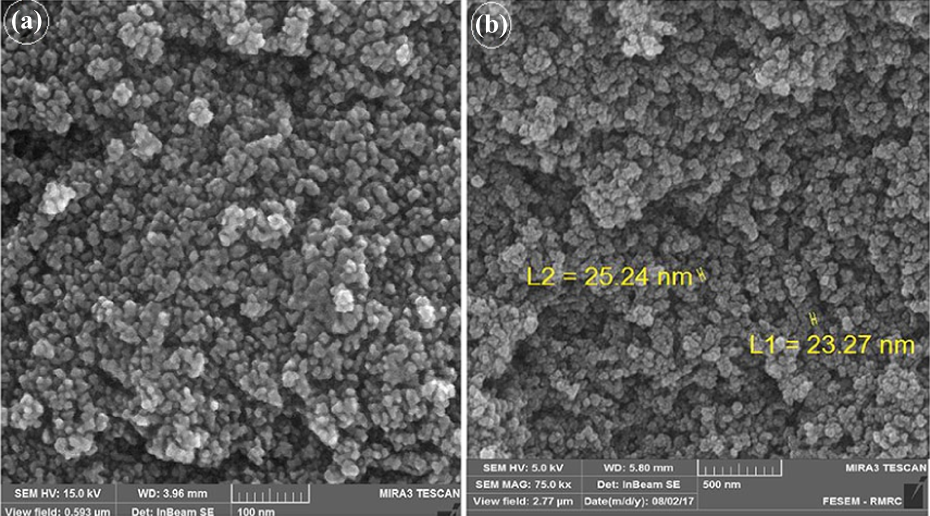
FE-SEM micrographs of the Fe3O4 (a) and Fe3O4@D-NH2 (b). Fe3O4@D-NH2: dendrimer-functionalized magnetic iron oxide nanoparticles; FE-SEM: field emission scanning electron microscopy.
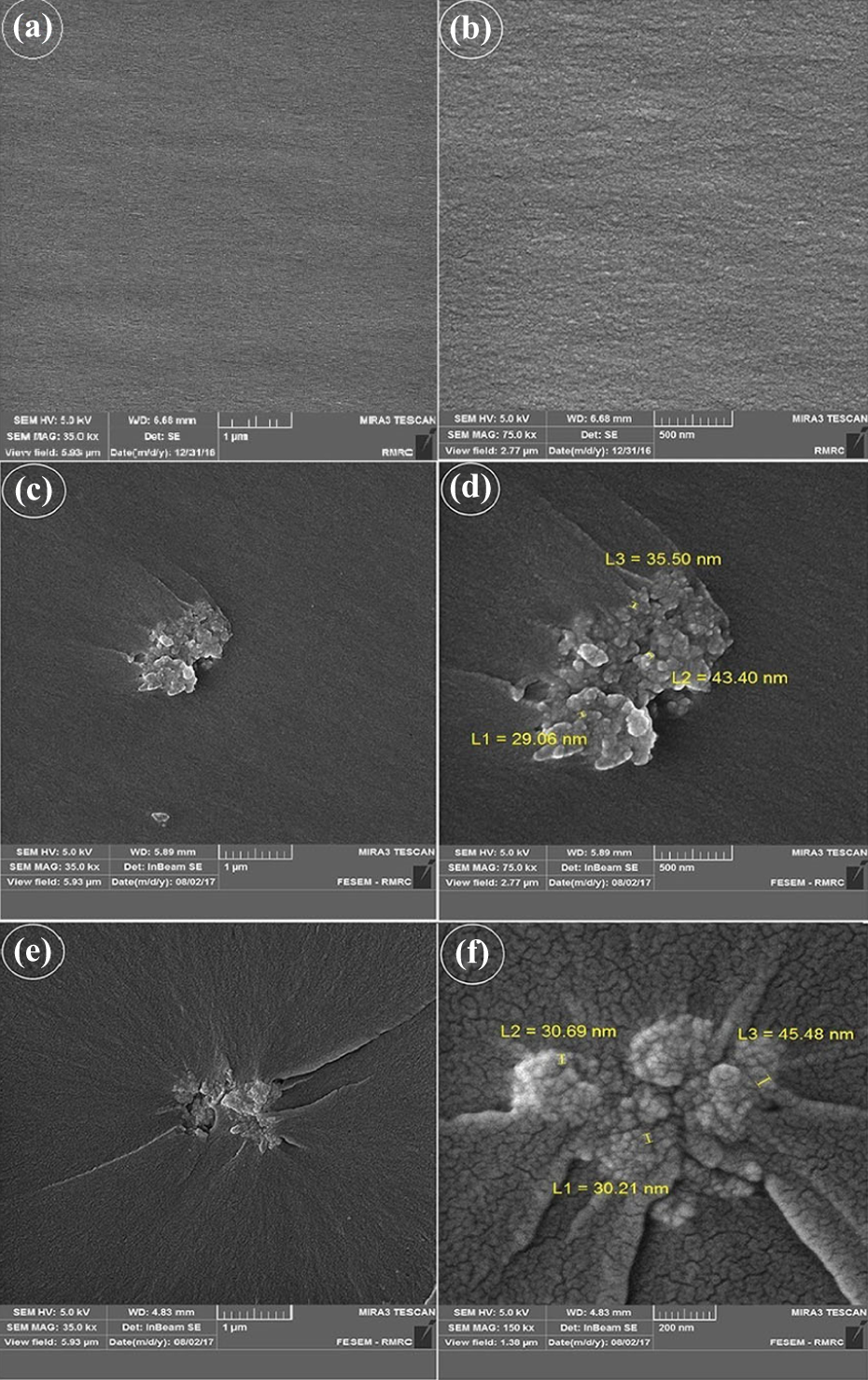
FE-SEM micrographs of the (a), EN (a and b), Fe3O4@D-NH2@EN 5 wt% (c and d), and Fe3O4@D-NH2@EN 10 wt% (e) and (f). Fe3O4@D-NH2: dendrimer-functionalized magnetic iron oxide nanoparticles; FE-SEM: field emission scanning electron microscopy; EN: epoxy network.
According to the images Fe3O4@D-NH2@EN 5 and Fe3O4@D-NH2@EN 10, it seems that the discontinuity and heterogeneity in the textures increases with increasing the loaded nanoparticle content. Their average sizes in all two nanocomposites are nearly equal, and according the results, no agglomeration occurred during the loading process.
The XRD diffractogram of Fe3O4, Fe3O4@D-NH2, neat epoxy (EN), and Fe3O4@D-NH2@EN series is illustrated in Figure 5. For the Fe3O4 and Fe3O4@D-NH2, several intense diffraction peaks were exhibited at 2θ = 18.3, 30.3, 35.6, 43.1, 53.6, 57.4, and 62.7°, corresponding to the typical reflections (220), (311), (400), (422), (333), and (440) of Fe3O4, respectively. The diffraction peaks correspond to the inverse spinel cubic crystal structure of iron oxide. Organo modification of Fe3O4 by dendrimer does not significantly change these diffraction peaks. The strong and sharp peaks reveal that Fe3O4 nanoparticles are well-crystallized. Diffractogram of the neat epoxy (EN) shows a peak at 2θ = 15–30°. Fe3O4@D-NH2@EN series spectrum shows several additional peaks, proportional to the neat EN spectrum that indicates the presence of Fe3O4@D-NH2. Since the magnetite Fe3O4 itself is crystalline, it is expected that the amorphous nature of the epoxy matrices can be significantly changed by adding Fe3O4@D-NH2.
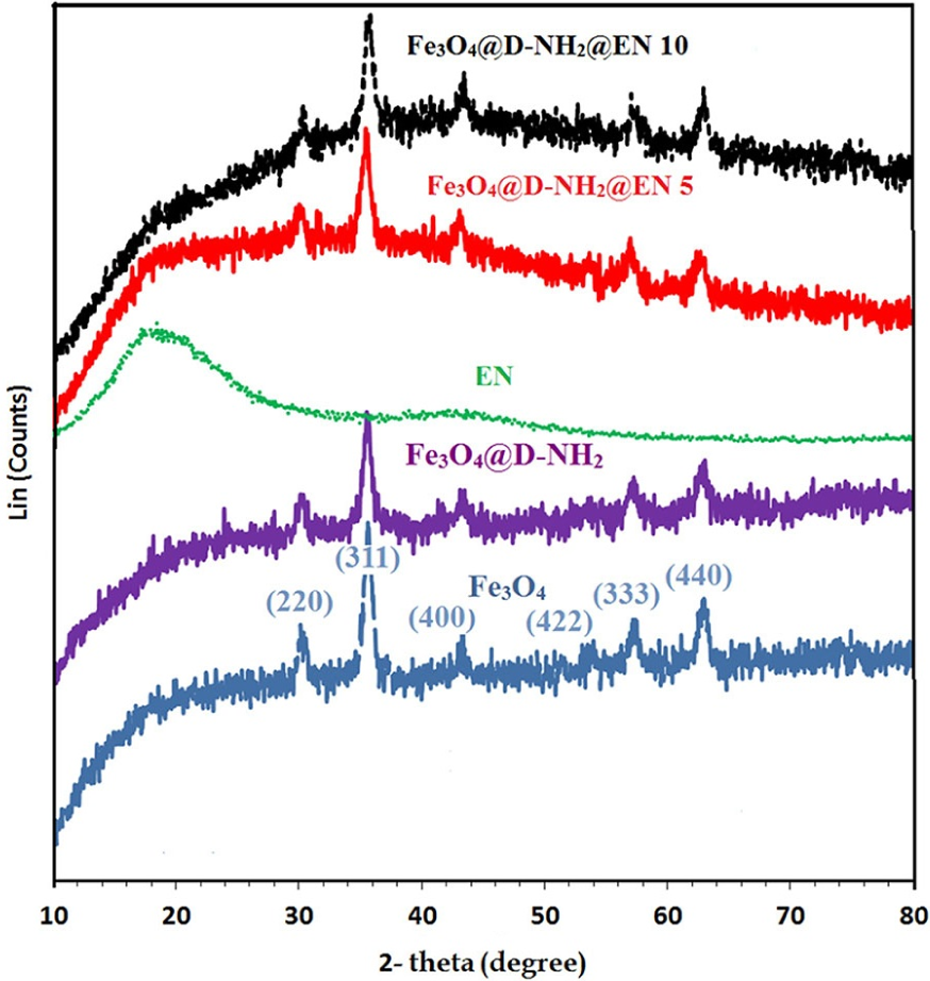
XRD of Fe3O4, Fe3O4@D-NH2, neat epoxy (EN), and Fe3O4@D-NH2@EN. Fe3O4@D-NH2: dendrimer-functionalized magnetic iron oxide nanoparticles; XRD: X-ray diffraction; EN: epoxy network.
Thermal behavior of the prepared samples including Fe3O4 and Fe3O4@D-NH2 (Figure 6) also neat epoxy (EN), and Fe3O4@D-NH2@EN series was investigated by their TGA thermograms (Figure 7).
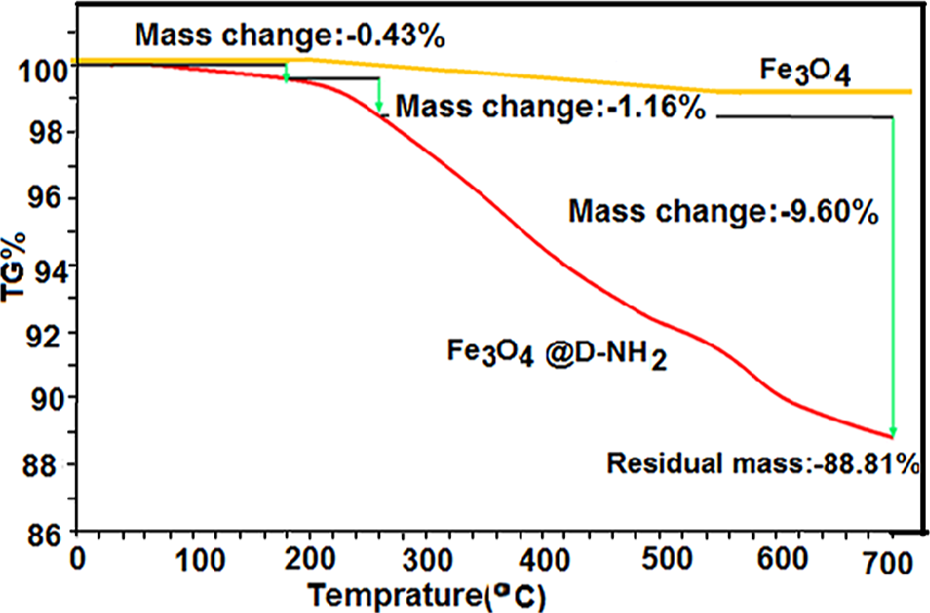
TGA thermograms Fe3O4 and Fe3O4@D-NH2. Fe3O4@D-NH2: dendrimer-functionalized magnetic iron oxide nanoparticles; TGA: thermogravimetric analysis.
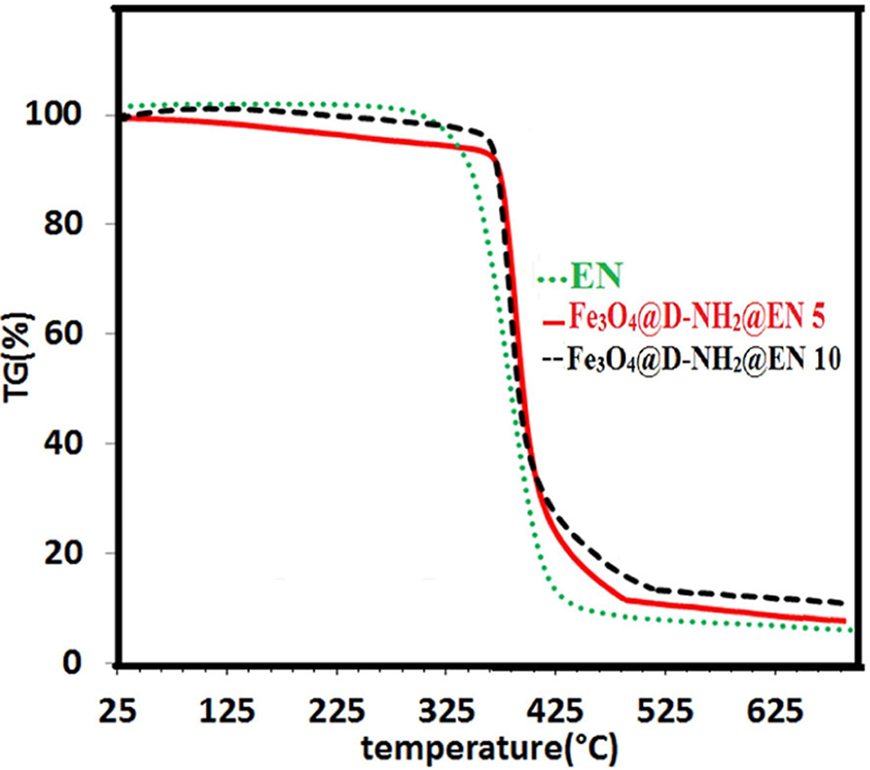
TGA thermograms neat EN, Fe3O4@D-NH2@EN 5 wt%, and Fe3O4@D-NH2@EN 10 wt%. Fe3O4@D-NH2: dendrimer-functionalized magnetic iron oxide nanoparticles; TGA: thermogravimetric analysis; EN: epoxy network.
Some data related to the TGA measurements, such as onset temperature of decomposition, the temperatures of the maximum decomposition rate (T max), and the char yields at 600°C, are also summarized in Table 1. The first weight loss is very small for Fe3O4@D-NH2@EN series and appears at around 100°C (≈2.4%). It can be attributed to water absorbed on the nanoparticle surface stabilized. In general, the main weight losses of the resulting epoxies occurred at the thermal range of 345–470°C. According to the results obtained, the thermal stabilities of the epoxies were somewhat reinforced after participation of Fe3O4@D-NH2 in the hardening processes.
Some thermal data of Fe3O4@D-NH2@EN nanocomposites compared to the neat EN.
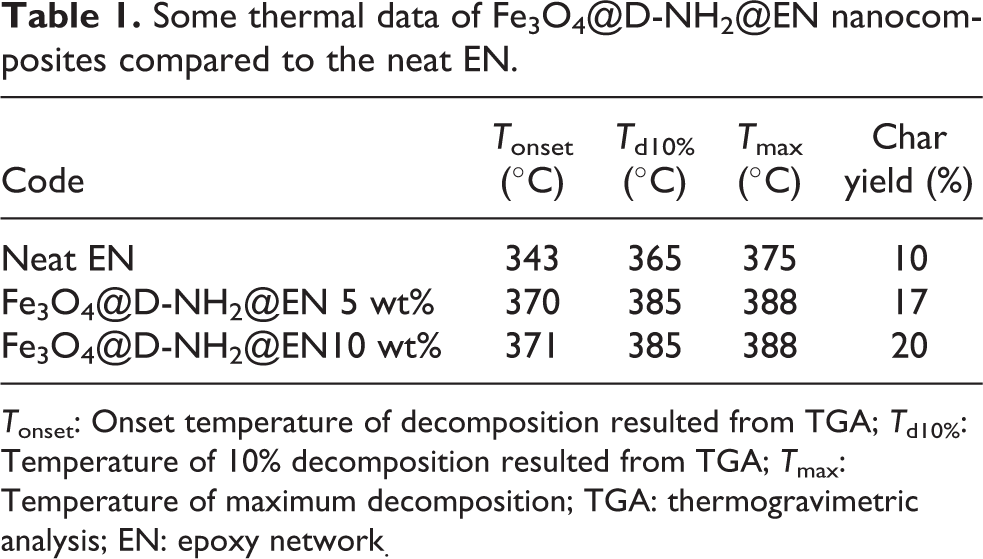
T onset: Onset temperature of decomposition resulted from TGA; T d10%: Temperature of 10% decomposition resulted from TGA; T max: Temperature of maximum decomposition; TGA: thermogravimetric analysis; EN: epoxy network.
The T d10% and T max values of Fe3O4@D-NH2@EN series increased up to 20°C and 10°C, respectively, relative to the neat EN. In addition, thermostable solid residue or char yield is 10, 12, and 16% for EN, Fe3O4@D-NH2@EN 5 and Fe3O4@D-NH2@EN 10 series at 600°C, respectively. Fe3O4@D-NH2 significantly meliorates the thermostability of the epoxy matrix. This remarkable thermostability of Fe3O4@D-NH2@EN nanocomposites in comparison with the neat epoxy should be associated with the strong interaction of Fe3O4@D-NH2 with EN chains. It seems that dendrimers have an important role in heat spread. Consequently, the destruction of rigid chains of the polymer is significantly delayed.
Mechanical stabilities at elevated temperatures were then measured by DMTA. Parts A and B of Figure 8 show the storage modulus and tan δ (also known as loss factor) of the nanocomposites. The storage moduli (E′) recover dramatically with an increase in Fe3O4@D-NH2. This result shows that dendrimer-functionalized magnetic iron oxide nanoparticles restricted chain mobility in the EN.
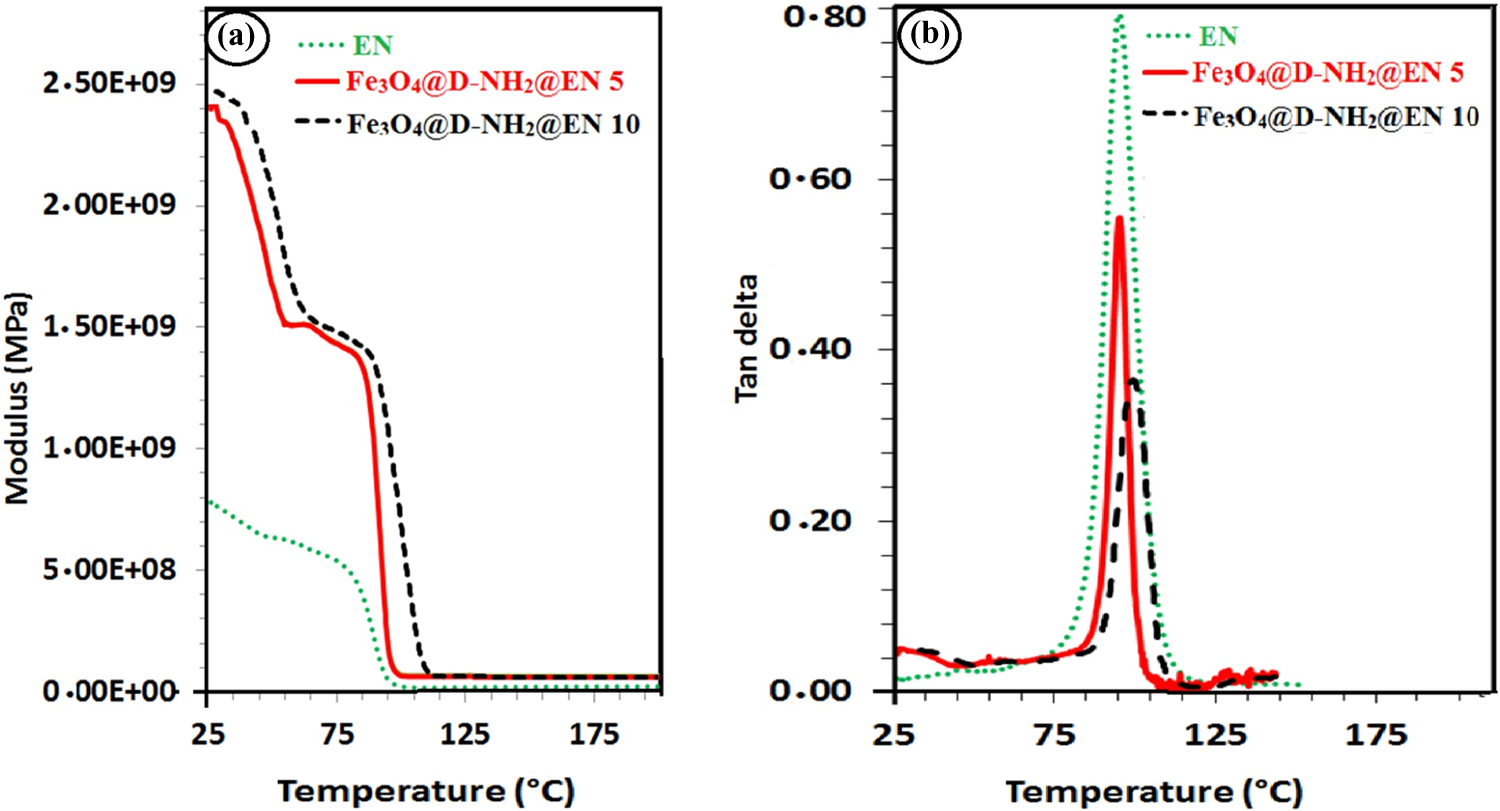
Storage modulus curves (E′) and loss factors (tan δ) profiles of Fe3O4@D-NH2@EN nanocomposites compared to the neat EN. Fe3O4@D-NH2: dendrimer-functionalized magnetic iron oxide nanoparticles; EN: epoxy network.
The peak temperature of tan δ is used for describing the glass transition temperature (T g) of composite materials. T g of the nanocomposites increases in comparison with pure EN; This was attributed to the facts that the incorporation of uniformly dispersed Fe3O4@D-NH2 restricts polymer chain movement and increasing effective cross-linking densities result from the amine group of Fe3O4@D-NH2 reacting with epoxy. Tan δ versus temperature plots of epoxy/Fe3O4 nanocomposites displayed a gradual reduction in the tan δ peak height and broadening of peak width with increasing amount of Fe3O4@D-NH2. This shows that the increase in stiffness and rigidity of the epoxy/Fe3O4@D-NH2 networks is due to the strong interfacial interaction between the Fe3O4@D-NH2 and the epoxy matrix. It was observed that the addition of 10 wt% of Fe3O4@D-NH2 increases the T g of epoxy matrix approximately by 10°C, which is the highest among all the nanocomposites.
Some thermal and mechanical data of Fe3O4@D-NH2@EN 5 nanocomposites were compared to the EN/AS-5 nanocomposites in table 2 of previous study. 7 In our previous study, DGEBA/IPD ENs loaded by (3-aminopropyl) triethoxysilane-modified SNP’s are cured and characterized.
Some thermal and mechanical data of Fe3O4@D-NH2@EN 5 nanocomposites compared to the EN/AS-5 nanocomposites.
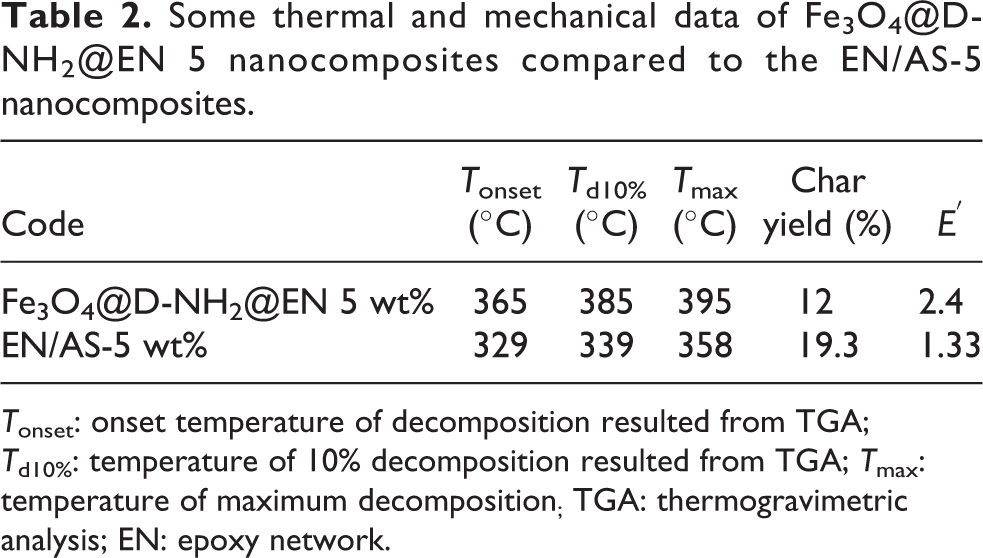
T onset: onset temperature of decomposition resulted from TGA;
T d10%: temperature of 10% decomposition resulted from TGA; T max: temperature of maximum decomposition; TGA: thermogravimetric analysis; EN: epoxy network.
Conclusions
When Fe3O4 is surface modified with PAMAM possessing amine functional groups, it can successfully play the role of an efficient Co-hardener accompanied with the main amine hardener for preparing an epoxy-based network. This chemical interaction with the epoxy matrix can give it an exceptional opportunity to disperse homogeneously within the thermosetting polymer. According to the results obtained from DMTA measurements, it could be concluded that no appreciable agglomeration in the loaded inorganic phase occurs in these conditions. Here, dendrimer-functionalized magnetite nanoparticles incorporated into the DGEBA/IPD EN affect the T g values of the resulting thermosetting materials. These nanoparticles caused further restriction in the segmental motions of the matrix macromolecular chains.
Footnotes
Acknowledgment
The authors wish to express their gratitude to the Faculty of Chemistry and Research Council of Damghan and Hakim Sabzevari University for financial support for this research.
Declaration of Conflicting Interests
The author(s) declared no potential conflicts of interest with respect to the research, authorship, and/or publication of this article.
Funding
The author(s) received no financial support for the research, authorship, and/or publication of this article.