






Abstract
We designed and synthesized two novel azobenzene functionalized poly(aryl ether)s (PAEs), PAE-azo-1 and PAE-azo-2, from a new azobenzene monomer via nucleophilic aromatic substitution polycondensation. This direct polymerization approach via azobenzene monomer has the advantages of controlling the distribution and amount of the azobenzene chromophores in the polymer. Both of the polymers showed very good thermal stability and excellent solubility for future application in the electronics industry. These polymers were fabricated as films by simple spin-coating and both of them were then prepared as sandwich memory devices. PAE-azo-1 and PAE-azo-2 exhibit write-once-read-many-times-type memory behavior, which can be encoded as “0” and “1,” and possess the low operation voltage below −3.0 V. The memory mechanism was investigated through ultraviolet–visible optical absorption spectrum and the cyclic voltammetry. These obtained results indicate that the novel azobenzene functionalized PAEs are a promising candidate for low power consumption and high-performance materials for data storage.
Introduction
Recently, organic molecular and polymeric materials, as active layers used in electrical memory devices, have attracted great attention because they can be miniaturized in memory device applications, and their properties can easily be tailored through chemical synthesis. 1 –5 Compared with organic small molecule materials, which require more elaborate and expensive processes, such as vacuum evaporation and deposition, polymeric materials exhibit an excellent film-forming ability, low processing temperature, and a relatively high thermal and chemical resistance. Thus, polymeric materials, as solution-processed active layers, can be readily combined with a variety of solution processing techniques, including inkjet printing, spin coating, spray coating, dip coating, and roller coating for large area, flexible circuits, and electronic systems. 6 Previously, polymer materials were reported to exhibit write-once-read-many-times (WORM) memory, flash-type memory, static random access memory, and dynamic random access memory effects. 7 –14 Furthermore, the memory switching characteristics of these polymers can be assigned to filamentary conduction theory, space charge limited current, charge transfer (CT) between the donor and acceptor moieties, field-induced conformational change, ion motion, carrier trapping and detrapping, and so on. 5,6,15 –18 However, most of these polymers have aliphatic hydrocarbon backbones, which lack dimensional, chemical, and thermal stability. The development of electrical polymer memory devices based on dimensionally, chemically, and thermally stable high-performance polymers remains in an exploration stage. It is well known that the material structure is one of the essential factors in determining memory device performances. Thus, it is a significant task to develop novel, high-performance memory material systems and new design principles.
Poly(aryl ether)s (PAEs) are a family of high-performance engineering thermoplastics with excellent thermal, mechanical, and electrical properties. These materials can be used in a wide range of demanding applications from aerospace to microelectronics. 19 Our group has developed several novel, functional PAEs, including through the use of direct copolymerization, a post-functional reaction, and investigated their corresponding optical and electrical properties. 20 –25 Polymers containing azobenzene groups have been considered as promising materials for optical data storage, electro-optical modulators, and in other electro-optic areas, due to the photosensitive trans–cis isomerization and orientation effects of the azobenzene chromophores. Aside from the optical properties, the electronic properties of azobenzene groups, as the conjugated moiety, can be tuned. Thus, polymers containing azobenzene groups are promising for the application in resistive memory devices. The combination of the PAEs backbone with conjugated azo groups could provide a new approach to develop novel, high-performance materials with electrical memory properties.
In this article, we designed and prepared novel PAEs, containing azobenzene groups in the side chains, through direct polymerization from a new bisfluoroazobenzene monomer (i.e. N-ethyl{[4-(4-nitrophenyl)diazenyl]phenyl}aminoethyl-2,6-difluorobenzoate (ENDAF)), bisphenol A, and 4,4′-difluorobenzophenone (Figure 1(a) and (b)). The use of the direct polymerization method to combine the PAEs backbone with the electrically active azo groups has the advantages of tuning the distribution and amount of the chromophore in the polymer. To the best of our knowledge, few reports have focused on developing a new azo-monomer and synthesis for azobenzene-functionalized PAEs via a direct polymerization for an electrical memory application. These two polymer memory devices were fabricated with a sandwich configuration (Figure 1(c)), and the memory properties were characterized by current–voltage (I–V) measurements. The thermal properties, optical properties, and electrochemical properties of the polymers were also investigated.
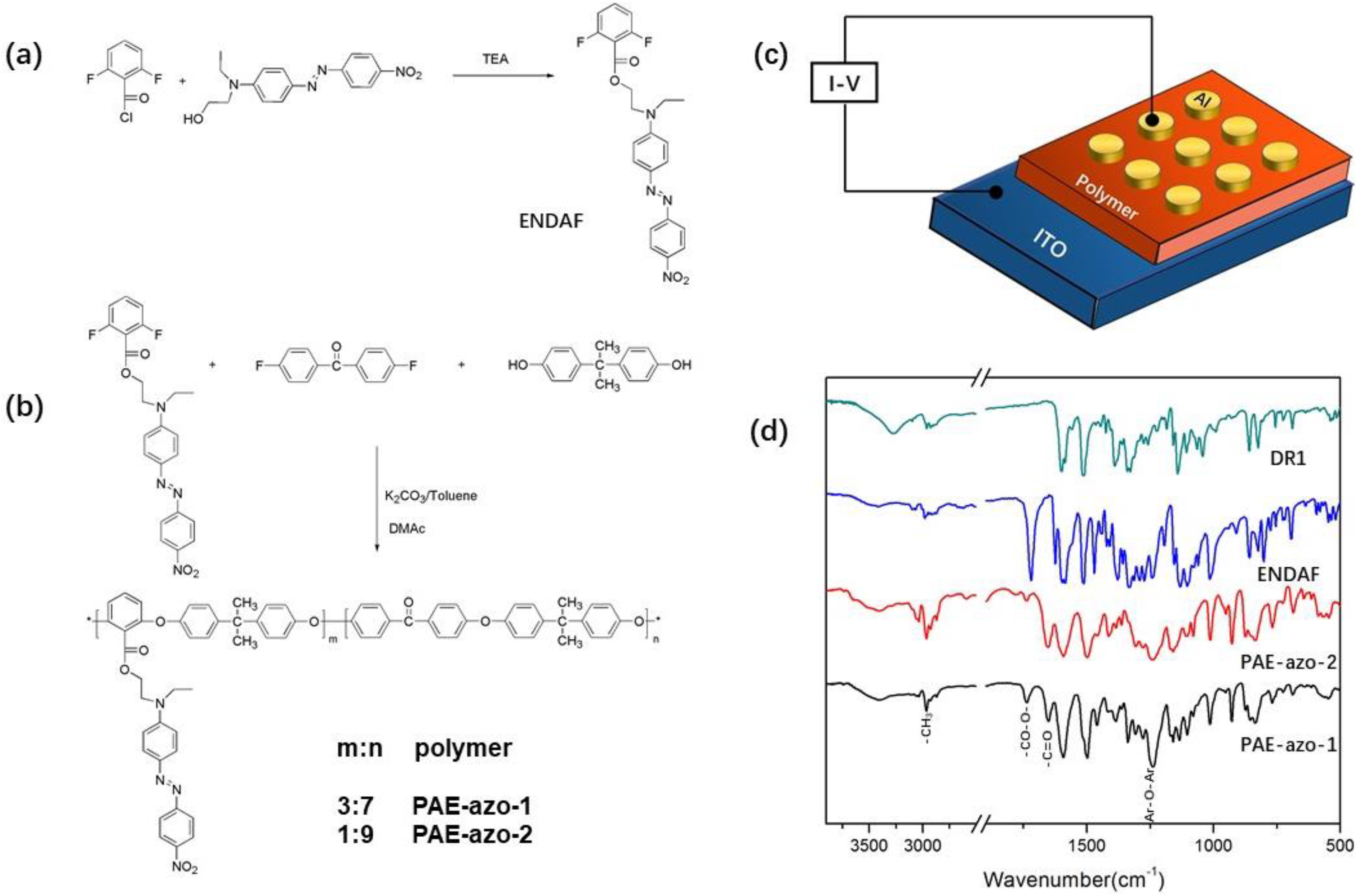
(a) Synthesis route of ENDAF. (b) Synthesis route of PAE-azo-1 and PAE-azo-2. (c) Scheme of the ITO/polymer/Al memory device. (d) IR (KBr) spectra of DR1, ENDAF, PAE-azo-1, and PAE-azo-2. ENDAF: N-ethyl{[4-(4-nitrophenyl)diazenyl]phenyl}aminoethyl-2,6-difluorobenzoate; PAE: poly(aryl ether); ITO: indium tin oxide.
Experimental
Materials
2,6-Difluorobenzoyl chloride, triethylamine (TEA), 4,4′-difluorobenzophenone, and bisphenol A (BPA) were all purchased from Sigma Aldrich (St. Louis, Missouri, USA). All other reagents and solvents were obtained commercially and purified by conventional methods. Potassium carbonate (K2CO3) was dried at 130°C for 12 h before polycondensation.
Materials preparation
Synthesis of N-ethyl{[4-(4-nitrophenyl)diazenyl]phenyl}aminoethyl-2,6-difluorobenzoate
Under N2 atmosphere, a solution of 2,6-difluorobenzoyl chloride (3.52 g, 0.02 mol) in dichloromethane (20 mL) was added dropwise into a mixture of Disperse Red 1 (6.28 g, 0.02 mol) and TEA (2.52 g, 0.025 mol) in dichloromethane (80 mL), which was then stirred for 12 h at room temperature. After washing with water/dilute hydrochloric acid/water, the dichloromethane was evaporated, and the product was recrystallized. Red crystals were obtained. 1H NMR (300 MHz, CDCl3) δ (ppm) 8.45–8.23 (m, 2H), 8.02–7.81 (m, 4H), 7.45 (tt, J = 8.4, 6.3 Hz, 1H), 7.07–6.91 (m, 2H), 6.85 (t, J = 6.2 Hz, 2H), 4.58 (t, J = 6.3 Hz, 2H), 3.83 (t, J = 6.3 Hz, 2 H), 3.59 (q, J = 7.1 Hz, 2H), 1.27 (t, J = 7.1 Hz, 3H). IR (KBr, cm−1) 3067 (Ar–H), 2983 (–CH3), 1724 (–CO–O–), 1011 (–C–F). Melting point (m.p.): 122°C (DSC); Elem. Anal. Calcd. for C23H20F2N4O4: C, 60.79; H, 4.44; N, 12.33; Found: C, 62.45; H, 4.336; N, 12.48.
Synthesis of PAE-azo-1 and PAE-azo-2
The synthetic procedure of azobenzene-functionalized PAEs was as follows. For PAE-azo-1, a 100-mL three-necked flask, equipped with a mechanical stirrer, Dean–Stark trap (Beijing Synthware Glass), cold-water condenser, N2 inlet/outlet, and thermometer, was charged with BPA (1.5980 g, 0.007 mol), ENDAF (0.9537 g, 0.0021 mol), 4,4′-difluorobenzophenone (1.0684 g, 0.0049 mol), anhydrous potassium carbonate (1.1126 g, 0.008 mol), dimethylacetamide (DMAc; 12 mL), and toluene (15 mL). Under nitrogen atmosphere, the mixture was heated to 130°C and maintained at that temperature for 2 h to dehydrate the system, by means of a Dean–Stark trap using toluene. After dehydration and removal of toluene, the reaction temperature was increased to 155°C and maintained at this temperature for 9 h until a viscous solution was obtained. The viscous solution was slowly poured into water to obtain the thread-like polymer. The crude product was washed with deionized water and ethanol, followed by drying at 110°C under vacuum for 24 h. The copolymers were prepared by varying the mole fractions of ENDAF (m) and 4,4′-difluorobenzophenone (n). Copolymers with the differing m/n ratios 3/7 and 1/9 were prepared and designated as PAE-azo-1 and PAE-azo-2, respectively. IR (KBr, cm−1): 3040 (Ar–H), 2972 (–CH3), 1735 (–CO–O–), 1652 (–Ar–CO–Ar–), 1239 (–Ar–O–Ar–).
Instruments and characterization
Thermogravimetric analysis (TGA) was performed on a Pyris 1 thermogravimetric analyzer (Perkin Elmer, Waltham, Massachusetts, USA) under nitrogen atmosphere at a heating rate of 10°C min−1. Fourier transform infrared spectroscopy (FTIR) spectra (KBr pellet) were recorded on a Nicolet Impact 410FTIR spectrophotometer (Wisconsin, USA). The structures of the ENDAF and polymers were determined by nuclear magnetic resonance (NMR) spectroscopy (Bruker 300 MHz, Germany), and ultraviolet–visible (UV–Vis) absorption spectra were recorded on a SHIMADZU UV2501-PC spectrophotometer (Shimadzu, Kyoto, Japan) at room temperature. Cyclic voltammetry (CV) was measured on a CHI 600E electrochemical workstation (CH Instruments, USA) using a conventional three-electrode cell, with an indium tin oxide (ITO) substrate as the working electrode, a platinum plate as the counter-electrode, and a silver (Ag)/silver nitrate (AgNO3) as the reference electrode, at a scan rate of 100 mV s−1. Tetrabutylammonium perchlorate (Bu4NClO4; 0.1 M) in acetonitrile (AN) is the electrolyte. Elemental analysis results were obtained on a vario EL cube CHNS elemental analysis instrument (vario EL cube, Germany). The m.p. of ENDAF was performed by differential scanning calorimetry (DSC) measurements (Mettler Toledo DSC821e instrument (Mettler Toledo, Switzerland), heating rate of 10°C min−1 under nitrogen atmosphere). The weight-average molecular weight (
Device fabrication
The memory devices were fabricated as a sandwiched configuration of ITO/polymer/Al (Figure 1(c)). The ITO glass substrate was precleaned, sequentially, with water, acetone, and 2-propanol in an ultrasonic bath (15 min). The copolymer solution was prepared in N,N-dimethylformamide (DMF) and filtered through micro filters with a pinhole size of 0.22 μm, followed by spin coating onto ITO. The solvent was removed in a vacuum chamber at 80°C for 12 h. Finally, a 250-nm-thick Al topped electrode was thermally evaporated at a pressure of approximately 10−7 Torr through a shadow mask. The current–voltage (I–V) characteristics were performed using a Keithley 2636B semiconductor parameter analyzer (Cleveland, OH, USA). All electrical measurements of the devices were characterized under ambient conditions.
Results and discussion
Synthesis and characterization
Two azobenzene-functionalized PAEs, PAE-azo-1 and PAE-azo-2, were designed and synthesized (Figure 1(a) and (b)). A novel bisfluoro monomer ENDAF, containing azobenzene groups, was successfully synthesized via an esterification reaction (Figure 1(a)). The structure of the ENDAF was determined by FT-IR and 1H NMR, in which the FT-IR spectrum showed characteristic absorption band of –CO–O– at 1724 cm−1 and –C–F– at 1011 cm−1 (Figure 1(d)). In the 1H NMR spectra, all magnetic resonance signals were clearly assigned according to the chemical shifts of the hydrogen atoms (Figure 2(a)); this assignment suggests that the ENDAF has been successfully prepared. Then, we prepared two copolymers with azo-monomer contents of 30% (PAE-azo-1) and 10% (PAE-azo-2). The azobenzene-functionalized PAEs, with different azo moiety content, were synthesized by the typical nucleophilic substitution polycondensation reaction from ENDAF, bisphenol A (BPA), and 4,4′-difluorobenzophenone (Figure 1(b)). The copolymerization was carried out in DMAc under nitrogen atmosphere with potassium carbonate as a base catalyzer and toluene for dehydration (Figure 1(b)). The chemical structures of the azo-polymers were confirmed by FT-IR and 1H NMR. The FT-IR spectrum of PAE-azo-1 and PAE-azo-2 exhibited characteristic bands of Ar–CO–Ar and –CO–O– at 1652 cm−1 and 1735 cm−1, respectively (Figure 1(d)). Although some signals in the 1H NMR spectrum overlapped, the signals corresponding to the proton located at ortho-position of the –NO2 group (δ, 8.33) and azo group (δ, 7.90) could be easily distinguished from other protons, which correspond well with the expected structures (Figure 2(b)). The azo-polymers exhibited excellent solubility in polar organic solvents, such as tetrahydrofuran, DMAc, DMF, and CHCl3, which is conducive to the fabrication of an electrical memory device by a solution process. The weight-average molecular weight (

1H NMR spectra of (a) ENDAF and (b) PAE-azo-1 in CDCl3. PAE: poly(aryl ether); 1H NMR: proton nuclear magnetic resonance; ENDAF: N-ethyl{[4-(4-nitrophenyl)diazenyl]phenyl}aminoethyl-2,6-difluorobenzoate; CDCl3: deuterochloroform.
Thermal stabilities
The excellent thermal stability of the azobenzene-functionalized polymers is essential for their application as active materials in electrical memory devices. 26 The thermal properties of the novel azo-monomer and azo-polymers were evaluated by TGA under nitrogen atmosphere. The TGA curves and experiment data of the polymers are summarized in Figure 3 and Table 1, respectively. The 5% weight-lost temperature (T 5) of the ENDAF, PAE-azo-1, and PAE-azo-2 were found to be 295°C, 294°C, and 431°C, respectively, suggesting that two of the polymers exhibited good thermal stability. Since the thermal stability of the aromatic backbone of PAEs was stronger than the thermal stability of azobenzene chromophores, the temperatures at T 5 and T 10 increased with the azo-monomer content, from 30% to 10%. The presence of the azo groups in the polymer determines the first step of decomposition. 27 The amount of carbonized residue from the two polymers, in nitrogen atmosphere, were both above 37% at 800°C, compared to the ENDAF, which was 22% due to its high aromatic content. The results demonstrate that the two azo-PAEs are expected to meet the requirement of heat resistance in the electronics industry.

TGA curves of ENDAF, PAE-azo-1, and PAE-azo-2 in nitrogen atmosphere at a heat rate of 10°C min−1. TGA: thermogravimetric analysis; ENDAF: N-ethyl{[4-(4-nitrophenyl)diazenyl]phenyl}aminoethyl-2,6-difluorobenzoate; PAE: poly(aryl ether).
Thermal properties of polymers and monomer.

ENDAF: N-ethyl{[4-(4-nitrophenyl)diazenyl]phenyl}aminoethyl-2,6-difluorobenzoate; PAE: poly(aryl ether); T 5: the temperature of 5% weight loss; T 10: the temperature of 10% weight loss.
Optical properties
The optical absorption spectra of PAE-azo-1 and PAE-azo-2 in solid films and in a series of solvents, with different polarities, are shown in Figure 4(a) and (b), respectively. In the spectrum, the peak at the shorter wavelength absorption was assigned as a Π−Π* electronic transition of the aromatic ring, while the peak at the longer wavelength absorption resulted from the CT in the azobenzene moiety. In the solution, with an increasing solvent dielectric constant, the wavelength of the lower energy absorption peak of PAE-azo-1 shows a redshift from 465 nm in CHCl3 to 483 nm in DMF, while PAE-azo-2 shows a corresponding shift from 404 to 420 nm. The similar solvent-dependent changes could also be found in the novel azo-monomer. As shown in Figure 4(c), the UV–Vis absorption spectra of the azo-monomer ENDAF were studied across a range of solvents. The dielectric constants of a series of solvents and the corresponding maximum absorption are summarized in Table 2. The peak of the lower wavelength absorption of the azo-monomer exhibits a positive solvatochromic shift of 15 nm, from dioxane to AN. This phenomenon is due to the increased dipolar character of the excited state upon an increase in the solvent polarity. 18 In a film state, the CT absorption peaks of PAE-azo-1 and PAE-azo-2 are broadened, compared to their solution counterparts, ascribed to the formation of molecular aggregation. The optical energy band gap (Eg ) of the polymers is estimated by the onset wavelength (Table 3). The obtained band gap of PAE-azo-1, PAE-azo-2, and the ENDAF are 2.05 eV, 2.12 eV, and 2.18 eV, respectively.

UV–Vis absorption spectra of (a) PAE-azo-1 and (b) PAE-azo-2 in dilute THF solution, DMF solution, CHCl3 solution, and solid thin film. The dielectric constants of DMF, THF, and CHCl3 are 37.6, 7.5, and 4.8, respectively. (c) Solvatochromic behavior of ENDAF recorded in different solvents of varying dielectric constants. (d) UV–Vis absorption spectra of ENDAF in chloroform with different concentrations. UV–Vis: ultraviolet–visible; PAE: poly(aryl ether); THF: tetrahydrofuran; DMF: dimethylformamide; CHCl3: chloroform; ENDAF: N-ethyl{[4-(4-nitrophenyl)diazenyl]phenyl}aminoethyl-2,6-difluorobenzoate.
UV–Vis absorption and solvatochromic data of ENDAF in different solvents.

UV–Vis: ultraviolet–visible; ENDAF: N-ethyl{[4-(4-nitrophenyl)diazenyl]phenyl}aminoethyl-2,6-difluorobenzoate; THF: tetrahydrofuran; CHCl3: chloroform; DCM: dichloromethane.
Electrochemical and optical properties of monomer and polymers.

PAE: poly(aryl ether); HOMO: highest occupied molecular orbital; LUMO: lowest unoccupied molecular orbital; ENDAF: N-ethyl{[4-(4-nitrophenyl)diazenyl]phenyl}aminoethyl-2,6-difluorobenzoate.
To study the aggregation phenomenon of the novel monomer, the absorption strength, wavelength, and shape of the absorption band in the UV–Vis spectra of the ENDAF were measured in CHCl3 at different concentrations (ranging from 0.005 mM to 0.1 mM). As shown in Figure 4(d), the shape of the absorption band did not change as the concentration increased, even when the maximum concentration increased to a 10−4 order of magnitude. The absorbance increased almost linearly as the concentration increased, which showed that the interval of absorbance change was uniform. The strong dipole–dipole interaction could lead to the aggregation of chromophores, and possibly, nanocrystal generation (self-assembly) via a solvent exchange method. 28 These results indicated that there are only weak dipole–dipole interactions among the azo-monomers.
Electrochemical properties
The electrochemical properties of the polymers and new monomer ENDAF were investigated by CV, conducted in a 0.1 M Bu4NClO4/AN solution at a scan rate of 100 mV s−1. The obtained cyclic voltammograms are shown in Figure 5(a), and the electrochemical data are listed in Table 3. The highest occupied molecular orbital (HOMO) energy level of the polymers and ENDAF can be calculated from the onset of oxidation, with reference to ferrocene (4.80 eV), using the equation: HOMO = −(E ox(onset)+4.8 − E foc), where E foc is the onset oxidation potential of ferrocene versus the Ag/AgNO3 reference electrode (0.013 V). The lowest unoccupied molecular orbital (LUMO) energy level was estimated from the optical band gap and the corresponding HOMO level. The HOMO and LUMO energy levels of PAE-azo-1 and PAE-azo-2 are −5.30eV/−3.25 eV and −5.29eV/−3.17 eV, respectively.
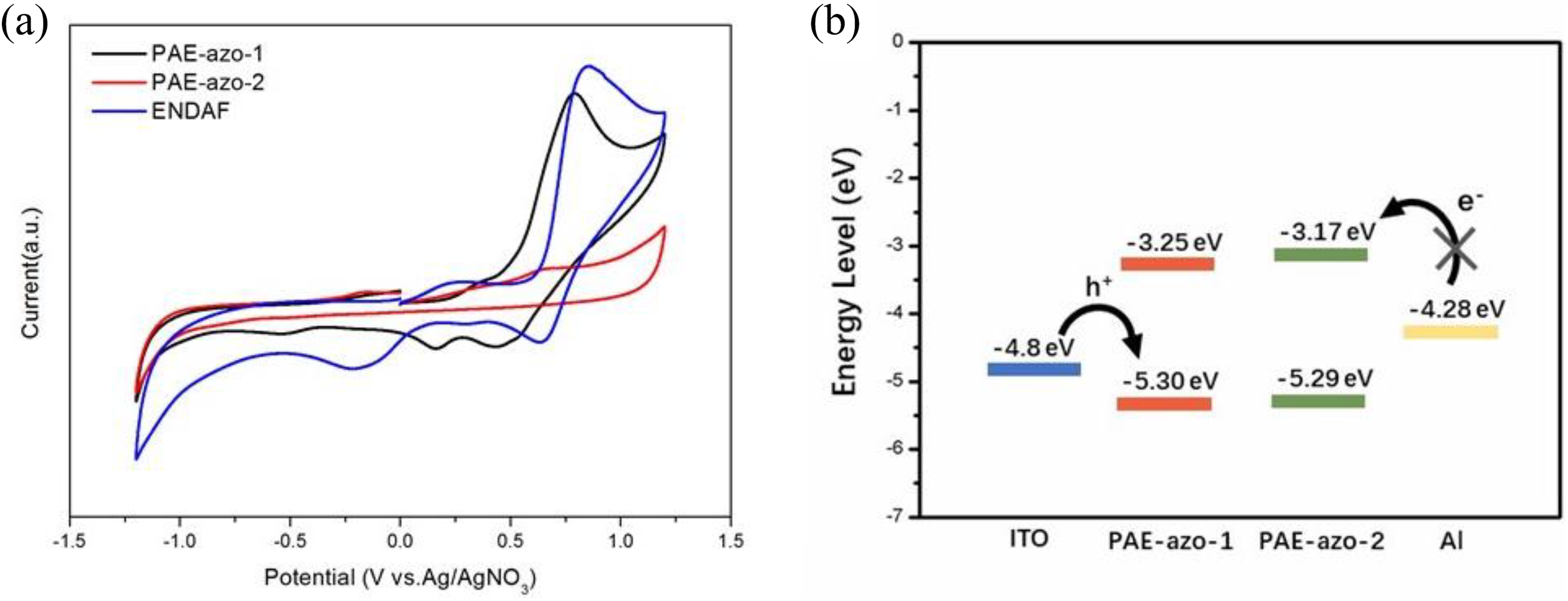
(a) CV curves of ENDAF, PAE-azo-1, and PAE-azo-2 in AN solution with 0.1 M Bu4NClO4 as the supporting electrolyte. (b) Energy-level diagram of ITO/polymers/Al device. CV: cyclic voltammetry; ENDAF: N-ethyl{[4-(4-nitrophenyl)diazenyl]phenyl}aminoethyl-2,6-difluorobenzoate; PAE: poly(aryl ether); ITO: indium tin oxide; and AN: acetonitrile; Bu4NClO4: tetrabutylammonium perchlorate.
To further understand the storage mechanism of the novel materials, detailed energy-level relationships between the azo-polymers are summarized in Figure 5(b). The energy barrier for hole injection from ITO (−4.80 eV) to the HOMO of the PAE-azo-1 (−5.30 eV) is 0.5 eV, which is much lower than the energy barrier of 1.03 eV for electron injection from Al (−4.28 eV) to the LUMO of PAE-azo-1(−3.25 eV). This indicates that the hole injection from the ITO electrode into the HOMO of PAE-azo-1 is easier than the electron injection from the Al electrode into the LUMO level of PAE-azo-1. Therefore, PAE-azo-1 is a p-type material, and holes predominate the conduction process of the memory devices. Meanwhile, the PAE-azo-2 is also a p-type material, deduced from the optical absorption spectra and CV measurements (Table 3 and Figure 5(b)).
Memory properties
The electrical properties and switching effects were observed from the characteristic current–voltage (I–V) curves of the ITO/polymer/Al devices (Figure 6). The electrical properties of the devices can be tuned by varying the composition of the functionalized azo-polymer and the thickness of the film. Figure 6(a) shows the I–V characteristics of the electrical memory device with the PAE-azo-1 film and a thickness of approximately 120 nm. This device initially exhibited a low-conductively (OFF) state, however, as the negative bias increased, a sharp transition from the low-conductively (OFF) state to a high-conductively (ON) state was observed at −2.82 V (the switch ON voltage) (sweep 1). The ON/OFF current ratio of the studied memory device is approximately 102, when read at −1.0 V. This OFF-to-ON transition can function in a memory device as a “writing” process. In addition, once the device has reached its ON state, it remains there and cannot be returned to the OFF state by applying an opposite bias or even after the power is turned off. This memory device therefore demonstrates typical nonvolatile WORM-type memory behavior. The impacts on the device characteristics through different film thicknesses were also investigated. Figure 6(b) shows the I–V curves based on ITO/PAE-azo-1 (40 nm)/Al memory cells. This device exhibits only a single high-conductivity state, and no conductance switching behavior is observed.
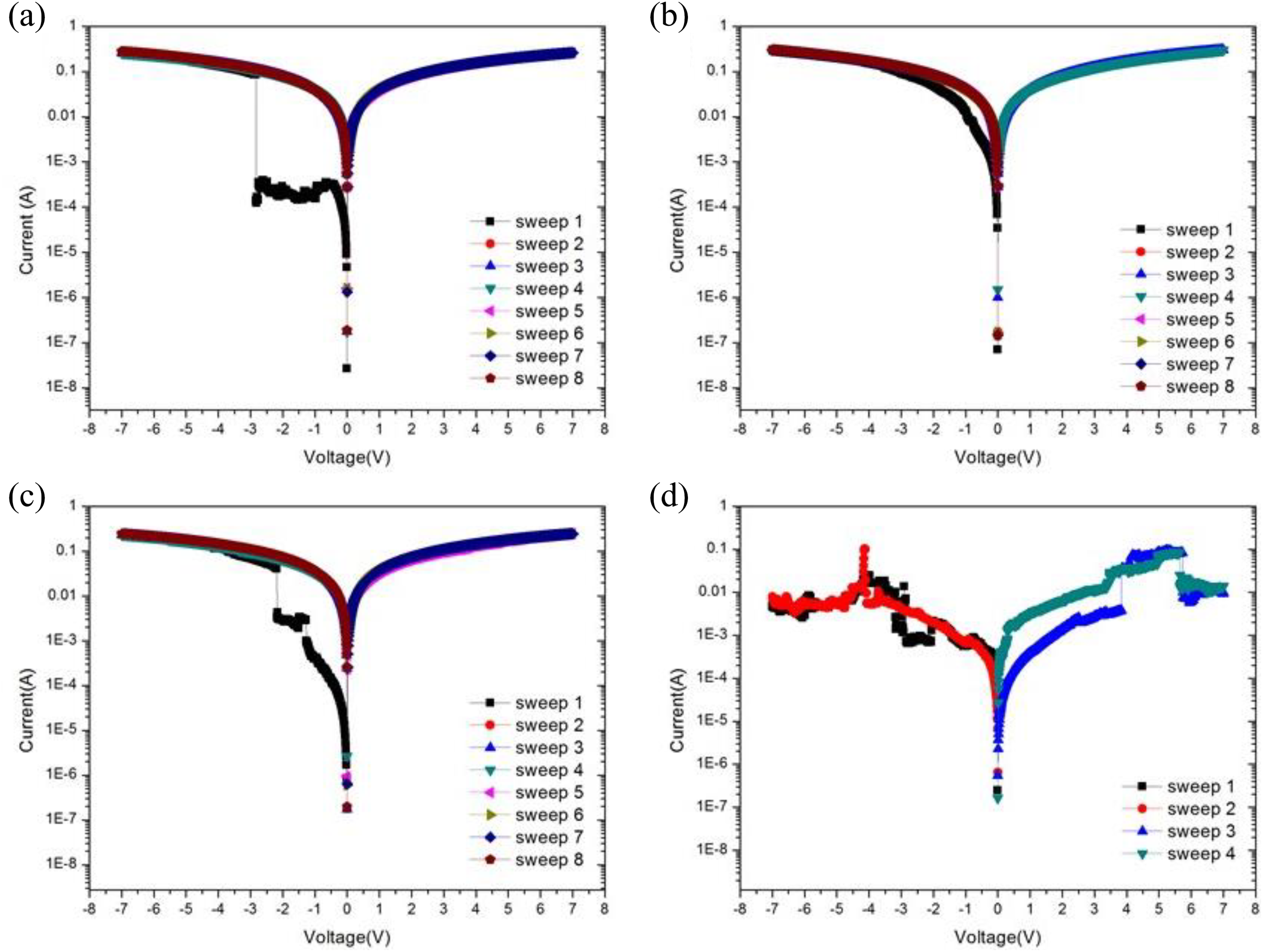
Current–voltage (I–V) characteristics of the azobenzene functionalized poly(aryl ether)s memory devices with various thicknesses: (a) PAE-azo-1, 120 nm; (b) PAE-azo-1, 40 nm; (c) PAE-azo-2, 60 nm; and (d) PAE-azo-2, 120 nm. PAE: poly(aryl ether).
The PAE-azo-2, with lower azobenzene content when compared to PAE-azo-1, also exhibits an interesting electrical memory behavior. Figure 6(c) shows the typical I–V characteristics of the memory device fabricated with PAE-azo-2 as the active layer (60 nm). Compared to the device with PAE-azo-1 (120 nm) as the active layer, this device switches at a lower turn-on voltage of −2.17 V, which promotes low power consumption. The ON/OFF state current ratio of the device is roughly as high as 102 at −1.0 V and exhibits a WORM memory switching behavior. With increasing film thickness, as shown in Figure 6(d), the I–V curves of the ITO/PAE-azo-2 (120 nm)/Al memory cells do not exhibit the electrically bistable behavior, indicating that this PAE-azo-polymer system exhibits composition- and thickness-dependent memory characteristics.
Conclusion
A new monomer ENDAF was designed and synthesized via an esterification reaction. It is the first time that novel functionalized azo-PAEs, PAE-azo-1 and PAE-azo-2, have been successfully prepared from this new monomer ENDAF. These polymers exhibit excellent thermal stability, good solubility, and suitable energy gaps of 2.05 eV (PAE-azo-1) and 2.12 eV (PAE-azo-2). With tuning the thickness, both PAE-azo-1 and PAE-azo-2 exhibit WORM memory behavior in ITO/polymer/Al sandwich structures, with low operation voltage −2.82 V and −2.17 V, respectively, resulting in low power consumption. The high ON/OFF ratios of these memory devices are both up to 102, under a read voltage of −1.0 V. The memory mechanism of the device has been investigated, and the PAE-azo-1 and PAE-azo-2 were both p-type material. The aggregation of novel monomer ENDAF was also investigated, and the result shows that there are only weak dipole–dipole interactions among the azo-monomers. A comprehensive study not only demonstrates the functionalized azo-PAEs, which are a promising candidate for a resistive memory device, but also provides fundamental insight into the rational design of high-performance functional polymers materials for data storage applications.
Footnotes
Acknowledgment
The authors gratefully acknowledge the National High-tech R&D Program of China (863 Program) for financial support.
Declaration of Conflicting Interests
The author(s) declared no potential conflicts of interest with respect to the research, authorship, and/or publication of this article.
Funding
The author(s) disclosed receipt of the following financial support for the research, authorship, and/or publication of this article: This work was financially supported by the National High-tech R&D Program of China (863 Program) (2015AA033801).
