






Abstract
Polyimide (PI) aerogels with excellent properties have received a lot of attention, and the use of nanoparticles to improve the properties of aerogels has been investigated in the last few years. In this work, aminated functionalized MXene nanoparticles were successfully prepared as a cross-linking agent as well as an inorganic reinforcing phase, homogeneously embedded in PI aerogels, to synthesize a new PI composite aerogel. The results show that m-MXene can act as a cross-linking point to effectively maintain the network structure, which further improves the dimensional stability and compressive modulus. These PI composite aerogels have a high specific surface area, low density, low shrinkage and excellent mechanical properties.
Introduction
Aerogel is a kind of solid material with a three-dimensional nanoporous network, and the pores are filled with gaseous medium.1–6 Because of its unique nanoporous network structure,7–10 aerogel has the characteristics of low density, high porosity, and low thermal conductivity and is widely used in aerospace, electronic communication, flame retardant and thermal insulation, energy storage, adsorption, catalysis and sensing.11–14 Polyimide (PI) and other organic aerogels with excellent properties have received a lot of attention.15–18 In addition, PI aerogel also has the following characteristics superior to other organic aerogels: (1) PI aerogel can withstand a wide range of operating temperatures. (2) PI aerogel is a self-extinguishing polymer in case of fire, with low smoke generation rate and less harmful gas. (3) PI aerogel has good flexibility. (4) PI aerogel has good dielectric properties, and its dielectric constant can be as low as 1.19. (5) PI aerogel is easy to process and mold, not easy to damage, and environmentally friendly. 19
The dimensional stability of polymer aerogels is an important property under stringent conditions, especially when applied in space exploration or in long-term high-temperature environment. The use of nanofillers, including carbon nanotubes (CNTs), 20 carbon nanofibers, 21 graphene oxide (GO), 22 cellulose nanofibers, 23 clays, 24 and polyacrylonitrile fibers,25,26 to improve the properties of aerogels has been well investigated in the last few years.
In these kinds of nanofillers, MXene is a two-dimensional (2D) layered material composed of early transition metal carbides, nitrides or carbonitrides.27,28 Due to the unique layered properties, high electrical conductivity, high specific surface area, excellent hydrophilicity, and good thermal stability, 29 MXene has broad application prospects in the fields of physics, chemistry and nanotechnology. It can be used in various scientific fields such as catalysis, energy storage and sensors.30–35 The addition of MXene to some kinds of polymer aerogels has been reported. Cheng et al. 36 demonstrated MXene/carboxymethyl cellulose aerogel to shield electromagnetic irradiation, harvest biomechanical energy, and perceive bio-mechanical movements. Wu et al. 37 described silane modified MXene and polybenzazole nanocomposite aerogels with low density, surface hydrophobicity and mechanical robustness. There are few relevant studies on the addition of MXene to PI aerogels. Yang et al. 38 reported a robust strategy to fabricate architecturally controllable and multifunctional MXene/aramid nanofiber/PI aerogels. The aerogel demonstrated desirable multifunctional electromagnetic wave absorption, adjustable mechanical property and high thermal insulation. Zhao et al. 39 fabricated multifunctional fire-retardant PI/MXene/Ag2Se nanowires composite aerogels, which had good strength and flexibility via freeze-drying and dip-coating. However, most of the current studies are on the direct incorporation of MXene into the polymer system, which may limit the dispersion effect of MXene in the aerogel. Few studies related to the effect pattern of modified MXene incorporation on the properties of PI aerogels have been reported.
Aerogels with excellent insulation properties have promising applications in pipeline transportation, aerospace, construction and other fields. However, the defects in thermal stability and mechanical properties are the main factors limiting the use in special environments. The incorporation of nanoparticles in polyamic acid (PAA) solutions can suppress the linear shrinkage in the thermal imidization process and the supercritical drying process. In this work, 3-aminopropyl triethoxysilane (APTES) functionalized MXene nanoparticles were successfully synthesized as a cross-linking agent as well as an inorganic reinforcing phase, homogeneously embedded in PI aerogels, to synthesize a new PI composite aerogel. The physical, structural, mechanical and thermal properties of the modified MXene (m-MXene)/PI aerogel were tested. This aerogel shows promise to become lightweight and heat-resistant porous materials in aerospace applications.
Experiment
Materials
3,3′,4,4′-biphenyltetracarboxylic dianhydride (BPDA), 3,3′,4,4′-benzophenonetetracarboxylic dianhydride (BTDA) and 4,4′-diamino-2,2′-dimethyl benzidine (DMBZ) were supplied by Forsman Scientific (Beijing) Co., Ltd., China. APTES and 1,3,5-triaminophenoxybenzene (TAB) were bought from Shanghai Macklin Biochemical Co., Ltd., China. Dimethylacetamide (DMAc), triethylamine and ethanol were supplied by Beijing Chemical Works, China. Acetic anhydride was purchased from Sinopharm Chemical Reagent Co., Ltd., China. Ti3AlC2 (98% purity) was bought from 11 Technology Co., Ltd., China.
Preparation
Preparation of modified MXene
Ti3C2Tx MXene was synthesized following the well-documented HCl/LiF etching method. The synthetic process of Ti3C2Tx MXene nanosheets was based on the previous investigation. 40
Ethanol (160 mL), water (10 mL) and ammonia solution (15 mL) were measured in a beaker, MXene (1.0 g) was added and stirred magnetically for 24 h. After that, APTES (1.0 mL) was added and stirred magnetically for 24 h. The reacted solution was centrifuged and washed with ethanol three times to remove unreacted substances. Finally, the powder was dried in a vacuum oven at 60°C for 12 h to obtain the aminated MXene (m-MXene) powder.
Preparation of m-MXene/PI aerogel
The m-MXene/PI aerogel was prepared as shown in Scheme 1 and Figure 1. PAA precursor was prepared using the molar ratio of BPDA&BTDA to DMBZ of (n + 1): n to provide PAA capped with anhydride. The number of repeat units in the PAA is 30. DMBZ (2.1336 g) was dissolved in 51.21 g DMAc. BPDA (0.7616 g), BTDA (2.525 g) and the remaining 76.86 g DMAc were slowly added, fully dissolved and reacted at room temperature for 12 h to produce anhydride capped PAA with a certain degree of polymerization. The m-MXene was added to the weighed DMAc solution and then moved into an ultrasonic device for 30 min to make it uniformly dispersed, followed by adding it to the PAA and reacting for 2 h. After that, the TAB (0.0797 g) was added as the cross-linker, and the PAA was then imidized by triethylamine (3.04 g) and acetic anhydride (3.06 g). Then the solution was poured into the mold after mechanical stirring (5 min) and left for 24 h at room temperature to produce PI wet gel. As shown in Table 1, The mass fraction of the nanoparticle was adjusted into 0% (G3), 0.1% (M1), 0.25% (M2), 0.5% (M3), 1.0% (M4) and 2.0% (M5) comparing to PAA. For sample M0, 1.0% unmodified MXene was added to evaluate the effect of amination modification. Synthesizing mechanism of m-MXene/PI aerogels. Schematic diagram for the preparation of m-MXene/PI aerogels. Amination modified nanoparticle cross-linked PI aerogel formulation.


The DMAc in the wet gel was gradually removed by solvent replacement using a mixture of DMAc and ethanol. The samples were subsequently placed in a supercritical drying machine (Nantong Yichuang Instruments Co., Ltd., China) with the parameters of 40°C, 10.5 MPa, 8 h. Finally, they were placed in a vacuum oven (Shanghai Yiheng Technology Co., Ltd., China) for drying at 80°C for 10 h.
Tests and measurements
The morphologies of the samples were observed by using a scanning electron microscope (SEM, JSM7500, JEOL, Japan). The sample compositions were carried out using X-ray photoelectron spectrometer (XPS, Thermo ESCALAB 250Xi, Thermo Fisher Scientific, USA) and Fourier transform infrared spectrometer (FTIR, Nicolet iS50, Thermo Fisher Scientific, USA). The nitrogen adsorption isotherms of aerogels were determined by JW-BK112 (Beijing JWGB Sci. & Tech., China) at 77 K, and the pore size distributions of the samples were recorded from the desorption branch of the isotherm by using the BJH method. 41 Thermogravimetric analysis (TGA, Q5000IR, Thermo Fisher Scientific, USA) was also conducted for quantitative analysis of these samples. Thermal conductivity tester (DRPL-III-P, Xiangtan Xiangyi Instrument Co., Ltd., China) was used to determine the thermal conductivity of the samples. The diameter of aerogels before and after supercritical drying was measured using the vernier caliper. Then the difference between the before and after diameters divided by the original diameter to obtain the shrinkage data. Compressive properties of aerogels were obtained according to GB/T 8813-2008 on the universal material testing machine (HY-0350X, Shanghai Hengyi Precision Instrument Co., Ltd., China). The aerogel was heated in air and then held for 4 h to detect the dimensional change. The selected treatment temperature was 80°C, 120°C, 160°C and 200°C. The dimensional retention data before and after heat treatment were measured.
Results and discussion
Characterization of modified MXene
The key of the modified MXene is grafting APTES to effectively introduce -NH2. The m-MXene will be used as a chemical cross-linker for PI chains. XPS full spectrum scans were performed on the untreated MXene and amination-modified m-MXene surfaces, and the scanned spectra of the nanoparticle surfaces with element compositions and contents were obtained, as shown in Figure 2 and Table 2. It can be seen that the untreated MXene nanoparticle surface contains six elements, Ti, Al, C, N, O and F. The element content of N is 1.25%, and the presence of Si element could not be detected. After the amination modification, the content of N element on the nanoparticle surface increases to 3.89%, while the content of Si element reaches 3.32%. This indicates that after the amination modification, nitrogen-containing functional groups appear on the nanoparticle surface and the content of Si element increases due to the presence of Si element from APTES. XPS full spectrum scans of (a) untreated MXene and (b) amination modified MXene. Element compositions and contents of MXene.

In order to further prove the successful grafting of the amino group, the spectrum of N 1s was scanned on the surface of the nanoparticles, and the XPS Peak analysis software was also applied to split and fit the N 1s peaks. The different peaks belong to carbon atoms in different chemical bonds, and their relative contents could be obtained from the area of the peaks, so as to obtain the ratios of different carbon-containing functional groups. As shown in Figure 3 and the peak splitting results in Table 3, m-MXene nanoparticles can be divided into two peaks, in which the peak at 400.6 eV corresponds to the -NH2 part and the peak at 399.0 eV corresponds to the -NH- part, and the ratio of nitrogen-containing functional groups is calculated according to the ratio of their peak areas, and it can be seen that the content of amino group is enhanced, which proves that APTES has been successfully grafted on MXene nanoparticles. The presence of amino groups allows the m-MXene nanoparticles to cross-link with the PI chains, as well as the hydrogen bonding between the amino groups and the PI chains, which can reduce the shrinkage during the aging and drying of the aerogel. XPS N 1s spectrum scans of m-MXene. Element compositions and contents of m-MXene (N 1s).

Characterization of MXene cross-linked PI aerogel
The photograph of MXene cross-linked PI aerogel is shown in Figure 4, and it can be seen that the color of the aerogel gradually became darker with the increase of the added m-MXene content. Appearance of MXene cross-linked PI aerogel.
The synthesized aerogel was tested for the FTIR analysis and the results are shown in Figure 5. There are three prominent peaks at 3440 cm−1, 1627 cm−1 and 553 cm−1 in the FTIR spectrum, belonging to O-H stretching vibration, C-O stretching vibration and Ti-O stretching vibration, respectively,
42
which reflect the successful introduction of MXene. For example, from sample M5, the characteristic peak at 549 cm−1 is attributed to Ti-O from MXene. Other modified samples show similar situation. Peaks at 727 cm−1 and 1370 cm−1 (C-N in imide group), 1715 cm−1 (C=O symmetric vibration) and 1775 cm−1 (C=O asymmetric vibration), which are characteristic peaks of PI are observed in all samples, while none of the sample groups shows a significant 1860 cm−1 band. For example, from sample G3, the characteristic peak at 732 cm−1, 1367 cm−1, 1721 cm−1 and 1775 cm−1 are attributed to C-N and C=O from PI. The FTIR results indicate that PI aerogels were successfully synthesized. FTIR results of PI aerogels.
Properties of MXene cross-linked PI aerogel
Physical properties of PI aerogel
After a series of physical properties characterization tests, the properties of PI aerogel are obtained as shown in Figure 6. The diameter shrinkage of the unmodified aerogel obtained by supercritical drying process is 12.9% on average, and the diameter shrinkage decreases significantly after the addition of m-MXene nanoparticles. The shrinkage first decreases then increases with the raise of nanoparticle content, and the shrinkage is minimized for specimen M3. The shrinkage of the aerogel with 0.5 wt% of m-MXene added is 9.4%. The decrease in shrinkage of the aerogel is due to the fact that m-MXene can be used as a cross-linking agent, which can be present as part of the polymer chain and improves the rigidity of the solid network in PI aerogels. Also the presence of nanoparticles leads to a reduction in the surface energy of PI aerogels. The shrinkage of the aerogel with the addition of unmodified MXene nanoparticles is 13.8%, which is higher compared to the addition of the same amount of m-MXene, probably because the unmodified MXene nanoparticles do not act as a cross-link and could not effectively reduce the shrinkage of the aerogel during the drying process. Shrinkage density diagram of PI aerogels with MXene and m-MXene nanoparticles.
Figure 6 also presents the density data for PI aerogels. The density shows the same variation as in previous data, illustrating the opposite variation with respect to shrinkage. M3 added with 0.5 wt% of m-MXene has the lowest density of 9.4 mg/cm3. Due to the high porosity of the aerogel, the addition of MXene nanoparticles of 2 wt% and below has a low effect on the skeletal density of PI aerogel, so the amount of added nanoparticles does not have a direct effect on the density of the aerogel. The effect of the number of nanoparticles on the density of PI aerogels is carried out by affecting their shrinkage rate.
Characterization and analysis of aerogel structure
Results of specific surface area average pore size and porosity of PI aerogels.

The N2 adsorption-desorption isotherms of aerogels with MXene and m-MXene nanoparticles detected by Brunauer-Emmett-Teller (BET) analysis are shown in Figure 7(a), and their pore size distribution ranges from 1 to 100 nm as shown in Figure 7(b). According to the message from the International Union of Pure and Applied Chemistry (IUPAC), the adsorption isotherms of these aerogels indicate a H1 hysteresis of IUPAC IV adsorption behavior, indicating the presence of a large number of mesopores from 2∼50 nm.43,44 The pore size distribution data in Table 4 as well as Figure 7 show a more concentrated pore size distribution in the PI samples with m-Mxene nanoparticles added compared to the unmodified PI aerogels. The pore size of M3 is concentrated around 10 nm, and the pore sizes of M1, M2, and M4 are concentrated around 20 nm. (a) N2 adsorption-desorption isotherm (77 K) of PI aerogel with MXene and m-MXene nanoparticles, (b) pore size distribution of PI aerogel with MXene and m-MXene nanoparticles.
The specific surface area of PI aerogels measured by the BET method is shown in Table 4. The specific surface area of the prepared PI aerogels ranges from 421∼565 m2/g. Compared with the unmodified PI aerogels, the specific surface area of PI aerogels increases after the addition of MXene nanoparticles, in which the surface area of the aerogel of M5 with 2 wt% m-MXene is about 28% higher than that of G3 aerogel.
Effects of the addition of MXene and m-MXene nanoparticles on the morphology of PI aerogels are examined. SEM images of PI aerogels with uniform nanopore structure are shown in Figure 8. The polymer chains in PI aerogels are usually 10∼20 nm in diameter, which is explained by the nucleation and growth mechanism. Figure 8(a)–(f) shows SEM images of PI aerogels modified with the addition of different m-MXene. It can be seen that the m-MXene particles are components of the polymer network and the PI chains with added nanoparticles will aggregate near the nanoparticles due to the fact that the m-MXene nanoparticles can act as cross-linkers to link the PI chains together. Figure 8(b) and (c) show that the m-MXene nanoparticles are well dispersed and maintain the PI porous structure. It can be clearly seen in the high-magnification SEM images of Figure 9(d1, d2) that many PIs are connected at one point to form a stronger mesh structure. Moreover, increasing the added number of m-MXene nanoparticles leads to a certain degree of inhomogeneity in the porous structure of the modified aerogel, as shown in Figure 8(f) where the inhomogeneity is most obvious, and a clearer PI chain entanglement agglomeration phenomenon can be seen in Figure 9(f1, f2). It is conceivable that since the m-MXene nanoparticles can play the role of cross-linker to connect the PI chains together, the PI chains cross-link and entangle near the m-MXene nanoparticles, and the inhomogeneity will appear like agglomeration, and this inhomogeneity becomes more and more obvious with the increase of m-MXene nanoparticles. SEM images of PI aerogels with MXene and m-MXene nanoparticles, (a∼f) corresponding to M0∼M5. SEM images of PI aerogels with MXene and m-MXene nanoparticles added, (d1, d2) corresponding to high magnification SEM images of Figure 8(d), (f1, f2) corresponding to high magnification SEM images of Figure 8(f).

Mechanical properties of aerogels
The mechanical properties of aerogels are mainly characterized by their compressive strength and modulus. Figure 10 shows the compressive stress-strain diagrams of PI aerogels with the addition of MXene and different contents of m-MXene. Mechanical strength is a prerequisite for the practical application of aerogel materials. The compressive modulus of the aerogel increases and then decreases with the increase of the m-MXene nanoparticle content. Compared with the compressive strength of the unmodified aerogel of 0.47 MPa, the compressive strength of M3 with 0.5 wt% m-MXene added to the PI aerogel is 0.53 MPa. The main reasons for the relatively high compressive strength and Young’s modulus of M3 can be attributed to the following three factors. First, m-MXene nanoparticles can be present as a cross-linking agent to cross-link and entangle the PI chains, thus increasing the strength of the PI backbone. Second, the small pores provide more stress distribution pathways compared to the large pores. Third, there are also some m-MXene nanoparticles distributed at the pore walls of the aerogel, which can disperse the stress. Compressive stress-strain curves of PI aerogels with MXene and m-MXene.
In contrast, the compressive strength and Young’s modulus of the PI aerogel with 2 wt% m-MXene added (M5) decrease sharply, with the compressive strength decreasing by nearly 19% to 0.43 MPa and Young’s modulus decreasing by 33% to 4.97 MPa. This is due to the fact that the addition of too many m-MXene nanoparticles tends to be aggregated (Figure 8(f)) and precipitated in the PI matrix, forming many stress concentration points, which are easily damaged when subjected to force.
The compressive strength of M0 with the addition of unmodified nanoparticles MXene is 0.47 MPa and Young's modulus is 6.52 MPa, comparing with G3, the compressive strength has not increased and Young’s modulus has slightly increased. This is due to that the surface of the unmodified nanoparticles does not contain amino groups and cannot increase the mechanical properties of the aerogel by cross-linking, but only by hydrogen bonding during the drying process, so the modulus of the sample is increased slightly.
In order to analyze the mechanical properties of PI aerogels, the specific compressive strength and specific Young's modulus plots are still done in this work to eliminate the effect of density on the mechanical properties of aerogels. It can be seen from Figure 11 that after eliminating the effect of density, the aerogel samples with the best mechanical properties are M3 and M4, whose specific compressive strength and specific Young’s modulus are increased by 30 to 40%. In general, the mechanical properties of the aerogels are greatly enhanced by the addition of aminated nanoparticles, and they first increase and then decrease with the raise of nanoparticle content. With the addition of the same concentration of nanoparticles, the enhancement of amination nanoparticles was more significant than that of normal nanoparticles. Specific compressive strength and specific Young's modulus of PI aerogels with MXene and m-MXene nanoparticles.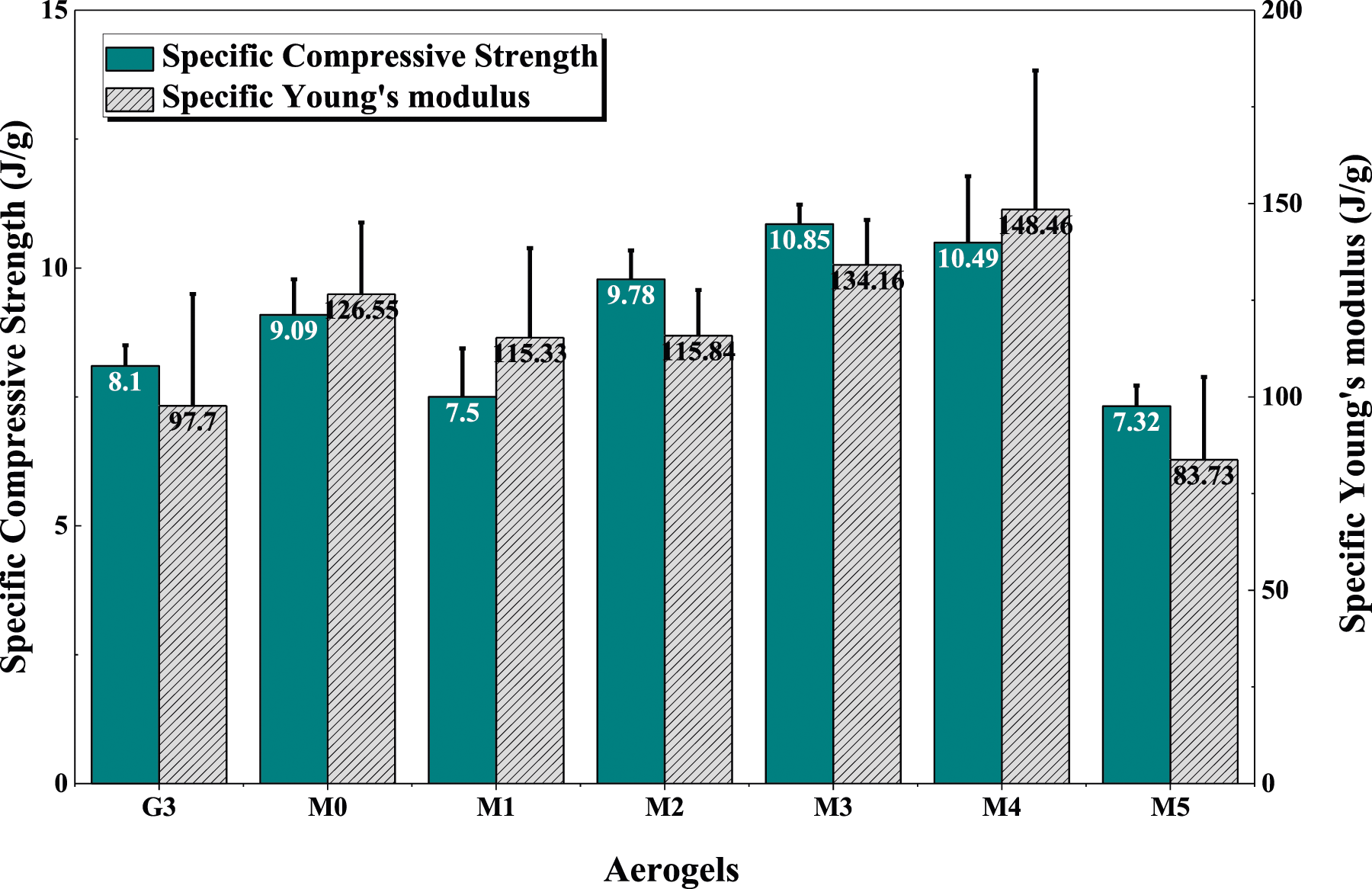
Thermal properties of aerogels
The practical application of aerogels over a wide temperature range is closely related to the thermal stability of the material. Figure 12(a) shows the TG curves of aerogels with different concentrations of nanoparticles added in N2 atmosphere from 30∼800°C. The PI aerogel exhibits high thermal stability with a thermal weight loss of 5% at about 500°C. The corresponding data are summarized in Figure 12(b). Only a small weight loss occurs near 100°C, which is due to the adsorption and evaporation of water molecules. After adding m-MXene nanoparticles, the thermal stability of the aerogel rises slightly (3∼7%), and the thermal stability increases more with the increase of nanoparticle content. While adding MXene nanoparticles, the thermal stability of aerogel increases. The 5% weight loss temperature of M0 is 542°C, which is 36°C higher than G3. Thermogravimetric curves (a) and 5% weight loss temperature (b) of PI aerogels with MXene and m-MXene nanoparticles.
The thermal stability of aerogels with added nanoparticles is not very different and fully satisfies the daily thermal insulation requirements, since most PI aerogels undergo some shrinkage (40∼50%) in an air atmosphere at temperatures between 150∼200°C. 45 The application of aerogels at high temperatures is always limited by their dimensional instability, which usually leads to a decrease in thermal insulation and an increase in dielectric constant. Therefore, for the thermal weight loss of 5% of the aerogel in the test at a temperature of about 500°C, its thermal stability decreases but still fully meets the requirements.
The shrinkage of the aerogels prepared in isothermal aging was measured with nanoparticle content as shown in Figure 13 in the temperature range of 80∼200°C. During the low-temperature aging process, the dimensional stability of sample M1 was higher and the addition of 0.1 wt% of m-MXene nanoparticles resulted in a lower shrinkage during aging, reflecting the role of m-MXene enhancement in maintaining the structural integrity of the aerogel. In contrast, it was M4 that showed better dimensional stability during aging at higher temperatures. Dimensional stability test results of PI aerogels with MXene and m-MXene nanoparticles.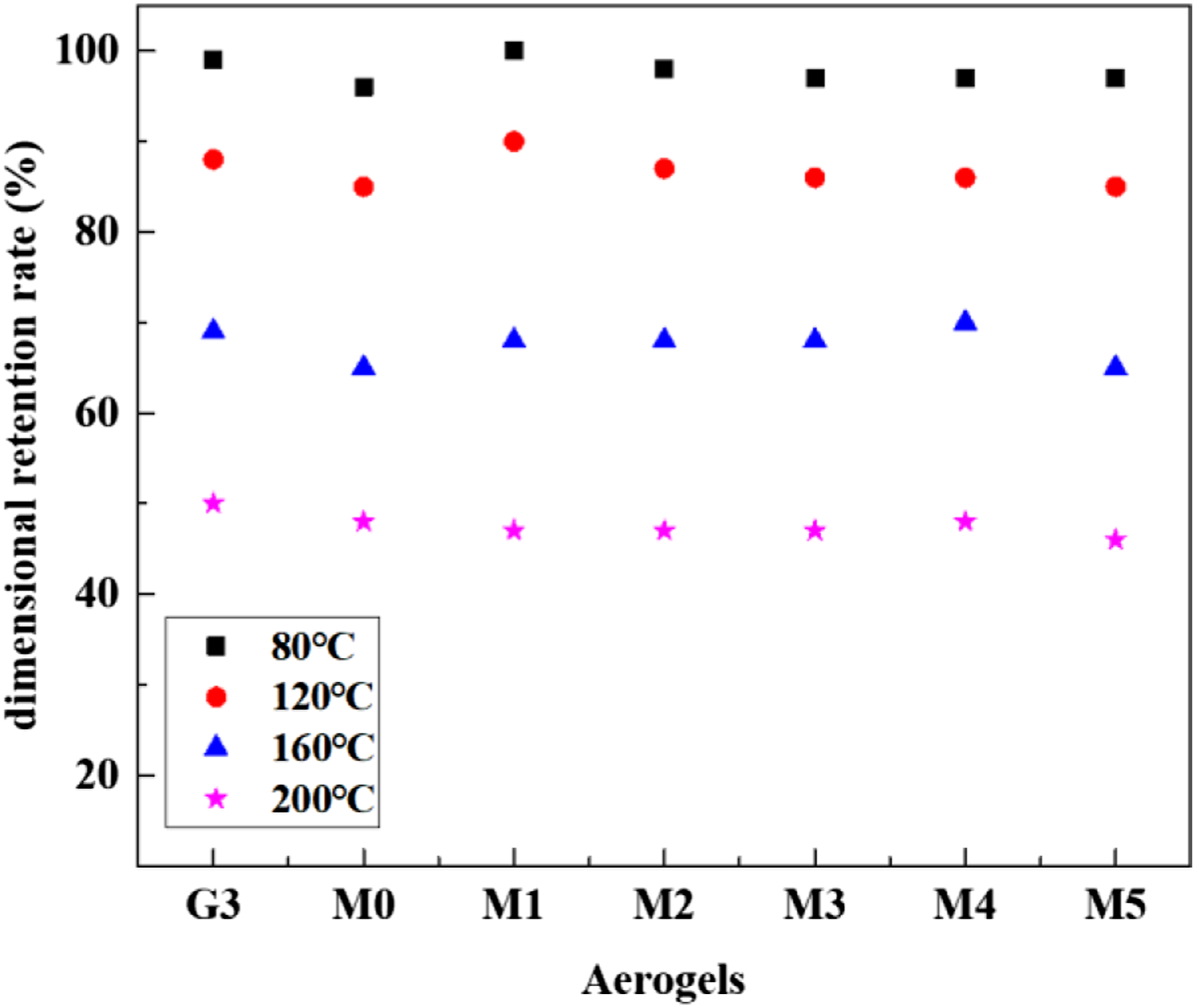
Even though m-MXene was incorporated into the PI matrix as a support backbone by cross-linking as well as van der Waals forces, the prepared aerogels still exhibited a high degree of shrinkage at relatively high-temperature conditions. The microstructural evolution of PI aerogels during thermal aging will still need to be explored to better understand this phenomenon and further reduce the shrinkage.
The thermal conductivity of aerogels was tested to reflect the thermal insulation property of the aerogel. After the addition of nanoparticles, the thermal conductivity of aerogels shows a slight increase in general. With the increase of m-MXene content, the thermal conductivity of aerogels shows a decreasing trend and then increases. Among them, the lowest thermal conductivity is M4 with a thermal conductivity value of 28.4 mW/mK. Based on the minimum thermal conductivity principle
46
and the Kagner model,
47
the thermal conductivity of the solid and gaseous portions of aerogels is closely related to their density and pore size, respectively. From Figure 6 and Table 4, it can be found that there is no obvious trend of density change of aerogel after the addition of MXene, but the average pore diameter shows an increasing trend, and thus resulting the rise in the thermal conductivity of aerogels (Figure 14). Thermal conductivity of PI aerogels.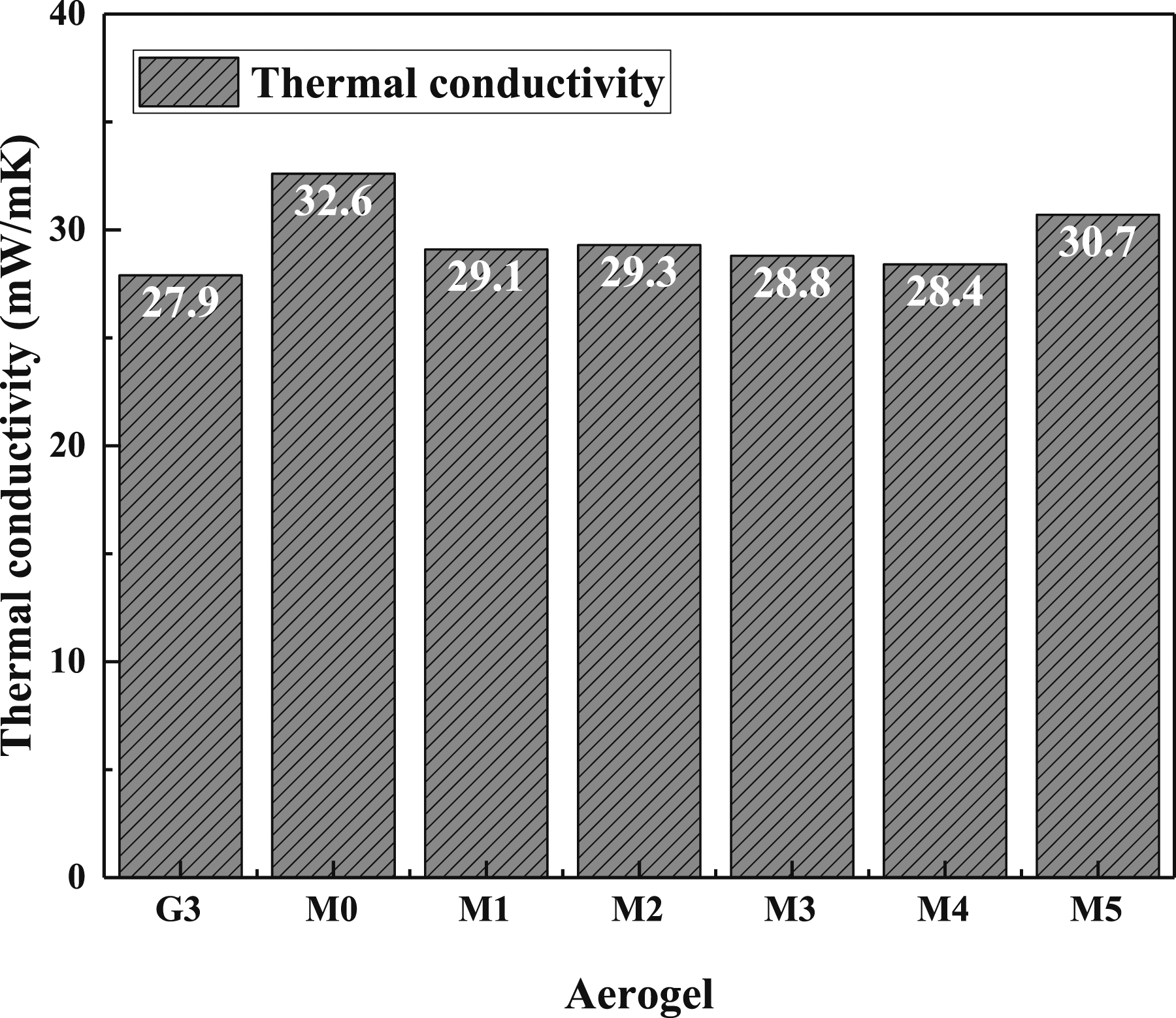
Conclusion
In this work, the amination modification of MXene was explored and the effect of nanoparticles on the structure and properties of aerogels was investigated by incorporating different concentrations of m-MXene nanoparticles into aerogels. According to the results, the introduction of nanoparticles into aerogels can reduce the shrinkage and adjust the physical and mechanical properties of PI aerogels during synthesis and drying by cross-linking or hydrogen bonding. This approach provides some results that can be referred for the structure and property tuning of aerogels. 1. The porosity of the MXene modified composite aerogel is in the range of 95.8∼96.5%, and the shrinkage of the composite aerogel decreases and the porosity increases compared to G3 without MXene addition. The aerogels have similar fibrous morphology with particle attachment and a degree of enrichment of nanoparticles on the PI chains as the nanoparticle content increases, which tends to aggregate and entangle the PI chains. According to the results of the characterization analysis of mechanical properties, the compressive modulus of the composite aerogel increases and then decreases with the increase of m-MXene content. 2. The thermal stability of the nanoparticle cross-linked PI aerogel could meet the insulation requirement. During the low-temperature aging process, samples with the addition of m-MXene nanoparticles results in nice dimensional stability, reflecting the role of m-MXene enhancement in maintaining the structural integrity of the aerogel. There is a slight increase in the thermal conductivity of the aerogels in general after the addition of nanoparticles, and the thermal conductivity of the aerogels shows a trend of decreasing and then increasing with the increase of m-MXene content. 3. By adding m-MXene nanoparticles, the shrinkage of PI aerogel during preparation is significantly reduced compared with that of unmodified aerogel. In composite aerogels, m-MXene can act as a cross-linking point to effectively maintain the network structure during supercritical drying, which further improves the dimensional stability and compressive modulus. These PI composite aerogels have higher specific surface area and lower density, excellent mechanical properties, and lower shrinkage than unmodified PI aerogels.
Footnotes
Acknowledgements
The authors gratefully acknowledge the support from the Laboratory of High Performance Polymer Materials & Processing, Beihang University and the Laboratory of Polymer Matrix Composites, Beihang University.
Declaration of conflicting interests
The author(s) declared no potential conflicts of interest with respect to the research, authorship, and/or publication of this article.
Funding
The author(s) received no financial support for the research, authorship, and/or publication of this article.
