






Abstract
As the electronic industry develops rapidly, the miniaturisation, integration and multifunctionality of electronic devices have resulted in a dramatic increase in power density, and the heat dispersal of electronic devices has attracted much attention. In this work, hydroxylated hexagonal boron nitride (BN-H) was obtained by hot alkali treatment, and boron nitride nanosheets (BNNS) with a thickness of about 4 nm were obtained by boric acid-assisted ball milling stripping. The effects of different types of fillers as well as filler contents on the thermally conductive and mechanical performance of organosilicon composites were also compared. Notably, when BN-H and BNNS thermally conductive fillers were added at 12 wt%, the thermally conductive coefficients of the composites were 0.4831 W·m−1·K−1 and 0.7131 W·m−1 K−1, respectively, which were 183% and 318% of higher than that for the pure silicone rubber (SR, with a thermally conductive coefficient of 0.1706 W·m−1·K−1). In addition, in respect of mechanical performance, the tensile strengths of SR/BN-H and SR/BNNS composites with a filling level of 12 wt% were 3.59 MPa and 3.89 MPa, respectively, and the storage moduli were 4501 MPa and 4583 MPa, respectively, which were improved to a certain extent compared with pure SR. The present work provides an effective way to develop organosilicone rubber composites with good thermal conductivity and mechanical properties by boric acid assisted ball milling to strip boron nitride in the field of electronics packages.
Introduction
Recently, due to the rapid growth of the electrical technology, electronic devices and logic circuits tend to be miniaturised and densified,1,2 and the performance and longevity of the electronic equipment has been seriously affected by the increase in functional density. So the problem of heat dissipation of the components has attracted a great deal of attention and needs to be solved urgently.3–6 The high performance of electronic equipment puts forward higher requirements for the integrated properties of electronic packaging materials. And it is of significant importance to prepare a polymer matrix composite material with high thermal conductivity, low density, high thermal stability and excellent mechanical properties to promote the speedy development of modern electronic equipment.
Polymer-based electronic packaging materials play a pivotal role in modern electronic equipment, widely to be applied in new energy vehicles, aerospace, electronic circuits and other fields. Silicone rubber (SR) is considered as a good encapsulation material in electronic circuits owing to its high flexibility, high electrically insulating properties, high weather ability and low viscosity.7–10 However, there are still some problems in its domestic research, such as low overall thermal conductivity, high density, and low comprehensive mechanical properties. Therefore, there is an immediate requirement to develop a thermally conductive silicone rubber potting material with excellent performance. There are two ways to improve the thermal conductivity of the material: one is to improve the thermal conductivity of the polymer matrix itself by finely tuning the arrangement and interaction of the polymer molecular chain segments through a special process; and the other is to be used to introduce high-thermal-conductivity fillers into the polymer matrix, which are prepared as composite materials.11–15 However, most electrically and thermally conductive nanofillers highlight a number of drawbacks in practical applications. Firstly, these electrically conductive fillers are usually not suitable for some areas where electrical insulation is required. Secondly, the high cost of carbon nanofillers and the lack of performance of metal particles in complex environments (e.g. humid and corrosive atmospheres) limit their application areas. More importantly, most of the preparation processes mentioned above involve complex processes that are less suitable for practical applications. 16
Presently, thermally conductive fillers with high thermal conductivity include inorganic fillers such as boron nitride (BN),17–25 silicon carbide (SiC),26–31 aluminium nitride (AlN) 32 and aluminium oxide (Al2O3).33–36 The effect of controlling their particle size, geometry, surface treatment and orientation on the thermal conductivity of polymer matrix composites has been widely studied. An example is that Zhou et al. have investigated the effects of Al2O3 filled fraction, filler size, filler mixing ratio, and coupling agent dosage on the thermal conductivity and mechanical properties of SR using different granular sizes of Al2O3 as a filler and SR (vinyl-terminated polymethylsiloxane) as a matrix. When the filler fraction was 64 vol%, the mass filling ratio of Al2O3 with different particle sizes M25 mm/M5 mm/M0.5 mm/M50 nm = 2:5:1:1, and the dosage of silane coupling agent KH-570 was 2 wt%, a thermally conductive silicone rubber was obtained with thermal conductivity of 1.45 W·m−1·K−1, a tensile strength of 2.5 MPa, and an elongation at break of 81%. 37 Zhou et al. adopted mechanical mixing and thermal curing processes to prepare thermal conductivity silicone rubber composites populated with different types of BN particles. The impact of the shapes, particle sizes and amounts of BN on the microstructure, thermal conductivity and Shore hardness of the complex materials were investigated. 38 By simultaneously doping two spherical BN particles into SR, the thermally conductive path was improved and the synergetic influence of fillers was realised, 38 and hybridised spherical BN/SR composites were prepared, 23 and the thermal conductivity of the complexes was up to 1.70 W·m−1 K−1. 39 Wang et al. also examined the influence of the type of thermally conduction filling (α-Al2O3, SiC), filler volume score and filler particles size distribute on the thermoconductivity and viscosity of room-temperature cured SR. It was noticed that the maximum thermal conductivity of SR was up to 1.48 W·m−1·K−1 when the distribution of particle sizes (0.8 μm and 6 μm) of the filler was controlled to be 600-700, at which time the viscosity was minimised to 3.4 × 10⁴ mPa·s. 40
In summary, the present work aimed to increase the thermoconductivity of the polymer substrate and reduced the filler filling to decrease the density of the material, and hydroxylated boron nitride (BN-H) and functionalized boron nitride nanosheets (BNNS) were prepared by treating the BN with thermoalkaline method as well as stripping the BN with boric acid-assisted ball milling. The effects of various kinds of BN and different additions of the filler on the thermoconductive, mechanical and thermal stability properties of the matrix were studied using organosilicone rubber (PDMS) as a substrate. The thermoalkaline treatment of BN improved the compatibility of the filler with the matrix, and the introduction of fewer layers of BNNS greatly improved the thermal stability, mechanical strength and thermal conductivity of the material. The use of BNNS doped Dow Corning silicone rubber is less studied and prepared by boric acid assisted ball milling technology, BNNS, very small thickness and high thermal conductivity. The prepared boron nitride doped organosilicone rubber composites have a broad application prospect in the field of electronic circuits, medical devices, aerospace and parts of automobiles.
Experimental section
Materials
Two-component additively moulded liquid silicone rubber Sylgard® 184 (vinyl silicone oil (Mn = 35,000, 5500 mPa·s with 40% fumed silica) in component A, hydrogenated silicone oil (Mn = 5000, 1300 mPa·s) in component B) was supplied by Dow Corning (Shanghai). Hexagonal boron nitride (h-BN average size 5 μm, purity 99%) was purchased from Tianyuan Aerospace Materials (Yingkou) Technology Co. Boric acid (H3BO3, AR) and sodium hydroxide (NaOH, AR) were bought from Shanghai Aladdin Biochemical Technology Co. Anhydrous ethanol (C2H5OH, purity ≥99.7%) was obtained from Tianjin Hengshan Chemical Technology Co. Deionised water was homemade in the laboratory. All chemicals were used as received without further purification.
Synthesis of BN-H and functionalized BNNS
The bulk h-BN was treated in 25 wt% NaOH solution for 6 h, washed to neutrality with deionised water and dried. Subsequently, high-temperature sintering was employed, and the dried bulk h-BN was placed in a tube furnace and held at 800°C for 2 h with a temperature increase rate of 10°C/min. The final product obtained was labelled BN-H (the preparation process is shown in Figure 1(a)). The boric acid-assisted chemo-mechanical stripping method was used by placing 20 g of h-BN and 80 g of boric acid (mass ratio 1:4) mixed powder into a sealed agate grinding jar, starting the ball mill with the rotational speed set at 200 rpm, and ball milling for 24 h. The white powder obtained after ball milling was washed three times repeatedly with deionised water to completely remove free boric acid, and finally pure BNNS powder was acquired by freeze-drying method (the procedure of preparation is shown in Figure 1(b)). (a) Preparation of BN-H by high-temperature sintering. (b) Boric acid-assisted ball milling for stripping of block h-BN. (c) Process flow for the preparation of SR composites.
Preparation of SR composites
The organosilicone rubber composites was produced by mechanical blending method as shown in Figure 1(c). Firstly, different contents of thermally conductive fillers BN, BN-H and BNNS (3 wt%, 6 wt%, 9 wt%, 12 wt% of SR) were added to the A-component vinyl silicone oil and dispersed homogeneously in a high-speed shear disperser, respectively. Hydrogen silicone oil, component B, was included in the mixture (the quality ration of component AB was 10:1), and the paste was prepared by mechanical agitation for 15 min. Subsequently, the paste was inverted into a tetrafluoroethylene abrasive, and the bubbles were exhausted in a vacuum oven at 65°C for 15 min. Finally, SR composite materials were produced by heating and solidifying in an oven at the same temperature for 4 h. The composites with different filler contents were labelled as SR/BN-3, SR/BN-6, SR/BN-9, SR/BN-12, SR/BN-H-3, SR/BN-H-6, SR/BN-H-9, SR/BN-H-12 and SR/BNNS-3, SR/BNS-6, SR/BNS-9, SR/BNNS-12.
Characterization
The microscopic morphology of the thermally conducting filler and the sectional morphology for the composite were obtained by field emission scanning electron microscopy (SEM, Nova Nano SEM450, FEI, USA) and transmission electron microscopy (TEM, Talos F200S, FEI, USA). The chemical composition was characterised using Fourier transform infrared spectroscopy (FTIR, IRAffinity-1S, Japan) and X-ray photoelectron spectroscopy (XPS, Thermo Scientific ESCALAB 250Xi, USA). The crystal structures of the fillers were analysed by a wide angle X-ray diffractometer (XRD, MiniFlex600, Japan) to characterise the fillers. The degree of hydrophilicity and hydrophobicity of the fillers were examined using an optical contact angle tester (DAS30, Germany). Viscosity, density and hardness were acquired by viscometer (SNB-2), density balance (JA1003) and Shore A hardness tester (ME-13). The mechanical performance of the composites was tested using an electronic versatile testing machine (CMT6104, China). Dynamic Mechanical Analyser (DMA-7100, Japan) was used to test the composites in tensile mode under the conditions of temperature range of −145∼25°C, with frequency of 1 Hz and temperature increase rate of 5°C/min. The thermogravimetric analysis (TGA, SDT Q-600, TA Instruments, USA) was conducted using a thermal analyser in a N2 environment with a temperature increase rate of 10°C/min. Thermal conductivity was obtained by instantaneous planar heat method thermal conductivity meter (HCDR-S, China). The heat dissipation of the materials was tested using an infrared thermal imager (ST-9450).
Results and discussion
Characterisation of BN, BN-H and BNNS
Figure 2(a-d) exhibits the SEM figures of BN, BN-H and BNNS, which clearly shows that the original BN has a flaky morphology with uneven thickness (Figure 2(a)). After high-temperature sintering and treatment with hot alkali, the BN shows a spherical-like morphology and the transverse size of the particles become smaller (Figure 2(b) and (c)). The thickness of lamellar BNNS obtained after ball milling is significantly reduced (Figure 2(d)), and accordingly, the lamellar morphology (Figure 2(e)) and lattice streaks (Figure 2(f), about 0.3 nm) of BNNS can be clearly observed under high-resolution TEM, which shows a strong crystallinity. And the thickness of single BNNS is about 4 nm, which proves the effective peeling of BNNS. (a) SEM images of blocks h-BN, (b,c) BN-H, (d) BNNS. (e) Low-magnification and (f) high-resolution TEM images of BNNS, and the inset shows magnified images of lattice spacing and thickness of BNNS.
The chemical compositions of pure BN, BN-H and BNNS were characterised using FTIR, TG, XRD and XPS. As displayed in Figure 3(a), the FTIR spectra of pure BN shows two powerful characteristic peaks near 1375 cm−1 and 815 cm−1, which corresponded exactly to the in-plane extension vibration of B-N and the out-of-plane flexural vibration of B-N-B. In addition to this, BN-H corresponds to a broad peak of absorption at 3210 cm−1 for -OH; BNNS exhibits two separate broad absorptions at 3402 cm−1 and 3212 cm−1 corresponding to the -OH vibration and the B-O-H tensile vibration.
41
The grafting of -OH onto the pristine BN surface due to high-temperature sintering and boric acid ball milling means resulted in some thermal mass loss for both BN-H and BNNS (shown in Figure 3(b)). Correspondingly, in the XRD spectra (Figure 3(c)) pure BN, BN-H and BNNS exhibit the same characteristic peaks at (002), (100), (101), (102) and (004), respectively. The peak intensity of the BNNS at the (002) crystal plane slightly decreases due to the decrease in thickness. Importantly, a new peak at 27.8° appears on the BNNS sample which is attributed to B(OH)3 diffraction at the (010) crystal plane compared to pristine BN. This indicates the formation of -OH surface moieties on the surface of BNNS,
42
which is in agreement with the FTIR test results. The chemical compositions of the BN, BN-H and BNNS surfaces were further featured by XPS in Figure 3(d). Due to the introduction of oxygen into the BN lattice during the thermal oxidation process,
43
the O/B atomic percentages of BN-H and BNNS are 1.6 and 2.5 times more than that of BN, respectively. The hydrophilicity of BN-H and BNNS is significantly improved by the inclusion of the hydrophilic group -OH, and the contact angle of BN, BN-H, and BNNS decrease from 122° to 42° as shown in Figure 3(e). It is confirmed by the Tyndall effect in the inset that the colloidal nature and nanoscale dispersion of BNNS in ethanol. Characterisation of pure BN, BN-H and BNNS. (a) FTIR analysis of BN, BN-H and BNNS. (b) Thermogravimetric (TG) curves of BN, BN-H and BNNS. (c) XRD spectra of BN, BN-H and BNNS. (d) XPS spectra of BN, BN-H and BNNS. (e) Contact angle test results of BN, BN-H and BNNS, inset photo of BNNS/ethanol dispersion.
Section morphology of SR and SR composites
SEM images of SR and SR composites were shown in Figure 4 and S1. It was observed from Figure 4(a) that the pure SR exhibits a step-like fracture surface. When the filler is added, the cross sectional morphology of the composites becomes rougher and rougher with the increase of filler content, showing a tough nest-like structure, which is primarily attributed to the fact that the increase of filler content enhances the probability of contact between the filler and the substrat, and increases the filler-matrix interactions, which can also be clearly observed in Figure S2. The EDS images are shown in Figure 4(j–l), the composites SR/BN-H and SR/BNNS have more oxygen elements, which proves that there are more -OH groups inside the body, which increases the interaction force between the filler and the matrix.
44
Importantly, from the electron microscope picture, we can also observe that the filler is uniformly dispersed without obvious agglomeration, which is because of the introduction of the hydroxyl group on the surface of the filler, which improves the compatibility with the matrix of the filler. The good thermal conduction network formed by the filler and the matrix creates good conditions for enhancing the thermal conduction of the material. (a) SR, (b)SR/BN-H-3, (c) SR/BN-H-6, (d) SR/BN-H-9, (e) SR/BN-H-12, (f) SR/BNNS-3, (g) SR/BNNS-6, (h) SR/BNNS-9, (i) SR/BNNS-12 SEM images of the sections and EDS images of (j) SR/BN-12, (k) SR/BN-H-12, (l) SR/BNNS-12.
Physical properties of SR and SR composites
As shown in Table S1, the composites were tested for viscosity and hardness according to GB/T 2794-2013 and GB/T 529-2008, respectively. Density test was performed on the composites according to GB/T 533-2008, and the test results were expressed according to equation (1).
Thermal stability of SR and SR composites
One of the most significant performance of composites is thermal stability, which has a direct impact on the processability and lifetime of the composites. TGA curves for SR and SR composites at filler additions of 3 wt%, 6 wt%, 9 wt% and 12 wt% are depicted in Figure 5 and Figure S3 (representative data are summarised in Table 1), with the selected characteristic thermal parameters being 5% weight loss temperature (T5%, initial decomposition temperature), 10% weight loss temperature (T10%) and residual carbon rate (Yc). It is noteworthy that all composites are shown to exhibit similar thermal decomposition behaviour, indicating that the incorporation of fillers don’t have an effect on the thermal degradation of SR. The initial decomposition temperatures of all composites are higher than that of SR, indicating that the thermal stability of the composites is improved by the incorporation of fillers and that the higher the filler content, the better the thermal stability of the matrix. BN-H and BNNS as the thermally conductive fillers of the composites hindered the thermal movement of the organosilicone rubber molecules in the thermal decomposition process, absorbed part of the heat and hindered the heat transfer, thus enhancing the thermal stability of the composites. Among them, the more -OH on the surface of BNNS, the stronger the ability to act on the composite material and the stronger the blocking effect on thermal decomposition, thus greatly improving the thermal stability of the composite material. In addition, we can observe that the residual carbon rates of SR/BN, SR/BN-H and SR/BNNS composites are 68.3%, 68.8% and 69.4%, respectively, which are all improved over the residual carbon rate of pure SR (Yc = 53.5%) when the filler addition is 12 wt%. This can be explained by the fact that BNNS has a physical barrier effect, which effectively prevents heat transfer and diffusion, thus increasing the residual carbon rate of the material. Generally, the 12 wt% SR/BNNS composite has the best thermal stability and the highest residual carbon rate. TGA profiles of SR/BN-H (a) and SR/BNNS (b) in N2. Summary of thermogravimetric data for SR and SR composites.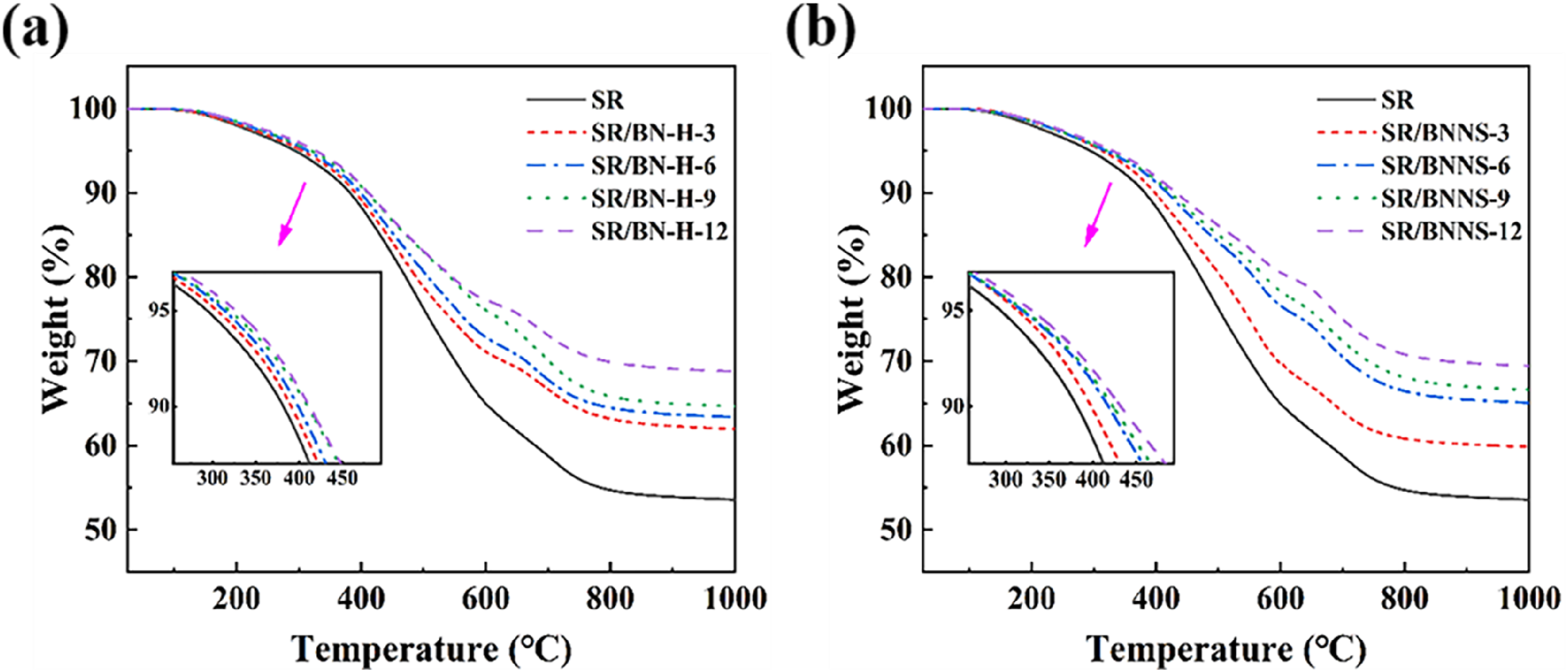

Mechanical properties of SR and SR composites
The excellent mechanical properties ensure that the composites can be valuable in various applications. The stress-strain curves and modulus of elasticity of SR/BN, SR/BN-H and SR/BNNS composites are shown in Figure 6 and Figure S4, and the corresponding data test results are listed in Table 2. It can be observed that the tensile strength, elongation at break and modulus of elasticity of the three composites gradually enhance with the growth of filler content. When BN-H and BNNS are added at 12 wt%, the tensile strength of SR/BN-H and SR/BNNS composites increase from 2.23 MPa to 3.59 MPa and 3.89 MPa, respectively, which is 61% and 74%; the elongation at break increase from 142.79% to 198.07% and 195.23%; and the elastic modulus increase from 0.87 MPa to 1.88 MPa and 2.66 MPa. This can be attributed to the excellent mechanical properties and structure of the fillers. Both BN-H particles and BNNS nanosheets are smaller in size and have a larger specific surface area, which leads to more interactions between -OH on the filler surface and the polymer chains, giving the composites rigidity. In addition the tensile strength of SR/BNNS composites is overall higher than that of SR/BN-H composites, while the elongation at break is basically comparable between the two, with SR/BNNS composites being somewhat lower. This is mainly attributed to the higher surface -OH of the BNNS thermally conductive filler, and the stronger the ability to act with the composite matrix, the more rigid the material is and the less elastic it is. The mechanical properties of SR/BNNS composites were assessed to be superior. Mechanical properties of SR and SR composites. Stress-strain curves of SR/BN-H (a) and SR/BNNS (b) composites with different filler additions. (c) Tensile strength of the composites. (d) Modulus of elasticity of the composites. Summary of test data on mechanical properties of SR and SR composites.

The dynamic mechanical performance of the composites was analysed with test results shown in Figure 7 and Figure S5. Data on the dynamic mechanical performance of SR and SR composites are presented in Table S2. The addition of BN, BN-H and BNNS significantly increase the energy storage modulus of SR over the entire temperature measurement range. When BN-H and BNNS are added at 12 wt%, the composites increase from 3279 MPa to 4501 MPa and 4583 MPa, respectively, and the energy storage modulus of the composites is progressively enhanced with the increasing filler inclusion. This is due to the filler reinforcement effect, which effectively restricts the migration of the molecular chains of the silicone rubber. The addition of fillers enhances the rigidity of the SR and the ability to restrict the movement of the SR molecular chains increases as the filler content increases. The end result is an increase in the energy storage modulus of the composite. In addition, the glass transition temperature (Tg) is another key parameter that determines the application of polymer composites and is closely related to the state of motion of the polymer segments (molecular mobility, free volume and cross-linking).
45
The Tg of SR composites increases gradually with increasing filler content. This is due to the reinforcing effect of BN-H and BNNS on the system, which the movement of the SR molecular chains are restricted and the free volume of the SR molecular chains are reduced, which hinders the curing and cross-linking of some of the SRs, thus leading to the increase of Tg. Dynamic mechanical properties of SR and SR composites. Energy storage modulus versus temperature curves for SR/BN-H (a) and SR/BNNS (b) composites with different filler additions. Loss factor versus temperature curves for SR/BN-H (c) and SR/BNNS (d) composites with different filler additions.
Thermal conductivity of SR and SR composites
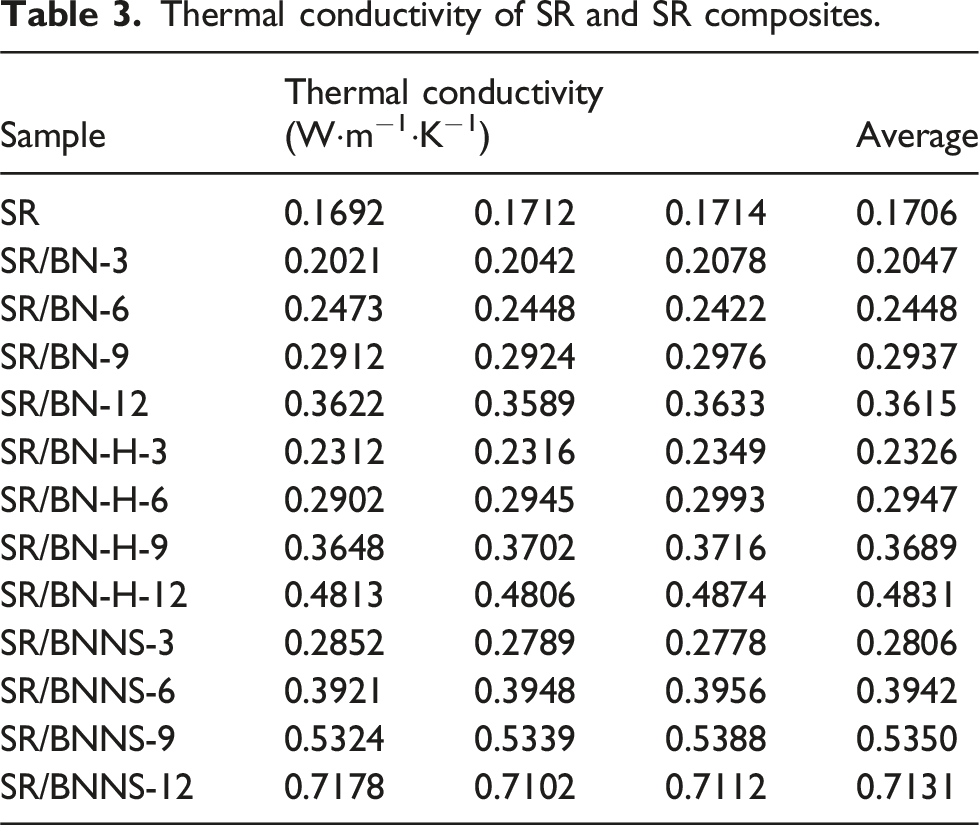
The variation of thermal conductivities of SR and SR composites as a function of filler loading is presented in Figure 8(a), and the corresponding thermal conductivities are given in Table 3. Due to the amorphous structure of SR itself, the thermal conductivity (TC) is only 0.1706 W·m−1 K−1, which has poor thermal performance. The TC of the composites increased significantly with the increase of the thermally conductive filler content. It is remarkable that the composition thermal conductivity increases to 0.4831 W·m−1 K−1 and 0.7131 W·m−1 K−1 for BN-H and BNNS additions of 12 wt%, respectively, which are 183% and 318% more than that of pure SR. At low filler content, the TCs of the composites are very low because the fillers are present in the polymer in the form of “islands”,
46
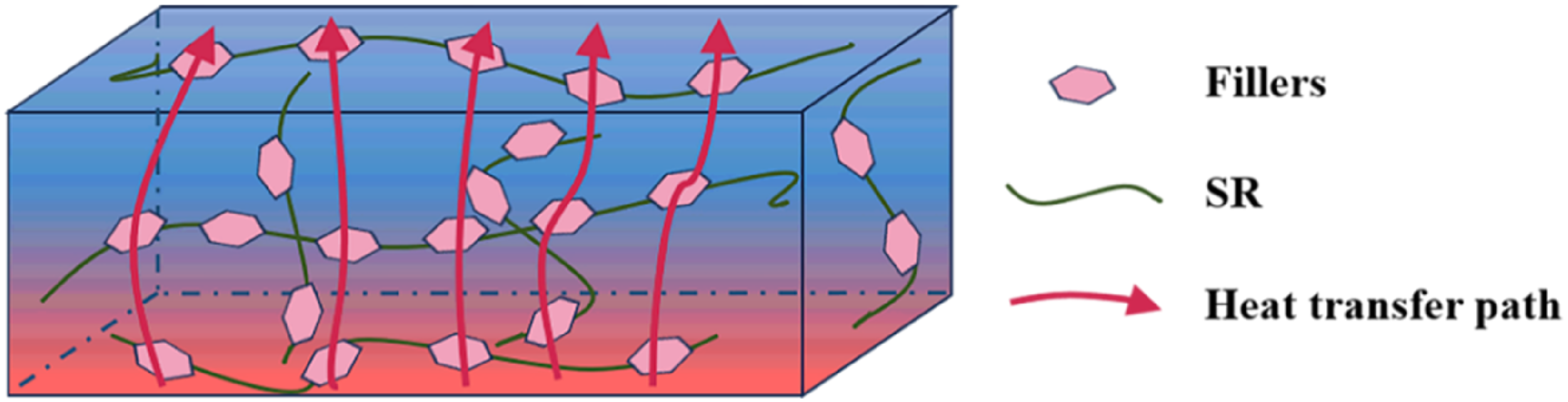
which do not allow the development of thermal conduction pathways. As shown in Figure 9 for the heat transfer path of the composites, when the filler content is increased to a certain extent, the thermally conductive filler forms a heat transfer network, which is eliminated the phonon scattering at the interface of the filler and the polymer and the phonon transmission efficiency is enhanced, and thus the thermal conductivity of the composites is greatly improved. In order to further investigate the thermal management properties of the materials, the thermal diffusion behaviour of SR and SR composites (filler content of 12 wt%) during cooling was investigated using an infrared imager. After being heated in an oven at 60°C for 2 h, the samples were instantly transferred to an iced iron box and the surface temperature changes were noted. From Figure 8(b) and (c), it can be noticed that the cooling rates for the composites are in the order of SR < SR/BN < SR/BN-H < SR/BNNS, reflecting the much better heat dissipation property of SR/BNNS and confirming the high thermal conductivity of the composite. Thermal conductivity of SR and SR composites. (a) Thermal conductivity of SR and SR composites with different filler additions. (b) Infrared thermography of the cooling process of SR and SR composites. (c) Infrared thermography temperature time variation curves. Thermal conductivity of SR and SR composites. Schematic of the heat conduction path of the composites.
Conclusion
In summary, a series of organosilicone rubber composites with high thermostability, high mechanical properties and high thermoconductivity were prepared by high-temperature sintering of hot alkali-treated BN and boric-acid-assisted ball-milling of stripped BN, and by physical co-mingling, mechanical stirring and heat curing. The impact of the shape and addition of BN on the composite’s thermal, mechanical and thermal conductivity properties of the composites were investigated. The effects of the shape and addition of BN on the thermal, mechanical and thermal conductivity properties of the composites were investigated. When the filler addition was 12 wt%, the tensile strength of SR/BN-H and SR/BNNS composites increased by 61% and 74% over SR, the energy storage modulus increased from 3279 MPa to 4501 MPa and 4583 MPa, and the thermal conductivity increased from 0.1706 W·m−1·K−1 to 0.4831 W·m−1·K−1 and 0.7131 W·m−1 K−1, which are 183% and 318% higher than that of pure SR. Consequently, the organosilicone rubber with excellent properties prepared in this study has a wide application prospect in the field of encapsulation of electronic equipment and electronic devices.
Supplemental Material
Supplemental Material - Effect of hydroxylated boron nitride and boron nitride nanosheets on the properties of doped organosilicone rubber composites
Supplemental Material for Effect of hydroxylated boron nitride and boron nitride nanosheets on the properties of doped organosilicone rubber composites by Han Zhao, Jianxin Rong, Dengke Li, Dianqiu Jia, Xiaoyan Yu and Qingxin Zhang in High Performance Polymers.
Footnotes
Acknowledgments
The authors sincerely appreciate the financial support from the Natural Science Foundation of Hebei Province, China (E2021202035, E2019202348).
Author contributions
Declaration of conflicting interests
The author(s) declared no potential conflicts of interest with respect to the research, authorship, and/or publication of this article.
Funding
The author(s) disclosed receipt of the following financial support for the research, authorship, and/or publication of this article: This work was supported by the Natural Science Foundation of Hebei Province, China (E2021202035, E2019202348).

Data availability statement
Data sharing not applicable to this article as no datasets were generated or analyzed during the current study.
Supplemental Material
Supplemental material for this article is available online.
References
Supplementary Material
Please find the following supplemental material available below.
For Open Access articles published under a Creative Commons License, all supplemental material carries the same license as the article it is associated with.
For non-Open Access articles published, all supplemental material carries a non-exclusive license, and permission requests for re-use of supplemental material or any part of supplemental material shall be sent directly to the copyright owner as specified in the copyright notice associated with the article.
