







Abstract
The first steps toward bilingual language acquisition have already begun at birth. When tested on their preference for English versus Tagalog, newborns whose mothers spoke only English during pregnancy showed a robust preference for English. In contrast, newborns whose mothers spoke both English and Tagalog regularly during pregnancy showed equal preference for both languages. A group of newborns whose mothers had spoken both Chinese and English showed an intermediate pattern of preference for Tagalog over English. Preference for two languages does not suggest confusion between them, however. Study 2 showed that both English monolingual newborns and Tagalog-English bilingual newborns could discriminate English from Tagalog. The same perceptual and learning mechanisms that support acquisition in a monolingual environment thus also naturally support bilingual acquisition.
The human affinity for language begins at or before birth. Neonates show many perceptual sensitivities that are important for language acquisition (Gervain & Werker, 2008). In monolingual acquisition, infants must detect and learn the regularities that characterize a single language. In bilingual acquisition, infants must simultaneously detect and learn the regularities of each of two languages. This requires recognizing both languages as native while continuing to discriminate them. What tools do neonates have available to negotiate a bilingual environment?
To break into two languages and bootstrap acquisition, one source of information that bilingual infants might use is rhythmicity (Mehler, Dupoux, Nazzi, & Dehaene-Lambertz, 1996). Traditionally, the world’s languages have been classified into three rhythmic classes: stress-timed (e.g., Dutch), syllable-timed (e.g., French), and mora-timed (e.g., Japanese). Ramus, Nespor, and Mehler (1999) identified two acoustic dimensions that correlate with rhythmic-class distinctions: the standard deviation of the duration of consonantal intervals within each sentence (ΔC) and the percentage of vocalic intervals (i.e., vowels) within each sentence (%V; see Grabe & Low, 2002, for an alternate measurement scheme). Studies have revealed that although categorical divisions are useful, languages fall somewhat continuously along these dimensions (see Fig. 1).
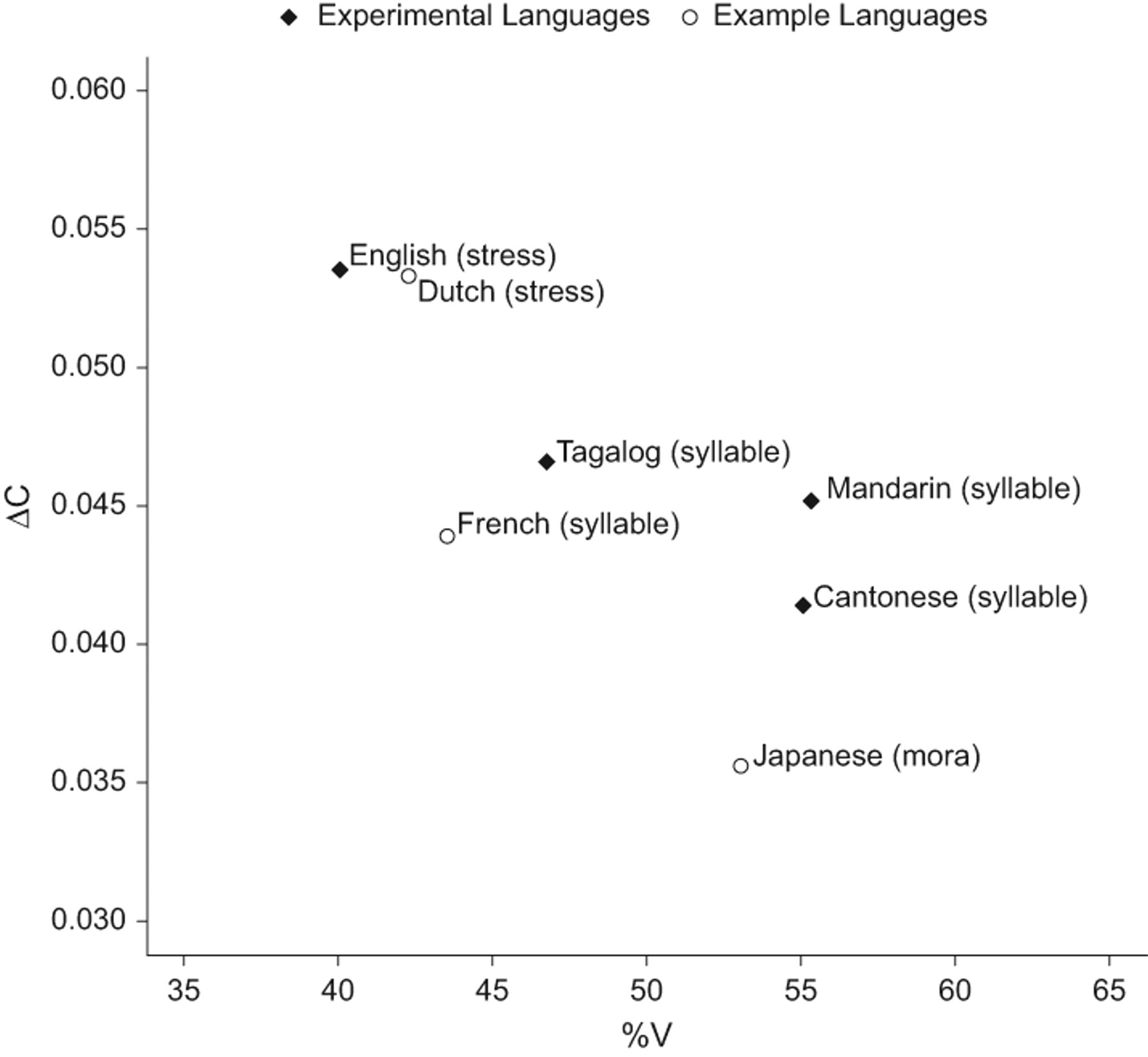
Mean location of languages in the (%V, ΔC) plane. ΔC represents the standard deviation of the duration of consonantal intervals within each sentence; %V represents the percentage of vocalic intervals (i.e., vowels) within each sentence. Measurements for English and the languages used as rhythmic-class examples in this article are from Ramus, Nespor, and Mehler (1999). Measurements for Tagalog are from Bird, Fais, and Werker (2005); those for Cantonese are from (Mok, in press); and those for Mandarin are averaged from Mok (in press) and Lin and Wang (2007).
Research has demonstrated the importance of rhythmicity in early language processing. Newborn infants exposed to only a single language prenatally show greater interest in their native language than in an unfamiliar language from a different rhythmic class (Mehler et al., 1988; Moon, Cooper, & Fifer, 1993). Preferential attention to the native language shows an early effect of learning on language processing, either during prenatal development or immediately after birth. 1 Studies also show that monolingual neonates can discriminate two languages from different rhythmic classes even if both are unfamiliar but typically fail at discriminating languages within the same class (Mehler et al., 1988; Nazzi, Bertoncini, & Mehler, 1998; Ramus, 2002; Ramus, Hauser, Miller, Morris, & Mehler, 2000). These findings are understood as evidence that although language preference is learned through experience, the ability to discriminate languages from different rhythmic classes is an evolutionarily deep perceptual bias that operates independently of learning (Ramus et al., 2000). Moreover, it has been asserted that the ability to discriminate languages is foundational to bilingual acquisition (Nazzi et al., 1998). No studies to date, however, have actually tested either language preference or language discrimination in neonates with prenatal bilingual exposure. Here, we provide the first empirical test of the hypothesis that the same initial perceptual biases and early learning mechanisms that underlie monolingual acquisition operate in the bilingual neonate to propel bilingual acquisition.
To test this hypothesis, we explored the earliest foundations of two capacities crucial to bilingual acquisition. We compared preference for (Study 1) and discrimination of (Study 2) English and Tagalog (languages from different rhythmic classes) in bilingual newborns, whose mothers spoke both languages regularly during pregnancy, with those of monolingual newborns, whose mothers spoke only English during pregnancy. Although it could be the case that infants only gradually develop the skills to negotiate a bilingual environment (Arnberg & Arnberg, 1985), our results demonstrate that from birth, the recognition and discrimination skills that support monolingual acquisition also support bilingual acquisition.
Study 1a
No previous studies have investigated language preference in bilingual neonates. Although monolingual neonates orient more toward their native language than toward an unfamiliar language in preferential listening tasks, for optimal learning, infants growing up bilingual should orient to both of their native languages. To investigate the impact of prenatal experience on language preference at birth, we tested newborn infants for their preference for syllable-timed Tagalog (a major language of the Philippines; Bird, Fais, & Werker, 2005), relative to English, a stress-timed language (Ramus et al., 1999; see Fig. 1). Two groups of neonates were tested: English monolinguals (whose mothers spoke only English during pregnancy) and Tagalog-English bilinguals (whose mothers spoke both English and Tagalog regularly during pregnancy). We expected that monolinguals would be significantly less interested in Tagalog than in English, as Tagalog was unfamiliar (Mehler et al., 1988; Moon et al., 1993). The previously untested prediction was that bilinguals would be interested in both of their native languages.
Method
Testing was conducted at a maternity hospital in Vancouver, British Columbia, Canada, a multicultural city where English is the majority language but many other languages are widely used. Thirty newborn infants (0–5 days old), half from monolingual English backgrounds and half from bilingual Tagalog-English backgrounds (henceforth called Tagalog bilinguals) completed the study. 2 Mothers of Tagalog bilinguals reported speaking each language 30% to 70% of the time.
Stimuli were sentences matched for pitch, duration, and number of syllables. They were recorded from native English and native Tagalog speakers and low-pass filtered to a cutoff of 400 Hz, to remove surface segmental cues while preserving rhythmicity. Infants were tested using a high-amplitude sucking-preference procedure, which capitalizes on newborns’ sucking reflex. Newborns sucked on a rubber nipple and were played a sentence contingently on producing a suck in the upper 80% of their sucking range, as calculated by the computer during an initial silent baseline minute. Infants were presented with 10 min of speech, alternating each minute between English and Tagalog. Four different English and four different Tagalog sentences were used, recorded from three native English and three native Tagalog speakers. The order of the two languages was counterbalanced. To assess preference, the number of high-amplitude sucks produced during Tagalog minutes versus English minutes was compared.
Results
A preference score was computed for each infant, as the difference in the average number of high-amplitude sucks produced during Tagalog minutes minus those produced during English minutes (see Fig. 2). One English monolingual and one Tagalog bilingual outlier, whose preference scores were more than 2 SDs from their group’s mean, were removed. 3 Preliminary analyses suggested heterogeneity among group variances, Levene’s F(1, 26) = 4.87, p =.036; therefore, subsequent analyses used Welch’s correction. This correction often yields noninteger estimates of degrees of freedom.
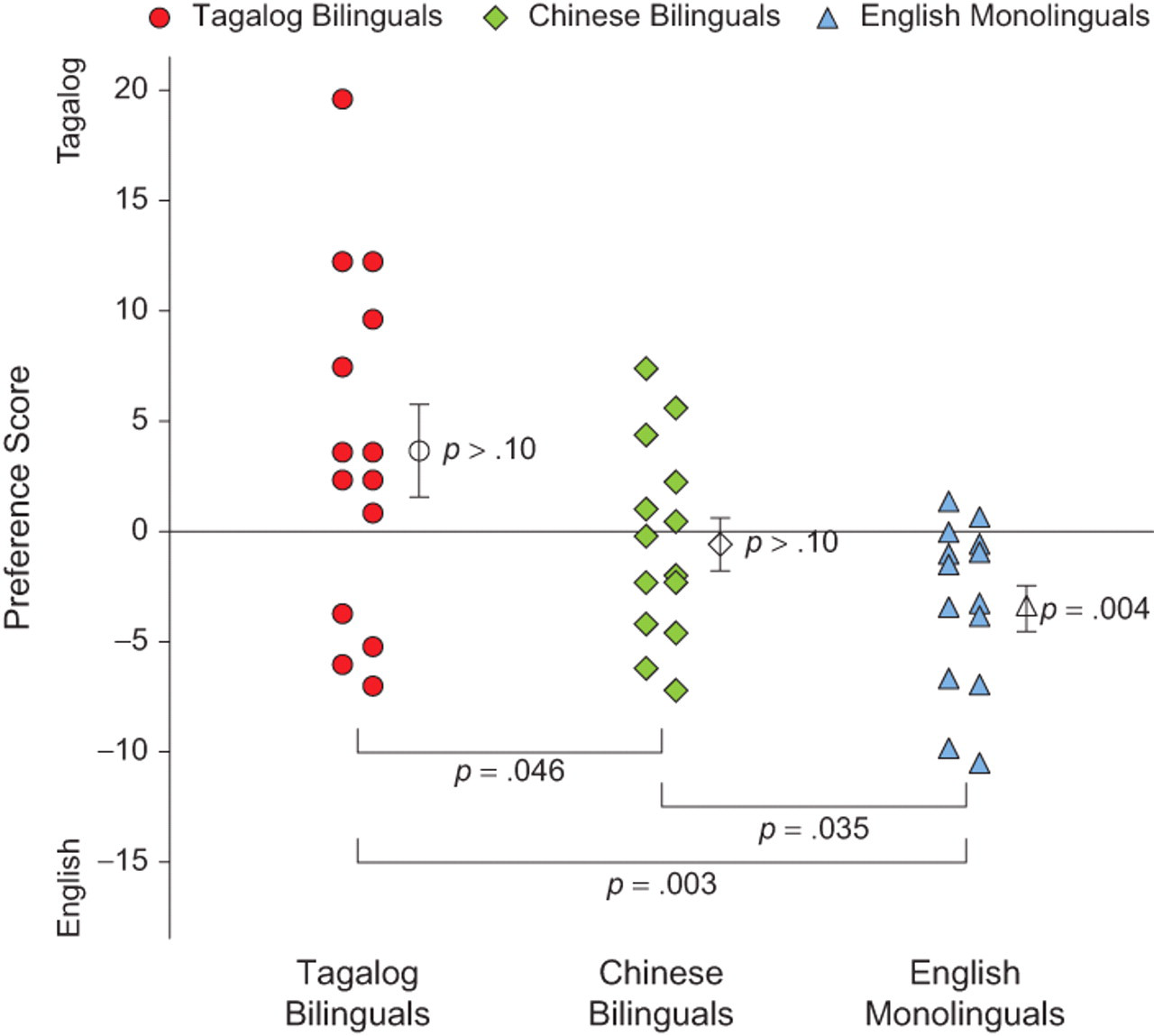
Individual preference scores (colored symbols) and group means (open symbols) for monolingual English, Chinese-English bilingual, and Tagalog-English bilingual infants in Studies 1a and 1b. Preference scores were calculated by subtracting the average number of high-amplitude sucks produced during English minutes from the average number of high-amplitude sucks produced during Tagalog minutes. Significance values for between-group comparisons are shown with brackets; significance values adjacent to group means are for comparisons to zero. Error bars represent standard errors of the mean.
To determine whether the groups could be characterized as having significant absolute preference for one language over the other, two-tailed one-sample t tests were conducted, comparing infants’ preference scores with zero. Monolingual English infants were significantly less interested in Tagalog than in English, t(13) = –3.44, p = .004. Tagalog bilinguals did not show a significant preference for either language, t(13) = 1.76, p = .103. To directly compare the performance of the two groups, a planned directional comparison of infants’ difference scores was conducted. Relative to their interest in English, English monolinguals had significantly less interest in Tagalog than did Tagalog bilinguals, t(18.8) = 3.08, p = .003.
Discussion
The results of this study demonstrate that prenatal bilingual exposure affects infants’ preferences. English monolingual newborns were less interested in Tagalog than in English, but Tagalog bilinguals were similarly interested in their two native languages. Bilinguals’ attention to both languages is consistent with their having learned about two languages prenatally.
A counterexplanation consistent with these data would be that Tagalog bilinguals recognized neither language as native. Because bilinguals’ time is divided between two languages, their experience with each language may have been insufficient to have an effect on perception. The insufficient-experience explanation leads to a clear prediction: Regardless of the particular native languages, any group of bilingual newborns will show the same pattern of language preference. Conversely, evidence that two groups of bilingual newborns demonstrate different patterns of preference would support the position that bilingual newborns have had sufficient experience to learn about each language prenatally.
Study 1b
To directly test the insufficient-experience explanation, we sought a second group of bilingual newborns to evaluate on their preference for Tagalog versus English. Because English was a common language to the two groups tested in Study 1a, it was necessary to find another group of bilinguals who had heard English prenatally. Chinese-English bilinguals were such a group that was available in our community.
Similarities and differences between Tagalog and Chinese make Chinese-English bilinguals an interesting test case. Both Chinese (Mandarin and Cantonese) and Tagalog have been classified within the larger typological category of syllable-timed languages (Bird et al., 2005; Lin & Wang, 2007; Mok, in press). But as shown in Figure 1, Tagalog and Chinese show rhythmical differences, and there is evidence that 4-month-old bilingual infants are sensitive to intraclass differences (Bosch & Sebastián-Gallés, 1997, 2001). Further, Chinese is characterized by lexical tone (perceptible by adults even in filtered speech; Fu, Zeng, Shannon, & Soli, 1998), whereas Tagalog is not. Overall, we expected that Tagalog would be somewhat, although not completely, familiar to the Chinese bilingual infants. Thus, because Tagalog is neither completely novel (as it is to English monolinguals) nor completely familiar (as it is to Tagalog bilinguals), we predicted that Chinese bilingual infants would show a preference intermediate to the preference shown by the two other groups and statistically different from each of them.
Method
Fourteen neonates whose mothers spoke both English and Chinese (Cantonese, Mandarin, or in two cases both) regularly during pregnancy were tested for their preference for Tagalog versus English, in a procedure identical to that used in Study 1a.
Results and discussion
The results demonstrated that Chinese bilingual neonates did not show an outright preference for either English or Tagalog, t(13) = –0.49, p = .63. As predicted, however, these infants showed a pattern of preference distinct from that of either English monolinguals or Tagalog bilinguals (see Fig. 1). Planned directional comparisons showed that their interest in Tagalog relative to English was greater than that of English monolinguals, t(25.5) = 1.89, p = .035, but less than that of Tagalog bilinguals, t(20.4) = 1.77, p = .046. Therefore, relative to their interest in English, Chinese bilingual infants were less interested in Tagalog than were Tagalog bilingual infants (for whom Tagalog was native) but were more interested in Tagalog than were English monolingual infants (for whom Tagalog shares few similarities with the native language). These results demonstrate that bilingual newborns’ language preference is affected by the specific languages they heard before birth, indicating that bilingual newborns have indeed learned about both their native languages prenatally.
Study 2
Study 1 demonstrated that by birth, bilingual neonates have already learned about their two languages and, like monolinguals, use this information to direct their attention. However, to successfully acquire the structures of two languages, bilingual infants must also separate and discriminate these languages. A possible interpretation of the results of Study 1a is that experience with two languages can overwrite the perceptual biases that facilitate language discrimination and that Tagalog bilingual neonates have no preference because they lump English and Tagalog into a broad class of familiar language sounds.
Previous research supports the idea that any newborn can discriminate two languages as long as the languages are from different rhythmic classes (Mehler et al., 1988; Nazzi et al., 1998; Ramus, 2002). However, systematic studies have not been conducted to date with bilingual newborns. Because monolinguals are familiar with only one language, discrimination of any particular language pair involves either discriminating a rhythmically familiar language from an unfamiliar one or discriminating two rhythmically unfamiliar languages. For bilingual infants, successful acquisition requires their discrimination of two familiar languages, a potentially challenging and as yet untested task.
To investigate whether newborns with prenatal bilingual experience discriminate their native languages, Study 2 tested 50 newborn infants for their discrimination of English and Tagalog in a high-amplitude sucking habituation procedure. As in Study 1a, newborns from a Tagalog-English bilingual background were compared with newborns from a monolingual English background.
Method
Infants were habituated to either four English or four Tagalog low-pass-filtered sentences (counterbalanced) until sucking declined, so that the number of high-amplitude sucks across a 2-min window was at least 25% fewer than that produced in the previous minute. Infants habituated in an average of 7 min (range: 5–15), and the mean time to habituation did not differ across groups, F(2, 47) = 0.49, p = .62. At test, infants in the experimental condition heard two novel sentences from a new speaker in the other language (n = 32; 16 monolingual, 16 bilingual infants) for 4 min. To rule out spontaneous recovery (Jeffrey & Cohen, 1971), a control group (n = 18 monolinguals) heard two novel sentences from a new speaker in the same language. Bilingual controls were not tested, because spontaneous recovery was not expected to differ across groups. If infants could discriminate the languages, then those in the experimental condition would show increased sucking at test whereas those in the control condition would not.
Results and discussion
Both English monolingual and Tagalog bilingual infants discriminated between the two languages (see Fig. 3). The number of high-amplitude sucks was computed in three blocks: last 2 habituation minutes, first 2 test minutes, and second 2 test minutes. Preliminary analyses showed no effects or interactions with test order (English first vs. Tagalog first). A mixed 3 (block) × 2 (condition: control, experimental) analysis of variance (ANOVA) showed a significant Block × Condition interaction, F(2, 96) = 3.20, p = .045. A follow-up repeated measures ANOVA showed that in the control group, sucking did not differ as a function of block, F(2, 34) = 2.04, p = .15. In the experimental group, a similar ANOVA with an additional factor of exposure group (English monolingual, Tagalog bilingual) showed a significant effect of block, F(2, 60) = 4.64, p = .013, but no Block × Exposure Group interaction, F(2, 60) = 0.40, p = .67. Planned directional t tests compared sucking in the final habituation block with the average across the 4 test minutes (both test blocks). Both English monolingual infants, t(15) = 2.00, p = .032, and Tagalog bilingual infants, t(15) = 1.99, p = .033, showed a significant recovery of sucking during test. Tagalog bilingual infants, then, were still able to discriminate their two languages, despite having shown similar preference for the languages in Study 1a.
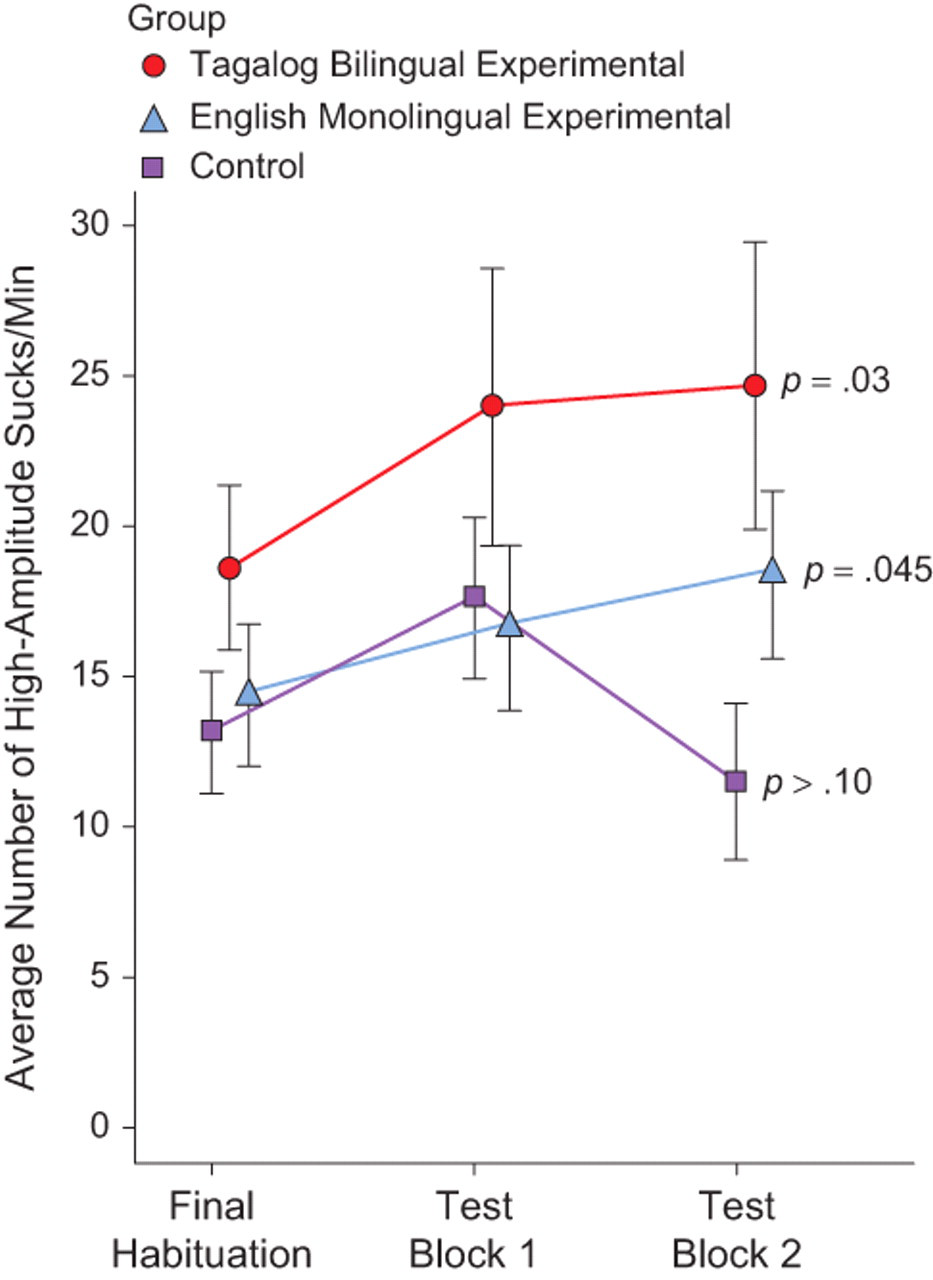
Average number of high-amplitude sucks per minute as a function of group and experimental block in Study 2, which tested the ability to discriminate English and Tagalog. Results are shown for the Tagalog-English bilingual and English monolingual experimental groups and for the control group. Error bars represent standard errors of the mean.
General Discussion
Previous work with bilingual infants has shown that 4-month-olds can discriminate their languages auditorily (Bosch & Sebastián-Gallés, 1997) and visually (Weikum et al., 2007). The current work reveals that language discrimination in bilinguals is robust at birth and that language preference at birth reflects previous listening experience. Monolingual newborns’ preference for their single native language directs listening attention to that language. Bilingual newborns’ interest in both languages helps ensure attention to, and hence further learning about, each of their languages.
This study investigated neonates who were learning rhythmically distinct languages. Still unanswered is whether the same sensitivity to rhythm can also support infants’ acquiring two languages from the same rhythmic class. The differential preference for Tagalog by Tagalog-English bilinguals in comparison with Chinese-English bilinguals hints that bilingual neonates have some sensitivity to intraclass rhythmic differences or to other differences between language pairs in the same rhythmic class. Further research is required to directly test these possibilities.
In sum, these findings show that from the very beginning, the same perceptual and learning mechanisms that support monolingual acquisition are also available to support bilingual acquisition. Moreover, our results confirm that infants exposed to two languages throughout gestation have already begun the process of bilingual acquisition at birth.
Footnotes
Acknowledgements
We thank Marisa Cruickshank, Erin Moon, Vivian Pan, Ke Heng Chen, Ayasha Valji, Mohinish Shukla, and Laurel Fais for their comments, assistance, and support.
The authors declared that they had no conflicts of interests with respect to their authorship and/or the publication of this article.
This research was funded by grants from the Social Sciences and Humanities Research Council of Canada, the Human Frontier Science Program, the Natural Sciences and Engineering Research Council of Canada, and the James S. McDonnell Foundation to Janet F. Werker; by a University of British Columbia psychology postdoctoral fellowship to Tracey C. Burns; and by a Natural Sciences and Engineering Research Council of Canada fellowship to Krista Byers-Heinlein.
1.
It is difficult if not impossible to separate the influence of prenatal experience from the possible effects of very early postnatal experience. However, given the much greater amount of prenatal as compared with postnatal listening, we have highlighted prenatal experience throughout this article.
2.
Data were excluded from an additional 28 infants in Study 1 (preference) and 87 infants in Study 2 (discrimination) because of crying (12 preference, 27 discrimination), falling asleep or stopping sucking (12, 31), experimenter or technical error (3, 3), spitting out the rubber nipple (1, 5), high-amplitude sucks during less than 2 test minutes (0, 10), failure to habituate (0, 6), parental or hospital-staff interference (0, 4), and hiccups (0, 1).
3.
Including these infants yielded the same pattern of results.