






Abstract
The social good often depends on the altruistic behavior of specific individuals. For example, epidemiological studies of influenza indicate that elderly individuals, who face the highest mortality risk, are best protected by vaccination of young individuals, who contribute most to disease transmission. To examine the conditions under which young people would get vaccinated to protect elderly people, we conducted a game-theory experiment that mirrored real-world influenza transmission, with “young” players contributing more than “elderly” players to herd immunity. Participants could spend points to get vaccinated and reduce the risk of influenza. When players were paid according to individual point totals, more elderly than young players got vaccinated, a finding consistent with the Nash equilibrium predicting self-interested behavior. When players were paid according to group point totals, however, more young than elderly players got vaccinated—a finding consistent with the utilitarian equilibrium predicting group-optimal behavior—which resulted in higher point totals than when players were paid for their individual totals. Thus, payout structure affected whether individuals got vaccinated for self-interest or group benefit.
Public health is profoundly affected by private choices. The decisions of individuals to get vaccinated, for example, are fundamental to the control of many infectious diseases. As a result of transmission dynamics and herd immunity, an individual’s vaccination decision affects the likelihood that others will become infected. Notably, when self-interested individuals make their own decisions, the members in the population who get vaccinated differ from when the vaccination decision is made by policymakers interested in achieving optimal population-level results.
In the case of influenza, children are responsible for most transmission, although they experience less morbidity and mortality from this disease than the elderly do (Brownstein, Kleinman, & Mandl, 2005; Longini & Halloran, 2005; Weycker et al., 2005). Accordingly, the optimal vaccination strategy for the population stipulates that children should assume the costs of vaccination to protect the elderly, despite the fact that children receive less personal benefit from vaccination. This discrepancy presents an intriguing human social dilemma.
Game theory (von Neumann & Morgenstern, 1944) is an ideal theoretical framework with which to investigate the complex social dynamics of influenza vaccination (Barrett, 2003; Bauch, Galvani, & Earn, 2003). When an individual’s payoff is influenced not only by that individual’s decision but also by the decisions of the other group members, as is the case for influenza vaccination, game theory can predict the behavior of self-interested individuals making private decisions. In contrast to game-theory predictions, results from experiments on social dilemmas such as public-good games demonstrate deviations from pure self-interest, with altruism contributing to private choices (Camerer, 2003; Dawes & Messick, 2000; Fehr & Gächter, 2002).
In the traditional social dilemma described by game theory, each individual faces the same choice between one option that is best for the individual (defection) and another option that is best for the group (cooperation). Vaccination is an interesting variation of a social dilemma because payoffs vary with age, so not everyone faces the same outcomes. In addition, vaccination and nonvaccination do not correspond simply to cooperation and defection, respectively, because vaccination is in the self-interest of many but not all of the relevant decision makers. Although game theory has been applied in modeling who chooses to be vaccinated against influenza (e.g., Galvani, Reluga, & Chapman, 2007), and the predictions of game theory have been empirically tested in behavioral experiments on economic behavior (e.g., Camerer, 2003), no previous study has examined the social dynamics of influenza vaccination using behavioral game-theory experiments. This novel approach can illuminate the motivations underlying vaccination decisions.
We used a laboratory computer task to simulate age-dependent decision making about influenza vaccination. Individuals in a group made private choices about whether to get vaccinated (which required them to pay points) to reduce the risk of infection. If they became infected, they lost points. The risk of infection was determined by an epidemiological influenza model that incorporated herd immunity (Galvani et al., 2007). When greater numbers of individuals got vaccinated, the infection risk was lower for everyone, although in some situations, expected payoff to an individual was maximized by refusing vaccination. Players were assigned to “young” and “elderly” roles, with young players contributing more to herd immunity but elderly players facing higher costs of infection.
At the end of the game, participants received a cash payment based on their remaining points. We varied whether participants were paid according to individual or group point totals. Our prediction was that those in the individual-payout condition would behave in a manner consistent with theoretical predictions for self-interested agents, with more elderly than young players choosing to get vaccinated. In contrast, we predicted that participants in the group-payout condition would behave in a manner consistent with the group-optimal solution, with more young than elderly players choosing to get vaccinated.
Method
Participants
The participants were 282 undergraduate students (157 male, 124 female, 1 undeclared) who participated in groups of 8 or 10 as partial fulfillment of a course assignment or in exchange for a $5 gift card. Participants were also paid cash in an amount based on their own or their group’s final point totals in the session.
Experimental design
Key variables
Five key independent variables were manipulated in the experiment: payout condition, age condition, vaccine cost, influenza severity, and transmission risk. To manipulate the payout participants received, the experimenter randomly assigned groups to two payout conditions. All participants started the game with 4,000 points, and they won or lost points according to such factors as the cost of vaccination and whether they became infected. At the end of the game, participants were paid in cash according to the number of points they had left. Participants in 15 of the 30 groups were paid according to their own individual point totals at the end of the session, and the participants in the remaining 15 groups were paid according to the average point total of their group. Age condition was manipulated by randomly assigning half of the players within each group to play the roles of young people and half to play the roles of elderly people. Young players contributed more than elderly players to herd immunity. In addition, becoming infected with influenza resulted in a larger point loss for elderly players than for young players. Vaccination was 80% effective for young players and 50% effective for elderly players in reducing the risk of infection.
The other three key variables were manipulated within subjects, across the rounds of the session. Vaccine cost was 20 points on half of the rounds and 90 points on the other rounds. The severity of influenza for elderly players was varied such that on half of the rounds, elderly players lost 150 points if they became infected; on the other rounds, they lost 400 points if they became infected. Young players who became infected always lost 100 points. Finally, we varied transmission risk. On low-risk trials, the risk of infection fell off quickly as additional players got vaccinated, whereas on high-risk trials, the risk of infection fell off slowly (Table 1).
Risk of Infection for an Unvaccinated Player
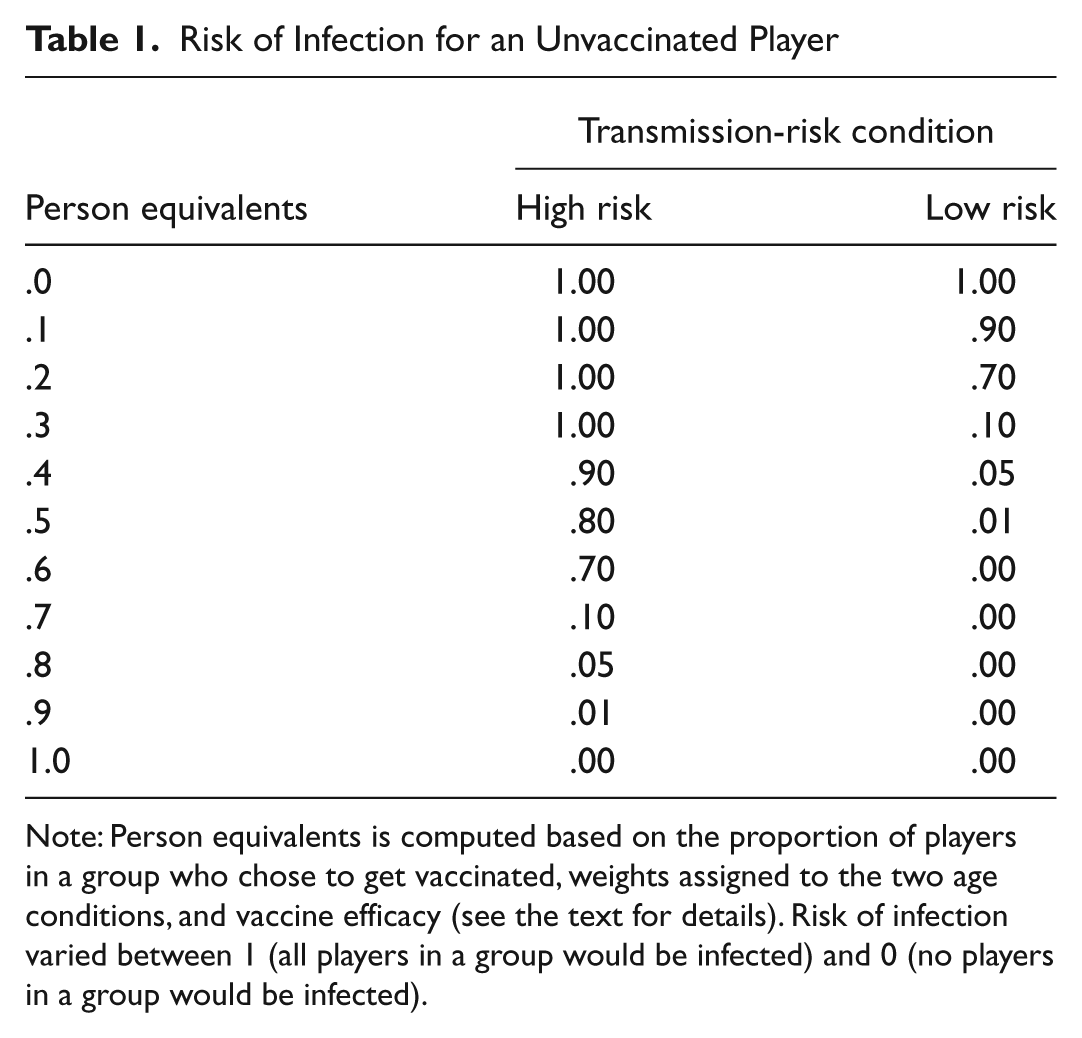
Note: Person equivalents is computed based on the proportion of players in a group who chose to get vaccinated, weights assigned to the two age conditions, and vaccine efficacy (see the text for details). Risk of infection varied between 1 (all players in a group would be infected) and 0 (no players in a group would be infected).
Each game session had 24 rounds, which resulted from the 2 (vaccine cost) × 2 (influenza severity) × 2 (transmission risk) design, with three replications of each combination. The eight combinations of parameters were randomly ordered, and each combination was presented for three rounds in a row.
Transmissibility function
The risk of infection conditional on choosing not to be vaccinated depended on both the baseline transmission risk (which varied across rounds), as well as the number of young and elderly players who chose to get vaccinated. Vaccination of young players contributed substantially more to risk reduction than did vaccination of elderly players; this was because the vaccine was more effective for young players and they made a greater contribution to herd immunity than elderly players did. The transmissibility function was based on a calculation of person equivalents (PEs), where
The number of young and elderly players who chose to get vaccinated are represented by ny and ne, respectively. The weights that the young and elderly players had on influencing herd immunity (Wy and We, respectively) were constrained to a 5:1 ratio. Ey and Ee are the vaccine efficacies for young and elderly players: .80 and .50, respectively. The total number of participants in the session (either 8 or 10) is designated by n. Across rounds, ny and ne varied depending on how many players chose to get vaccinated. Given these parameters, PE was bounded by 0 and 1.
Table 1 shows the risk of infection conditional on choosing not to be vaccinated as a function of PEs for the high-risk and low-risk experimental conditions. In both conditions, if no players got vaccinated (PE = 0), everyone would become infected. If all players got vaccinated (PE = 1), no one would become infected. In the high-risk condition, there was a sharp decline in risk if PE reached .7, which occurred when 4 out of 5 young players (in a 10-participant session) chose to get vaccinated. In contrast, in the low-risk condition, the sharp decline in risk was reached when PE equaled .3, which occurred when 2 out of 5 young players chose to get vaccinated. The number of elderly players who got vaccinated had little effect on the PE value. (The difference between 0 versus 5 elderly players getting vaccinated corresponded with a .11 difference in PE. In contrast, the addition of a single young player getting vaccinated corresponded with a .18 increase in PE.)
Procedure
Participants were seated at computer cubicles that obscured their view of one another. The experimenter randomly selected the payout condition (group or individual) for the session. Participants put on headphones and viewed a 15-min instructional slide show that described the procedure and design of the experiment, including the differences between young and elderly players and how herd immunity worked in the session. The concept of vaccine efficacy was explained with examples. The instructions also explained how risk of infection decreased as the number of players who got vaccinations increased and that young players who chose to get vaccinated had a much larger effect on this risk reduction than did elderly players who chose to get vaccinated. The parameters to be varied across rounds in the session were also explained, and participants were informed of the exact vaccine efficacy, point cost of vaccination, and cost of getting infected in each parameter condition.
Participants were shown example screen shots of the game to further clarify the information they would receive during the session. Participants were also told about the payment scheme for their group, that they would start the game with 4,000 points, and that each point had a cash value of half a cent. Finally, participants answered eight comprehension questions. If they responded incorrectly to a question, they were directed back to the sequence of slides from the instructions that provided the correct information. The average subject answered 7.25 of the 8 questions correctly (range = 2–8), which indicated good overall comprehension. Half the participants (51%) answered all 8 questions correctly.
Prior to the first round, participants were randomly assigned in equal numbers to young or elderly player status. Participants were told their player type on the first round, and it remained the same type for the entire session.
On each round, participants were told their current individual point total and the group’s current point total. They were also presented with all relevant parameters of the round, including those that were held constant across the session—their own player type and the vaccine efficacy for young and elderly players—as well as those that changed across rounds—the cost of the vaccine, the number of points they would lose if they became infected (this varied only for elderly players), the number of points that the other type of player would lose if they became infected, and whether the transmission risk was high or low. Participants then made their choice (to get vaccinated or not), and after all players had responded in a round, each was shown his or her outcome for that round (i.e., whether they avoided the flu or not). At the beginning of every round after the first, participants were shown feedback from the previous round. This feedback included their own choices and outcomes. In addition, they saw the number of young players who did and did not get vaccinated and the number within both of these sets of young players who became infected. They saw analogous information for elderly players.
While the experimenter was preparing the envelopes of cash payouts after the session ended, participants completed a brief postsession questionnaire that included an item asking how they were to be paid (according to their own point total or the group-average point total). This question was answered correctly by all but 4 participants (99%, 272 out of the 276; survey data were not available for 6 participants). The survey also asked participants whether they played the role of a young or elderly participant. All but 1 participant (99.6%, 275 out of 276) answered this correctly. Thus, despite the complexities of the game session, participants showed good comprehension.
Theoretical Solutions
We computed two theoretical solutions to the study task (see Fig. 1a and Normative Theoretical Solutions in the Supplemental Material available online). The Nash equilibrium predicts the actions of rational, self-interested agents. It was defined here as the number of elderly and young players who would get vaccinated, beyond which there was no self-interested incentive for any additional players to get vaccinated. The utilitarian equilibrium represents the group-optimal solution. It was defined here as the number of elderly and young players who should get vaccinated to maximize the net payoff for the group as a whole.
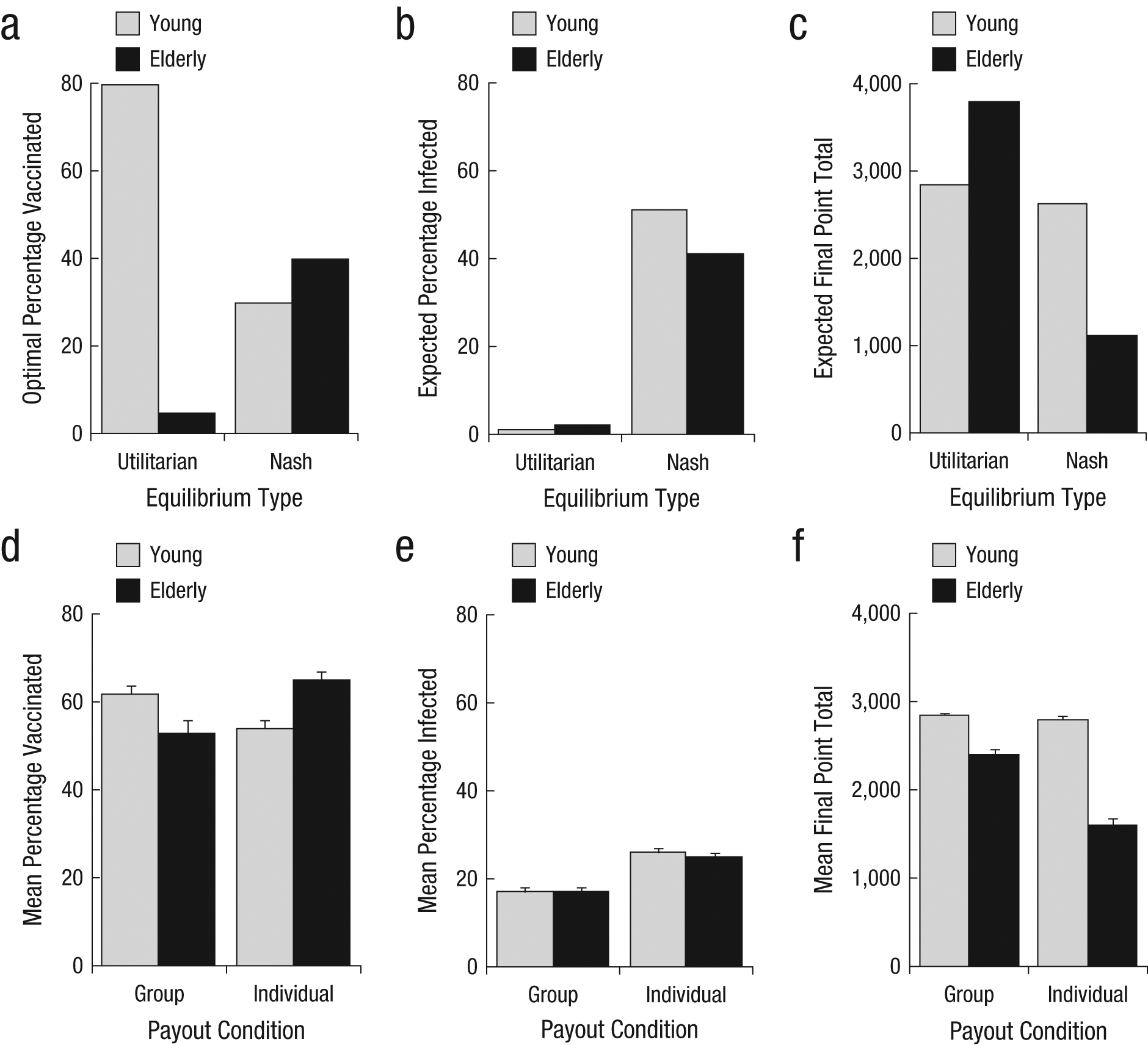
Game-theory predictions and experimental results. The graphs in the top row show the predictions of the utilitarian and Nash equilibria for (a) the mean percentage of players who would choose to get vaccinated, (b) the mean percentage of players who would get infected, and (c) the mean final point total for young and elderly players. The graphs in the bottom row show actual results for (d) the mean percentage of participants who chose to get vaccinated, (e) the mean percentage of participants who got infected, and (f) the mean final point total as a function of payout condition; results in all graphs are shown for players in both young and elderly roles. Error bars show standard errors of the mean.
Results
Figure 1a shows the theoretical solutions averaged across the within-subjects parameter combinations. Given the study parameters, the Nash equilibrium predicts that more elderly than young players in a group would choose to get vaccinated. In contrast, the utilitarian equilibrium predicts that most of the young players and few of the elderly players in a group would choose to get vaccinated. In comparison with the Nash equilibrium, the utilitarian equilibrium leads to lower infection rates and higher point totals for both young and elderly players (Figs. 1b and 1c).
We expected that study participants who were paid according to their individual point totals would behave in a manner consistent with the Nash equilibrium, which predicted that more elderly than young players would get vaccinated. In contrast, participants paid according to the group point total were expected to behave in a manner consistent with the utilitarian equilibrium, which predicted that most of the young players would get vaccinated but few elderly players would. This behavior pattern was indeed observed (Fig. 1d). Participants paid according to group performance had lower infection rates (Fig. 1e) and ended up with more points (Fig. 1f) than did participants paid according to their individual performance.
Analytic approach
For each of the 30 groups, we collapsed data across players and trials to compute the mean percentage of trials on which young and elderly players chose to get vaccinated, the mean percentage of trials on which each type of player became infected, and the mean final point total of each player type. Each of these variables was entered in a 2 (payout condition: group vs. individual) × 2 (player type: young vs. elderly) analysis of variance (ANOVA) with player type treated as a repeated measure and payout condition as a between-groups variable. 1
Vaccination choice
The players’ vaccination choices showed an interaction between payout condition and player type, F(1, 28) = 12.27, p = .002. When players were paid according to individual point totals, more elderly than young players chose to be vaccinated, consistent with the prediction of the Nash equilibrium. However, when players were paid according to group point totals, more young than elderly players chose to be vaccinated, consistent with the prediction of the utilitarian equilibrium. Thus, empirical results showed a pattern of behavior that followed theoretical predictions but was less extreme. We also examined the subset of 6 rounds (out of 24) in which the cost of the vaccine and the severity of influenza were both high (Fig. 2a). In these rounds, the utilitarian and Nash equilibria were in stark opposition, with the former specifying that most of the young and none of the elderly would get vaccinated, and the latter specifying that all the elderly and none of the young would get vaccinated. Analyses of vaccination choices limited to these rounds again showed an interaction between payout condition and player type, F(1, 28) = 18.30, p = .0002 (Fig. 2b).
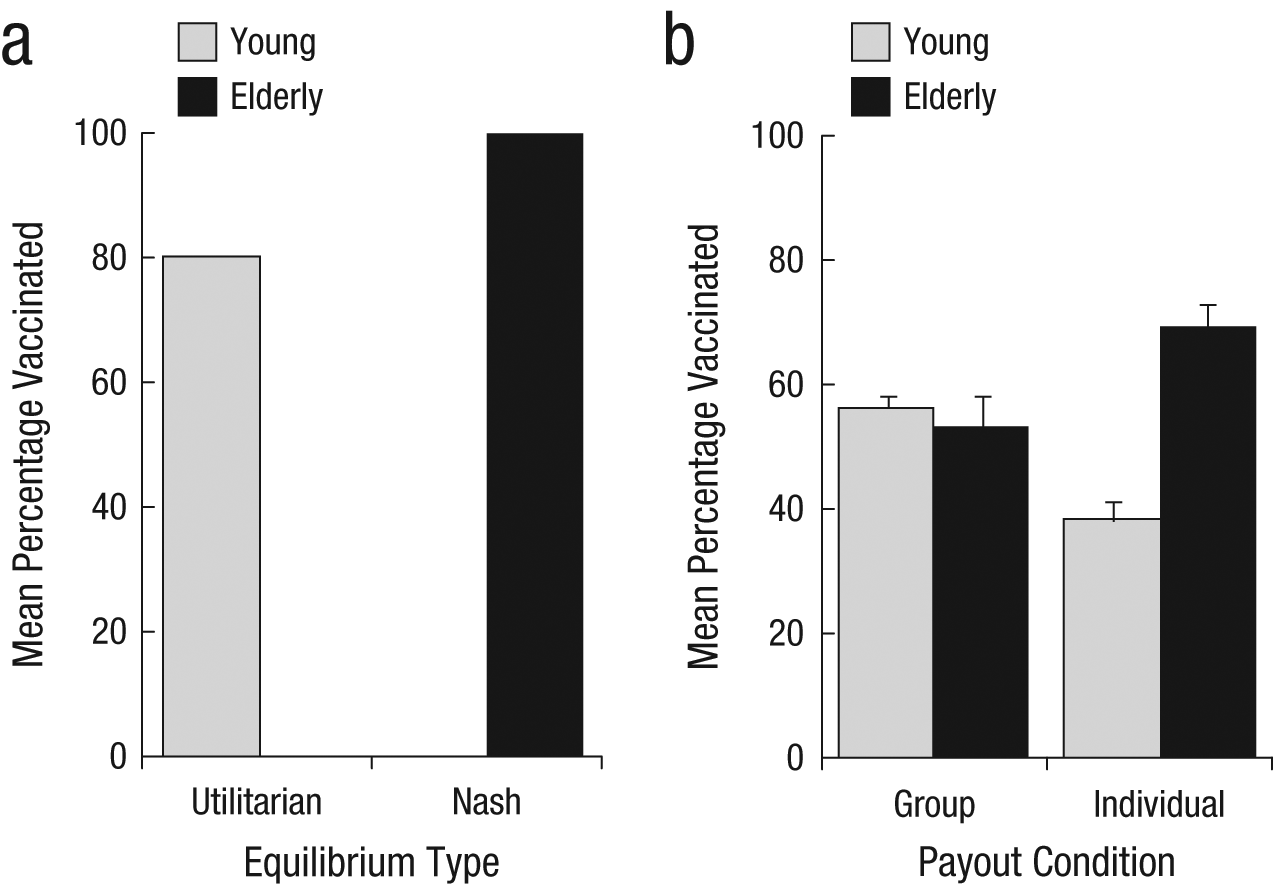
Predicted and actual vaccination results. The graph in (a) shows the predictions of the utilitarian and Nash equilibria for the mean percentage of young and elderly participants who would choose to get vaccinated. The graph in (b) shows the mean percentage of young and elderly participants who actually chose to get vaccinated as a function of payout condition. Analyses were based on the 6 rounds (out of 24) in which the cost of the vaccine and the severity of infection were both high. Error bars show standard errors of the mean.
Infection rate
The percentage of trials in which players were infected was higher when payment was given according to individual point totals rather than according to group point totals, F(1, 28) = 11.11, p = .002. This empirical result was parallel to the theoretical prediction, in which the expected percentage infected was higher according to the Nash equilibrium than according to the utilitarian equilibrium.
We next examined whether the effect of payout condition on infection rate was mediated by the percentage of young players in each group who got vaccinated on each round (Fig. 3). This analysis was based on 720 observations (30 groups × 24 rounds) formed by computing the percentage of young players who got vaccinated and the percentage of all players of each group infected in each round. We conducted a series of regressions with payout condition as a between-groups variable and round as a repeated measure. Payout condition affected the mean percentage of young players who got vaccinated (β = −0.14, SE = 0.04), t(28) = −3.89, p = .0006, as well as the mean percentage of participants infected (β = 0.14, SE = 0.04), t(28) = 3.67, p = .001. The percentage of young players who got vaccinated was also associated with the percentage of all players infected (β = −0.70, SE = 0.03), t(689) = −26.17, p < .0001. After controlling for the percentage of young players who got vaccinated, payout condition no longer predicted percentage infected (β = 0.04, SE = 0.03), t(28) = 1.34, p = .19. Thus, the percentage of young players who got vaccinations mediated the effect of payout condition on the percentage of all players infected (Sobel test: z = 3.83, p = .0001).
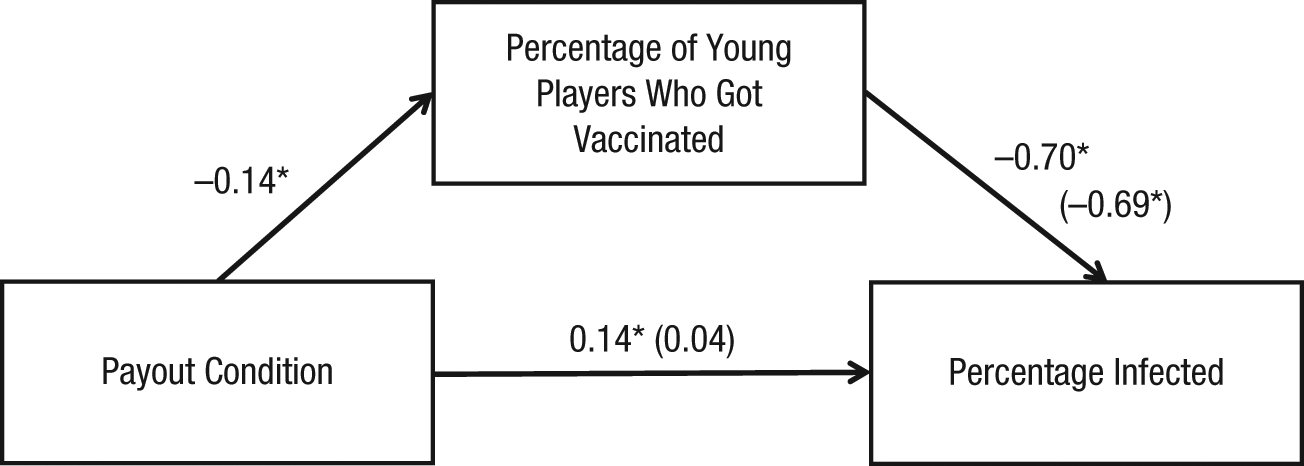
Mediation model showing the effect of payout condition on mean percentage of subjects infected, as mediated by the percentage of young players in each group who got vaccinated on each round. Standardized regression coefficients are shown. Values outside of parentheses show the simple path weights without controlling for the remaining variable, and values inside parentheses show the path weights after controlling for the remaining variable. Asterisks indicate significant paths (*p < .05).
Point totals
Final point totals were higher when players were paid according to group totals than when they were paid according to individual totals, F(1, 28) = 16.96, p = .0003. In addition, young players had higher point totals than elderly players did on average, F(1, 28) = 108.34, p < .0001. An interaction between payout condition and player type indicated that payout condition primarily affected the point totals for elderly players, F(1, 28) = 21.25, p < .0001. Analogous to this empirical finding, the theoretical point totals expected by the utilitarian equilibrium were higher than those expected by the Nash equilibrium, and this was primarily the case for elderly players. 2
Motivation to protect other people
In the postgame survey, we asked participants to express their level of agreement (on a 5-point scale) with several statements, including one that asked whether they chose to get vaccinated to protect other players. Ratings of this statement were used as the dependent variable in a linear regression based on 274 observations (survey responses were missing for 8 participants) with group as the unit of analysis, payout condition as a between-groups variable, and player type as a repeated measure. The analysis revealed an interaction between payout condition and player type, F(1, 242) = 3.64, p = .0003, such that ratings of protecting other players were highest among young players in the group-payout condition (Fig. 4).
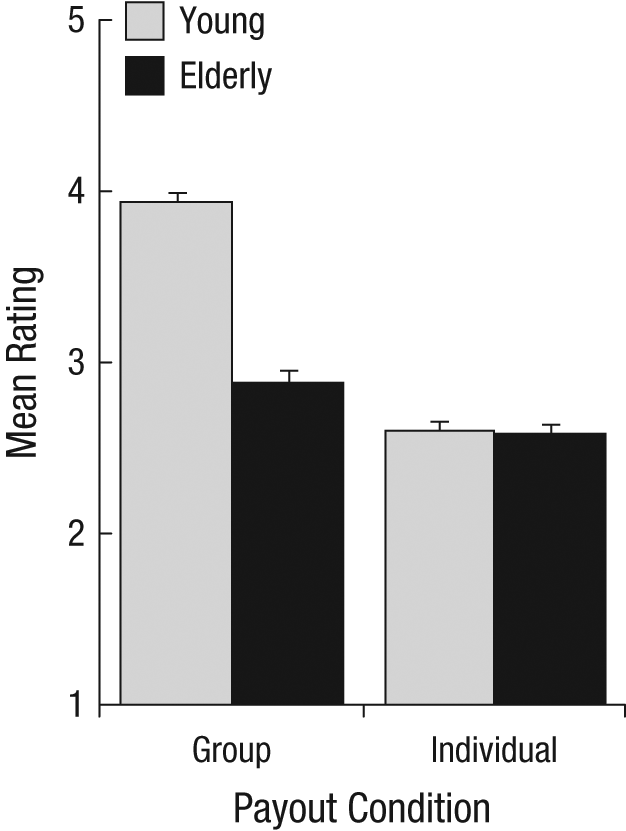
Subjects’ mean agreement that they got vaccinated to protect other players (on a 5-point scale) as a function of payout condition and age condition. Error bars show standard errors of the mean.
To examine whether ratings of this survey item mediated the effect of payout condition and player type on vaccination likelihood, we first computed the percentage of trials for which each participant chose to get vaccinated (individual vaccination rate). This individual vaccination rate was correlated with ratings of protecting other players (r = .33, p < .0001, n = 274). We then used individual vaccination rate as the dependent variable in a linear regression, with payout condition, player type, and their interaction as predictors and group as the unit of analysis. As in the previous ANOVA, the interaction between payout condition and player type was significant (β = 0.05, SE = 0.01), t(250) = 4.19, p < .0001. We then repeated this analysis after controlling for rated motivation to protect other players. The regression showed that this variable was a significant predictor of individual vaccination rate (β = 0.08, SE = 0.01), t(241) = 6.19, p < .0001, and the interaction between payout condition and player type was still significant but smaller (β = 0.03, SE = 0.01), t(241) = 2.72, p = .007. That is, responses to this survey item partially mediated the interaction effect (Sobel test: z = 3.14, p = .002). Thus, the effect of payout condition on the pattern of vaccination choices was partially due to the elevated motivation to get vaccinated to protect other players among young players in the group-payout condition.
Discussion
The epidemiology of influenza entails that vaccinating young people benefits elderly people more than the young people themselves. Our game-theory experiment was structured to mirror this epidemiological reality. Because of the payout structure, vaccination in any particular round rarely improved the situation of a young player but did improve that of the elderly players. Therefore, the Nash equilibrium, which assumes self-interested behavior, predicted that more elderly than young players would get vaccinated. However, the utilitarian equilibrium, which assumes behavior consistent with the group optimum, including the best outcome for young players, predicted that a high percentage of young and few elderly players would get vaccinated. In groups with participants who were paid according to their individual point totals, participants behaved in a way similar to that predicted by the Nash equilibrium: More elderly players than young players got vaccinated. In contrast, when groups of participants were paid according to the group point average, more young than elderly players got vaccinated. In this payout condition, self-interest was brought into alignment with the utilitarian equilibrium—the strategy that was best for the group was also best for the individual. Consequently, more young players than elderly players got vaccinated. The effect of payout condition on vaccination patterns can be partially explained by the motivations of players—young players in the group-payout condition expressed higher motivation to get vaccinated to protect other players than did young players in the individual-payout condition or elderly players in either payout condition.
Although our results fit the qualitative predictions of the Nash and utilitarian equilibria for the individual- and group-payout conditions, respectively, the pattern of vaccination was much less extreme in our study participants than the normative equilibria would predict. We therefore computed additional theoretical solutions for our game based on two behavioral game theories that assume that players are rational within certain constraints: cognitive hierarchy theory (Camerer, Ho, & Chong, 2004) and quantal response equilibrium (McKelvey & Palfrey, 1995). These theories predict vaccination patterns that are less extreme and more in line with our experimental results (see Behavioral Game Theoretical Solutions in the Supplemental Material).
Our study was limited in that college students made hypothetical decisions about getting vaccinated after extensive instructions about the structure of the game. Real-life vaccination decisions are frequently made not only by young adults but also by elderly adults or by parents on behalf of children. Furthermore, real-world decision makers rarely face clearly defined parameters. It therefore remains to be seen to what extent people who get vaccinated in the real world respond to incentive conditions similar to those in our study.
In our game experiment, players could deduce the behavior pattern that was optimal for the group. In addition, they exhibited behavior that approximated this pattern when incentives to do so existed. However, players did not exhibit group-optimal behavior without the group payout incentives. It is interesting that although elderly players enjoyed higher point totals in the group-payout condition than in the individual-payout condition, it was not at the expense of the young players, whose scores were similar in both situations. The reason for this is akin to the traditional prisoner’s dilemma: Although vaccination reduced the expected payout for individual young players on any particular trial, if many young players got vaccinated, the overall infection rate was reduced, which increased points for elderly and young players alike. Thus, if players who were paid according to individual point totals had not acted out of self-interest but instead acted out of concerns for group outcome, the young players would have done no worse and the elderly players would have done much better.
In summary, in many high-stakes situations, the population outcome is determined by the cumulative effect of individual actions; elections, revolutions, pandemics, and climate change all hinge on large numbers of people making choices that have minimal impact in isolation. In these situations, achieving the optimal population outcome necessitates that some individuals act outside of their self-interest. Our study suggests that there are circumstances under which some individuals will act at a cost to themselves in order to protect others in their group. More specifically, young people could be expected to get vaccinated voluntarily in order to prevent morbidity and mortality among elderly people if incentive conditions are right. In an actual infectious-disease situation, the incentives could include good citizenship, preventing social disruptions caused by high infection rates, and protecting the health of elderly family members or community contacts.
Footnotes
Declaration of Conflicting Interests
The authors declared that they had no conflicts of interest with respect to their authorship or the publication of this article.
Funding
This research was supported by a collaborative National Science Foundation grant to the first author (Award No. SBE-0624098) and last author (Award No. SBE-0624117).

Notes
References
Supplementary Material
Please find the following supplemental material available below.
For Open Access articles published under a Creative Commons License, all supplemental material carries the same license as the article it is associated with.
For non-Open Access articles published, all supplemental material carries a non-exclusive license, and permission requests for re-use of supplemental material or any part of supplemental material shall be sent directly to the copyright owner as specified in the copyright notice associated with the article.
