






Abstract
Psychological research using mostly cross-sectional methods calls into question the presumed function of shame as an inhibitor of immoral or illegal behavior. In a longitudinal study of 476 jail inmates, we assessed shame proneness, guilt proneness, and externalization of blame shortly after incarceration. We interviewed participants (N = 332) 1 year after release into the community, and we accessed official arrest records (N = 446). Guilt proneness negatively and directly predicted reoffense in the 1st year after release; shame proneness did not. Further mediational modeling showed that shame proneness positively predicted recidivism via its robust link to externalization of blame. There remained a direct effect of shame on recidivism: Unimpeded by defensive externalization of blame, shame inhibited recidivism. Items assessing a motivation to hide were primarily responsible for this pattern. Overall, our results suggest that the pain of shame may have two faces—one with destructive potential and the other with constructive potential.
Keywords
Psychological theory and research underscore the distinction between shame and guilt. Furthermore, they call into question the presumed function of shame as an inhibitor of immoral or illegal behavior. Most research on the psychological and behavioral implications of shame, however, has been conducted on nonclinical, low-risk samples—particularly college students—using cross-sectional methods (for a review, see Tangney, Stuewig, & Mashek, 2007).
What’s the Difference Between Shame and Guilt?
Shame and guilt are both self-conscious emotions that arise from self-relevant failures and transgressions, but they differ in their object of evaluation. Feelings of shame involve a painful focus on the self—“I am a bad person”—whereas feelings of guilt involve a focus on a specific behavior—“I did a bad thing.”
When people feel guilt about a specific behavior, they experience tension, remorse, and regret. Research has shown that this sense of tension and regret typically motivates reparative action—confessing, apologizing, or somehow repairing the damage done (De Hooge, Zeelenberg, & Breugelmans, 2007; Ketelaar & Au, 2003; Lewis, 1971; Sheikh & Janoff-Bulman, 2010; Tangney et al., 1996; Wicker, Payne, & Morgan, 1983).
In contrast, when people feel shame about the self, they feel diminished, worthless, and exposed. Rather than motivating reparative action, the acutely painful shame experience often motivates a defensive response. When shamed, people want to escape, hide, deny responsibility, and blame other people. In fact, proneness to shame about the self has been repeatedly associated with a tendency to blame other people for one’s failures and shortcomings (Bear, Uribe-Zarain, Manning, & Shiomi, 2009; Luyten, Fontaine, & Corveleyn, 2002; Tangney, 1990; Tangney, Wagner, Fletcher, & Gramzow, 1992). This tendency to externalize blame has been shown to mediate the link between shame and aggression (Stuewig, Tangney, Heigel, Harty, & McCloskey, 2010).
Does the Propensity to Experience Shame or Guilt Inhibit Criminal Reoffense?
To what degree does the propensity to experience shame or guilt inhibit reoffense? Most research on these moral emotions comes from social and personality psychology, and it has focused on low-risk samples of people who engage in low rates of dangerous or immoral behavior. Furthermore, most studies have been cross-sectional, linking current proneness to shame and guilt to retrospective reports of past misdeeds and failures.
Here, we present longitudinal data from a large sample of jail inmates held on felony charges. We anticipated that guilt proneness assessed shortly after incarceration would negatively predict (i.e., inhibit) criminal reoffense in the 1st year after release. In theory, guilt should be more effective than shame in fostering constructive changes in future behavior because the issue is not a bad, defective self but a bad, defective behavior. It is generally easier to change an objectionable behavior than to change an objectionable self. In contrast, we anticipated that shame proneness would positively predict reoffense, specifically through its robust link to externalization of blame.
Method
Participants
Participants were pre- and posttrial inmates held on felony charges in a county jail in a suburb of Washington, D.C. They were enrolled shortly after incarceration between 2002 and 2007; postrelease data are still being collected. Approximately 1 year after release, participants completed a follow-up interview. Participants received honoraria of $15 to $18 at baseline and $50 at the 1-year follow-up interview. All procedures were approved by the George Mason University Institutional Review Board.
Of the 628 inmates who consented to participate and were enrolled in the study (74% of those who were approached), 482 had completed full, valid baseline assessments (i.e., they had not been transferred or released on bond before the assessments could be completed) and were eligible for the 1-year follow-up at the time of these analyses. Six people were subsequently dropped from all analyses because they reported being incarcerated elsewhere for the year after release. This left a sample of 476 people (mean age = 33 years, SD = 10.2, range = 18–70; 67% male, 33% female; mean education = 12 years, SD = 2.2, range = 0–19). This sample was ethnically and racially diverse: 45% African American, 35% White, 9% Latino, 3% Asian, 4% mixed race, and 4% “other.”
One year after their release, we interviewed 332 participants (70%) and had official reports of recidivism on 446 participants (94%). This retention rate compares very favorably with the rates from other longitudinal studies of inmates (Brown, St. Amand, & Zamble, 2009; Inciardi, Martin, & Butzin, 2004). Attrition analyses on data collected as of September 27, 2012, evaluated baseline differences between eligible participants who were reinterviewed and those who were not (i.e., were not found, refused to participate, or withdrew). The 34 variables examined, including demographics (e.g., sex, education), mental health (e.g., schizophrenia, borderline personality), personality (e.g., shame, self-control), criminality (e.g., criminal history, psychopathy), and substance dependence (e.g., alcohol, opiates), showed few differences. The participants who were missed were somewhat younger and more likely to be Hispanic than the participants who were retained.
Measures and procedures
Initial incarceration
Several days after incarceration, we described the study to eligible inmates and assured them of the voluntary and confidential nature of the project. In particular, we emphasized that the decision to participate would have no bearing on either their status at the jail or their release date. We conducted interviews in the privacy of professional visiting rooms (i.e., those used by attorneys) or secure classrooms; data are protected by a Certificate of Confidentiality from the U.S. Department of Health and Human Services. Participants completed questionnaires using touch-screen computers while wearing headphones. The computers presented the items both visually and auditorily (i.e., to accommodate participants with limited reading proficiency). For participants who required Spanish versions of the measures, questionnaire responses were gathered by individual interview; both interviewers and participants had paper copies of the translated measures.
Shame proneness, guilt proneness, and externalization of blame were assessed with the Test of Self-Conscious Affect—Socially Deviant Version (TOSCA-SD; Hanson & Tangney, 1996), which was developed for use with incarcerated respondents and other socially deviant groups. Like the family of TOSCA measures developed for children, adolescents, and adults living in the community, the TOSCA-SD uses a scenario-based approach in which respondents are asked to imagine themselves in a series of situations they have probably encountered in everyday life (e.g., “You are driving down the road and hit a small animal”). Each scenario is followed by plausible responses that describe shame, guilt, and externalization-of-blame experiences with respect to the specific context (e.g., for shame: “You would think ‘I’m terrible’”; for guilt: “You would probably think it over several times wondering if you could have avoided it”; and for externalization of blame: “You would think the animal shouldn’t have been on the road”). Participants rate on a 5-point scale (1 = not likely, 5 = very likely) their likelihood of responding in each manner indicated. (For more information on reliability and validity of the TOSCA-SD in this sample, see Tangney, Stuewig, Mashek, & Hastings, 2011).
One-year follow-up
Approximately 1 year after release, participants completed an interview over the phone; face-to-face interviews were conducted with participants who had been re-incarcerated or who chose a face-to-face interview.
Recidivism during the 1st year after release was assessed in multiple ways. First, participants self-reported whether they had been arrested for any of 17 types of crime (e.g., theft, assault, drug offenses) during the year after their release. Second, participants self-reported whether they had committed but had not been caught for the same 17 types of crime. The 17 types of crime were recategorized using the five types of crime defined by the Bureau of Justice Statistics (violent, property, drug, public order, and other; Langan & Levin, 2002). Two self-report variables were created to assess criminal versatility (i.e., the number of different types of crimes committed; versatility was used instead of arrest or offense frequency because the latter is confounded with type of crime). Self-report arrest versatility was the number of different types of crimes for which participants were arrested, and self-report offense versatility was the number of different types of crimes participants committed, but for which they were not arrested. Third, we coded arrests recorded in the U.S. Federal Bureau of Investigation National Crime Information Center using the same five crime categories. The number of different types of crimes for which participants were arrested, according to these records, constituted our measure of official-record arrest versatility. The actual range for each of the arrest-versatility variables was 0 to 4, and the actual range for the self-report offense-versatility variable was 0 to 5 (see Table 1 for descriptive statistics and correlations among the variables used in the analyses).
Intercorrelations and Descriptive Statistics for the Key Variables
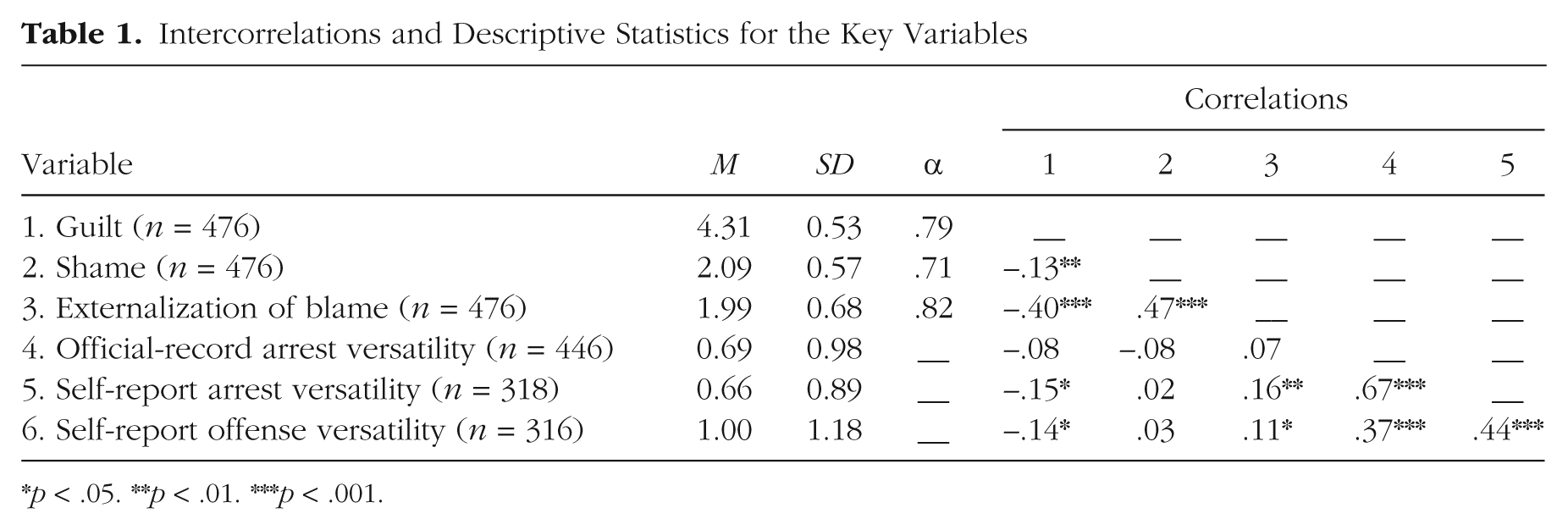
p < .05. **p < .01. ***p < .001.
Analytic strategy
We used Mplus Version 6.12 (Muthén & Muthén, 2010) with full-information maximum likelihood procedures to take advantage of the entire data set. We first tested whether shame proneness and guilt proneness differentially predicted recidivism during the 1st year after release. We then conducted more focused follow-up analyses of shame proneness using a mediational model in which externalization of blame mediated the link between shame proneness and recidivism.
Results
A latent variable representing criminal recidivism during the 1st year after release was defined by the three indicators of criminal versatility, which were based on official records of arrests, self-reports of arrests, and self-reports of undetected offenses. As anticipated, guilt proneness assessed at incarceration negatively predicted criminal recidivism in the 1st year after release. In contrast, shame proneness did not predict postrelease criminal behavior (see Fig. 1). 1 The model fit the data well, χ2(4) = 5.93, p = .20, root-mean-square error of approximation (RMSEA) = .03, comparative fit index (CFI) = .99, and standardized root-mean-square residual (SRMSR) = .02.
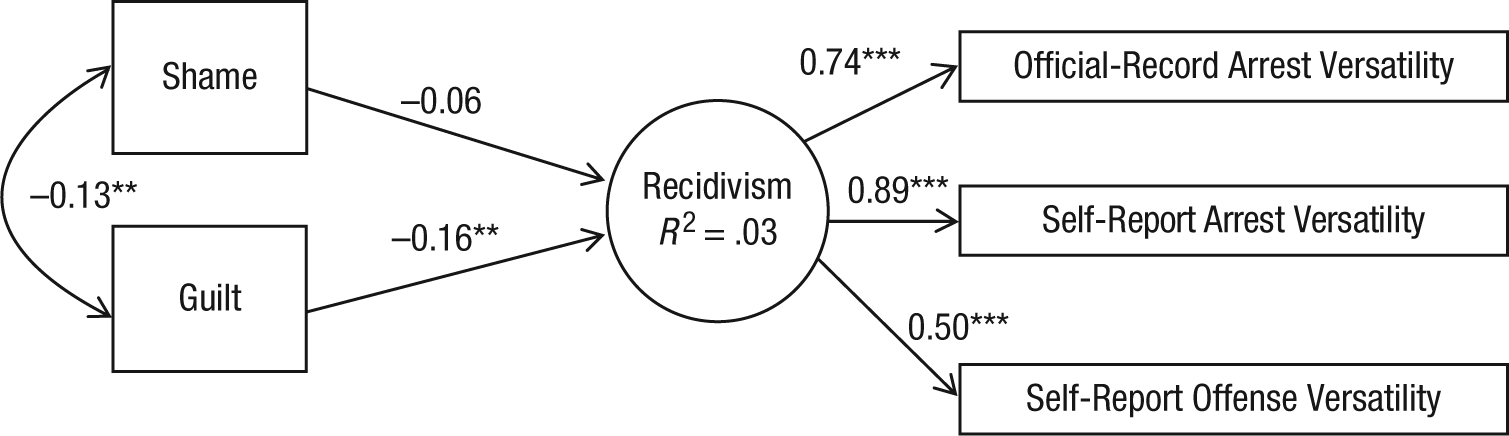
Results of the latent-variable analysis: shame and guilt proneness assessed at incarceration as predictors of recidivism (arrests and offenses) 1 year after release. Standardized parameter estimates are shown.
In theory, shame proneness should be positively linked to recidivism via its well-demonstrated robust link to externalization of blame. Shame often prompts defensive efforts to project blame outward, presumably hindering the ability to accept responsibility, to learn from one’s mistakes, and to use the pain of shame to motivate constructive changes in the future. We tested this mediational model (see Fig. 2), which fit the data well, χ2(4) = 3.27, p = .51; RMSEA = .00, CFI = 1.0, SRMSR = .02; indirect effect = 0.08, p < .01. As hypothesized, shame exerted a significant positive mediated effect on recidivism via its relation to externalization of blame (indirect effect = 0.08, p < .01). There remained a marginal negative direct effect of shame on recidivism (β = −0.12, p = .052), however—an effect in the opposite direction. Shame unimpeded by defensive externalization of blame exerted an inhibitory effect on recidivism. 2 A Wald test of parameter constraints indicated that the indirect effect was significantly different from the direct effect, χ2(1) = 5.88, p = .015. We also tested this model using shame with guilt residualized out. Model-fit indices and path coefficients were virtually identical except that the direct path from the shame residual to recidivism reached statistical significance (β = −0.13, p = .028).
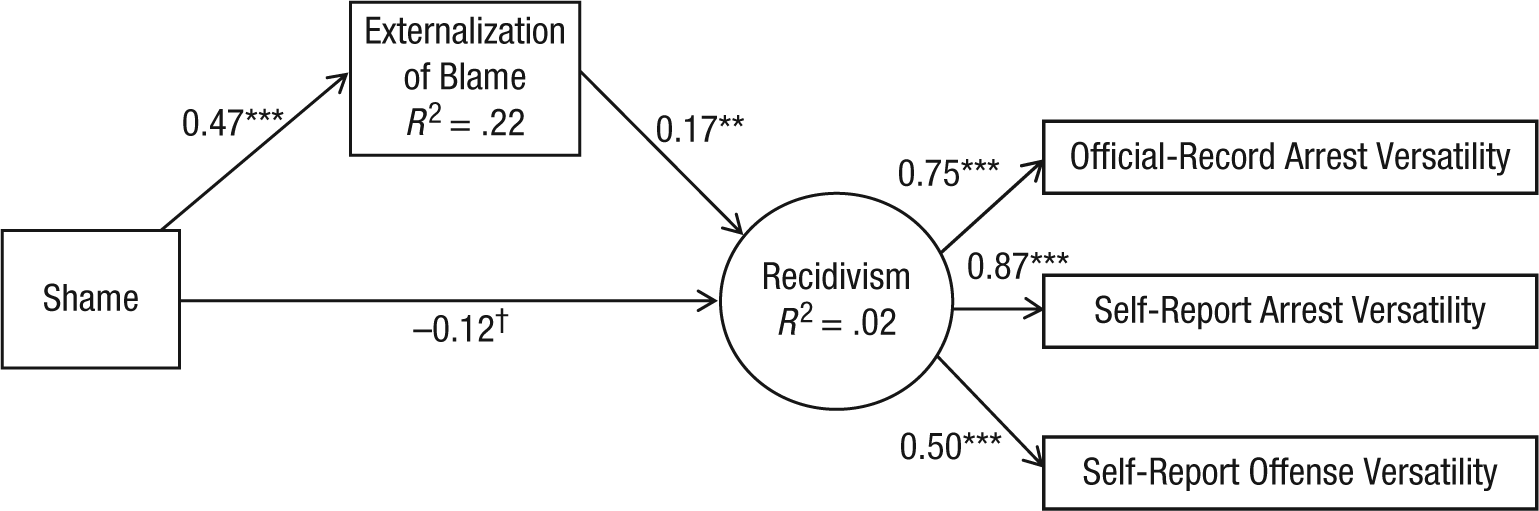
Externalization of blame as a mediator of the link between shame proneness and recidivism 1 year after release. Standardized parameter estimates are shown (†p = .052, **p < .01, ***p < .001).
Finally, we examined whether different components of shame proneness might explain the inconsistent mediation effect observed for shame (Fig. 2). 3 The TOSCA-SD contains two types of shame items (see the Supplemental Material available online for the TOSCA-SD items and scoring criteria): For five of the scenarios, the shame response reflects negative self-appraisals (e.g., “You would think: ‘I am a disgusting person’”). For eight of the scenarios, the shame response reflects a motivation to hide or escape (e.g., “You would feel like you wanted to hide”). Tangney et al. (2011) concluded that it was reasonable to combine the two types of items into a single index of shame proneness because the subscales were positively correlated (r = .35), and the total shame scale demonstrated acceptable reliability, higher than that of each of the separate subscales. Nonetheless, because there is substantial unique variance in these two constituents of shame, we tested the model in Figure 2 substituting the subscales in turn for the total shame proneness scale (see Fig. S1 in the Supplemental Material). The inconsistent mediation effects observed for total shame was almost entirely driven by the items assessing the motivation to hide or escape. For the model with the Shame Behavioral Avoidance subscale, the mediated effect was significant (indirect effect = 0.13, p < .01), as was the direct effect (β = −0.18, p < .01). In contrast, when the model used the Shame Negative Self-Appraisal subscale, neither the mediated effect (indirect effect = 0.02, p = .08) nor the direct effect (β = −0.03, p = .55) reached the conventional level of significance.
Discussion
Inmates’ propensity to experience guilt, assessed shortly after incarceration, negatively predicted criminal recidivism during the 1st year after release. Results from this diverse high-risk sample further underscore the adaptive functions of guilt previously observed in college students and low-risk samples (Baumeister, Stillwell, & Heatherton, 1994; Cohen, Panter, & Turan, 2012; Tangney, 1990; Tangney et al., 2007). Inmates prone to feelings of guilt about specific behaviors are less likely to subsequently reoffend than their less guilt-prone peers.
The pattern of results regarding shame is an example of what MacKinnon and his colleagues (MacKinnon, Fairchild, & Fritz, 2007; MacKinnon, Krull, & Lockwood, 2000) termed “inconsistent mediation”—that is, a special case of partial mediation in which the direct effect and the indirect effect via a mediator are opposite in sign. Bivariate models that do not include the mediator are apt to mask such a complex pattern of influences and yield apparently null effects, because two distinct pathways essentially cancel one another out.
At the bivariate level, shame does not appear to influence criminal reoffense one way or the other (Fig. 1). However, more-nuanced processes are at play (Fig. 2). The propensity to experience shame is in some ways a liability, and in other ways, it is a potential strength. On the one hand, shame proneness is a liability in the sense that it prompts people to blame other people rather than taking responsibility for their failures and transgressions, and this externalization of blame is a risk factor for recidivism. By failing to take responsibility and blaming others, ex-offenders are apt to continue doing the same thing—in this case, commit crime. On the other hand, shame had a direct negative effect on recidivism. Therefore, another, more-adaptive process is also at play.
Follow-up analyses indicated that it was primarily the motivation to hide associated with shame, not global negative self-appraisals, per se, that accounted for these two distinct pathways. In theory, the cognitive-affective experience of shame (negative self-appraisals) motivates the action tendency to hide or avoid. In this sense, behavioral avoidance is more proximal to other, more downstream ramifications (e.g., criminal recidivism) relative to the initial experience of shame. Thus, it is not surprising that the most pronounced pattern of effects was observed for the more proximal behavioral-avoidance component of shame. Behavioral avoidance in particular directly inhibited recidivism and indirectly facilitated recidivism via externalization of blame.
Further research is needed to clarify the mechanism (or mechanisms) by which behavioral avoidance directly inhibits recidivism. It may be that after release, shame-prone ex-offenders are inclined to withdraw from other people—both prosocial and antisocial peers—which may reduce the likelihood of reoffense. Another possibility is that, relative to their less shame-prone peers, shame-prone ex-offenders withdraw, use the downtime to rethink, and in doing so, better anticipate shame at the thought of future involvement in the criminal-justice system, which in turn inhibits reoffense.
Yet another possibility is that shame prompts both defensive and prosocial motives. Recently, Gausel, Leach, Vignoles, and Brown (2012) astutely observed that although few researchers have discussed shame’s positive motivations, a surprising amount of evidence links shame to motivations to repair, apologize, and reform (e.g., at the individual level, see De Hooge, Breugelmans, & Zeelenberg, 2008; De Hooge, Zeelenberg, & Bruegelmans, 2010; at the group or collective level, see Gausel et al., 2012). Gausel et al. (2012) asserted that this consistent association between shame and prosocial motivations “challenges the prevailing view of shame as self-defensive in nature” (p. 943). Our findings underscore that the issue is not whether shame is defensive or prosocial in nature. Rather, our model regarding criminal recidivism indicates that shame has both a defensive pathway (here defined as externalization of blame) and a potentially prosocial pathway.
These results provide empirical evidence of two faces of shame, and contribute substantially to the literature on emotions and criminology. For several decades, social-personality psychologists (Tangney & Dearing, 2002; Tangney et al., 2007), clinicians (Gilbert & Irons, 2005; Lewis, 1971; Potter-Efron, 2002; Teyber, McClure, & Weathers, 2011), authors of self-help books on addiction (e.g., Bradshaw, 1988) have emphasized the dark, destructive side of shame in modern society. The possibility that shame could be harnessed for social good is tantalizing. A promising direction for future research is to examine whether interventions aimed at decreasing defensive responses (e.g., motivational interviewing, acceptance-based therapies) are effective in helping people from many walks of life make constructive use of the pain of shame.
The implications of inmates’ propensity to experience guilt were much clearer and highlight the adaptive functions of guilt (Baumeister et al., 1994; Stuewig et al., 2010; Tangney, 1990): Inmates’ proneness to guilt directly inhibited recidivism during the 1st year after release, without the defensive baggage associated with shame. Thus, “guilt-inducing, shame-reducing” interventions guided by restorative-justice principles (e.g., Malouf, Youman, Harty, Schaefer, & Tangney, 2013) may be especially promising for reducing criminal recidivism and for enhancing postrelease adjustment in the community.
Footnotes
Acknowledgements
Andres G. Martinez is now at the University of Pennsylvania. We are grateful for the assistance of the members of the Human Emotions Research Lab and the inmates who participated in our study.
Declaration of Conflicting Interests
The authors declared that they had no conflicts of interest with respect to their authorship or the publication of this article.
Funding
This research was supported by National Institute on Drug Abuse Grant R01-DA14694 (to J. P. Tangney and J. Stuewig).

Notes
References
Supplementary Material
Please find the following supplemental material available below.
For Open Access articles published under a Creative Commons License, all supplemental material carries the same license as the article it is associated with.
For non-Open Access articles published, all supplemental material carries a non-exclusive license, and permission requests for re-use of supplemental material or any part of supplemental material shall be sent directly to the copyright owner as specified in the copyright notice associated with the article.
