







Abstract
The legal system for renewable energy in Japan, Feed-in Tariff system, was deregulated in 2021 by the central government to reflect the international calls to reduce greenhouse gas emissions. However, this sudden change has raised concerns about social, environmental, and long-term economic sustainability. Thus, we conducted a state-of-the-art review of legal and policy frameworks of wind power projects in Japan and discussed the multi-layered structure at national- and municipal-level ordinances. By doing so, several gaps are highlighted. First, there are procedural gaps that business operators can de facto bypass by checking the environmental procedures. Second, there are issues at the scale (national or local), where the decisions are met. For example, while the overall framework is decided at the national level, the most contentious issues of the location of wind power facilities are left at the local level, where residents, municipalities, and developers are burdened to solve these issues. Third, in the current legal system, environmental impacts on popular natural landscapes are not taken into consideration. In the face of deregulation and concerns about multiple factors, there has been an increase in the number of municipalities opposing the construction of wind farms. Finally, existing legal cases related to wind power projects are provided to illustrate changes and disputes at different sites across Japan. These cases demonstrated how landscape elements (e.g. biodiversity) can be vital for wind power project development in Japan.
Introduction
The plans to develop renewable energy sources attract attention in the international arena as part of the global energy transition to meet the Sustainable Development Goals. 1 Among the renewable energy sources, wind energy is anticipated to supply one-quarter to one-third of electricity across the globe by 2050. 2 In the global arena, the potential impact of wind energy in reducing greenhouse gas emissions is frequently used by stakeholders in favor of the technology.3,4 However, there is growing evidence of their negative impacts on biodiversity and landscape.5,6 For biodiversity, collision mortality of birds and bats to wind turbines has been documented, for instance, in northern European contexts, 7 the United States,8,9 Central Ethiopia, 10 and Canada. 11 Wind farms also led to indirect impacts such as habitat loss and fragmentation resulting from land-use change, vegetation removal, on-site construction of wind turbines on cement bases, and road sprawl.12–15 In terms of landscape impacts, wind power projects have received negative perceptions of their visual (aesthetic) and noise (acoustic) impacts.16–19 For example, Möller 20 quantified the visual impact of regional wind-power development in Denmark with varying thresholds. The impacts on indigenous peoples’ historical, traditional, and cultural landscapes have also been noted in certain countries.21–23 Besides, Pedersen and Waye 24 reported people's annoyance to wind turbine noise in Sweden, which was influenced by visual interference on landscape scenery. Meanwhile, there is an argument that wind farms are gradually being recognized as a modern beauty.25–27 Well-planned regulatory schemes can be important drivers for the development of renewable energy,28,29 however, regulations that are too strict will hinder power generation by wind energy.30,31
In Japan, similar negative impacts are documented.32–38 For instance, Kitano and Shiraki 39 recorded bird fatalities related to wind turbine collision at 42 turbines in Tomamae, northern Hokkaido, Japan. Habitat loss associated with land use conversion during wind farm installations had also been reported in the country. 40 In terms of noise, it cannot be said that it is illegal because it is close to the noise standard, are there cases wherein people with delicate senses, called “highly sensitive persons”, suffered. 41 In terms of landscape impacts, residents living near wind farms are, to some extent, annoyed by the noise produced and visual obstruction.42,43
Despite the general understanding of the demand for clean energy,44,45 the construction and operation of wind power plants have concerned the local society because of its potential impacts on the environment and landscape causing oppositions in certain places.46–48 These trade-offs on biodiversity and landscape are identified to help developers mitigate the impacts of wind power projects,5,6,49 which in turn decrease the opposition movement. 42 Involving locals in the process can also be beneficial to lessen the opposition and increase social acceptance of wind farm developments. 50 Moreover, to solve the concerns involving the construction of wind power plants, the designs of the devices can be improved.51,52
To improve decision-making processes, several policies were implemented such as the environmental impact assessments, which were recommended to be strategic and consistent.53–56 In Japan, the Environmental Impact Assessment (EIA) Law (Law No. 81 of 1997) has been applied to wind power projects.42,57 Municipalities in the country now regulate the installation of onshore wind turbines in areas where they may potentially affect the landscape. 40 As of 2021, further promotion of renewable energy is being discussed in the country, particularly installing wind and solar farms in appropriate areas.
To date, there are limited case studies in Japan that highlight wind energy development and landscape, and how these two influences each other from legal systems framework perspectives. The lack of science-based or objective indicators are underpinning these difficulties and challenges; there are no widely accepted indicators, nor recommended standards for implementation of wind energy development. Given the lack of objective benchmarks or widely accepted indicators for the landscape aspect, wind power projects will be promoted through “regional agreement,” in which the people of the region take comprehensive consideration, and either agree or give consent. There are two layers to ensure the “accountability” of operating entities in reaching regional agreements, namely “provision of information” and “process of agreements and consents.” The latter layer entails a domain that should be based on scientific indicators including landscape factors, which are currently lacking. Thus, in this study, we examined how “landscape factors” such as “natural scene conservation” can be embedded in existing policies that can lead to renewable energy development in appropriate areas, which are typically located in mountainous areas with landscape and moral rights of local people importance. Additionally, we emphasized the necessity to establish science-based indicators and/or standards for landscape elements while comprehending local contexts and considerations. To do this, we reviewed the legal frameworks (and their ongoing changes and implications for the practices), at the theoretical and practical levels guided by two hypotheses.
First, the role of natural landscapes varies depending on the technology type (i.e. solar and wind power), and there are certain differences, such as their technical elements, legal differences, and length of technical and practical history (solar has a longer history) between the solar and wind. Though we specifically looked into the role of natural landscapes in wind power projects, there are cases presented in this study that are related to solar power projects due to similar pathways.58–60 Additionally, the history of wind farms in Japan is relatively young, and it is only in 2011 that the research and development funding for wind energy in the country significantly increased. 61 We argue that what already happened or issues on solar power projects will most likely emerge as issues for wind power generation in Japan. This will provide a unique opportunity to better understand the technical and social characteristics of wind power projects shall these issues arise in the future. Moreover, given the circumstances that the issues surrounding the location selections are largely left at the site level, between the local governments, municipalities, and the business operator, what is the role of natural landscape? What kind of perceptions, actions, and discussions exist surrounding such debates? The second hypothesis is drawn from legal perspectives. Though the legal rights and benefits of “popular natural landscapes” are contested and not well established, the concept of a natural landscape tends to serve as a powerful catalyst in social movements while it is less powerful in the legal retreat in the proceedings, due to their legal destination or general ambiguity.
Alternatively, we propose that elements that can be objectively or scientifically demonstrated tended to be more appealing than landscapes. One of the most powerful ones is elements related to safety or noise (nuisance) in the proceedings. The issues related to biodiversity can also be a point as the conservation of biodiversity, especially the protection of endangered species, has been established as an asset of humankind, or the scientific meanings of biodiversity has been established as fairly certain. Thus, damage due to its deterioration has been confirmed to some extent. Regarding the noise problem, we have positioned it as “pollution” legally, and it is administrative standard. Thus, a judgment cannot be based on the agreement of the local residents solely, but it is also possible for the court to make a judgment in accordance with the “legal standards” of desirable biota, its conservation, and desirable noise environmental standards.
Review of legal systems in Japan
Brief characteristics of related legal systems on renewable energy
This section presents an overview of relevant national legal instruments and processes related to renewable energy in Japan. Under the Paris Agreement of the United Nations Framework Convention on Climate Change (UNFCCC) adopted in December 2015, Parties are committed to a decarbonized society in their national contexts. 62 This in turn led to an increase in the ratio of renewable energy generation, inter alia, in developed countries. 63 A few of these countries include Canada, Germany, Italy, the United Kingdom, China, France, and the United States, with a ratio of renewable energy of 66.2%, 40.2%, 39.7%, 37.5%, 26.8%, 20.0%, and 17.6%, respectively. In 2018, more than 25% of the total electricity generated by the international community had been covered by renewable energy generation. 64
In Japan, overall trends in terms of the ratio for renewable energy lag behind the trends seen in the EU, aiming to reach a ratio of renewable power generation of 18.1% in FY2019. This ratio is derived from 6.7% solar power, 0.7% wind power, 2.6% biomass, 0.3% geothermal power, and 7.7% hydropower. 62 Japan's renewable energy rate drastically increased from 10.4% in 2011 to 19.8% in 2020 when the Feed-in Tariff (FIT) system was initiated in 2012. 65 Particularly, solar power generation remarkably increased from 0.4% in 2011 to 7.9% in 2020. 65 However, it cannot be at a high standard internationally, and the Japanese Government is under pressure to tackle a decarbonized society.
There is a move in Japan to accelerate the shifts at the political level since 2020.66,67 In October 2020, Mr Suga, the Prime Minister at the time, delivered his policy speech on the Diet with a concrete timeline that “Japan aims to reduce greenhouse gas (GHG) emissions to zero as a whole, that is, to realize a carbon-neutral, carbon-free society by 2050” (Prime Minister's Office of Japan, 2021). A year later, in October 2021, a new global warming countermeasure plan and Japan's Long-term Strategy under the Paris Agreement were approved by the Cabinet of the Ministry of the Environment (MOE) of Japan under Prime Minister Mr Kishida. 67 In this plan, Japan declared in April 2021 that it would aim to reduce GHG emissions by 46% (compared to 2013) in 2030 and continue to take on the challenge of reaching a height of 50%. Besides, in the 2022 fiscal year budget requests by the ministries, 20 billion yen (approximately $ 170 million) was added as the “Decarbonization Transition/Re-energy Promotion Grant” that continuously supports local municipalities working on decarbonization-preceding.68,69
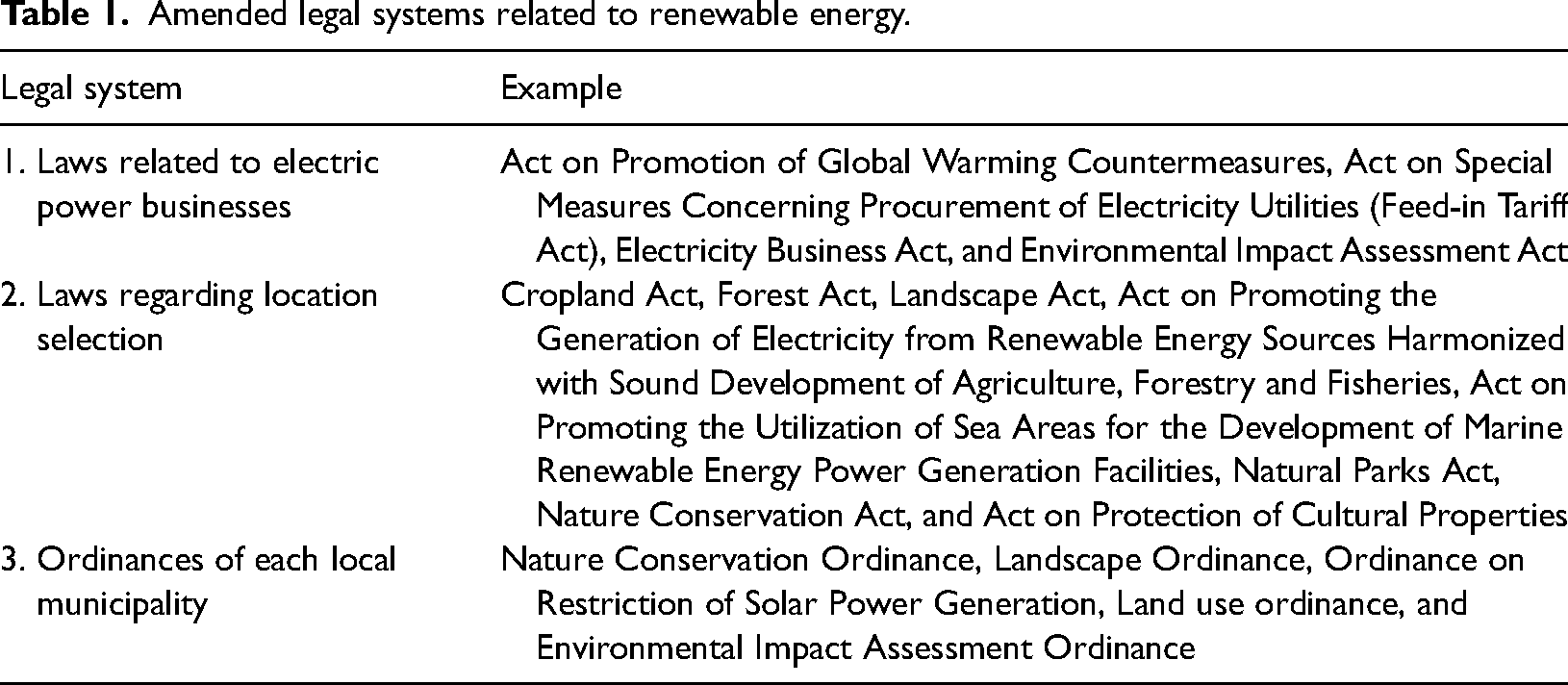
To realize this policy, laws, and regulations related to renewable energy have been drastically revised. The Japanese government intended to reduce GHG emissions by promoting renewable energy. The main amended laws (including regulations) and ordinances can be classified into the following three categories: (1) Laws related to the electric power business, (2) Laws on location selection that are most important for setting up renewable energy facilities, and (3) Ordinances of each local municipalities (Table 1). The location selection is strongly influenced by both the second and third categories, where local residents play important roles (though are not reflected in the ordinances).
Amended legal systems related to renewable energy.
Another motivation for renewable energy in Japan is the energy-related trade deficit (i.e. oil and liquefied natural gas) with the Middle East, Russia, and other regions. According to the Ministry of Economy, Trade and Industry (METI) of Japan, the country's self-sufficiency rate of primary energy in 2020 was about 11.2%, equivalent to 11 trillion yen or 84.5 billion USD (Figure 1). 70 Given that the primary energy self-sufficiency rate is calculated from the domestic primary energy calculation/domestic primary energy supply, Japan has consequently low primary energy sources (i.e. coal, crude oil, natural gas, nuclear energy, and renewable energy), which are limitedly produced domestically, thus, heavily relies on imported sources. The promotion of renewable energy in Japan is an attempt to recover some of the 89% of the electricity that the country is paying overseas as well as to contribute to climate change measures. The findings of this present study can be of interest to other regions with limited energy sources such as Korea or Taiwan, in Asia and beyond.
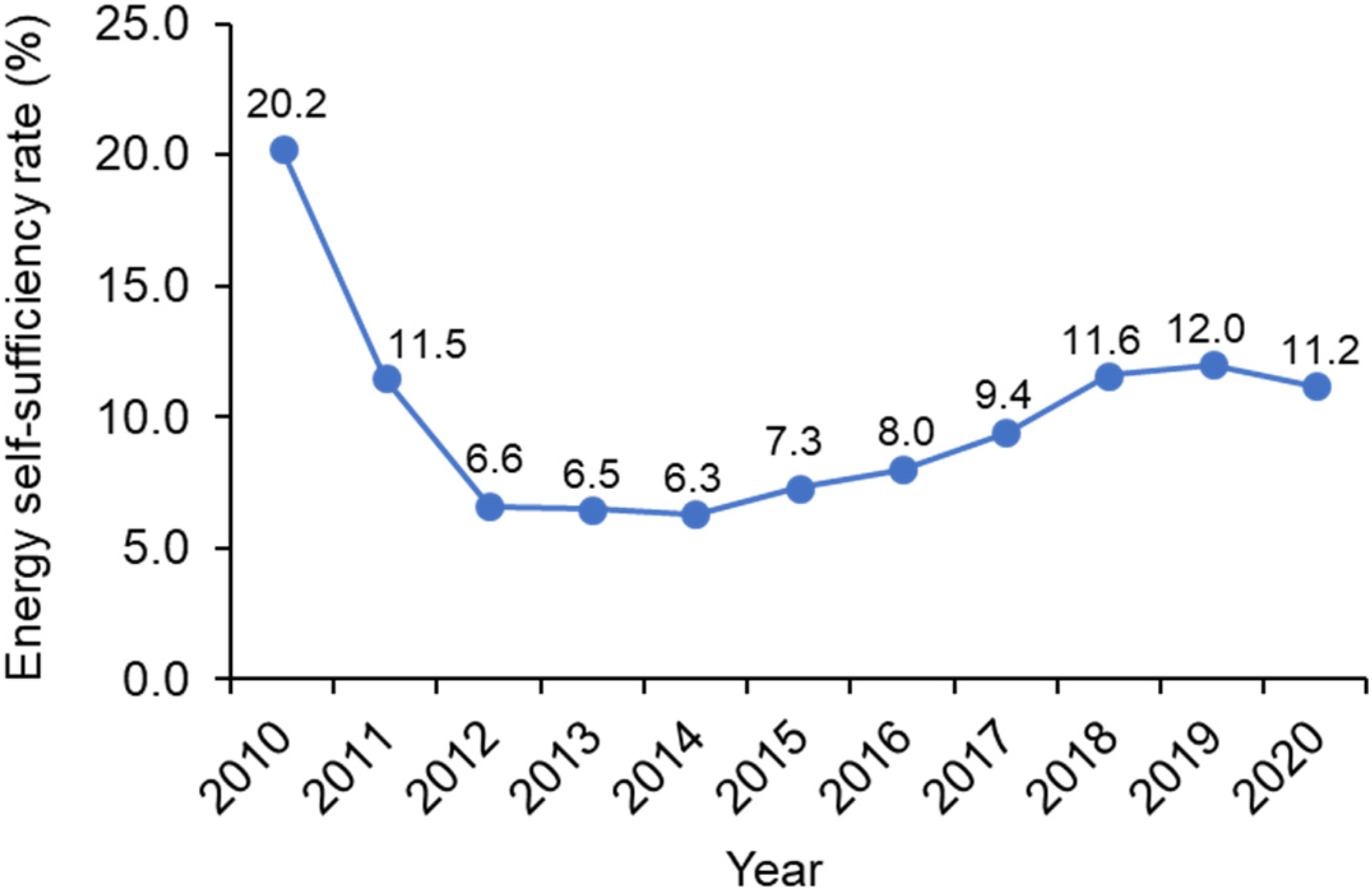
Energy self-sufficieny rate of Japan. 70
The number of renewable energy sites is increasing due to the “renewable energy institutional incentives” by the Renewable Energy Power Generation Promotion Allotted Surcharge (hereafter REPGAS or Saisei-kanou-enerugi Hatsuden Sokushin Fukakin).71,72 We identified two advantages and one disadvantage of the REPGAS framework. 72 The first advantage is the spread and increase of renewable energy sources, resulting in positive environmental effects. The second is the contribution to energy security with an improved energy self-sufficiency ratio in Japan. Consequently, the rate of REPGAS is rising annually, which we considered a disadvantage. The reason behind the increased rate of surcharge is the rise of utilities covered by the FIT system, wherein the rate is hiked in the proportion of increased power plants for renewable energy that the REPGAS supports.
As a national scheme, the burden and benefits are designed to be equal nationwide in principle. The local residents frequently feel that the benefits are skewed toward operating entities and fewer benefits are realized in the local community at the site level.73–75 Thus, the residents in certain local communities may not necessarily prefer to have the power plant facilities to be installed in a nearby location given the “equal” surcharges in proportion to the electricity consumption, regardless of the existence of such facilities. Besides, there are broadcasted news of disputes over facilities with renewable energy suffering from noises, landscapes, or risks of landslides. Such challenges in the incentive schemes can be compared to the introductions in the European experiences or can be compared to other Asian countries. It is the characteristic of Japan that public sectors related to energy utility are partially privatized but the national government has the authorizing entities, in the domain of gas, electricity, and water or sewerage. 76
Overview of renewable energy legal systems related to landscape
The amended legal systems in the country highlighted the importance of landscape (site selection) in renewable energy project development, though the relationship between these two is not yet well established.77,78 As hypothesized in this study (see introduction), the concept of a natural landscape tends to serve as a powerful catalyst in social movements, which include the selection of an appropriate site for renewable energy projects. In the first category provided in Table 1, the term “scenery,” which refers to natural scenery, is incorporated into the EIA law (Article 11[4] of the Environmental Impact Assessment Act). This law indicates that: (1) natural components of the environment (e.g. atmosphere, water, soil) are kept in good condition, (2) the diversity of ecosystems and the different types of natural environments (e.g. ecosystems, wildlife species, biodiversity) are conserved systematically, and (3) people can stay in touch with abundant nature and natural landscape with the natural and social conditions of the area (Article 14 of Basic Act on the Environment).
The second category (Table 1) refers to regulations related to location site selection or zoning of constructions of facilities related to renewable energy. 79 For example, in both the Cropland Act and Forest Act, the location of the developments is regulated. Meanwhile, the Landscape Act (or Keikanho) functions along with the planning schemes and ordinances to conserve landscapes. 80 Other examples of measures particularly necessary for preserving the landscape include the designation of a special protection zone (Natural Parks Act and Conclusion of a Scenic Area Protection Agreement), designation of wilderness areas and nature conservation areas (Nature Conservation Act), and designation of traditional rice-paddy fields (Tanada) and Satoyama (Act on Protection of Cultural Properties).
Finally, in the third category (Table 1), certain municipalities determine the guidance to promote renewable energy projects or relevant zonings.81–83 Certain municipalities set “Landscape Ordinance,” which can have legally binding norms and characters when jointly applied with planning schemes under the Landscape Act. However, once discussions are focused on the actual site of the project, other challenges arise. For instance, in case wind power projects can be built near rural residential areas (mostly those located near mountainous areas), people will either positively or negatively welcome the project. In terms of positive perceptions, local communities will think of it as advantageous such as a reduced price on the electricity rate and employment opportunities. Yet, in reality, electricity rates remain unchanged since the electricity produced in these rural areas is supplied to urban areas (e.g. the Tokyo Metropolitan area) and employment opportunities are given to private contractors instead of locals. In contrast, communities who perceived the environmental and social impacts tend to treat the development of wind farms as “not in my backyard” (NIMBY). However, since there are no established indicators for such issues, particularly for landscape-related topics, these opposition movements are rather weak in legal proceedings. 84
Overview of environmental impact assessment permits for electric power businesses
In the current EIA system of Japan, Environmental Impact Statement (hereafter EIS) or Hyokasho is required for large-scale constructions. Yet, the application is extremely unlikely to be unpermitted by the EIS in practice. As the Japanese EIA is frequently called project-oriented assessment, it is a prerequisite that the project will be conducted. Secondly, the law related to the electric power business and Act on Special Measures Concerning Procurement, which FIT law is one form, do not require content of EIS as a prerequisite for permission grants.
There will be considerations given to ordinances related to landscapes and assessments. However, an application of the FIT scheme before the EIS can de facto bypass the assessment and enable constructions of large-scale constructions.
Given these conditions of the legal frameworks in the environmental assessments, the aesthetic regulations from the ordinance within the current legal scopes are relatively loose.
The basis to restrict any activities is mostly voluntary basis which are forms of requests, consultations, and agreements. Compared to constitutional rights of economic freedom, the right of business activity, such basis is relatively weak. Furthermore, there are also international and national movements and backgrounds to promote renewable energy from global climate changes.
In the following step, the construction will be registered under FIT law with the Environmental Impact Statement (the compliance with the relevant ordinances are self-reporting systems by the developers). Then the development will be initiated.
Municipalities with competent human resources will be able to establish necessary assessments or landscape-related ordinances. Yet, the majority of municipalities face difficulties to establish such ordinances. Besides such limitations to human resources in-house, there will be variations among the regions (as social movements and in lawsuits).
According to the prescribed procedure in the current legal system, the FIT application is submitted to the national government after approval based on the landscape ordinance and the EIA ordinance in each municipality (Article 9 of the Feed-in Tariff Act). In practice, however, the liaison and collaboration between the municipalities and the state government are not necessarily smooth. The requirement for the operating entities in the application is merely to check and sign the item “We will comply with municipality's ordinances regarding the location” in the application form. The mechanisms to ensure credibility of the item are de facto absent neither by the state nor by the relevant municipalities as the applicants are not required to confirm these by the official bodies.
Therefore, the FIT application in practice may be permitted before and the requirements may well be bypassed before the responses to the ordinance are settled (as an example, Fujinomiya City, Shizuoka Prefecture, confirmed by the author on 6 January 2021). However, the municipality cannot easily suspend the installation of equipment. If the suspension or suspension measures are implemented by the municipality, the problem of compensation for damages might be held between the municipality and the operating entities, because they conventionally start the business immediately after FIT registration.
In these circumstances, permission as an electric power company is decided between the state government and the operating entity, and location selection is decided between the municipality and the operating entity. In other words, the municipalities are the ones who are frequently left to compulsory deal with and resolve location issues. Consequently, the frequently most difficult problem, which is the site selection (including the installation of an agreement between operating entity and municipality and local residents) on the municipality side. Due to these circumstances, both administrative and technical requirements are frequently beyond the capacity and resources for small-scale municipalities in mountainous areas to deal with.
Legal systems related to natural and urban landscapes
The difference between “natural landscapes” and “urban landscapes” (cityscapes including historical buildings or landmarks) is rooted in their legal interests and characteristics (Table 2). 85
Types of legal instruments of landscape and scenic views based on urban and rural (mountainous) areas.
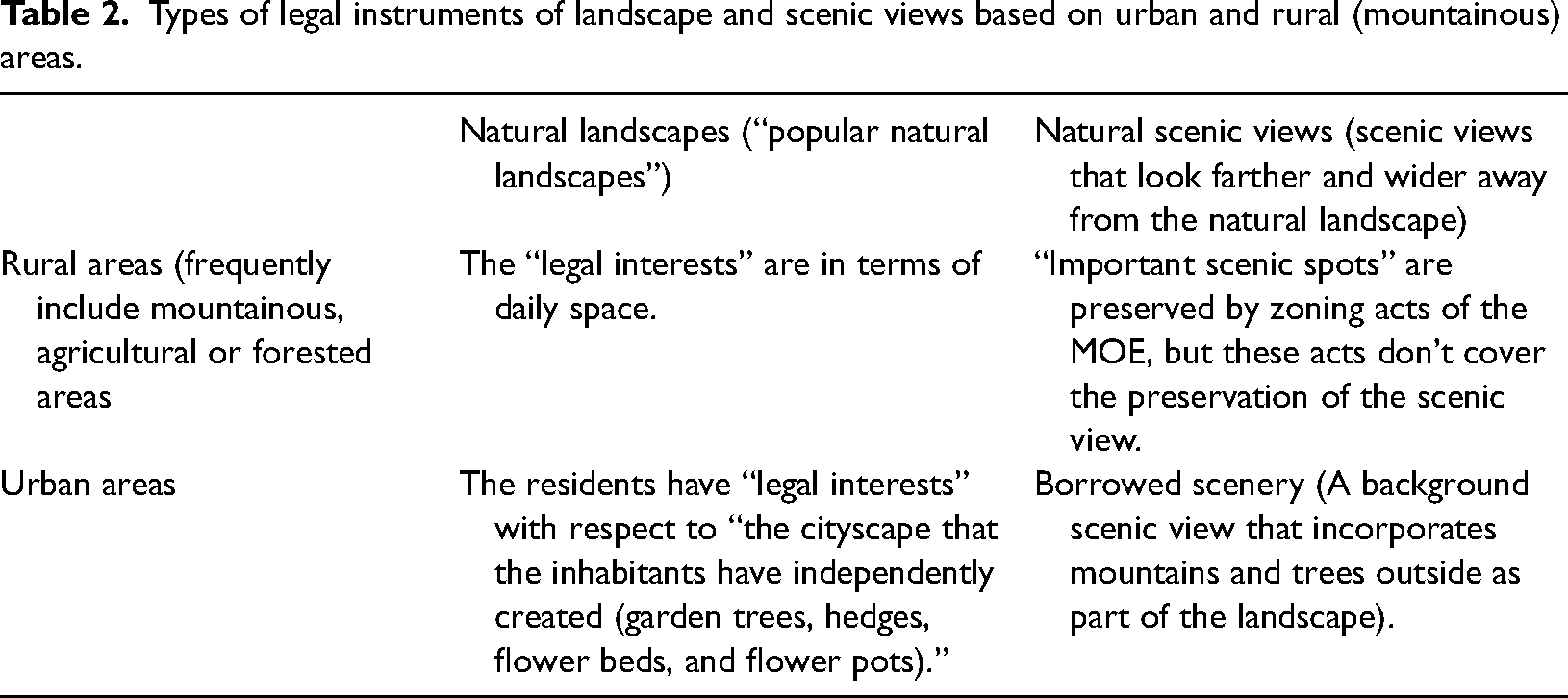
For urban landscapes, they are treated in the context of “townscape creation by citizens.”86,87 In addition, urban design planning is embedded in the relationship with private and public spheres. 88 In addition, legal (landscape) interests of cityscapes are acknowledged while landscape rights are not recognized. As an example, the supreme court decision on urban landscape infringement proceedings on the construction of high-rise condominiums in Kunitachi City (Heisei 18, 30 March 2006) is the leading case. The ruling specifically establishes “the three requirements for scenic benefits,” which are traditionally considered to be a type of environment, in which the enjoyment of the landscape is an individual benefit (Article 709 of the Civil Code). These three requirements are described as (1) objectively good landscapes, (2) residences in nearby areas, and (3) daily benefits. This ruling is an epoch-making judgment in the recognition that “the inhabitants have legal interests” with respect to “the cityscape that the inhabitants have independently created.” However, the judgment does not comprehend the idea of “environmental rights of sovereignty,” and its infringement does not immediately constitute illegality, but rather it is difficult to assume that it is a “right.” 89
For natural landscapes, there are laws in the country that preserve them such as the Nature Conservation Act, the Natural Parks Act, and the Act on Protection of Cultural Properties including protection of cultural landscapes. These laws have gradual regulations according to the stage that mainly preserve “important scenic spots” by zoning. However, even if important scenic spots are preserved, laws and regulations for preserving “popular natural landscapes” are lacking (e.g. Japanese nature conservation legislation is intended to protect the beauty, and hence ironically nicknamed as the “Beauty Protection Act”). 90
Furthermore, there are issues related to the awareness of the local residents. 91 Though a natural landscape frequently exists for long periods of time, there is limited awareness among local residents to appreciate them, which frequently led to destruction or ill-maintenance. 92 In particular, the “natural scenic view” (or Shizen Chobo, Enke Shizen), which refers to a scenic view that looks farther and wider away from the natural landscape including skyline (Figure 2), requires careful consideration because of its delicate character. 93 The natural scenic view is regarded as ruined if (1) something that blocks the view is built in the foreground or (2) an artifact enters the field of vision.
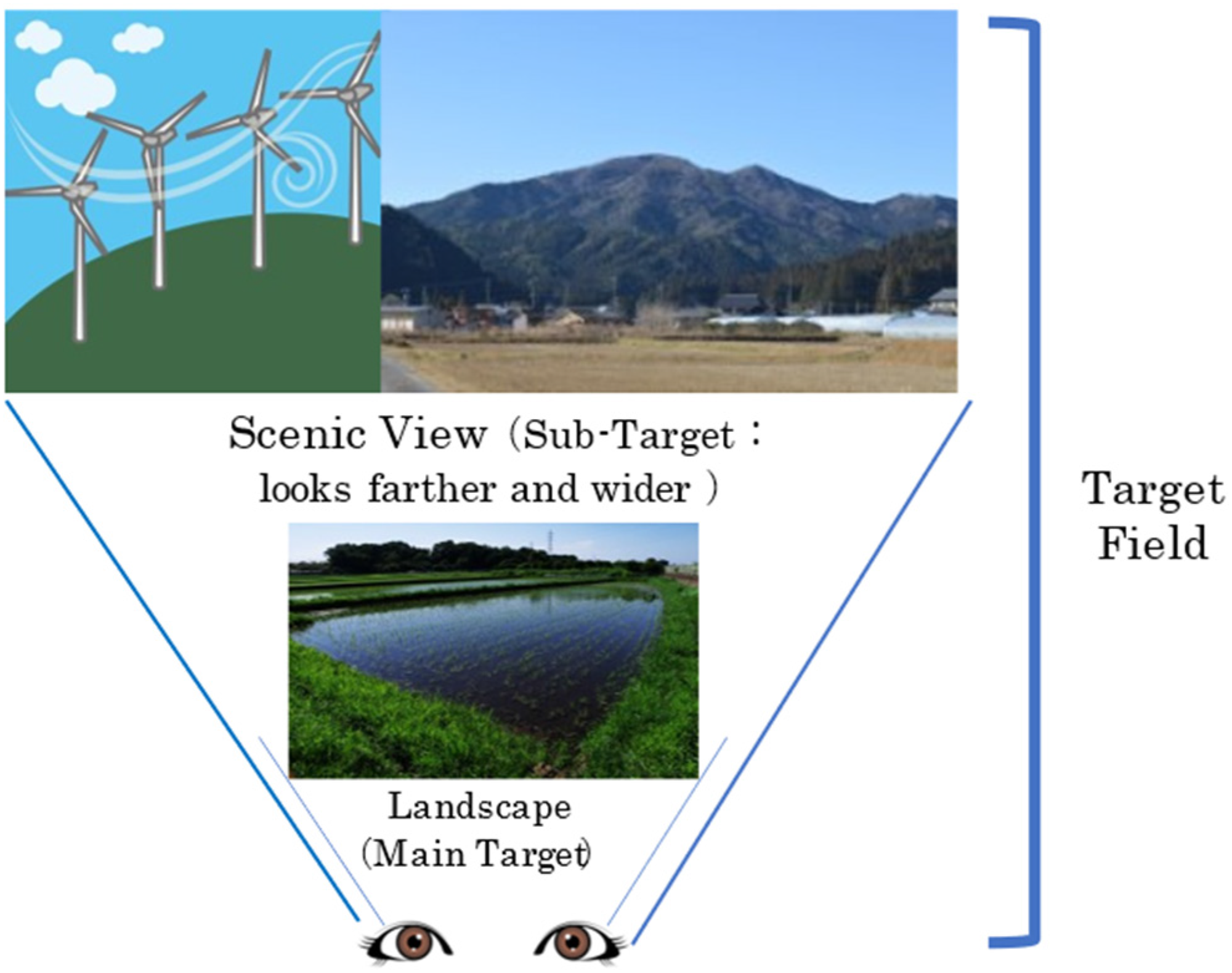
Landscape and scenic view (simplified version of landscape grasp model imaged by Shinohara 94 ).
In summary, the legal rights of the landscape are weak, particularly in the legal examination. If the residents contribute to the maintenance of the landscape, they are granted “legal benefit,” but if they do not do so, they will not be granted “individual benefit.” 95 Moreover, the scenic view, which is more delicate than the landscape (it must be preserved over a farther and wider area), is not well preserved legally. 96
Legal role of landscape in wind power projects
Landscape is one of the factors that is considered in wind power project constructions and operations.9,97,98 Meanwhile, in pre-construction processes, ecosystem deterioration (increased risk of extinction of endangered species), increased noise (for humans), and increased disaster risk due to land modification are considered negative impacts.39,40,42 Because of these negative impacts on the landscape setting of the area, regulations were enacted (Figure 3), leading to the reduction of wind power project installations. Though, such measures have negative financial implications for the wind power business.
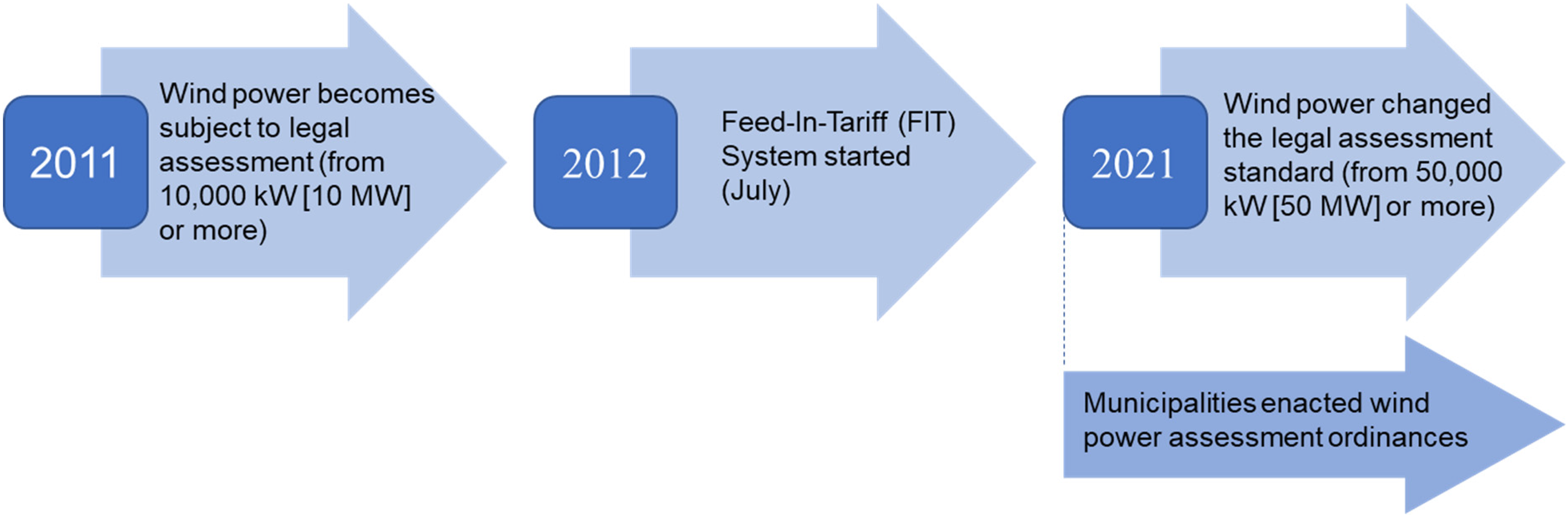
Timeline of legal enactment of wind power assessment (image source: Japan wind power association 2011 and MOE 68 ). MOE, Ministry of Environment.
Although the Landscape Act is established at the national scale, there is no explicit definition of “landscape” that currently exists. There is a concept of “good landscapes” in Article 2 of the Landscape Act, which implies that the maintenance of good landscape conditions is indispensable for creating an attractive and comfortable living environment, and therefore measures to protect it are prescribed. However, there are no criteria or concreted definitions to distinguish “good landscape” from other categories of landscapes. As a result, no appropriate measures are listed nor defined for business operators to prevent landscape deterioration.
Despite these complex and conflicting factors in practice at the site level for the construction area, the assessment requirements for wind power generation were relaxed starting from 31 October 2021, when the environmental impact requirement standards based on the EIA Act changed. 99 Based on this revision, the requirement threshold will be up to 50,000 kW (50 MW), instead of 10,000 kW (10 MW), if no ordinance containing ordinance assessment regulations is formulated in the municipality, as outlined above (Figure 3). We reviewed the changes in the legal regulations to explain the changes. Hereinafter, the environmental impact assessment stipulated by the act is referred to as “legal assessment” and the EIA stipulated by the municipal ordinance is referred to as “ordinance assessment.” There is no liability for the business operators to implement neither at the legal assessment (so-called Type I category) nor at the ordinance level.
To date, cases and concrete estimates regarding the removal and disposal of wind turbines for wind power generation and how they affect the landscape of the area are limited. Waste generated from wind turbine blades is roughly estimated to be 43 million tons by 2050 and will result in serious environmental problems if no proper disposal is observed. 100 For instance, wind turbine blade waste is sent to landfills, yet, this is not an environment-friendly solution, so, in several EU countries, landfilling of composite wastes is forbidden. 101 In 2008, Larsen 102 summarized several potential recycling options for wind turbine blades but due to the short history of the wind power industry at that time, there were no successful industrial-scale recycling processes. Recently, Beauson et al. 103 recommended that a holistic approach encompassing economic, technical, environmental, legislation, and social aspects are needed to implement recycling solutions for wind turbine blades. Meanwhile, Mello et al. 104 conducted a literature review to identify and discuss the environmental impacts of wind farm life cycle. Since scientific literature on wind power-related wastes are limited, we present here the case of disposal of solar power panels because we argue that the legal systems governing solar and wind power projects are relatively similar. Additionally, they have a similar long lifespan and a sound recycling process is needed for both panels and turbines nearing end-of-life uses. 105 Although removal and disposal may not be directly related to the landscape but rather to safety issues, it has cascading impacts on the overall health of the environment, including landscape elements. 106 For example, chemical heavy metals like lead, tin, and cadmium, which predominate solar panels, can pose threat to human health (safety issues) and pollute the environment leading to its deterioration (landscape issues). 106 The global estimate of end-of-life solar panels by 2050 is approximately 9.57 million tons, and several policies on recycling panels are being implemented in the EU and the United States. 106 For instance, in Germany and Czech Republic, photovoltaic manufacturers are legally obligated for end-of-life treatment or tailor-made waste management while in the United States, the Department of Toxic Substances Control in California treated solar panels as hazardous waste and should be disposed of accordingly. 106 Meanwhile, in Japan, the country has taken a step toward recycling solar panels. 106 For wind power-related wastes, it can be predicted that the deterioration of wind turbines caused by leaving them unattended will also have great landscape and environmental impacts.105,107 Kohsaka and Kohyama 84 pointed out that wind farms tend to “cut off the skyline” and “occupy the view.” Therefore, legal instruments or mechanisms to cover removal and disposal costs from retired wind power generation facilities should also be deployed under public schemes, such as the FIT system that is currently implemented for solar power facilities. However, as suggested by Mizuno, 61 the FIT system that differentiates various site-specific characteristics and project scales should be developed; for instance, higher FITs for mountainous and remote areas and smaller FITs for municipal-scale projects. The overall number of large-scale wind power generation projects in Japan is still limited as of 2022, and it can be said that traceability management is sufficiently possible for such facilities at this stage. Pro-active considerations at this early phase are required to enable prompt disposal of retired facilities by business operators. For example, there is an opportunity in Japan to implement policies that require manufacturers of wind turbine blades to provide end-of-line treatment or proper waste disposal schemes similar to that of solar panels. 106 Moreover, business operators can be highly encouraged to disclose information on manufacturing waste, service waste, and end-of-life waste, which are the major sources of wind turbine blade waste. 100 Lastly, as pointed out by Mizuno, 61 wind power industry players must work together with national and regulatory agencies, local communities, and other relevant stakeholders to develop the wind energy development principle in Japan.
Current Status and oppositions of wind power
The case of canceled wind power operations
To date, there are examples of cases where business operators halted their constructions before developing into a trial due to landscape elements (including the scenic view). However, in the lawsuit, landscape elements alone are presumably not enough to win the case despite their wide range of impacts in daily settings (i.e. the scenic view of skylines). Some examples are listed below with the place and a short description of what stage in the development they were stopped (Table 3). We also included the opposition movements, where applicable, that lead to the cancelation of the projects or to the reduction of the project size due to landscape deterioration concerns.
Examples of wind power related plans and projects where the opposition movements led to halt or reduction of the sizes.
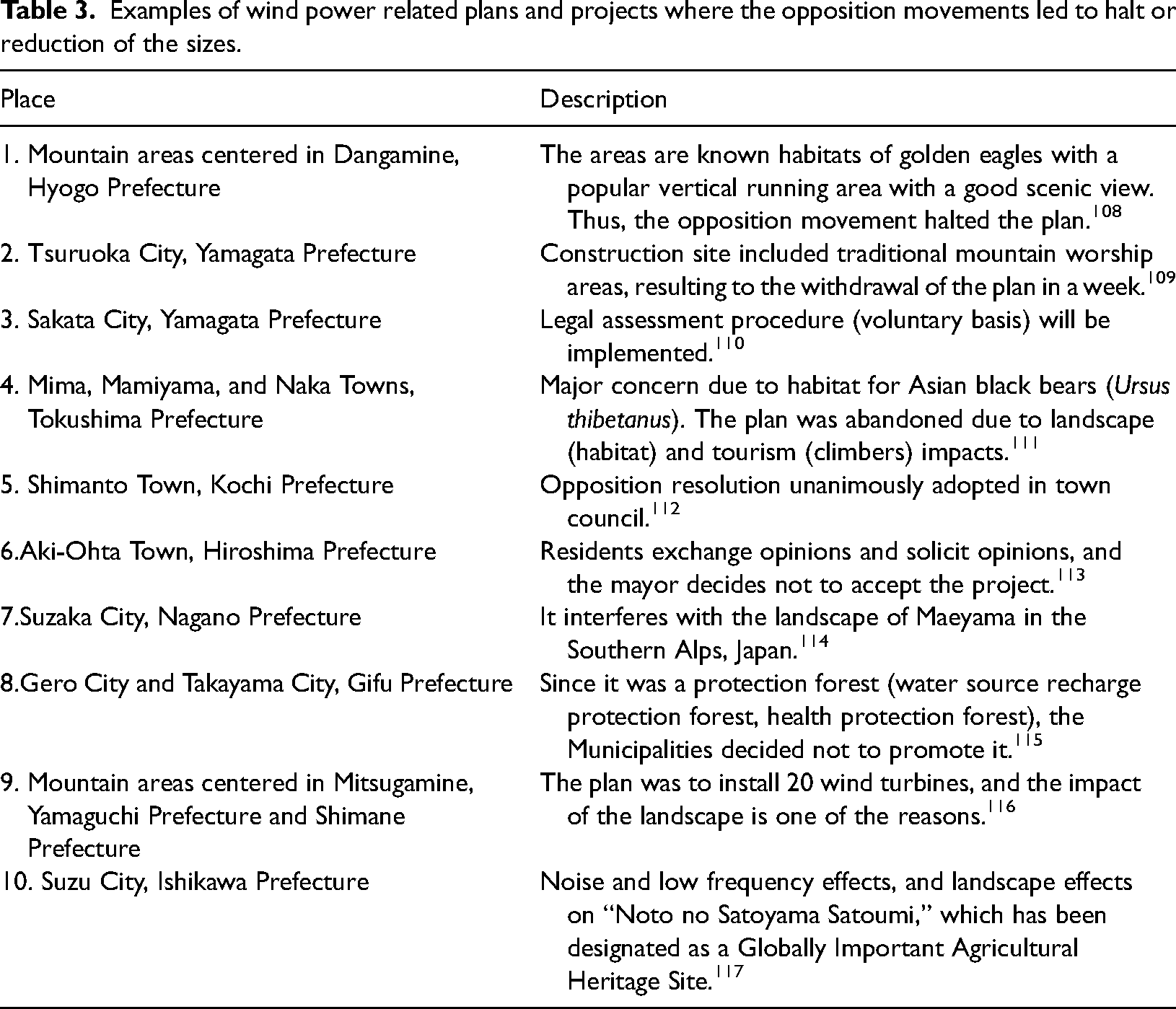
From the cases reviewed (Table 3), we observed several factors that made the opposition movements successful in changing the wind power development plans. First, these opposition movements were communicating with one another, and frequently encouraging other movements. For example, symposiums (held online after the COVID-19 pandemic) were held in the affected areas where opposition movements are occurring. These phenomena are also observed in solar power generation in Japan as negative views related to the destruction of nature and disturbance of communities’ life increased. 84 Consequently, these negative perceptions led the opposition movements to form a nationwide network for information and strategic know-how exchanges among organizations. This, in turn, results in the establishment of ordinances and laws at the local and national levels, respectively, that business operators of solar power projects need to be cleared. 84
Next, there were political factors identified. By nature, municipality heads and municipality council members are politicians, and during election campaigns, they tend to incorporate the opinions of the residents. If the issues are raised in the EIA procedure, the opinions of residents (including those involved in the movements), the prefectural governor of the area, and the ministers of related ministries and agencies will discuss and express their views, which frequently leads to reduction of the scale.
Moreover, there are advantages in mobilizing opposition movements, particularly in relation to landscape deterioration, which affects many stakeholders (widely voters and politicians). Such movements require business operators to deal with landscape preservation and to reduce the number of facilities, which in turn has strong economic implications. Though elapse periods existed due to the deregulation of EIA based on the EIA Act, the municipalities coped by enacting ordinances (31 October 2021 to 30 September 2022). 118
The case of well-received wind power projects
As noted in the overview of renewable energy legal systems related to landscape section, wind power projects tend to be treated as NIMBY facilities. However, there were cases where projects were welcomed in the region and some of which have been evaluated for “landscape” considerations. To provide concrete examples, we presented here in-depth reviews of two cases of wind power projects. First is a project conducted by private operators, which is invested mainly by local companies in Kitakami City, Akita Prefecture. Local enterprises collaborated and aimed to gain income from outside the prefecture borders. A local Akita bank has formed a syndicated loan through project financing, and Akita Prefecture is also supporting the formulation of the Akita Prefecture New Energy Industry Strategy. 119 Along with wind power generation, employment was created by industrializing the manufacturing of wind turbines and the operation and maintenance of wind turbine peripheral industries in the local area. 120 Such effects are critical as northern Japan, including Akita, has one the highest rate of aging populations and a decrease in the production population aged between 15 and 60. Furthermore, there is a general expectation for synergies with the fishery by utilizing electric power from wind turbines for fisheries, and positive effects on environmental conservation. 121 There are initial findings mainly in Europe and these effects are to be examined in the future in Japan.122,123
In the second case, regional consents were reached based on rational discussions further leading to registration at the so-called “Promotion Areas” (or Suishin-kuiki) for renewable energy projects. 124 As of December 2021, 7% of the municipalities had remained “under consideration” for the designation of “Promotion Areas” in the Renewable Energy Project. 125 An example of this is the Choshi City coast in Chiba Prefecture, which is currently designated as the single promotion area in the Kanto region (close to Tokyo). A multinational trading company is in charge of this project. They held a citizen briefing session in order to obtain the consent of the region, and they promised to give the local citizens “consideration to the landscape of Mt. Fuji,” “creation of local industries and jobs,” and “maximum consideration for coexistence with fisheries.” 126
Based on the concrete examples presented above, there are two lessons to be learned to reach consent. Firstly, benefit sharing with local communities is critical (a mechanism for mutual benefits for both parties) so that the overall business plan is met with fewer oppositions either at the national level or the general phase in the community. Frequently, integrity and respect by business operators for communities are common factors for obtaining consent, and consequently approvals. Secondly, science-based or objective measures to monitor and discuss the impacts of such facilities are necessary to limit negative impacts on local communities. Although, it is a challenge to establish elaborated plans based on such long-term and objective measures in consultation with local communities. This will require patience and understanding from the parties involved and require detailed planning.
Conclusion
This paper presented two hypotheses—(1) natural landscapes play a significant role in the implementation of wind power projects and (2) in legal proceedings, natural landscapes can be a catalyst in opposition movements. Although the history of wind power projects in Japan is relatively young, 61 we were able to discuss the procedural and scale gaps in wind power facility constructions in Japan by looking at similar (solar power) and current cases (wind power) available in news databases.
From the cases and movements reviewed, landscape elements tend to be a stronger motivation in the movement against wind power projects. An example is the proceeding case in Shimanto Town, Kochi Prefecture. The case is the first anti-construction movement explicitly based on the preservation of cultural landscape grounded on the Act on Protection of Cultural Properties and in accordance with the municipality's ordinances. Both residents and the municipality are collaborating to confront business operators coming from outside the area to develop their wind power projects. However, it is rare to win cases with landscape elements in the proceedings. One of the influential factors in the past proceedings is ecosystem conservation. While landscape elements face difficulties to be proven, there are certain scientific data and evidence that can be demonstrated in the case of biodiversity and ecosystems. Besides, there are no scientific findings or solid evidence that demonstrate causal relationships to link the “good quality of landscape or good scenic view will contribute to the well-being.” Also, there are certain variations as to what composes a “good landscape” both at the individual or community level. Such ambiguity is clear when compared to biodiversity or noise prevention. Biodiversity has Conventions at the UN level and noise has WHO standards.127,128 There is a pan-European level treaty for the landscape but there are no clear set standards or minimum requirements for the landscapes. The absence of reference levels or standards complicates the judgments. Such external factors to conserve the landscapes are critical factors and should be further explored in future studies.
In the current legal system, environmental impacts on popular natural landscapes are not taken into consideration. In that respect, ordinances and movements (politics) of local governments are more likely to be effective as “circumstances according to the actual conditions of the region.” The “legal rights” to the natural landscape are not established as well, and only the “legal interests” are recognized in judiciary proceedings. The “landscape right” is conventionally regarded as an individual right instead of a collective one. Such assumptions are common to that of the general “environment rights” in Japan. Such dichotomy of individual versus collectives is central to the “landscape concept” because the landscape is collectively comprised of landowners and other people (e.g. neighbors, developers). For example, if a room in a condominium with a beautiful view at an expensive price is obstructed by another condominium, it is possible to seek damages from the real estate agents who sold this real estate with promising rooms “with the beautiful view.” However, residents, municipalities, and business operators do not have a contract-based commercial relationship. Besides, popular landscapes are often not the subject of discussions of legal rights and interests, as they often do not focus on objective “important scenic spots.” It is the landscape where only these individual rights are still recognized.
The legal assessment based on the EIA Act and the ordinance assessment linked to the revision of the law were also described in this review work. If the EIA is applied to the construction of facilities, environmental considerations, including landscape elements play a role in the implementation of the projects. The EIA process may seem self-evident, however, there are cases where measures are bypassed due to their scales or timings of implementation. There is also the revision of the EIA Act in 2021 to promote renewable energy, resulting in a decrease in the number of occasions of EIA. The revised EIA Act was applied swiftly to wind power projects and created a loophole (blank zone) due to changes in the minimum required scale (wind power type 1 increased from 10,000 kW to 50,000 kW). These loopholes are filled by municipalities by enacting ordinances. For instance, municipalities established ordinances that promote renewable energy projects based on relevant zoning.81–83 There is also the issue related to the location of facilities which is challenging to handle by local stakeholders since the overall legal frameworks are mainly managed at the national level. Overall, though landscape elements are not as strong as other factors in legal proceedings, the landscape serves as a symbol and catalyst for opposition movements of the general public. These symbolic meanings for social movements will be one of the future research areas.
Footnotes
Acknowledgments
The authors would like to thank Dr Jay Mar Quevedo, Dr Yoshitaka Miyake, and Dr Yuta Uchiyama for their support in this study.
Declaration of conflicting interests
The authors declared no potential conflicts of interest with respect to the research, authorship, and/or publication of this article.
Funding
The authors disclosed receipt of the following financial support for the research, authorship, and/or publication of this article. This work was supported by the JST RISTEX Grant Number JPMJRX20B3, JSPS KAKENHI Grant Numbers JP22H03852; JP21K18456; JP20K12398; JP20K01417; JP17K02105, JST Grant Number JPMJPF2110, Asahi Group Foundation (2022), and Heiwa Nakajima Foundation (2022).
