






Abstract
Intimate partner violence is often known to a wider social network. Still little research exists on the experiences of social networks, how they respond and how women and children experiencing intimate partner violence perceive these responses. This article draws on 16 qualitative interviews with women victims of intimate partner violence, intimate partner violence-exposed children and their relatives in three kin networks. The overall aim of this article is to study responses to intimate partner violence from a multivocal perspective where the possibly concurring and conflicting perspectives of both the victims and the networks are heard. More specifically, the article explores what responses are perceived as possible/impossible to end violence and create safety for women and children. The article shows how masculinity, in intersection with kin position and age, figures both as an obstacle and a possibility to end intimate partner violence. Moreover, the article shows that responses are shaped from intersections of age, kin and gender in victims, more specifically understandings of maturity and adulthood of female victims and how this linked to responsible motherhood. The study provided insights into responses to intimate partner violence as co-constructed in a wider social network and how a focus on multivocality may be useful for understanding the multidimensional character of responses to intimate partner violence.
Keywords
Men’s violence against women in intimate partner relationships is frequently discussed as invisible or hidden. Although social isolation is a major problem confronting women in abusive relationships and their children, intimate partner violence (IPV) is often known to a wider social network (Klein, 2012). Studies have shown that adult IPV victims more often disclose to informal social network members than to formal institutional support, such as social services and the police (Belknap, Melton, Denney, Fleury-Steiner, & Sullivan, 2009). To date, studies on IPV have primarily focused on abused women and increasingly on IPV-exposed children. The informal social networks such as the relatives, friends, colleagues and neighbours of victims are, however, also affected by and respond to IPV (Klein, 2012).
Still fairly little is known about social networks’ roles and responses, and more knowledge is needed of how responses to IPV emerge as an intersubjective phenomenon actively made sense of within a wider social network. This article situates itself within a small, but emerging, field of research on the responses of the social networks of battering men and women and children experiencing IPV (Gottzén, 2016; Hydén, 2015; Klein, 2012; Latta & Goodman, 2011; Sandberg, 2015, 2016a, 2016b; Van Niekerk & Boonzaier, 2016). As Goodman and Smyth (2011) argue, IPV needs to be understood not only as a matter between two individuals but as something involving both formal and informal social networks, and always occurring in a community context.
Social network responses are often multidimensional, and victims and network members may perceive them differently (Rose, Campbell, & Kub, 2000; Trotter & Allen, 2009). IPV victims, on the one hand, frequently experience negative or mixed reactions when disclosing IPV to their social networks (Goodkind, Gillum, Bybee, & Sullivan, 2003). Social network members, on the other hand, often experience that they respond in order to help, but sometimes feel unsure about how to respond (Latta & Goodman, 2011). This article, therefore, engages with multiple voices from diverse positions, both victims and the social network. It draws on material from an interview study in Sweden with three kin networks, which included women experiencing IPV, their children and members of their kin networks. They all in various ways narrate how they and people around them have responded to IPV.
The overall aim of this article is to study responses to IPV from a multivocal perspective where the possibly concurring and conflicting perspectives of both the victims and the networks are heard. More specifically, the article explores what responses are perceived as possible/impossible to end violence and create safety for women and children. The article focuses particularly on how gender, kin position and age intersect and are used by interviewees as narrative/discursive resources in order to make sense of responses.
Theorizing responses to IPV and intersections of gender, age and kin position
IPV is defined as violence between individuals (more commonly against women) who are, or have been, in an intimate relationship, cohabiting or non-cohabiting, and includes physical and emotional/psychological violence, threats of violence and stalking (Basile & Black, 2011). While there is considerable research on the causes and effects of IPV from medical, psychological and social work perspectives, this article, however, focuses on responses to IPV. Studying responses to violence is a field of research currently in development (Hydén, Gadd, & Wade, 2016), and the concept of response is, as I have argued elsewhere, useful since it encompasses a diversity of reactions and actions: supportive, non-supportive and ambiguous (Sandberg, 2015). As Hydén et al. (2016, p. 2) suggest: “responses to violence show how others interpret it, including their construction of the perpetrator and the victim”, and this may shed important light on the possibilities of and obstacles to ending IPV in different contexts. Existing research on responses has, however, not sufficiently expanded on responses as gendered and how gender in intersection with other social categories is important for what responses become intelligible and possible. This article, therefore, focuses on gender in intersection with age and kin position as significant for how to understand responses.
Theoretically and analytically, this article uses the framework of intersectionality, which seeks to analyse how gender and other social categories are co-constituted. The intersectional analyses focus on the everyday meaning-making processes within which social categories operate rather than on structural processes, as seen in, for example, Collins (1998) or Crenshaw (1991). Like Staunæs (2003), I am interested in a social psychological approach to intersectionality, examining how various discourses are mutually articulated to shape available subject positions and responses linked to these. Following a tradition of feminist poststructuralism, gender, age and kin positions are here understood as social categories accomplished in ongoing interaction and as available narrative/discursive resources that interviewees actively use to position themselves and others (Boonzaier, 2008).
Gender, age and kin position are significant for how we become intelligible as subjects and social beings. Here age does not refer to chronological age but to a life phase or an age category where different ages/life phases – childhood, adulthood and old age – are linked to various social expectations and hold different meanings (Närvänen & Näsman, 2004). As a relational concept, age, like gender, is constructed from opposites, that is, where being a Child is associated with, for example, innocence, irrationality, a lack of responsibilities and dependency, and being an Adult is constructed as its opposite: taking responsibility and being reasonable, rational and independent (James & James, 2004). To mark out how age operates as social categories, I spell Adult/Child with initial caps in my discussion. Moreover, when discussing kin position, I am not primarily thinking in terms of blood ties but in terms of the roles based on sets of social expectations and ongoing negotiations (Finch & Mason, 1993).
Although gender, age and kin position are to some extent analytically distinct, this article shows how they are empirically intertwined and “‘inhabited’ simultaneously” (Eriksson, 2008). In other words, for example, what it means to be a parent or a grandparent is highly gendered but also age related; Adults are expected to be responsible for Children. Notably too, gender, age and kin position are all connected to social structures and power relations that in this case influence whose responses are understood as possible.
Methods
Participants and interviews
This article is based on 16 interviews with 18 respondents in Sweden who participated in a larger project (2011–2014) on IPV-exposed children and the social network responses. Although the project initially set out to study networks’ responses to children, it became clear during the analysis that these responses were difficult to disentangle from responses to the abused mothers. Thus, this article engages with responses directed both towards the women and their children.
The interviews were conducted in Swedish by either me or doctoral candidate Nina Åkerlund and the extracts appearing in this article are translations from Swedish. The interviewees were recruited through contacts with the social services in a region in central Sweden. We established contact with the mothers that had agreed to meet us, and as such they were key respondents who also gave us access to their children and other social network members. In some cases, interviews (not included here) were conducted with mothers who did not allow us to interview their children or other network members.
For safety reasons and the sake of convenience, the participants could choose the time and place (either in a private office at the local social services or in their own homes) to be interviewed. The place of the interview could have shaped the content. Yet given the sensitive nature of the interviews, it was essential that the interviewees could talk in an environment of their choice. Two interviews were done with couples: the grandparents in the Englund network and the woman’s ex-partner and his new wife in the Svensson network (to be presented below). They chose to do these interviews jointly.
The interviews were semi-structured and opened with the following question: “Tell me what’s happened in your family” or “Tell me about your family”. This enabled the participants to open up and speak in their own words about their families and kin networks and their IPV experiences. The interviewer subsequently followed up with questions based on what the participant initially said. The interviews were all similar in that all interviewees were asked to talk about the IPV (women and children) or what they knew about the IPV (network members). This was to identify the central persons in the social networks and to describe how they experienced their (re)actions and those of others in response to the IPV. In some interviews, the participants were asked to draw a map of their network and to identify its positive and negative persons. This method enabled interviewees to visualize the networks and how they had responded (see Hydén, 2015).
Three networks are discussed: Bergström, Englund and Svensson. All names included in the article are pseudonyms. The abused women in all the networks reported both physical and psychological violence but no sexual violence.
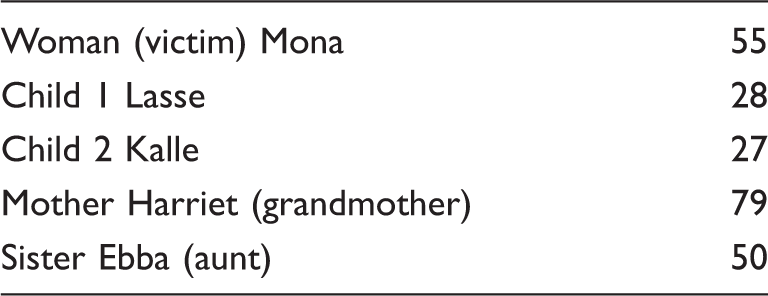
The woman in the Bergström network had experienced severe physical and psychological violence from her husband for more than a decade, including threats, being stalked and the destruction of property. This also happened after the woman and her children had left her abusive partner. The interviews were conducted more than 10 years after the abuse had ended. Two minors were exposed during their entire childhood and they were interviewed.
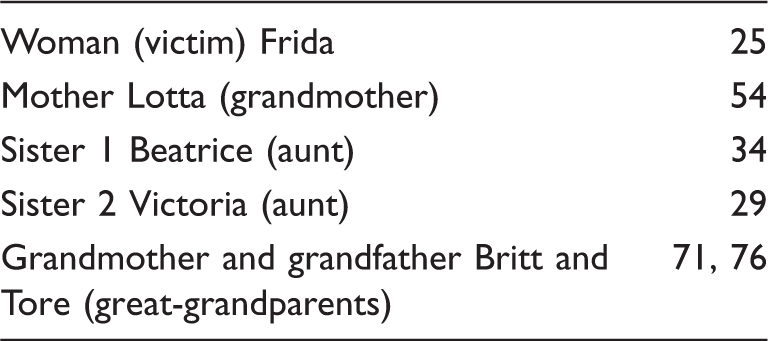
The woman in the Englund network recounted her husband’s over-five-year-long severe physical violence, which included attempts at choking her. The woman had ended the abusive relationship two years prior to the interviews, at the time of which the violence had stopped. Two IPV-exposed children (aged one and three at the time of exposure) were not interviewed because of their young ages.
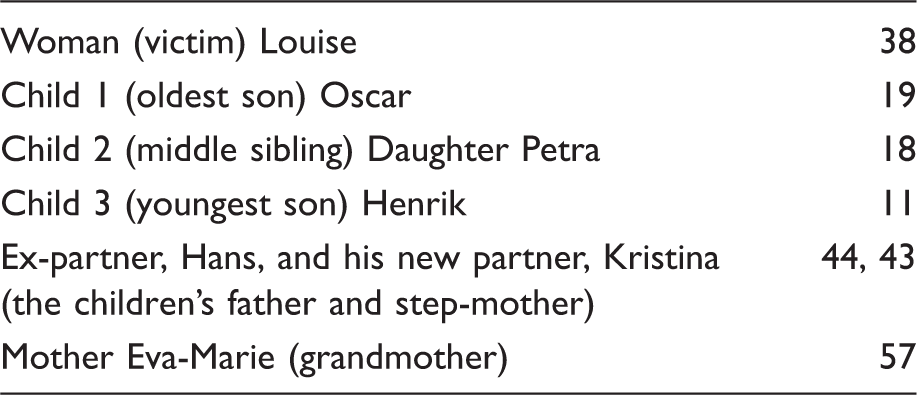
The woman in the Svensson network had mainly experienced psychological partner violence, but severe physical violence had occurred twice. The woman had left the two-year relationship less than a year prior to the interviews. Three IPV-exposed children, aged between 10 and 18, were interviewed. It was not the children’s father who had been abusive.
All participants were of Swedish extraction and lived in a rural region in Sweden, either in the countryside or in small communities with fewer than 5000 inhabitants.
List of interviewees
(relationship to children in brackets)
BergströmAge
Englund
Svensson
Reflexivity and ethical considerations
This study’s feminist poststructuralist epistemology entails an understanding of all knowledge production as partial and situated. Interviewing members of the same family may shape participants’ stories in particular ways, for example making interviewees less critical of and outspoken about conflicts and problems within the network, especially in the two cases where couples were interviewed jointly. Also, all the interviews are expressions of retroactive accounts of violence, and how distant the memories discussed were and thus how the narratives emerged varied among the networks.
Feminist ethics also pervaded the conduct of the study, which involved recognizing the vulnerability of participants, in particular when victimized by violence and/or as children. Revealing different perspectives in an IPV-exposed kin network may cause further conflict in an already strained situation, especially when the interviewees’ positionings were asymmetrical in terms of gender, age and kin position. I take the view, however, that understanding responses to IPV from several perspectives is an urgent issue which would benefit from research and practice on IPV and that having their voices heard was more advantageous than the potential harm it could cause the participants, even those who are children. All interviewees gave informed consent to participate, and for the children under the age of 18, both custodial parents consented. All interviewees’ names and personal details are anonymized. Importantly, we stressed that what was said in interviews was not referred to in other interviews and only the researchers, none of the other family members, could access the interview material. For safety reasons, a participation requirement was, moreover, that the violence had ended and that the abused woman had already left the relationship at the time of the interview. The researcher interviewing the minors was a skilled social worker with experience of talking to IPV-exposed children. We also collaborated with a support programme for victimized women, children and network members, to which we could direct interviewees who felt they needed further support.
Analysis
The material has been analysed as it originally emerged in Swedish using a form of thematic analysis driven by an analytical interest in responses (Braun & Clarke, 2006). The initial coding involved making three thematic maps of the responses to violence that the interviewees in the different networks described. Responses were loosely defined as actions and reactions – negative, positive or ambivalent – that interviewees narrated: at the very time of a violent episode, in the more long-term process of the IPV and after the woman had finished the relationship. The response themes that emerged from the thematic maps were thereafter compared both within each network and between networks in order to look for similarities or differences. I then coded the responses in terms of gender and how the responses in various ways were linked to gender. At this juncture, I conducted a more detailed coding of the specific interview extracts, the narrations of what men and women did or did not do, what meaning was attributed to these responses and how understandings of masculinity and femininity shaped the responses. Here I found that gender was made intelligible in intersection with various narratives on kin position and/or age, which directed me to the particular focus of this article. The analytical examination of what were possible or impossible responses is characterized by a poststructuralist analytic approach informed by Søndergaard (2002), which studies “inclusive and exclusive discursive processes”. This entails looking for the “discursive boundaries” of categories – in this case, what are the boundaries of a possible response.
Results
Patriarchal and matriarchal network responses
Similar to other studies (e.g. Trotter & Allen, 2009), narratives on responses to IPV were indeed multidimensional; voices within the same network but also within the same person were often complex and contradictory. Moreover, the Bergström and the Englund networks, for example, differed significantly in how the members narrated their ability to respond, and this was very much linked to how gender and kin figured in the narratives of the respective networks.
The Bergström interviewees all narrate a network highly strained by long-term IPV, which is placed within a wider culture of violence within the network. In particular, when drinking, fights broke out between male family members and neighbours. The network members’ narratives were very contradictory regarding what responses had been possible. The mother, Mona, and her children, Lasse and Kalle, clearly express their disappointment at the lack of resolute responses. “They should’ve taken us away from there”, says Mona. Similarly, the response Lasse had wanted was for the network “to make it possible to break free earlier” by making all three move away from their father earlier. Mona’s mother, Harriet (the children’s grandmother), and sister, Ebba (the children’s aunt), narrate their responses in much more contradictory terms, however: both taking up positions as caring and supporting family members and recounting that responses to intervene and stop the violence were impossible.
To make sense of why it was impossible for her to intervene against the IPV, Ebba positions herself through her kin position and age as a younger sister. By dint of this position, she makes sense of herself as unaware of what was going on. Ebba [sister]: Mona is five years older than me, so when we were young, we were never really in the same phase. She moved away from home when I was a teenager. So really it was more when she had her kids; I was 15; she was 20, and I was babysitting and those kinds of things. But it has changed. […] When I had a kid myself that I [realized], when their family troubles started. It had probably been going on earlier too, but it was at that point that I became aware. I believe I was too young and had not really realized [what was going on].
In this extract, taking up the position of the younger sister but also that of the Child/Adolescent becomes linked to unawareness, which explains why she did not intervene earlier. As Ribbens McCarthy, Edwards and Gilles (2000) argue, Adult and Child are tied to moral understandings where children are constructed as lacking moral responsibilities, whereas being an Adult is strongly linked to taking responsibility for being morally accountable.
While Ebba draws on an aged kin position, Harriet instead refers to gendered kin relations, narrating how her husband (Mona’s father) is loyal to the perpetrator and strongly opposes divorce. Harriet told her daughter that she would help her move out whenever she was ready, “…’cause I said, ‘You can’t live like this’”, but her husband did not help her make Mona leave.
Harriet [mother]: It was no use talking to my husband ’cause he didn’t like that. There should be no divorce, absolutely not.
The father’s opposition to the idea of his daughter getting a divorce supports previous research on social network responses whereby cultural norms of coupledom in the network may function as a barrier to leaving an abusive relationship (Latta & Goodman, 2011; Rose et al., 2000). But Harriet also speaks of her husband’s loyalty towards friendship with the perpetrator as a reason for why a firm intervention was not possible. Her husband, she argues, went hunting and drinking together with the perpetrator, her daughter’s husband, and therefore he did not want to oppose him. Harriet: My husband never dared to get involved in this ’cause he didn’t want to be on bad terms with him. He drove me there many times, but he didn’t want to come inside as he [Mona’s abusive husband] might take it the wrong way, and he didn’t want this to happen.
Moreover, Mona points to her father’s friendship with the perpetrator as an impeding factor for why her network never stopped the violence. But she also talks of her brothers as sometimes attempting to stop the violence, but how they afterwards often became friends with the perpetrator again. Mona [abused woman]: [M]y brothers, they dealt with it [the IPV…], yes, and there was fighting and rows. But it all ended with: if I stay there [with him], I had only myself to blame. But I had no… that they laid into him was of no help to me. They should’ve taken me away from there. And then they became friends again and that was all. The next weekend things were back to normal. Nothing really came out of it until my husband got into a fight with my brother and my sister-in-law, and after that, all contact with them ceased.
In the Bergström network, the voices of Mona, Harriet and Ebba concur in a narrative of how responses became impossible due to male domination and homosocial loyalty between men in the network. The description of Mona’s father as condoning the violence experienced by his daughter depicts him as the patriarch in its most classical sense as an intersection of kin position and gender, where fathers hold authority over women in the household and as such enable or prevent different responses (Walby, 1990). But Mona’s description of her brothers’ ambivalent responses (“laying into him” about the IPV and becoming “friends again”) also reflects the response network overall as a patriarchal network where men’s peer support is an important aspect of the continued assaults on women (DeKeseredy & Schwartz, 2009).
There is a strong polyphony in Harriet’s and Ebba’s narratives: they refer to the gendered kin network and the dominance of men as preventing their responses. Yet they also strongly position themselves as “being there” by providing care and support to Mona and her children and by reacting angrily and reproaching the abuser. These narratives of care and support that Harriet and Ebba articulate can be interpreted as ways of doing and displaying family, of realizing themselves as mother/grandmother or sister/aunt, kin positions that are simultaneously gendered positions (Finch, 2007). By speaking of their support, they position themselves as morally accountable subjects and responsible family members who do not accept violence.
If the responses in the Bergström network are understood as framed by patriarchal relations and men’s domination, the Englund network, in contrast, presents kin positions and gender as enabling responses to IPV through the formation of a matriarchal collaborative network. Unlike many social networks often strained due to IPV, resulting in the further isolation of abused women and children (Goodkind et al., 2003), the Englund network narrates a great cohesion. The interviewees present a coherent family narrative on solidarity, support and understanding why it is difficult for the abused woman to leave.
Frida starts a relationship with the abusive man, the father of her children, when she is in her late teens, and she leaves him and returns several times. Frida tells how her family (her mother Lotta, sisters Beatrice and Victoria, and grandparents Britt and Tore) have tried to help her extricate herself from the relationship, persuaded her to leave and assisted with caring for her children when she has left and returned. All the interviewees narrate that the occasions when Frida returned to the perpetrator were particularly difficult to respond to. Beatrice speaks about how the whole network acted together when Frida went back to her abusive partner. Beatrice [sister]: It was pretty obvious ’cause when she didn’t reply to our texts or phone calls, then you knew she was back [with him]; you’d sense it at once. And then we called each other, Mum and us sisters, and ‘Okay, Frida’s not answering, okay, what is she doing?’ We became sort of a telephone chain.
Lotta and Victoria speak of their responses in very similar terms: how they called each other a “circle”, and Beatrice refers to the network responses as “sibling power”. Lotta in particular is positioned as central to the network’s responses as a coordinator but also as a source of knowledge and experience. Beatrice [sister]: I think it matters a great deal, this thing being able to bounce ideas off each other, that we are all different with different perspectives on things. Different advice and ideas: it’s really important, and Mum in particular has been through a great deal in her life, and I mean she’s like that; she deals with things, makes phone calls, is firm and decisive and that’s great. […] She’s passed a bit of that on to all of us [sisters] I think, this thing of being decisive yet empathetic, you notice how people are feeling.
Beatrice describes her mother as a “hub” from which responses are organized. In this, her age (an older woman who has experienced hardships) and her kin position (a mother who through raising her daughters has passed on her qualities) are used as narrative resources to explain how supportive responses became possible. However, although Lotta is described as central to the network, it is the collaboration between the women in the network that is continuously emphasized, not only the mother and the sisters but also the grandmother.
The gendered structures of the Bergström and Englund networks differ significantly: the former is structured around the responses of men and the latter around those of women. Gendered kin positions drawn upon in both networks’ narratives are significant for what responses become possible: the father in the Bergström network (in collusion with the brothers) hinders Mona and her children from leaving, whereas the mother in the Englund network (in collaboration with the sisters and the grandmother) becomes an enabler by providing support for Frida to leave the relationship. Unlike the Bergströms’ patriarchal network, described as structured by hierarchies between men and settled by reoccurring violent fights, the Englund network is delineated as more equal and where words such as “sibling power” indicate strength in kin collaboration instead of the domination of a mother or father.
Masculinity and heroic protection responses
So far I have discussed how gender and kin are employed differently to narrate what responses are possible. Particularly in the Bergström network, masculinity figures strongly as problematic and perpetuating violence. Still, masculinity and men also feature as important since men’s violent responses to IPV were discussed as legitimate and even necessary. The interviewees in all three networks to various degrees draw on a “heroic protection discourse”, which refers to “a set of interpretative resources and practices that normalise a form of masculine identity that combines physical strength and aggression with the motivation to use physical force in the service of protecting others” (Dryden, Doherty, & Nicolson, 2010, p. 6).
In the case of the Englund network, the sister Victoria evokes an imaginary masculine heroic response by reflecting on the role that her deceased father could have played in ending the violence. If her father had still been alive, he would probably have gone to the abuser and given him an “almighty blow to the head”. This imaginary response of a departed father who acts as a hero is interesting and surprising since the interviewees in the Englund network, including Victoria, acknowledge the ability of the women to provide help and support. Moreover, the interviewees largely understand the kin responses as successful. Still, Victoria narrates a potential male response as more resolute and effective, arguing that there had been a “need for a dad or somebody who could’ve gone there and put his foot down and talked to him”. The father, as a masculine kin position, thus figures in two ways: he may condone violence but also he protects the family and could use legitimate force to end the violence.
In the absence of a protective father, other Adult males could, however, function as protectors. In the Bergström network, Mona and her two children in particular narrate the forceful/violent responses of one man, a family friend who also knows the perpetrator, as positive and significant. Lasse describes the man as the only one who intervened. Lasse [child]: He was the only one I know of who could grab Dad when he went too far. Interviewer: Was he important to you, this man who intervened? Lasse: Yes, he was. Yeah, I guess he was; he was big and protective and assured. Mona [abused woman]: ’Cause he was the only one who actually did something. And he intervened and was threatened with weapons and everything. But he didn’t care; he still intervened. And he was big and strong and sort of tipped him upside down more than once.
The evocation of the words “big” and “strong” creates images of a particular kind of masculinity in the man, whose bodily features also come to signify him as a protective person who helps keep both the children and their mother safe. Not backing down, despite the risk of being harmed, makes him figure as the fearless lone hero. In other instances, the Bergström children, Kalle and Lasse, describe the fighting between their abusive father and other men as something negative that normalized the violence at home and thus prevented responses. In the case of the male friend, however, his “grabbing” of their father, the perpetrator, is narrated as something positive and as the only ever real response. Similarly, while Mona describes her brothers’ responses of “giving him a talking-to” as ineffective, she looks upon her male friend’s forceful intervention positively.
In the two examples above, there are Adult males who figure as (potential) heroes, taking up the role of protectors through using force. In the Svensson network, however, it is the oldest child, Oscar, an adolescent, who, in the absence of Adult males, assumes the role of the male hero. Unlike the two other networks, the children’s father had not been abusive. The perpetrator is instead the mother Louise’s new partner. This man has primarily been psychologically violent but on two occasions physically violent. Both times, Oscar, then 18 years old, intervenes to stop the assaults by being physically violent towards the perpetrator. That he eagerly intervened was not the way Oscar presented this; instead, he had to when things went too far (cf. Åkerlund & Sandberg, forthcoming). Oscar [child]: Sure, quarrels happen, but then I see in the corner of my eye how he grabs [Mum’s] hair and pulls her from the bed, and then it’s only a matter of seconds before I react. I went there and grabbed him and asked him what the fuck he’s doing. And he pushed me, and Mum got angry and stood up, and he started pulling her hair, and I had to intervene and pull them apart ’cause he was holding her by the hair.
Both in this extract and when he speaks of his response during the second assault, he says that he “had to intervene” since no one else could respond. When his mother describes the violence, she regards her son as a hero and a protector for using force against the perpetrator. Louise [abused woman]: We’d been out and when we returned, he [the abusive partner] pulled my hair and dragged me across the living room. And I lost a lot of hair. [He was] yelling and screaming, kicking the door and walking around [the place]. And my son was at home with a friend, and [he] just threw him [the abusive partner] out. Interviewer: Right, so your son took him and sort of… Louise: Yeah, he saved me. Eva-Marie: Well, the oldest boy got a slap the last time, but in return, he beat him up and gave him a few real good blows. But that was something I applauded. I said that was the right thing [to do].
By drawing on a heroic protection discourse where men’s violence becomes legitimized to save women, the joint narratives on Oscar’s violent responses by his mum, her mother and Oscar realize him as a masculine subject. Similar to the other examples from the Bergström and Englund networks, a man’s violent response is understood as a possible and effective response. However, whereas in the Englund and Bergström cases, Adult males are expected to respond forcefully, the Svensson network deemphasizes the position of Oscar as a Child, vulnerable and in need of protection, and instead promotes him as a responsible masculine Adult protector. Oscar, however, assumes this position more ambiguously and also reinstates his position as a Child by referring to his own father’s inaction and how he would have wanted him to act differently. Oscar [child]: [Dad said] that there was nothing he could do. That Mum had to decide for herself. But the only thing he could do was to let me and my siblings come and stay with him. Interviewer: Did you feel that this was enough? Oscar: At the time I didn’t think so; he couldn’t have done more, but I wanted him to talk to her and make her realize. He did talk to her, but I wanted him to force her somehow [to leave the abusive man].
Here Oscar resists the responsible Adult position and instead reinstates his father (i.e. Louise’s ex-husband) as someone who should have taken control and could have “forced” his mother to leave the abusive relationship. As I have argued elsewhere, IPV-exposed adolescents are vulnerable since they are confined between an Adult and Child position (Åkerlund & Sandberg, forthcoming). Adults in the network position Oscar and, to some extent, also his adolescent sister as competent and mature, while their vulnerability and need for protection are overlooked. By positioning his father as a male kin figure who should forcefully make his mother leave, he seemingly tries to evoke his own vulnerability and Child position and challenge a heroic protection discourse.
Positioning abused women as lacking adulthood
So far I have discussed gender primarily in terms of how masculinity shaped what responses were understood as possible. Next, I will turn to the women as victims to argue that what was perceived as a possible response was also linked to perceptions of the victimized woman as either a Child or Adult and to her kin position as an (ir)responsible mother.
Unlike the Englunds’ self-described cohesive network, where narratives on possible and desirable responses were very uniform, the Svensson network consisted of more contradictory narratives. Louise’s mother, Eva-Marie, describes her daughter as a rebellious teenager and how their relationship for a long time was conflict ridden. Her daughter had often taken the opposing view to her, and this also shapes the grandmother’s responses to the abuse later on. Eva-Marie [grandmother]: Well, I could probably say, of all her boyfriends, I’ve only approved of one, one I liked, so to speak. The others were more out of protest; I don’t know if she saw it that way, but if I said no [to a man], it attracted her even more. […] But I’ve learnt [to keep quiet]; with the last guy [the abusive man], I didn’t say no even though I didn’t like him; there was something dodgy about him. But I promised myself not to say no ‘cause then she might see reason.
Here Eva-Marie positions her daughter as a Child by referring to her as wilful and unreasonable. Although Eva-Marie distrusts the abusive man from the start, she feels unable to respond as her daughter will only act childishly and oppose her. Later, when asked how she feels about the violence having affected their family, Eva-Marie returns to her daughter’s immaturity as an obstacle that prevented her and her husband from responding: “We’re there [for her/them], and there’s not much to do about it. Well, we just hope she’ll grow up at some point”. The impossibility of responding to IPV is here made sense of in terms of the character of the abused woman, who lacks adulthood.
However, Eva-Marie, despite her assertions about how “there’s not much to do about it”, also narrates that she responds firmly: she “forces” Louise to move out and “makes her realize” that “if he beats you once, he’ll never stop”. This response is seemingly enabled by regarding her daughter as a Child who cannot make the right decisions and thus needs direction. In a similar vein to how Eva-Marie narrates her own responses as forceful, Hans, the Svensson children’s father, and his current partner describe their responses as significant in making Louise leave her abuser. Hans speaks of how he demanded that she move out or else the children would stay with him permanently. Hans [the children’s father]: So I said, ‘They are not coming back until you’ve moved out from there [the abuser’s house]’. And then like, ‘You can choose for yourself; it’s your life, but the children won’t be staying with you in that case’.
When interviewed, Hans and his new partner describe how they have attempted to create a normal everyday life for the children in the aftermath of the violence but also how he “put his foot down” for the sake of the children. They simultaneously position Louise as “partying a lot” and self-centred. Both Hans and Louise’s mother, Eva-Marie, use expressions like “I made her realize” and “it seems like it finally sank in”, which partly positions her as naïve and themselves as capable.
Through these narratives, in which they position Louise as a Child and an irresponsible mother, they simultaneously realize themselves as responsible and caring Adults and parents/grandparent. As Ribbens McCarthy et al. (2000) have discussed, in constructions of the Child and the Adult, the latter is formulated as morally accountable and responsible for children in their care. Proper parenting thus depends on an Adult positioning. Eriksson (2008) argues, however, that prevalent discourses often question the parenting of abused mothers and that the dependent victim’s position may be difficult to reconcile with the responsible mother’s. This becomes evident in the above narratives of Eva-Marie and Hans, where they motivate their responses from constructions of the abused woman as a Child and an irresponsible mother. Notably, Louise resists this construction of her and tries to establish herself as morally accountable by narrating herself as a supportive mother who is close to her children. Louise [abused woman]: They [my children] know I’ve always been there for them no matter what. I would stop at nothing [for them]. So we’ve become very close after this [the violence]; we were close before that too, but even more now.
In the Englund network, the narratives on adulthood also figure repeatedly as a resource with which the interviewees make sense of their responses. There is a significant difference, however, between the Svensson and Englund networks: the latter’s members seek to enable Frida to be an Adult and thus grant her agency beyond her victimhood.
The interviewed network members position Frida in rather ambivalent terms as an Adult or Child. Victoria, one of Frida’s sisters, discusses how it has sometimes been difficult to know whether their attempts to help Frida were effective but argues that she ultimately feels their involvement has been helpful and a way to counter the perpetrator’s attempts at isolation. In this, she evokes a discourse of an independent Adult as someone who should be able to take care of herself. Victoria [sister]: I think it’s helped; if we hadn’t cared at all or, you know, ‘mind your own business – we shouldn’t interfere, you’re a grown-up’, then she would’ve felt very lonely.
In the quote above, Victoria uses the term “grown-up” and links this to autonomy, referring to how one does not interfere in an Adult’s business. However, treating Frida like an Adult, responsible for her own life and her children, would not have got her out of the violent relationship, she argues. Elsewhere in the interview, Victoria is critical of how her other family members have treated Frida too much like a “small child”. Victoria: And then it’s been like, if she’s moving out, ‘Oh, we’ll help you’ and all that mollycoddling, and she’s not allowed to take any responsibility herself.
Frida’s mother, Lotta, also uses the term “Adult” when discussing her response to her daughter’s return to her abusive partner. She argues that since Frida is an Adult, all they could do was accept her decision. Lotta [grandmother]: We had to accept it; there was nothing else [to do]. She’s an adult, but still, you feel it’s terrible for the kids.
Being treated like an Adult is discussed here as an important aspect of the responses to IPV, and Victoria uses the word “mollycoddling” to point out that her sister needs to be treated like an Adult and take responsibility. Lotta similarly stresses that her daughter needs to be positioned as an Adult, and as one, she should be able to make her own decisions. As I have explored elsewhere, “acknowledging the independence and self-determination of the Adult children” was overall a central response for grandparents whose grandchildren were exposed to IPV, and in this case, Lotta’s acknowledgement of her daughter as an Adult is experienced as conflicting with her kin position as a grandmother who should care for her grandchildren (Sandberg, 2016).
Frida’s adulthood is seemingly unstable and subject to ongoing negotiation within the narratives of the Englund network. All in all, it seems as if the family members experience that she needs to be enabled to become an Adult, but she is not entirely there yet. The grandparents Britt and Tore, for example, discuss her trajectory of leaving and going back to her abusive partner by saying that “it probably had to mature [within her]. And realize yourself that it doesn’t get better”. They talk about how living with long-term violence has not allowed her to develop her own Adult agency. Breaking free from IPV and becoming an Adult are thus constructed as simultaneous and interlinked processes.
In the Englund and Svensson networks, the ages of the victims, in terms of Adult/Child, figure as a narrative/discursive resource used to relate possible and impossible responses. Both abused women in these networks were narrated as a Child but with different consequences for the responses. In the Svensson network, Louise is narrated as a Child in the sense that she is positioned as irresponsible and as such cannot conform to proper motherhood, according to the network; this warrants resolute responses, for instance forcing her to leave and threatening to take the children. In the Englund network, Frida is also partly conceptualized as a Child in terms of being dependent and vulnerable. But this is seen as a consequence of her position as abused, and instead of intervening and “forcing” her to leave, the network members argue that she had to be granted a position as an Adult.
Conclusion
Social networks could be an important source of support for women and children experiencing IPV but also an obstacle to ending abuse (Klein, 2012). This article has explored kin network responses from multivocal perspectives to understand further how some responses emerge as possible and impossible and how intersections of gender, kin position and age matter in this.
In the three networks discussed above, masculinity figures in two ways: On the one hand, masculinity, mutually articulated with kin and age through the narratives about Adult males, is expressed as an obstacle to responding to IPV. This was most evident in the Bergström network. On the other hand, masculinity features as the solution through a heroic protection discourse where Adult males, a father (figure) or brother, respond violently to end IPV. Masculinity, in intersection with father/brother positions and adulthood, thus becomes a narrative resource to explain why it was impossible to intervene and how it is possible to intervene. Although it seems from this study that men’s violent/forceful responses were more often recognized as really “doing something”, i.e. an effective response, it is also in a poststructuralist vein significant to acknowledge disruptions to male hegemony. The Englund network could be understood as such disruption since gender, kin and age were configured differently. Here it was the kin collaboration of women and where the mother was understood as a “hub” that made positive responses possible.
Intersections of gender, age and kin also mattered for how the victimized women were positioned. Examples from the Svensson and Englund networks show how the abused women’s adulthood was questioned or negotiated. The articulation of the abused woman as a Child warranted different responses from the networks, however. For the Svensson network, that members forced her to leave was made sense of as a possible response since she was positioned as an irresponsible Adult/parent. The Englunds, in contrast, understood the abused woman as a non-Adult in terms of her dependency and how IPV had deprived her of adulthood. They thus sought to provide her with Adult agency through letting her make her own decisions. This can be compared to the study by Latta and Goodman (2011) in which the social network members’ engagement strategies also involved listening to the IPV victim’s needs and believing that she knew what she required.
The positioning of women as Child victims is understood from the links between victimhood and dependency. Since dependency is so closely associated in modern society with being a Child, being a victim becomes by definition a non-Adult position (Ribbens McCarthy et al., 2000). But concurring with Boonzaier (2008), the historical representation of women as childlike has also been part of their exclusion and disempowerment. Positioning the abused woman as naïve, immature and irresponsible, and turning her into a Child, and consequently responding by overruling her perspectives could thus be understood as a disempowering response. Also, as Eriksson (2008) argues, and which is visible in the Svensson network, the victim’s position as a dependent Child may, however, be difficult to reconcile with that of the responsible Adult parent. This may require extensive discursive work by the victimized women in order to become acknowledged as good-enough mothers. However, the Englunds’ attempts represent a middle way: the woman is acknowledged as both a vulnerable victim in need of support and an Adult and capable parent possessing agency.
This first attempt to study social network responses as gendered has focused on kin, but future research needs to also involve the voices of friends, colleagues, neighbours and others in the social network to further expand the picture of social network responses. It is for example likely that the understanding of (lack of) adulthood of victimized women differs significantly between relatives and friends of IPV victims. Future studies, moreover, need to engage with children’s experiences of social networks as this study shows that the perspectives of minors are often overlooked and largely positioned as dependent and their voices and agency were not accounted for. While adults in children’s social networks may, for example, leave children out and omit telling children about what’s going on with regards to the IPV as a way to protect them, children may experience this as disempowering and frustrating (cf. Åkerlund & Sandberg, forthcoming).
In attempting to understand why IPV persists, despite substantial political and policy efforts to end violence, the responses of social networks play a crucial role. It may seem straightforward that members of social networks should always respond to end IPV. Still, the polyphony of narratives of abused women and children and their kin networks of this study suggest that how to respond is far from straightforward and linked to processes of collaborative meaning-making on IPV and the narrative/discursive resources at hand. This article aligns with the significant emerging field of social network responses to IPV and contributes unique knowledge of how intersections of gender, age and kin position matter. First, this knowledge may be of use for practitioners supporting victims of IPV and designing intervention with abusers, to get a better understanding of how social networks may or may not be helpful resources for ending violence. Second, the knowledge emerging from this study may forge theoretical discussions in feminist studies of IPV, to further challenge the pervasive understanding of IPV as a private matter.
Footnotes
Acknowledgements
The author wishes to sincerely thank the interviewees for sharing their stories and making this study possible. Thanks also to Lucas Gottzén, Klara Arnberg, Linnéa Bodén, Helena Hill and the participants at the Gender Studies Higher Seminar, Stockholm University, for feedback and suggestions on earlier drafts of this article. The author is also grateful for the support and inspiration provided by Margareta Hydén and the Responses to Interpersonal Violence research team, Linköping University, in conducting this research.
Declaration of conflicting interests
The author(s) declared no potential conflicts of interest with respect to the research, authorship, and/or publication of this article.
Funding
The author(s) received no financial support for the research, authorship, and/or publication of this article.