






Abstract
In online multiple testing, an a priori unknown number of hypotheses are tested sequentially, that is, at each time point, a test decision for the current hypothesis has to be made using only the data available so far. Although many powerful test procedures have been developed for online error control in recent years, most of them are designed solely for independent or at most locally dependent test statistics. In this work, we provide a new framework for deriving online multiple test procedures that ensure asymptotical (with respect to the sample size) control of the familywise error rate, regardless of the dependence structure between test statistics. In this context, we give a few concrete examples of such test procedures and discuss their properties. Furthermore, we conduct a simulation study in which the type I error control of these test procedures is also confirmed for a finite sample size, and a gain in power is indicated.
Keywords
Introduction
In times when ever larger amounts of data become more readily available, there is a growing interest in carrying out numerous statistical tests as quickly as possible. To this end, the online setting that was introduced by Foster and Stine 1 provides a flexible framework where it is assumed that an unknown and arbitrarily large number of hypotheses can be tested in a sequential manner. In order to address the arising multiplicity problems, many different online test procedures have been developed over the years. While most of them aim for control of the false discovery rate,1–4 there are also situations in which the control of the familywise error rate (FWER) may be more appropriate.
This can be the case when optimizing machine learning algorithms 5 or in a platform trial, where different treatment arms start at different time points and use a shared control group. 6 Tian and Ramdas 7 developed online procedures specifically for FWER control, for example, the powerful ADDIS (Adaptive-Discarding) spending algorithm. Furthermore, Fischer et al. 8 derived an online version of the traditional closure principle, and the application and interpretation of ADDIS procedures were facilitated using graphical approaches. 9
Despite the great progress in the online literature in recent years, there is still a lack of methods that work for dependent test statistics or
As a concrete motivational example, consider the case of a platform trial (see Figure 1). Here, different treatments may enter the trial at any time. Each treatment arm is tested against the control once sufficient data have been collected for that arm. This results in a sequence of hypothesis tests, with their order determined by when each treatment arm accrues sufficient data for analysis. In this situation, dependency issues arise due to the shared control data. Online algorithms for error control in platform trials have been considered, for example, by Robertson et al. 6 and Zehetmayer et al. 11
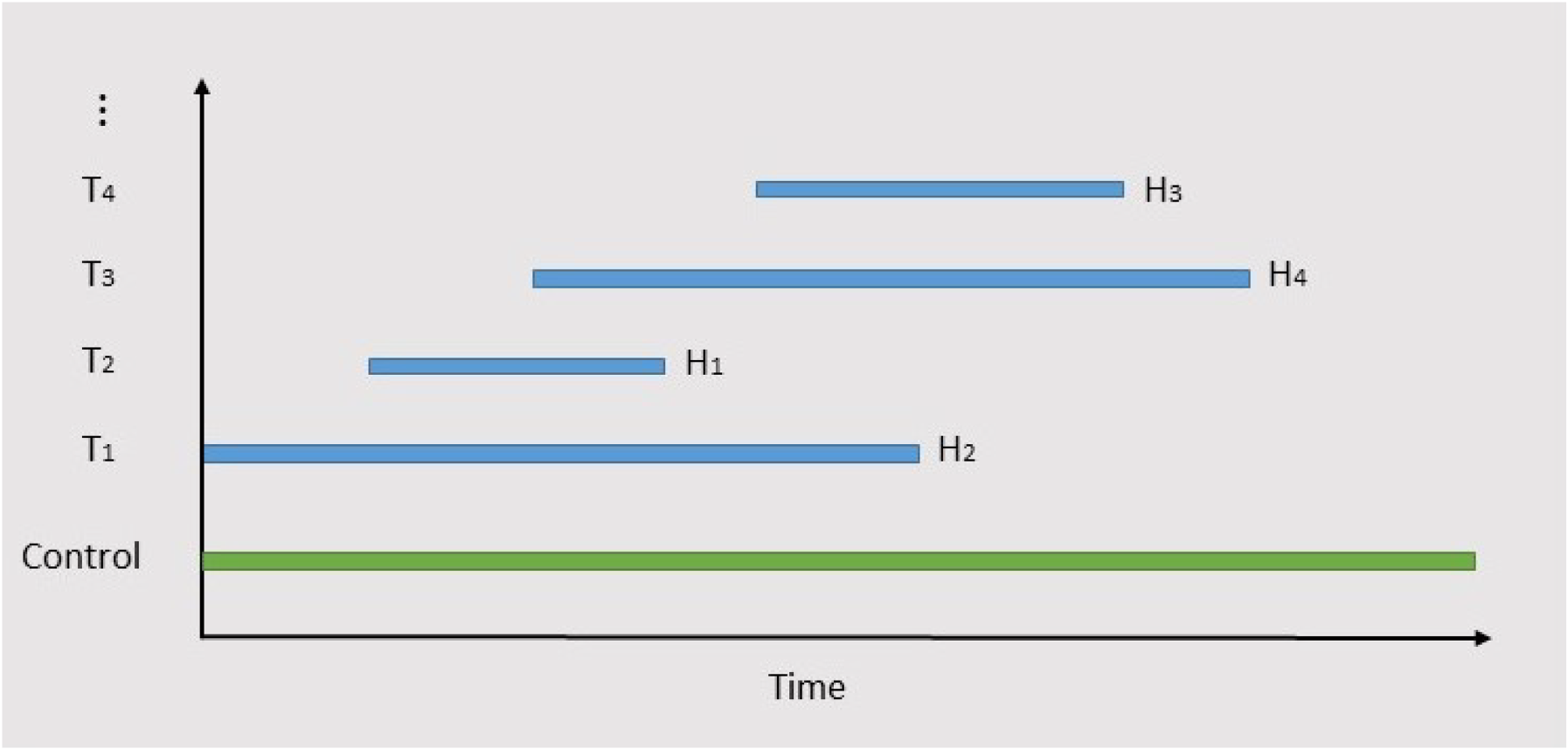
Diagram of a platform trial.
But there are also other reasons why observations corresponding to different hypotheses could be highly dependent. For example, the observations regarding different hypotheses could originate from the same individual, or a hypothesis that was not rejected at first could be tested again using old and new data. Another application that causes dependencies would be public databases, where different independent research groups have access to the same data and perform their own tests and analyses. 10
In the literature so far, the test levels of online procedures depend only on the previous
The remainder of the paper is structured as follows: in Section 2 we introduce the underlying set-up and notation and review some of the already existing methods for online FWER control. The main results are given in Section 3, where we introduce the notion of consistent weights and, building upon this, derive new online procedures for FWER control under dependency. In Section 4 numerical simulations are performed in two different settings to exemplify the theoretical considerations. The results are again summarized and discussed in Section 5. Additional technical proofs, detailed derivations, and further simulation results are provided in the Supplementary Material.
Notation and model set-up
Suppose we want to sequentially test null hypotheses
For an



We begin by reviewing some of the currently existing procedures for online FWER control. The most straightforward method is the so-called Alpha-Spending algorithm.
1
The idea is to simply divide the global error budget among all hypotheses, and thus it can be seen as an online version of the weighted Bonferroni correction in traditional multiple testing. This can be implemented by selecting a non-negative sequence

Tian and Ramdas
7
derived advanced spending algorithms, most notably the powerful ADDIS-Spending procedure, which combines the concepts of adaptivity and discarding. Since we focus in this work on the notion of adaptivity (see also the discussion in Section 5), that is, accounting for the proportion of true null hypotheses, we briefly introduce the so called Adaptive-Spending.
7
For this, let

As a concrete example of such a procedure, they proposed to pick a non-negative sequence

The idea of (2) is to decrease the remaining error budget only when a true null hypothesis has been tested. The use of the candidate indicator, as a surrogate for the indicator of a true alternative, relies on the fact that
Since the test levels in (2) depend directly on the previous

Using the same proof as Tian and Ramdas, 7 it is clear that FWER control is guaranteed when (2) and (4) are fulfilled.
While (4) is always true when the
Let
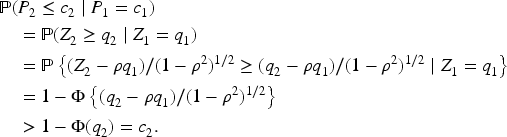
Consistent weights
As discussed in Section 2.2, the main idea of the Adaptive-Spending algorithm is to categorize the
(Consistent weights)
Let

Although not required for FWER control, the weights
Next, we illustrate two methods for obtaining weights that satisfy (5) from observed data.
Assume that, in each step

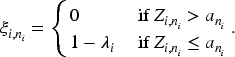
For a more advanced example, we use a resampling technique that is referred to as the low intensity bootstrap. The idea is to resample fewer observations than in the original sample to remedy consistency issues. A commonly given heuristic motivation is that resampling with fewer observations more accurately reflects the relationship between the original sample and the entire population.
17
The specific resampling scheme depends on the form of the data,
We are assuming the same set-up and notation as in Example 3.2. Additionally, consider the bootstrap variables
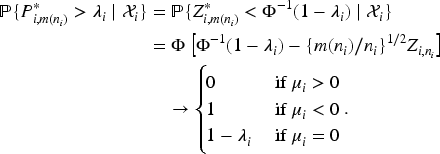
As just demonstrated, it is possible to obtain weights
As mentioned before, besides fulfilling the assumption (5) it is also desirable that
Although both of the mentioned methods lead to consistent weights and therefore are valid choices for the upcoming procedures, we propose to use the bootstrap weights as in Example 3.3, because they rely less strictly on pure asymptotics compared to the thresholding weights in Example 3.2 and thus seem to perform better in practice. In support of this, it can be shown that for certain situations, procedures using bootstrap weights are guaranteed to have error control not just asymptotically, but also for finite sample sizes (see Theorem 3.11).
We now present a general framework for incorporating the notions from the previous section into existing algorithms. Therefore, we assume that random variables
We can now formulate a general rule, very similar to (2), for creating online procedures under dependency: let

The test levels
The null
Assumption 3.5 implies that, due to the definition of consistent weights (5) and the continuous mapping theorem, for every
Let

Let
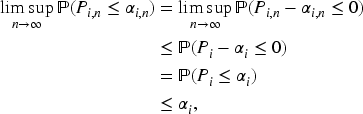
Let
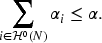
For all

Now, we can combine the previous lemmas to obtain the main result.
Let

This is a direct conclusion of Lemma 3.8 and Lemma 3.9 plus the fact that
We conclude this section with a finite sample size result for the case of independent test statistics.
Let
In the following, we give a few examples of concrete implementations of online procedures that assure (6) and thus, according to Theorem 3.10, control the FWER.
For an easy implementation of an online procedure, we choose the test levels as



For a more advanced example, we first briefly review the ADDIS-Graph that was proposed by Fischer et al.
9
for independent or locally dependent


In Section 3.2, we established the general rule (6) that can be used to produce asymptotically valid online test procedures. While this condition is sufficient, there are also other ways to design asymptotically valid online test procedures that do not necessarily fulfill (6). To exemplify this, we now provide an example of a class of online test procedures that can be seen as a natural adaptation of the Adaptive-Spending algorithm (3).
For a given

This allocation rule states that, in each step, we lose a bit of wealth determined by the fractions
Before we prove error control, we state the following lemma, which takes on a similar role as Lemma 3.9 in Section 3.2.
Let
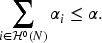
Now, we can state the main theorem for formal error control.
Let

Since the test levels are continuous transformations of the consistent weights, we can apply Lemma 3.8 to obtain

To conclude this section, we give a concrete example of an online procedure according to the continuous-spending approach (10).
Let


One of the most important concepts for control of the FWER in the classical offline framework is the closure principle.
21
Here, every intersection hypothesis is tested with a local test, and the resulting multiple test rejects an elementary hypothesis
Let


It is apparent that both of these closed procedures are uniform improvements of the original ones, respectively.
General set-up
To investigate the theoretical results for a finite sample size, we perform a simulation study. Here, we consider two different settings. The first one is a general scenario, where test statistics that are close in time are strongly correlated (e.g. due to data reuse), and those which are further apart from each other have a low or close to zero correlation. The second set-up is more specific and mimics the scenario of a platform trial, where different treatment arms enter the trial at different time points and are tested against a shared control group.
In both settings, we explore the closed versions of the proposed continuous Adaptive-Graph (13) and the continuous adaptive-spending approach (14) (in this section referred to as Continuous-Graph and Continuous-Spending, respectively), as well as the Online-Fallback procedure,
7
that grants FWER control regardless of the dependency structure, for comparison. Furthermore, we include the original Adaptive-Spending (3), for which no online FWER control is guaranteed in these scenarios, to evaluate the impact on the power caused by the adjustments for dependency. In all of the following simulations, we choose
Autocorrelation
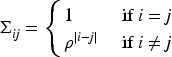
We test in a Gaussian setting
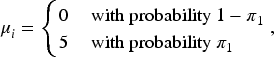
It can be seen in Figure 2 that the Continuous-Spending, Continuous-Graph, and Online-Fallback seem to control the FWER at the nominal level
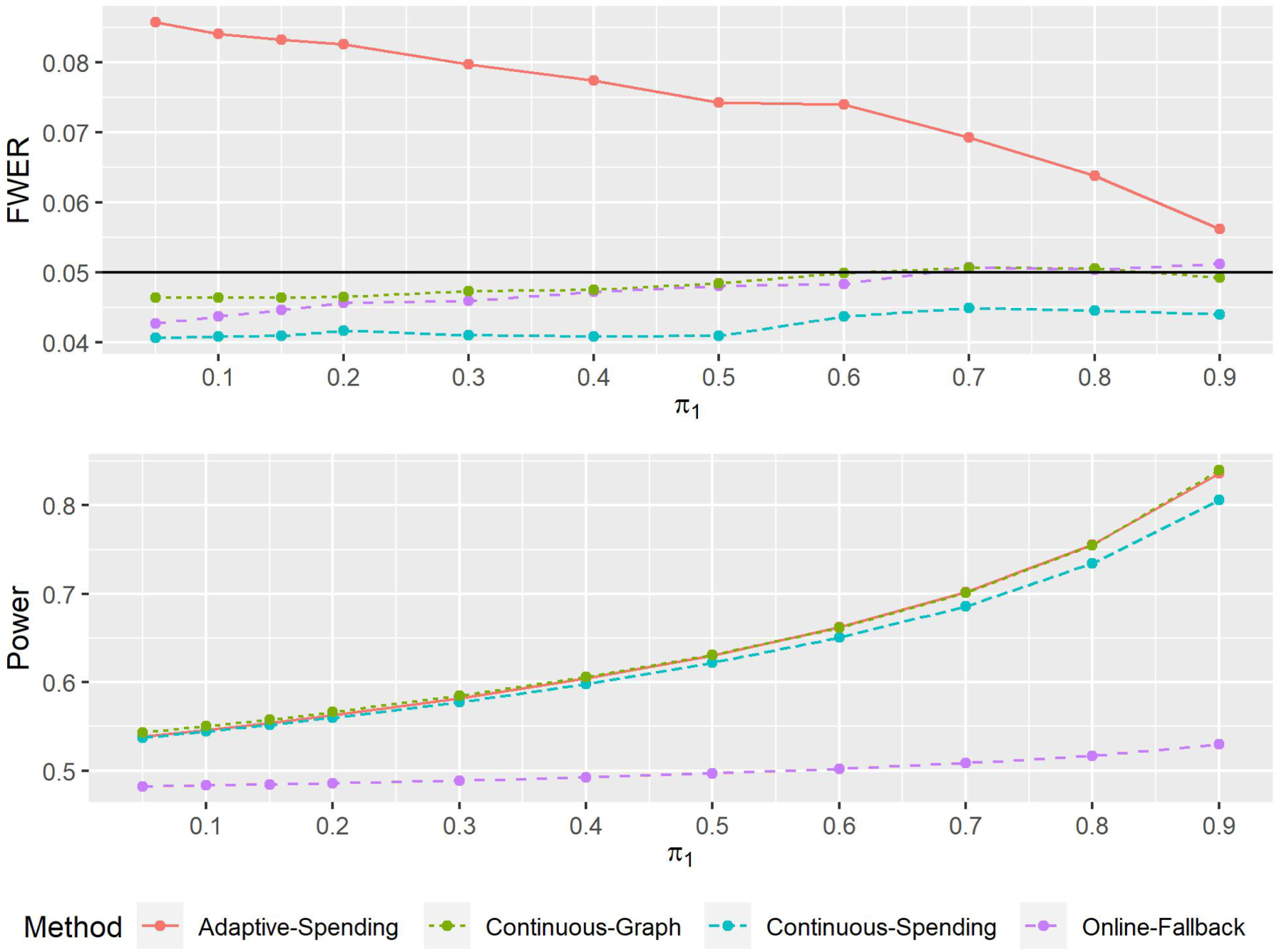
Estimated FWER and power in an autocorrelation set-up with
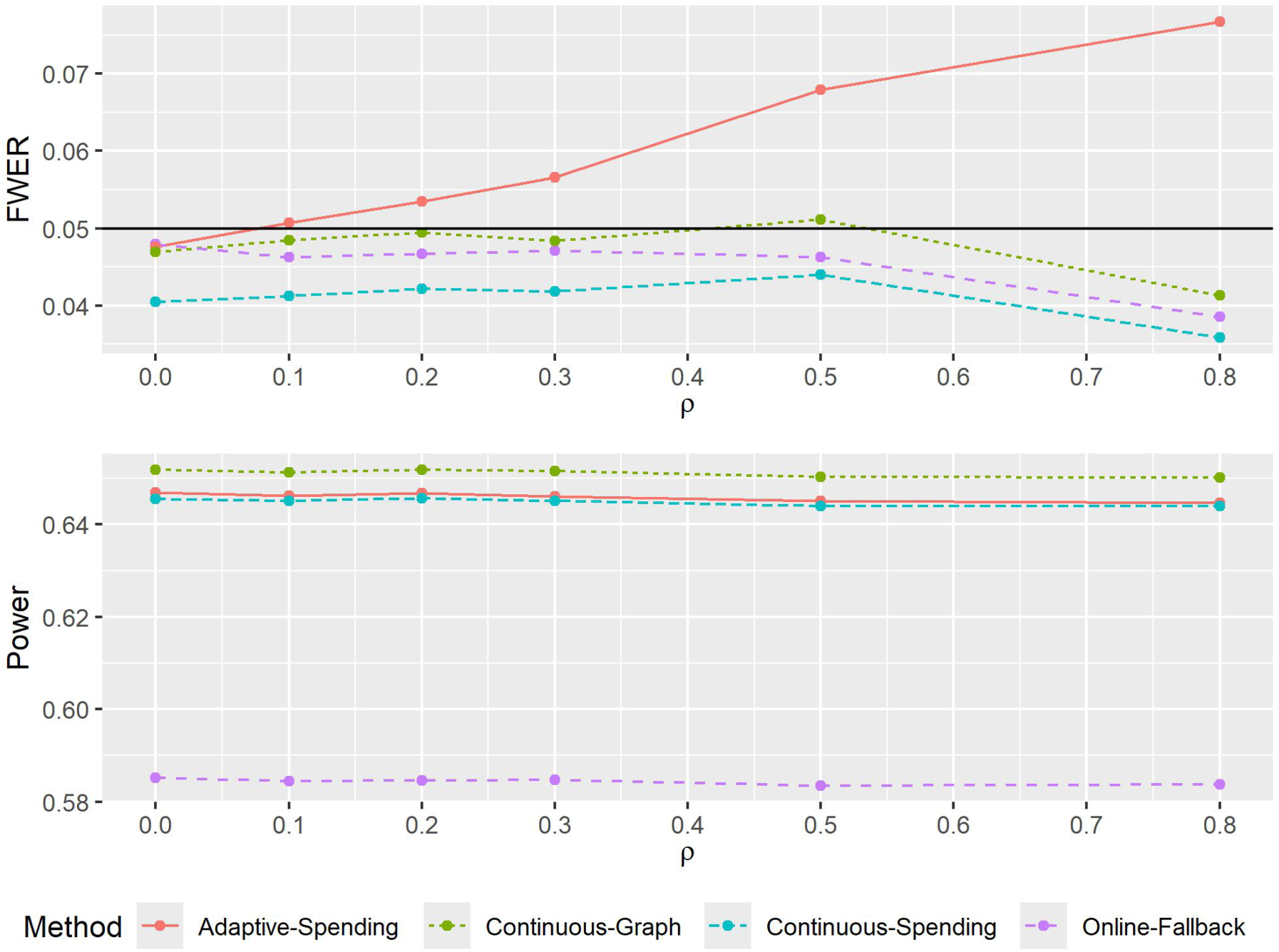
Estimated FWER and power in an autocorrelation set-up with
Estimated FWER and power in an autocorrelation set-up with
We follow the set-up described by Robertson et al.
6
Let

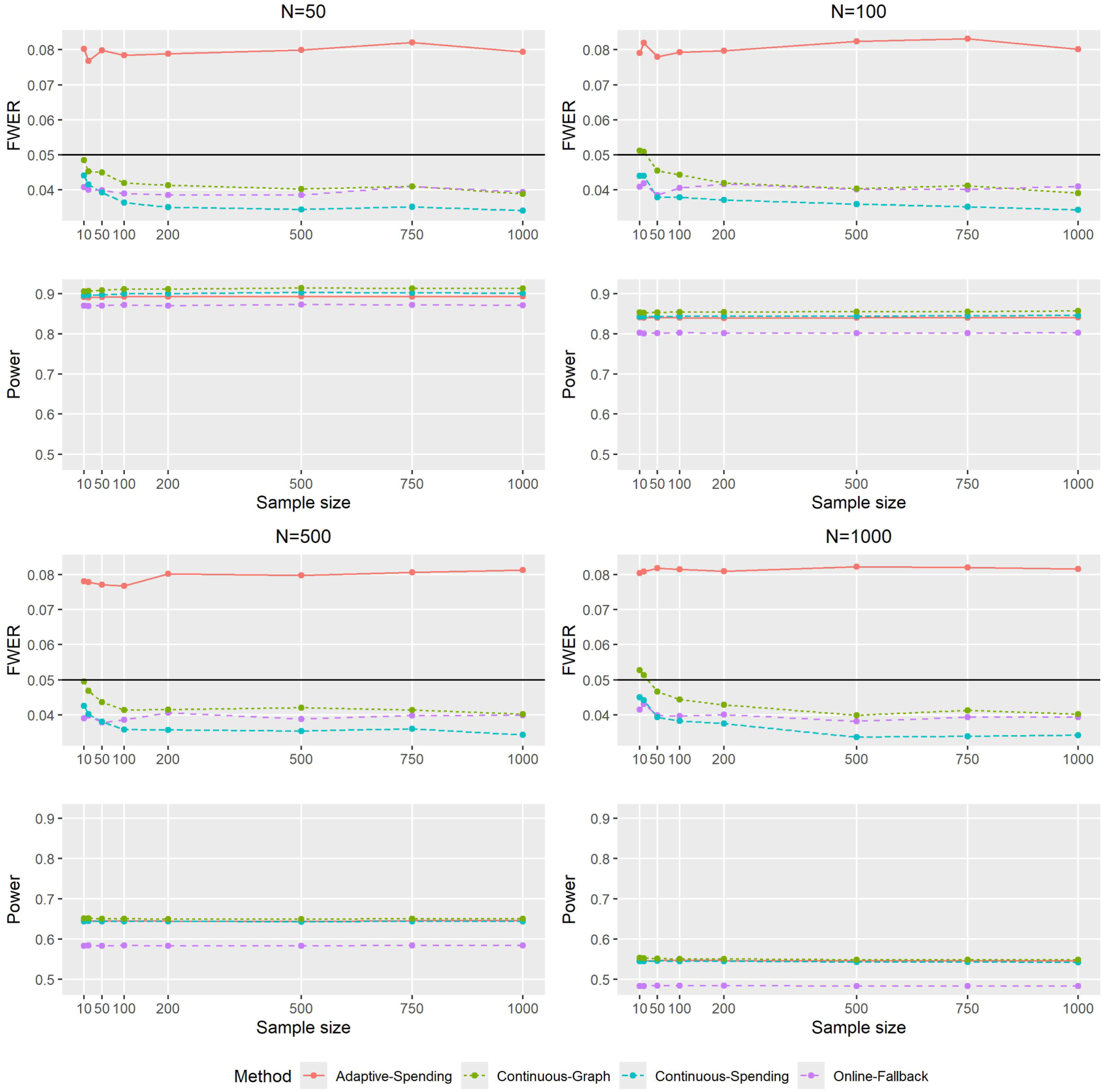
As can be seen in Figure 5, all procedures besides Adaptive-Spending control the FWER. The latter exhibits moderate error inflation, when
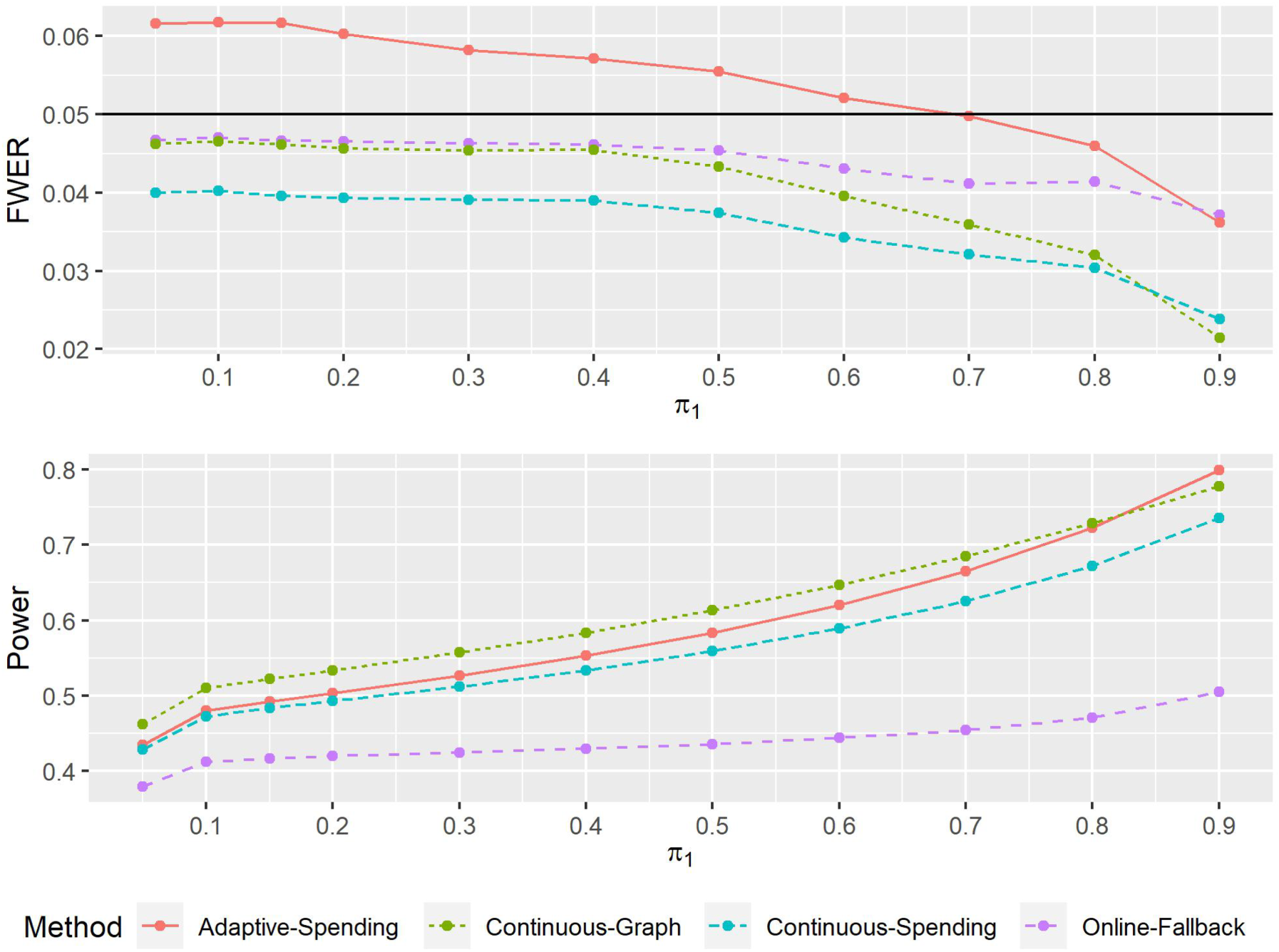
Estimated FWER and power in a platform trial scenario with
Existing advanced online multiple testing procedures only guarantee FWER control under the assumption of either independent or, at most, locally dependent
While our simulations indicate that the Continuous-Graph method generally maintains the FWER close to the nominal level and offers higher statistical power than the other evaluated methods, its performance may vary under different data-generating processes or testing scenarios. Rather than advocating for its universal application across all study designs, we recommend that researchers conduct tailored simulation studies to assess each method’s suitability for their specific context, including calibrating relevant hyperparameters. We hope that the provided source code will support such evaluations.
It is worth noting that all of the proposed procedures, except for the closed procedures in Section 3.5, effectively control the expected number of false rejections. So they can as well be used to obtain control of the
One current shortcoming is that, although the most powerful procedures developed for the case of independent (or locally dependent)
Another task for the future would be the extension to more general test set-ups, as only one-sided 1-sample and 2-sample hypothesis tests have been considered in this work. Similar resampling schemes can probably be used to obtain consistent weights in different situations, such as regression models. Moreover, although the proposed approach can, in principle, be applied to various data distributions, we only provide examples for constructing consistent weights specifically for normally distributed data. While this may be adequate in practice for large sample sizes, where the normal approximation is reasonable, alternative strategies for weight construction may be required in settings with heavily skewed or non-normal data.
In addition, there is still interest in developing more efficient methods for testing an initially unknown but finite number of hypotheses. Improvements could be expected here if the design of the procedures takes into account that ultimately, only finitely many hypotheses are tested.
Supplemental Material
sj-pdf-1-smm-10.1177_09622802261461776 - Supplemental material for Asymptotic online FWER control for dependent test statistics
Supplemental material, sj-pdf-1-smm-10.1177_09622802261461776 for Asymptotic online FWER control for dependent test statistics by Vincent Jankovic, Lasse Fischer and Werner Brannath in Statistical Methods in Medical Research
Supplemental Material
sj-zip-2-smm-10.1177_09622802261461776 - Supplemental material for Asymptotic online FWER control for dependent test statistics
Supplemental material, sj-zip-2-smm-10.1177_09622802261461776 for Asymptotic online FWER control for dependent test statistics by Vincent Jankovic, Lasse Fischer and Werner Brannath in Statistical Methods in Medical Research
Footnotes

Ethical considerations
Not applicable.
Consent to participate
Not applicable.
Consent for publication
Not applicable.
Funding
The authors disclosed receipt of the following financial support for the research, authorship, and/or publication of this article: Lasse Fischer acknowledges funding by the Deutsche Forschungsgemeinschaft (DFG, German Research Foundation) (Project number 281474342/GRK2224/2).
Declaration of conflicting interest
The authors have no conflicting interests to declare with respect to the research, authorship, and/or publication of this article.
Data availability
Not applicable.
Supplementary material
Supplemental material for this article is available online.
References
Supplementary Material
Please find the following supplemental material available below.
For Open Access articles published under a Creative Commons License, all supplemental material carries the same license as the article it is associated with.
For non-Open Access articles published, all supplemental material carries a non-exclusive license, and permission requests for re-use of supplemental material or any part of supplemental material shall be sent directly to the copyright owner as specified in the copyright notice associated with the article.
