







Abstract
Multi-scalar strategies, upscaling local degrowth initiatives, and rescaling are considered necessary for transforming towards degrowth. With burgeoning research on spatiality and scales in the degrowth literature, it becomes pertinent to reflect on the ontological foundations underlying the concept of scale and to strengthen some common ground for approaches to scales for the degrowth agenda. Being informed by the critical realist ontology, this paper aims to lay an ontological underpinning for degrowth scalar approaches, situated within the planning context. The argument starts with an ontological inquiry of ‘what is scale’. With an understanding of spatial scales as social structures, the argument moves to explicate ‘how does scale matter for degrowth initiatives’. This explication conceptualises five dimensions relevant to the degrowth agenda: scalarising degrowth values and norms, scalar mechanisms, scalar strategies, cross-scale impacts and rescaling. The conceptual framework is then further illustrated by exploring multi-scalar strategies for degrowth housing development and planning, partly contextualised by the case of Oslo City. Finally, the paper concludes with suggestions on ‘how can degrowth research and movements better integrate the question of scale’. Explanatory, critical, relational and holistic approaches are proposed as ways of taking spatial scales into account as an integral part of degrowth transformation.
Introduction
Despite different streams of disciplinary and activist imaginations of, and approaches to degrowth (Kallis et al., 2018; Sekulova et al., 2013), some shared norms and values can be seen as being fundamental. The acknowledgement of a finite planet lays the foundation of the argument for selective downscaling of production and consumption, and advocates sufficiency as an organising principle of human society, in order to deal with human ecological overshooting (Hickel, 2020; Schneider et al., 2010). Degrowth holds a strong ethical premise of justice, which is at the same time, anti-anthropocentric, intra- and inter-generational (Martínez-Alier, 2012; Muraca, 2012). Satisfying basic needs for all, and achieving a more equal society in terms of wealth and living conditions, is the manifestation of justice. Within planetary boundaries, degrowth advocates the achievement of justice through redistribution (Gabriel and Bond, 2019; Kallis, 2011). Degrowth confronts the meaning of a ‘good life’, as defined in a materialistic way. Instead, it promotes a non-materialistic quality of life by maintaining minimally sufficient material living standards, in exchange for more time and freedom to pursue non-materialistic sources of meaning (Muraca, 2012; Rosa and Henning, 2018). Moving away from economic growth as the goal, degrowth proposes improvement of the quality of life as the ultimate pursuit. Moreover, the increase of democracy is viewed as being both a moral imperative, and a necessity in the transformation towards degrowth (Asara et al., 2013).
These degrowth norms and values have a strong spatial dimension and relate particularly to the question of scale. Since re-emergence of the degrowth movement during the turbulent global period in 2008, the spatial dimension has gradually been raised and debated – especially by scholars with a background in urban studies, geography and planning. The early celebration of ‘localism’ and booming research studies that primarily focused on local degrowth practices (Latouche, 2009; Trainer, 2010; Rees, 2015) have been subject to questioning and criticism (Krähmer, 2022; Xue, 2014). Local degrowth-oriented practices–such as co-housing, urban farming, off-grid energy projects and eco-villages – suggest not only an image of localised socio-spatial organisation but also an ideal political order characterised by decentralised power distribution, direct democracy, community-based decision-making and even anarchist thinking (Mocca, 2020; Xue, 2014; Widmer and Schneider, 2018). Criticisms of localism warned against the ‘local trap’ which tends to perceive the local scale as being inherently good, equating it with desirable outcomes (Purcell, 2006). A call for multi-scalar strategies has been forwarded by many scholars (Kallis and March, 2018; Krähmer, 2022; Xue and Kębłowski, 2022).
In recent years, an exploration of the spatiality of degrowth (beyond local experiments and practices) has proliferated (De Castro Mazarro et al., 2023; Kaika et al., 2023; Savini, 2021, 2024b; Xue, 2022b). Most of these studies focus on urban, or urban–regional scales (Varvarousis et al., 2024). For example, Savini (2021) proposes a spatial imaginary of a ‘region’ as a polycentric federation of autonomous settlements. In a discussion of the implications of degrowth for planning practices, Xue (2022b) suggests urban regional planning strategies that can facilitate degrowth transformation. De Castro Mazarro et al. (2023) take a scalar approach to operationalising degrowth into spatial practices at building, neighbourhood and city scales. Some scholars have started to engage with the question of upscaling localised degrowth practices (Otchere-Darko, 2023; Kaika et al., 2023). Kallis and March (2018) introduce the notion of rescaling to the degrowth debate – that is, the process of reconfiguring relations among and across scales and producing new scales of action. Other scholars have proposed a relational approach to spatialising degrowth and spatial politics under the overarching principle of a ‘multi-scalar strategy’ (Krähmer, 2022; Varvarousis et al., 2024).
It can be argued that the diverse attitudes to the scale issue in the exploration of degrowth reflect different ontological understandings of scale, which are made only implicitly in current discussions. Even though the notion of a multi-scalar strategy has become mainstreamed in degrowth, some questions remain elusive and under-studied – such as how degrowth is embedded spatially on different scales, how scales are formed and constitute and produce power relations, and how multi-scalar strategies can function coherently. Different ontological propositions on scale will have profound implications for how these questions may be answered. As Buch-Hansen and Nesterova (2021: 2) argue, ‘ontological and epistemological assumptions deeply impact the knowledge that can be produced to support the change that degrowth scholarship aims to understand and the degrowth movement aims to enact/achieve’. For instance, some criticisms of localism have referred to a socially constructed ontology of scale as being nothing inherent (Purcell and Brown, 2005), while other studies that operationalise spatial practices for degrowth perceive scale primarily as a nested hierarchy of spaces with differentiated geographical sizes (e.g. De Castro Mazarro et al., 2023; Krähmer, 2018; Xue, 2022b).
In human geography, scale has been intensely debated and theorised, spawning diverse and even contradictory notions of the attributes of scales, and elements of scale politics. The earlier dominant empiricist perception of scale as being a rigid, fixed, and nested hierarchy of differentially sized and bounded spaces was heavily challenged by a social constructivist perspective that emerged in the 1980s. Nowadays, although scale is viewed largely as a social construction that is non-fixed, fluid and contingent, a noticeable span of divergence can still be found under this broad agreement (Moore, 2008). Generally, two main strands can be identified, concerning the social construction of scale. First, the political-economic approach views scales as material socio-spatial entities, produced by wider social, economic and political processes (MacKinnon, 2011; Smith, 2012; Swyngedouw, 1997). As Purcell and Brown (2005) describe it, ‘there is nothing inherent about any scale or scalar arrangement’ (279). Second, on the idealist extreme, the post-structural approach considers scale as being a purely epistemological construct, without ontological existence (MacKinnon, 2011; Moore, 2008). This approach criticises the political-economic approach for overly stressing vertical relations between bounded territories, and instead, proposes a flat ontology of scale that addresses the horizontal interconnections between actors and social processes (Marston et al., 2005). This viewpoint has even rendered the concept of scale unnecessary.
An elaborated review of the literature on the ontology of scale in human geography is beyond the scope of this paper and can be consulted elsewhere (e.g. MacKinnon, 2011; Moore, 2008). This paper focuses on an ontology of scale based on the critical realist philosophy. According to MacKinnon (2011), a critical realist position synthesises the two above-mentioned ontological strands (the political-economic and post-structural approaches) and combines ‘an ontological sense of scale as a set of material relations with an interest in the epistemological construction of scale through particular social representations and discourses’ (23). Enquiring into the nature of scale has the purpose of consolidating an ontological underpinning for the engagement of degrowth approaches with scale issues. As the rest of the paper will demonstrate, degrowth multi-scaler strategies – and initiatives for upscaling and rescaling – will benefit from such a systematic ontological clarification and consolidation.
In this paper, I explore the following three questions: (1) What is scale? (2) How does scale matter for degrowth initiatives? and (3) How can degrowth research and movements better integrate the question of scale? The exploration is situated in the planning context, where both the spatial and the political are central, and the practices in this context are often framed within an existing, hierarchical institutional order. The debates on scale often focus on the political dimension where political processes and power engaging with different scales are the centre of analysis. With discretion, I use the term ‘spatial scale’ interchangeably with ‘scale’, with the intention of highlighting the implicated spatial component. The ‘spatial’ embraces the physical, built environment characteristics, such as area size, topography, building density, land use types and structure, and transportation infrastructure. The arguments are built up as follows. First, I start by presenting a critical realist ontology of scale, responding to the first question (see section ‘A critical realist ontology of scale’). Then, I move on to conceptualise scale in the degrowth context in a systematic way, by elucidating how scale relates to values and norms, mechanisms, strategies and impacts in that context (see section ‘Conceptualising spatial scales for the degrowth agenda’). The conceptual framework is then further illustrated by exploring multi-scalar strategies for degrowth housing development and planning, partly contextualised by the case of Oslo city (see section ‘Grounding a multi-scalar strategy for degrowth housing development and planning’). Sections ‘Conceptualising spatial scales for the degrowth agenda’ and’ Grounding a multi-scalar strategy for degrowth housing development and planning’ illuminate the second question of how scale matters for degrowth initiatives. In the last section which addresses the third question, I summarise how a critical realist ontological underpinning of scale can benefit degrowth transformation, and propose some principal approaches for degrowth movements and research, to engage and integrate the question of scale.
A critical realist ontology of scale
Abandoning scale as an analytical category and reducing it to pure epistemology – as proposed by the post-structuralist approach (Marston et al., 2005), offers neither practical meaning nor analytical advantage when scales are dealt with in the planning context. Existing planning practices are situated in an institutionalised hierarchical system with differentiated geographical areas, actors and accountability. As a profession and discipline, planning contains both political and spatial dimensions. Spatial elements (such as physical structures, land use, infrastructure) and built environment features which are often considered as the ‘substance’ of planning, are central to the field (Næss, 2015b). Geographical scales are an essential part of the spatial structure. While debates on the ontology of scale in human geography have been preoccupied predominantly with the political dimension by addressing the ‘politics of scale’, the spatial component is not sufficiently addressed. In relating the exploration of scales in the context of degrowth to spatial planning, it is necessary to combine the ‘spatiality of scale’ and the ‘politics of scale’.
Critical realism is a school of thought committed to ontological realism, which believes in the existence of external, mind-independent reality (Bhaskar and Hartwig, 2016). This ontology holds that reality is deep, open, emergent and causally efficacious (Buch-Hansen and Nielsen, 2020). MacKinnon (2011) proposes a critical realist position on scale, thus combining the political-economic and post-structuralist approaches. Within the planning context, Næss (2015a, 2015b) discusses critical realist presuppositions on causal relations between spatial structures, societal conditions and the actions of agents, which makes planning possible and meaningful. Being inspired by those scholars, I expand the critical realist ontology of scale by particularly incorporating and highlighting the spatial component. I contend that spatial scales are real, causally efficacious, contingent, differentiated, and emergent.
According to critical realist ontology, spatial scales are real and have an ontological existence. They are real material entities, comprising both objects and processes (Sayer, 1985). In spatial terms – regarding buildings, neighbourhoods, or city scales – the material objects constituting scale include an identified geographical size, and elements of the built environment (e.g. density, links, nodes, land use types, infrastructure), as well as the relations between them. Admittedly, establishing scales and scalar structures (such as ‘the regional’ or ‘the global’) is itself a social construction process, produced by wider processes, driving forces and social relations (Brenner, 2001), and mediated by concepts and language. However, once scales are established, they bind social, political and spatial identities. They exist independently of individual actors’ conceptions of them, and function as a single type of social structure.
As a social structure, established spatial scales and scalar structures have causal power and are causally efficacious. Critical realism considers structure and agency as an analytical dualism, each being ontologically distinctive with its own causal power, but dialectically related to each other (Archer, 1995). Spatial scales with an established composition of objects and material relations are a precursor to any emergent social activity, and shape forthcoming social processes and actions in certain ways (MacKinnon, 2011). For example, spatial arrangements as polycentric or monocentric structures at an urban regional scale will have strong implications for how people commute to their workplaces (e.g. choice of model split, travel distance) (Næss et al., 2019; Wolday et al., 2019). Institutionalised planning systems and established power relations between local, regional and national planning authorities influence how different land-use issues are dealt with and how they play out. Although established scalar structures are subject to change through social processes and the actions of agents, they are relatively stable geographically and temporarily, and can have long-lasting impacts, thus forming periodic ‘scalar fixes’ that bind socio-economic and political activities (Brenner, 2001: 605).
Following the analytical dualism described above, although social structures condition actions in an objective way, they are created, reproduced and transformed by the actions of agents, and are thus prone to change. Therefore, spatial scalar structures are never fixed, but instead, are changeable, fluid and subject to reconstruction and rescaling.
From the critical realist position, being causally efficacious can be seen only in terms of having a tendency and liability. This is because many causal mechanisms are concurrently active in an open system, where some reinforce each other and others counteract each other (Danermark et al., 2019). The outcome is therefore a complex, compound effect of different mechanisms at play. The implication is that the scalar effects of political projects and spatial strategies are contingent, depending on circumstances and the composition of relevant mechanisms. For instance, a regional land-use plan that designates protected natural areas for the region will possess the causal power to hinder construction within those areas. However, the effects are also dependent on many other factors, such as the legal status of the regional plan, local political willingness to follow the regional plan, etc. MacKinnon (2011) argues that rather than having scale per se as the prime focus, attention should shift to the scalar repercussions of particular political and social initiatives, as these often aim to exert influence or control over particular areas of social activity.
According to the critical realism standpoint, reality is differentiated, as they possess distinct causal powers. Established spatial scales are layered with differentiated levels of causal power. Each spatial scale – such as the building scale or the urban regional scale–has its own properties, causal mechanisms and tendencies, which are non-identical. The scalar uniqueness of causal effectiveness is visible mostly in terms of spatial mechanisms (Næss, 2015a). Scalar spatial mechanisms can influence and shape actions in quite different ways, and thus generate different impacts on society, the environment, and the economy. Individual residential buildings – by their internal and external design such as size, layout and technical standards – can accommodate different needs and demands regarding dwelling purposes, but they alone can rarely influence whether people will choose to travel by train or car. That choice is highly affected by the location of the dwellings relative to workplaces and city centres, road infrastructure and the availability of trains – namely the urban-scale spatial structural forms. The same built environment feature on different spatial scales can generate different effects, as a result of distinct and efficacious spatial properties. For example, a densely built neighbourhood area generally has very moderate influences on reducing travel distances and energy use for transportation, when other spatial structure factors are controlled, whereas a high density at the urban scale exerts significant impacts on those travel behaviours (Næss, 2012).
In the planning context, differentiated scalar causal power also lies in the established hierarchical planning system, shaping power relations and allocation of responsibilities. For example, planning regulations can empower the national planning authority to arbitrate if a local planning proposal is in dispute with the regional planning authority. This is a causal property that is entrenched in the national planning authority, even though this power relation may be redefined through modifying legal framework. Likewise, regional and local planning authorities are equipped with distinct planning powers and responsibilities, different from that at the national level.
Hierarchically layered into distinct scales, each spatial scale has emergent properties. The higher stratum builds upon the lower stratum but possesses emergent powers that cannot be reduced to the mechanisms of the lower ones (Buch-Hansen and Nielsen, 2020). This emphasises the vertical and hierarchical links between bounded geographies. For example, big cities and local holiday home destinations comprise larger geographical recreational regions, that generate new mobility patterns and urban-rural social and economic dynamics (Arnesen et al., 2012). Although the piecemeal loss of natural land at the local level may have non-significant environmental impacts locally, it can lead to the emergence of severe degradation of ecosystems when the aggregated effects are taken into account at the bioregional level. MacKinnon (2011) notes that ‘scales are created from the interactions between actors and organisations, but once established, are irreducible to those actors and organizations’ (31–32). The higher strata with causal powers can also cause reactions on the lower strata. For example, national land-use principles (such as development around transportation nodes) will influence the possibilities of land take, development activities and land-use patterns at the local level. A local housing crisis could be the compound result of the national housing policy and movement in global capital investments.
To summarise, as a social structure, spatial scales are hierarchically and relationally layered, each having distinctive causal mechanisms and emergent properties, and are subject to reshaping.
Conceptualising spatial scales for the degrowth agenda
This critical realist ontological exploration of spatial scales is theoretically and practically illuminating, especially when interpreting and practising multi-scalar strategies and scalar transformations for the degrowth agenda. As alluded to in the introduction of this paper, the concept of degrowth can be summarised in terms of four core values and norms: (1) an imperative for reduction in production and consumption, based on an acknowledgement of a finite planet; (2) justice across space, time and species, through reduction and redistribution, based on ethical principles of basic needs satisfaction and equity; (3) non-materialistic quality of life and wellbeing as the ultimate pursuit; and (4) a democratic pathway to achieving degrowth goals. Any conceptualisation of spatial scales needs to relate to these normative degrowth propositions. As visualised in Figure 1, the proposed conceptual framework consists of five dimensions: scalarising degrowth values, scalar mechanisms, scalar strategies, cross-scale impacts and rescaling. In the discussion that follows, I use this conceptualisation to unpack how spatial scales matter in terms of the degrowth agenda.
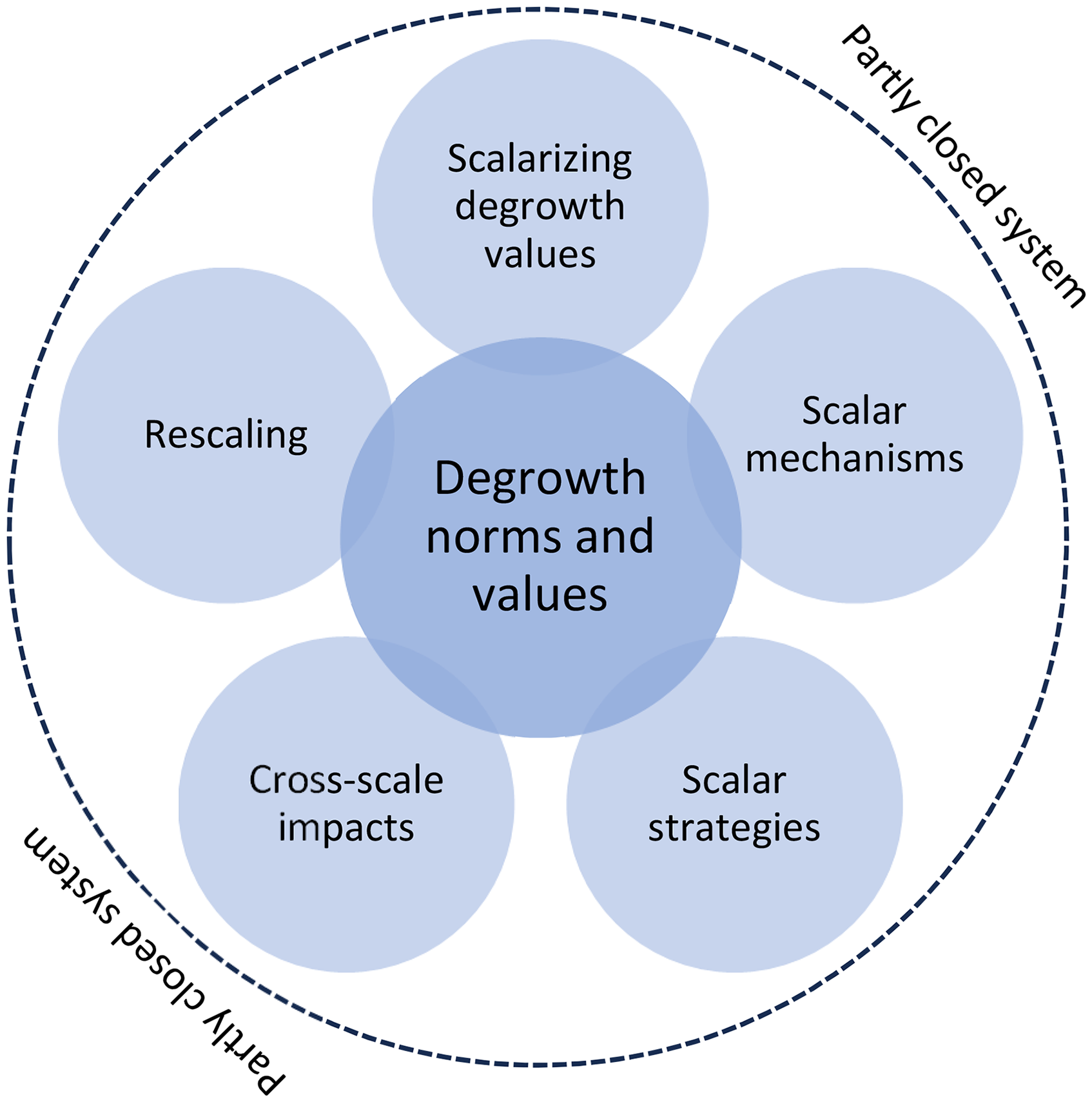
Conceptualising spatial scales in degrowth agenda.
Degrowth values and norms need to be scalarized in order to form meanings, goals and principles on different scales. Consistency and reconciliation of various degrowth initiative will not necessarily or automatically be achieved without conscious engagement with the question of scales. For example, building a new collective housing project that shares the degrowth values – such as reducing materials and energy throughput, using local sustainable materials, and developing commoning practices – may come into conflict with realising degrowth on the urban scale, where the existence of empty dwellings would suggest reuse as the prioritised measure. Many emergent, innovative social and political degrowth initiatives do not themselves focus on spatial scales but inevitably embrace scalar dimensions and generate scalar repercussions. It is necessary to evaluate whether these initiatives that apply degrowth values reinforce or contradict each other across scales. In other words, realising degrowth values can mean different prioritisations on different scales. Another example is a policy to gradually downscale fossil fuels, which would influence local societies differently. For those local societies where livelihoods are dependent on exploiting and producing fossil fuels, a degrowth-oriented policy would need to prioritise reducing the unproportionally heavy burden that would fall on those who would lose their jobs and source of income.
The realisation of the degrowth agenda requires various transformative forces, including those that are spatial, social, economic and political (Buch-Hansen and Nesterova, 2023), all of which embed a scalar dimension. As spatial scales are causally efficacious, scalar mechanisms are involved. On one hand, understanding existing scalar mechanisms that sustain growth-oriented, unjust and unsustainable practices and power relations (and thus hinder degrowth mobilisation initiatives) will contribute to the eradication of those mechanisms. For instance, it is helpful to understand that established power relations between hierarchical planning authorities may favour or hinder certain types of degrowth-oriented practices (Ruiz-Alejos and Prats, 2022; Mete, 2022). Similarly, a national legal framework may constitute a barrier to local degrowth innovations (Xue, 2022a). On the other hand, recognising scalar mechanisms as possessing different causal powers will help to nurture and strengthen actions towards degrowth. Pathways of influence will differ when actions take place on different scales. For example, Savini (2024a) argues for degrowth regionalism that could possibly synthesise different local degrowth movements and practices, and provide essential services to facilitate those movements. Arguably, it is on the regional scale that the possibilities of connecting different localities with a strategic vision, providing common goods, and avoiding exclusionary tendencies can best be realised (Savini, 2024a; Xue, 2022a). The degrowth agenda would certainly benefit from activating a combination of different scalar mechanisms.
This brings us to the dimension of scalar strategies for degrowth, where scalar structures can be created and mechanisms triggered to achieve desired effects. In order to prevent a reductionist approach to degrowth strategies, it is necessary to take seriously the nature of spatial scales as being non-identical and possessing differentiated causal power. Averting a reductionist degrowth strategy does not only apply to the prevalent ‘local trap’, but also to any scalar trap that draws primarily on one particular scale. Degrowth strategies need to optimise the advantages and potentials that lie on each scale, as well as across scales. Further, coherence is vital for multi-scalar strategies, as strategies targeted and implemented on one scale do not always conform with those on other scales. Thus, it is essential to build up synergies between scalar strategies working in concert with each other. This can range from bottom-up, small-scale experiments, to national policy-transforming structures, and even initiatives that could influence global discourse and policies.
As spatial scales are relational and emergent, it is crucial that policies and measures on one scale take into account intended or unintended effects on other scales. For example, the international policy for conserving 30% of the world's land, freshwater and seas by 2030 (UN, 2022) can generate uneven local impacts, with more consequences for those localities with important biodiversity and ecosystem functions. In particular, frameworks for local land use will be significantly changed, which could have economic and social impacts for local societies. Furthermore, desirable outcomes on one scale do not necessarily result in desirable outcomes on another. Neighbourhood urban agriculture projects may come into conflict with a compact city strategy for the entire city. Similarly, small-scale practices – such as prioritising the use of local materials in building construction in a local housing project in a European city – can generate negative and positive impacts on the livelihoods of Indigenous people in Latin America working in mining for exportation. These cross-scale impacts are emergent and contingent and also have implications for degrowth movements that aim to upscale small-scale, local practices. For example, eco-villages may contribute to lower resource use, self-sufficiency, or better quality of life in certain local circumstances, but upscaling these practices to a large scale as an ideal human settlement pattern could lead to unintended environmental consequences (Xue, 2014). Therefore, upscaling initiatives need to consider possible unexpected negative consequences of emergent power. Moreover, emergence and contingency may be accountable for the pitfalls, failures and risks associated with upscaling initiatives. The process of upscaling in the context of a variety of social structures and mechanisms can lead to co-option where the transformative edge of innovative initiatives is removed.
Established scalar structures, especially where scalar fix prevails (Brenner, 2001), can function as obstacles to degrowth, yet they are changeable. Since degrowth transformation entails changes to many social structures, scalar transformation in the form of rescaling is required in order to create favourable conditions. Rescaling implies restructuring and reconfiguring social, economic and political relations among and across scales, obliterating obstructive scalar relations, and creating new scalar arrangements in accordance with the degrowth agenda. Degrowth-oriented practices can be viewed as emerging forms of new scalar relations that challenge existing ones. However, the extent to which old scalar structures may be challenged by new ones is an empirical question (MacKinnon, 2011). Regarding the degrowth agenda, scalar transformation needs to consider specific geographical and temporal contexts.
It is necessary to note that scalar mechanisms, strategies and transformations exist and take place in partly closed system. This makes possible the ‘qualitative and crude predictions of aggregate level effects’ resulting from certain scalar strategies (Næss, 2004: 157). Notwithstanding, unlike in a completely closed system, the manifestation and outcomes of scalar mechanisms are also contingent on interplay of many conditions. Being aware of these conditions will help to avoid deterministic approaches which believe that certain scalar strategies will inevitably lead to certain outcomes.
Grounding a multi-scalar strategy for degrowth housing development and planning
In this section, I take degrowth housing development and planning as an example to illustrate the potential of a multi-scalar strategy grounded in the critical realist approach to scales. Part of the discussion is contextualised within the city of Oslo. This example is not designed to offer original research on degrowth housing and planning in the city. Rather, the purpose is to illustrate a systematic approach to incorporating spatial scales in degrowth policies, movements and research. Degrowth housing development and planning is a widely discussed subject in the degrowth literature (e.g. Nelson and Schneider, 2018), with topics ranging from individual residential buildings (Anson, 2018; Stefánsdóttir and Xue, 2018), through various forms of local housing projects (Cucca and Friesenecker, 2022; Lietaert, 2010; Savini, 2023), urban housing policies (Martínez Alonso, 2022; Mete, 2022), to national policy making and legislation and globalisation of capital for real estate speculation (Schneider, 2018). Based on these studies, the scalar approach I advocate aims to engender more coherent and holistic thinking regarding housing policies and planning for degrowth, which will consolidate and combine scalar strategies. As the topic of housing and planning is highly dependent on contexts, what is presented below cannot be more than a rather general way of thinking. Moreover, considering my research background in the field of planning, I follow the institutionalised planning system that includes national, urban and neighbourhood and individual building spatial scales.
The national scale
Scalarising degrowth values for housing development and planning means – first and foremost – taking this as an overarching national goal, in order to stabilise (or reduce) the average per capita consumption of residential space (Sandberg, 2018). Based on the concern for redistributive justice, setting maximum standards in terms of per capita housing consumption should be accompanied by a minimum standard (Næss and Xue, 2016). Housing plays an important role in people's well-being and quality of life. However, as addressed by many scholars (Mete and Xue, 2021; Schneider, 2018), for the housing sector to be liberated from the growth paradigm, residential homes cannot be treated as commercial goods, objects for financial investment or conspicuous consumption goods. Instead, they need to be perceived as a satisfier of the basic need for shelter and a welfare right, in the same way as education and health are considered. Being able to access housing, through diverse distributive schemes, is crucial to the principle of housing justice.
Implementing the above-mentioned degrowth measures – such as setting upper and lower standards, decommodification and diverse distributive schemes – should be a prerogative for national policy makers and planning authorities. National scalar strategies can employ legal frameworks – such as the constitution, sectoral laws regarding housing, housing tenancy and planning – to legislate upper and lower standards, enhance affordability and offer a variety of housing schemes. Further, national states could limit housing overconsumption through progressive taxation (Bohnenberger, 2021; Næss and Xue, 2016).
The decommodification of housing systems requires institutional transformation of the housing market, financial regulations and housing provision systems, which need to be tackled at a national (or even international) level. Not very far back in history, many European countries experienced a state-led process of privatisation and commodification of housing supply and distribution (e.g. Stamsø, 2009), which led to the dominance of market mechanisms and a growth imperative in the housing sector. Understanding such historical scalar mechanisms leading to the current status will facilitate the policy transformation that is necessary to address housing decommodification for the degrowth agenda. Spatial strategies that can be employed at the national level include stipulating land-use principles for the location of residential buildings and construction standards, and formulating guidelines to determine the quality of small dwellings.
In the Norwegian context, the average residential floor area per capita has exceeded 55 m2, which is among the highest in the world. It is therefore reasonable to expect national authorities to set a maximum limit on the per capita residential floor area. Although there is currently no national policy about this, existing laws and guidelines could accommodate such a maximum norm, for example, the Planning and Building Act, National Expectations for Regional and Municipal Planning and the State Planning Guidelines for Land Use and Mobility. A minimum standard has been included in the Building Technical Regulations, which could be renewed with new norms that take into account a specified maximum standard.
The current housing sector in Norway is highly commercialised. However, past experiences under the social-democratic regime succeeded in providing adequate and affordable housing in the post-war period (Stamsø, 2009). Policies regarding rental controls and regulated land prices have played a significant role in promoting accessibility to housing. These policies are relevant to housing for the degrowth agenda.
The urban scale
On the lower, urban scale, the implications of maximum and minimum housing standards can vary from one context to another, and they do not necessarily mean a complete termination in the construction of new houses. Some urban areas may experience rapid population growth with currently lower-than-average dwelling standards, while other cities may experience depopulation and a low demand for housing. In some cities, there may be a large share of vacant building stock and thus an oversupply of housing opportunities. In those areas where depopulation and urban shrinkage have led to abandoned or empty housing, demolition for rewilding or reuse for other purposes can be argued to be degrowth strategies.
In major cities with constant population growth and housing shortages (such as Oslo), building new dwelling units to satisfy the housing need is a defensible degrowth strategy – if the construction considers incorporating degrowth values. For example, the size of new dwellings needs to be bounded by specified maximum and minimum standards. The location of new dwellings should be based on knowledge about urban spatial mechanisms that reduce transportation demands and enhance the use of public and non-mobile modes of transport. These degrowth measures will be conducive to reducing environmental impacts and enhancing accessibility to essential facilities for well-being. In many ways, the city of Oslo is a good example of constructing environmentally friendly dwellings. Urban development boundaries against surrounding forest areas have largely prevented urban sprawl. New dwellings have been built by densifying existing built-up areas, or on brownfields, and are close to public transportation nodes (Næss et al., 2020). However, there is no policy that aims to reduce housing consumption through regulating maximum housing standards. One research study demonstrated the extent of environmental gains to be had by reducing housing consumption. If the average per capita residential floor area were to be reduced from 50.5 m2 (in 2012) to 44.2 m2 (in 2030), it would stabilise the total amount of residential energy consumption (Mete and Xue, 2021).
In addition, urban housing policy schemes and planning measures could play a stronger role in securing housing accessibility through, for example, capping rental and selling prices, allocating municipal land for new developments, requiring a supply of social housing in commercial housing projects, or facilitating alternative non-profit housing commons (Bohnenberger, 2021). In the case of Oslo, policies for housing redistribution are scarce. Instead, housing densification projects compounding market logics have exacerbated housing inaccessibility and social exclusion (Cavicchia, 2021). This demonstrates that decommodification at the national level would be an important precondition for the success of urban-scale degrowth-oriented housing projects. Moreover, despite a clearly formulated re-distributional vision of affordable housing by the Oslo municipality, this goal is yet to be integrated sufficiently into statutory plans (Hanssen et al., 2024).
In certain circumstances where housing standards are way higher than average, satisfying further housing demand driven by population growth should occur through redistributing and reutilising existing housing stock. This could include partitioning existing spacious dwelling units, renovating and repurposing non-residential buildings, and developing regulative or economic schemes to increase occupancy rates and restrain speculative investment. Such measures may be quite unfamiliar and challenging for actors in the urban planning and housing policy sectors. Some of these strategies could also be adopted at the national level to provide legal and regulatory institutions for implementation on the urban scale.
The neighbourhood and individual building scales
Regarding neighbourhood and individual building scales, the degrowth housing and planning agenda indicates dynamics and processes that are different from the other spatial scales. In the situation where housing demands suggest the need to build new houses, implementing degrowth values has implications for the construction process, organisation of the community, and spatial arrangements. For example, housing commoning can offer potential space for decommodification, direct and participative forms of democratic decision-making and management, fulfilment of the basic right to shelter and ecologically low-impact living (Savini and Bossuyt, 2022; Widmer and Schneider, 2018). Commoning practices often involve a rescaling process of relations and configurations between actors involved on different scales, such as commoners, local authorities, the financial sector, etc. (Cucca and Friesenecker, 2022; Savini and Bossuyt, 2022). In addition, higher scalar conditions constitute important factors shaping the outcome of these practices, such as a national neoliberal housing policy (which would be a hindrance), or urban governments’ supportive policies (which would be a facilitating factor).
Regarding spatial mechanisms, neighbourhood-built environment features can provide functional quality for a good life and meeting basic needs, atmospheric quality, and physical conditions that enable social interaction and conviviality. Creating collective sharing spaces can reduce the need for private residential space, and contribute to a more environmentally friendly lifestyle through ‘saving by sharing’ (Stefánsdóttir and Xue, 2018). Providing spaces for shared libraries, tools, kitchens and gardens can promote social activities and community life. Increasing the proximity to a variety of urban functions in a neighbourhood would reduce travel distances and improve accessibility and liveability. In this regard, Oslo has adopted the ‘10-min city’ principle as an approach to neighbourhood development, with the intention of reaching everyday urban functions within a walking distance of 10 min.
On the scale of individual building design, smart design that considers the quality of life and flexible spaces that adapt to life phases and changing demands will also contribute to attaining degrowth goals (Bohnenberger, 2021). However, in some contexts, housing for degrowth at the neighbourhood level can also mean restructuring existing neighbourhoods, in terms of organising community life and the composition of spatial elements, instead of building a new neighbourhood from scratch.
Conclusion: Integrating spatial scales in degrowth research and movements
In this paper, I have sought to consolidate an ontological ground for integrating the question of scale into existing degrowth debates, policies and movements. Despite an increasing interest in scale-related topics within degrowth – such as multi-scalar strategies, rescaling and upscaling – there is still a lack of consistent and systematic thinking about how scales are understood. That is, many degrowth studies that focus primarily on local practices, are blind to the broader impacts that such practices can entail.
Scale has been an intensely debated topic for decades in human geography, leading recently to an ontological denial of it, and even rendering redundance of the concept. Distinct from that extreme, my approach to the notion of scales is inspired by a critical realist ontology. Acknowledging the ontological existence of scales as real entities – that is, social structures that are composed of objects and processes – I hold that spatial scales are hierarchically and relationally layered, each with distinctive causal mechanisms and emergent properties, and are subject to change. Given my entry point to the question of scales from the perspective of spatial planning, I have emphasised both the ‘spatiality of scales’ and the ‘politics of scales’ in this ontological exploration.
The inquiry of ‘what is scale’ leads to the question of ‘how scale matters for degrowth’. Through conceptualising scales for the degrowth agenda, I have provided a systematic way to examine scales as an integral part of degrowth transformation. This includes (1) scalarising degrowth values, as degrowth can imply different goals, principles and priorities on different scales; (2) identifying scalar mechanisms and structures – both those that reproduce the growth society and hinder the degrowth agenda, and those that can drive transformation towards degrowth; and (3) inventing and implementing scalar strategies based on scalar mechanisms and scalarised degrowth values, and addressing cross-scale reconciliation of those strategies. Further, (4) all these dimensions need to be aware of cross-scale impacts, in order to avoid unintended negative effects and outcomes and to reinforce actions working in concert. Finally, (5) degrowth initiatives require rescaling in order to restructure those scalar configurations that hinder the achievement of desired social and ecological outcomes. Such a critical-realism-informed approach can enhance an integrated and coherent approach to multi-scalar strategies, avoid the pitfalls of upscaling initiatives, and entrench scalar restructuring as a conscious degrowth strategy.
The conceptualisation proposed in this paper has been partially illustrated by a discussion of multi-scalar strategies for degrowth housing development and planning initiatives. This illustration reveals a pluralism of interrelated and intertwined scalar strategies based on the scalar elements that degrowth projects can engage with. It is worth noting that the proposed ways of incorporating scales in degrowth housing policies are by no means complete and absolute, but need to be developed and adopted according to specific circumstances. Concrete research is needed to discover the actual conditions imbued in such specific contexts.
In conclusion, I would like to address three principal approaches that the critical realist philosophy offers for the degrowth agenda, in order to better integrate the scale issue. First, critical realism has an emancipatory axiology. The ‘critical’ in critical realism refers to explanatory critique which attempts to explicate the structural mechanisms that persist and reproduce oppressive and unjust social conditions (Bhaskar, 2014). This is particularly pertinent to degrowth transformation, as existing, rather stable scalar structures and mechanisms often constitute cornerstones that perpetuate, expand and entrench capitalist modes of production and consumption, thus reproducing capitalist social relations and power structures (Brenner, 1998; Harvey, 2010; Swyngedouw, 1997). Taking an explanatory and critical approach to the analysis of scales as social structures is necessary in order to pave the way for eradicating these structures and taking transformative action. An analysis of the evolution of changes in scalar arrangements – both politically and spatially, and the conditions that produce them, will benefit a deep understanding of how and why we find ourselves in the current situation (Brown and Purcell, 2005). The potential of scales as a strategy to achieve the degrowth agenda could then be utilised to better effect.
Second, critical realism emphasises the relational conceptualisation of social structures. Social structures refer to relational social positions and the relations connecting these positions and social objects (such as rules and resources) (Buch-Hansen and Nesterova, 2021; Porpora, 2015). Scalar structures comprise relations between actors and organisations at different levels, and between spatial components. All these relations are either necessary or contingent (Sayer, 1985). The features of scalar structures as emergent and contingent bring further nuances in our attempts to understand these relations, both horizontally and vertically. For degrowth policy making, taking this relational approach to scales will avoid negative consequences across scales, as well as the scalar trap that draws primarily on one particular scale. From the point of view of degrowth activists, building up desirable relational scalar arrangements means mobilising actors in different social positions, and employing their positional recourses strategically. This also suggests that attempts to upscale local degrowth practices need to be based on a careful evaluation of the relational set-up, considering both necessary and context-dependent conditions. For researchers studying degrowth practices, a relational approach will encourage a perspective beyond a particular scale, and will also offer an additional critical edge to the analysis.
This leads to the third approach advocating for the degrowth movement to incorporate scales, namely the holistic position. Anti-reductionism is a feature of critical realism that is suggested by its deep and emergent ontology and position of causality. A holistic approach considers both the totality, as well as relations between parts, and between parts and the whole (Bhaskar and Hartwig, 2016). This does not mean that degrowth research and actions need always to take into account all scales at the same time, but it is important to situate the action or object of study within the broader scalar conditions and as part of an entire whole.
Footnotes
Acknowledgements
I would like to thank Tim Richardson, Mina Di Marino and Kostas Mouratidis for inspiring discussions in the early phase of the paper, and two anonymous reviewers and editors for constructive comments and suggestions on the paper.
Declaration of conflicting interests
The author declared no potential conflicts of interest with respect to the research, authorship, and/or publication of this article.
Funding
The author received no financial support for the research, authorship, and/or publication of this article.

Author biography
Jin Xue is a Professor in urban and regional planning. Her areas of research are sustainable urban and housing sustainable development, second-home planning, post-growth urban development and planning, urban futures based on scenario planning, and critical realism.