







Abstract
To contain the triple planetary crises associated with fossil-based plastics and chemicals, numerous actors, including a wide range of states, call for a downscaling of primary plastic production. In this light, a material degrowth of the production of plastics and plastic chemicals appears not only ecologically imperative but also within grasp politically. In this paper, I examine the deep-seated challenges that this apparent possibility faces. Drawing on central tenets of critical realist philosophy, I discuss the prospects of a degrowth transformation of the petrochemical industry. By informing the analysis with critical realism, I bring into focus structures that simultaneously guide and extend beyond sectoral developments and which are not undone by capping petrochemical production globally, qualifying the pursuit of material degrowth on a sector-by-sector basis.
Introduction
The escalating ecological breakdown is closely associated with increasing production and use of materials (Hickel et al., 2022). A key characteristic of this trend is that the scale of production of synthetic materials such as plastic grows at a considerably higher rate than other bulk materials (IEA, 2018). Indeed, plastic growth rates dwarf those of steel, cement and aluminium, making plastics and their material precursors, petrochemicals, key drivers of pollution, climate change and biodiversity loss (Villarrubia-Gómez et al., 2024). Relying on fossil hydrocarbons as its raw material, the petrochemical industry produces the intermediate compounds used to create synthetic materials 1 (Tilsted et al., 2023a). Associated with the dramatic growth of plastic production and due to continuous expansion across geographies, petrochemical production constitutes the main driver of oil demand growth (IEA 2024). In recent years, the petrochemical industrial complex has faced increased political pressure. This pressure is manifested in the resolution to ‘end plastic pollution’ decided at the United Nations Environmental Assembly in 2022, adopted by 175 member states (UNEA, 2022). In the wake of this resolution, scientists, social movements and a coalition of 66 countries all call for prohibitive supply-side measures and downscaling of primary plastic production (i.e. plastic which is not made from recyclates) (Baztan et al., 2024; Brander et al., 2024; HAC, 2024). Thus, while degrowth in general is generally conceived as politically infeasible (Büchs and Koch, 2019), the potential for downscaling synthetic materials appears, on the face of it, increasingly tenable politically.
Addressing this conjuncture, this paper invokes key concepts from critical realism to reflect on the prospects and dimensions of transforming the petrochemical industry. I take up the question: What are the implications of grounding the study of petrochemical transformations in critical realism? By doing so, I seek to deepen the dialogue between critical realism and sustainability transformations research (cf. Buch-Hansen and Nesterova, 2021), addressing the purpose of the special issue that this contribution is part of. I reflect on how critical realist philosophy brings into view different relations that obstruct structural change and socio-ecological justice. I enquire into structures of social reality that make continued petrochemical production growth possible (see also Buch-Hansen and Nielsen, 2023: 354), despite or even in the face of a triple planetary crisis of climate change, pollution and biodiversity decline, as well as social organising for reducing plastic production. I illustrate my points with reference to all three crises, but focus on toxicity, which is more specific to the chemical industry than climate and biodiversity impacts. Stressing the limits of sectoral or piecemeal material degrowth, I contribute to the emerging literature on critical realism and degrowth (cf. Buch-Hansen and Nesterova, 2021), as well as the literature on industrial transformation (Nilsson et al., 2021).
The relevance of these issues relates to the importance of the fate of the petrochemical industrial complex to sustainability transformations; a complex that ‘stretches across key sectors of the economy, from energy and agriculture to transport, health, and the military’ (Tilsted and Newell, 2025: 10). I focus here on petrochemicals in a broad sense as chemicals materially derived from fossil fuels, thereby including everything from thermo- and thermoset plastics to compounds for pharmaceuticals and cosmetics, elastomers, synthetic fibres and ammonia for synthetic nitrogen fertiliser (IEA, 2018). Despite their importance for the social reproduction of contemporary ways of living and everyday capitalism (Hanieh, 2021; Tilsted and Newell, 2025), petrochemicals have mostly come into focus in social science through single case studies and the environmental justice literature (Mah, 2023). In this paper, I rely on the insights from recent contributions that have started to address the global petrochemical complex, its history and its political economy (Hanieh, 2024; Mah, 2023; Tilsted and Newell, 2025), engaging with central tenets in critical realist philosophy of science.
I lean on the understanding of degrowth and transformation outlined by Buch-Hansen and Nesterova (2023), who invoke a critical realist social ontology to define these concepts. In this view, degrowth involves more and less of different items across the four planes of social being (Bhaskar, 2008), which are (a) material transactions with nature, (b) social interactions between people, (c) social structure and (d) individuals’ inner being. The planes thus include the psychological and sociological as well as the politico-economic and biophysical, and any social phenomenon is held to exist simultaneously across all four planes. While a more limited, material degrowth pertains to lowering throughput in the plane of material transactions with nature, degrowth transformations in principle imply changes guided by gentleness and care across all four planes (for more, see Buch-Hansen et al., 2024; Buch-Hansen and Nesterova, 2023). In the section ‘Degrowth and petrochemicals’, I come back to this conceptualisation and relate to the four planes to discuss the prospects of a degrowth transformation of petrochemicals, sketching out implications for each plane and bringing into focus the structures that oppose and condition transformative change.
The paper builds on learnings from research projects that invoked a neo-Gramscian theorisation of social change. In the neo-Gramscian view, social contestation is ongoing and evolving. In ‘endlessly unfolding’ wars of position, actors and actor groups seek to mobilise and employ various forms of power in a relational manner (Levy and Egan, 2003: 810). Neo-Gramscian theory explains why some actors and actor formations are more influential than others by considering both the material and social context of change, looking to the sustained advantages of some over others, while seeing such hegemony as non-stable and in need of active (re)production (Holmberg et al., 2024). Contesting the hegemony and power of the dominant actors thus requires confronting their material, institutional and discursive power (Tilsted and Newell, 2025). While this paper is an attempt to engage with critical realism rather than neo-Gramscian theory, the latter shapes what structures of social reality I foreground in explanation.
The paper proceeds as follows. First, I elaborate on why downscaling or limiting plastic production appears more tenable than material degrowth in most other domains. This section provides background information relevant to the remainder of the paper. Second, I introduce elements of critical realism that I use to inform the discussion later in the paper, before conceptualising petrochemical degrowth through the four planes of social being (Buch-Hansen and Nesterova, 2023). In the penultimate section, I bring the previous sections together, discussing the limits of material degrowth from a critical realist perspective, before briefly concluding, summarising the implications of critical realism for petrochemical transformation.
Is (material) plastic degrowth tenable?
Limits to and reduction of primary plastic production are part of the scope of the – at the time of writing – ongoing multilateral negotiations on a globally binding instrument to end plastic pollution. As such, material plastic degrowth appears more tenable than for other issue areas. To provide context for the discussion, I elaborate on the current conjuncture, utilising Buch-Hansen's (2018) framework on the prerequisites for a degrowth paradigm shift. This framework draws on the critical political economy literature, including the (neo-) Gramscian scholarship, aligning with the position that guides the discussion in later sections of the paper. Buch-Hansen (2018) identifies four prerequisites for transformative change: (i) crisis; (ii) an alternative political project; (iii) a comprehensive alliance of social forces; and (iv) wider content for the said political project. In the following, I make observations regarding each of these (see Table 1) and return to the benefits of engagement with critical realism for such an analysis in section ‘A critical realist perspective on petrochemical transformations’.
Criteria for a paradigm shift and their application to petrochemicals and plastics.
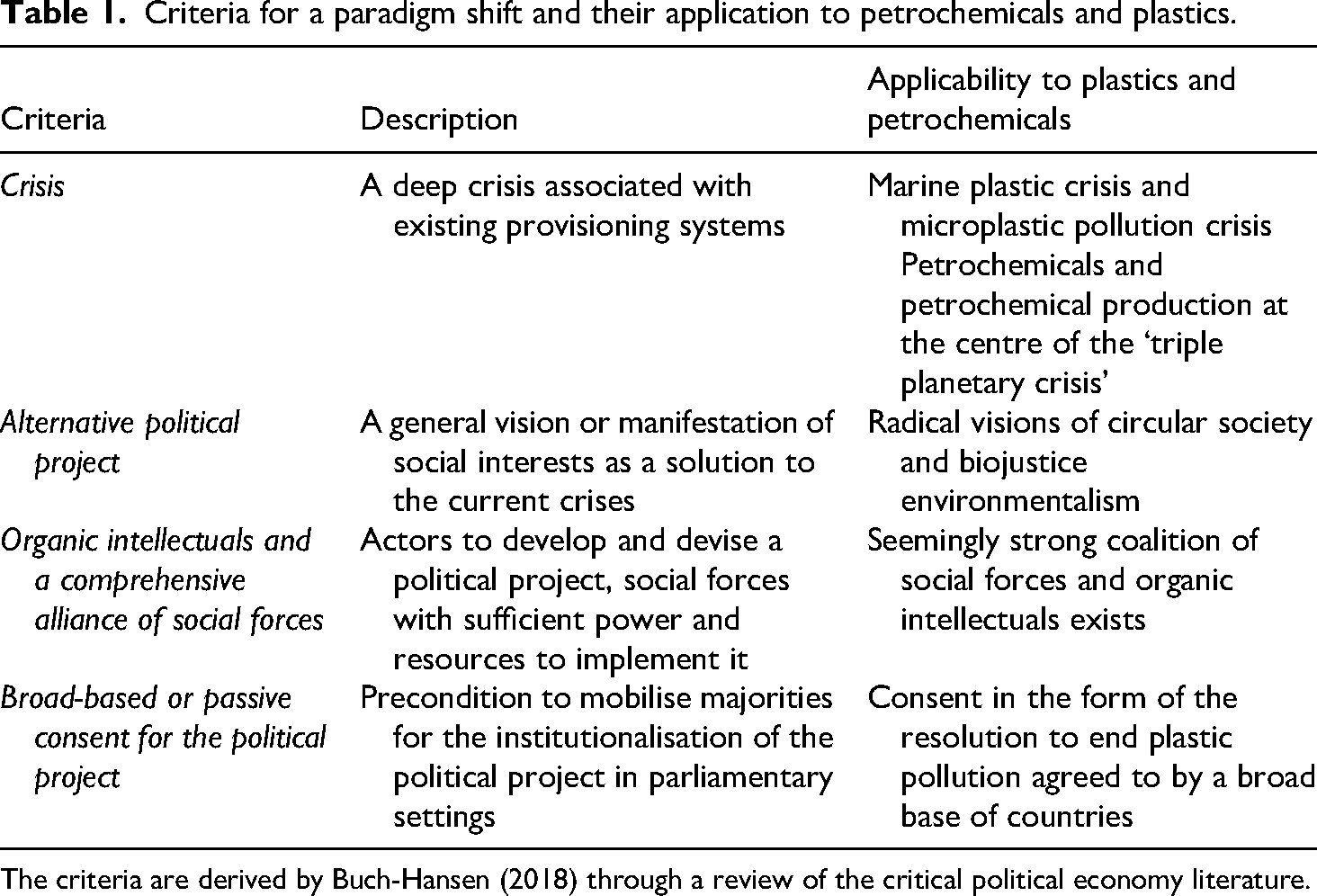
The criteria are derived by Buch-Hansen (2018) through a review of the critical political economy literature.
The existence of multiple related crises is widely accepted within the liberal world order. As for plastic pollution, corporate, state and civil society recognise wide-ranging socio-ecological impacts (Palm et al., 2022). With growing attention in multilateral environmental governance (UNEA, 2021) and after the marine plastic crisis took off in the late 2010s, pollution became a defining strategic concern for the petrochemical industry (Mah, 2021a). Although industry organisations and multistakeholder partnerships foreground waste management and tone down the scale of the issue (Nielsen et al., 2020; Yalçin et al., 2024), they struggle to call off the crisis. The United Nations Environmental Assembly refers to the ‘plastic pollution crisis’, and the resolution that decided to set in motion treaty negotiations describes the issue as a ‘serious environmental problem at a global scale’ (UNEA, 2022). In addition, alarmed by the scale of the issue, the scientific community studying plastic pollution, including toxicologists, exposure scientists, biologists and more, have been vocal in calling for capping and lowering total production (Baztan et al., 2024; Bergmann et al., 2022; Tessnow-von Wysocki et al., 2023), organising to intervene in and affect the treaty process (Scientists’ Coalition, 2024). Researchers call attention to the ‘triple planetary crisis’, emphasising petrochemical productions as a key driver of all three, and join social movements in expanding the problem formulation beyond pollution to extraction (Almroth et al., 2022; Break Free From Plastic, 2024). In short, despite significant pushback on the nature and extent of the crisis, the first criterion for a paradigm shift appears to be fulfilled.
A political project, that is, a ‘general vision of a different form of society as a solution to the current crises’, also appears to exist (Buch-Hansen, 2018: 159). For example, although competing and contradictory visions of circular economy exist (Corvellec et al., 2020), the most radical form of the discourse arguably aligns with degrowth and its allied eco-social projects, with advocates pointing to the inadequacies of decoupling, the refusal rather than reduction of waste, and the need for egalitarian distribution (Calisto Friant et al., 2020). Going beyond an exclusive focus on plastic pollution that is abstract from the social context in which pollution is produced, many movements struggle for ‘biojustice environmentalism’ (Dauvergne and Clapp, 2023), resonating with broader campaigns for socio-ecological justice and well-being. In this way, pollution-oriented projects that seek to solve and address the crisis of petrochemicals and plastics are aligned with and arguably essential to a degrowth agenda.
The project of substantive plastic degrowth as it relates to socio-ecological justice has a range of advocates operating as ‘organic intellectuals’, that is, outlining and lending legitimacy to the project (Buch-Hansen, 2018). Think tanks like the Center for International Environmental Law advocate phase-out and decommissioning of petrochemical production facilities on the basis of environmental and climate justice, doing detailed analysis on the consequences of petrochemical build-out (CIEL, 2024). The GAIA grassroots network (representing over 1000 organisations from 92 countries) devises policy to massively reduce waste alongside climate justice, publishing, for example, a 50-page booklet with priorities on production, finance, justice and circular economy for each round of the multilateral plastics negotiations (GAIA, 2024). Moreover, researchers have organised, in particular through the Scientists Coalition for an Effective Plastics Treaty, to map out policy approaches that drastically change the governance of petrochemicals and plastics (Brander et al., 2024).
As for the existence of a comprehensive alliance of social forces, material plastic decline is situated differently than degrowth as a wider political project. At the time of writing, the coalition of forces behind reducing the scale of plastic production includes, at least on the face of it, state, civic and corporate actors. As the pressures to address plastic pollution grew in strength, corporate actors sought to co-opt circular economy discourse through industry-led multi-stakeholder partnerships (Mah, 2021a; Ralston and Taggart, 2025). These have been set up in a way that makes small concessions while stripping circular economy discourse of the social and ecological elements that most clearly align with degrowth (Ralston and Taggart, 2025). Despite these efforts, calls to change production and use systems beyond disposability and mass consumption remain prominent in plastic and petrochemical governance (Break Free From Plastic, 2024). In addition to the 3500 organisations in the ‘Break Free From Plastics’ movement, a total number of 66 states are part of the so-called High Ambition Coalition to End Plastic Pollution, formed in the wake of the resolution that codified the negotiation process. A defining feature of the coalition's position is the call to ‘reduc[e] production and consumption of primary plastic polymers to sustainable levels,’ a demand that has been featured recurrently throughout the negotiations (HAC, 2024). Shortly before the fifth round of the negotiations in late 2024, Reuters reported that even the United States has changed position to back production reduction targets (Volcovici, 2024), and the Business Coalition for a Global Plastics Treaty (counting major multinational brands like Coca-Cola and Unilever) signed a declaration whose wording called for ‘achiev[ing] sustainable levels of production of primary plastic polymers’ (Business Coalition for a Global Plastics Treaty, 2024). A broad coalition of forces thus, at least in principle, support reducing primary plastic production.
The existence of passive, if not broad-based, consent for the political project comes across in surveys of public perceptions towards plastic pollution. In a recent review, Walker et al. (2023) conclude that negative sentiments towards plastic pollution are widespread across the globe, and several surveys report support for reduction of single-use plastics. More broadly, consent is arguably reflected in the United Nations Environmental Assembly resolution to end plastic pollution across the life cycle. With the ambition to establish a legally binding instrument, the plastic treaty negotiations were scoped for progressive and impactful policy, and the Executive Director of the United Nations Environmental Programme, Inger Andersen, labelled the resolution the most important development in multilateral environmental governance since the Paris agreement (UN News, 2022). At the same time, rhetorical support for the ambition is widespread across all stakeholders engaged in the negotiations. Although social contestation in and around the negotiations is widespread, with plenty of examples of obstructive tactics from a range of member states, commentators flag that an ambitious treaty is politically and legally feasible if voting is favoured over consensus-adoption (Løvold, 2024). In sum, prerequisites for a decline in production and throughput – if not for complete plastic and petrochemical degrowth – do appear to exist.
Critical realism and petrochemicals
To deepen the dialogue between degrowth and critical realism and to explore the implications of critical realism for petrochemical transformations and the conjuncture outlined above, I now turn to critical realist philosophy. Because critical realism is a ‘massive and highly complex field’, there are, in principle, numerous relevant aspects to address (Buch-Hansen and Nesterova, 2021; Buch-Hansen and Nielsen, 2023: 348). I delineate my engagement by focusing on core concepts of basic critical realism, its general and social ontology, and its relativist epistemology (which I use to inform the discussion in later sections) and exemplify their implications with illustrations relevant to the petrochemical complex.
Ontology
Critical realism promotes a deep general ontology with three ontological domains, as well as a useful account of the nature of social reality. In terms of the general ontology, a distinction is made between ‘the real’, which includes ‘whatever exists’; ‘the actual’, that which occurs or is actualised; and then finally ‘the empirical’, which includes what humans experience (Bhaskar, 2013; Sayer, 1999: 11). In opposition to the ‘empirical realism’ of positivism, which assumes that ‘reality consists solely of observable phenomena and is thus ready to be read by the observer’, critical realism emphasises the openness of systems, owing to a multitude of mechanisms and tendencies which are not always manifested at the level of the actual and the empirical (Buch-Hansen and Nesterova, 2021: 3). From the vantage point of this ontology, the various socio-ecological consequences of petrochemicals occur regardless of human awareness of them, and ills need not manifest themselves as invariant event regularities. The time horizon and spatial ambiguity associated with the secretion of toxicants, for example, make it challenging to establish causality in the positivist law-like sense, linking specific toxins to ills (Davies, 2018). A critical realist ontology thus helps make sense of how pollution and toxicity can be so widespread and yet still hard to pin down. The openness of systems makes toxicity a form of ‘slow violence’: ‘violence that occurs gradually and out of sight, a violence of delayed destruction that is dispersed across time and space, an attritional violence that is typically not viewed as violence at all’ (Nixon, 2011: 2). That is not to say that the consequences of toxins only operate at the levels of the real and the actual, that is, that they are literally ‘out of sight’ as they hit humans, non-humans and ecosystems. Yet, politico-economic structures ensure that the voices of those who experience the racialised and uneven consequences rarely count (Davies, 2019).
Another central feature of critical realist ontology that is also central to transformation and socio-ecological crises is that reality is stratified. The notion of stratification that implies that the world consists of multiple layers or levels, including the physical, chemical and ecological as well as the levels of the social world, is important in the context of petrochemicals (Bhaskar et al., 2010). These layers are hierarchical in that they constrain one another, but while a given level is dependent on more basic levels, it is not reducible to them. In the context of petrochemicals, the notion of stratification is important because it allows us insights into the limits and possibilities of change, as lower levels decide the scope of possibility. More specifically, the chemical level defines the boundaries of chemical production, establishing the achievable chemical reactions and their facilitation. At the same time, a higher-order social level provides the conditions under which chemical reactions are pursued. For example, while it is chemically possible to defossilise, that is, produce fossil-free chemicals using carbon captured via various technologies and hydrogen from electrolysis powered by renewable electricity, these processes are costly and uncertain and expected to not provide stable returns (Hunt and Tilsted, 2024; Tilsted and Newell, 2025). Politico-economic structures and processes, therefore, decide the extent to which they will actually occur. In this way, since the chemical and physical levels that limit the possibilities of petrochemical production are ‘more firmly anchored than are those of society’ (Buch-Hansen and Nielsen, 2020: 37–38, 95, 2023: 350), the emergent level of political economy is key to industrial transformation.
In terms of social ontology, critical realist accounts emphasise the pre-existing nature of social structures (Archer, 1995; Bhaskar, 2014). Such structures condition actions and are, in turn, reproduced or transformed by individuals, who exercise agency, understood in terms of intentional causality (Bhaskar, 2014; Buch-Hansen and Nesterova, 2021). In the critical realist account, structures are relational, connecting social positions and objects (Bhaskar, 2010). Positions are relational in that they are defined in reference to others (e.g. the manager and the subordinate employee, the buyer and the seller) and are linked to social objects (e.g. economic resources, laws, policies). Relating this to the topic of this paper, transformative strategies for petrochemicals and plastics cannot operate outside of existing power structures. For example, despite procedural inequities in multilateral environmental governance (Newell et al., 2021; Xie et al., 2025), the negotiations on a global legally binding instrument that the United Nations resolution to ‘end plastic pollution’ set in motion shape future action. At the same time, it would be restrictive and reductive to consider the prevailing order and institutional framework without attention to their contradictions and what opening for alternatives might arise. A guiding question thus becomes: from this point onwards and within this or that context, what intentional forms of activity make transformative change more likely?
Epistemology
Critical realism, in line with its deep ontology, emphasises two dimensions of science: the transitive and the intransitive. While the intransitive is the dimension of ‘the being of objects of scientific investigation’, the transitive is the dimension of ‘socially produced knowledge of them’ (Bhaskar et al., 2010: 1). This separation allows for ontological realism alongside epistemological relativism. While the intransitive exists independently of knowledge and discourse, the transitive remains incomplete, fallible, historically dependent and social in character (Buch-Hansen and Nielsen, 2023). Distinguishing the two dimensions highlights that the triple planetary crisis exists independently of our knowledge of it and that whatever we know is not a direct reflection of this phenomenon (Buch-Hansen and Nielsen, 2020).
A line of contestation from the plastic treaty negotiations illustrates the relevance of epistemological relativism to research on petrochemicals and environmental governance. No matter the number of studies on the discovery of micro- and nano-plastics across the entire globe and the presence of hazardous chemicals, knowledge remains fallible (Buch-Hansen and Nielsen, 2023). The critical realist position thereby lends itself to a precautionary hazard- and group-based approach to the toxicity of chemicals, which entails classifying chemicals as of concern on the basis of hazard criteria (persistence, mobility, accumulation potential and toxicity) (Wagner et al., 2024). But in the context of the treaty, industry actors who stand to lose sources of rent and opportunities for accumulation oppose hazard- and group-based assessments, advocating existing risk-based alternatives (Wagner, 2024). Such approaches demand that harms to human health are documented in line with positivist ideals of law-like patterns, concerning themselves with the level of the empirical, claiming that what we know reflects the true nature of the phenomenon (known as the ontic fallacy) (Buch-Hansen and Nielsen, 2020). But risk assessments require substantial resources, and with more than 3,600 identified plastic chemicals of concern, 6% of them being subject to global regulation, such work could take decades (Wagner et al., 2024). At the same time as the social production of risk assessments is burdensome, there is no guarantee that such assessments would translate into regulation. The transitive dimension of science is a site of contestation or terrain of struggle, influencing the prospects and direction of change. Few understand that as well as corporate actors in the chemical industry: for decades, they have intentionally and strategically been spreading doubt about the existence of toxic impacts, appealing to positivist ideals (Markowitz and Rosner, 2013).
Degrowth and petrochemicals
Having introduced critical realism, I now turn to sketch the contours of a degrowth transformation of the petrochemical complex, discussing what petrochemical degrowth implies. Once we have this vision outlined, we can then discuss the implications of critical realism for studying petrochemical transformations. To conceptualise and make sense of petrochemical degrowth, I invoke the four planes of social being and point to degrowth-aligned examples of interventions and practices at each plane (see Table 2). I thus invoke Buch-Hansen and Nesterova's (2023) understanding of degrowth and transformation, as noted in the introduction.
Petrochemical degrowth and the four planes of social being.
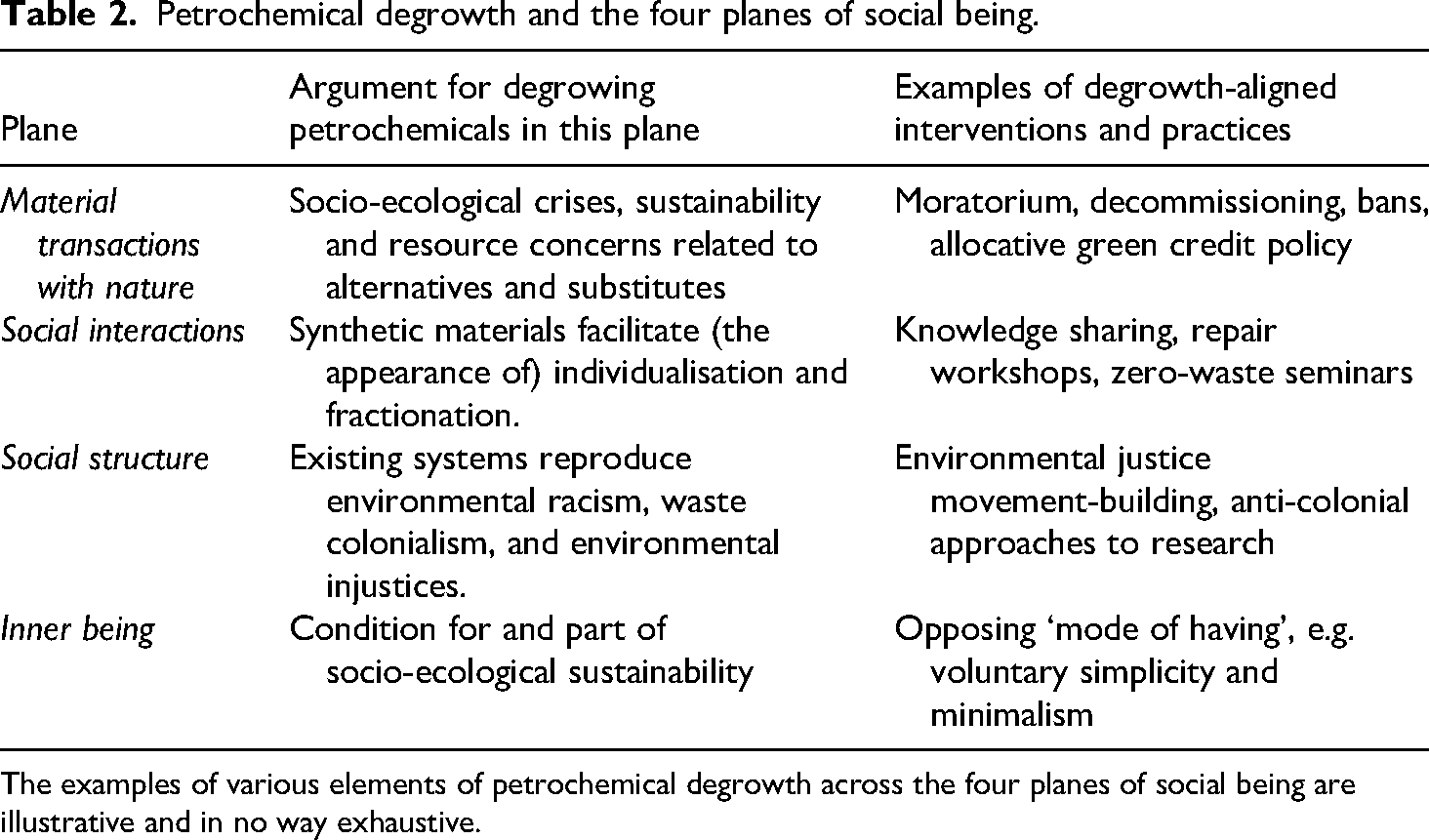
The examples of various elements of petrochemical degrowth across the four planes of social being are illustrative and in no way exhaustive.
Starting with the plane of material transactions with nature [a], we can note a central justification for degrowth: socio-ecological degradation demands changing the metabolism of the economy and markedly decreasing material and energy throughput (Buch-Hansen and Nesterova, 2023). Petrochemicals became, with industrial modernity, central to mass production and consumption (Hanieh, 2024), and degrowth, thus, per definition, involves addressing the throughput associated with the petrochemical complex. Sustainability does not arise by improving existing and future production alone, making it less toxic and lowering greenhouse gas emissions; such improvements must be combined with limits to global petrochemical production (Bauer et al., 2024).
The importance of establishing production limits arises in part through the constraints of the lower layers of reality. Fossil feedstock is relatively abundant and is coproduced alongside fuels in refineries, while integrated petrochemical clusters make use of waste streams from various processes (built around specific feedstocks) to optimise overall production (Tilsted et al., 2023a). Sourcing alternative feedstocks, biomass, recyclates and captured carbon are all constrained in different ways (Meng et al., 2023). Switching to bio-based feedstock excludes other sustainability-related uses and requires land use change with severe biodiversity impacts (Helm et al., 2025). Although biomass rather than fossil hydrocarbons are the material precursors for bio-based plastics, insofar as the physical properties are to be the same to maintain commercial value, bio-based plastics can be as toxic as fossil-based counterparts (Altman, 2021). Recirculating synthetics involves dissipation and entropy, resulting in losses that are both quantitative (material) and qualitative (downgrading) in nature (Cullen, 2017) and raises significant concerns about toxic impacts (Mah, 2021a). Lastly, carbon capture and utilisation involve massive land, energy and water resources and involve significant technological risks (Hunt and Tilsted, 2024). In short, for the petrochemical complex to align with degrowth, chemical production must take a different form as well as decrease in scale.
As mapped out above, there is support for limiting production among a coalition of actors. Policy options that are within scope (cf. section ‘Is (material) plastic degrowth tenable?’) range from those that are least controversial in nature to incumbent actors, such as targeted bans on specific compounds, to more broad-based policies directly enforcing limits. Interventions to enforce such limits include a moratorium on new production capacity and decommissioning of existing petrochemical facilities and infrastructure to ensure phase-out under a global cap (e.g. Bauer et al., 2024; Kirk, 2020). Other more indirect options influencing total production are also in play, including weakening or removing plastic and fossil fuel subsidies, as well as restricting public institutions from financing fossil-based petrochemical investments (Skovgaard et al., 2023).
In terms of plane [b] – social interactions – degrowth entails transformations in the direction of more solidarity, sufficiency and care, with interactions dictated less by, for example, competition, individualism, alienation and racism (Buch-Hansen and Nesterova, 2023). The history of synthetic materials reveals that the petrochemical complex, in multiple ways, promoted a specific cultural politics. Invoking examples from the 1950s and 60s, Huber (2013) shows how industry actors promoted ‘the appearance of an individuated or fractionated life’ with reference to synthetic compounds and their ‘material properties’ (Huber, 2013: 153). Various integrated oil, gas and chemical companies engaged in public relations efforts to associate fossil-based products – be it plastics, fertiliser, asphalt or paints – with specific ways of relating. Asphalt, for example, enabled the construction of roads and was associated with car dependence masked as freedom (Paterson and Dalby, 2006; Tilsted, 2024). Indeed, plastics constituted a whole ‘new way of life’, as a 1960 article in the magazine Good Housekeeping put it, ‘co-ordinating relations between people and things in ways that realised new practical, moral, and economic orders’ (Hawkins, 2018: 401). This life, Huber argues, ‘was individuated as a singular project in search of management and control’, serving privatised, racialised and patriarchal life in single-family homes in suburban geographies (2013: 157). As such, there was a fit between the material abundance associated with the petrochemical revolution and the seeming lack of dependence on others co-evolving with a wider set of cultural politics.
In lieu of the increasing policy attention to the pollution crisis in the last decade, individuated understandings of synthetic compounds live on. Prominent industry actors portray materialist individuals as the root cause of pollution, rendering, most prominently, the plastic crisis a matter of littering and waste (Villarrubia-Gómez et al., 2022). In this view, market transactions are the social interactions of relevance. Petrochemical degrowth would thus involve disentangling synthetics from such logics and ways of relating. For example, detailing alternative practises of zero-waste and voluntary simplicity, Nesterova (2024a) notes dependency on others, be it in the form of learning, sharing or borrowing. Chertkovskaya, Hasselbalch and Stripple, similarly, note the communality associated with such efforts in their analysis of the zero-waste networks of grocery stores, suppliers and shoppers. Observing affective interactions between owners and shoppers, they argue that such engagements make zero-waste stores ‘spaces for deepening relations’ (Chertkovskaya et al., 2023: 309). Zero-waste lifestyles, however, are quarrelsome and muddled. Challenges are plentiful and include, for example, affordability, the time-intensive nature of zero-waste and unequal access and knowledge (Nesterova, 2024a). To embed the production and use of synthetic materials within interactions guided by gentleness and care thus requires social structures that enable and are much more supportive of petrochemical degrowth.
Plane [c], social structure, is central in much degrowth literature as the facilitator of socio-ecological injustice and climate breakdown (Buch-Hansen and Nesterova, 2023). This plane features many of the phenomena to which the degrowth literature typically attributes the ecological crisis in plane [a], namely the socio-economic orders of late capitalism (cf. Alami et al., 2023). On the global scale, the petrochemical complex is characterised by a fossil-based regime with a strong orientation towards costs and incremental process improvements in integrated clusters (Bauer and Fuenfschilling, 2019). Relatedly, efforts to develop and sustain markets, achieve efficiency gains and scale have defined industry developments for decades (Aftalion, 2001; Bauer and Fuenfschilling, 2019). To ensure profitability, companies have historically engaged in price collusion, setting up cartels to exert market control (Buch-Hansen and Henriksen, 2019). Today, the biggest producers collaborate through joint ventures and other commitments. Financial and legal commitments tie the multinational petrochemical majors together, co-owning and funding think tanks, industry organisations and production sites (Tilsted and Bauer, 2024). Illustrating the direction that these structures (re)produce, the most central producer in the global petrochemical ownership network is SABIC, owned by the biggest oil company in the world, Aramco, explicitly committed to increasing the share of crude oil utilised for chemical production (Tilsted and Bauer, 2024).
These social structures also underpin the racialised, gendered and classist dimensions of petrochemical production and consumption. The literature on environmental injustice and racism shows, among other things, the unevenly distributed consequences of pollution and the imposition of harms onto vulnerable communities (Bullard, 2000; Lerner, 2010). While movements in toxically exposed communities in many instances oppose impacts and are ‘bearing witness through embodied experience’ (Davies and Mah, 2020), their voices rarely count, and when they do, the burdens are often displaced to elsewhere rather than eliminated (Davies, 2019; Hallowes, 2011; Mah, 2023). In terms of the spatiality of production, colonial land relations structure the petrochemical complex, maintaining indigenous lands as sacrifice zones (Liboiron, 2021), while waste flows reproduce colonial structures, exporting toxic waste from the North to the South (Gündoğdu, 2024; Liboiron, 2021). Scholars working in this tradition also advocate anticolonial approaches to research, highlighting the colonisation of the science of pollution and the developmentalist logics that structure such research (Liboiron, 2021; Liboiron et al., 2023; Liboiron and Cotter, 2023). In short, the structures that shape industry developments also devalue nature and people, reinforcing existing inequities and highlighting the importance of alternatives ‘from below’ (Dauvergne and Clapp, 2023).
Plane [d] – people's inner being, or the stratification of the embodied personality – is an aspect to which the degrowth literature generally has devoted limited attention, although it is arguably partly a condition for, partly a part of socio-ecological sustainability transformations (Buch-Hansen et al., 2024). When considering this plane in relation to the petrochemical complex, we can think of the unfathomable variations of goods that synthetic materials are used for and how they speak to what Fromm (2013) refers to as ‘the mode of having’, that is, a self-orientation focused on pursuing accumulation and status said to reflect characteristics such as egoism and greed. Synthetic materials are integral to consumer culture and the accumulation of possessions because they are cheap, flexible and abundant. The hyper-fast fashion phenomenon, for example, is completely reliant on synthetic fibres.
In the mode of having, prevalent in contemporary societies, humans and non-humans are means rather than ends, instilling a sense of expendability. Scholars of waste colonialism highlight, for example, how settler mentalities instil entitlement to land and indigenous spaces, giving rise to the petrochemical complex in its present-day form (Liboiron, 2021; Peryman et al., 2024). In contrast to the mode of having, the mode of being promotes humanness in the form of capacities such as care, empathy, solidarity and fellow-feeling (Fromm, 2013), resonating with degrowth aspirations (Buch-Hansen et al., 2024). Practices of minimalism that seek to ‘maximise’ this mode of existence (Nesterova, 2024b) thus relate to radically different futures than the ones promoted by dominant actors (cf. Palm et al., 2024).
A critical realist perspective on petrochemical transformations
What comes into view when we see the above sections in relation to each other, that is, when we revisit the prospects of plastic degrowth from a critical realist perspective? Thinking in and across the planes of social being, critical realism reminds us of the multiplicity of relevant causal mechanisms. In this section, I discuss how the interventions related to plastic degrowth in the multilateral context foreground plane [a] and are preconditioned on restricting or scoping changes in other planes, where degrowth runs into more direct opposition. I argue that transformation requires undoing cross-plane cutting social structures that obstruct degrowth while sustaining injustices and ecological degradation.
Considering the four planes and their interrelated coexistence, we can think of deep-seated phenomena that operate through various mechanisms, influencing all four. In general terms, we can think of concepts that speak to defining overarching features of the global political economy/ecology of petrochemicals – and thereby the root causes of global socio-ecological injustices – such as extractivism, militarism, oil hegemony, modernity, settler colonialism or growthism. These concepts foreground related but varied aspects of the social structures that sustain petrochemical proliferation and thereby offer an opportunity to reflect on the interdependence of the four planes. Synthetics, co-evolving alongside energy production, link to all the above.
To illustrate such linkages, we can think of the development of the petrochemical industry throughout the 20th century, in which militant growth imperatives played a decisive role. With the First World War (the so-called ‘chemists’ war’), the chemical industry went beyond producing primarily dyes to supply huge quantities of both explosives and poison gas (Borkin, 1978). And when Germany and later the United States faced production constraints prior to and during the Second World War due to limits to the supply of natural resources, synthetic materials enabled production beyond hitherto existing limits (Hanieh, 2011, 2021). This shows the intricate links between synthetics, mass production and growthism. Petrochemicals are a means of overcoming material scarcity – pushing back on limits related to land-intensive natural resources in the biosphere by utilising more abundant resources from the geosphere (plane a). The war also marked the petrochemical revolution and the shift from coal to oil-based feedstock, which started in the United States and became a global shift with American hegemony (Hanieh, 2021). The expansion that followed during the so-called golden era of capitalism consolidated oil hegemony, reproducing colonial land relations (plane c) as part of the petrochemical expansion in the United States and the associated devaluation of peoples and nature. But the production capacity that the petrochemical revolution facilitated required new markets, and with the rise of advertising, petrochemical plastics became a manifestation of modernity, promoting individuated and non-communal modes of living and relating (plane b). These, in turn, promoted the ‘mode of having’ in plane [d], consolidating and influencing the prospects of organising for changes to other planes.
Importantly, the current predicament of the petrochemical industry is not simply a matter of continuing down a path decided in the 20th century. Although ongoing commitments to fossil-based feedstocks build on historical developments and the associated process improvements that have decreased costs substantially through improved energy efficiency, the ongoing expansion of synthetics in recent decades is more than the crude quantitative reproduction of materialist growth; it also involves dramatic qualitative changes. For example, Feltrin et al. (2022) point to the phenomenon of noxious deindustrialisation, whereby diminishing job opportunities for ‘fenceline’ residents due to automation and long-range recruiting is “coupled with the continuing exposure to the socioenvironmental damage and hazards.” Such weakening of the industry-community social contract, they argue, is a global phenomenon. Another important qualitative change is the emergence of ‘hyper-fast’ fashion in the last decade, characterised by ever faster production cycles and shorter use. This business model is based on inexpensive synthetic fibres (Dzhengiz et al., 2023). Or consider the geographical reconfiguration of global petrochemical production. The ongoing build-out is strongly concentrated in China (Bauer et al., 2023; IEA, 2023). Driven by domestic growth targets, unprecedented urbanisation and the imperatives of Chinese self-sufficiency and security, this trend and the associated demand for feedstock involve substantial changes to the global energy order (Larsen and Tilsted, 2024). For such and other reasons, plastic growth rates since the 2000s have been much higher than those for GDP and other bulk materials (IEA, 2018). These changes are further complicated by the role of petrochemicals in renewable energy, which are used to produce, for example, the carbon fibres for wind energy turbines (something industry actors are quick to note) (Tilsted et al., 2022). The petrochemical revolution enabling mass production at hitherto unprecedented scales was not a one-off qualitative shift. Synthetic materials are continuously entangled with new frontiers of accumulation.
When reflecting on the claim above that plastic degrowth is more tenable than degrowth in general, it immediately becomes important that this argument refers to material degrowth, that is, restricting the global primary plastic production in plane [a]. Looking beyond environmental justice movements and the associated actor coalitions, support for material degrowth is arguably premised on restricting the scope of change in plane [b–d]. Corporate and state actors might rally behind production reductions and foreground how such proposals address plastic pollution in plane [a] while seeking to shape the enactment of such calls through their engagement. In other words, to accommodate pressures so as to ensure that the outcome is more manageable (Newell, 2019). This tactic, that is, pursuing or inviting socio-technical reconfigurations that leave broader power relations intact, is a hallmark of how petrochemical incumbents navigate social pressures (Mah, 2023; Tilsted et al., 2022).
In critical realist terms, the support for material degrowth is evident at the empirical level. At this level, we can note the various actors that sit inside and outside the coalition calling for production restrictions, pointing to similarities between opposers such as China, Saudi Arabia and ExxonMobil (e.g. Dreyer et al., 2024 and Palm et al., 2024), but not directly observe the structural conditions of the fossil-based petrochemical regime. With this point I do not simply refer to the things that are not publicly known, such as the now publicly documented story of how industry promoted recycling publicly as a silver bullet, knowingly disregarding fundamental limitations discussed internally (Allen et al., 2024; Sullivan, 2020). Rather, I refer to how going beyond a positivist account reveals multi-faceted and deep-seated structures mentioned above that petrochemical production is part of and which are not confronted in the process of overcoming consensus-based adoption in multilateral environmental governance.
More generally, we can think of obstructing structures that are not undone with a global multilateral treaty stipulating a production cap and the conditions under which the proposals for capping and reducing primary production would be enacted. While the articulation of caps by certain actors might be done in reference to socio-ecological justice, and whilst production caps are certainly applaudable and worth pursuing in their own right, progressive policy proposals risk remaining limited to ‘reducing demand’ or implementing the waste hierarchy (which places reduction at the top). In effect, insofar as incumbent actors guide phase-down so as to make it manageable, deliberate decline might maintain rather than unsettle existing power relations (Tilsted et al., 2023b; van Oers et al., 2021). As long as militarist and (state-)capitalist imperatives take precedence, the ability of a global treaty to meaningfully reduce throughput appears naïve. The structural power of petrochemical incumbents is partly a function of the material importance of petrochemicals for the conditions of capital accumulation and social reproduction (Tilsted and Newell, 2025). While business actors and states support limiting primary production to ‘sustainable levels’, they open for maintaining production through recycling and, more importantly, frame out aggressive decommissioning combined with a moratorium on fossil-based expansions and allocative green credit policy. Rather, derisking approaches that cater to financial capital known from other domains are also championed in the petrochemical and plastic space, seeking to render waste management interventions investable (Taggart and Power, 2024). Such limits to transformations are indicative of the social and political structures that are not unsettled when focusing exclusively on material transactions with nature.
Conclusion
In this paper, I enquired into the implications of studying petrochemical transformations from a critical realist perspective, arguing that a critical realist philosophy brings into focus the structural dimensions of transformative change. Whereas the conditions for plastic degrowth may suggest that the prospects of materially degrowing petrochemicals are within the scope of feasibility, attention to underlying structures illuminates important obstacles to deep transformations that restrictions to primary plastic production do not address. In critical realist terminology, these structures relate to all four planes of social being as well as the deeper levels of reality. As long as the pursuit of material degrowth on a sectoral level remains exclusively focused on materials transactions with nature, and interventions do not undo inhibitive structures at the level of the real, such efforts remain limited in their transformative potential and potentially support the stability of said structures. Reuse is not of much use at all, so to speak, when conditioned by structures of accumulation and integrated into the mode of having; non-fossil plastics do not bring environmental justice in a system that sustains extractivism; and non-synthetic materials are not sustainable under growthism. Overall, a critical realist lens can offer a more comprehensive account of loci of stability and change, thereby guiding research on industrial transformation.
With this argument, I do not seek to imply that an envisioned non-synthetic, ‘natural’ world is fundamentally more desirable, nor that replacing fossil hydrocarbons with, for example, bio-based feedstocks, brings us ‘closer to nature’ in any ontologically meaningful sense. The materials that make our world synthetic, including the host of thermoplastics, resins, rubber and monomers, as well as the agrochemicals, are used for many different purposes with many different consequences. Therefore, we should engage with the consequences and governance of synthetics alongside the contestations and sources of power that shape such governance. As alternatives to fossil-based materials and production emerge and gain momentum – be it in terms of defossilised chemicals, green steel or hydrogen-derived fuels – the social structures that endure remain as important as ever.
This paper is inevitably partial and selective in its analysis of the petrochemicals complex, the examples that I foreground, and the mapping of the social structures which petrochemical degrowth transformations confront. Future research could thus do much more to criticise the (re)production of the social structures and beliefs that sustain the socio-ecological ills linked to synthetics and the petrochemical complex. Such research would align with the critical realist ideal of explanatory critique (Bhaskar, 2010), seeking to confront the multi-scalar socio-ecological inequities of the petrochemical complex and foster a world in which synthetics co-facilitate well-being (Mah, 2021b).
Footnotes
Acknowledgements
I want to thank Hubert Buch-Hansen and Iana Nestorova for their generous comments on this paper, as well as the anonymous reviewers, whose constructive engagements helped improve the paper immensely. Thanks also to Ellen Palm for helping me get the definitions right.

Funding
The author disclosed receipt of the following financial support for the research, authorship, and/or publication of this article: This work was supported from Novo Nordic Foundation through the CARBONCHAINS project.
Declaration of conflicting interests
The author declared no potential conflicts of interest with respect to the research, authorship, and/or publication of this article.