







Abstract
This article analyses media representations of the strengthening technological energy policy orientation in the UK and Finland. Drawing from over 1200 newspaper articles from 1991 to 2006, it scrutinises how energy policy in general and energy technologies in particular have been discussed by the media in these two countries, and how the media representations have changed over time. The results point to the importance of national political, economic and cultural features in shaping media discussions. At the same time, international political events and ideas of technology-driven economic growth have transformed media perceptions of energy technologies. While the British media have been rather critical towards national policies throughout the period of analysis, the Finnish newspaper Helsingin Sanomat has supported successive national governments. In both countries, energy technologies have increasingly become linked to global societal and political questions.
1. Introduction
Technology has become an important part of climate and energy policies around the world. Under mounting pressure to mitigate climate change, international consensus has gradually developed on the pivotal role of new, particularly renewable energy technologies in national energy systems. Connecting climate change not only to the environmental sphere but also to economic and innovation policies (Stern, 2006; DTI, 2007; MEE, 2008) has further highlighted the importance of technology in all societal development. This article analyses how the strengthening technological orientation was discussed in British and Finnish newspaper media in 1991–2006, when climate change increasingly penetrated into international and national political discussions. Energy technologies are understood not only as climate and energy policy instruments but also as social constructions that are actively interpreted and reinterpreted in policy debates (Bijker, 1995; Barry, 2001). Transformations in the ways technology-driven policy developments have been portrayed thus also reflect broader politico-ideological changes.
A comparison between the UK and Finland is interesting in many respects. Both are members of the European Union and have since the 1980s undergone significant restructuration in the energy sector. Since the 1990s, discussions concerning energy security, efficiency and low-carbon energy systems have strengthened in both countries. An emerging theme has also been nuclear new-build, which has related particularly to the decommissioning of the operating nuclear power plants and the looming energy gap in the UK (MacKerron, 2009) and self-sufficiency and industrial competitiveness in Finland. Yet the two countries have distinct economic production structures, natural resources and patterns of energy production and consumption. The UK is a globally important trading power and financial centre with a strong financial and business services sector. The country’s rich natural resources (oil, gas and coal) have balanced politico-economic uncertainties and protected it from economic crises (Helm, 2003) – the share of oil and gas in the total production of primary energy was 82.5% in 2007 (Eurostat, 2010). Finland has a heavy-industry-dependent economic structure (especially pulp, paper and metal industries), Nordic location, low density of population and a lack of oil, gas and coal resources. In 2007, renewable energy accounted for 54.6% of the total production of primary energy and nuclear power for 38.4%, while these figures in the UK were 2.5% and 9.4%, respectively (Eurostat, 2010). Moreover, Finland’s relative dependency on energy imports (53.8% in 2007) and energy intensity have been substantially higher than in the UK (20.1%), with energy intensity approximately twice as high as in the UK (Eurostat, 2010).
The UK and Finland also differ in their decision-making systems (Rootes, 2007; Bickerstaff et al., 2008; Litmanen, 2009; Teräväinen, 2010). Whereas the UK is a majoritarian democracy with a simple plurality, first-past-the-post electoral system, a centralised mode of decision-making and moderate stakeholder inclusion, Finland has a multiparty parliamentary system based on proportional representation with expansive corporatism and relatively open, inclusive and consensual policy orientation. Unlike the British institutional scepticism, a characteristic of Finland has been a strong public trust in state institutions (Bickerstaff et al., 2008; Litmanen, 2009).
This article scrutinises how energy technologies have become the core of national climate and energy policies and discusses the degree to which media representations have reflected, departed from or reasserted their respective politico-economic contexts. Key questions include the following: How have national newspapers represented policies concerning energy technologies at different points in time? How are international and national political changes reflected in the media? What kinds of differences and similarities can be found between the UK and Finland? The period of analysis, 1991–2006, is a formative period in energy technologies’ growing public and political salience. It is also concurrent with important international political events, from the United Nations Framework Convention on Climate Change (UNFCCC) (1992) to the Kyoto Protocol (1997) and several UN Conferences of Parties. After the publication of the Stern Review (2006) and recent EU policy developments, energy technologies have been consistently high on national political agendas; thus, more recent years are not covered in this article. The article discusses the newspaper coverage of energy policy in 1991–2006 and develops a periodisation of key trends. It then utilises this periodisation in the analysis of media representations and concludes with comparative reflections.
2. Data and methodology
Media representations play an important role in translations between science, policy and the public. They do not merely report political events but also constitute particular interpretations about the social world (Dunwoody and Peters, 1992; Bell, 1994; Thompson, 1995; Allan, 2002; Petersen, 2007). Indeed, newspaper articles involve choices, whether explicit or hidden, in terms of covering certain themes, with specific ways of representing them. Organising elements of the social world according to a specific perspective also entails prioritising some understandings over others and advocating particular interpretations of reality (Carvalho, 2007).
A vast body of literature has emerged regarding media representations in general and of environmental issues in particular. Studies have scrutinised historical trends, discursive strategies and ideological cultures, as well as representations of scientific claims and public perceptions of climate change, uncertainty and risk (Dunwoody and Peters, 1992; Bell, 1994; Mazur, 1998; McComas and Shanahan, 1999; Carvalho, 2005). These studies have emphasised the importance of discursive processes in understanding how the media produce meanings for social phenomena, and how media representations reflect particular values, norms and ideologies (Boykoff and Boykoff, 2004; Carvalho, 2007). They have also highlighted the contextual factors of media representations, such as historico-political conditions, ideological viewpoints, journalistic norms and news selection criteria (Fairclough, 1995; Boykoff and Boykoff, 2004; Carvalho, 2007). This article builds on these findings and situates media representations in relation to key international and national political events and politico-ideological shifts. Using qualitative content analysis (Mayring, 2000; Hsieh and Shannon, 2005), it analyses media representations both historically, tracing key trends over time, and by comparing the two countries at particular points in time (cf. Carvalho, 2005, 2007).
The data cover articles published in two British “quality” newspapers, The Times and The Guardian (including The Sunday Times and The Observer), and in the Finnish Helsingin Sanomat. In the UK, the two newspapers represent rather different political standpoints: The Times is associated with the Conservatives, and The Guardian with more leftist and Labour Party-oriented views (Carvalho, 2007). In Finland, such divisions are less visible in newspapers of general circulation. The biggest newspaper, Helsingin Sanomat, claims to be politically “independent” and is difficult to situate on left–right or party politics axes. Yet it has political aims that sometimes diverge from government policies or public attitudes (e.g., in questions concerning nuclear power and NATO, its position has countered public opinion). In practice, however, it is the only nationwide newspaper of its kind and was therefore selected for the analysis.
The data were collected from electronic databases (Helsingin Sanomat archives and the FACTIVA database) by keyword searches using “energy policy” and “energy technology” (including energy, environmental, clean, green and low-carbon technologies) as keywords. Possible biases in different databases were controlled by making several preliminary searches and comparisons across newspapers and countries and by using various translations of multiple keywords (some keywords, such as “low-carbon technology,” had no equivalent in the Finnish data). Rather than counting exact quantities of particular issues and making comparisons on this basis, however, the analysis focused on discussing newspaper representations as indicating broad tendencies and qualitative changes in the two countries.
There were 2986 articles altogether (excluding letters to the editors and duplicates) in the three newspapers (637 in The Times, 905 in The Guardian and 1444 in Helsingin Sanomat) about energy policy, and there were 1263 articles (353 in The Times, 511 in The Guardian and 399 in Helsingin Sanomat) about energy technology during 1991–2006. The first phase of the analysis identified key trends in the newspaper coverage of energy policy to form a preliminary understanding of media representations. These findings were then compared across countries in relation to developments in international climate policy. In the second phase, the data were elaborated for qualitative analysis by focusing on the technological dimension of energy policy and narrowing the data into articles that had energy technologies as the main or one of the main themes. In total, the qualitative analysis included 688 articles, of which 204 were published in The Times, 279 in The Guardian and 205 in Helsingin Sanomat.
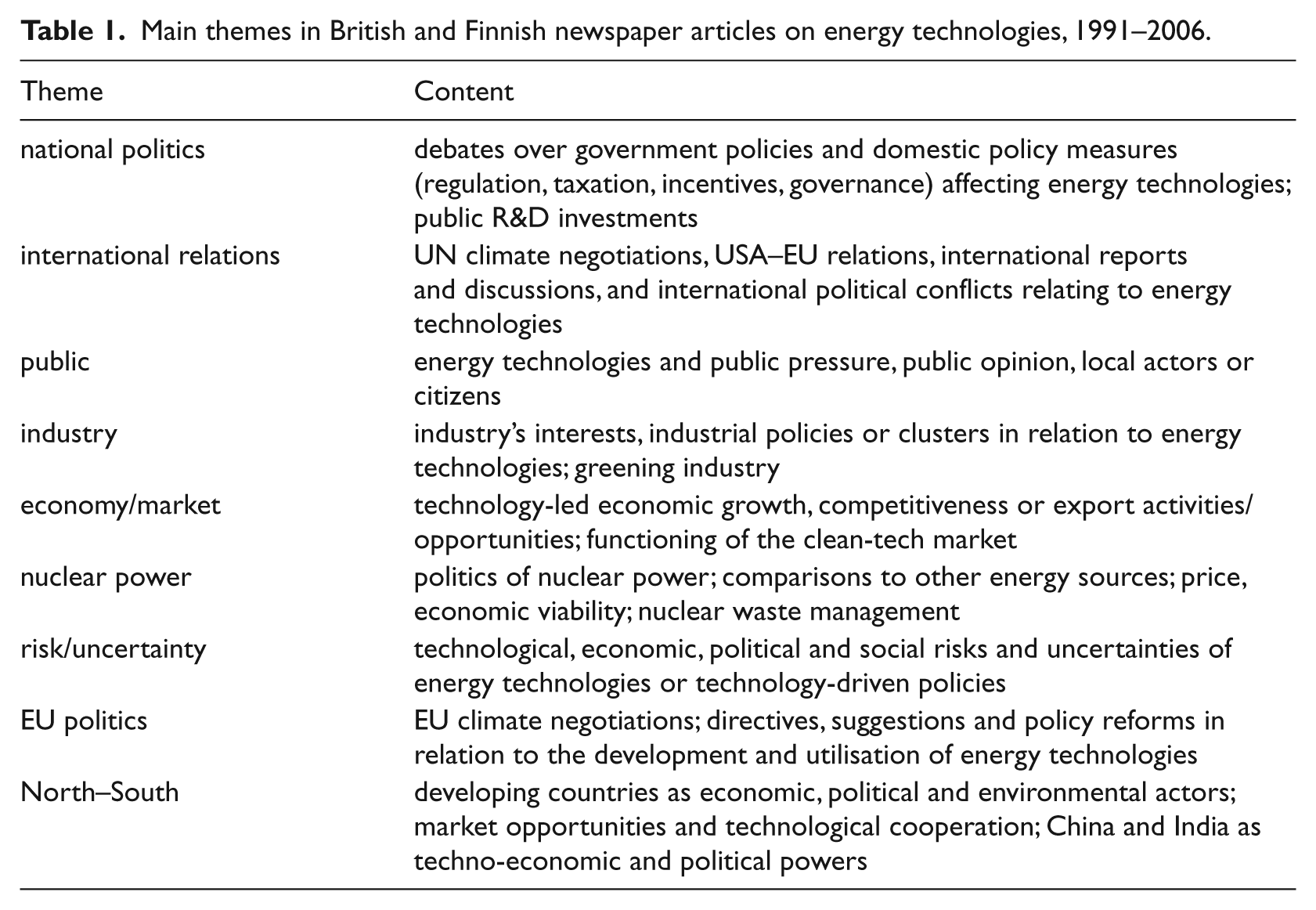
The qualitative analysis was based on a data-oriented qualitative content analysis that seeks to develop an integrated, contextually sensitive understanding of text data and goes beyond merely counting words to scrutinising explicit or implicit patterns of meaning and interpretation (Hsieh and Shannon, 2005). Instead of using prefixed categories and themes, this article utilised inductive category development, which allows categories and themes to arise from the data (Mayring, 2000; Hsieh and Shannon, 2005). In order to systematically account for key trends in the data over time and across the newspapers, the main contents of the 688 articles were first summarised and organised in chronological order. The summary was then complemented by rereading the articles, coding them in detail at the level of sentences and phrases, and integrating the initial codings first into thematic categories and then into nine broader, partly overlapping, themes (cf. McComas and Shanahan, 1999; Brossard et al., 2004) (Table 1). Each article may, therefore, contain more than one theme. The purpose of quantifying the data was to scrutinise the relative importance of the key themes. Yet, counting their frequencies does not explain how the three newspapers discussed these themes and emphasised specific policy questions. Therefore, the analysis focuses on the contents and qualitative changes of the newspaper representations within the nine themes.
Main themes in British and Finnish newspaper articles on energy technologies, 1991–2006.
Elaborating and analysing the data in several phases helped in handling the rather large amount of data and allowed moving between different levels of analysis from close reading of individual articles to managing the data as a whole. Yet, in accordance with the principles of qualitative content analysis, analytical attention was given primarily to the content rather than to the quantity of particular themes.
3. Energy policy in national newspapers 1991–2006
The variation in “the simple quantity of exposure” (Mazur, 1998: 459) (the amount of newspaper coverage over time) reflects the relative importance of a given political issue in public and political discussions (Dunwoody and Peters, 1992; McComas and Shanahan, 1999). The quantitative trends of newspaper articles thus indicate the weight of energy policy issues in the two countries at different points in time (Figure 1). Although the absolute numbers in the two countries are not comparable due to diverging databases, the figure identifies key tendencies in the newspaper coverage. It illustrates common features between the newspapers and across countries but also reveals national and media-specific peculiarities.
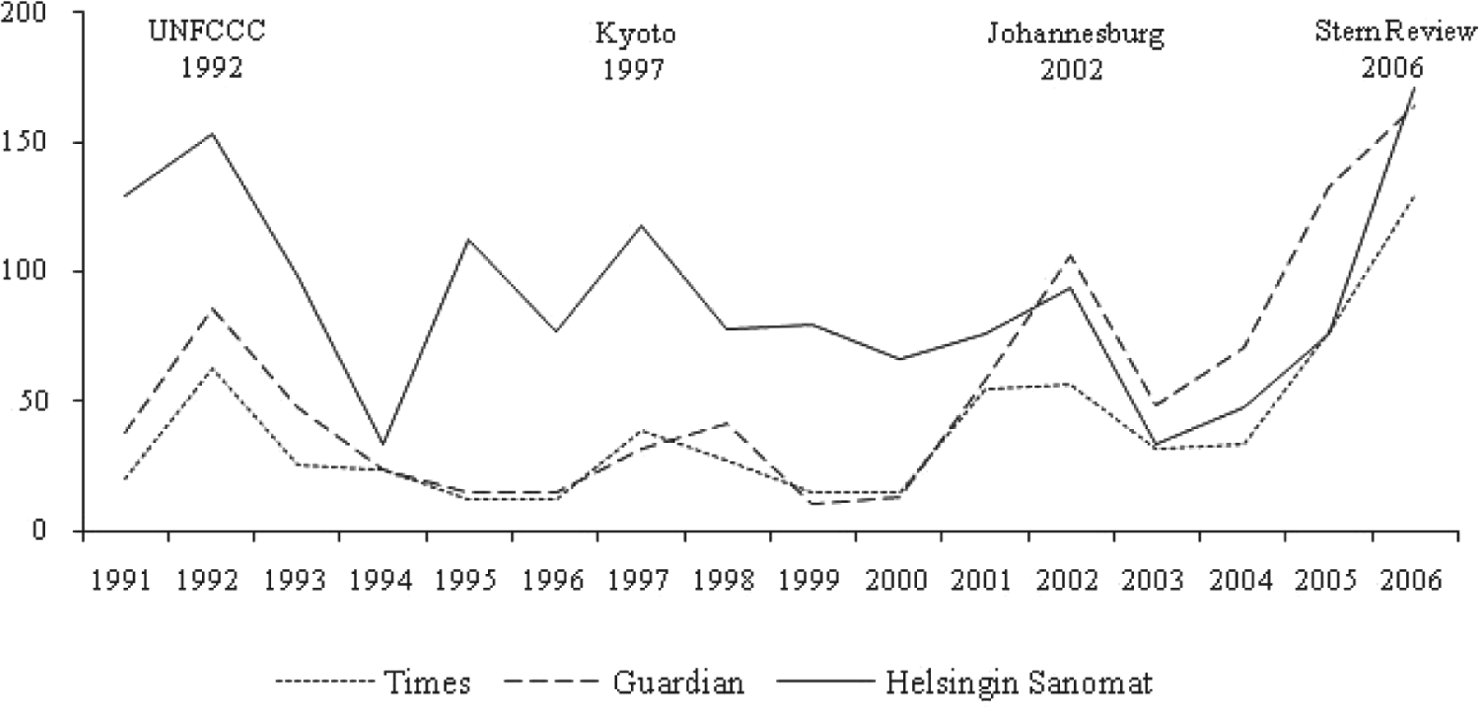
Energy policy articles in The Times, The Guardian and Helsingin Sanomat in 1991–2006.
General trends in the three newspapers have followed quite similar patterns including peak years 1992, 1997/1998 and 2002 and a sharp rise in the number of energy policy articles during the last few years. Helsingin Sanomat deviates from the UK newspapers to some extent, however, throughout the period and especially in the mid-1990s, pointing to the influence of national politics on media representations.
The variation in the newspaper coverage is concurrent with some key developments in international and national climate policies. Sustainable development and climate change came into international political consciousness through the Brundtland report (WCED, 1987) and the 1988 established Intergovernmental Panel on Climate Change (IPCC). The peak years 1991 and 1992 (Figure 1) coincide with the UNFCCC, which sets key principles for international climate policies, e.g. acknowledging human impact on climate change, introducing the precautionary principle (scientific uncertainty should not be used as a reason for not taking precautionary policy measures) and committing to climate change mitigation and adaptation. The UNFCCC became a boundary mark for many countries’ climate and energy policies, raising the issues of sustainable development and climate change into national policy discussions (e.g., Cabinet Programme of Finland, 1991).
The relatively high number of articles in the early 1990s was followed by a few years of a declining trend. An exception in this respect was a peak in Helsingin Sanomat in 1995 that coincided with national political changes. In 1995, Finland’s membership in the EU transformed its energy policy profoundly towards an international orientation. Finland also carried out a deregulatory reform in its energy sector and opened the electricity market to international competition.
In 1997, energy policy regained increasing media attention in both countries. Internationally, an important event was the adoption of the Kyoto Protocol, which explicitly urged national governments to develop innovative energy technologies. This signified a shift towards an eco-modernist approach, simultaneously highlighting technological, economic and environmental goals. At the national level, the UK experienced a coal crisis and appointed the New Labour government. In Finland, the government’s energy policy review raised nuclear power into public discussion for the first time since the parliament’s 1993 negative nuclear power decision.
Since the early 2000s, energy policy has attracted increasing media attention in both countries. The 2002 peak coincided with the UN Johannesburg Summit 2002, which focused on the implementation of the Agenda 21. Moreover, media attention experienced rapid growth during 2004–2006, reflecting the increased international discussion on climate change, the EU Emissions Trading Scheme (2005), the Stern Review (2006), and technology-led policy initiatives in international and national policies (Winskel et al., 2006; DTI, 2007; MEE, 2008; MacKerron, 2009). At the national level, political discussions were shaped by the publication of the 2003 Energy White Paper and the 2006 Energy Review in the UK and by the 2001 and 2005 national energy and climate policy strategies in Finland.
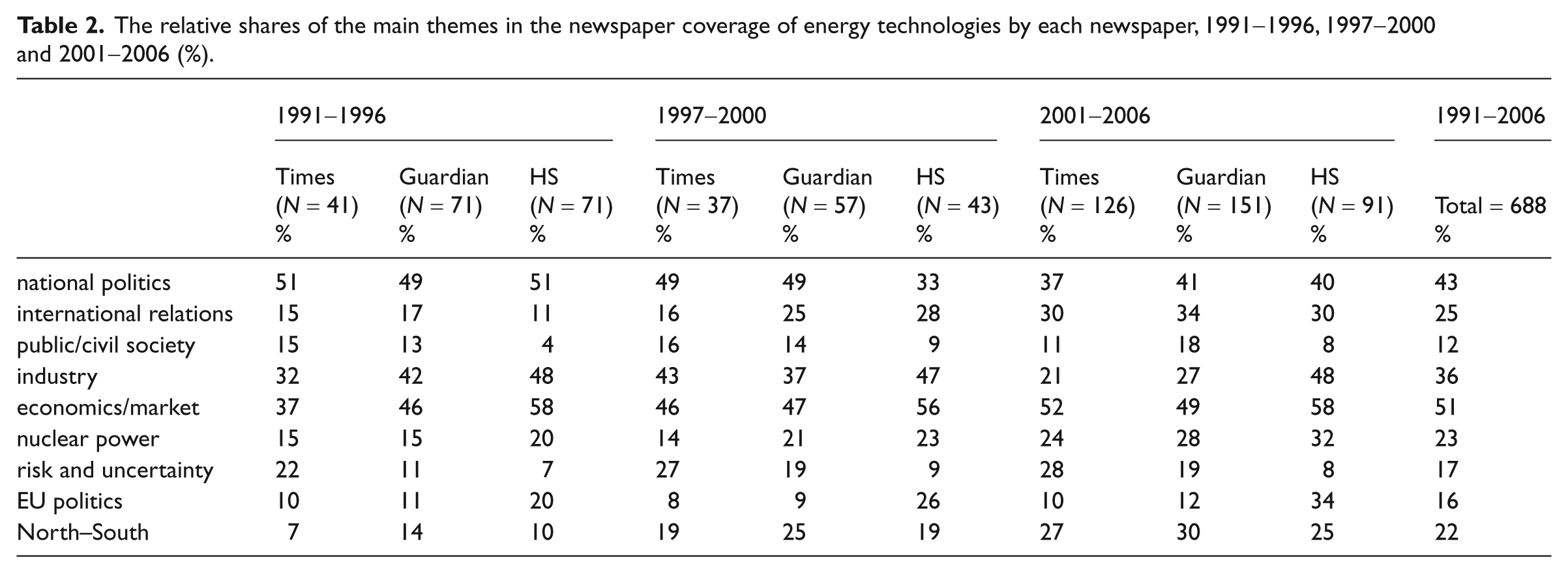
Based on these findings, the media coverage of energy policy can be broadly divided into three main phases: (1) Climate change penetrating into national political agendas (1991–1996), (2) Towards an eco-modernist approach (1997–2000) and (3) Technologisation of energy policy (2001–2006). The following sections focus on the ways energy technologies have been portrayed in these three phases, particularly in relation to the key themes (Table 2) inherent in the media representations.
The relative shares of the main themes in the newspaper coverage of energy technologies by each newspaper, 1991-1996, 1997-2000 and 2001-2006 (%).
4. 1991–1996: Climate change penetrating into national political agendas
The UK 1991–1996
Led by prime ministers Margaret Thatcher in the 1980s and John Major after 1990, successive Conservative governments reformed the British energy sector by liberalising the energy market and privatising state-controlled energy companies (Helm, 2003). At the same time, climate change began to pave its way into the national policy agenda. Environmental organisations had reproached the UK for being “the dirty man of Europe” because of the acid rain problem in the late 1980s. In 1988, under increasing public pressure, Thatcher suddenly raised climate change to a high-priority issue to address environmental questions (Carvalho, 2005; Cass, 2007). Yet energy technologies did not have much policy relevance in this approach. While the government focused on advocating international climate policy negotiations (Rootes, 2007), it remained reluctant to introduce specified national policy measures or to commit to developing new technologies. Instead, it capitalised on climate change by justifying difficult political questions, such as gasoline taxes through emission reduction targets, and conditioning environmental policy decisions through economic concerns (Rootes, 2007).
In the early 1990s, the UK media frequently commented on national politics (Table 2), criticising the government for failing to establish an effective energy policy. Not only did The Guardian (24 January 1991) call for significant political reforms such as green legislation and systemic changes, but also The Times was critical towards government policies, claiming that they “should be more long-term and well considered than privatising nuclear power to fund one-off tax cuts” (24 April 1995). To some extent, concerns also arose about the level of government support for green technologies. The Guardian noted in 1996 that “during the six-year period when fears of global warming were being confirmed, government support for new and renewable energy technologies fell by nearly one-third” (6 July 1996). Both newspapers also highlighted the economics of energy technologies (Table 2), pointing to the inability of British companies to take advantage of the growing international market. The Guardian attacked the government for failing to establish an adequate regulative regime to promote emerging environmental technologies and to formulate national energy policy. Referring to an annual industry survey, it reported that among the biggest obstacles for British firms are the “poor enforcement of green regulations and a lack of incentives” (15 January 1996). In this sense, The Times was also critical towards the Conservative government. It referred, for instance, to a report prepared by a lobbying group, the Environmental Industries Commission, claiming the following: Britain is in danger of missing out on the fast-growing, multi-billion pound, global market in green technologies without firm government action to strengthen the market here and spearhead an export drive. (21 April 1995)
The UK newspapers also referred to techno-economic development at the international level more frequently than did Helsingin Sanomat (Table 2). The Times pointed out that the market was dominated by Germany, the US and Japan, whose governments “have more vigorously enforced environmental laws that have stimulated the market in green technologies” and “provided tax breaks and fiscal incentives for such devices and services while supporting more research and development” (21 April 1995). Similarly, The Guardian noted that “foreign companies are winning an increasing share, partly because of a more helpful regulatory and financial environment” (15 January 1996). Yet links between energy technologies and climate change remained ambiguous. In terms of environmental concerns, the media largely addressed rather traditional issues such as air pollution and waste management, representing environmental problems primarily in terms of finite ecological resources.
Finland 1991–1996
In Finland, the right–left Holkeri government (1987–1991) introduced an export-oriented economic growth programme based on market deregulation and strong state support for export activities. These objectives were encouraged by the commitment to “secure an undisturbed and inexpensive supply of energy for national industry” (Cabinet Programmes, 1987–1995) and by aggressive research and development (R&D) investments focused on select technological areas such as the environment, telecommunications and energy that were perceived as having substantial economic potential. Additionally, as part of the market liberalisation programme, the national electricity market was opened for international competition, and the earlier state-owned national power line network company was re-established, with industrial companies becoming its majority shareholders in the mid-1990s.
In Finland, the emphasis on national politics, industry and the economy was even stronger than in the UK in the early 1990s (Table 2). Helsingin Sanomat yielded support for the government’s objective of strengthening R&D in the energy sector and praised the launch of a large state-funded research programme, SIHTI, for promoting concerted national efforts to foster energy technologies and their access to international markets (27 March 1991). Even in the middle of the economic recession, it underlined that both public R&D investments and trust among decision makers in the growth of the international market continued to increase. Unlike in the UK, in Finland energy technologies were perceived as one of the most promising “industrial clusters” to offer new economic opportunities. This was emphasised by pointing to heavy industry’s vulnerability to economic fluctuations and by the suggestions of the newly appointed President Martti Ahtisaari to create new technology-led industrial clusters such as the cluster of environmental technology (HS, 24 May 1994). In addition, Helsingin Sanomat highlighted increasing export opportunities in several articles concerning technological cooperation between Finland, the Soviet Union and the Baltic countries (6 March 1991, 19 April 1991) and the exportation of technological knowledge to other countries such as the UK, whose technological know-how was considered outdated (11 April 1991). Developing energy technologies was thus portrayed as an integral part of national export-oriented industrial policy with little connection to sustainable development or climate change – although these were gaining increasing prominence in broader political discussions (HS, 22 October 1993, 1 February 1995; Cabinet Programmes, 1991, 1995).
Yet another issue shaping Finnish energy policy discussion in the early 1990s was nuclear power (Table 2), an issue that divided opinions between and within political parties and the government. Helsingin Sanomat took a positive stance towards additional nuclear power and typically portrayed it as a non-pollutive and cost-efficient energy source that provided affordable electricity for industrial use. As the government was not unanimous on the issue and there was substantial opposition to nuclear power among political parties, the voting decision in Parliament was left entirely to the discretion of individual representatives (Litmanen, 2009). In September 1993, Parliament rejected the government’s proposal of building a fifth nuclear power plant (votes 107–90). Contributing factors to the decision included general uncertainty about Finland’s economic future in the midst of economic recession, the collapse of the Soviet Union, which emphasised questions concerning nuclear waste management and export, and the 1986 Chernobyl accident that still remained strong in the public’s memory (Litmanen, 2009). Moreover, opponents’ arguments gained legitimacy from the UNFCCC’s idea of ecological sustainability, which was interpreted by the government and Parliament’s commerce committee as adjusting energy production to the world’s ecological carrying capacity (Kyllönen, 2004).
Despite increasing enthusiasm about new technologies at a general level (Cabinet Programme, 1991; HS, 18 April 1993), Helsingin Sanomat ignored policy options other than coal after nuclear power was excluded: “the much talked of natural gas option, a gas pipe from the coast of mid-Norway, is not a viable option with this schedule … relying increasingly on coal seems unavoidable” (25 September 1993). The 1993 nuclear decision was reflected also in the 1995 government decision-in-principle on energy policy that did not comment on nuclear power. Instead, it emphasised energy saving and changes to taxation that favoured energy producers. At the same time, however, the nuclear power lobby was already constructing a pro-nuclear political network within and outside Parliament.
5. 1997–2000: Towards an eco-modernist approach
The UK 1997–2000
After the Conservative governments’ policies of deregulation, privatisation and decreasing public investments in energy technologies (The Guardian, 6 July 1996; Cass, 2007; Rootes, 2007), the appointment of the Labour government in 1997 raised new political expectations in environmental policy. The Labour election manifesto (1997) suggested viewing environmental protection and economic growth no longer as alternatives to each other but rather as a “win–win” solution. It highlighted “new green technologies” as both creating jobs and contributing to environmental protection.
Despite international policy developments, most importantly the Kyoto Protocol (1997), both newspapers largely focused on national politics (Table 2). While The Times (14 April 1997) remained sceptical about the government’s eco-modernist policy orientation and raised doubts over the compatibility of environmental protection with job creation and maintenance, The Guardian took a positive stance towards achieving both environmental and economic objectives through new technologies. It claimed that the UK was backward in this respect and needed “tougher environmental regulations and committing to green taxation and public expenditure priorities” (27 April 1997) to take advantage of the rapidly growing market for energy technologies. The UK was perceived as trailing the global market because of the previous governments’ fixation with free markets, deregulation and cost-cutting; many felt it should have followed the example of other countries that had focused on planning, public investments and regulation: Estimates already put the total value of the global environmental market at $400bn a year, but at the moment the jobs and the rich profits are going to the Germans, the Japanese, the Americans and the Scandinavians. (The Guardian, 19 May 1997)
In comparison to Helsingin Sanomat, the UK media referred to public opinion and concern more frequently throughout the three periods (Table 2). Unlike in Finland, however, in the UK energy technologies remained relatively marginal in the public debate in the 1990s. Although it praised the government for allocating funds for technology initiatives such as the environmental technology company EIC Export Services in 1997 and “taking environmental issues seriously for the first time in its Green Budget” (11 October 1997), The Guardian noted a rather low level of public recognition of technology. Yet, if you mention the sector this company operates in, most people will switch off. In Britain, at least, few see environmental technology as a cutting-edge industry and an engine for jobs and prosperity. (13 October 1997)
The increasing emphasis on energy technologies was also confronted by emerging controversies between technology developers, decision makers and stakeholders. For instance, the plans to build large-scale wind farms met strong resistance among local nature conservationists because of wind power’s allegedly high price, unreliability and visual intrusiveness. The Times supported these claims by noting that although wind power would represent an endlessly renewable, safer than nuclear power and non-pollutive energy source, wind turbines would be located in “some of the wildest and most beautiful landscapes in Britain” and would have marginal contribution to emission reductions (20 May 1997, 20 March 1998).
Public reluctance regarding energy technologies was also reflected in discussions concerning the price of alternative energy sources. The Times reported on 20 March 1998 that one major obstacle hindering greener policies was that few consumers would be prepared to pay a premium for renewable energy. Similarly, The Guardian claimed that few would buy eco-friendly houses (11 December 1999) or value renewable energy sources over fossil fuels (14 September 2000) because of green technologies’ weaker price competitiveness in relation to fossil energy sources.
Given the Treasury’s alleged “long record of ignoring or blocking green measures” (The Guardian, 14 March 1998), doubts endured in the media regarding the government’s commitment to taking a tougher course in energy policy. This was rooted in public attitudes, including certain scepticism towards the government’s capability of transferring political rhetoric into concrete policies. Soon after the 1997 election, the Labour government was criticised for failing to establish energy policy or take action to combat climate change. The Times (10 June 1998) referred to a cross-party committee of MPs that attacked the government for “lacking leadership in energy technology development and export strategy.” The Guardian accused the Labour Party of failing to redeem its pre-election promise of a road tax reform (17 March 1998) and published a commentary criticising Gordon Brown for “breaking the government’s manifesto promise to put the environment at the heart of policy-making” (23 March 1998).
Similar concerns arose throughout this period, as the credibility of the Labour Party’s ambitious promises was weakened by Tony Blair’s remote public visibility on environmental issues. A 2000 Blair speech was characterised as his first green speech since having been appointed as Prime Minister. The Times (25 October 2000) argued that Blair not only was too late in greening but also was incapable of producing a convincing policy framework. The Guardian (25 October 2000) applauded Blair’s intention of “pushing green issues back up the political agenda” but criticised him for lacking concrete initiatives. Moreover, the fall of carbon emissions was claimed to have been “entirely fortuitous: a lower carbon fuel (gas) was cheaper than a high carbon fuel (coal). But reliance on gas will not bring deep and long-term cuts in emissions” (The Guardian, 22 February 2000).
Finland 1997–2000
While the British media represented technology as an economically potential but politically marginal opportunity, Helsingin Sanomat supported the respective governments’ export-oriented economic growth policies and emphasised the competitive advantage that energy technologies had already brought to the Finnish economy. Although the EU’s relative weight and international politics strengthened in this period, its energy technology articles were still largely dominated by the themes of market and industry (Table 2). On 27 November 1998, Helsingin Sanomat reported that the volume of Finnish energy technology exports had tripled during the past decade, amounting to almost 10% of the total export of goods and exceeding the OECD average. On 19 August 1999, it highlighted the importance of wind power components and diesel boilers, pointing out that energy technology exports had already quadrupled in the 1990s. Representing Finland as “a success story” thus served to legitimise three kinds of political aims.
First, it strengthened national political expectations regarding the potential of new technologies. With the ICT sector leading the way in the late 1990s, there was strong trust among national decision makers and the media concerning technology’s capability to create economic growth and societal well-being. Helsingin Sanomat (26 July 1999) called for public support of risky energy technology projects, arguing that the national industry’s energy efficiency, increasing demand for gasification, wind power and nuclear safety technologies, and Finnish world-class know-how provided a good basis for creating technological leaps in the energy sector.
Second, it contrasted technological and economic development with tightening climate regulation, particularly the EU emission reduction targets. In this respect, Helsingin Sanomat (13 December 1997) advocated looser emission reduction obligations because “Finland already is among the leading countries in the world in energy efficiency” and “almost all means available to decrease emissions are already in use.” It also defended the Finnish official representatives’ resistant stance in the EU negotiations, claiming that the proposed targets would cause severe troubles to national industry. Here Helsingin Sanomat thus prioritised traditional industrialist and corporatist concerns over a high-technology-led climate policy approach.
Third, Helsingin Sanomat provided legitimacy to the government’s market-oriented policies that raised the functioning of the market above other political objectives. Its orientation was therefore to retain the politico-economic status quo, and hardly any criticism towards government policies was visible. In articles about the Kyoto Protocol, for instance, Helsingin Sanomat emphasised opening international markets and new business opportunities on the one hand and the consequences of emission reduction obligations to the economically important heavy industry on the other.
In both countries, the question of nuclear power was raised in the media in the late 1990s. The Finnish government’s energy policy review in 1997 and the British cross-party Trade and Industry Select Committee’s energy review in 1998 suggested that additional nuclear power might be needed in the future. While the British media claimed that this would require a huge shift in public opinion (The Times, 10 June 1998) and that it would face “big political challenges” (The Guardian, 22 February 2000), Helsingin Sanomat openly advocated nuclear power and supported the government’s renewed interest in building an additional power plant. Although Helsingin Sanomat had been supportive towards nuclear power throughout the 1990s, the latter half of the decade marked a more favourable political context for advocating nuclear new-build. Enough time had passed since the Chernobyl accident, the consensus between the two major pro-nuclear government parties narrowed the space for generating critical public debate, and nuclear lobbying was becoming more systematic and professional. Moreover, the emerging economic growth prospects were accompanied by the government’s strong technology policy and public trust in government, science and technology (Kyllönen, 2004; Litmanen, 2009). On 19 December 1997, referring to its own survey, Helsingin Sanomat reported that for the first time since the 1986 Chernobyl accident, a slight majority of Finns (51%) supported a fifth nuclear power plant at least “to some extent.” Yet another study (Yhdyskuntatutkimus, 2010) suggested only minor changes and substantially lower public support (35%) for this.
6. 2001–2006: Technologisation of energy policy
The UK 2001–2006
In the UK, the number of energy technology articles rose significantly from 2005 onwards, indicating a shift towards greater public awareness of technology. Signs of this shift were visible throughout this period. In 2002, The Times highlighted the growth prospects of new energy technologies, claiming the following: … this is the case of when, not if. The drivers of growth are there for all to see. Heightened awareness, particularly among the young, of the damage done to the environment by fossil fuels should stoke demand. And even governments are beginning to give serious consideration to alternative sources of power, such as wind, biomass, solar power and hydrogen fuel cells. (1 June 2002)
The Guardian (13 June 2001) used in a similar vein the term “clean rush” to describe British companies’ continuously increasing investments into the fast-growing sector of green technology. Yet to some degree, both newspapers emphasised uncertainty regarding the government’s commitment to this shift. The Guardian (27 February 2003) pointed to industry representatives’ concern over high political risk in “green projects” and the related criticism of Blair’s ambitious climate change rhetoric in contrast to the government’s insufficient financial support for new technologies. It also became increasingly visible that the government’s approach, which was still largely based on market dogmatism, would not sufficiently encourage the development of low-carbon technologies. Particularly since the Kyoto Protocol entered into force in 2005, public investments in environmental technologies were often required (e.g., The Times, 12 March 2005).
The publication of the Stern Review strengthened expectations of “a big shift towards a new environmental agenda” (The Times, 8 December 2006), entailing support for “the development of low-carbon and high-efficiency technologies” (The Guardian, 31 October 2006). Yet The Guardian (12 June 2006) highlighted political and regulatory uncertainties and called for “smart regulation” and changes in public procurement policies. Quoting Neil Carson, a chief executive of Johnson Matthey, it stated (7 June 2006) that “strong policies to tackle climate change could give UK businesses an advantage in the new global markets for low-carbon technology.” The Times (31 October 2006) similarly argued that “Mr Brown is right to see a competitive opportunity for environmental technologies” but remained cautious towards the emerging technological enthusiasm: Talk of clean or green energy implies that there are ways to secure our future power without environmental damage. This, of course, is an illusion. There are always compromises that have to be made with the planet. (19 December 2006)
Technological uncertainties also prevailed in relation to other “green” technologies, illustrated for instance by the newspapers’ commentaries on the “zero carbon” homes that were advocated by Chancellor Gordon Brown: There are worries that the homes will not work. That is the way with green technology. One minute it’s the answer to all our problems, the next some scientist discovers that it gives you cancer, requires the liquidation of the world’s beaver population, or produces a new form of rain that kills toads. (The Times, 10 December 2006)
While Helsingin Sanomat placed relatively strong emphasis on the EU level, the UK media represented climate change as an inherently global problem and as part of international politics (Table 2). In its leading article, The Times (9 December 2004) assessed the government’s announcement of its failure to meet its self-imposed emission reduction target in 2010 as “honest” but “irrelevant” in the context where “global efforts to cut carbon emissions are confined to the framework of that [Kyoto] protocol” and argued that Britain’s claim of moral leadership in climate change negotiations would mean little because “no purportedly global climate change agreement can be truly global, or effective, without American support.”
The UK presidency of the G8 in 2005 raised new hopes of creating an international climate policy regime. After shifting his target-based approach to favour “informal mechanisms” with the hope of persuading the United States to accept an international climate agreement, however, Blair was criticised for failing to fulfil his climate promises both domestically and in international negotiations. The government was also accused of seeking economic success through a “fossil-fuel fantasy” instead of taking action to drive the development of clean technologies (The Guardian, 12 February 2006). Moreover, the rising prices of fossil fuels together with the recognition of developing countries’ strengthening role in the global energy economy further highlighted the concern over the failure to take advantage of new technologies (The Times, 12 March 2005). These concerns also raised nuclear power back into public discussion, fuelled by Prime Minister Blair’s (2006) announcement that “nuclear power is back on the agenda with a vengeance.”
Finland 2001–2006
Although earlier energy technologies were seen primarily as a high-potential, fast-growing industrial cluster providing a competitive advantage for Finnish industry in the international market, the early 2000s saw the strengthening of technology also as a key tool in combating climate change (HS, 29 March 2001, 12 February 2003). Helsingin Sanomat represented energy technologies as capable of not only fostering employment and Finnish companies’ competitiveness in international markets but also contributing to the development of cleaner energy sources and energy-efficient production and consumption. This implied a shift from seeing climate change as an additional cost to viewing it as a profit opportunity and stretching the understanding of technology from the earlier industrial policy orientation towards the framework of mitigating climate change. Integrating these policy fields was still, however, largely interpreted as adopting the tenets of technology/innovation policy in the environmental sphere rather than as greening other policies (cf. Teräväinen, 2010). Moreover, the trust in (certain) technologies’ capability to decouple economic progress from environmental degradation fit the government’s broader innovation-led and growth-oriented policy approach. Helsingin Sanomat therefore continued to support the government’s rather selective competitiveness agenda. This entailed promoting selected elements of ecological modernisation and conditioning this selection through Finnish industry’s international competitiveness – indeed, almost all articles on the theme “industry” (Table 2) emphasised this national long-term objective.
The EU Emissions Trading Scheme raised concerns in Helsingin Sanomat about the competitiveness of the national export-oriented heavy industry (9 October 2004), the price of electricity (14 December 2005) and the cost burden potentially transferred to taxpayers (4 March 2004). It was also portrayed as a threat towards investments in national power production capacity and the then voluntary-based climate policy (HS, 20 January 2002). These viewpoints clearly indicated the prevailing tendency to prioritise industrial competitiveness over other policy objectives. In this sense, Helsingin Sanomat legitimised the government’s selective technology policy orientation, favouring those renewable energy sources that would not require large additional investments or structural changes and would not threaten Finland’s “international competitiveness.” Using the same reasoning, nuclear power was typically represented as a “clean” and “cost-efficient” energy source necessitated by Finland’s Kyoto obligations, the survival of national industry, energy security and welfare, and the global need for large-scale “clean” energy technology (9 May 2002). In spring 2002, Helsingin Sanomat appraised Parliament’s decision to give a construction licence for a fifth nuclear power plant: “energy policy can now rely on diverse forms of energy production without having to compromise climate policy demands” (25 May 2002).
Towards the mid-2000s, however, researchers and politicians increasingly challenged the highly optimistic ideas of creating “Green Nokias” (HS, 29 March 2001, 18 March 2004), recognising the limited potential of technology to reduce greenhouse gas emissions, the failures of using existing technologies, the need to reduce energy consumption, and the call for better regulation in technology markets (HS, 25 April 2006, 23 September 2006). At the same time, energy became an increasingly strong societal and political issue. In Helsingin Sanomat guest editorials, climate and energy policies were seen also as questions of values and a factor in international conflicts and struggles over resources (e.g., former Minister of Finance Niinistö, 6 June 2006; Professor Massa, 7 November 2006). As in the UK, the role of developing countries was also increasingly recognised. On the one hand, China and India, in particular, were represented as highly potential market areas for expanding technology exports. On the other hand, developing countries were increasingly portrayed as actors in the global economy, which raised new questions regarding their right to economic development and responsibilities towards emission abatement.
7. Concluding remarks: changing interpretations of technology
The analysis indicates that media representations of energy technologies were in both countries shaped by national characteristics such as patterns of energy consumption, economic production structure and political culture. Whereas in Finland energy technologies were seen as an integral part of successive governments’ policies of technology-led economic growth over three decades, the UK did not see the growth of their political weight until the 2000s. Moreover, Helsingin Sanomat embodied the national consensus-seeking orientation accompanied by the public’s trust in state institutions and continuously supported government policies. Conversely, the British media remained critical towards successive governments, reflecting the “institutional recreancy and suspicion” (Bickerstaff et al., 2008: 162) typical of British politics.
At the same time, the two countries had much in common. The governments’ normative principles of economic growth and free markets, which also shaped media representations, were accompanied in the early 1990s by a concern over climate change, arguably reflecting the UNFCCC and the growing public salience of emission reduction commitments in many countries (cf. Cass, 2007). Both countries also saw little critical reporting on the existence of climate change, unlike the situation in the United States (cf. Boykoff and Boykoff, 2004) and often focused on US–EU conflicts in this respect. According to Brossard et al.’s (2004) study on French and US media, this might relate to the way European identity is dealt with as an international political power. While recognising the need to correlate economic growth with environmental protection and sustainable development (WCED, 1987), however, media representations in both countries focused on traditional environmental and economic concerns. Technology and climate change were discussed largely as separate issues, although for different reasons. While in Finland, technological development was a crucial part of national export-oriented industrial policy, in the UK, technology had only a minor role in the media discussion that centred on criticising the government for a lack of effective energy policy.
In 1997–2000, governments in both countries continued to interpret climate and energy policies in an economic framework and avoided specified targets about national-level action. In the UK, newspapers responded to Blair’s promises of a “green revolution” and of making the UK a “global leader in climate policy” by calling for stronger government action and a long-term energy strategy. Conversely, Helsingin Sanomat supported the government’s export-oriented policy and, countering EU policies, remained sceptical towards tightening national emission reduction targets. It also used these arguments in advocating additional nuclear power. Unlike in the UK, however, the Finnish market orientation was, significantly, a state-led programme of techno-economic development. Helsingin Sanomat also had an undefined position regarding the emerging discussion of global responsibility that in many countries, including the UK, Germany and Denmark, gained notable public attention (cf. Cass, 2007; Petersen, 2007).
In 2001–2006, connections between technology and climate change strengthened in national policies. Whereas earlier, particularly in Finland, energy technologies had been typically viewed as tradable commodities in the international market with primarily economic value, they were now referred to as an important means of combating climate change. This also indicated a change in the way climate change was discussed. In both countries, tackling climate change transformed from an additional cost towards a profit opportunity, especially because of new technologies’ economic and environmental potential. This also served to justify nuclear new-build in both countries. At the same time, however, energy technologies were seen as related not only to cleaner energy production and economics but also to international power struggles and conflicts.
The analysis also points to a transformation in the ways relationships between technology, society and the environment have been conceived. This has entailed a shift from an eco-centric view (techno-economic development threatening the eco-system) towards techno- and socio-centric understandings (technology solving environmental problems; energy also as a question of justice, equity, peace and welfare). Consequently, technology has gradually become perceived as having not only environmental and economic impacts but also increasingly political and social significance. This implies an emerging multi-polar worldview in place of the division between the “industrialised” North and the “developing” South. Since the early 2000s, developing countries have been in both countries portrayed as actors in the global energy economy, which has raised questions regarding the role of the EU in the global politics of climate change (cf. Brossard et al., 2004; Petersen, 2007). The international emphasis on energy technologies, together with debates concerning a global climate regime, thus open new questions for comparative research on changing perceptions of technology in an increasingly global setting.