







Abstract
This study is about how lay persons perceive and represent artificial intelligence in general as well as its use in weaponised autonomous ground vehicles in the military context. We analysed the discourse of six focus groups in Estonia, using an automatic text analysis tool and complemented the results by a qualitative thematic content analysis. The findings show that representations of artificial intelligence-driven machines are anchored in the image of man. A cluster analysis revealed five dominant themes: artificial intelligence as programmed machines, artificial intelligence and the problem of control, artificial intelligence and its relation to human life, artificial intelligence used in wars and ethical problems in developing autonomous weaponised machines. The findings are discussed with regard to people’s tendency to anthropomorphise robots despite their lack of emotions, which can be seen as a last resort when confronting an autonomous machine where the usual interpersonal understanding of intentions does not apply.
Keywords
1. Concerns
In his novel ‘Klara and the Sun’, Kazuo Ishiguro (2021) describes a utopian world where artificial ‘friends’ pay company to lonely children. These are highly developed robots with the ability to learn and remember aspects of their surroundings and the talk and behaviour of their human friends. Towards the end of the novel a person talks to the principal artificial friend figure and tells her (sic) that there’s growing and wide-spread concern about [artificial friends] right now. People saying how you’ve become too clever. They are afraid because they can’t follow what’s going on inside [. . .] They accept that your decisions, your recommendations, are sound and dependable, almost always correct. But they don’t like not knowing how you arrive at them. That’s where it comes from, this prejudice (Ishiguro, 2021: 297).
One of the ideas to meet the concerns is to ‘take a look under the hood’, by reverse engineering the innards of people’s artificial friends.
In this episode of Ishiguro’s novel, he expresses the widespread uneasiness about the workings of artificial intelligence (AI) among lay people and some experts. People feel that this technology and its workings are mostly opaque to them, and they request help to understand the innards of this technology. In fact, lay persons tend to be worried about complex technologies whenever such a technological development enters their everyday lives, whether it was the invention of steam machine-driven trains in the nineteenth century or the genetic engineering of plants and animals to render them resistant to pests or to extend the expiration date of perishable vegetables (e.g. Gaskell et al., 2000; Pivetti, 2007).
This article is about the perception and social representation of AI used in ground-bound autonomous military vehicles, weaponised or not, as found with focus-group discussions in Estonia. We analyse the discourse using IRAMUTEQ, a tool for the analysis of large text corpora, and amend the results with qualitative thematic content analysis.
2. Representing AI
Symbolic coping with new technology
In theoretical terms, we follow the guidelines of social representation theory (Jovchelovitch, 2019; Moscovici, 2000; Wagner and Hayes, 2005). In this theory, everyday knowledge results from, and is elaborated in, communication and personal and mass-mediated discourse in communities. Simultaneously, a widely shared system of social representations is a prerequisite of communication as representations provide the background upon which meaningful interaction can unfold.
The theory of collective symbolic coping applies social representation theory to model lay persons’ understanding of new scientific and technological developments (Kronberger et al., 2009, 2012; Wagner et al., 2002b). It suggests a scheme of how people cope symbolically with new and potentially threatening technology in discourse including mass media. The process involves four steps: awareness, divergence, convergence and normalisation. First, a significant proportion of the public needs to become aware of a new technological development that triggers the attention of media. Once mass media, the press, TV and social media on the Internet take up the issue, we observe the use of an increasing number of often fantastic images that are supposed to capture the gist of the novel in iconic form. The longer an agenda thrives in the media, the more the circulating imagination will converge to a few that are considered particularly fitting. The emerging images act like memes by spreading the gist of a representation and a simplified understanding of the technology. In genetic engineering, it was the idea of ‘natural’ tomatoes being ‘corrupted by artificial genes’ (Wagner et al., 2002a). In the case of AI, a simple web search reveals the present state of how the public imagines AI. The images symbolising AI feature humanoid robots supposedly engaged in thinking and contemplation. A random web search reveals surprisingly convergent images that depict an idealised computer circuit projected onto a human brain. This imagery of AI is inseparably related to humans and the human brain. It merges the idea of intelligence as a specific human feature that is being implanted or mimicked in computers and their algorithms. Similar imagery has been used in science fiction films and novels (Viidalepp, 2020).
It must be stressed that public understanding of AI as exemplified by the images floating in the media is a socially constructed representation that allows people to follow conversation and participate in public discourse. This representation does not need to be a veridical reproduction of the issue. The main function of a representation is to provide an imaginary understanding that allows following media communication and partaking in a discursive community (Wagner, 2007).
The concept of AI
The concept of AI dates back to 1955, when McCarthy et al. (2006: 12) proposed a summer project for 1956 to find out how to make machines that can simulate human intelligence. Ever since, the concept has been used to describe a variety of things, systems and phenomena mostly pertaining to the idea of a certain direction in technological development. Over decades, intelligent machines have been equated with problem-solving processes (McCarthy et al., 2006; Simon and Newell, 1971), ‘physical symbol systems’ (Newell, 1980) and neural networks (Castelle, 2020; Rosenblatt, 1958). Hence, AI would be a computer system ‘that exhibits the characteristics which we associate with intelligence in human behaviour- e.g. understanding language, learning, reasoning, solving problems etc’ (Born, 1987: viii).
In the opposition of ‘weak’ and ‘strong’ AI, the latter is equated with a dream to achieve a kind of technological development that is equal or better than human cognitive capabilities. The concept has been criticised as an impossible goal in the volume ‘Artificial Intelligence: The Case Against’ (Born, 1987). Hence, all the currently existing technologies belong to the ‘weak AI’ category as specialised solutions that use certain automated functions. The most recent typical designation for AI is ‘algorithm’. In a study about theistic beliefs related to AI, Beth Singler (2020) uses the two concepts interchangeably ‘as this reflects the common public conception of algorithms as being the same as AI’ (p. 948).
Currently, the public meets, uses and has access to a wide variety of applications and technologies that use so-called ‘intelligent’ functions in some of their workings. These include client-relation chatbots, recommendation algorithms, and virtual assistants such as Siri and Alexa. These are all software applications. In addition, the concept is often used to refer to robotic devices, such as autonomous vehicles, robotic lawnmowers and vacuum cleaners, but there is no clear-cut definition of what applications can be considered to be AI-driven in a strict sense.
Perception of AI-driven machines
There is a growing body of literature looking at human–computer interaction in the context of AI and in the field of social robotics, that is, robots interacting with humans (Duffy, 2003; Leite et al., 2013; Serholt, 2018). Duffy (2003) conceptualises social robotics as the ultimate human–machine interface, an alternative approach to ubiquitous computing, where interaction is rendered so transparent that people do not realise the presence of the interface (Castelle, 2020; Rosenblatt, 1958). That is, the best social robot would be the kind that people do not perceive as a robot. Some examples of early social robots include Paro the robot seal and AIBO the robot dog. One desirable application for social robotics is, for instance, assistive or therapeutic care. Studies showed that interactions with the therapeutic seal reduced stress levels of residents at an elderly care house (Leite et al., 2013: 293).
The possibilities and success or lack thereof of AI in health care is a well-researched topic. Using chatbots in health assistance to replace doctors or part of their work is a desirable, but difficult, if not impossible goal. Korngiebel and Mooney (2021) deem synthetic text generators, such as GPT-3, unusable for health care support because they ‘cannot dynamically adjust a conversation or interaction for tone or body language’. However, virtual agents may prove useful in collecting certain patient data in a user-friendly way, provided there is a staff member to supervise and review the data (Korngiebel and Mooney, 2021: 1f).
Over recent years, multiple studies have mapped the associations, keywords and frames used in AI-related discourses in public and social media (Cave and Dihal, 2019; Fast and Horvitz, 2017; Gao et al., 2020; Vergeer, 2020; Yigitcanlar et al., 2020; Zeng et al., 2020; Zhai et al., 2020) or through surveys (Cave et al., 2019; Oh et al., 2019) mostly using quantitative methods. ‘Public perceptions and concerns about AI are important because the success of any emergent technology depends in large part on public acceptance’ (Zhai et al., 2020: 138).
In the United States, support for AI development increases in correlation with the annual income (Zhang and Dafoe, 2019: 7). In other variables, being supportive of AI is more likely for highly educated millennial males with Democratic views and no religious affiliation (p. 5). A similar study was conducted in Australia (Selwyn and Gallo Cordoba, 2021).
Robert Geraci (2008) describes his approach of ‘Apocalyptic AI’ as a way of thinking about technology that closely follows ‘the apocalyptic traditions of western culture’: ‘Apocalyptic AI looks forward to a mechanical future in which human beings will upload their minds into machines and enjoy a virtual reality paradise in perfect virtual bodies’. Two major proponents of this perspective are Hans Moravec and Ray Kurzweil among others (p. 140).
There is also general doubt about a viable human future with strong AI. For example, Yarden Katz contends that the current conceptualisations of AI perpetuate privilege, white supremacy, and raced, classed and gendered models of the self. He outlines what he calls ‘epistemic forgeries’, or ‘the fictions about knowledge and human thought that help AI function as a technology of power’ that ‘work in tandem to produce fear and uncertainty about an impending social transformation ushered in by machine intelligence’. These epistemic forgeries posit AI-based technologies as providing a ‘view from nowhere’, surpassing human capabilities and enabling access to ‘truth’ through computational processes, while in fact the ‘view’ belongs to a white, male, middle-class US citizen, where AI capabilities are largely overestimated when compared to humans, and knowledge is situated and embedded (Katz, 2020: 93-126).
Representations of military uses of AI are particularly likely to trigger fantastic imaginations because of its potential lethal effects, because of involving larger risks, and because it is not part of most people’s everyday life experience. In fact, war always receives prime media attention making war also a frequent topic of lay discourse that triggers emotions. It has been shown that the core of social representations of wars and similar events is defined by affective and emotional elements (Wagner et al., 1996).
To our knowledge, there are barely any studies about lay people’s beliefs about military AI beyond drones (Aydin, 2019; Clothier et al., 2015; O’Dwyer and Ҫoymak, 2020; Steinbrecher and Westphal, 2022). In fact, it was an incident with a drone that triggered new fears about AI-driven killing (Hambling, 2021). Ground-based machines can take different forms, one of which is the well-known robot dog 1 that can be armed with a gun. Other versions of ground-based autonomous military machines are weaponised vehicles that can be tracked or wheeled.
Frequently, the term ‘autonomy’ is used to describe AI-driven machines. For us, this is not the most appropriate term for such systems due to the anthropomorphic connotation of autonomy as a characteristic of personhood. It would be logically correct to write about ‘artificially intelligent automation’, that is a technical system, which has some autonomous functions that are programmed and not the result of some ‘willing’ process (Koch, 2022). Having said that, we continue to use the term ‘autonomous’ in the remainder with the aforementioned reservation.
In this research, we focus on how focus groups represent AI in general and in the context of ground-based military vehicles.
3. Method
Sample
The study was run in Estonia with six focus groups, four Estonian-speaking and two Russian-speaking groups, 2 each consisting of eight to nine participants. In total, 53 people participated, 25 of them female and 28 male. Education levels were mostly mixed. Most participants were not specifically literate in technology (see supplemental material).
Focus–group topics
Discussion topics were developed by conducting a pilot focus group. The final topics consisted of 12 themes which were supposed to initiate a discussion and to provoke statements by the participants.
To give a visual impression of military uses the participants watched a 60-second stimulus-movie showing a small unmanned and weaponised tracked vehicle operating in the forest. 3 In the video, the vehicle operates semi-autonomously and engages with an ‘enemy’ vehicle on the roadside. A shot is triggered by a remote human operator whose hands on the command board are visible in the video. All references to the brand, location and any other textual information had been removed from the video.
The main statements in the main section of the focus-group discussion focussed on the use of armed autonomous vehicles in the military, the question of human control and the respondents’ thoughts about decisions made by humans or machines. Participants were encouraged to imagine facing such a vehicle in armed conflict. One topic focussed specifically on their ideas of the concept of AI and of ethical aspects (see supplemental material for all topics).
4. Text analysis
The original language transcripts were translated to English. This corpus of the discussions was analysed first by an automatic statistical analysis, IRAMUTEQ (Ratinaud, 2009), which is based on the classical ALCESTE package (Reinert, 1990). This statistical package performs a cluster analysis of words that co-occur within an extended text segment, such as a sentence. Based on this step, the programme extracts text snippets and sentences that are prototypical for each cluster (cf. Idoiaga-Mondragon and Belasko, 2019). This method has been used in social representation research in various domains (Idoiaga-Mondragon et al., 2021; Kalampalikis, 2005; Klein and Licata, 2003).
In addition, a so-called similarity analysis produces a tree-graph with vertices and edges that represents the strength of relationship between words (Vergès and Bouriche, 2003). The tree depicts lexical communities of co-occurring words in the corpus. The bolder the edges between the vertices (words), the more often the words co-occur.
Subsequently, a structured thematic content analysis focussed on the prototypical sentences that the programme extracted for each cluster. The researcher identified the extracts’ location in the corpus and investigated its semantic context. By taking into account the discursive events that preceded and followed the extract, the researcher obtained an impression of how the respective sentence was semantically embedded in the discourse.
Combining both methods, the automatic and the qualitative analysis, allows the tackling of textual data from two sides simultaneously, combining structural quantitative statistical text features with qualitative insights into the contextual meaning of structurally significant sentences and paragraphs (see also Bauer et al., 2000; Kronberger and Wagner, 2000). Above all, the results of statistical text analysis appear to converge with certain aspects of qualitative research methods used in social sciences (Allum, 1998; Lahlou, 1996) (see supplemental material).
5. Results
Representing AI in relation to humans
The idea of machines is anchored in humans
The technology of AI in the long run aims at creating computer systems that can mimic decisions and actions that humans can perform due to their natural sub-cortical and cortical system. This is implied by the technology’s name where the term ‘intelligence’ has clear human connotations. Therefore, it does not come as a surprise that thinking and talking about AI reveals a strong connection between humans and mankind on one hand and machines that are driven by AI on the other hand. The similarity analysis shows this exceptionally strong edge between the nodes ‘human’ and ‘machine’ as a central feature (Figure 1). This replicates the findings of an Internet search, where the depiction of AI is also strongly anchored to humans and their cognitive abilities. It should be mentioned that most likely a purely qualitative study would not have revealed the strength of this relationship.
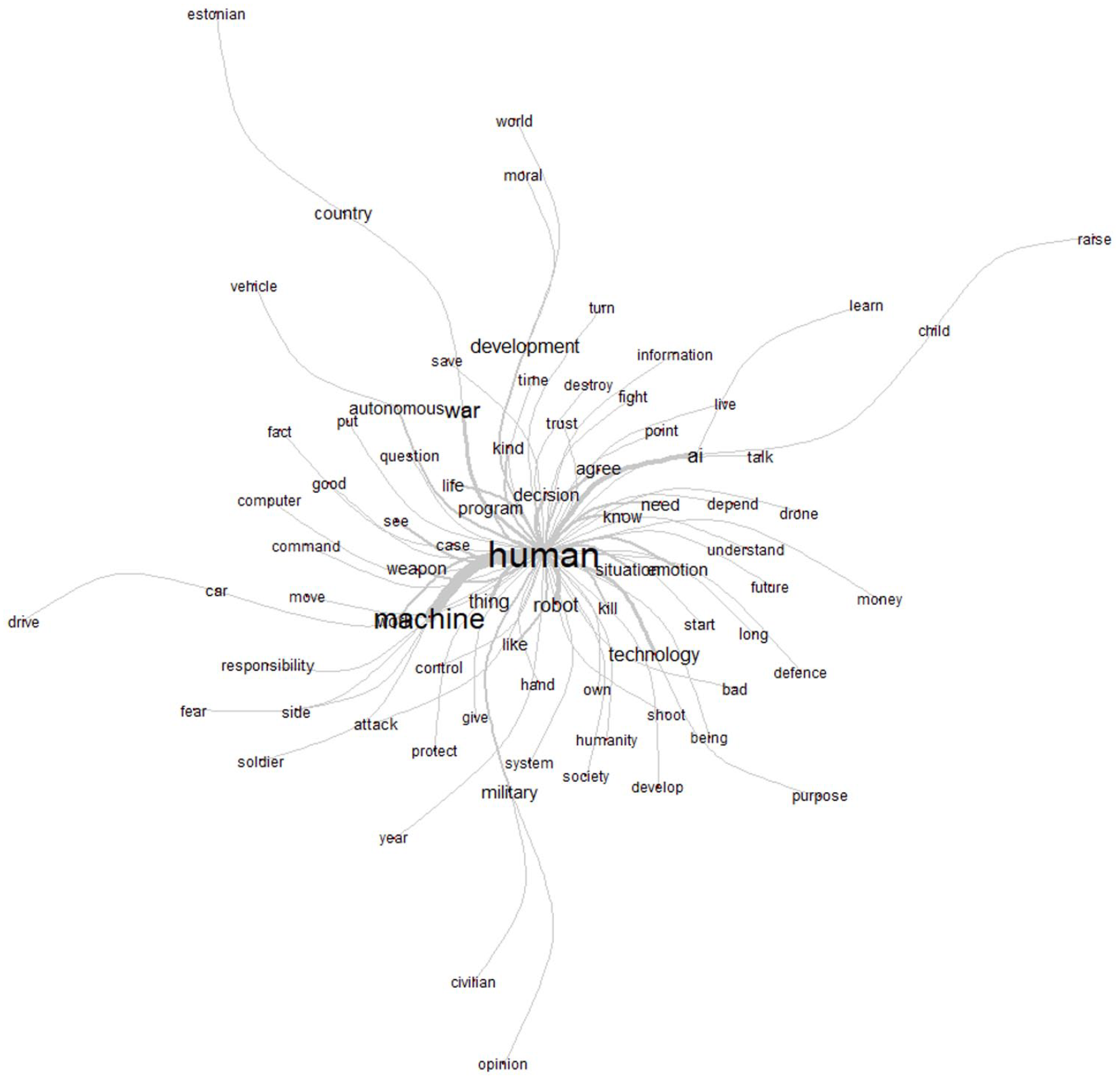
Graph of similarity analysis including words with a minimum frequency of 30.
Figure 2 shows the result of the cluster analysis. It shows five clusters of which three clusters together explain 62% of variance (inertia) and can be interpreted as semantic fields relating to ‘AI as programmed machines’, ‘AI and human control’ and ‘AI in relation to human life’. The latter two clusters ‘AI in war’ and ‘developing weaponised AI’ explain 38.41% of variance.
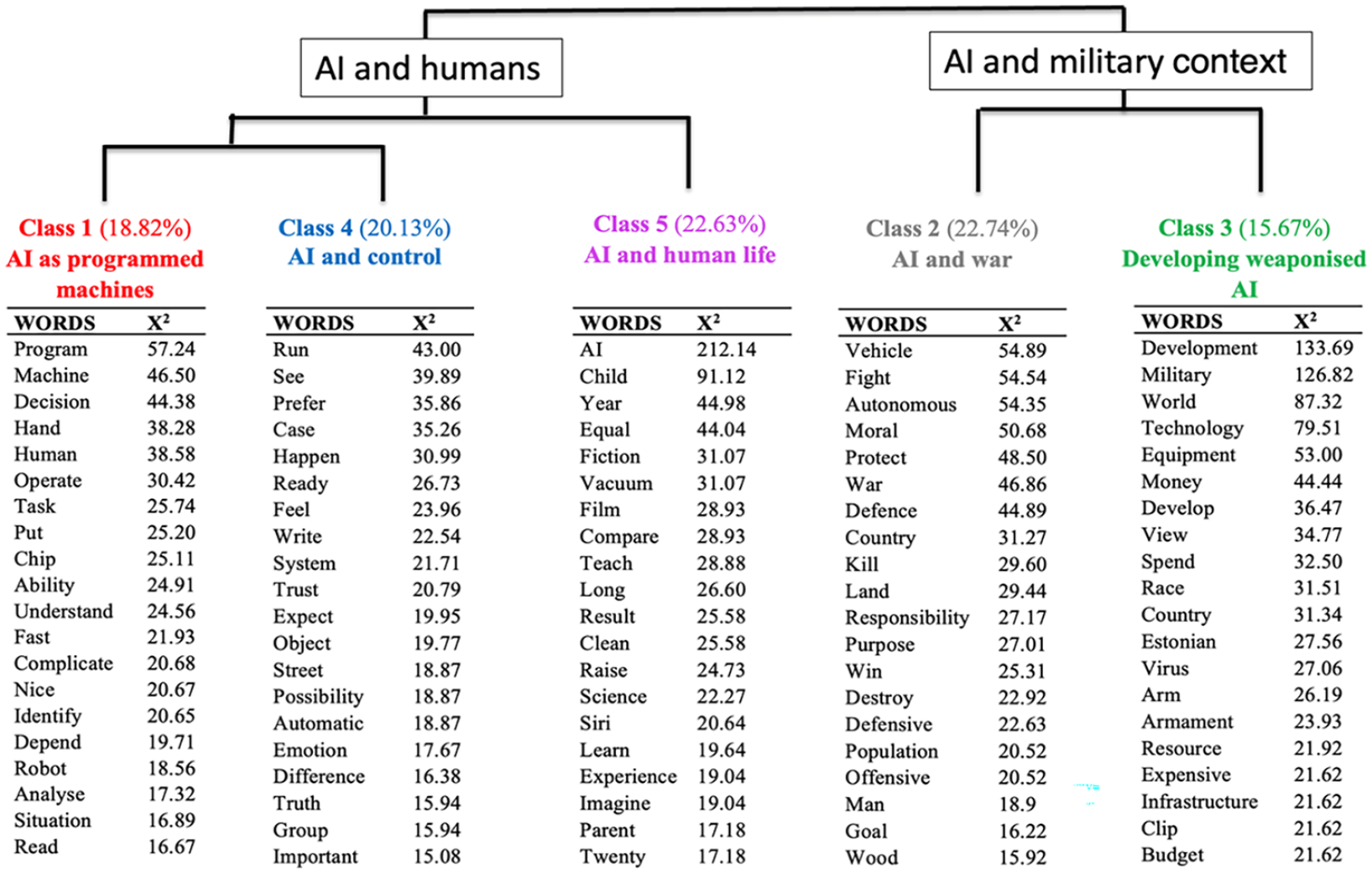
Dendrogram of the hierarchical clustering of the corpus, showing the 20 words with the strongest association for each cluster (χ2(df = 1), p < .001).
The scatterplot of the words pertaining to the five semantic clusters are shown in Figure 3.
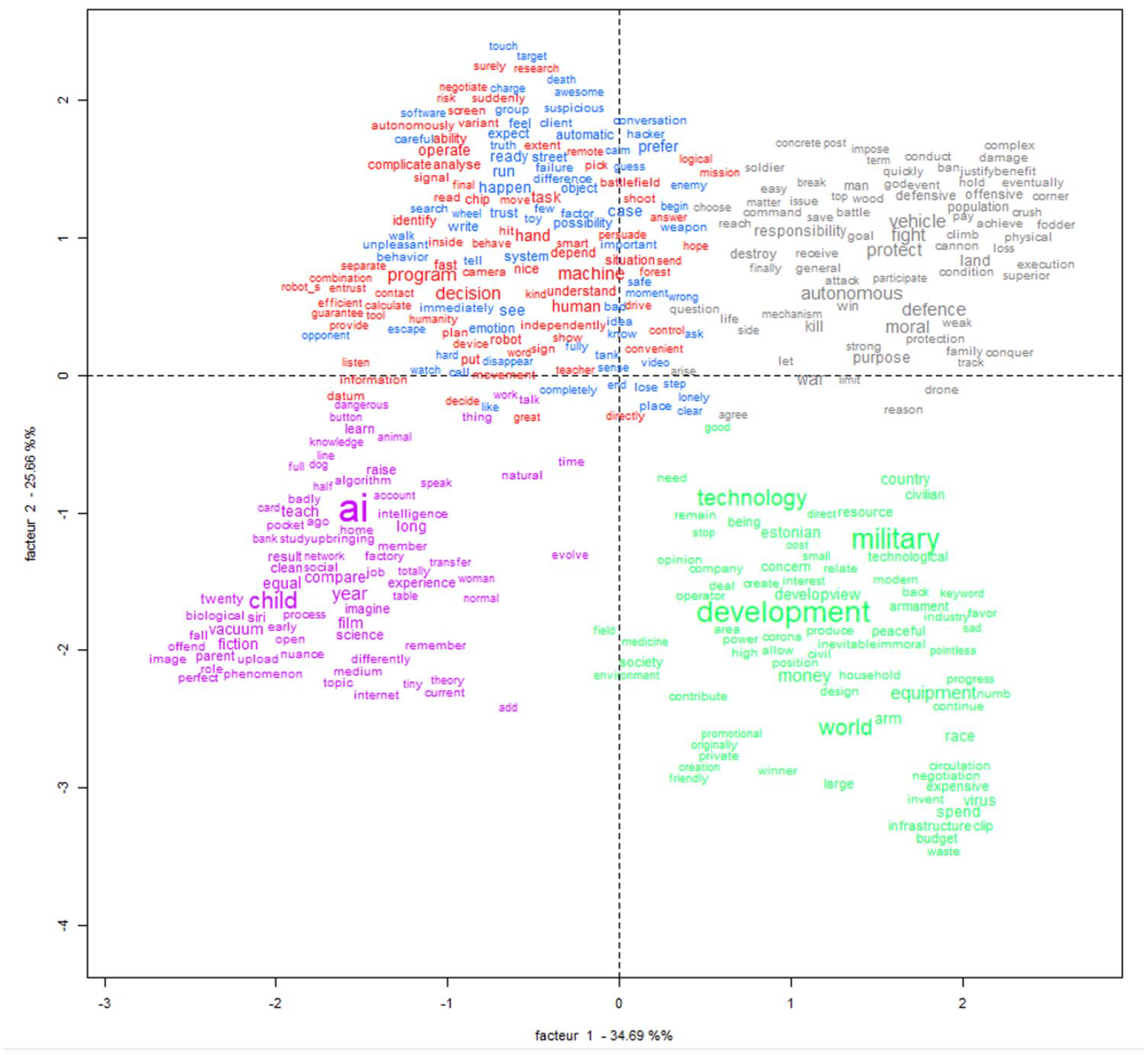
Scatterplot of the words constituting the five semantic clusters resulting from the hierarchical clustering of the corpus on the first two axes (χ2(df = 1) ⩾ 3.89, p < .05). A third axis is needed to separate Classes 1 and 4.
AI as programmed machines
The aspect of ‘AI as programmed machines’ is dominated by an exchange about the character of AI and its autonomy, how AI capable machines are programmed and how an encounter between humans and autonomous machines can be imagined, touching the classic human–machine interface topic. At one point, autonomous machines are defined as a ‘device that can make any movements so that you don’t have to press a separate button for each move’ (
Machines are seen as being programmed to follow unequivocal commands without emotions, which would be important for humans as expressed in this exchange: A person bases their decisions on emotions, technology [bases its decisions on] what it is programmed in. Man’s decisions depend on their upbringing, education. I agree that a person is guided by emotions, and the machine simply listens to commands (
and it all depends on what programs are put on the machine, in that sense I don’t know how much the machine understands my hand lifting (
The mention of hand lifting refers to the fictive situation of meeting a weaponised autonomous vehicle in a combat situation, where lifting one’s hand signals surrender. This encapsulates the concern of several participants about how a machine may be able to communicate with, and to understand humans in an encounter. A misunderstanding of the surrender-signal by the machine is likely to have significant consequences for the human.
The principal focus in this cluster is on the fact of machines being autonomous by programming and training. Such training will enable the machine to act in a clear logical way that allows to perform tasks straightforward and fast. However, when needing to interact with humans, pure logic is not enough because human intelligence also consists of feelings and implicit affective social understanding. In the view of the focus-group participants, this is the crucial part missing with programmed machines. This lack of emotion and understanding emotional affordances in the situation is also a crucial obstacle in human–computer interactions.
AI and control
The experience with supposedly intelligent daily appliances leaves respondents with an understanding that currently existing technologies ‘are not truly intelligent’ as they can only carry out narrow and specific tasks. The machine is sometimes perceived as a nuisance when it malfunctions, or when one needs to ‘get through the chatbot’ before talking to a human. The assumed lack of intelligence in AI implies: It probably won’t happen soon that some artificial intelligence will run such a machine, we certainly won’t see it. In this sense, you can be calm, behind all these technologies, there is still a man” (
In human–machine comparison, the problems of emotions, values and social roles of technologies come up in several groups. Again, respondents deny that emotions currently exist in machines or drive their behaviour even though social robots are mentioned. But, their existence is also seen as a defect of society, because we ought to aim for a kind of society where ‘we don’t need to socialize with robots’. Regarding values, it is stated that ‘humans must teach AI about our values, what is right and what is wrong’, but at the same time, there is the ambivalence that ‘we don’t know ourselves what is right or wrong’. As for the role of intelligent technologies in society and the future of work, one respondent stated that ‘AI should be developed to do the kind of work that is boring to humans’, so that, humans could dedicate themselves to more creative and artistic jobs, but at the same time, ‘AI should not think or decide for me; [and] it should not raise my kids for me’. This also implies that ‘We cannot allow AIs to vote or make decisions about the society yet’.
This raises the issue of control and restrained autonomy where the problem is that the machine as intermediary could be made to do things that ‘a man himself would never do’: When a person writes an order for a machine, it’s extremely easy to carry [bad things] out. Someone can write a command completely emotionlessly that if [the machine] sees some kind of furry object called a dog, [. . .] hit him with a leg ( That is why I prefer that the machine goes to perform actions that a person is not ready to do, or is not ready to take responsibility (
Participants insist that giving autonomy to a machine means that this machine must be fully trustworthy. As this cannot be guaranteed because you ‘can never be sure of technology’ and because mistakes in programming, hacking the software and so on happen, full autonomy should be avoided. Another reasoning opposing autonomy refers to moral responsibility with which humans are endowed thanks to their emotions. Consequently, if human decisions are replaced by machines, nobody can be held responsible for any damage. This entails the conclusion that it is difficult to imagine a fully autonomous, intelligent and reliable technological device at all.
AI in relation to human living
One topic introduced in the discussions was, if the contemporary capabilities of AI in general could be compared to a child’s development of intelligent behaviour at a certain age, such that, one could say that AI is as capable as an infant of, say, 6 months of age or of 2 years of age and so on. Most respondents considered such a comparison as being impossible, but interestingly, in some groups, this topic was understood as relating to using AI machines in child education. Even though the original intention of this topic was misunderstood, the discussion revealed some interesting issues.
It was widely rejected that AI should be involved in family life or be used with children. Robots are considered alien to human biology and behaviour and should not mingle with humans and interfere in human life just as animals do not exist side by side with humans and are only used for certain purposes: Cows have not become equal members of society to humans [despite a long shared history]. It’s the same with AI in my opinion. Suppose I live 1000 years and [. . .] offered to marry AI and have children. I haven’t even seen such a story line in science fiction films ( I have no experience with AI I do not know anything about this thing I don’t think I’d compare this process to raising a real child. Raising a child is connected with many emotion components that I can’t imagine conveying to a machine (
In this sense, robots may fulfil certain functions, such as health care, but family life – as the most intimate sphere of human life – is currently considered inappropriate for AI-driven robotic appliances.
The next excerpt refers to emotions in parent–child relations, which are not part of robots and AI. Moreover, emotions and affect are related to the social conditions of education that also are lacking with programming AI-driven machines: [. . .] human formation is influenced not only by upbringing, but also by heredity and the environment [. . . giving] such a positive result [i.e. a child]. If you take this artificial beetle and raise it we will not have a result equal to a child raised by a human ( [T]he child grows up and learns according to role models [. . .], or according to their own experience. Is the robot capable of learning from experience? AI must also be taught, [. . . because] AI is [not] capable of learning on its own (
Here, respondents juxtapose natural beings and artefacts, where humans, their procreation and family life are natural in contrast to the artefacts of technology. Respondents find that such a comparison is not at all adequate because children will eventually be independent, while AI will not, and raising children is emotional work and a shared experience. Machines lack emotions and values as well as the faculty of learning that children possess. The discussion of this topic once more underlines the deep divide perceived to exist between machines and humans even if the former may be logically intelligent.
AI in the military context
The two remaining word clusters highlight the representational field that the respondents have about AI in the context of military uses. Unsurprisingly, one issue that comes up is the moral perspective of using AI-driven weapons. One moral consideration is that AI could make warfare more ‘humane’ by sparing soldiers the violent events of combat: If drones or such unmanned land vehicles are acquired [. . .], then technology, not people, will perish in the fight. The person holding the remote control can sit in the headquarters or somewhere else, he doesn’t participate in the fight [. . .] ( Life has gone on; we do not use cannon fodder. If someone attacks, it is precisely the unmanned vehicles, on land, at sea and in the air, to save thousands of physical people [. . .] (
The benefits of unmanned (AI) military systems are seen in saving people’s lives. That is, technology is believed to make warfare safer and more humane, because soldiers would be more distant from direct combat, which in turn would reduce casualties and injuries. Weighing the loss of machines against the life of soldiers, respondents mention that losing machines means only losing money, but people stay healthy.
Only a few respondents point out that machines will not suffice to make war more humane, because if adversaries mutually destroy their machines, this will not end the war. The idea that ‘Robots against robots would be good, war would be over quickly. We’ll destroy the machines of others and move on. People might fight longer; the war would last longer [. . .]’ is countered by ‘If our robot is destroyed, the enemies would soon be at our door anyway [. . .] destroying the machines would not end the war’ (FG4, EduL, AgeM, Top10, LangE). The discussion along these lines left the impression as if there were an underlying belief that emotionless robots may also lack the motivating force of patriotism that could be assumed with soldiers.
Another benefit is seen in the decision-making capacity of the machines. Machines are believed to lack human flaws and hesitations and thereby give an advantage in combat situations by reducing reaction time. AI-driven machines are considered primarily to be prudently used for defensive means, but there emerged an interesting dilemma. While saving own soldiers’ lives using machines is preferred, in general the opinion prevails that machines alone will not suffice in combat because affect and emotion of live soldiers is considered a crucial factor in wars.
The moral considerations consequently touch on the problem of control, approval and development of autonomous weapons just as they exist for nuclear weapons: ‘The real causes of war might be hidden from the public’, which may also make the development of such machines intransparent. Therefore ‘there should be agreements in the sphere of the development of unmanned land vehicles, as there are agreements for nuclear weapons?’ (
The last significant cluster of words is about the sense and non-sense of developing AI technology in the military context. In the debate, participants use different variations of moral considerations ranging from spending too much money for military weapons instead of developing better machines for civilian applications, to generalised immorality: Some countries agree not to develop at all, but others still continue. Money should not be invested into military equipment and warfare at all, this would be the most ethical solution ( Technologies need to be developed and supported. As far as military action is concerned, there are countries that need to regulate the development of such technologies at world level [. . . and its] use in undesirable areas should be hampered (
The call for regulation is unmistakable, and the last quoted statement is followed by an appeal ‘to use technologies for civilian and peaceful purposes, not for military purposes’. It is interesting that the issue of investing more money in technological development for civilian uses is emphasised more strongly in Russophone, and less so in Estonian-speaking focus groups. In fact, this is the only semantic field where differences between language groups become visible. The reason for this divergence may be in the Estonian language-speaking participants’ fear of their country’s big neighbour Russia, and therefore, embracing the idea of developing defensive weapons based on AI and autonomous capabilities.
Socio-demographic variables
In the study, we considered three passive variables, that is the socio-demographic characteristics of the focus groups: mother tongue (Estonian or Russian), level of education (mixed, secondary and higher) and age group (young, medium and older). As this study was not an experiment, the passive variables were not orthogonal to each other and covary to a certain extent. This is a consequence of the sampling procedure.
We projected all three passive variables into the scatter plot resulting from the cluster analysis. Of the three variables, only language showed a tendency to relate to separate clusters. Estonian-speaking focus groups tended to delve into the topic of Cluster 1, ‘AI as programmed machines’ and Russian-speaking groups elaborated more on the issues of Cluster 4, ‘AI and control’. These two clusters are superimposed in the first two dimensions of the scatterplot and are separated on a third axis that explains 21.45% of total variance (Figure 3).
6. Discussion and conclusion
We presented the results of a focus-group study about lay representations of AI and autonomous weaponised military machines. The study was done in Estonia with Estonian- and Russian-speaking participants. Even though Estonia is a small country that transitioned from being part of the Soviet Union to a state of its own after 1990 and became EU member in 2004, we think the results can be generalised to a certain extent. As Estonians are known to have an overall optimistic attitude towards technology (European Commission, 2021), we could expect the focus-group discourse to develop more positively than in countries with a more critical stance against modern technology.
The transcript of the focus-group discussions was analysed using IRAMUTEQ, which is an automatic statistical package for text analysis. The programme produced a cluster analysis and a similarity analysis where the former analysis guided a thematic content analysis.
We found a strong indication that lay people’s ideas about ‘intelligent’ machines are strongly anchored to the idea of humans. Both concepts appear in proximity throughout the corpus, implying that humans and their intelligence is an anchor for the representation of machines in general and of AI in particular. Intelligence is deemed a capability that can be programmed or somehow inserted into robots by some complex information technology. Having said that, robots are imagined lacking emotions that are a pivotal characteristic of human actors. Their behaviours are not informed by happiness, empathy, or any other affect that colours human intentions; an autonomous vacuum cleaner cannot be happy or unhappy (Bonarini, 2016). This lack of feeling and emotional understanding makes human interaction with intelligent machines ‘in the wild’ problematic. This is particularly acute in the case of weaponised machines that may act autonomously in the case of combat and that may not understand, for example, if a soldier is willing to surrender or not.
Human decisions are usually based on relatively wide situation awareness that triggers emotional affordances regarding the desires and necessities of surrounding persons. Social surroundings include bodily expressions, social norms and value-laden objects, gestures or symbols that are lost in purely logical processing. That is, AI lacks the multimodal emotional mechanisms that allow to code emotional content to transmit and receive emotional meaning about any context (Vallverdú and Trovato, 2016). The fact that robots are imagined as logical machines is such a central feature of their social representation that experimental subjects responded with an eerie feeling when presented with fictive robots as ‘experiencers’ who are able to ‘feel’ (Appel et al., 2020).
The affective ‘incompleteness’ of robots on one hand is a boon when it comes to executing monotonous tasks, but on the other hand, it immediately raises the issue of how to control such systems and whom to attribute responsibility for damage and unintended losses, for example, in a war. People see that this aspect also creates a problem for humans communicating with, and signalling to robots should there be a conflict of interest, for example, in a combat scenario. Lacking better options for communication with autonomous military machines, the fall-back scenario is to project anthropomorphic attributes and to hope that the robot will ‘understand’ (see Sciutti et al., 2018).
Anthropomorphism in fact is a recurring element in representing AI-driven machines (Duffy, 2003; Festerling and Siraj, 2021). One reason for this tendency can be assumed to be the lack of a deeper understanding of the hardware-technological and algorithmic programming, and deep-learning processes involved in designing AI for autonomous machines. Actors follow a ‘theory of mind’ that states that humans are aware of their own mental states, that is beliefs, feelings and intentions, and they possess the ability to infer that other humans are likely to be governed by a comparable set of mental states. This theory about the mental states of others allows inferences about the others’ beliefs, feelings, intentions and actions, which is a crucial precondition for concerted interaction (Fodor, 1992; Premack and Woodruff, 1978; Wimmer and Perner, 1983). For simple physical interaction, one does not even need to understand the other’s culture (Wagner, 2021), but if an interactant fails to have such assumptions about the other’s mind in more complex situations, interaction becomes disoriented, such as with some autistic persons (Baron-Cohen et al., 1985). Similarly, artificially intelligent robots are prototypical for an interactant where humans lack a theory of their functioning and possible behaviour. Equally, robots are not (yet) programmed to have a theory of mind (Oguntola et al., 2021; Rabinowitz et al., 2018). We suggest that in this situation of structural ignorance the best strategy is to expect anthropomorphic behaviours from an AI-guided machine.
Anthropomorphism, hence, is an important part of the social representations as a way of ‘understanding’ the novel and enabling communication about technologically opaque issues as suggested in collective symbolic coping theory (Wagner, 2007). Representations fulfil similar functions as do other forms of knowledge. Like technical, scientific, and school knowledge, symbolic coping by way of images reduces ambivalence and provides confidence in judgments about the world. Both are forms of knowledge that are equivalent in terms of replacing ignorance (Wagner et al., 2002b: 326).
AI and autonomous machines, whether in the military or in civilian life, are still far from being ubiquitous in daily life. Therefore, it can be expected that in the future, the general knowledge and the prevailing images used in lay representations will normalise to a certain degree. In any case, technological development in AI is going to offer a wide field of social scientific research in the foreseeable future.
Supplemental Material
sj-pdf-1-pus-10.1177_09636625231167071 – Supplemental material for Lay representations of artificial intelligence and autonomous military machines
Supplemental material, sj-pdf-1-pus-10.1177_09636625231167071 for Lay representations of artificial intelligence and autonomous military machines by Wolfgang Wagner, Auli Viidalepp, Naia Idoiaga-Mondragon, Kairi Talves, Eleri Lillemäe, Janar Pekarev and Markus Otsus in Public Understanding of Science
Footnotes
Acknowledgements
The authors gratefully acknowledge the support of Raul Järviste and Epp Leete in organisational matters.
Declaration of conflicting interests
The author(s) declared no potential conflicts of interest with respect to the research, authorship and/or publication of this article.
Funding
The author(s) disclosed receipt of the following financial support for the research, authorship and/or publication of this article: The research was funded by the European Union grant ‘EDIDP-MUGS-2019-002-iMUGS’.
Ethical Approval
The method was cleared by the Ethics Committee of the University of Tartu.
ORCID iDs

Supplemental material
Supplemental material for this article is available online.
Notes
Author biographies
References
Supplementary Material
Please find the following supplemental material available below.
For Open Access articles published under a Creative Commons License, all supplemental material carries the same license as the article it is associated with.
For non-Open Access articles published, all supplemental material carries a non-exclusive license, and permission requests for re-use of supplemental material or any part of supplemental material shall be sent directly to the copyright owner as specified in the copyright notice associated with the article.
