






Abstract
Although many studies have indicated that people in low-quality relationships are less healthy, precisely how relationships influence health remains unclear. We focus on one physiological pathway that may provide clues to the link between relationships and health: the hypothalamic-pituitary-adrenal (HPA) axis. Evidence indicates that attachment processes in adult romantic relationships are associated with HPA responses to stress (assessed via cortisol levels). Specifically, attachment insecurity predicts different cortisol patterns in response to stress than does attachment security, especially when the stressor potentially threatens the relationship. Thus, attachment may get under the skin through biological responses to attachment-relevant stressors, but further work is needed to pinpoint the complete physiological and behavioral pathways through which attachment may influence health and disease outcomes.
Many studies have established that social isolation, few social ties, and unsupportive close relationships are risk factors for poor emotional and physical health comparable to established risk factors such as smoking (Holt-Lunstad, Smith, & Layton, 2010; House, Landis, & Umberson, 1988). What features of relationships potentially influence emotional and physical health? Is it the mere presence or absence of close bonds with others, the objectively positive or negative qualities of those bonds, or people’s perceptions of and expectations about them that matter? Recent work on the physiological correlates of attachment processes in adult romantic relationships has begun to provide some answers regarding people’s perceptions of and expectations about close bonds. Through past relationship experiences, people develop distinct lenses through which they interpret events in their current romantic relationships. These different lenses, or attachment styles, are inextricably connected to people’s affective responses to relationship stressors, including physiological reactions, and their ability to regulate distress.
Most evidence connecting attachment styles to affective reactions has come from studies examining people’s self-reported, consciously accessible affective experiences, but affective reactions occur at multiple levels, including a less consciously accessible physiological level. Links between attachment and physiological indicators of affective reactions are important to consider because these physiological indicators are distinct from self-reports of distress (Dickerson & Kemeny, 2004; Powers, Pietromonaco, Gunlicks, & Sayer, 2006) and constitute likely pathways through which attachment-related processes might influence later health and disease outcomes.
In this article, we focus on how attachment styles are connected to physiological stress responses that reflect activation in the hypothalamic-pituitary-adrenal (HPA) axis, a major stress-response system in humans that modulates the release of cortisol. Although other physiological systems (e.g., the sympathetic adrenal medullary axis) are implicated in stress responses (e.g., cardiovascular activity), we focus specifically on HPA responses because a large literature has identified HPA responses as a mechanism through which psychological stress may influence a wide range of mental- and physical-health outcomes (Dickerson & Kemeny, 2004; Miller, Chen, & Zhou, 2007). This article reviews research suggesting that HPA responses may constitute a pathway through which attachment in adult relationships shapes health and disease outcomes. We first provide a brief overview of attachment theory in connection to affect regulation and then discuss evidence demonstrating that different attachment styles predict different patterns of cortisol responses to stress, especially in attachment-relevant contexts.
Adult Attachment Theory
According to attachment theory, people develop working models of their close relationships that are initially based on experiences with caregivers in childhood but are open to revision on the basis of experiences in later relationships (e.g., with romantic partners; Bowlby, 1973; Hazan & Shaver, 1987; Mikulincer & Shaver, 2007). These working models consist of sets of expectations, beliefs, and desires about whether a relationship partner will be responsive and whether the self is worthy of love, and they guide people’s reactions in their close relationships (see Mikulincer & Shaver, 2007; Pietromonaco & Beck, in press).
Working models serve a primary function of the attachment system: to help individuals regulate distress in the face of an actual or perceived threat. The affective response to relationship threat and the particular behavioral and cognitive strategies people use to regulate distress depend on their prior experiences with relationship partners (Mikulincer & Shaver, 2007). Secure individuals trust that their partners will be responsive and are comfortable with both receiving support from and giving it to their partners; they can apply a variety of constructive strategies to regulate distress, including relying on their partner when needed. Insecure individuals with an anxious attachment style expect that their partners will not be sufficiently responsive and therefore show a pattern of hyperactivation that calls attention to their distress. Anxious attachment is associated with heightened distress and more intense emotions (e.g., Davis, Shaver, & Vernon, 2003; Hazan & Shaver, 1987; Pietromonaco & Barrett, 1997; Pietromonaco & Carnelley, 1994) and with more symptoms of depression (Carnelley, Pietromonaco, & Jaffe, 1994; Simpson, Rholes, Campbell, Tran, & Wilson, 2003). Insecure adults with an avoidant attachment style show a pattern of deactivation, which is marked by an avoidance of closeness and a preference for self-reliance (see Mikulincer & Shaver, 2007; Pietromonaco & Beck, in press). Avoidant individuals evidence blunted emotions (Pietromonaco & Barrett, 1997) and suppress their feelings (Fraley & Shaver, 1997). Attachment avoidance, however, is associated with distress and depression under conditions of chronic stress, which may tax cognitive resources and interfere with the use of self-protective interpersonal distancing strategies to regulate distress (Berant, Mikulincer, & Shaver, 2008; Carnelley et al., 1994; Simpson et al., 2003; see Pietromonaco & Beck, in press).
Attachment and HPA Activation
Although research focusing on how attachment relates to the conscious experience and regulation of affect has provided an important first step in understanding links between attachment and health, revealing the physiological components of affective experiences is arguably a necessary second step toward fully understanding these links. Thus, we focus next on research examining whether individual differences in adult attachment are related to responses within the HPA axis. When activated by a stressor, the HPA axis initiates the release of a cascade of hormones that trigger the secretion of cortisol from the adrenal cortex into the bloodstream. The release of cortisol influences the metabolic, immune, and nervous systems, all of which play an important role in health and disease. Cortisol has been flagged as a primary mechanism through which psychological stress may influence health, and disruptions in HPA functioning have been linked to deleterious health outcomes (Miller et al., 2007).
Building on research linking psychological stress and cortisol, relationship researchers have begun to examine cortisol responses as a pathway linking relationship processes to later health outcomes (see Pietromonaco, Uchino, & Dunkel Schetter, in press). A growing literature suggests that the way in which partners perceive and provide support to each other predicts their cortisol responses (Gunlicks-Stoessel & Powers, 2009; Laurent & Powers, 2006). Because adults’ attachment-related anxiety and avoidance within intimate relationships are closely tied to their perceptions of support and the way in which they provide support (see Pietromonaco & Beck, in press), researchers have hypothesized that couple members’ levels of attachment anxiety and avoidance could directly contribute to each partner’s cortisol responses to interpersonal stress.
Some evidence supports this hypothesis and also suggests that these links differ for women and men. In one study, 124 young dating couples discussed an unresolved conflict in their relationship and provided saliva samples as measures of cortisol levels before, during, and after the discussion (Powers et al., 2006). Compared with women low in attachment avoidance, women high in attachment avoidance showed higher cortisol levels when entering the lab and during the discussion, but they recovered rapidly when the discussion ended (see Fig. 1a), a pattern that may reward and perpetuate avoidant coping behavior. Compared with men low in attachment anxiety, men high in attachment anxiety showed greater cortisol reactivity when they were anticipating the discussion and recovered more slowly afterward (see Fig. 1b). Furthermore, men evidenced lower cortisol reactivity and quicker recovery when their female partner was more securely attached (and, presumably, more responsive).
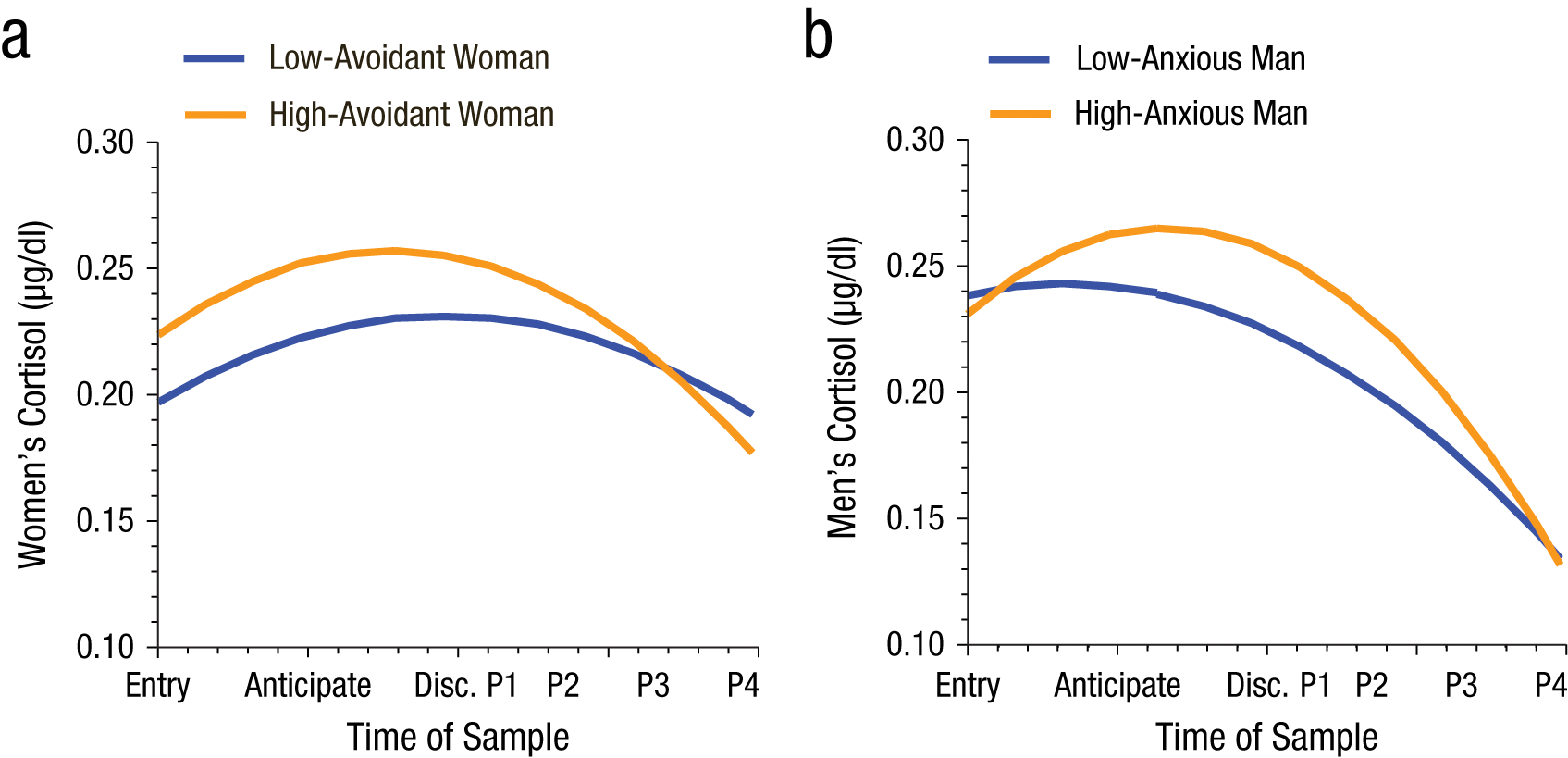
Cortisol reactivity and recovery trajectories for women at low (25th percentile) and high (75th percentile) levels of avoidant attachment (a) and for men at low (25th percentile) and high (75th percentile) levels of anxious attachment (b). Participants’ cortisol levels were measured at 7 time points. Samples reflect participants’ cortisol levels before they entered the lab (Entry), while they were anticipating a discussion about a relationship conflict with their romantic partner (Anticipate), during the discussion (Disc.), and at four post-conflict points (Ps): at the end of the conflict task (P1), 15 minutes after the task (P2), 30 minutes after the task (P3), and 45 minutes after the task (P4).
These different patterns for men and women may have resulted from different gender norms in the context of the task (see Powers et al., 2006). Women typically guide discussions of relationship problems, a role that may be difficult for avoidant women who prefer to disengage from conflict. Men, however, are expected to take a less active role, which may produce tension in anxiously attached men who want to share their concerns. We note that one study replicated our findings for anxious men, but not for avoidant women (Brooks, Robles, & Schetter, 2011). This study differed from ours in sample size (30 couples) and other aspects (e.g., fewer cortisol samples were taken) that may explain these variations. Overall, we expect that contextual features of the stressor task should determine when attachment and gender interact, but further work is needed to specify when such differences arise.
Research using other paradigms has revealed similar associations between attachment styles and cortisol responses to relationship-related stressors. In one study, participants believed their partner would be interviewed by an attractive experimenter of the opposite sex about the intimate details of the partner’s past and current romantic relationships, and that the participants and their partner would later watch a video of the interview (Dewitte, De Houwer, Goubert, & Buysse, 2010). In this situation, greater cortisol reactivity was observed for men who were more anxiously attached and for women who were higher in both attachment anxiety and avoidance (reflecting “fearful-avoidant” attachment, or a desire for closeness while fearing rejection). In work examining married individuals’ daily cortisol levels before, during, and after a 4- to 7-day travel-related separation from their spouse, attachment anxiety predicted higher cortisol levels during the separation, a result supporting the idea that separation is particularly threatening for those who are preoccupied with closeness (Diamond, Hicks, & Otter-Henderson, 2008).
Overall, attachment patterns have been consistently linked to cortisol responses in situations that provoke an attachment threat, such as a discussion about conflict within a close relationship. The picture is less clear for studies examining stressful contexts that are not specifically attachment related. For example, two studies using a standard social-stress task (e.g., giving a speech and performing mental arithmetic in front of an audience) did not find a link between attachment and cortisol patterns (Ditzen et al., 2008; Smeets, 2010); however, another study found that anxious attachment predicted greater cortisol reactivity in a task involving uncontrollable noise (Quirin, Pruessner, & Kuhl, 2008). Additional work is needed to understand links between attachment and cortisol in attachment-relevant contexts, other interpersonal contexts (e.g., tasks involving strangers), and noninterpersonal contexts.
Most research has focused on cortisol reactivity to specific stressors (e.g., conflict, separation), but naturally occurring daily cortisol patterns are also of interest because flat patterns of cortisol levels at awakening and over the day can co-occur with adverse health outcomes, such as depression (Hsiao et al., 2010). Such flat patterns contrast with more normative daily cortisol patterns whereby people experience a marked rise in cortisol about 30 minutes after waking up, followed by a gradual decline in cortisol over the day. Some work has indicated that more anxiously attached individuals have a blunted cortisol response after awakening (Hicks & Diamond, 2011; Quirin et al., 2008), suggesting dysregulated HPA activation. In recent work, however, anxious attachment predicted higher cortisol levels over 2 days following a discussion of marital problems, but patterns did not vary by time of day (Jaremka et al., 2013). These few studies of attachment style and diurnal cortisol differed considerably in their methodology, and more work is therefore required to clarify this link (Hicks & Diamond, 2011).
Conclusions and Future Directions
Attachment styles shape not only people’s perceptions of distress but also their cortisol responses to stress, which have been connected to health and disease outcomes in separate lines of work. The findings reviewed here indicate that attachment insecurity is associated with different cortisol response patterns than attachment security is. These differential responses may be especially likely to emerge in contexts that are relevant to attachment, such as interpersonal conflict or separation.
Research has also suggested that another aspect of the situational context—one’s partner’s attachment characteristics—needs to be considered in evaluations of biological stress responses. Emerging evidence suggests that one relationship partner’s attachment style may influence the other’s physiological stress reactions (e.g., Laurent & Powers, 2007; Powers et al., 2006). Indeed, findings from a recent study of 218 newlywed couples indicated that the interplay between spouses’ attachment styles predicts their cortisol patterns (Beck, Pietromonaco, DeBuse, Powers, & Sayer, 2012). Couples consisting of an anxiously attached wife and an avoidant husband showed a sharp increase in cortisol followed by a rapid decline in anticipation of a discussion about conflict, and this pattern was distinct from those observed for other pairings (e.g., anxious-wife/nonavoidant-husband couples). Although the mechanisms underlying such partner-based effects remain to be determined, they may follow from different expectations based on recurring interaction patterns in a relationship. For example, anxious-wife/avoidant-husband couples evidenced difficulty in constructively engaging during the conflict discussion, which may explain their physiological disengagement even before the interaction begins (Beck et al., 2012). Given the potential for partners to influence each other’s physiological responses and downstream health outcomes (see Pietromonaco et al., in press), examining the interplay between partners’ attachment styles and the mechanisms through which partners influence each other represents an important avenue for future research.
Research also is needed to determine the complete physiological and behavioral pathways through which attachment is linked to differential health outcomes. For example, avoidantly attached married individuals showed an increased inflammatory response after a conflict-related interaction with their spouse but not after a supportive interaction (Gouin et al., 2009). Other work has indicated that both attachment anxiety and higher daily levels of cortisol are associated with lower cellular immunity (Jaremka et al., 2013). Immune responses may precede HPA-axis responses (Sapolsky, Romero, & Munck, 2000), and inflammation is prognostic of a host of negative health consequences (Kiecolt-Glaser, Gouin, & Hantsoo, 2010). Conversely, cortisol can inhibit immune responses (Sapolsky et al., 2000), which may increase susceptibility to infectious disease. Supportive romantic relationships also promote health-enhancing behaviors (e.g., exercise, nutrition), whereas unsupportive relationships hinder such behaviors (Kiecolt-Glaser et al., 2010), and attachment dynamics likely play a key role in determining whether individuals perceive their relationships as supportive or not.
Another critical question is whether attachment patterns in childhood, which are related to children’s cortisol reactivity (e.g., Gunnar, Brodersen, Nachmias, Buss, & Rigatuso, 1996), predict cortisol responses in adulthood. Furthermore, cortisol patterns show some stability over the course of development (e.g., from childhood to adolescence; Shirtcliff et al., 2012), and it would be important to determine whether such individual differences in cortisol patterns are related to attachment in childhood, adulthood, or both. Answering questions such as these will illuminate the role of attachment patterns and associated relationship processes in contributing to health outcomes across the life span.
The findings reviewed here suggest that patterns of HPA activation and related biological responses may constitute a key pathway connecting attachment-related processes to health and disease outcomes. Developing an understanding of the role of attachment processes in health outcomes may suggest ways in which health care systems could more effectively use patients’ close-relationship networks in treatment and prevention efforts, or underscore the importance of supportive family policies for improved health outcomes. However, no studies have yet determined whether biological responses to relationship-related stressors lead to detrimental health outcomes over time. Research examining this question will enhance our understanding of how attachment-related relationship processes get “under the skin.”
Recommended Reading
Diamond, L. M., & Fagundes, C. P. (2010). Psychobiological research on attachment. Journal of Social and Personal Relationships, 27, 218–225. doi:10.1177/0265407509360906. An overview and analysis of connections between adult attachment and a broader range of psychophysiological responses than those covered in this article.
Miller, G. E., Chen, E., & Zhou, E. S. (2007). (See References). A comprehensive review and analysis of the link between chronic stress and HPA-axis functioning.
Pietromonaco, P. R., & Beck, L. A. (in press). (See References). A chapter providing an accessible review of theory and research on attachment processes in adult romantic relationships.
Pietromonaco, P. R., Uchino, B., & Dunkel Schetter, C. (in press). (See References). An article discussing the significance of attachment processes for research in several health domains (e.g., health behavior, pain, chronic disease) and its implications for health-related interventions.
Powers, S. I., Pietromonaco, P. R., Gunlicks, M., & Sayer, A. (2006). (See References). The first empirical study to demonstrate links between adult attachment insecurity and dating partners’ cortisol patterns in response to a conflict-negotiation task.
Footnotes
Declaration of Conflicting Interests
The authors declared that they had no conflicts of interest with respect to their authorship or the publication of this article.
Funding
Preparation of this article was supported by National Cancer Institute Grant R01 CA133908 to Paula R. Pietromonaco and Sally I. Powers and by National Science Foundation Graduate Research Fellowship S121000000211 to Casey J. DeBuse. Some of the research described here was supported by National Institute of Mental Health Grant R01 MH60228-01A1 to Sally I. Powers.