







Abstract
Goal-directed behavior in a constantly changing environment requires a dynamic balance between two antagonistic modes of control: On the one hand, goals need to be maintained and shielded from distraction (stability), and on the other hand, goals need to be relaxed and flexibly updated whenever significant changes occur (flexibility). A dysregulation of this stability-flexibility balance can result in overly rigid or overly distractible behavior, and it is therefore important to understand how this balance is regulated in a context-sensitive, adaptive manner. In the present article, we review recent evidence on how positive affect, reward prospect, and task context modulate the stability-flexibility balance. Two distinct underlying cognitive mechanisms will be discussed: Flexibility may result either from lowering the updating threshold in working memory or from keeping multiple tasks active in working memory. Critically, these two mechanisms allow different (testable) predictions: Whereas lowering the updating threshold should ease the access of new information in working memory and thereby increase flexibility in general, concurrent task activation should only increase flexibility between the respective tasks.
Have you ever been so absorbed in an ongoing activity—such as reading a novel by your favorite author—that you forgot about the kettle you put on to prepare a cup of tea? Conversely, do you experience days in the office when it is hard to concentrate on one task because of the constant distractions by incoming e-mails, phone calls, and the nagging bad conscience from an upcoming deadline for an overdue review? In fact, goal-directed behavior can be conceived of as the challenge to find the ideal balance between these two antagonistic control demands: cognitive stability on the one side and cognitive flexibility on the other. Although cognitive stability helps shield the organism against distraction, this stability might—on the downside—result in maladaptive rigid behavior and increase the risk of missing important information. Likewise, cognitive flexibility helps in the adjustment of action and thoughts to changing goals or task demands, but this flexibility can come at the cost of increased distractibility and erratic behavior. Consequently, most current frameworks on cognitive control in some form or another address these antagonistic control demands (see Aston-Jones & Cohen, 2005; Braver, 2012; Dreisbach, 2012; Egner, 2014; Goschke, 2003, 2013; Hommel, 2015). It therefore seems of major importance to identify and understand how this balance is regulated adaptively. In the following, we review recent research, showing how positive affect, reward prospect, and the specific task context differentially modulate the stability-flexibility balance toward either more flexible or more stable behavior. However, before doing so, we first define how flexibility and stability can be measured and diagnosed in a range of classical cognitive-control paradigms.
Defining Stability and Flexibility
Stability is characterized by goal maintenance and goal shielding, thereby preventing interference from distractors. Flexibility is a consequence of reduced goal maintenance and shielding, resulting in an increased ability to switch actions and thoughts to changing task demands. Table 1 gives an overview of measures that can be taken as a sign of cognitive stability or cognitive flexibility, respectively. This listing illustrates that research within this stability-flexibility framework finally allows for an integration of research disciplines and paradigms that so far have existed rather independently from each other. On a different matter, and also apparent from the overview, stability and flexibility seem to show a reciprocal relationship in that a measure that is typically taken as a sign of high stability at the same time is a sign of reduced flexibility, and vice versa. Moreover, what is not addressed in this table is that flexibility to adapt to changing task and context conditions might not be the only possible consequence of reduced stability. In fact, creativity and higher verbal fluency could, in a broader sense of the concept, also be taken as measures of cognitive flexibility.
Sample Paradigms and Dependent Measures Used to Investigate Cognitive Stability and Cognitive Flexibility
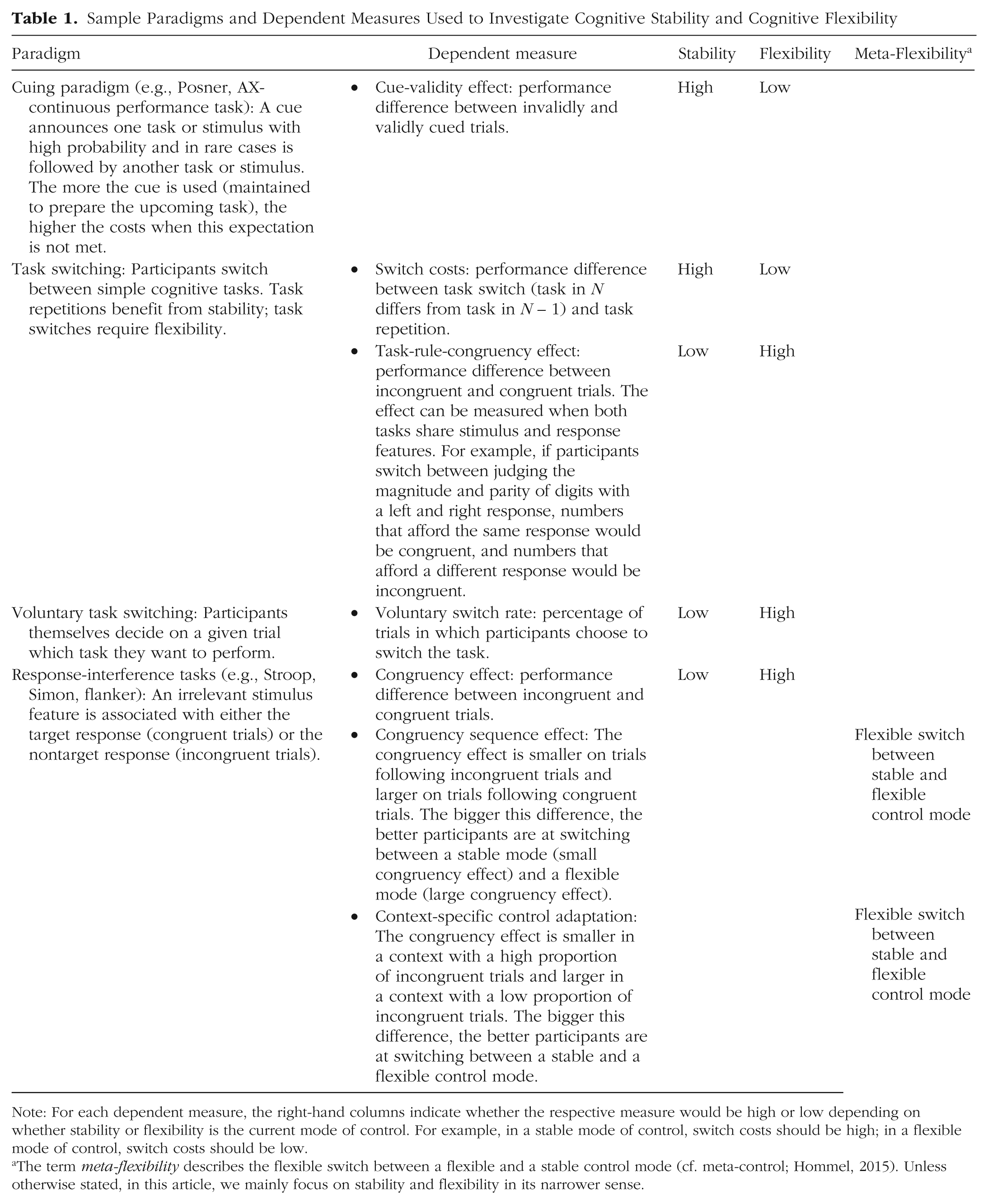
Note: For each dependent measure, the right-hand columns indicate whether the respective measure would be high or low depending on whether stability or flexibility is the current mode of control. For example, in a stable mode of control, switch costs should be high; in a flexible mode of control, switch costs should be low.
The term meta-flexibility describes the flexible switch between a flexible and a stable control mode (cf. meta-control; Hommel, 2015). Unless otherwise stated, in this article, we mainly focus on stability and flexibility in its narrower sense.
The Influence of Positive Affect on Cognitive Flexibility and Stability
The first evidence that mild positive affect changes the way we think came from social psychologist Alice Isen. She was among the first to show that positive affect increases cognitive flexibility in all sorts of cognitive tasks (for a review, see Isen, 2001). Cognitive flexibility and creativity in this line of research were often used interchangeably, for example, in creative-problem-solving tasks, word categorization, and verbal-fluency tasks. The general conclusion is that positive affect has beneficial effects for thinking and general well-being (Fredrickson, 2001). During the rise of positive psychology of the time, the idea was lost that the benefit of positive affect might also come at a cost (Seligman, 1990). In the past 15 years, there has been increasing evidence from cognitive psychology showing that the well-documented increase in cognitive flexibility under positive affect actually comes at the cost of increased distractibility and reduced goal maintenance (Dreisbach, 2006; Dreisbach & Goschke, 2004; Fröber & Dreisbach, 2012; van Wouwe, Band, & Ridderinkhof, 2011; for a review, see Goschke & Bolte, 2014). Flexibility (unlike creativity) here was measured as the ability to switch cognitive sets and adjust to unexpected (invalidly cued) tasks. And, as noted, the increased cognitive flexibility under positive affect typically comes at the cost of increased distractibility. A possible mechanism that may account for these effects is that positive affect lowers the updating threshold in working memory, thereby making access to new information more likely (cf. Goschke & Bolte, 2014). Such a mechanism would display both sides of flexibility: the improved ability to react to unexpected or new events and the increased ability to be distracted by irrelevant information.
The Influence of Reward on Flexibility and Stability
Inducing positive affect via a reward that is given as a gift—not conditional on performance—also increases cognitive flexibility (Fröber & Dreisbach, 2014, 2016a). And because reward reception, even when given contingent on performance, typically also leads to positive affect, the differential effects of positive affect and performance-contingent reward on cognitive control have long been neglected (cf. Fröber & Dreisbach, 2014; for a review, see Dreisbach & Fischer, 2012). In fact, positive affect as a consequence of performance-contingent reward has the opposite effect on control; namely, it increases cognitive stability and goal maintenance (e.g., Chiew & Braver, 2014; Hefer & Dreisbach, 2016; Locke & Braver, 2008) but comes at the cost of reduced flexibility (Hefer & Dreisbach, 2017; Müller et al., 2007). For example, Hefer and Dreisbach (2017) recently have shown that the prospect of performance-contingent reward misleads participants to use advance cues for task preparation even when this information is no longer a valid predictor for the upcoming task.
Given this maladaptive persistence under reward conditions, the question arises whether reward can also be used to promote flexibility. Shen and Chun (2011) were the first to show that the performance-stabilizing effect of reward holds true for unchanged high reward only. By using two reward magnitudes (high vs. low), they were able to look into the effects of the immediate reward history (namely, whether the reward remained low, increased, remained high, or decreased from one trial to the next) on task-switching performance. They demonstrated that a sequential increase in reward enhances flexibility (smaller switch costs), whereas only unchanged high reward promotes stability (better performance on task repetitions, higher switch costs).
Inspired by the findings of Shen and Chun (2011), we recently conducted a series of experiments using the voluntary-task-switching paradigm to measure the voluntary switch rate as a more direct marker of cognitive flexibility (Arrington & Logan, 2004). More precisely, we used a combined paradigm of forced- and free-choice task switching and replicated the data pattern of Shen and Chun on forced choices. Moreover, on free-choice trials, the reward history systematically influenced choice behavior: With an unchanged high reward, the voluntary switch rate was lowest, and it was highest when the reward increased or decreased from one trial to the next (Fröber & Dreisbach, 2016b; see Fig. 1). Note that by using four different cues per reward magnitude, we can exclude the possibility that switching was induced by low-level perceptual (cue) switches (cf. Mayr & Bell, 2006). In sum, the findings thus suggest that the well-documented performance-stabilizing effect of performance-contingent reward is restricted to unchanged high reward, whereas the prospect of changing reward can increase cognitive flexibility.
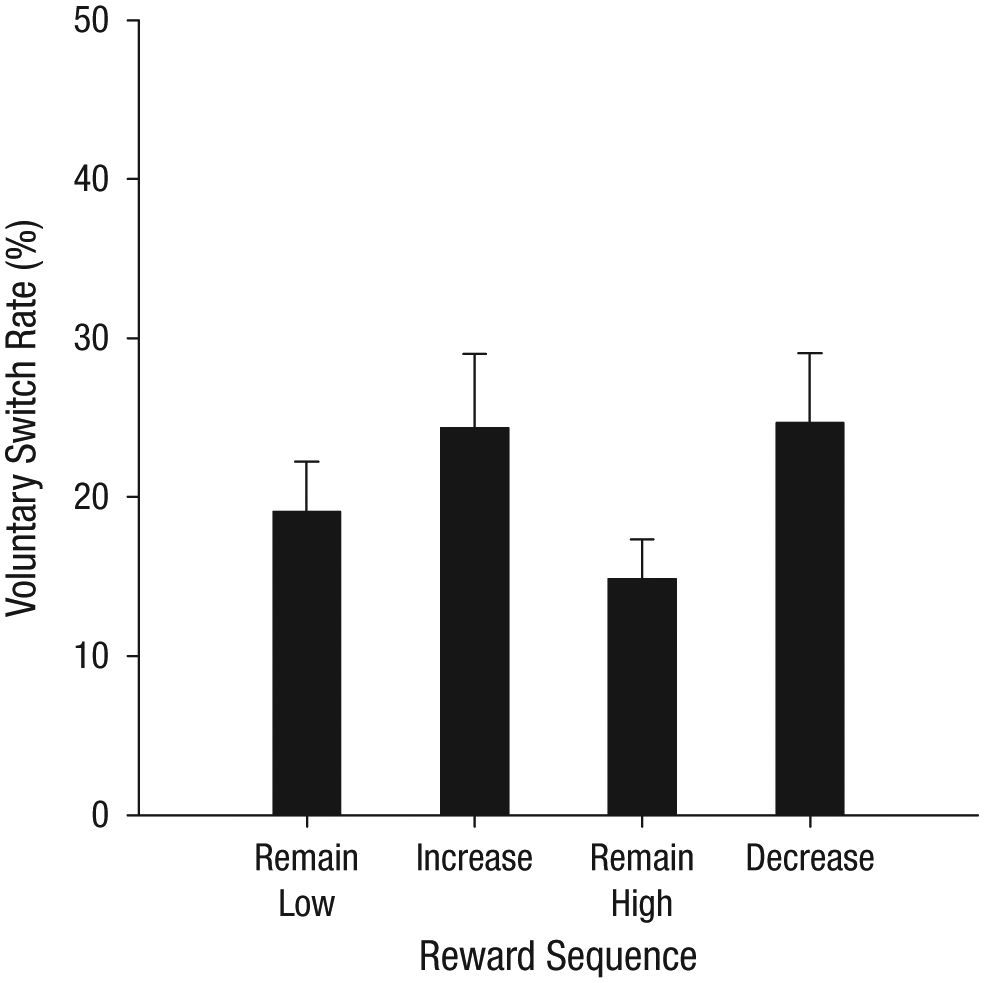
Mean voluntary switch rate in four different reward sequences. Error bars represent +1 SEM. Adapted from Fröber and Dreisbach (2016b, Experiment 5).
So even though participants were rewarded not for frequent switching (see Braem, 2017) but for responding quickly and correctly, we consistently found increased switch rates when the reward increased or decreased. This seems surprising given that task switching incurs costs, which is why participants usually prefer task repetitions (e.g., Kessler, Shencar, & Meiran, 2009). Irrational as it sounds in the laboratory context, this sensitivity to reward changes might follow evolutionary pressures, because significant reward-cue changes in the natural environment more often than not might call for action alternations (for related arguments, see Czaczkes, Koch, Fröber, & Dreisbach, 2018). That is, the sequential reward effects might follow a basic rule such as “change behavior if the reward context changes.” The underlying mechanism is that a significant cue change transiently promotes explorative behavior by lowering the updating threshold in working memory.
How Task Context Modulates the Stability-Flexibility Balance
Aside from motivational and affective influences, the task context has also been proven to modulate the balance between stability and flexibility. First, indirect evidence comes from studies showing that more switches than repetitions in a given block reduce switch costs, suggesting that the act of switching per se increases flexibility (Dreisbach & Haider, 2006; Monsell & Mizon, 2006; Schneider & Logan, 2006). More direct evidence comes from a recent study, in which we manipulated the ratio of forced versus free-task choices (25:75, 50:50, 75:25; for forced choice, there were always equal frequencies of repetitions and switches). Results showed a systematic increase in voluntary switch rates with increasing forced choices. In a further experiment, the rate of forced switches versus forced repetitions within the forced choices was additionally manipulated. Again, we found increasing switch rates with increasing forced choices—even more so when the forced choices were mostly forced switches (Fröber & Dreisbach, 2017, Experiment 2; see Fig. 2).
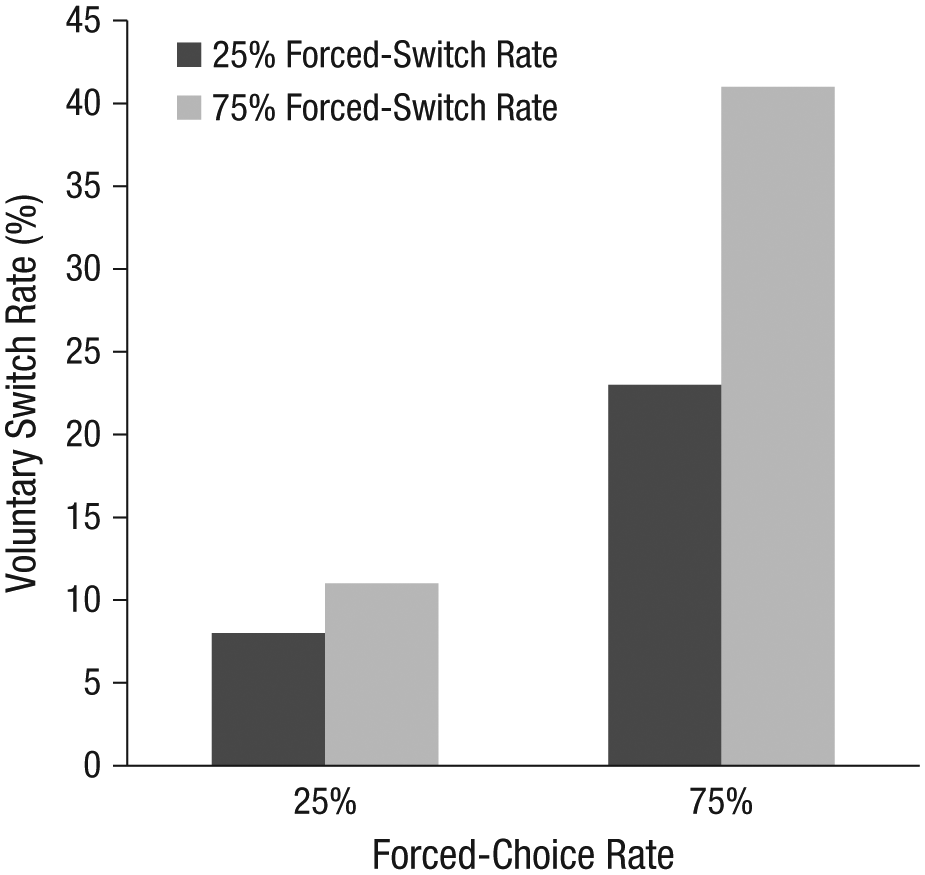
Mean voluntary switch rate as a function of forced-choice rate and forced-switch rate in Experiment 2 of Fröber and Dreisbach (2017).
These results thus clearly show that a context of frequent forced switches promotes cognitive flexibility. Interestingly, these global context effects interact with the local and short-lived reward effects described above. When participants are put into a generally stable control mode (by frequent free choices and rare forced switches), only an increase in reward can promote a voluntary switch, whereas when being in a flexible mode already, any change in reward further increases flexibility (Fröber, Raith, & Dreisbach, 2018). This latter result suggests that context effects have more sustained effects on flexibility or stability, whereas local reward changes evoke transient effects, which might serve to quickly switch the current mode of control. Likewise, Chiu and Egner (2017) recently showed in a forced-task-switching paradigm that single items that are associated with either a high or a low switch frequency eventually show low versus high switch costs. This might be taken as a further hint that flexibility versus stability can also be triggered on a shorter time scale.
In contrast to the positive affect and reward effects, it is hard to believe that a context of frequent (or infrequent) task switching would modulate the updating threshold in working memory in general. In fact, the generalizability of this switching-induced flexibility may be limited. In a recent study, participants had to switch between the same two tasks across several blocks. Even though it showed a steep learning curve, substantial costs emerged when participants were confronted with two new tasks in the end (Sabah, Dolk, Meiran, & Dreisbach, 2018). We therefore assume that frequent forced switching motivates participants to keep the respective tasks in a highly active state (for related evidence, see Schneider, 2015). This then eases switching between both tasks and also increases the likelihood of voluntary switches, but it may not necessarily transfer to new tasks.
Underlying Mechanisms
In conclusion, we suggest two distinct cognitive mechanisms that might account for the modulation of the stability-flexibility balance. Flexibility may result either from lowering the updating threshold in working memory (positive affect, changing reward prospects) or from keeping multiple tasks active in working memory (context effects). To speculate, we would assume that lowering the threshold should be domain general and transfer to other tasks. And although the effects of positive affect are presumably more sustained in nature, reward changes appear to exert their effects quickly and transiently. Moreover, the switching-induced increase in flexibility presumably follows from the concurrent activation of the respective tasks in working memory. From there, it follows that this flexibility should be restricted to the respective tasks and not generalize to new tasks. Even though these assumptions so far lack direct empirical evidence, they allow the inference of testable hypotheses that can be subject to further research. Moreover, the observation that flexibility can be modulated in both a sustained and transient manner implies that flexibility and stability might not be mutually exclusive. As explicated above, the context of rare forced task switching induces a sustained stable control mode (as evidenced by rare voluntary switches), but transient flexibility can still be achieved by increasing reward prospect. This is important because goal pursuit requires stability, but during goal striving, flexibility in response to significant changes may still be necessary (without changing the goal).
From a neurophysiological perspective, there is much evidence that the stability-flexibility balance is modulated by the neurotransmitter dopamine (for a review, see Cools & D’Esposito, 2011). In fact, in current models of dopamine function, a reciprocal relationship between dopaminergic activity in striatal and prefrontal cortex is assumed, with optimal prefrontal dopaminergic activity promoting cognitive stability and optimal striatal dopaminergic activity promoting flexibility. Empirical support comes from in vitro and computational studies (Durstewitz & Seamans, 2008) but also from pharmacological interventions and studies with specific patient groups suffering from selective dopamine depletion (cf. Cools & D’Esposito, 2011). However, as Goschke and Bolte (2014) have recently pointed out, dopaminergic activity may appear to modulate the stability-flexibility balance, but this does not necessarily mean that the affect and reward effects are mediated by these same circuits.
How to Be Flexible
Is there an ideal control state? Is it better to be more stable or more flexible? All the evidence provided here and elsewhere suggests that in fact there is no such thing as an ideal control state (even though it seems as if, in everyday life, flexibility enjoys a better reputation than stability and persistence). Maybe we should approach the question differently and rather ask, which control mode is more effortful and more resource demanding? Again, there is no easy answer to that. Switching between tasks obviously comes with costs, but in a context of frequently changing task demands, these costs might be outweighed by the effort it would take to shield the cognitive system against all the incoming distracting information. In fact, it might be most efficient to flexibly adjust the current mode of control to the context and task demands. Alternatively, when the context is, in fact, under my own control, I could reduce distractions from the environment (going off-line, closing the office door; see Kuhl, 1983) to ease goal maintenance and stability (and to finally submit the overdue review). And, as we have shown above, rewards for goal achievement might be of further help.
Recommended Reading
Arrington, C. M., Reiman, K. M., & Weaver, S. M. (2014). Voluntary task switching. In J. Grange & G. Houghton (Eds.), Task switching and cognitive control (pp. 117–136). Oxford, England: Oxford University Press. Provides an up-to-date review of research on voluntary task switching, which seems to be the ideal tool to study cognitive flexibility.
Goschke, T. (2014). Dysfunctions of decision-making and cognitive control as transdiagnostic mechanisms of mental disorders: Advances, gaps, and needs in current research. International Journal of Methods in Psychiatric Research, 23, 41–57. doi:10.1002/mpr.1410. Places dysfunctions in adaptive control adjustments in the context of mental and psychiatric disorders.
Hommel, B. (2015). (See References). Provides an in-depth overview on how stability versus flexibility is also shaped by genetic predispositions and cultural context.
Footnotes
Action Editor
Randall W. Engle served as action editor for this article.
Declaration of Conflicting Interests
The author(s) declared that there were no conflicts of interest with respect to the authorship or the publication of this article.
Funding
Part of the research presented here was supported by Deutsche Forschungsgemeinschaft Grants DR 392/7-1 and DR 392/8-1 (to G. Dreisbach).