







Abstract
What makes one person better at controlling attention than the next person? Attempts to answer this question have largely focused on measuring individuals’ cognitive abilities. However, variation in attentional performance can also be due to differences in strategy. Here, we describe research showing that individuals vary dramatically in how they choose to control attention, with many reliably choosing suboptimal strategies. Optimal strategy choice appears to be unrelated to attentional control ability, general cognitive ability, or even strategy choice on other attention tasks. It does, however, correlate with how effortful individuals find the optimal strategy, which suggests that strategy choice may be driven by subjective, task-specific effort demands. These findings represent initial steps toward fully characterizing an individual profile of attentional control strategies.
People vary greatly in how they use attention. Take the classic Easter egg hunt, which can leave some children celebrating and others sobbing over their modest bounty. Why does one child spot eggs quickly while another child does so slowly? How do we explain variation in visual search times? Of course, this question pertains not just to kids searching for candy but also to all manner of everyday tasks of greater consequence, including driving, baggage screening, and cancer screening.
Some of the variance will be attributable to individuals’ current state: A hungrier child may search faster than one who has just eaten. State-based factors have been shown to influence how attention is allocated (e.g., Cunningham & Egeth, 2018; Engelmann & Pessoa, 2007). Similarly, random events, such as which bush a child happens to look under first, will affect performance. But these factors vary over time and contexts; how do we explain more enduring individual differences?
Here, we discuss two sources of variation across individuals. The first is ability, a person’s capacity to perform cognitive work. We know that individuals vary in their ability to control attention. A comprehensive body of research has shown broad, reliable individual differences and produced rigorous measures for capturing those abilities (e.g., Fan, McCandliss, Sommer, Raz, & Posner, 2002; Kane, Bleckley, Conway, & Engle, 2001; Miyake et al., 2000). The capacity to control attention is dependent on other cognitive abilities, such as working memory capacity and intelligence (Cowan et al., 2005; Engle, 2002; Kane & Engle, 2002; Unsworth, Fukuda, Awh, & Vogel, 2014), and has been linked to underlying neural functioning (e.g., Fan, McCandliss, Fossella, Flombaum, & Posner, 2005; Rosenberg et al., 2016). In our example, perhaps searcher A, thanks to their particular neural architecture, is simply better at focusing attention on eggs and ignoring the distraction of other children than is searcher B.
A second factor that drives individual variation is strategy (Cooper & Regan, 1982; Schunn & Reder, 2001; Sternberg & Grigorenko, 1997). In most everyday tasks, we have choices about how we direct our attention, and our chosen strategy can impact performance. For example, searcher B may have searched serially, moving from bush to bush to check under each for eggs. In contrast, searcher A, knowing that many eggs have bright-red foil that contrasts with the bushes, may have restricted their attention to red-colored items only and collected many red eggs very quickly.
In contrast to the large body of work on ability, there has long been little systematic exploration of individual differences in attentional control strategies. In this article, we report on recent efforts to embark on such an exploration, including our own work. We focus on externally directed attention (see Chun, Golomb, & Turk-Browne, 2011); much of the work in this area explores the use of attention in searching behavior. This work has led us to believe that attentional control strategy may have just as much of an impact on task performance as attentional ability, and a full understanding of how individuals deploy attention in the real world must incorporate a strategy dimension.
Individual Differences in Attentional Control Strategy
Existing work on individual differences in strategy, though limited, suggests that individuals vary substantially in the strategies they use to control attention (e.g., Hogeboom & van Leeuwen, 1997; Irons & Leber, 2016a, 2018; Kristjánsson, Jóhannesson, & Thornton, 2014; Lleras & von Mühlenen, 2004; Muhl-Richardson et al., 2018; Nowakowska, Clarke, & Hunt, 2017). Moreover, many individuals choose strategies that yield suboptimal performance, where optimal performance is defined by speed and accuracy metrics. Boot and colleagues (Boot, Becic, & Kramer, 2009; Boot, Kramer, Becic, Wiegmann, & Kubose, 2006) identified stable individual differences in eye-movement control during visual search. Some individuals searched more overtly, moving their eyes along with the focus of attention, whereas others searched more covertly, shifting attention around the display while keeping their eyes still. Individuals maintained the same strategy across tasks, even when their chosen strategy was not optimal for the task. Critically, strategy accounted for roughly 60% of the variation in detection accuracy. More recently, Nowakowska and colleagues (2017) tested a time-limited search task in which the target could appear in one of two sections, one with heterogeneous distractors and one with homogenous distractors. Because a target embedded in the homogenous section would be highly salient, the observer would require very little time to search this area and determine whether or not the target was present. Observers should therefore direct more time and attention (measured using eye movements in these studies) to the heterogenous section. Although some participants used this optimal strategy, others searched evenly on both sides, or even directed their attention away from the heterogenous region, which led to poorer performance than that achieved by the optimal searchers. Individuals’ strategies were stable over time, with high test-retest reliability (Clarke, Irons, James, Leber, & Hunt, 2020).
We have begun to systematically explore the role of strategy in the control of feature-based attention, which we define as our ability to bias attention toward objects with a particular feature, such as a color or shape. Our work uses a visual search task in which participants search through displays of colored squares to find a target—a red or blue square containing one of the prescribed target digits. In this type of visual search, individuals can use feature-based attention to engage in subset search (Egeth, Virzi, & Garbart, 1984): If a target is known to be red, a searcher can bias their attention toward red items only, inspecting each in turn until the target is found. In our method, we add a critical twist: Each display contains both a red and a blue target, and participants can choose to search for either one (see Fig. 1). In addition, the ratio of red to blue distractors changes periodically, which alters the efficiency of search for the two targets. That is, when there are fewer red distractors than blue, searching through the red items for the red target should be faster (or more optimal) than searching for the blue target. When there are fewer blue distractors than red, the blue target is optimal. Our key dependent variable is the target selected on each trial (evidenced by whether participants identify the digit on the red target or the blue target). The optimal search strategy is to select the target in the smaller subset on each trial, which necessitates adaptively changing between targets as the ratio of colors changes. Hence, the task is called adaptive-choice visual search (ACVS; Irons & Leber, 2016a).
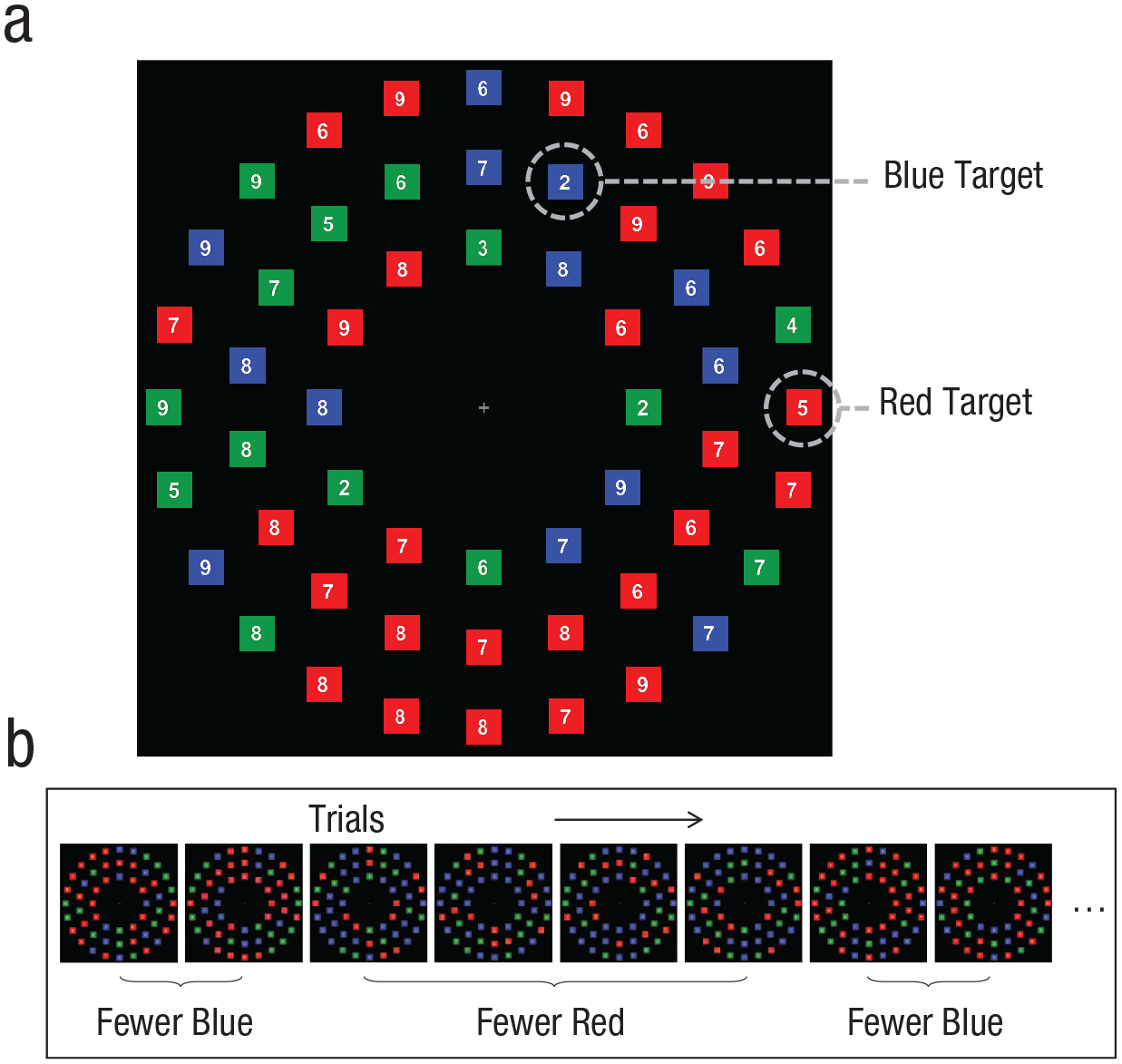
Example search display (a) and trial sequence (b) from the adaptive-choice visual search task (based on the variant used by Irons & Leber, 2018). Each display contains a blue and a red target. Targets can be identified by the combination of color (red or blue) and digit (2, 3, 4 or 5). In this example, there are fewer blue squares than red squares, making the blue target optimal. In each block, runs of trials with fewer blue and fewer red items are interspersed.
The results have revealed a striking range of different strategies across individuals. In our first study, as shown in Figure 2, the percentage of trials in which individuals chose the optimal target ranged from very high (98%) to below chance (28%, indicating a preference toward the nonoptimal target). Additionally, participants who did not use the optimal strategy displayed wide variation in the degree to which they switched between target colors (e.g., responded to the blue target on one trial and the red on the next trial). Some participants switched infrequently, preferring to continue searching for the same color across many trials. Others switched frequently and almost at random. This strategy seems particularly inefficient, as switching between attentional control settings incurs a response time cost (e.g., Wolfe, Horowitz, Kenner, Hyle, & Vasan, 2004).
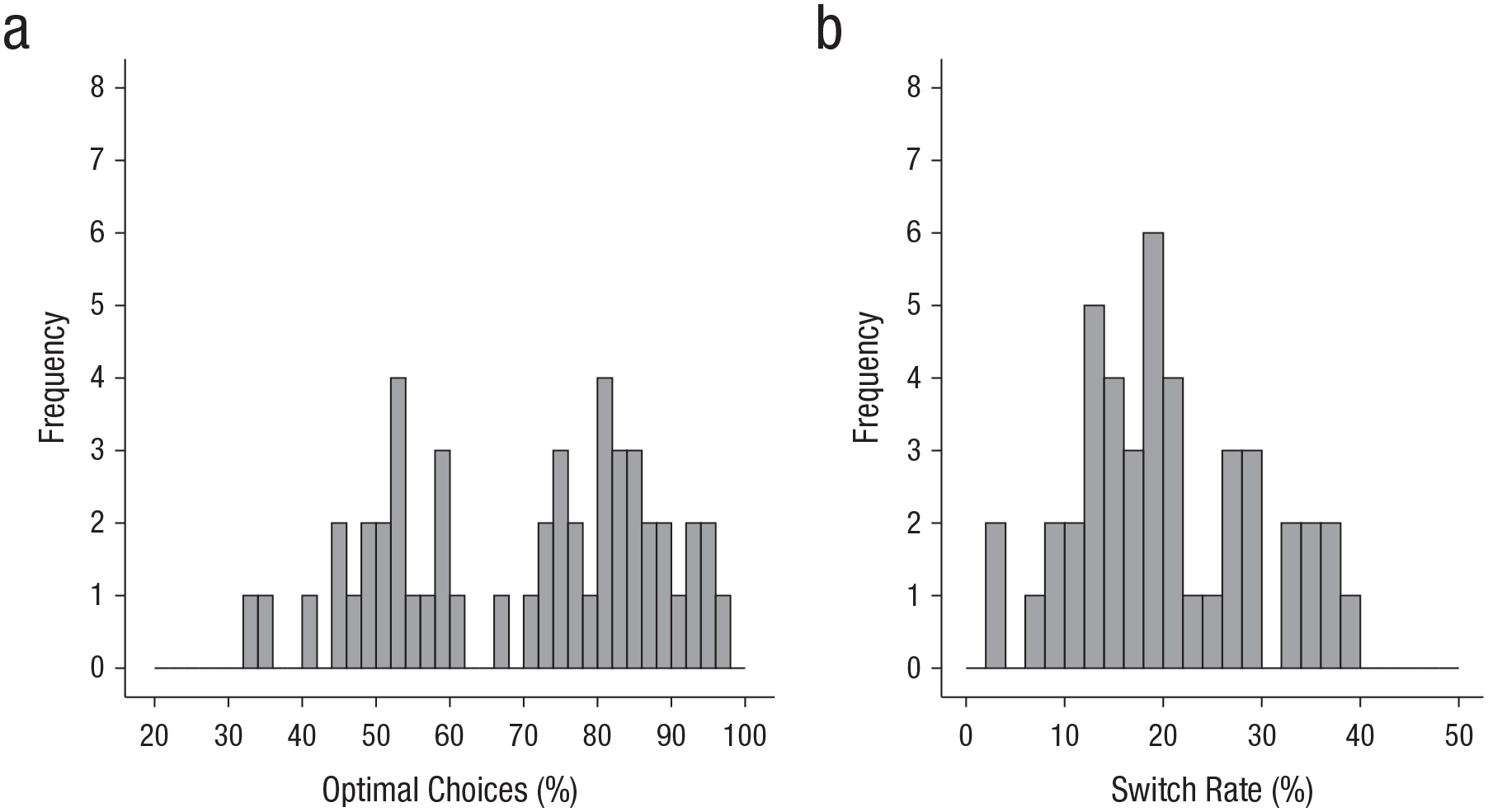
Frequency with which individuals chose the optimal target (a) and switched between target colors (b; data obtained from Irons & Leber, 2016a).
We later showed that these differences in strategies appear to be stable over time and are not simply the result of random error or participants’ momentary state (Irons & Leber, 2018); strategy measures had good test-retest reliability across separate sessions on different days (r = .83 for optimal choices and r = .77 for switch rate). Strategy use was also reasonably correlated with individuals’ own self-reports of their strategy, suggesting some metacognitive insight into their behavior. Importantly, strategy had a significant impact on performance: Higher rates of optimal choices and lower rates of switching were both associated with faster response times, r = −.58 and r = .50, respectively (see Fig. 3).
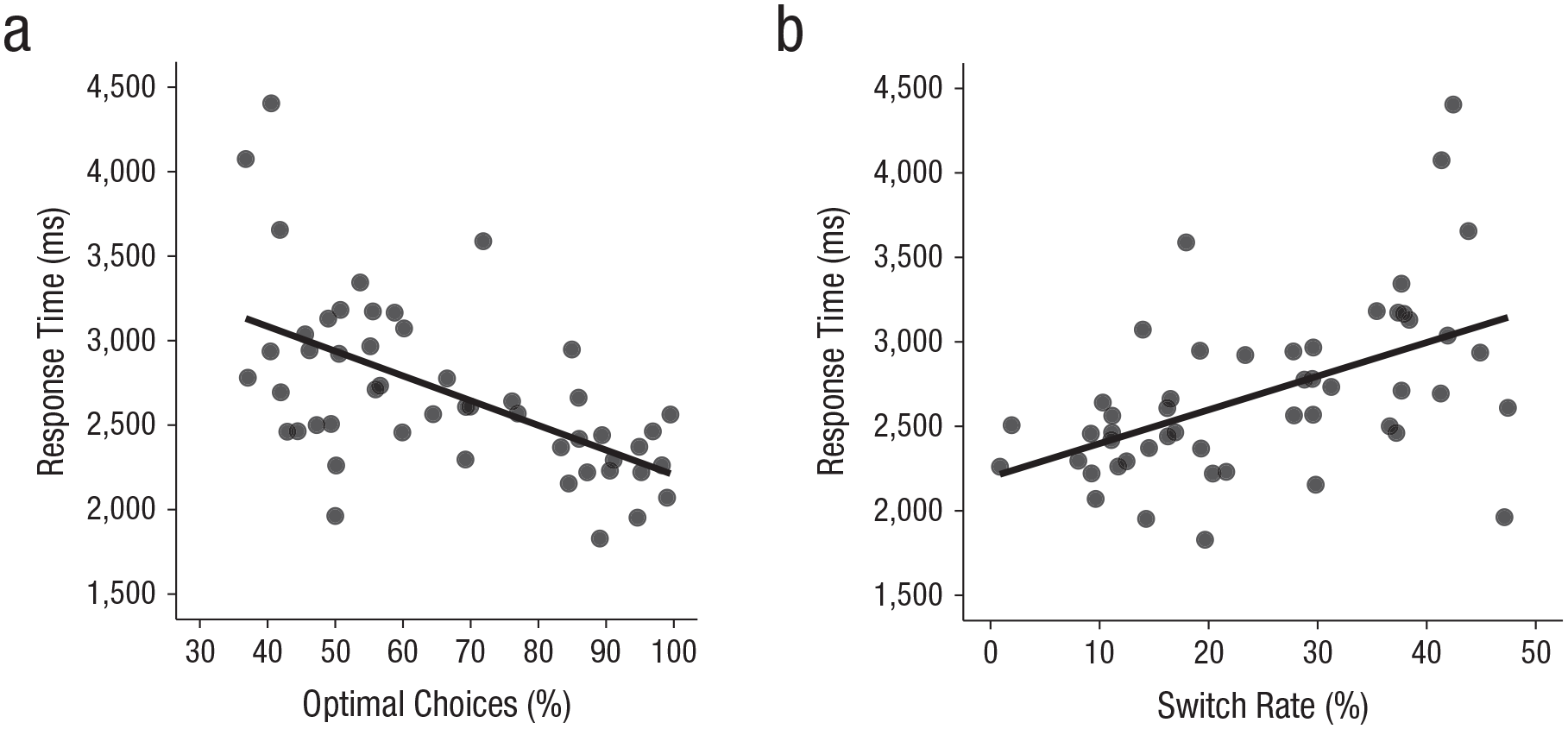
Scatterplots (with best-fitting regression lines) showing the correlation between mean response time and optimal choices (a) and mean response time and switch rate (b) on the adaptive-choice visual search task (data obtained from Irons & Leber, 2018).
Can Strategy Be Explained by Ability?
A key question to investigate is whether strategy choice is a natural consequence of ability. Individuals may adopt strategies that take full advantage of their strengths or compensate for their weaknesses (Schunn & Reder, 2001). Our work so far suggests that for strategy on the ACVS, this is not the case. We had participants perform control “no-choice” versions of the task, in which only a single predefined target was present on every trial, prior to completing the choice ACVS (Irons & Leber, 2016a). From this we computed an optimality cost, defined as how much slower participants were when searching through the larger subset than the smaller subset. We also computed participants’ switch costs, defined by how much slower they were on trials in which they switched to the other color subset as opposed to repeated the same subset. Theoretically, a person who exhibits a large optimality cost has more to gain by searching for optimal targets, whereas a person with a small optimality cost but a large switch cost may forgo searching for the optimal target in order to avoid switching. However, neither cost predicted strategy choice, although it does remain possible that a link may be found using a broader range of optimality and switch costs.
More broadly, it does not appear to be the case that individuals with stronger cognitive abilities are more likely to use the best strategy (see Table 1). Response time on control no-choice visual search tasks—an indicator of individual processing speed (Fry & Hale, 1996)—did not predict strategy choice, nor did visual working memory capacity (Luck & Vogel, 1997), a measure strongly tied to attentional control ability and general intelligence (Cowan et al., 2005; Engle, 2002; Kane & Engle, 2002; Unsworth et al., 2014). We also recently examined whether ACVS strategy correlated with reasoning, as measured by the International Cognitive Ability Resource (ICAR; Condon & Revelle, 2014), and academic ability, as measured by the ACT, a college entrance exam. Although both the ICAR and ACT scores correlated with response time, indicating a relationship to visual search ability, neither predicted ACVS strategy (McKinney, Hansen, Irons, & Leber, 2019).
Correlations Between Optimal Choices in the Adaptive-Choice Visual Search (ACVS) Task and Measures of Cognitive Ability
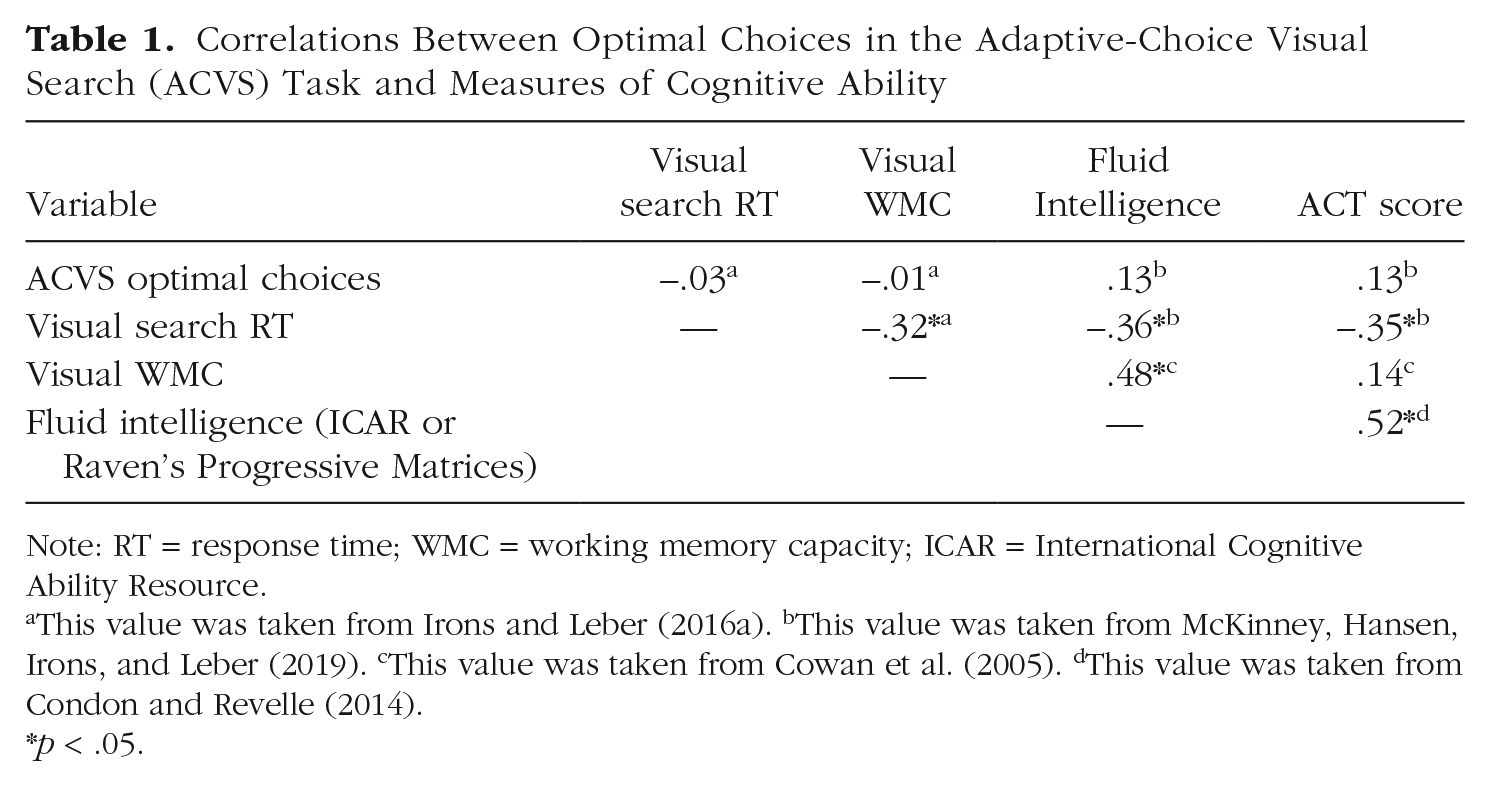
Note: RT = response time; WMC = working memory capacity; ICAR = International Cognitive Ability Resource.
This value was taken from Irons and Leber (2016a). bThis value was taken from McKinney, Hansen, Irons, and Leber (2019). cThis value was taken from Cowan et al. (2005). dThis value was taken from Condon and Revelle (2014).
p < .05.
What Determines Strategy Choice?
If not cognitive ability, what drives a person’s strategy choice? And why do individuals so frequently adopt strategies that are demonstrably suboptimal? In pursuing the traits and behaviors that can explain strategy choice, we have examined whether relationships exist between the ACVS and a range of different personality scales (see Table 2). We hypothesized that some traits—such as need for cognition, the desire to engage in cognitively challenging activities (Cacioppo & Petty, 1982)—would be associated with a drive toward more optimal choices. Other traits, such as impulsiveness (Patton, Stanford, & Barratt, 1995), were predicted to correlate positively with increased switching. Only one correlation emerged as significant: Need for cognition was associated with a reduced switch rate (Irons & Leber, 2018, Experiment 2). We note, however, that additional unpublished data (Irons & Leber, 2016b) have not replicated this finding. All told, we have not found clear evidence that strategy choice is related to personality.
Correlations Between Measures of Adaptive-Choice Visual Search Strategy (Optimal Choices and Switch Rate) and Personality Traits
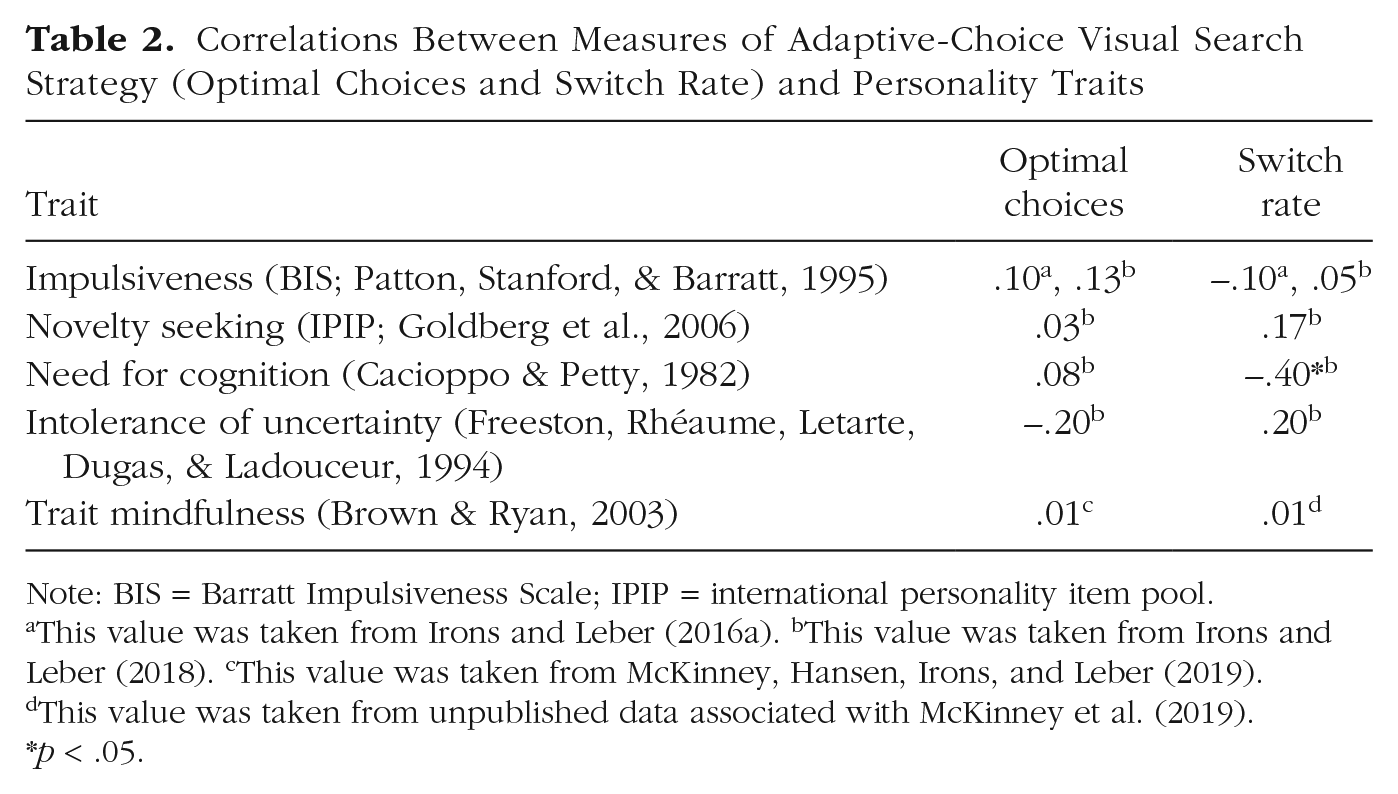
Note: BIS = Barratt Impulsiveness Scale; IPIP = international personality item pool.
This value was taken from Irons and Leber (2016a). bThis value was taken from Irons and Leber (2018). cThis value was taken from McKinney, Hansen, Irons, and Leber (2019). dThis value was taken from unpublished data associated with McKinney et al. (2019).
p < .05.
Surprisingly, even strategy on other visual search tasks does not necessarily correlate reliably with the ACVS. In a recent study, we (Clarke et al., 2020) had participants complete three visual search tasks that have demonstrated individual differences in strategy: the split-half task (Nowakowska et al., 2017), conjunction foraging (Kristjánsson et al., 2014), and the ACVS. The frequency with which individuals engaged in optimal strategies did not correlate across the three tasks.
Nevertheless, we have identified one key factor that can predict strategy choice: subjective cognitive effort. Subjective cognitive effort refers to the experience of mental demands incurred by a task. Evidence suggests that individuals differ in how effortful they find various tasks (Bettman, Johnson, & Payne, 1990; Westbrook, Kester, & Braver, 2013). We conducted an experiment in which individuals were given practice on three different strategies for the ACVS, including the optimal strategy, and were asked to rate their subjective-effort expenditure for each one. Individuals who reported the optimal strategy as being more effortful were less likely to subsequently use it in the standard-choice version of the ACVS (Irons & Leber, 2018; see Fig. 4). This is consistent with the view that individuals avoid expending effort unless sufficiently motivated (Botvinick & Braver, 2015; Kool, McGuire, Rosen, & Botvinick, 2010). Whether the optimal strategy is worth deploying will depend on each person’s subjective sense of effort: If it is considered too demanding, individuals may fall back on a less-effortful strategy at the expense of performance.
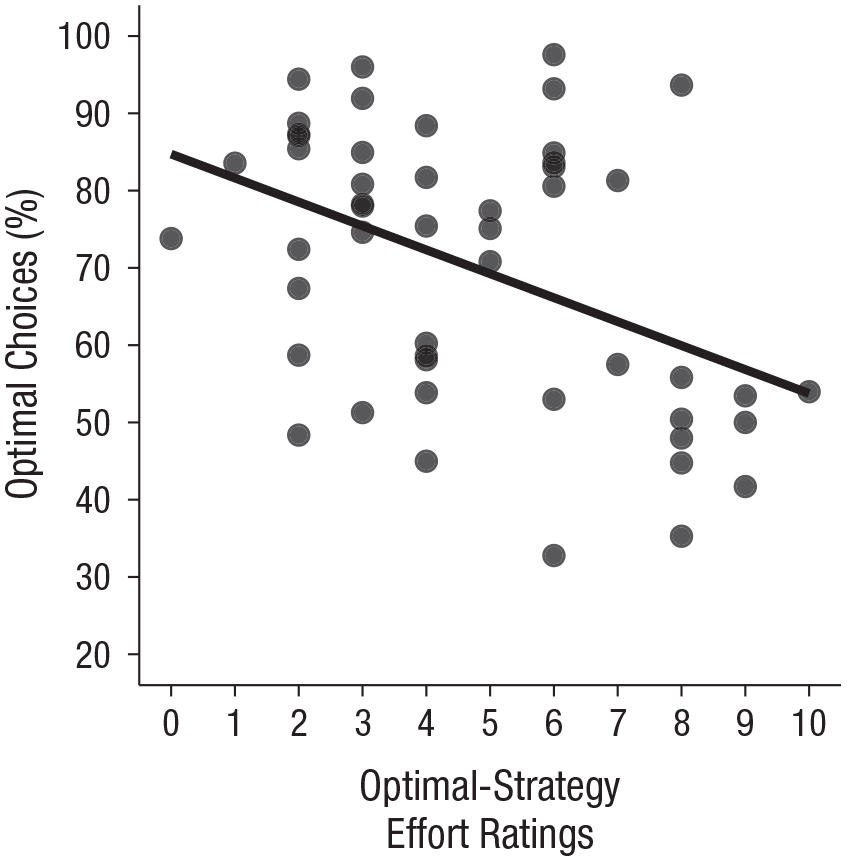
Scatterplot (with best-fitting regression line) showing the correlation between mean subjective-effort ratings for the optimal strategy and the percentage of optimal choices (data obtained from Irons & Leber, 2018).
What does this mean for understanding the drivers of strategy? We propose that the reason attentional control strategies are so difficult to pin down is because strategy is not a unitary construct. Any attention task involves a number of subtasks and component cognitive processes, each with its own effort requirements. For example, the optimal strategy on the ACVS involves a series of steps: appraising the display, determining the ratio of red to blue squares, applying a rule to choose a target, configuring attention control to prioritize the selected color, and directing attention toward matching items (Hansen, Irons, & Leber, 2019). The choice to perform optimally or otherwise could originate from any of these subprocesses. Critically, every individual may possess their own idiosyncratic “effort profile” by which they find some subtasks more effortful than the average person does and other subtasks less effortful than average. Individual heterogeneity in effort profiles could explain why strategy use correlates poorly across visual search tasks (Clarke et al., 2020), especially if these tasks differentially tax different subprocesses. Such an explanation would also cast our unsuccessful attempt to link ACVS to more high-level life-strategy metrics, such as academic performance, as overly optimistic (McKinney et al., 2019). Note that it is possible that these effort profiles relate in some way to ability (e.g., individuals with higher working memory capacity may find tasks taxing working memory less effortful than most) and other characteristics (e.g., personality or past experience); however, we have yet to find evidence supporting this notion. Ultimately, the notion that strategy is not unitary offers an enticing challenge: If we are to fully understand strategy, we must proceed to systematically investigate all of the constituent subcomponents that could be driving it.
Conclusions and Future Directions
Strategy is a crucial factor driving individual variation in attentional control. It is distinct from both random error and ability, but it may account for just as much variation in visual search speed and accuracy. Rather than dismissing strategy as a nuisance variable to be controlled, we suggest that exploring strategy as a fundamental dimension of individual variation will support a richer understanding of attentional control and its connection to other cognitive functions. Much work is still to be done; for example, internally directed attention is also influenced by strategic factors (e.g., Seli et al., 2018), but little is known about how this varies across individuals. There is also fertile ground to pursue in applied science; for many real-world applications, in which performance is the ultimate critical outcome, strategy has crucial implications. Moreover, although attempts to improve attentional abilities have made little headway (e.g., see Katz, Shah, & Meyer, 2018, for a discussion on how brain training does not fundamentally improve cognitive ability), the flexibility of strategies may make them far more amenable to training (e.g., Boot et al., 2009). Identifying the drivers behind strategy choice appears to be a challenging puzzle but one that promises to reward our effort.
Recommended Reading
Boot, W. R., Becic, E., & Kramer, A. F. (2009). (See References). A study demonstrating that individual differences in eyemovement strategy are stable across different tasks.
Botvinick, M., & Braver, T. (2015). (See References). A comprehensive review of research on effort and a neuropsychological model of the trade-off between effort and motivation.
Irons, J. L., & Leber, A. B. (2018). (See References). A more detailed exploration of individual differences in adaptivechoice visual search and the link to subjective effort.
Nowakowska, A., Clarke, A. D., & Hunt, A. R. (2017). (See References). Describes individual differences in optimal strategy use on the novel split-half task.
