







Abstract
Individual differences in attention abilities predict performance in a number of domains. We suggest that two aspects of attention are especially important for variation in attention abilities: intensity and consistency. We review evidence suggesting that individual differences in the amount of attention allocated to a task (intensity) and how consistently attention is allocated to a task (consistency) are related to each other and to overall task performance. We suggest that a number of factors (e.g., capacity, arousal, regulation, motivation) drive variation in intensity and consistency and demonstrate that these two aspects of attention are important in accounting for variation in working memory, learning, and preparatory control. Examining individual differences in both intensity and consistency will be important in order to understand variation in attention abilities in and out of the laboratory.
There is a great deal of variability in attention abilities. Some individuals can seemingly pay attention with ease, whereas others struggle to pay attention. What factors give rise to differences in attention abilities? Prior research suggests that there are important individual differences in various control processes, such as updating, inhibition, and switching (Miyake et al., 2000); goal maintenance and conflict resolution (Engle & Kane, 2004); proactive and reactive control (Braver et al., 2007); and constraint and restraint (Kane et al., 2016), to name a few. These prior individual-differences studies largely focused on examining different types of control. However, not only the type of control but also the intensity, or strength, of control is important (Shenhav et al., 2017). In recent years, we have investigated factors related to individual differences in intensity. In our framework, intensity refers to how much attention (attentional effort) is allocated to a given task. Some individuals have a greater intensity of attention allocated to different types of control than other individuals do, because of a variety of factors.
In addition to examining variation in overall intensity levels, it is important to consider whether intensity remains stable throughout a task or whether there are fluctuations of intensity that influence task performance. In our framework, consistency refers to how consistently attention (attentional effort) is allocated to a given task. We suggest that there are important individual differences in consistency of attention that are related to, but distinct from, individual differences in overall intensity levels and that both intensity and consistency influence task performance in a wide variety of domains. We are not suggesting that these are the only two sources of variation in attention abilities. As noted previously, there are likely individual differences in different types of control, and this variation is likely characterized by both unity and diversity (i.e., general and specific components) in various control abilities (Miyake et al., 2000). Furthermore, it is likely that variation in intensity and consistency influence the various types of control, such that consistently allocating high levels of intensity may be a prerequisite for some types of control (e.g., goal maintenance, conflict resolution) to function properly (Shenhav et al., 2017; Unsworth & Robison, 2020).
Similarities and Differences Between Intensity and Consistency of Attention
As noted previously, intensity refers to how much attention (attentional effort) is allocated to a given task. The intensive aspects of attention have long been recognized as important, and they are a key component of various cognitive-energetic models of performance (Hockey, 2013; Kahneman, 1973; Kanfer & Ackerman, 1989; Shenhav et al., 2017; van Zomeren & Brouwer, 1994). Intensive aspects of attention are thought to be related to, but distinct from, selective and divided attention (Kahneman, 1973; van Zomeren & Brouwer, 1994) and are critically important for variation in overall task engagement. When intensity is high, task engagement is high, and this leads to optimal levels of control. However, when intensity is low, task engagement is low, and current control levels are inadequate. Thus, the intensity of attention determines, in part, how well control is implemented both within and between individuals (Unsworth & Robison, 2020; see also Shenhav et al., 2017).
Our conceptualization of intensity is heavily influenced by prior research by Kahneman (1973), Kanfer and Ackerman (1989), Hockey (2013), and Shenhav et al. (2017) and is consistent with similar conceptualizations, such as mental effort and workload (Matthews & Reinerman-Jones, 2017). Indeed, prior research has suggested “that the intensive aspect of attention corresponds to effort” (Kahneman, 1973, p. 4; see also Shenhav et al., 2017). Consistency, on the other hand, refers to how consistently attention is allocated to a given task (how stable attention is) and corresponds to sustained attention. That is, individual differences in fluctuations and lapses of attention are another important source of variation in performance, such that those individuals who experience more fluctuations of attention (as a result of internal and external distractions) will likely not perform as well as individuals who can consistently maintain their attention on task (Unsworth, 2015; Unsworth, Robison, & Miller, 2020).
Prior research has relied on a number of methods to measure both intensity and consistency. These include self-report measures of attentional effort and off-task thinking (Matthews & Reinerman-Jones, 2017; Smallwood & Schooler, 2015; Unsworth & McMillan, 2014b), as well as a number of physiological measures (Matthews & Reinerman-Jones, 2017; Smallwood & Schooler, 2015; Unsworth & Robison, 2015). Recently, we have utilized pupillometry, as research has suggested that the pupil dilates in response to the cognitive demands of a task and that pupil dilation is a reliable and valid indicator of intensity (attentional effort; Beatty & Lucero-Wagoner, 2000; Just & Carpenter, 1993; Kahneman, 1973). Recent research has also used fluctuation in pupillary responses as an indicator of the consistency of attention (Hutchison et al., 2020; Unsworth & Robison, 2017a). In addition, consistency can be measured using thought-probe techniques, in which participants are periodically presented with a thought probe asking if their attention is currently on task or off task (i.e., if they are mind wandering, externally distracted, or mind blanking; see Unsworth, Robison, & Miller, 2020, for a review). Other useful markers of inconsistency include particularly slow reaction times and periodic performance failures. In a recent large-scale latent variable study (Unsworth, Robison, & Miller, 2020), we found that a number of different behavioral markers of inconsistency all loaded on the same factor, and this factor was related to a factor composed of self-reports of off-task thinking as well as factors for working memory, attention control, motivation, alertness, and boredom. Thus, there are a number of ways to measure (albeit imperfectly) intensity and consistency.
Research using these different techniques suggests that intensity and consistency are related, yet distinct. In particular, research suggests that during a lapse of attention, there is a temporary reduction in intensity. For example, as shown in Figure 1, using pupillary responses to track intensity and thought probes to track consistency, we found that when participants reported being off task (in a sustained-attention task), they exhibited much smaller pupillary responses both when waiting for a target to appear (preparatory control) and at target onset, compared with when they reported being fully on task (Unsworth, Miller, & Robison, 2020; see also Hutchison et al., 2020). Similar within-participant relations have been demonstrated in long-term memory tasks (Miller & Unsworth, 2021).
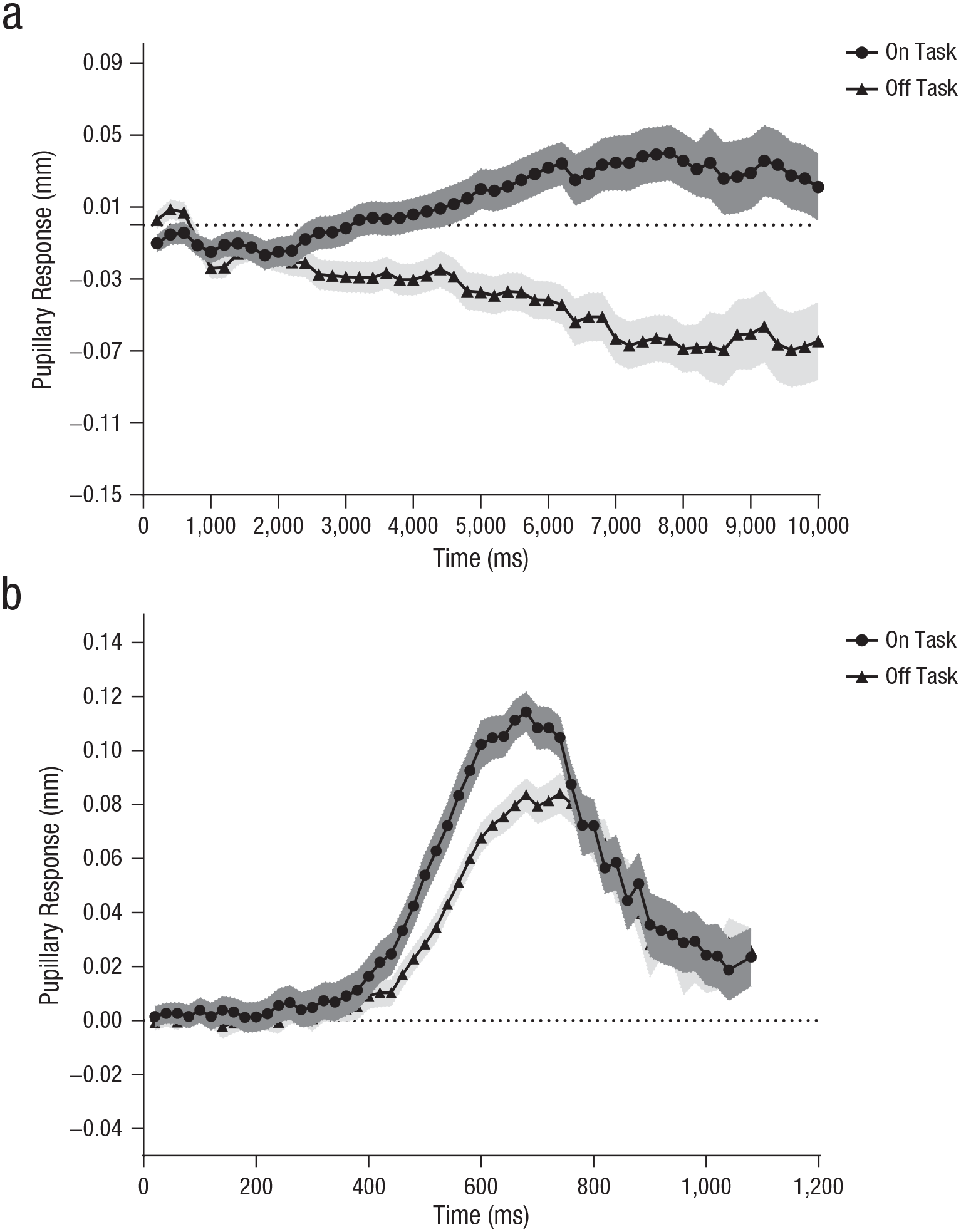
Pupillary response during a psychomotor vigilance task (a) while participants waited for the target to appear (the preparatory interval) and (b) during target presentation (data from Unsworth, Miller, & Robison, 2020). Results are shown separately for trials on which participants self-reported being on task and trials on which they self-reported being off task (i.e., when they were mind wandering, externally distracted, or mind blanking). Shaded areas represent ±1 SEM.
Individuals with lower intensity will likely experience more lapses of attention (more inconsistency), as their attention is more likely to be captured by internal or external distractors. Thus, intensity and consistency should be related. At the same time, our theoretical and empirical work suggests that intensity and consistency are distinct aspects of attention that are differentially influenced by a variety of factors, and that both account for variation in performance on many cognitive tasks (Unsworth, Miller, & Robison, 2020; Unsworth & Robison, 2020). That is, some individuals could be high in both intensity and consistency, and thus attain high levels of performance (see Fig. 2a for a hypothetical depiction of how levels of intensity and consistency might vary across individuals). Other individuals could be low in both intensity and consistency, and thus perform at low levels. Still other individuals could be high in intensity, but low in consistency. These individuals would demonstrate high levels of performance when they are on task, but lower task performance on many trials as a result of frequent lapses of attention. Conversely, some individuals could be low in intensity, but high in consistency. These individuals would allocate low levels of attention to the current task (because of decreased capacity or low levels of motivation), which would lead to lower levels of task performance, but their allocation of attention would not change much from trial to trial. Critically, this suggests not only that intensity and consistency should be related, but also that both should be important unique predictors of performance in various domains.
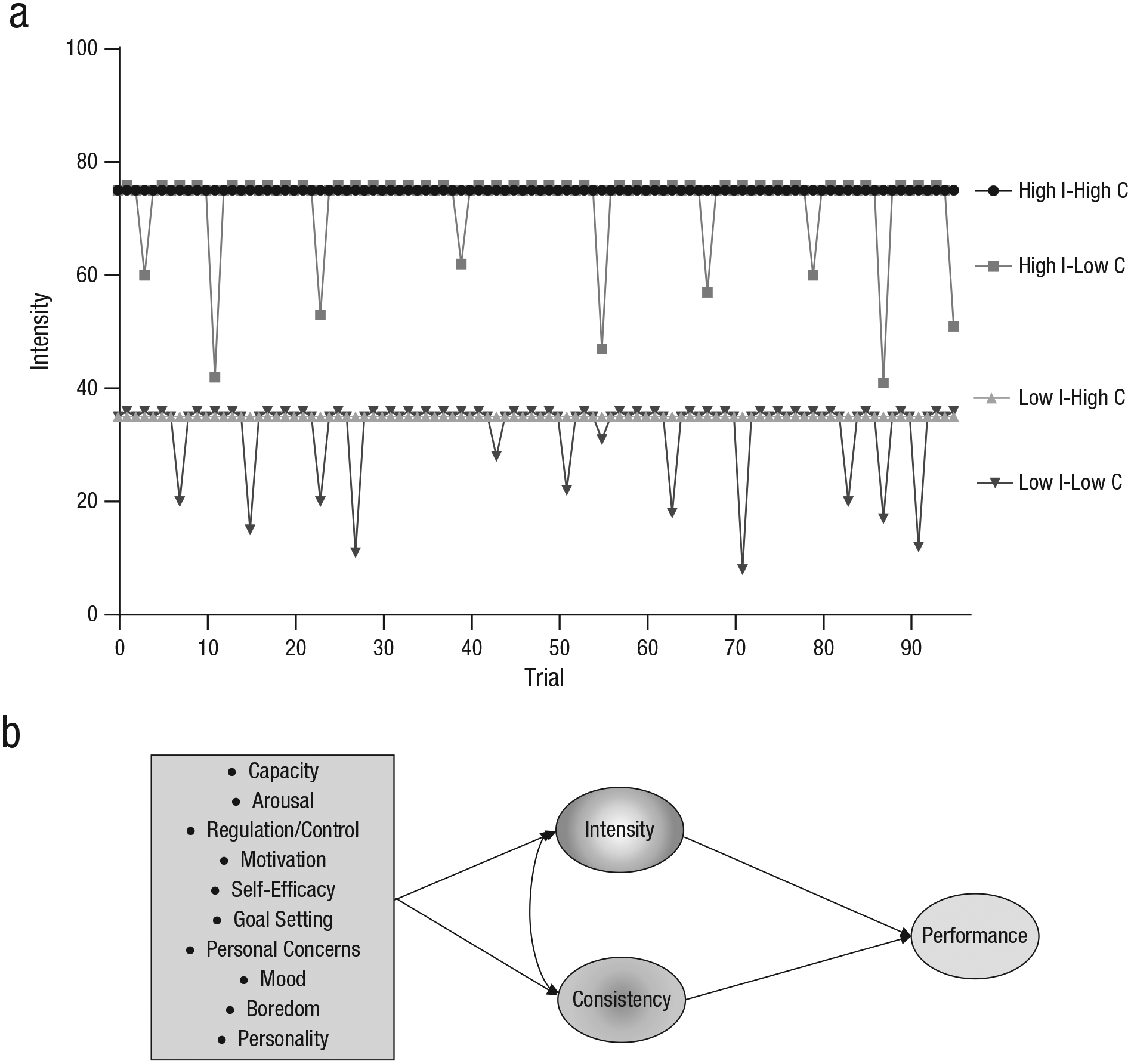
The proposed framework: intensity and consistency of control as predictors of task performance. The graph (a) shows hypothetical variation in intensity across trials for individuals who have high intensity and consistently maintain that intensity across trials (High I-High C), who have high intensity but difficulties maintaining intensity across trials (High I-Low C), who have low intensity and consistently maintain that low intensity across trials (Low I-High C), and who have low intensity and have difficulties consistently maintaining intensity across trials (Low I-Low C). The schematic (b) depicts the interrelations of intensity, consistency, and task performance, as well as factors that may influence variation in intensity and consistency.
Depicted in Figure 2b is our working framework for examining factors associated with intensity and consistency and for examining the interrelations of intensity, consistency, and task performance (i.e., intensity and consistency account for both shared and unique sources of variance in task performance). Variation in intensity is likely influenced by a number of factors, such as an individual’s overall capacity (some individuals could simply have more attention available for mental processing than others do; Kanfer & Ackerman, 1989). Intensity will also be influenced by arousal levels, which determine the currently available amount of attention (Kahneman, 1973). For example, Individual A might have more capacity than Individual B, but if A has not gotten enough sleep, A is underaroused, will allocate less attention to a task than B does, and will perform more poorly than B. Thus, factors that influence arousal (e.g., sleep deprivation, drugs, stress, fatigue) will influence how much attention can be allocated (Hockey, 2013) and can contribute to individual differences in performance.
Intensity is also likely influenced by variation in the ability to regulate (control) the allocation of attention (a function likely associated with the locus coeruleus–norepinephrine system). That is, some individuals are better able than others to regulate the amount of attention allocated to a task. This ability includes not only upregulating attention, such that intensity is ramped up for difficult tasks or when a given task becomes more challenging (i.e., persistence), but also downregulating attention, such that intensity is ramped down for easier tasks or when a given task becomes easier. Regulation is important to consider in predicting performance because it is possible that two individuals who have the same overall capacity (and similar arousal levels) will perform differently because one is better able to regulate the allocation of attention within and between tasks. Finally, intensity will be influenced by a number of conative factors, such as task-specific motivation, self-efficacy, and goal setting (Bandura, 1989; Kanfer & Ackerman, 1989; Locke & Latham, 1990). Individuals who are more motivated, have higher self-efficacy, and self-set higher goals will allocate more attention to a task and thus achieve higher levels of performance.
Similarly, variation in consistency is likely influenced by a number of factors, such as current arousal levels related to sleep, stress, and anxiety (Robison et al., 2020; Unsworth, Robison, & Miller, 2020). For example, we have argued that fluctuations in arousal (linked to fluctuations in the functioning of the locus coeruleus–norepinephrine system) are an important contributor to variation in lapses of attention (Unsworth & Robison, 2017a, 2017b). Variation in regulation abilities is also likely important for variation in consistency; individuals with better sustained-attention abilities should more consistently allocate attention to a task, which in turn should reduce the likelihood that their attention will be hijacked by internal and external distractors. Other factors, such as individual differences in the propensity for off-task thoughts, also likely contribute to variation in consistency. That is, some individuals may be more prone to off-task thinking than others are because of factors such as personal concerns (Kane & McVay, 2012; Klinger, 1999), mood, boredom, and personality characteristics such as low conscientiousness and neuroticism (Robison et al., 2020; Unsworth, Robison, & Miller, 2020). Finally, consistency is also likely influenced by various conative factors. For example, we have found that task-specific motivation strongly predicts unique variance in consistency and task performance, even when various ability factors are taken into account (Robison et al., 2020; Unsworth, Miller, & Robison, 2020).
The Influence of Intensity and Consistency on Task Performance
Recent research suggests that both intensity and consistency are important in accounting for individual differences in performance in a number of cognitive domains. We expect that intensity and consistency are positively related and account for shared variance in task performance in many situations, but at the same time, they should account for unique variance in task performance as well. For example, both are important in accounting for variation in the ability to actively maintain items in working memory. In one study demonstrating this (Unsworth & Robison, 2015), participants were presented with one to eight colored squares on each trial and were required to remember the squares over a brief delay. At test, participants indicated if a cued square had changed color. As shown in Figure 3a, pupil dilation during the delay period was larger among participants with high working memory capacity than among those with low working memory capacity, which suggests that they allocated more attention to the items. Figure 3b shows results of path analyses examining if intensity (measured by pupil dilation), consistency (measured as trial-by-trial fluctuations in baseline pupil diameter), or both predicted task performance. The analyses demonstrated that intensity and consistency accounted for both shared and unique variance in task performance. Thus, variation in the amount of attention allocated to the task and variation in how consistently attention was allocated were related and accounted for both overlapping and unique variance in working memory performance.
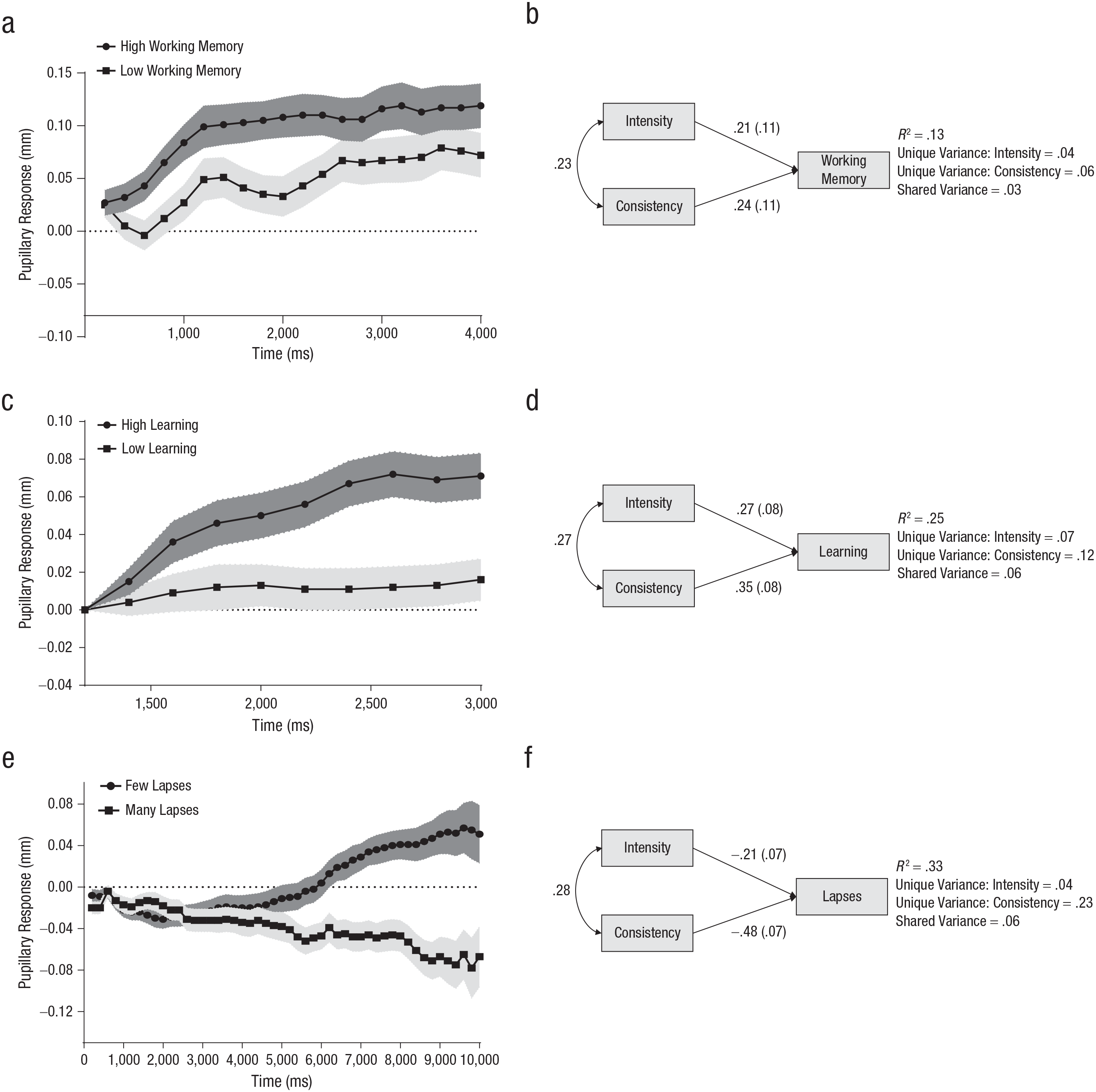
Relations between intensity and consistency of attention and task performance. The top row shows (a) pupillary response during the retention interval of a colored-squares working memory task, separately for individuals with high working memory capacity (top 25% of scores) versus low working memory capacity (bottom 25% of scores), and (b) the results of path analyses examining the unique and shared contributions of intensity (measured by pupil dilation at the last time bin) and consistency (measured by trial-to-trial fluctuations in baseline pupil dimeter; reverse scored) to performance on this task (data from Unsworth & Robison, 2015). The middle row shows (c) pupillary response during the encoding period of a paired-associates task, separately for individuals who exhibited high versus low learning (top vs. bottom 25% of scores), and (d) results of path analyses examining the unique and shared contributions of intensity (measured by pupil dilation at the last time bin) and consistency (measured by thought-probe responses; reverse scored) to performance on this task (data from Miller & Unsworth, 2021). The bottom row shows (e) pupillary response during the preparatory interval in a psychomotor vigilance task, separately for individuals with many versus few lapses of attention (bottom vs. top 25% of scores), and (f) results of path analyses examining the unique and shared contributions of intensity (measured by pupil dilation at the last time bin) and consistency (measured by thought-probe responses; reverse scored) to behavioral manifestations of lapses of attention on this task (the slowest 20% of reaction times for each participant; data from Unsworth, Miller, & Robison, 2020). The shaded areas in the graphs represent ±1 SEM. The path diagrams show standardized coefficients; values in parentheses represent 1 SEM. Note that although the graphs in (a), (c), and (e) show results for only certain groups (for visualization purposes), the analyses were run on the full samples.
Intensity and consistency are also important in accounting for variation in learning abilities (Miller et al., 2019; Miller & Unsworth, 2020, 2021). For example, in two studies (Miller & Unsworth, 2020, 2021), we had participants perform a paired-associates task in which they were presented with pairs of words (“Dog-Shoe”) to remember. At test, one of the words was presented (“Dog-???”), and participants had to recall the word that was associated with it. High-learning individuals (individuals who remembered many items on a subsequent test) exhibited larger pupil dilations while encoding word pairs than low-learning individuals did, which suggests that they allocated more attention to learning (see Fig. 3c for results from Miller & Unsworth, 2021). Figure 3d shows results of path analyses examining the relations of intensity (measured by pupil dilation) and consistency (measured by thought-probe responses) with task performance. As in the working memory task, intensity and consistency were related (accounted for shared variance), and each contributed uniquely to performance.
Our research has also demonstrated that intensity and consistency are important in accounting for individual differences in preparatory control during attention-control tasks (Unsworth, Miller, & Robison, 2020; Unsworth & Robison, 2020). For example, in one study (Unsworth, Miller, & Robison, 2020), we had participants perform a psychomotor vigilance task in which they saw a row of zeros (“00.000”) and were told that when the numbers began counting up (as on a stop watch), they should press a key as fast as possible. Critically, the numbers began counting up anywhere from 2 to 10 s after they first appeared. Thus, participants had to maintain a high level of preparatory control (intensity) in order to rapidly detect when the numbers began counting up. As shown in Figure 3e, individuals who exhibited fewer behavioral lapses of attention (particularly slow reaction times) had larger pupil dilations during the uncertain preparatory interval than did individuals who experienced many lapses of attention, which suggests that they allocated more attention to preparatory control processes. Figure 3f shows results of path analyses examining how intensity (measured by pupil dilation) and consistency (measured by thought-probe responses) were related to behavioral manifestations of lapses of attention. As in the working memory and learning tasks, intensity and consistency were related (accounted for shared variance). Also, each uniquely predicted susceptibility to behavioral lapses of sustained attention.
Collectively, these results suggest that both the amount of attention that is allocated to a task and the consistency of the allocation of attention across time are important contributors to individual differences in task performance. Intensity and consistency are related and contribute some overlapping variance in predicting task performance. Yet aspects of intensity and consistency are distinct, and each accounts for unique variance in task performance. In our view, these constructs (along with others) are likely important sources of variance in a wide variety of tasks. For example, prior research suggests that intensity and consistency are important for performance on measures of fluid intelligence (Unsworth & McMillan, 2014b) and on additional attention-control measures (Unsworth & McMillan, 2014a), and likely are important for performance on many other tasks. Future research is needed to better determine what factors contribute to variation in intensity and consistency and to examine the shared and unique contributions of intensity and consistency to task performance.
Conclusions
Our framework builds on prior research that has largely examined individual differences in various types of control. Here we suggest that both the overall intensity (strength) of attention devoted to control processes and the consistency with which intensity is maintained throughout a task vary between individuals and that this variation explains differences in task performance. Additionally, variation in intensity and consistency could account for some of the individual differences in various types of control. That is, individual differences in performance on tasks thought to measure various control processes likely reflect variation in the different types of control engaged (e.g., goal maintenance), variation in the intensity of the attention that is allocated to these control processes, and variation in how consistently attention is allocated to them. There are likely multiple sources of variation in task performance—hence the need to more fully examine the myriad of ways individuals vary in task performance.
These same ideas could be used to examine individual differences in cognitive development; that is, some developmental variation could be due to variation in intensity (Chevalier, 2018), and other developmental variation could be due to variation in consistency (Keulers & Jonkman, 2019), in addition to differences in types of control. For example, some children could perform poorly on an attention-control task because they have specific deficits in the type of control engaged (e.g., conflict resolution). Other children could perform poorly on the task because they are allocating lower levels of attention (perhaps because of low arousal, low capacity, or low motivation) to the particular type of control engaged. Yet other children could perform poorly because they experience frequent lapses of attention in which there are repeated, temporary reductions in intensity. Thus, development differences in task performance could arise from multiple, somewhat distinct, factors. Similarly, intensity and consistency are likely important in accounting for individual differences in educational contexts (due to variation in attention allocated to studying for exams and to lectures; Paas & van Merriënboer, 2020; Unsworth & McMillan, 2017) and work environments (Kanfer & Ackerman, 1989).
Although our review has been necessarily selective, it suggests that intensity and consistency are related to one another, yet are distinct processes that contribute uniquely to variation in performance on a wide variety of tasks. Our framework further suggests that a number of factors are likely central in accounting for individual differences in intensity and consistency, and future research is needed to more fully examine these factors. Investigating individual differences in intensity and consistency should provide a fuller understanding of why people differ in attention abilities in and out of the laboratory.
Recommended Reading
Kahneman, D. (1973). (See References). Outlines a theory of attention and effort and suggests that pupillometry can be used to measure the intensity of attention.
Kanfer, R., & Ackerman, P. L. (1989). (See References). Presents an update of Kahneman’s model in which motivational factors are added and suggests the importance of interactions between ability and motivation for understanding individual differences in task performance.
Shenhav, A., Musslick, S., Lieder, F., Kool, W., Griffiths, T. L., Cohen, J. D., & Botvinick, M. M. (2017). (See References). Provides an updated review on mental effort.
Unsworth, N., & Robison, M. K. (2017b). (See References). Suggests that the locus coeruleus-norepinephrine system is an important source of individual differences in attention abilities.
Unsworth, N., & Robison, M. K. (2020). (See References). Presents a cognitive-energetic model of individual differences in the intensity of attention.
