







Abstract
The literature on privacy-related behaviors and preferences often frames disclosure as strategic—the result of a weighing of costs and benefits and a pursuit of instrumental benefits rather than as a goal in and of itself. In the present article, we summarize evidence supporting the view that disclosure can exhibit drive-like qualities and that this “drive to disclose” can, at times, overwhelm the motive to maintain privacy. We discuss implications of this perspective, highlighting ways in which recognizing the existence of a drive to disclose can inform privacy research and policy making.
Privacy is a central issue in the digital age. The emergence of digital communication and social media, accompanied by advances in technology such as smartphones and smartwatches that place both readily at one’s fingertips, has transformed interpersonal communication and enabled the prolific sharing—as well as collection and permanent storage—of personal information. Although the revelation of such information has always entailed risks for the discloser, this new landscape presents novel challenges from a privacy perspective. First, people can engage in behaviors that do not involve disclosure per se but that nevertheless shed private information, for example, creating dating profiles, making online credit card purchases, and so on. Second, and of particular interest for the present article, people can explicitly share information, for example, when disclosing a controversial belief or stigmatized identity to an online audience over social media. 1 In an era of online shaming and “canceling,” such behavior can render one socially and reputationally vulnerable, as public disclosures from the past can come to haunt one’s present. They can also be materially costly when, for instance, information is used for individual profiling that determines access to employment (Pinchot et al., 2018) or, in a more extreme, deleterious example, in the service of burglary or identity theft (Al-Daraiseh et al., 2014).
Given these novel privacy challenges and their potentially dire consequences, it is no surprise that social and behavioral scientists have devoted considerable effort to understanding privacy-related behavior. Such investigations often conceive of disclosure as the end result of a conscious balancing of costs and benefits, sometimes referred to as the “privacy calculus” (for a review, see Smith et al., 2011). According to this perspective, individuals weigh the risks of disclosure—that is, “the potential for loss associated with the release of personal information” (Smith et al., 2011, p. 1001)—against the expected benefits.
To date, heavy empirical emphasis has been placed on the cost side of this equation. For example, a now large experimental literature has identified manipulations that change individuals’ disclosing behavior by heightening or suppressing privacy concerns, that is, considerations of the cost of sharing information (e.g., John et al., 2011). Implicit, and in some cases explicit, in this perspective is the idea that privacy is a goal in and of itself—a “universal human need” (Acquisti et al., 2015, p. 511) evolving over millennia (albeit not ideally adapted to cope with the new threats of the digital age; see Shariff et al., 2021).
In contrast, the disclosure of information has been assumed not to be intrinsically rewarding generally but, rather, motivated by indirect benefits. An individual might, for example, divulge personal information to others in order to receive advice or help in solving a problem. Or a consumer might trade off privacy for financial reward (Smith et al., 2011), access to entertainment (Debatin et al., 2009), or marketing personalization (e.g., tailored product recommendations, anniversary reminders; Chellappa & Sin, 2005).
In this article, we review evidence suggesting that a substantial portion of disclosing behavior is more indicative of a drive to disclose than of a rational calculation of benefits and that this drive may exhibit psychological primacy over the countervailing need for privacy. In fact, if we accept the fundamental, drive-like nature of the desire to disclose, couching disclosure in terms of “benefits” at all does not do justice to the underlying mechanisms driving disclosure.
The Drive-Like Nature of Disclosure
Individuals often disclose information as a deliberate means to some tangible or strategic end, as discussed already, and it is largely this deliberative disclosure that is captured in the existing privacy literature. But a nontrivial portion of what is shared with others is driven, at least in part, by nonreflective, impulsive, or even compulsive, psychological processes. By the same token, the act of withholding what one desires to disclose can require an aversive exertion of willpower. In the same way that we often overconsume, aggress, and engage in many other impulsive behaviors despite, and in some cases even with full awareness of, the possible repercussions, viewing disclosure as a drive can help to make sense of how and why people commonly overshare, that is, disclose information that they realize, even at the moment of revelation, might be better left unshared. Such behavior is incompatible with the prevailing view of disclosure as resulting strictly from a rational weighing of costs and (instrumental) benefits.
In what follows, we present evidence of the drive-like features of disclosure. 2 Specifically, like behavior that results from other drives, disclosure is preceded by a state of emotional or physical arousal that motivates action aimed at satisfying the associated (psychological) need(s), which can lead to the type of impulsive behaviors mentioned previously. We then discuss the relevance of this perspective to the privacy literature and its implications for privacy-related behaviors.
Emotions and arousal
Unlike the calculated, strategic disclosing depicted in the existing privacy literature, many instances of disclosure appear to be driven, or at least powerfully abetted, by emotions and accompanied by arousal. For example, participants who viewed strongly emotion-evoking film clips engaged in significantly more “social sharing of emotion”—that is, communicating to others the circumstances of, and their reactions to, emotion-eliciting events (Rimé et al., 1991)—than those shown less emotionally evocative clips (Luminet et al., 2000). This is consistent with the “fever model” of disclosure (Stiles, 1987), which maintains that, just as the level of fever increases with the degree of physical infection, disclosure increases with degree of psychological arousal. Research (e.g., Berger & Milkman, 2012; Heath et al., 2001) has consistently found that content evoking high-arousal emotions (e.g., anger, awe, disgust) is more likely to be shared with others than is unemotional material or material evoking weak, low-arousal emotions (e.g., sadness), controlling for other content features. Berger (2011) even observed that the propensity to share neutral content (e.g., an unemotional article or video) was elevated among study participants whose arousal was heightened by watching an unrelated amusing or anxiety-producing film clip or merely by jogging in place.
Along the same lines, Rimé et al. (1991) asked study participants to recall specific emotional experiences and life events and found that nearly all (90%) had reportedly disclosed these experiences to others—often on the same day as the occurrence (a hallmark of emotionally triggered actions)—and that sharing was positively correlated with the disruptiveness of the event. Such a desire to disclose life-disrupting experiences is consistent with the idea that disclosure can serve as an emotion regulation strategy to influence the intensity, duration, or quality of an emotional response; excessive reliance on disclosure can, however, result in a failure to consider other emotion regulation strategies, even where this strategy may be poorly matched for the environmental circumstance (Gross, 2015). Such an account can explain the case of perpetual “oversharers.”
Taken together, this evidence suggests that disclosure often arises from emotional arousal rather than from a rational calculation.
The carrot and stick of disclosure
Most drives motivate behavior via a carrot (the pleasure of satisfying the drive) and a stick (an aversive feeling when the drive remains unaddressed). The drive to disclose is no exception. Disclosure may be immediately satisfying in the sense that it offers emotional release. For example, Xiao and Houser (2005) found that individuals were ready to incur a financial loss to punish individuals who had treated them unfairly in an economic game but were significantly less likely to do so if they had been given an opportunity to convey their feelings to the offending player—as if the disclosure relieved them of their negative feelings. Perhaps even more compelling is neuroscience evidence suggesting that the act of disclosing even emotionally neutral information is inherently pleasurable. Tamir and Mitchell (2012) scanned participants using functional magnetic resonance imaging while they answered questions about their own or others’ beliefs and opinions (which were, on some trials, disclosed to others), and Tamir et al. (2015) scanned study participants as they made decisions about informing a randomly assigned partner of the correct selection in an experimental task (i.e., which card of four correctly completed a sequence). The scans from both studies revealed that sharing information activated reward centers of the brain. The same studies also revealed that individuals would incur costs to share even nonemotional information and would share absent plausible instrumental motives. For example, in Tamir et al. (2015), participants sacrificed earnings to inform their partners of the correct answer even when doing so had no impact on their reputation (partners never learned that they received the information because the focal participant opted to share it with them) and provided no pecuniary benefit to the partner (no additional money was earned for accurate responses, ruling out altruistic motivations).
The pleasures of disclosure may be realized immediately, but, like most other drives, benefits from satiation of the need to disclose also extend over time. Sharing emotionally evocative experiences can increase long-term well-being and produce positive health outcomes, including improved immune functioning and a reduction of intrusive thoughts and physical symptoms associated with traumatic events (for a review, see Frattaroli, 2006). Therapy, where many of these positive outcomes are achieved, offers an instructive means of delineating drive-like disclosures from the more strategic variety dominating privacy models. One might seek out therapy in a deliberate effort to work through a problematic behavioral or psychological tendency over time. This pursuit of instrumental benefit can be distinguished from the drive-like disclosures made to a therapist in pursuit of immediate relief from misery: catharsis.
A complementary literature, suggestive of the “stick” of disclosure, focuses on the effects of suppressing the need to disclose (e.g., secrecy; Slepian et al., 2017), which is associated with harmful patterns of thought (e.g., rumination) and can result in long-term health problems (e.g., anxiety, high blood pressure; e.g., Finkenauer et al., 2002). There is also some evidence of the hedonically aversive nature of an unrealized desire to disclose. Butler et al. (2003) observed increased blood pressure levels in conversational partners when one member of the dyad was instructed to suppress her emotional responses. Additionally, unpublished data (cited in Harber & Cohen, 2005) suggest that the need to disclose can intensify if not satiated: Participants who watched a gruesome film clip in an initial experimental session were less tempted to discuss the clip with others (outside the lab) prior to returning for a second session 6 weeks later if they had been given the opportunity to disclose their thoughts and feelings about the clip in the first session.
Like other drives, the drive to disclose likely evolved because it aided survival and reproduction. The “intrapsychic need” to disclose emotional or distressing experiences produces, in economic terms, positive externalities: Disclosing—in some cases to satisfy an individual’s drive to disclose—often inadvertently benefits others by disseminating psychologically relevant and important information to their social networks (Harber & Cohen, 2005). This social communication is evolutionarily advantageous, enabling—at the group level—the acquisition of knowledge and skills necessary for survival in diverse habitats (Pagel & Mace, 2004). Even “gossip” (i.e., sharing information about an absent third party), despite its usually negative connotations, can serve to discourage socially undesirable behavior (Beersma & Van Kleef, 2011). Hence it seems plausible that the drive for disclosure many have arisen from evolutionary forces operating at the group level. Given the crucial role of disclosure in cultural evolution (Csibra & Gergely, 2011), and perhaps due to generalization beyond its original function, modern-day humans seem to be hardwired to want to share information with others.
Impulsivity
The concurrence of both deliberate or strategic and viscerally driven, immediately gratifying disclosure suggests that different disclosing contexts can invoke different psychological processes, which, for simplicity, we broadly categorize into two distinct systems, one deliberative and one affective. The former system encompasses rational, cognitive, goal-oriented processes and is responsible for self-regulation and self-control, whereas the latter involves responses driven by emotions and motivational states (Loewenstein et al., 2015). Behavior, according to this perspective, is guided by the often-competing interplay between these two systems, the outcome of which is determined by factors internal to the decision-maker (e.g., availability of willpower, cognitive resources) as well as external features of the environment (e.g., the salience of privacy threats).
With this framing, disclosure can, like other drive states (e.g., hunger, sexual arousal), be associated with attempts at, and in some cases failures of, inhibitory control (Logan et al., 1997). When in a “cold,” unemotional state and/or with ample cognitive resources, one’s disclosing behavior is likely to be guided by the cognitive, deliberative system. But when self-regulatory faculties are lacking, or the content or context of a potential disclosure evokes a sufficiently powerful urge to share, disclosure is likely to occur, even against individuals’ better judgment. Examples of impulsive disclosing—often marked by regret after the fact or violations of resolutions to keep information private—abound and, in some cases of sharing personal, sensitive information, may result in a “vulnerability hangover,” a state of “anxiety, shame and regret felt after divulging something personal” (Burns, 2022).
Figure 1 summarizes the account of disclosure just discussed and introduces one new element: an affective fear of sharing (e.g., a visceral fear of making oneself vulnerable via information revelation) that can also enter into the decision to disclose or withhold information (i.e., nondisclosure). This motivational force favoring nondisclosure encompasses both dispositional factors (e.g., being a “private person” with a general fear of sharing) and situational factors (e.g., situational cues that heighten privacy concerns). Although emotional, this fear of sharing, however, leads to nonbehavior and behavioral suppression rather than action and lacks the other hallmark features of a drive highlighted in prior subsections.
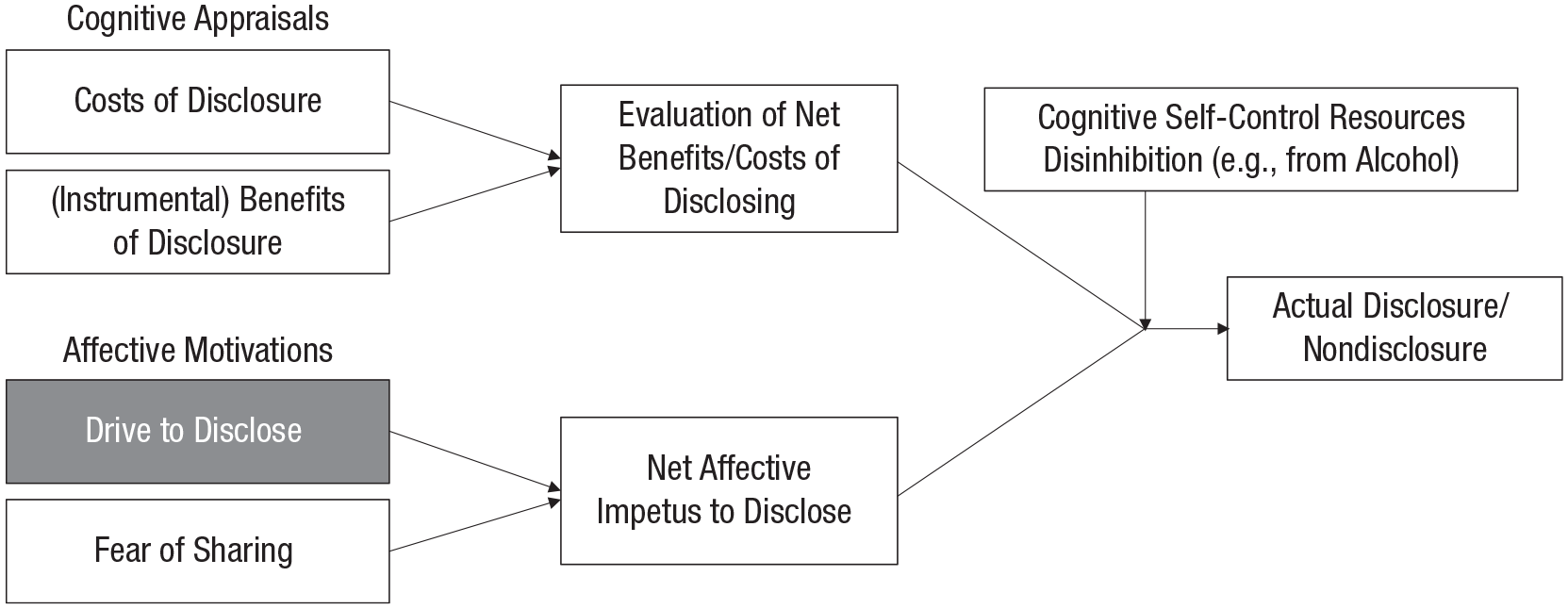
Interplay between cognitive and affective factors in determining disclosing behavior.
In a cold, unaroused state with no affective motivation either to disclose or withhold information, cognitive appraisals alone will dictate whether disclosure occurs. When the drive to disclose is activated, however, Figure 1 shows that people engage, in parallel, in both cognitive appraisals of the costs and benefits of disclosing, and affective reactions. Behavior is the joint product of these potentially competing motivations.
In many cases, cognitive and affective motivations will be aligned, both favoring either disclosure or withholding. In other situations, however, when the two systems are in conflict, impulsive disclosures are those that result when affective processes (e.g., the drive to disclose) overwhelm the force of deliberation (Loewenstein et al., 2015). Conversely, strategic disclosures arise when disclosure follows the dictates of deliberation, even when the drive to disclose, or fears associated with disclosure, provides contrary motivation. This could occur because the affective impetus is relatively weak or because the ability to marshal cognitive resources and exert self-control is high. Of note is the fact that both affective and deliberative disclosure or nondisclosure can ultimately be regretted—the former when affective factors overwhelm correct cognitive appraisals of costs and benefits, the latter when cognitive appraisals prevail but result from miscalculations.
The dual dimensions of disclosure highlighted in Figure 1 are paralleled by other drives. Just as disclosure can be strictly strategic or in response to the drive to disclose, not all instances of eating are a manifestation of the hunger drive. For instance, one might eat a large breakfast for instrumental reasons, say, to ensure sufficient energy in anticipation of a strenuous workout. Similarly, sexual intercourse can be motivated by the sex drive but also by the goal of procreation. Behaviors motivated by these drives can also manifest in different ways. Just as the sex drive might be satisfied though reliance on pornography or by in-person encounters, the drive to disclose may motivate individuals to talk to different people via different communication channels (e.g., face-to-face, online).
Implications for Privacy
The perspective presented thus far has both theoretical and pragmatic implications for the study of privacy. Perhaps most significantly, this perspective can help to explain the so-called privacy paradox, whereby individuals’ disclosing behavior contradicts their professed privacy preferences; for instance, individuals expressing high privacy concerns or low willingness to disclose information in specific domains were found, in practice, to reveal information from those exact domains in excess of their stated intentions (Norberg et al., 2007). There have been a number of proposed resolutions of the paradox (for a review, see Kokolakis, 2017), and the notion of a drive to disclose can complement other accounts: In certain instances, the impetus to disclose may be so visceral, immediate, or emotional that privacy costs do not factor in or do so only as an afterthought, perhaps after an impulsive disclosure occurs and its consequences are realized.
The need for privacy and the drive to disclose need not be related, but they can and often do operate in opposition to one another. When that happens, the impulsivity associated with this drive has important privacy implications, particularly as online sharing platforms offer a ready, instant audience. Research confirms this hazard: Wang et al. (2011) found that 21% of survey respondents reported having posted something to Facebook that they later regretted. Although these posts were sometimes the result of a miscalculation about who would see the post and/or how it would be received, many were examples of venting or disclosures made in a “hot” state. The authors argue that the regrets of Facebook users reveal the “impulsiveness of sharing or posting on Facebook [which] may blind users to the negative outcomes of posts” (Wang et al., 2011, p. 10).
The regrettable nature of these posts, combined with their potential to reach a wide and often unsympathetic audience—in perpetuity—renders them perilous. And, although many online platforms can ostensibly circumvent the risks associated with impulsive disclosure through their provision of visual anonymity and dissociation of real and online identities, few achieve “true anonymity” in terms of lacking identifiability (Morio & Buchholz, 2009). Indeed, even purportedly anonymous communications can often be traced back to an IP address.
Conclusion
Many of life’s greatest pleasures are associated with the gratification of drives, and disclosure is no exception. The sharing of private information can be emotionally rewarding and socially beneficial in a wide range of situations. At the same time, these pleasures, particularly when achieved over modern social media, can come at a cost. An appreciation of the drive-like properties of disclosure might encourage purveyors of social media and digital communications to introduce safeguards against excessive or impulsive disclosing. For example, companies might borrow the concept of a “cooling off” period—mandated for certain sales (e.g., firearms)—and apply it to online information sharing, leveraging their existing access to personal communications to develop algorithms that delay sending, and/or offer an opportunity to retract, any content categorized as “potentially regrettable.” Protections already in place to warn about, and discourage individuals from proceeding to, unsafe websites can be extended to mobile applications that obtain invasive access to personal information from unwitting users. Other interventions might safeguard individual rights after disclosures have taken place, as was the goal of the General Data Protection Regulation adopted by the European Union in 2016. This legislation establishes a “right to be forgotten” (e.g., to remove private information from online searches) and to withdraw consent to personal data collection and processing.
Given the overarching goal of the privacy literature to bring privacy outcomes into alignment with privacy preferences, reorienting how we think about, and extending our understanding of, disclosure is particularly important. The present review uncovers several avenues for future research to that end. First, if disclosure really is like a drive, then thwarting one’s ability to act on the desire to disclose (as the aforementioned proposed interventions would do) should be aversive, but there is limited research on the hedonic experience of an unrealized desire to disclose. Another promising research direction would be to explore the contextual factors that activate and intensify or mitigate the desire to disclose; much is known of these factors in connection with other drive states, but, to the best of our knowledge, almost no research attempts to trigger (or suppress) the desire to disclose. Advancing our understanding of the other side of the privacy equation—that is, the visceral drive to share information with others—can enrich the study of privacy, contribute to policy research, and help people make better decisions.
Recommended Reading
Berger, J. (2014). Word of mouth and interpersonal communication: A review and directions for future research. Journal of Consumer Psychology, 24(4), 586–607. https://doi.org/10.1016/j.jcps.2014.05.002. A comprehensive enumeration of the manifold instrumental benefits of disclosing.
Carbone, E., & Loewenstein, G. (2023). (See References). An extended discussion of the evidence supporting the drive-like nature of disclosure.
Joinson, A. N., & Paine, C. B. (2007). Self-disclosure, privacy and the internet. In A. Joinson, K. McKenna, T. Postmes, & U.-D. Reips (Eds.), The Oxford handbook of internet psychology (pp. 237–252). A review of the self-disclosure literature through a privacy lens, focusing on online disclosures and highlighting links between the self-disclosure and privacy disciplines.
Tardy, C. H., Dindia, K., & Hargie, O. (2018). Self-disclosure: Strategic revelation of information in personal and professional relationships. In O. Hargie (Ed.), The handbook of communication skills (4th ed., pp. 217–258). Taylor & Francis. A comprehensive review of the extant theoretical and empirical literature on instrumental self-disclosure across relationship types and modalities.
