






Abstract
Greater numbers of people are turning to artificial intelligence (AI) for empathy and emotional support. Here, we review and synthesize recent empirical work on how people perceive empathy from AI versus from humans. Growing evidence points to two dueling effects and a paradox: AI produces language that is rated higher in empathy than language written by humans, but when people perceive text as coming from AI versus a human, they rate it as less empathic. However, despite sometimes rating AI more empathic or having to wait for human empathy, people still show a preference for human empathy. This emerging literature carries significant implications for fundamental research on empathy and for public discourse as the use of AI for emotional support continues to grow.
Keywords
Introduction
With the vast developments in the capabilities of large language models (LLMs) to engage in conversation, more people are turning to LLMs for social support. Both OpenAI (Phang et al., 2025) and Anthropic (McCain et al., 2025) have released analyses of conversation logs that suggest that about 3% of conversations are emotional in nature. Although this number might seem small, given the increasing use of LLMs (with OpenAI processing billions of queries per day), this can be substantial. Other research suggests that 24% of adults (Stade et al., 2025) and 13% of adolescents (12–21 years old; McBain et al., 2025) report using LLMs for socioemotional support or mental health. Emotional support is fast becoming a mainstream aspect of interactions between humans and artificial intelligence (AI).
The value of seeking empathy from AI has sparked a growing debate, including among the authors of this article. Some argue that AI generates empathy that is consistent, unbiased, and without the moral distortions that affect human empathizers. Given that people perceive the language produced by AI as higher in empathy and compassion, such responses can leave individuals feeling understood, validated, and cared for, thus promoting human flourishing for some people (Inzlicht et al., 2024). Others caution against treating AI as empathic, citing ethical, safety, and psychological concerns (Perry, 2023). Core human traits, such as truly feeling emotions and being embodied beings with limited capacity for care, may be precisely what gives human empathy its value. Without these true feelings, some argue, empathy would be based on deception and therefore could not achieve its true purpose. The emergence of so-called artificial empathy, convincing, instantaneous, and continually improving, thus raises critical questions about what shapes the perception of empathy and how it differs when thought to come from humans versus machines.
What Is Empathy?
Empathy is a multifaceted construct that includes a cognitive component (understanding another’s emotional state), an affective component (“feeling with” the other), and a motivational component (feelings of concern for the other; e.g., Zaki & Ochsner, 2012). Genuine empathic connection fosters a profound sense of mutual understanding and togetherness, enhances resilience, builds relationships, and promotes altruistic and prosocial behaviors. But empathy is effortful and sometimes aversive (e.g., Cameron et al., 2019), which leads people to sometimes avoid empathizing (Zaki, 2014).
Importantly, psychologists have predominantly studied empathy from the perspective of the empathizer, focusing on factors that enhance or hinder empathic responses and the biases that may influence them (Inzlicht et al., 2024). With AI-generated empathy, it makes less sense to ponder whether AI “cares” or “shares your feelings”; instead, the focus shifts to how recipients perceive empathy (Hadjiandreou et al., 2026; Suh et al., 2026; Wenger, Cameron, & Reinecke, 2026), such as how people desire validation, feeling heard and understood, and that someone cares for them.
Empathy Is in the Mind of the Beholder
We note that although the ongoing societal conversation about AI empathy is in response to recent advancements in AI technology, the psychology of attributing empathy to a machine is hardly new. Six decades ago, Weizenbaum (1966) showed that people readily opened up to a simple computer program, ELIZA, that parodied a Rogerian therapist, writing that the human user will “contribute much to clothe ELIZA’s responses in vestments of plausibility” (p. 42), referring to how much people impute knowledge and intentions to, and forgive the faux pas of, a machine. Many scholars since (e.g., Reeves & Nass 1996) have elaborated on this human tendency to anthropomorphize technology. In other words, people readily project empathy (or traits such as caring) onto machines during interactions; this psychology interacts with modern AI’s increasing proficiency at producing natural text. Indeed, although many of the studies we reviewed used LLMs, the psychology of perceiving artificial empathy is not limited by specific LLM technologies, or even to language as a modality—people also perceive empathy when interacting with embodied robots (e.g., Cameron et al., 2025). Thus, we frame our discussions around “artificial intelligence” despite this being a broad and sometimes ill-defined term.
Current Work on Perceptions of AI-Generated Empathy
Recent research has compared perceptions of emotional support provided by people with support provided by AI—and here we discuss some 23 studies across seven articles. In general, people find language generated by modern AI to be more empathic than language written by humans. This is true when comparing AI-generated empathic support to messages written by crowdsourced workers (Yin et al., 2024), crowdsourced workers incentivized for greater emotional support (Li et al., 2025), research assistants (Lee et al., 2024), medical doctors (Ayers et al., 2023), and even crisis-line responders, who are trained to provide empathic support (Ovsyannikova et al., 2025, Study 4). Across these studies, this main effect, which we refer to as the “AI advantage,” is substantial; a recent meta-analysis (Ong et al., 2026) estimated an effect size (Hedges’s g) of 0.54 (see Fig. 1, top).
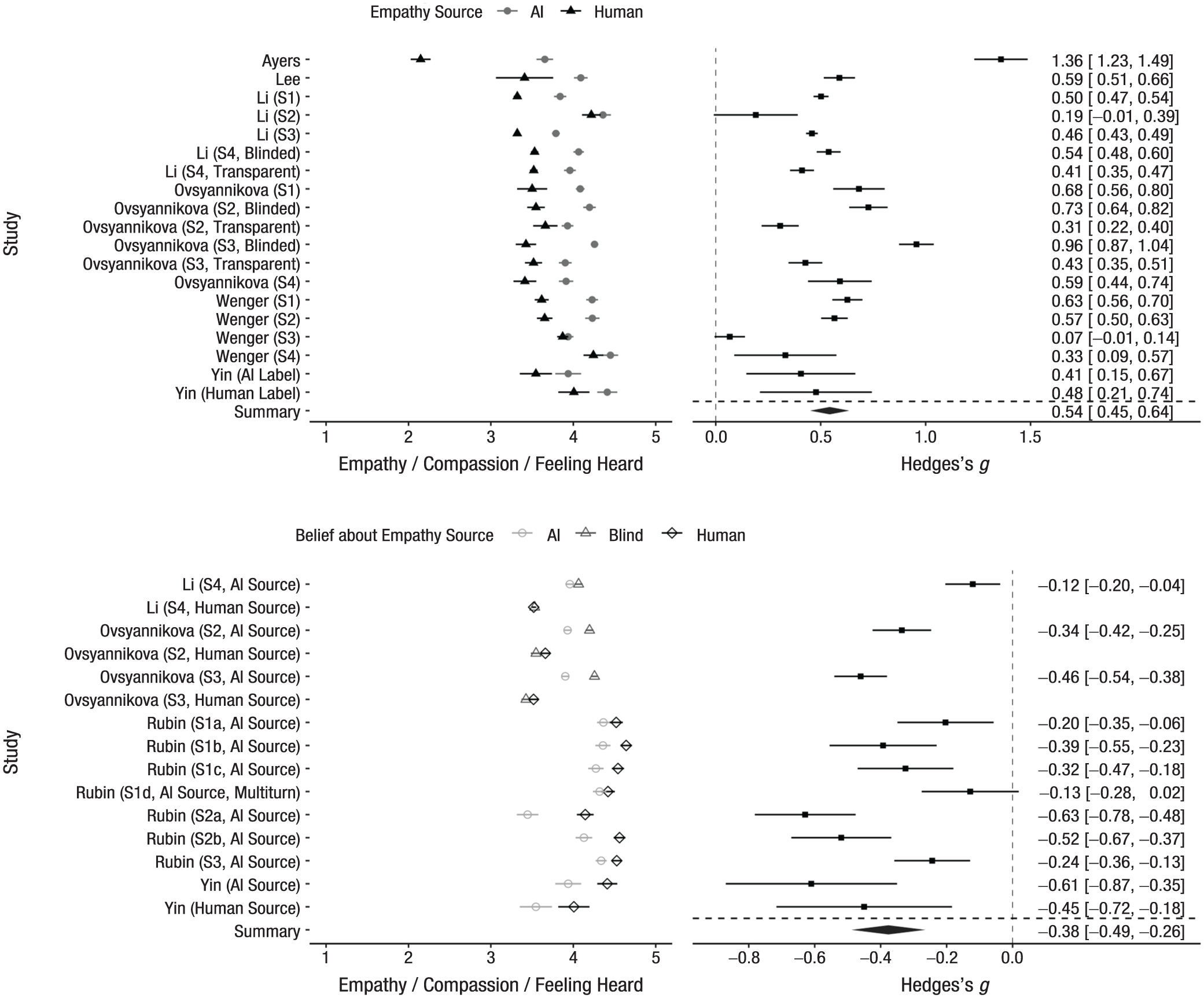
Graphical summary of recent studies that compared perceptions of AI-generated versus human-written empathic responses. The top graph shows the effect of the empathy source, that is, whether the response was generated by AI or written by a human). Studies found an “AI advantage” in which AI-generated responses were rated more empathic. The bottom graph shows the effect of beliefs about the empathy source, that is, whether participants knew the identity of the source (believed it was AI, believed it was a human, or were blind to the source). Studies found an “AI penalty” in which AI-labeled sources were “penalized” and rated lower on empathy. Mean ratings of the respective dependent variable (empathy, compassion, feeling heard, etc.) are shown on the left, and the effect sizes (Hedges’s gs) along with the numerical values and 95% CIs are shown in the forest plots on the right. The weighted meta-analytic effect size is shown at the bottom of each forest plot. For the bottom-right plot, we computed Hedges’s gs for the believe-AI versus believe-human contrast and the believe-AI versus blind contrast while controlling for the actual source to isolate the main effect of participants’ beliefs. Note that some of the comparisons shown in the top plot (specifically the “transparent” conditions and the Wenger study) actually conflated both main effects, so the meta-analytic effect size was slightly underestimated. Error bars represent 95% CIs. Note that data from some studies that appear in the top row also appear in the bottom row. Reproduced with permission from Ong et al. (2026). AI = artificial intelligence; CI = confidence interval.
Most of these studies (Ayers et al., 2023; Lee et al., 2024; Li et al., 2025; Ovsyannikova et al., 2025) started with vignettes of people seeking emotional support or advice and collected AI-generated and human-written responses to these vignettes. These vignettes and responses were then shown to independent participants who were asked to rate the responses on empathy or similar variables (i.e., third-party ratings). Participants in other studies (Li et al., 2025; Rubin et al., 2025; Wenger, Cameron, & Inzlicht, 2026; Yin et al., 2024) wrote about their own experiences, collected AI-generated or human-written responses to those descriptions, and then read those responses and provided first-person ratings of how much empathy or how heard they felt. Both types of studies found higher ratings for AI-generated responses.
Although most studies tended to use variants of GPT, these results replicated across a range of LLMs and contexts (Lee et al., 2024), suggesting that this phenomenon is not specific to a particular AI model or family. Moreover, the breadth of human populations that the various studies were drawn from—from laypeople to trained crisis responders—suggests that, although there may be study-specific differences in people’s empathic “skills,” motivation, or context, the AI-human difference in the quality of the language produced seems to be fairly robust.
However, as soon as people believe (accurately or not) they are interacting with AI, they downgrade the value of the text—a finding we call the “AI penalty.” When empathic responses are labeled as generated by AI, people prefer them less compared with when they are labeled as written by people, even when controlling for who or what actually produced the responses (Rubin et al., 2025; Wenger, Cameron, & Inzlicht, 2026; Yin et al., 2024). For example, AI-generated empathic responses to participants’ emotional situations were labeled as either provided by humans or AI. Although identically generated, human-attributed responses were rated more empathic and supportive and elicited more positive and fewer negative emotions, particularly when responses stressed emotional sharing or care. Moreover, the more a participant suspects AI aid in crafting human-attributed responses, the less empathy they perceive in the responses (Rubin et al., 2025). Similarly, responses labeled as being written by AI were rated as eliciting less of a feeling of “feeling heard” (Yin et al., 2024). Thus, people downgraded their ratings of AI’s empathic statements as soon as they believed the statements were generated by AI (Ovsyannikova et al., 2025). Knowledge of the source of the empathy plays a significant role in the recipient experience of empathy. This effect, estimated by Ong et al. (2026), is also substantial (g = 0.38; see Fig. 1, bottom).
All told, this growing literature has yielded two dueling main effects (summarized in Fig. 1): The language in AI-generated empathic responses are perceived to be of higher quality, making people feel more heard and cared for (the AI advantage), and people downgrade the quality of empathic responses as soon as they perceive them as being generated by AI, or even aided by AI (the AI penalty). The relative strengths of these two main effects differed by study. Among studies that directly compared them, one set of studies found that although third-person raters penalized text when they learned it was generated by AI, they continued to rate it as being more compassionate than those produced by even expert human empathizers (Ovsyannikova et al., 2025), whereas another study with first-person ratings found that the main effects were somewhat comparable in magnitude, with no significant differences between ratings of AI and human responses (Yin et al., 2024). In another set of studies, people rated transparently labeled AI responses as superior to transparently labeled human responses. However, when given a choice about who they personally wanted to receive empathy from, most preferred the human responder (Wenger, Cameron, & Inzlicht, 2026). This preference remained even if they had to wait longer for human responses (Rubin et al., 2025). Thus, there exists a paradox: From the language alone, AI-generated empathy is rated better; the same text is penalized when people think it is generated by AI; but when asked to choose, people may still prefer human empathy even if they rate the AI-generated text better.
We can only speculate on the source of this empathy-choice paradox. One suggested reason is that people have a general mistrust of algorithms, machines, and new technology such as AI (e.g., Dietvorst et al., 2015) or have a general preference for humans: Some people moralize numerous AI applications—from AI companions to AI art—rejecting them as morally problematic (Oldemburgo de Mello et al., 2025). These moralized beliefs tend to be domain-general and seem to stem from perceived violations of naturalness or authenticity. A second possible explanation for the opposition to AI-generated empathy arises from the fact that AI does not actually feel or genuinely care, and so AI-generated empathy feels fake and even deceptive (Perry, 2023; Rubin et al., 2025; Yin et al., 2024). Moreover, human empathy is costly—empathizing takes cognitive and emotional effort. Although this is sometimes presented as a downside of human empathy, this could also be why recipients may value it more than an always available, cheap AI response (Perry, 2023). A third possibility is that people may find AI to be more capable but less credible (Jackson et al., 2023) at empathy, which requires human capacities to feel emotions, or have experiences through which one can understand others’ experiences. Empathy from a nonemotional, nonexperiential being may seem prima facie uncompelling. Although all three claims may be true, and may not be exhaustive, more research should be done to further understand people’s preferences, especially because these preferences would likely be shaped by societal and cultural trends and norms.
The fact that growing numbers of people are turning to AI for empathy suggests expanding current theories of empathy to also include the psychology of the empathy recipient. For instance, Hadjiandreou and colleagues (2026) examined recipient goals and concerns while seeking out empathy (e.g., that recipients want to feel heard while not feeling judged) and concluded that AI could satisfy most of these goals—supported by many of the currently reviewed studies. Relatedly, Wenger, Cameron, and Reinecke (2026) argued that empathy should be understood as a relational, dyadic process that starts with the recipient’s experience, goes through the empathizer’s perceptions of the recipient and their expression of empathy, and ends with the recipient’s perception of empathy. We expect that further theoretical refinements will be proposed in the coming years alongside empirical evidence that supports these theories.
Limitations of Current Work and Thoughts for Future Studies
The reviewed empirical research has several important limitations. First, existing studies examined brief, one-time interactions or a small number of exchanges in a single session (Li et al., 2025; Rubin et al., 2025). Yet the interaction dynamics may change significantly over longer time frames. After months of repeated intimate conversations, a personal AI could become as valued as a human partner. Or the opposite may be true: People are initially moved by the unexpected empathy of an AI, but the novelty fades, and the emotional impact diminishes. This is especially true if AI responses keep being more similar to one another (Gueorguieva et al., 2026), without the variance inherent to human communication or the two-way, evolving nature of human relationships.
To study long-term outcomes, researchers could look into simulating longer conversations or recruiting participants to have conversations over many sessions (e.g., Suh et al., 2026), although this increases the experimental complexity and cost. Alternatively, researchers can look into soliciting and analyzing, in a privacy-preserving manner, transcripts donated by AI chatbot users (e.g., Moore et al., 2026); such naturalistic data sets are far richer than what researchers come up with in the lab. Looking forward, future efforts could take the form of a consortium of researchers collaborating to collect a panel of chatbot users (e.g., adolescents), including longitudinal follow-up surveys and focus groups.
Future longitudinal research should also study outcomes such as loneliness and well-being by measuring friendship networks and health markers. Some research has found that engagement with AI companions may reduce loneliness in the short run (De Freitas et al., 2026). Would such benefits continue in the long term, and if so, how will human relationships change? Will these interactions give way to deeper disconnection (Zhang et al., 2025) and reduced motivation to engage with other people? Or will the story be much more complicated (e.g., moderated by individual patterns of use; Liu et al., 2025)? Indeed, for some individuals who are geographically isolated, older adults with fewer friends alive, or otherwise facing other real barriers to accessing human connection, empathic support from AI may be far better than no support at all. In a promising recent trial, a social robot was found to alleviate loneliness and increase quality of life among older adults (Broadbent et al., 2024).
There is scant cross-cultural research on variation by cultural contexts. Is AI sensitive to different cultural expectations about emotions and behavior? Recent evidence suggests that current LLMs do not seem to be culturally sensitive (Tao et al., 2024; Zewail et al., 2026). Future work could explore cultural differences in the acceptability of AI empathy.
Last, research should examine the various contexts in which AI might be useful. One interesting context in which AI empathy has already been explored in depth is in medicine; a recent meta-analysis (Howcroft et al., 2025) examined 15 studies in the medical literature. Of these studies, only the Ayers et al. (2023) study overlapped with the studies we reviewed above. Howcroft and colleagues (2025) similarly found that AI-generated medical advice was perceived to be more empathic than that given by human health-care providers, with an estimated difference (d) of 0.87, or 2 points on a 10-point scale, which is very similar to and perhaps slightly higher than the difference estimated by Ong et al. (2026). But there are far more situation contexts in which AI-generated empathy might be in demand, such as life coaching, conflict management, and mental health, and people’s perceptions of and acceptance of AI-generated empathy may vary by context (Jackson et al., 2023; Oldemburgo de Mello et al., 2025).
Implications
However, there are also cases in which people have the potential to form new friendships or deepen existing relationships but hesitate to do so. Human connection requires effort and time and is not instantly rewarding. In these cases, loneliness, although painful, can serve an important psychological function (Zohar et al., 2026). It may act as a motivational signal, or nudge, that encourages people to seek out real human connection. In these situations, relying too heavily on AI for emotional support may not just fill a gap—it may reduce the motivation to pursue the kinds of connections that foster long-term psychological and social well-being. If AI begins to fulfill some of those loneliness-related needs, will people still feel compelled to reach out to others? And if not, what are the broader implications for social life and society at large?
An alternate perspective to AI empathy replacing and substituting human empathy is to design AI to augment human empathy. For instance, AI could be used to help people hone their empathy skills via feedback (Sharma et al., 2023). They could also step in in difficult situations, such as assisting customer service representatives with difficult clients (Das Swain et al., 2025).
Beyond empathy, people are also seeking out AI for mental-health applications, such as a (free, on-demand) therapist (e.g., Stade et al., 2025). But many of these AI models are not designed or trained for therapeutic purposes—nor are they regulated or licensed—and may not yet meet the bar in mental-health contexts in which there are much higher stakes of getting something wrong. Commonly used AI models have been shown to validate delusions (Moore et al., 2025), which has led to damage to relationships and loss of life. A related concern is AI sycophancy, in which AI is overly agreeable and flattering to the point of affirming users’ erroneous or socially nonnormative beliefs (Cheng et al., 2026; Moore et al., 2026); some research even suggests that AI models tuned to be more empathic become more sycophantic (Ibrahim et al., 2026), suggesting a deeper link between AI empathy and sycophancy. There remain many questions as to how to make these models safer in mental-health contexts.
The Future
Given such a rapidly developing field, it is difficult to forecast the future, but we provide some speculative predictions. First, perceptions of the acceptability of seeking out emotional support, companionship, or therapy from AI are malleable and shaped by societal norms. Given recent trends about the growing use of AI for emotional support, especially among younger users (Stade et al., 2025), we predict that acceptance will likely increase in the coming years. But this is not a certainty because growing fears about AI harms could also lead to the rejection of AI-generated empathy. Second, the quality of AI responses to express (or mimic) empathy will likely improve—researchers are actively working on issues such as how AI models consider context, store memory across interactions, or present personas. But some changes are far less likely, such as AI being able to care in the same way that human empathizers do. Last, at least with current incentive structures, these systems will most likely continue to be overly accommodating to users’ wishes, producing an unrealistically smooth experience of social-emotional interaction. Such frictionless engagement risks attenuating exposure to real-world disagreement, constraints, and feedback, which may in turn limit long-term personal and social growth.
Conclusion
The question of AI-generated empathy is no longer speculative but empirical and rapidly evolving. Here, we attempted to synthesize the most recent, high-quality psychological research on this topic and to chart a roadmap for future investigation, especially the longer term effects of AI-generated empathy on human well-being and flourishing.
Recommended Reading
Inzlicht, M., Cameron, C. D., D’Cruz, J., & Bloom, P. (2024). (See References). Points out that AI empathy would address many of the shortcomings of human empathy (e.g., time and effort, burnout, bias).
Perry, A. (2023). (See References). Proposes that AI empathy would not be valued as much as human empathy because it does not fully convey some essential components of human empathy (e.g., feeling, caring).
Sharma, A., Lin, I. W., Miner, A. S., Atkins, D. C., & Althoff, T. (2023). (See References). Reports results from a field experiment with peer supporters on a platform, TalkLife, in which peer supporters were given access to an AI that gave feedback on how to make their responses more empathic, and suggests one promising paradigm for enhancing human empathy.
Yin, Y., Jia, N., & Wakslak, C. J. (2024). (See References). Demonstrates both of the main effects summarized in this article.
