







Abstract
Cowpea is an important crop for food security, as it is a primary source of protein and cash income for farmers in the dry savanna areas of Sub-Saharan Africa. Improved varieties should contain reasonable amounts of protein in the grains, and to ensure this, timely and cost-effective analytical methods need to be developed. In this study, a procedure for estimating the grain nitrogen (protein) content in single seeds using near infrared spectroscopy was developed. Near infrared spectroscopic analysis of single seeds is a useful tool for breeders and food companies. A total of 200 cowpea germplasm accessions with wide variation in grain nitrogen content (2.44 – 5.12%N) were used for calibration. Two kinds of sample processing were performed for seed preparation (intact seed and husked seed). The models developed were validated using data from 88 and 89 genotypes. The calibration models based on both intact and husked seeds showed a high level of consistency (R2 = 0.88 and 0.88) in cross-validation. The calibration models predicted samples in validation sets with an accuracy of r2 = 0.85, RMSEP = 0.17%N, RPD = 2.55 and r2 = 0.88, RMSEP = 0.15%N, RPD = 2.90, for intact and husked seeds, respectively. With these levels of accuracy, the developed predictive models showed that NIR measurements for single seeds could be useful to determine the uniformity of grain quality, or for rapid screening of the nitrogen content in the seeds of cowpea genotypes.
Keywords
Introduction
Cowpea (Vigna unguiculata (L.) Walp.) is an important crop for food security, livelihood improvement, and cash income of farmers throughout Sub-Saharan Africa. The crop also plays an important role as a primary source of protein, especially where the consumption of animal proteins is precluded because of inaccessibility, poverty or dietary preferences. 1 The cowpea breeding programs of national agricultural research systems have developed and released a number of improved cowpea varieties in Sub-Saharan African countries. Cowpea grains show wide genetic variation in nutritional quality, including crude protein content, which ranges from 15.3% to 28.3% (based on a N-to-protein conversion factor of 5.45 for cowpea). 2 The high protein levels in the crop can help combat incessant malnutrition among rural and urban poor West African populations caused by insufficient intake of protein and micronutrients (i.e. minerals and vitamins).1–3 However, quality control for food security and routine nutritional analysis are unsatisfactory. Although there may be a huge number of superior crosses or lines per year in the breeding programs, the limited capacity and high cost for nutritional analysis services in Africa circumscribe ease of access to nutritional analysis by breeders.
Near infrared (NIR) spectroscopy is well established for quality analysis and can provide rapid measurements at low cost and non-destructively.4,5 For nitrogen content determination, the use of NIR spectroscopy is a cost- and time-saving option that does not require chemical reagents or gas, in contrast to standard methodologies, such as the Kjeldahl digestion and Dumas combustion methods. These advantages make NIR spectroscopy an attractive technology to plant breeders and researchers, although caution is required because of the sensitivity of the NIR spectroscopy calibrations to the influences of year, time of sowing, location and variety. 6
Muranaka et al. 1 applied NIR spectroscopy to determine nitrogen in cowpea grain samples and were able to provide robust average values for bulked samples (r2 = 0.92, RMSEP = 0.10%). However, the average values do not provide information on the distribution of the values of a given quality trait within a bulk sample; 5 thus, NIR spectroscopy for single-kernel and single-seed techniques has been developed and widely applied.7–12 The primary aim of this study was to develop suitable calibration models for the analysis of nitrogen in single seeds of cowpea which can contribute to the large scale evaluation of the nitrogen content of individual cowpea lines and sort seeds according to their protein content.
Materials and methods
Samples
A total of 224 cowpea genotypes with wide genetic variation in physical, nutritional/anti-nutritional, and functional properties, including grain protein content were collected from the IITA Genetic Resources Center and cowpea breeding program and used for the work as described previously by Muranaka et al. 1 These 224 germplasm accessions were grown in Kano State, Nigeria in 2011 and again in 2012 with the application of inorganic fertilizer (N:P:K = 15:15:15) at the rate of 100 kg ha−1. To minimize variation in soil fertility, plots in each location were arranged in an alpha-lattice design with two replications. Pods were collected from each plot and threshed without contamination by soil after being air-dried. Prior to analyses, grain samples were oven-dried at 40℃ for two days. Finally, a total of 292 seeds (123 germplasm from 2011 and 169 germplasm from 2012) in good condition (without insect damage, irregular shapes and color failure) were selected for model development.
Acquisition of spectra and N quantitative analysis
A downward sloping sample holder and glass slides were used for seed fixation (Figure 1(a)). Seeds were scanned with a Fourier transform infrared spectrometer (FT/IR 6100, JASCO, Tokyo, Japan) equipped with a reflectance unit (NRF PRO410-N), broadband KBr beam splitter (KBRBB-6000BS), halogen lamp as a light source, and InGaAs detector. Spectra (4000 to 10,000 cm−1) of the seeds were obtained using a diffuse reflectance method at 8 cm−1 resolution (Figure 1(b)). Every hour, baseline data were acquired using an internal standard to prevent baseline shift. Thermal and optical source dependent drift was less than 1.5% h−1 with this unit. Two spectra of the same seed were acquired. First, a spectrum of the seed was acquired non-destructively through the seed coat, and then a part of the seed coat was removed using a scalpel and another spectrum was acquired.
(a) Picture of single-seed cowpea and the sample holder, (b) Near infrared raw spectra of intact and husked cowpea seeds.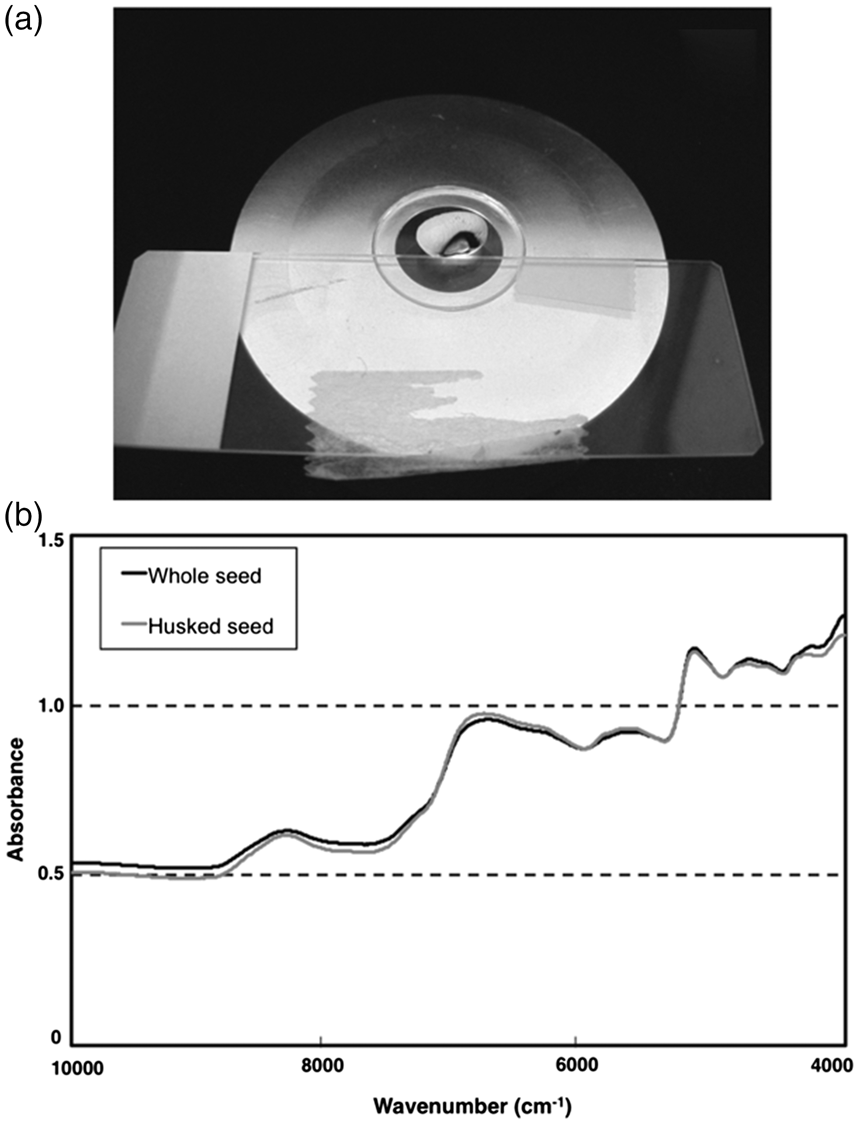
Total grain nitrogen content was determined using the Dumas combustion method. Ground grain samples (approx. 40 mg) were analyzed using an automated high sensitivity Sumigraph NC-22F (Sumika Chemical Analysis Service, Ltd. Tokyo Japan) to determine the total N and carbon content. Acetanilide was used as a standard to construct the calibration curve. The moisture content of each ground grain sample was measured after oven-drying at 80℃ for 48 h and used to calibrate the grain nitrogen content on a dry matter basis.
NIR data analysis
NIR data analysis and development of calibration models were performed using the Imaging-Model Analysis program (JASCO; http://www.jasco.co.jp). Spectral data points were processed by multiplicative scattering correlation and smoothing using a Savitzky-Golay filter of 11 points. 13 In addition, centering and scaling data processing techniques of the program were used. Four outliers were eliminated, and partial least squares (PLS) with cross-validation was used to develop a calibration model for 200 intact seeds. In the same way, three outliers were eliminated, and PLS with cross-valuation was used for 200 husked seed spectra. The models were assessed by the coefficient of determination in calibration (R2) and the root mean square error of cross-validation (RMSECV) with the optimum calibration model being chosen at the minimum RMSECV and maximum R2. To validate the developed models, spectra obtained from independent samples of intact seed (n = 88) and husked seed (n = 89) were used. Each validation process was evaluated using r2, the root mean square error of prediction (RMSEP), and the ratio of performance deviation (RPD).
Results
The nitrogen content of all 292 seeds used to develop the calibration model ranged from 2.44% to 5.12% with an average value of 3.70 ± 0.46%.
Figure 1(b) shows raw spectra of intact cowpea seed and husked seed. Both seed sample presentations gave characteristic absorption readings in three segments, 8000 to 8800 cm−1, 6500 to 7200 cm−1, and 4960 to 5390 cm−1. Other weakish characteristic absorptions were found in four segments, 6040 to 6480 cm−1, 5400 to 6000 cm−1, 4480 to 4950 cm−1, and 4186 to 4470 cm−1.
Calibration and cross-validation statistics for model development to determine N content (%) in single seed.

Note: N content (%) in single seed.
The validation with the set of intact seeds (n = 88) showed an r2 of 0.85 and a root mean square error of prediction (RMSEP) of 0.17% N. The r2 and RMSEP of husked seeds (n = 89) were 0.88 and 0.15%N, respectively. The RPD was 2.55 for intact seeds, and 2.90 for husked seeds.
Discussion
Cowpea has a wide genetic variation in nitrogen content, which typically ranges from about 2.8 to 5.2% (this equates to 15.3–28.3% protein based on a N-to-Protein conversion factor of 5.45) in the tested lines. In this study, the range of nitrogen content was normally distributed (2.44% to 5.12%) with a median value of 3.70 ± 0.46%. The average N content of the validation set samples ranged from 2.51% to 5.03%, with a mean value of 3.66 ± 0.42%. In this sense, the data sets used for the development of this model were assumed to cover the wide range of cowpea genetic variation in nitrogen content.
Spectra characteristics in Figure 1(b) were generally in agreement with literature reports describing the location of NIR regions.14,15 Although, typically peaks of fat and oil around 4250 to 4340 cm−1 were unclear, as cowpea has low fat and oil, essentially. 16
Seed curvature and shape could be among the main sources of spectral variance within seeds of the same variety. In whole yellow maize, Manley et al. 17 reported that the principal source of variance was in the information related to the kernel curvature. There are spectral differences between the sides (crease and back) of heterogeneous kernels such as wheat or corn. In reflectance mode, there will be more light scattering when the crease side faces the illumination source. In cowpea breeding materials, there are two major types of seed coats namely rough and smooth, and the seed texture is one of the important consumer preferences. The difference in form of seed may have caused the light scattering artifact and led to the high number of factors needed for calibration models. Peeling, or husking the seeds, was tested to see whether it reduced the influence of the light scattering artifact. Obtained results showed that the coefficient of correlation of the husked seed model was slightly better than the model for intact seed. Consequently, it is thought that the husking of the seed coat is effective to reduce the light scattering artifact in the case of cowpea seed measurement.
Conclusion
The NIR spectroscopy calibration model for nitrogen content using single seeds of cowpea was established with intact or minimally damaged seed. In addition, the technique has high time resolution (spectral acquisition within 20 s). Based on the results, this cost- and time-effective analysis will enable a high-throughput evaluation of seed quality in the screening/breeding for nutritional cowpea and quality control purposes, and thereby enhance cowpea breeding activities in West Africa.
Footnotes
Declaration of conflicting interests
The author(s) declared no potential conflicts of interest with respect to the research, authorship, and/or publication of this article.
Funding
The author(s) disclosed receipt of the following financial support for the research, authorship, and/or publication of this article: This work was conducted as part of the international collaborative research project funded by the Ministry of Agriculture, Forestry and Fisheries (MAFF) Japan.