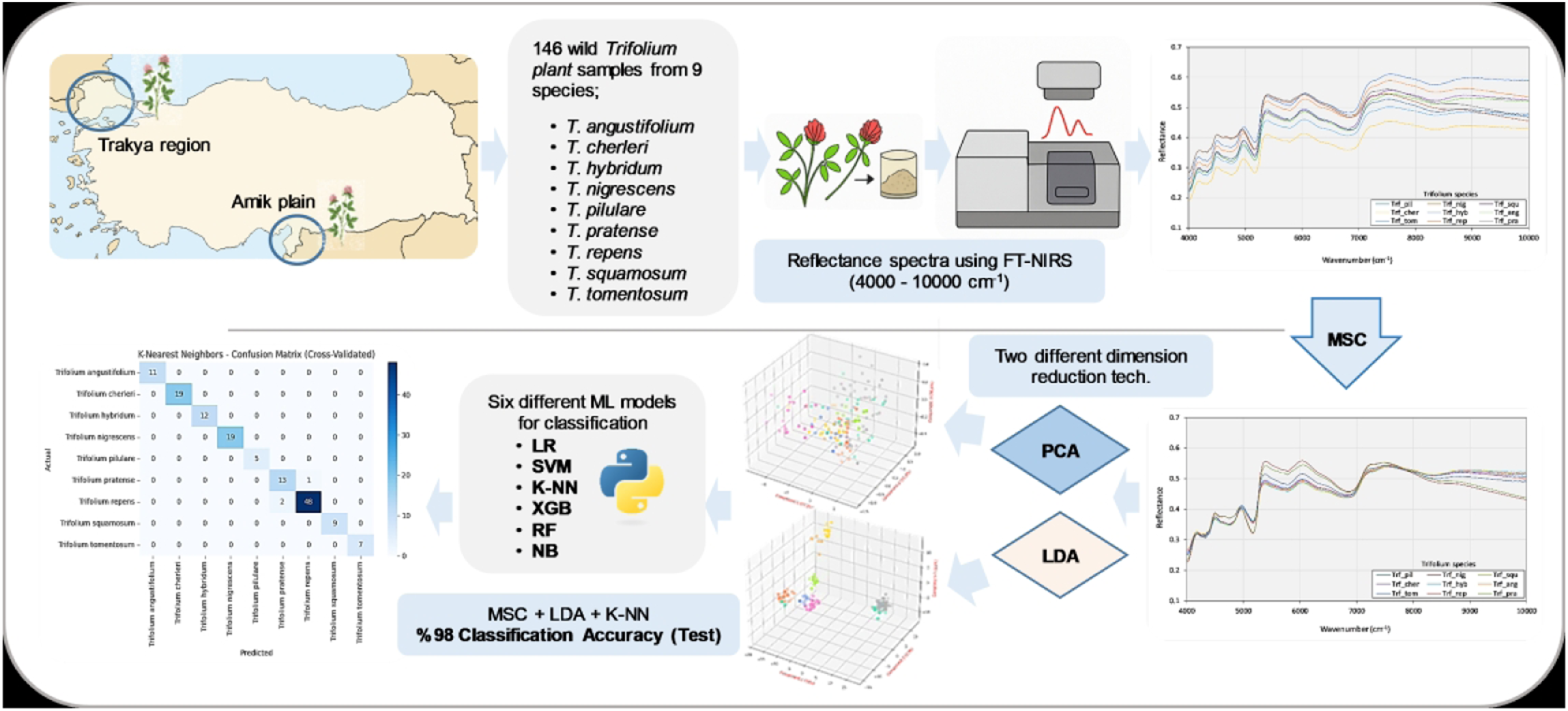
Clover (Trifolium) plants with rich protein, fiber and nutrient contents provide high forage yield, essential for efficient animal production. They also offer further ecological benefits including erosion control, soil reclamation, pollinator support, and urban greening. Wild clover species possess vital genetic traits to adapt to adverse growing conditions including drought, heat stress, and diseases. Thus, precise and quick identification of clover species can significantly aid successful plant breeding and sustainable agriculture. Human-based evaluations may not always be objective, while laboratory genetic analyses require significant amount of time, labor, and cost. The present work is the first study to accurately classify wild Trifolium species by using near infrared (NIR) reflectance spectroscopy and machine learning (ML) algorithms. NIR reflectance data (4000–10,000 cm-1) of 146 dried-ground plant samples belonging to nine Trifolium species were used for the classification along with four data pretreatment methods and six ML algorithms. Three different data sets were utilized in the analysis: (a) the data with no dimensional reduction, (b) the data with dimensional reduction by using principal component analysis (PCA), and (c) the data with dimensional reduction by using linear discriminant analysis (LDA). The most successful result was obtained with the LDA data coupled with multiplicative scatter correction (MSC) and K-nearest neighbors (KNN) algorithm with 98% test classification accuracy. The results of this study showed that the NIR spectroscopy coupled with ML algorithms can be utilized to correctly identify the Trifolium species needed for effective plant breeding and conservation strategies.
Mats G. ErikssonORCID, Paul WilliamsORCID, Johan LinderholmORCID
Abstract
Spectroscopy provides a new proxy for reconstructing prehistoric raw-material procurement, mobility, and inter-settlement interaction, through linking archaeological stone tools to specific quarry sources. In this paper, spectral responses have been analyzed using chemometric methods, particularly principal component analysis (PCA) and t-distribution stochastic neighbour embedding (t-SNE), to capture meaningful differences between quartz and quartzite raw materials and to analyse possible relationships between archaeological stone tool assemblages and quarries. Field adapted near infrared reflectance (NIR) spectroscopy and X-ray fluorescence (XRF) instruments have been used to analyse prehistoric quartz and quartzite quarries in inland Västerbotten (Sweden), and the collected spectral data were compared with tool assemblages from curated archaeological collections. Despite challenges inherent to field sampling, the combined spectroscopic approach reliably differentiates raw material groups, demonstrating its suitability for archaeological prospection and excavation. These findings underscore the value of integrating spectroscopy into routine fieldwork, providing a modern analytical toolkit that expands the interpretive potential of archaeological fieldwork.
Research article
Available accessResearch articleFirst published 2025
Earthen sites are important cultural heritages. Non-destructive quantitative analysis for moisture content in earthen sites is always appealing and important to heritage conservation. In this study, two ranges of hyperspectral imaging (HSI) systems, visible-near infrared (Vis-NIR: 400–1000 nm) and short-wave infrared (SWIR: 1000–2500 nm), are compared for the quantitative analysis of moisture content in simulated samples. To obtain the optimal prediction model, the raw data were pre-processed by several methods. The characteristic wavelengths were extracted by successive projection algorithm (SPA). Partial least squares (PLS) regression, support vector regression (SVR) and principal component regression (PCR) models were developed using the processed data, respectively. The results indicate that compared to Vis-NIR, the moisture content prediction model developed based on SWIR has good performance, with Rp2>0.903 and RMSEP <3.6%. The optimal model SG-SPA-PCR in SWIR was successfully used to visualize the moisture content distribution of the simulated earthen sites with time.
Review article
Available accessReview articleFirst published 2021
Zengling YangORCID, Linwei CaiORCID, Lujia Han , [...]
View All
Abstract
After half a century of development, near infrared spectroscopy has now reached a relatively mature position. It is widely used in agriculture, food, petrochemical, and pharmaceutical fields and plays an increasingly important role in industrial and agricultural production and commercial trade. The development of Standrds based on NIR spectroscopy represents the degree of recognition of the technology and applications. This article reviews domestic and global near infrared spectroscopy Standards in order to collate the myriad of existing standards in one listing.





 Open accessResearch articleFirst published 2026
 Available accessResearch articleFirst published 2025